OpenStack:
                       Why Is It Gaining So
                        Much Traction?
Kyle Mestery (@mestery)

Technical Leader, Office of the Cloud CTO, Cisco


© 2010 Cisco and/or its affiliates. All rights reserved.   1
 Minnesota OpenStack Meetup
   http://www.meetup.com/Minnesota-OpenStack-Meetup/
 We meet every 4-6 weeks and discuss all things OpenStack
 Growing community, not limited only to the Twin Cities
   Have members from all over the US (CA, MA, NC, TX) and all
     over the world (China, France, India)
 We are looking for presenters!
   Get in touch with me to schedule your own presentation!
 The audience:
  • Work for AMD, Best Buy, Cisco, Dell, Enstratius, Huawei, IBM,
     Kroll Ontrack, Lifetouch, Qlogic, Raytheon BBN, Super Go
     Faster, Target, UnitedHealth Group, and others
   • Are OpenStack/DevOps developers, OpenStack deployers,
     and/or OpenStack newbies
 What is OpenStack?
 What’s the community like?
 What’s the software like?
 Why Is OpenStack Getting So Much Traction?
“OpenStack is a global collaboration of developers and cloud computing
technologists producing the ubiquitous open source cloud computing
platform for public and private clouds. The project aims to deliver
solutions for all types of clouds by being simple to implement, massively
scalable, and feature rich. The technology consists of a series of
interrelated projects delivering various components for a cloud
infrastructure solution.”
-- openstack.org


    Basically, it’s software to run cloud
      services and the community behind
      that software.
 Founded in July 2010 by Rackspace Hosting, NASA, and partners.
   •   Nasa and Rackspace contributed the beginning code

• 7th release (Grizzly) due out in April
   •   OpenStack has a 6-month time-based release cycle

• Over 169 companies have now joined the community
   •   OS/Hypervisor makers
   •   Public cloud/service providers
   •   Equipment Vendors
   •   OpenStack Software & Services
 The OpenStack Foundation
 Board of Directors
• Technical Committee
• User Committee
• More details here.
 IRC Channels and Mailing Lists
 User/Meetup Groups
 Social Networking
 Code on GitHub, Bugs/Milestones in Launchpad
 Two Annual Design Summit/Conferences (coinciding roughly
  w/releases)
 Want to contribute? Start here.
 OpenStack is written primarily in Python
 Licensed under the Apache Public License 2.0
 Has traits typical of cloud OS’s:
 Can be used to build public, private, or hybrid clouds
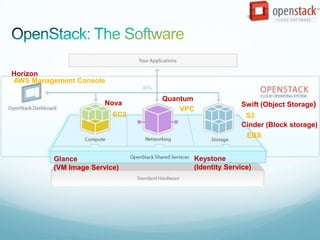
Horizon
AWS Management Console

                               Quantum
                       Nova                        Swift (Object Storage)
                                   VPC
                         EC2                        S3
                                                   Cinder (Block storage)
                                                     EBS


         Glance                      Keystone
         (VM Image Service)          (Identity Service)
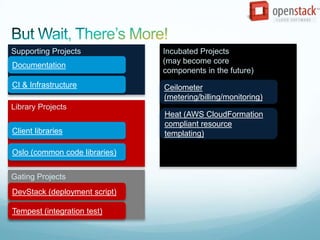
Supporting Projects            Incubated Projects
                               (may become core
Documentation
                               components in the future)
CI & Infrastructure            Ceilometer
                               (metering/billing/monitoring)
Library Projects
                               Heat (AWS CloudFormation
                               compliant resource
Client libraries               templating)

Oslo (common code libraries)


Gating Projects
DevStack (deployment script)

Tempest (integration test)
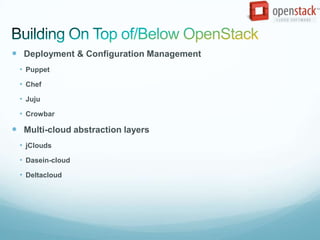
 Deployment & Configuration Management
 • Puppet
 • Chef
 • Juju
 • Crowbar

 Multi-cloud abstraction layers
 • jClouds
 • Dasein-cloud
 • Deltacloud
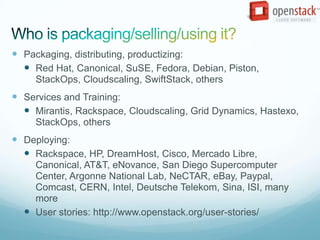
 Packaging, distributing, productizing:
   Red Hat, Canonical, SuSE, Fedora, Debian, Piston,
     StackOps, Cloudscaling, SwiftStack, others
 Services and Training:
   Mirantis, Rackspace, Cloudscaling, Grid Dynamics, Hastexo,
     StackOps, others
 Deploying:
   Rackspace, HP, DreamHost, Cisco, Mercado Libre,
    Canonical, AT&T, eNovance, San Diego Supercomputer
    Center, Argonne National Lab, NeCTAR, eBay, Paypal,
    Comcast, CERN, Intel, Deutsche Telekom, Sina, ISI, many
    more
   User stories: http://www.openstack.org/user-stories/
 Developers can get started fast with DevStack.
 Most major Linux distributions and some vendors offer
  packages.
 Start using an OpenStack-powered public cloud immediately.
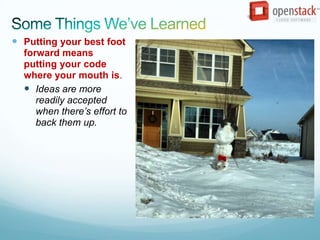
 Putting your best foot
  forward means
  putting your code
  where your mouth is.
   Ideas are more
     readily accepted
     when there’s effort to
     back them up.
 Don’t be intimidated.
  • HolycrapthingsmovereallyreallyfastinOpenStack
  • Jump in feet first: be agile and flexible.
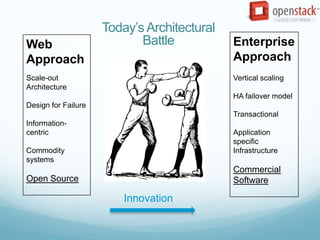
Today’s Architectural
Web                         Battle           Enterprise
Approach                                     Approach
Scale-out                                    Vertical scaling
Architecture
                                             HA failover model
Design for Failure
                                             Transactional
Information-
centric                                      Application
                                             specific
Commodity                                    Infrastructure
systems
                                             Commercial
Open Source                                  Software

                         Innovation
3 Reasons for OpenStack
      Momentum
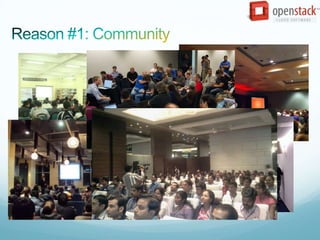
 Whether you’re a developer, deployer, or a user, there’s a place
  for you in OpenStack
 Ask a question, get many answers!
 Have some code, contribute it upstream!
 Most importantly: Have fun!
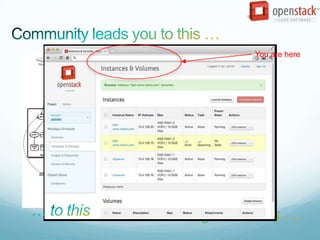
You are here
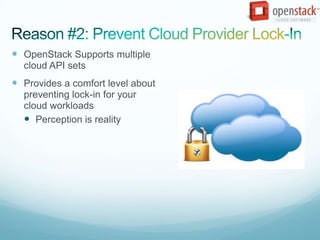
 OpenStack Supports multiple
  cloud API sets
 Provides a comfort level about
  preventing lock-in for your
  cloud workloads
   Perception is reality
 If everyone is offering the same cloud,
  where is the value for the operator?
 If everyone offers extensions to the same
  underlying cloud, does the customer feel
  the threat of lock-in?
 Ultimately it’s a level of comfort compared
  to vendor specific clouds
 Allowed an entire ecosystem of startups to
  proliferate
 Allowed enterprise users to dip their toes
  into this brave new world
 Opened people’s eyes to Commodity Web
  Scale Compute
 …


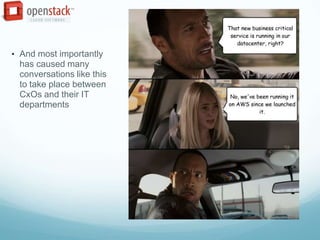
• And Fostered Cloud Computing Envy!
• And most importantly
 has caused many
 conversations like this
 to take place between
 CxOs and their IT
 departments
“We are all part of a community much
larger than each of us individually, all
creating a massively scalable cloud
operating system.”


          Questions?
             http://openstack.org/

OpenStack: Why Is It Gaining So Much Traction?

  • 1.
    OpenStack: Why Is It Gaining So Much Traction? Kyle Mestery (@mestery) Technical Leader, Office of the Cloud CTO, Cisco © 2010 Cisco and/or its affiliates. All rights reserved. 1
  • 2.
     Minnesota OpenStackMeetup  http://www.meetup.com/Minnesota-OpenStack-Meetup/  We meet every 4-6 weeks and discuss all things OpenStack  Growing community, not limited only to the Twin Cities  Have members from all over the US (CA, MA, NC, TX) and all over the world (China, France, India)  We are looking for presenters!  Get in touch with me to schedule your own presentation!
  • 3.
     The audience: • Work for AMD, Best Buy, Cisco, Dell, Enstratius, Huawei, IBM, Kroll Ontrack, Lifetouch, Qlogic, Raytheon BBN, Super Go Faster, Target, UnitedHealth Group, and others • Are OpenStack/DevOps developers, OpenStack deployers, and/or OpenStack newbies
  • 5.
     What isOpenStack?  What’s the community like?  What’s the software like?  Why Is OpenStack Getting So Much Traction?
  • 6.
    “OpenStack is aglobal collaboration of developers and cloud computing technologists producing the ubiquitous open source cloud computing platform for public and private clouds. The project aims to deliver solutions for all types of clouds by being simple to implement, massively scalable, and feature rich. The technology consists of a series of interrelated projects delivering various components for a cloud infrastructure solution.” -- openstack.org  Basically, it’s software to run cloud services and the community behind that software.
  • 7.
     Founded inJuly 2010 by Rackspace Hosting, NASA, and partners. • Nasa and Rackspace contributed the beginning code • 7th release (Grizzly) due out in April • OpenStack has a 6-month time-based release cycle • Over 169 companies have now joined the community • OS/Hypervisor makers • Public cloud/service providers • Equipment Vendors • OpenStack Software & Services
  • 8.
     The OpenStackFoundation  Board of Directors • Technical Committee • User Committee • More details here.
  • 9.
     IRC Channelsand Mailing Lists  User/Meetup Groups  Social Networking  Code on GitHub, Bugs/Milestones in Launchpad  Two Annual Design Summit/Conferences (coinciding roughly w/releases)  Want to contribute? Start here.
  • 10.
     OpenStack iswritten primarily in Python  Licensed under the Apache Public License 2.0  Has traits typical of cloud OS’s:  Can be used to build public, private, or hybrid clouds
  • 11.
    Horizon AWS Management Console Quantum Nova Swift (Object Storage) VPC EC2 S3 Cinder (Block storage) EBS Glance Keystone (VM Image Service) (Identity Service)
  • 12.
    Supporting Projects Incubated Projects (may become core Documentation components in the future) CI & Infrastructure Ceilometer (metering/billing/monitoring) Library Projects Heat (AWS CloudFormation compliant resource Client libraries templating) Oslo (common code libraries) Gating Projects DevStack (deployment script) Tempest (integration test)
  • 13.
     Deployment &Configuration Management • Puppet • Chef • Juju • Crowbar  Multi-cloud abstraction layers • jClouds • Dasein-cloud • Deltacloud
  • 14.
     Packaging, distributing,productizing:  Red Hat, Canonical, SuSE, Fedora, Debian, Piston, StackOps, Cloudscaling, SwiftStack, others  Services and Training:  Mirantis, Rackspace, Cloudscaling, Grid Dynamics, Hastexo, StackOps, others  Deploying:  Rackspace, HP, DreamHost, Cisco, Mercado Libre, Canonical, AT&T, eNovance, San Diego Supercomputer Center, Argonne National Lab, NeCTAR, eBay, Paypal, Comcast, CERN, Intel, Deutsche Telekom, Sina, ISI, many more  User stories: http://www.openstack.org/user-stories/
  • 15.
     Developers canget started fast with DevStack.  Most major Linux distributions and some vendors offer packages.  Start using an OpenStack-powered public cloud immediately.
  • 16.
     Putting yourbest foot forward means putting your code where your mouth is.  Ideas are more readily accepted when there’s effort to back them up.
  • 17.
     Don’t beintimidated. • HolycrapthingsmovereallyreallyfastinOpenStack • Jump in feet first: be agile and flexible.
  • 19.
    Today’s Architectural Web Battle Enterprise Approach Approach Scale-out Vertical scaling Architecture HA failover model Design for Failure Transactional Information- centric Application specific Commodity Infrastructure systems Commercial Open Source Software Innovation
  • 20.
    3 Reasons forOpenStack Momentum
  • 22.
     Whether you’rea developer, deployer, or a user, there’s a place for you in OpenStack  Ask a question, get many answers!  Have some code, contribute it upstream!  Most importantly: Have fun!
  • 23.
  • 24.
     OpenStack Supportsmultiple cloud API sets  Provides a comfort level about preventing lock-in for your cloud workloads  Perception is reality
  • 25.
     If everyoneis offering the same cloud, where is the value for the operator?  If everyone offers extensions to the same underlying cloud, does the customer feel the threat of lock-in?  Ultimately it’s a level of comfort compared to vendor specific clouds
  • 27.
     Allowed anentire ecosystem of startups to proliferate  Allowed enterprise users to dip their toes into this brave new world  Opened people’s eyes to Commodity Web Scale Compute  … • And Fostered Cloud Computing Envy!
  • 28.
    • And mostimportantly has caused many conversations like this to take place between CxOs and their IT departments
  • 30.
    “We are allpart of a community much larger than each of us individually, all creating a massively scalable cloud operating system.” Questions? http://openstack.org/

Editor's Notes

  • #3 Looking for content!A chance to meet OpenStack enthusiastsLearn about how existing technologies interface with OpenStackPlanning to start hackathons this summer
  • #4 A great crowd, diverse peopleIf we have WebEx, people from multiple countries, multiple states
  • #6 Just a quick note about the agenda here
  • #7 Give people time to read thisMake a note of Amazon hereAt the end of the day, it’s made up of the core componentsA Linux Analogy
  • #8 NASA contributed compute controller (Nova) it had built to control the NASA Nebula cloud (think Amazon EC2)Rackspace contributed the object storage controller (Swift) that it built to run it’s CloudFiles service offering (think Amazon S3)Releases: Austin (Oct. 2010), Bexar (Feb 2011), Cactus (Apr 2011), Diablo (Sep 2011), Essex (Apr 2012), Folsom (Sept 2012), Grizzly (Apr 2013)OS/HyperVisor Vendors: Citrix, Red Hat, Canonical, SuSE, VMwareCloud service/tools/SaaS/valure-add vendors: Puppet Labs, RightScale, FathomDB, OpsCode, ServiceMesh, New Relic, Scalr, EnstratiusEquipment Vendors: Cisco, IBM, HP, Intel, NetApp, EMC, Brocade, Dell, AcerOpenStack Software and Services: Piston, Nebula, Mirantis, CloudScaling
  • #9 OpenStack FoundationMembership free for individualsPlatinum, Gold, and Corporate memberships paid for by member companiesBoard of directors comprised of Platinum, Gold, and elected membersTechnical CommitteeLeads software direction and development8 project Technical Leaders elected by project contributors5 additional members elected by active technical contributorsUser CommitteeRepresents users with the Technical Committee and Board of directors
  • #10 Social Networking: Twitter, LinkedIn, Facebook,OhlohCode: Over 54,000 commits by over 850 contributorsDesign SummitUpcoming in 1.5 weeks in PortlandConference plus Design eventUnique, but modeled after UDS (Ubuntu Developer Summit)
  • #11 There was an early attempt at adding some Java code, but because no one knew Java, it was abandonded.Traits of Cloud OS:Abstraction layers (examples: multiple hypervisors, networks, storage)Multi-tenancyRich API’s, portals, clientsOn demand resource allocationResource pooling and schedulingPublic/Private/HybridUsed to tout cloud freedom to some extentRun your workloads on a OpenStack cloud, make them easily portable
  • #12 Some things to note here:Mention Amazon hereMake a distinct note of “Your Application” on the topWith regards to HW: Standard x86/x86_64 as well as ARMApplications running on top are the real item of importance here
  • #13 All of these things show how large the community isRoom for everyone to contributeIncubated Projects:A new project starts out as incubated.Allows for a gestation period as the project is vetted by the community and begins to function like other OpenStack projectsThis includes weekly meetings, involvement with the Technical Committee, and project integration (mailing lists, bugs, etc.)
  • #14 Important for this slide:Deployment is a challenge.Most of the “low-hanging fruit” of OpenStack integration is at this level.Upgrades? Who worries about upgrades?
  • #15 Mention Cisco’s use of OpenStack by our WebEx groupMention the Best Buy presentation given by Steve as users
  • #16 Some notes on devstack:Meant for developers.Typically the first taste of OpenStack for most people.Works on Fedora/Ubuntu, supports single and multi-node installs, works with all the major components.OpenStack powered clouds:RackspaceHP CloudDreamhostTrystack.org (x86 and ARM running Essex)
  • #17 Lessons learned while working with any open source community:Alternatively: It’s hard to turn down an idea with solid code behind it.Be vocal about your ideas. Doesn’t matter if you’re a developer or a user.
  • #18 Join the mailing listsJoin the IRC channelsParticipate in a local MeetupInstall it and give it a shot!
  • #20 Note how webscale apps and deployments are migrating into enterprise datacenters and applicationsNote how the flow of innovation is from web to enterpriseNote the surge in open source software usageTie it together with DevOps (e.g. DevOps is tieing open source software development together with deployment)DevOps is custom fit for Open Source development.
  • #22 These are happening all over the worldPeople are sharing ideas and helping each other outFosters growth in not only OpenStack, but in the participation level of people who are using, deploying, and developing OpenStack
  • #23 IRC, Mailing lists, Meetup Groups, Bi-annual conferencesPlenty of places to get help
  • #25 Cloud APIs:NativeOpenStack API (helps with workloads across OpenStack public and private clouds)Amazon Web Services APIGoogle Compute Engine API (Cloudscaling)<Your fancy Cloud API here>Regarding lock-in:Perception is realityIs it really preventing lock-in?
  • #26 Commoditization of the cloud provider.Commoditization of the cloud userMeet in the middle somewhere
  • #27 This is the biggest reason OpenStack is Gaining MomentumAmazon has shown everyone how to run a public cloud
  • #28 Notes:The conversation started as “I want to run on AWS.”Now the conversation is “I want to run AWS in my own datacenter.”Natural evolution of the Virtualization experience: Cloud.
  • #30 OpenStack Gaining Momentum Because:Community is important.The threat of Cloud Provider Lock-InAmazon Web ServicesLets remember what the cloud is supposed to offer: Freedom and Openness