OpenStack: Use Cases & Success Stories
Rhys Oxenham
Field Product Manager, Red Hat
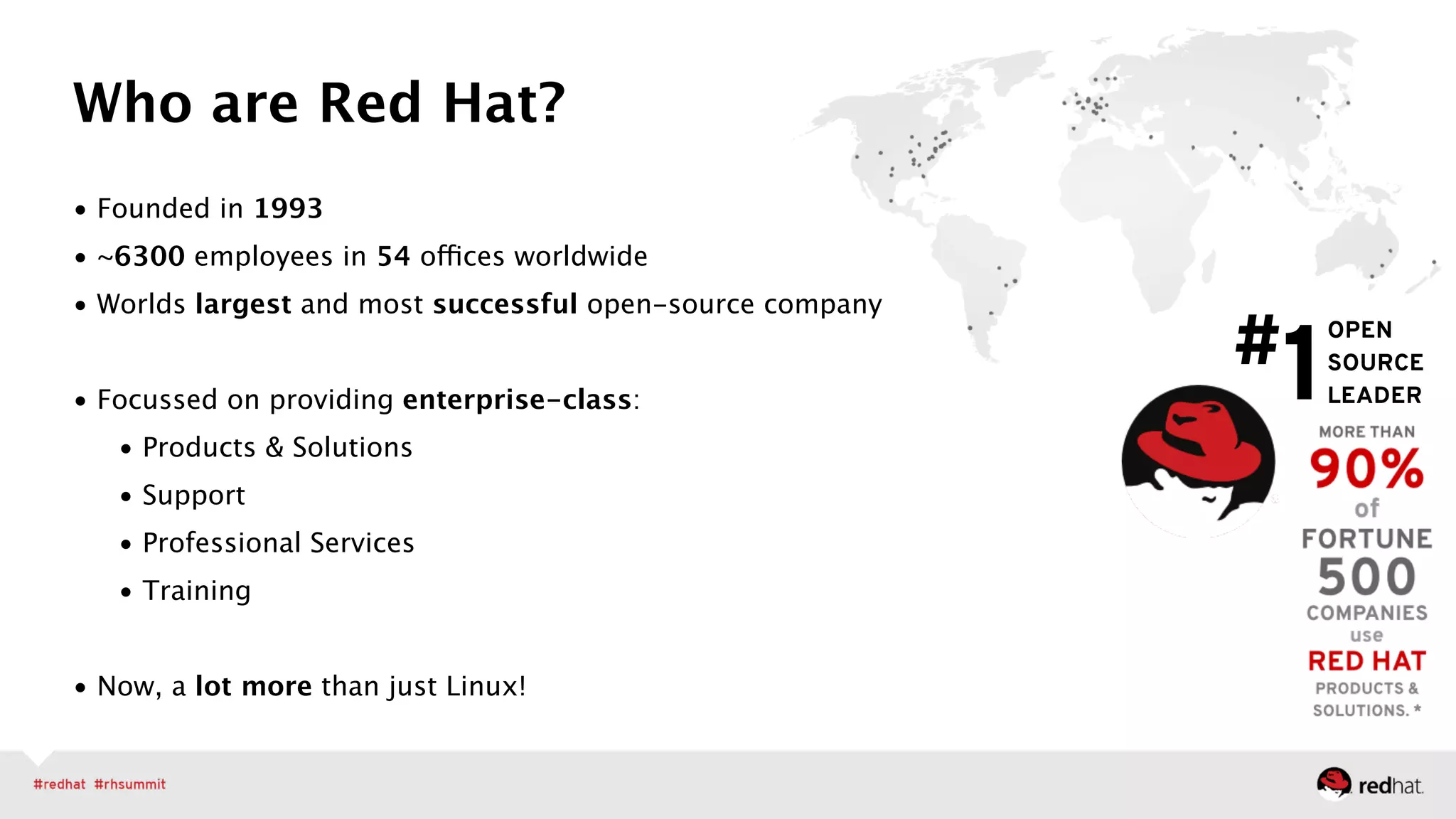
• Founded in 1993
• ~6300 employees in 54 offices worldwide
• Worlds largest and most successful open-source company

• Focussed on providing enterprise-class:
• Products & Solutions
• Support
• Professional Services
• Training

• Now, a lot more than just Linux!
Who are Red Hat?
OPEN

SOURCE

LEADER
#1
•d
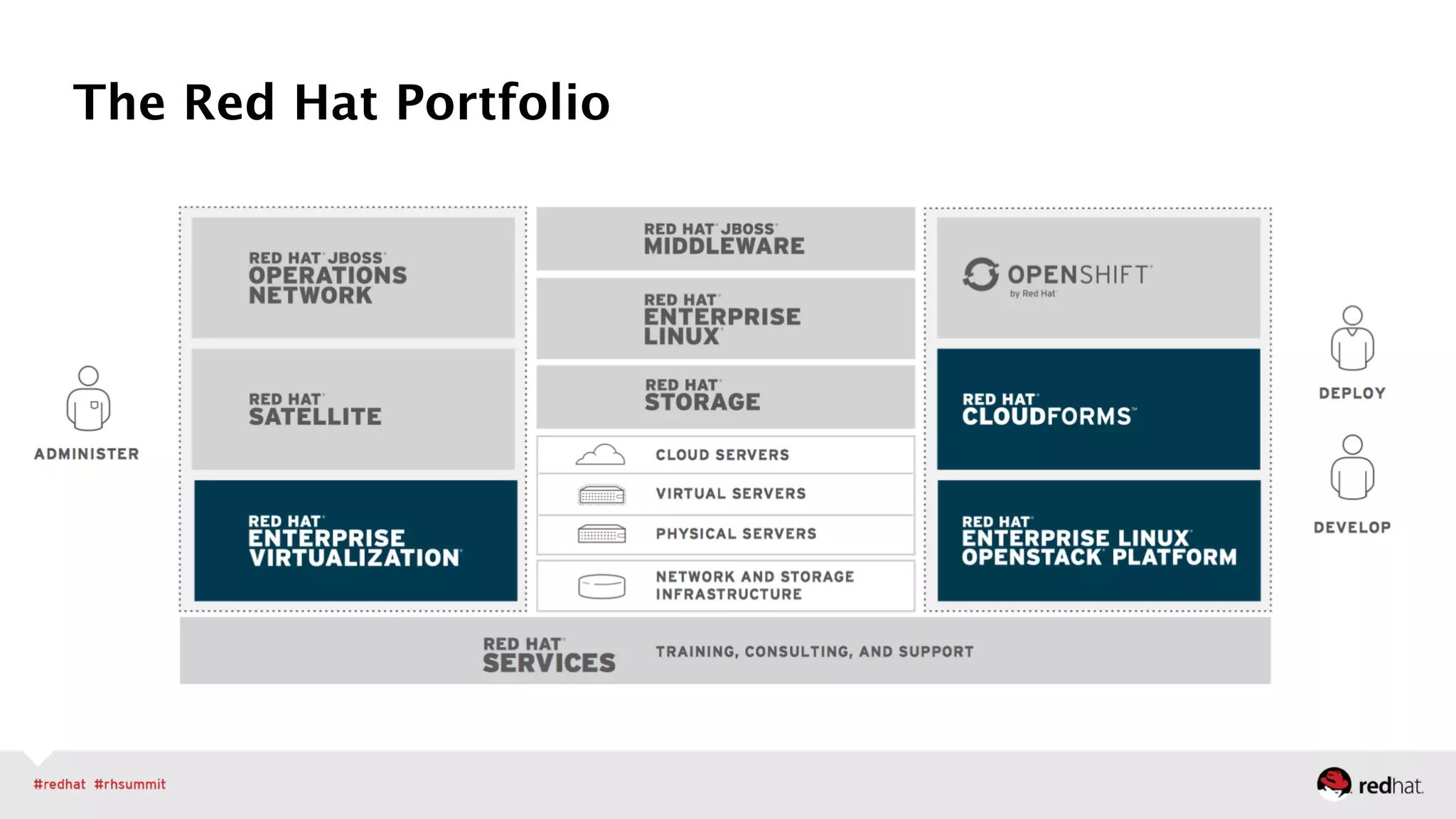
The Red Hat Portfolio
!
!
!
!
!
!
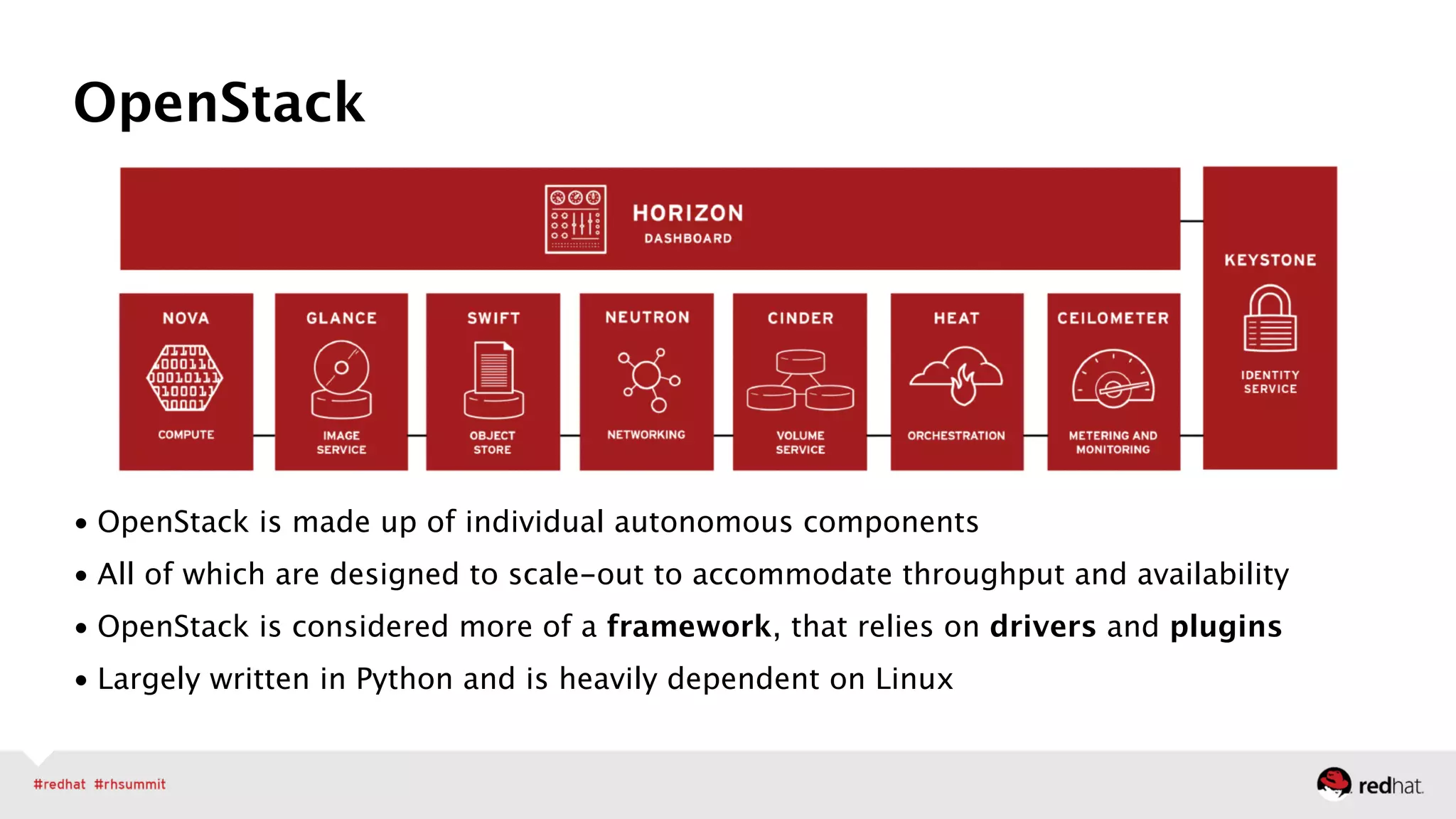
• OpenStack is made up of individual autonomous components
• All of which are designed to scale-out to accommodate throughput and availability
• OpenStack is considered more of a framework, that relies on drivers and plugins
• Largely written in Python and is heavily dependent on Linux
OpenStack
• Red Hat’s officially supported, enterprise-class, OpenStack distribution
• Built specifically for, and tightly integrated with Red Hat Enterprise Linux
• Released every six months; two months after upstream availability

• Focus on:
• Code maturity, stability, and security
• 3rd party ecosystem of value-add components and certified platforms
• Extended lifecycle- two years for Havana, three years for Icehouse
• Enterprise-class support from the #1 corporate contributors
• Rich product documentation and reference architectures
Red Hat Enterprise Linux OpenStack Platform
• Cloud is widely seen as the next-generation IT delivery model
• Agile & Flexible
• Utility-based on-demand consumption
• Self-service driving down administrative overhead and maintenance

• Public clouds are setting the benchmark of how IT could be delivered to users
• Not all organisations are ready for public cloud

• Applications are being written differently today-
• More tolerant of failure
• Making use of scale-out architecture
Why does the world need OpenStack?
• Our data is too large
• Volumes of data are being generated at unprecedented levels
• Most of this data is unstructured

• Service requests are too large
• More and more devices are coming online
• Tablets, phones, laptops, BYOD generation…
!
• Crucially, applications weren’t written to cope with the demand!
• Traditional infrastructure capabilities are being exhausted
• Service uptime, QoS, KPI’s and SLA’s are slipping
Major issues with traditional infrastructure…
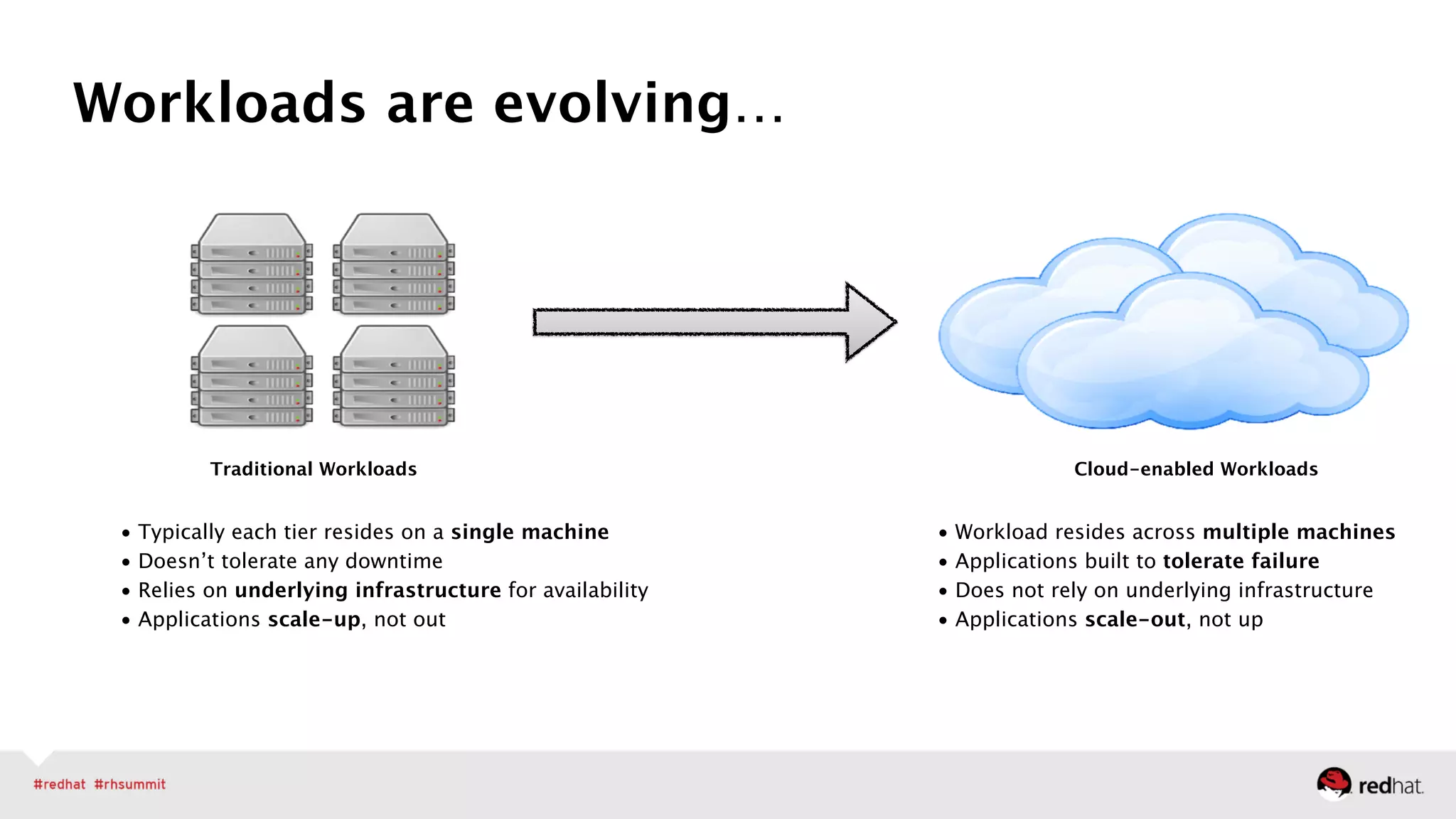
Workloads are evolving…
Traditional Workloads
• Typically each tier resides on a single machine
• Doesn’t tolerate any downtime
• Relies on underlying infrastructure for availability
• Applications scale-up, not out
Cloud-enabled Workloads
• Workload resides across multiple machines
• Applications built to tolerate failure
• Does not rely on underlying infrastructure
• Applications scale-out, not up
Whilst we see interest in many different areas, the “perfect fits” are as follows-

• A public cloud-like Infrastructure-as-a-Service cloud platform
• Internal “Infrastructure on Demand” - private cloud
• Test and Development environments - e.g. sandbox
• Cloud service provider platform - reselling compute, network & storage

• Building a scale-out platform for cloud-enabled workloads
• Web-scale applications
• Academic or pharma workloads, e.g. genetic sequencing

• Network Function Virtualisation (NFV) platform

So, how is OpenStack being used?
Customer Success Stories
• Broad Institute of Harvard and MIT
• Industry: Biomedical Research
• Type: On-premise private cloud for on-demand, self-service computing
• Use-case: Data processing of large sample sets for cancer research

• Midokura
• Industry: Network Virtualisation Vendor
• Type: On-premise private cloud for development and testing
• Use-case: Integrating their value-add tools and for testing scale, performance, and
stability, as well as diagnosing customer problems
Customer Success Stories
• National Computational Infrastructure (Australia National University)
• Industry: Weather Simulation
• Type: Internal scale-out platform for high-performance computing
• Use-case: High performance compute clusters with on-demand access for
processing weather data for simulation purposes

• University of Porto (Universidade do Porto)
• Industry: Academic Research
• Type: On-premise multi-site private cloud 
• Use-case: Providing elastic Infrastructure-as-a-Service to researchers and students
Customer Success Stories
• A few anonymous public cloud stories
• Customers choosing OpenStack (Red Hat’s!) to build their public cloud offering
• Providing alternative to Amazon AWS
• Exploiting data locality laws and anti-US “spying”


• THE platform for Network Function Virtualisation (NFV)
• OpenStack is the perfect platform for hosting network/telco apps & services
• Alcatel Lucent (ALU) doing just this with Cloudband and is using Red Hat
• Plus many more currently non-public
Customer Success Stories
Thank you! Any questions?
!
roxenham@redhat.com

An Introduction to Red Hat Enterprise Linux OpenStack Platform

  • 1.
    OpenStack: Use Cases& Success Stories Rhys Oxenham Field Product Manager, Red Hat
  • 2.
    • Founded in1993 • ~6300 employees in 54 offices worldwide • Worlds largest and most successful open-source company
 • Focussed on providing enterprise-class: • Products & Solutions • Support • Professional Services • Training
 • Now, a lot more than just Linux! Who are Red Hat? OPEN
 SOURCE
 LEADER #1
  • 3.
  • 4.
    ! ! ! ! ! ! • OpenStack ismade up of individual autonomous components • All of which are designed to scale-out to accommodate throughput and availability • OpenStack is considered more of a framework, that relies on drivers and plugins • Largely written in Python and is heavily dependent on Linux OpenStack
  • 5.
    • Red Hat’sofficially supported, enterprise-class, OpenStack distribution • Built specifically for, and tightly integrated with Red Hat Enterprise Linux • Released every six months; two months after upstream availability
 • Focus on: • Code maturity, stability, and security • 3rd party ecosystem of value-add components and certified platforms • Extended lifecycle- two years for Havana, three years for Icehouse • Enterprise-class support from the #1 corporate contributors • Rich product documentation and reference architectures Red Hat Enterprise Linux OpenStack Platform
  • 6.
    • Cloud iswidely seen as the next-generation IT delivery model • Agile & Flexible • Utility-based on-demand consumption • Self-service driving down administrative overhead and maintenance
 • Public clouds are setting the benchmark of how IT could be delivered to users • Not all organisations are ready for public cloud
 • Applications are being written differently today- • More tolerant of failure • Making use of scale-out architecture Why does the world need OpenStack?
  • 7.
    • Our datais too large • Volumes of data are being generated at unprecedented levels • Most of this data is unstructured
 • Service requests are too large • More and more devices are coming online • Tablets, phones, laptops, BYOD generation… ! • Crucially, applications weren’t written to cope with the demand! • Traditional infrastructure capabilities are being exhausted • Service uptime, QoS, KPI’s and SLA’s are slipping Major issues with traditional infrastructure…
  • 8.
    Workloads are evolving… TraditionalWorkloads • Typically each tier resides on a single machine • Doesn’t tolerate any downtime • Relies on underlying infrastructure for availability • Applications scale-up, not out Cloud-enabled Workloads • Workload resides across multiple machines • Applications built to tolerate failure • Does not rely on underlying infrastructure • Applications scale-out, not up
  • 9.
    Whilst we seeinterest in many different areas, the “perfect fits” are as follows-
 • A public cloud-like Infrastructure-as-a-Service cloud platform • Internal “Infrastructure on Demand” - private cloud • Test and Development environments - e.g. sandbox • Cloud service provider platform - reselling compute, network & storage
 • Building a scale-out platform for cloud-enabled workloads • Web-scale applications • Academic or pharma workloads, e.g. genetic sequencing
 • Network Function Virtualisation (NFV) platform
 So, how is OpenStack being used?
  • 10.
  • 11.
    • Broad Instituteof Harvard and MIT • Industry: Biomedical Research • Type: On-premise private cloud for on-demand, self-service computing • Use-case: Data processing of large sample sets for cancer research
 • Midokura • Industry: Network Virtualisation Vendor • Type: On-premise private cloud for development and testing • Use-case: Integrating their value-add tools and for testing scale, performance, and stability, as well as diagnosing customer problems Customer Success Stories
  • 12.
    • National ComputationalInfrastructure (Australia National University) • Industry: Weather Simulation • Type: Internal scale-out platform for high-performance computing • Use-case: High performance compute clusters with on-demand access for processing weather data for simulation purposes
 • University of Porto (Universidade do Porto) • Industry: Academic Research • Type: On-premise multi-site private cloud • Use-case: Providing elastic Infrastructure-as-a-Service to researchers and students Customer Success Stories
  • 13.
    • A fewanonymous public cloud stories • Customers choosing OpenStack (Red Hat’s!) to build their public cloud offering • Providing alternative to Amazon AWS • Exploiting data locality laws and anti-US “spying”
 
 • THE platform for Network Function Virtualisation (NFV) • OpenStack is the perfect platform for hosting network/telco apps & services • Alcatel Lucent (ALU) doing just this with Cloudband and is using Red Hat • Plus many more currently non-public Customer Success Stories
  • 14.
    Thank you! Anyquestions? ! roxenham@redhat.com