OPENSTACK
A ringside view of services, technology and architecture
OPENSTACK
ARCHITECTURE
The OpenStack Components
OpenStack Defined
■ OpenStack is a cloud operating system that controls large pool of compute, storage,
and networking resources throughout a datacenter.
■ The resources are all managed through a dashboard that gives administrators
control
■ Empowers the Users to provision resources through a web interface
■ IaaS
■ Modular Architecture
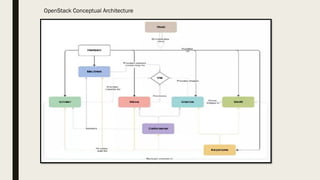
OpenStack Conceptual Architecture
OPENSTACK
COMPONENTS
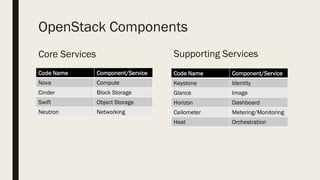
OpenStack Components
Core Services
Code Name Component/Service
Nova Compute
Cinder Block Storage
Swift Object Storage
Neutron Networking
Supporting Services
Code Name Component/Service
Keystone Identity
Glance Image
Horizon Dashboard
Ceilometer Metering/Monitoring
Heat Orchestration
Dashboard Service: Horizon
■ A dashboard provides administrators and users a GUI to OpenStack services
including Nova, Swift, Keystone etc.
■ Allows Users and Administrators of the environment to interact with and manage the
various functional components
Compute Service: Nova
■ To host and manage cloud computing systems, manages the lifecycle of instances
■ Major part of Infrastructure-as-a-Service(IAAS)
■ Interacts with Identity, Image Service and Dashboard
■ Spawning, Scheduling and decommissioning of virtual machines on demand
Identity Service: Keystone
■ Keystone is the identity service used for Authentication
■ Set of assigned user rights and privileges for performing a specific set of operations
■ A User token issued by Keystone includes a list of that User’s roles. Services that
determine how to interpret those rules
Image Service: Glance
■ The Glance project provides services for discovering, registering, and retrieving
virtual machine images
■ Glance has a RESTful API that allows querying of VM image metadata as well as
retrieval of the actual image
Block Storage: Cinder
■ Architected to provide traditional block level storage resources to other OpenStack
services
■ Presents persistent block-level storage volumes for use with OpenStack Nova
compute instances
■ Manages the creation, attaching and detaching of these volumes between the
storage system and different host servers
Object Storage: Swift
■ A distributed object storage system designed to scale from a single machine to
thousands of servers
■ Optimized for multi-tenancy and high concurrency
■ Ideal for backups, web and mobile content, and any other unstructured data that
can grow without bound
■ Swift provides a simple, REST-based API
Monitoring Service: Ceilometer
■ OpenStack Telemetry provides common infrastructure to collect usage and
performance measurements within an OpenStack Cloud
■ Its primary initial targets are monitoring and metering
■ Ceilometer was promoted from an incubation stage to an integrated component of
OpenStack
Networking Service: Neutron
■ Network as a Service (NaaS)
■ Provides REST APIs manage network connections for the resources managed by
other OpenStack services
■ Complete control over the following network resources in OpenStack (Networks,
ports, subnets)
■ Build complex network topologies
Orchestration Service: Heat
■ Heat provides a template based orchestration for describing a cloud application by executing
appropriate OpenStack API calls to generate running cloud applications
■ Templates specify the relationships between resources (e.g. this volume is connected to this
server). This enables Heat to call out to the OpenStack APIs to create all of your infrastructure in
the correct order to completely launch your application.
■ The software integrates other components of OpenStack. The templates allow creation of most
OpenStack resource types (such as instances, floating ips, volumes, security groups, users, etc), as
well as some more advanced functionality such as instance high availability, instance auto scaling,
and nested stacks
■ Heat primarily manages infrastructure, but the templates integrate well with software configuration
management tools such as Puppet and Ansible
■ Multiple composite cloud applications by using either the native HOT template format or AWS
CloudFormation template through OpenStack native REST API and a CloudFormation-compatible
Query API
KEY CUSTOMERS OF
OPENSTACK
Key Customers
■ American Airlines
■ AT&T
■ AVAYA
■ American Express
■ AtoS
■ BestBuy
■ Bloomberg
■ Discovery
MARKET SHARE
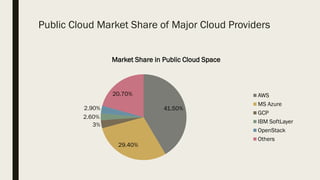
Public Cloud Market Share of Major Cloud Providers
41.50%
29.40%
3%
2.60%
2.90%
20.70%
Market Share in Public Cloud Space
AWS
MS Azure
GCP
IBM SoftLayer
OpenStack
Others
OPENSTACK IN MULTI
CLOUD ENVIRONMENT
OpenStack and Multi-Cloud
Environment
■ Enterprises with OpenStack private cloud can adopt multi-cloud platform
■ Challenges need to be tackled around data management and platform compatibility
■ Multi-cloud computing enables an enterprise to tap into a diverse set of cloud
services
■ Users might choose GCP for high-performance computing, AWS for its broad portfolio
of features and Oracle for its database as a service offerings
Success in Multi-Cloud Deployment
■ Enterprise IT teams must evolve their management practices
■ Teams need to orchestrate workloads and translate virtual network configuration
files
■ Ansible facilitates moving workloads between OpenStack and a major public cloud
■ Industry is also facilitating by standardizing images for both VMs and containers
■ Because of varied set of services and APIs, onus is on the IT teams for compatibility
■ Data management is critical to avoid performance bottlenecks
■ Deployment to S3 compatibility to maintain a single REST interface across all clouds
Success in Multi-Cloud Deployment
(contd.)
■ Avoid transfer of whole data sets between the public cloud and the OpenStack cloud
as it is time consuming and costly
■ Replicate data in each cloud platform to obviate latency
■ Run OpenStack private cloud with high-bandwidth fiber links
■ Among major public cloud providers, Google is focused to have multi-cloud
environment with OpenStack
OPENSTACK USE CASE
Case Study: OpenStack in Telecom Vertical
OpenStack in Telecom Domain
Problem Statement:
■ Complex and expensive infrastructure
■ Challenging to operate and maintain
■ Slow rolling out of services
End Goal
■ Cloud based model
■ Always-ON services
■ Affordable
■ Reliable
NFV with OpenStack
■ Deployed on cost-effective COTS hardware
■ Based on Open Source Software
■ Can be easily adopted to any customization
■ Community Driven
■ Standard APIs
■ Software managed High Availability (HA)
■ Automated Deployment
■ Virtualized Infrastructure
– Scalable, Upgradable, Optimizable, Modular, Customizable
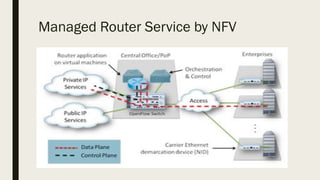
Managed Router Service by NFV
Benefits of NFV
■ Reduce CapEx: Reduces the need to purchase purpose-build hardware, instead
supports pay-as-you-grow model
■ Reduce OpEx: Reducing space, power and cooling requirements of
equipment, simplifying the roll-out of network services
■ Accelerate Time-to-Market: Reduce the time to deploy new networking services
■ Deliver Agility and Flexibility: Quickly scale up or down services to address changing
demands
■ Support innovation by enabling services to be delivered via software on any
industry-standard hardware
Carrier Benefits
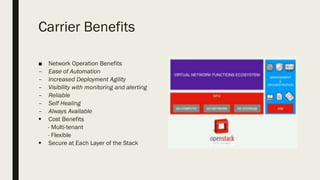
■ Network Operation Benefits
– Ease of Automation
– Increased Deployment Agility
– Visibility with monitoring and alerting
– Reliable
– Self Healing
– Always Available
 Cost Benefits
- Multi-tenant
- Flexible
 Secure at Each Layer of the Stack
OPNFV + OPENSTACK
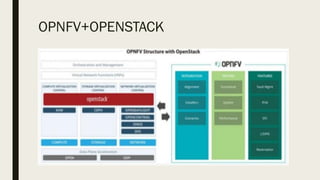
■ OPNFV is a carrier-grade, integrated, open source platform for NFV products and
services
– Widespread collaboration across many telcos
– Uses OpenStack as Virtualized Infrastructure Manager
OPNFV+OPENSTACK
CASE STUDY: CHINA
MOBILE
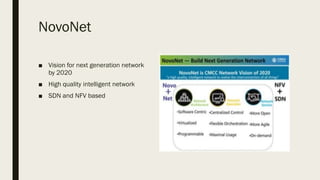
NovoNet
■ Vision for next generation network
by 2020
■ High quality intelligent network
■ SDN and NFV based
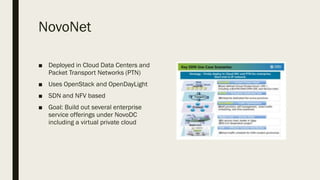
NovoNet
■ Deployed in Cloud Data Centers and
Packet Transport Networks (PTN)
■ Uses OpenStack and OpenDayLight
■ SDN and NFV based
■ Goal: Build out several enterprise
service offerings under NovoDC
including a virtual private cloud
Thank You

OpenStack- A ringside view of Services and Architecture

  • 1.
    OPENSTACK A ringside viewof services, technology and architecture
  • 2.
  • 3.
    OpenStack Defined ■ OpenStackis a cloud operating system that controls large pool of compute, storage, and networking resources throughout a datacenter. ■ The resources are all managed through a dashboard that gives administrators control ■ Empowers the Users to provision resources through a web interface ■ IaaS ■ Modular Architecture
  • 4.
  • 5.
  • 6.
    OpenStack Components Core Services CodeName Component/Service Nova Compute Cinder Block Storage Swift Object Storage Neutron Networking Supporting Services Code Name Component/Service Keystone Identity Glance Image Horizon Dashboard Ceilometer Metering/Monitoring Heat Orchestration
  • 7.
    Dashboard Service: Horizon ■A dashboard provides administrators and users a GUI to OpenStack services including Nova, Swift, Keystone etc. ■ Allows Users and Administrators of the environment to interact with and manage the various functional components
  • 8.
    Compute Service: Nova ■To host and manage cloud computing systems, manages the lifecycle of instances ■ Major part of Infrastructure-as-a-Service(IAAS) ■ Interacts with Identity, Image Service and Dashboard ■ Spawning, Scheduling and decommissioning of virtual machines on demand
  • 9.
    Identity Service: Keystone ■Keystone is the identity service used for Authentication ■ Set of assigned user rights and privileges for performing a specific set of operations ■ A User token issued by Keystone includes a list of that User’s roles. Services that determine how to interpret those rules
  • 10.
    Image Service: Glance ■The Glance project provides services for discovering, registering, and retrieving virtual machine images ■ Glance has a RESTful API that allows querying of VM image metadata as well as retrieval of the actual image
  • 11.
    Block Storage: Cinder ■Architected to provide traditional block level storage resources to other OpenStack services ■ Presents persistent block-level storage volumes for use with OpenStack Nova compute instances ■ Manages the creation, attaching and detaching of these volumes between the storage system and different host servers
  • 12.
    Object Storage: Swift ■A distributed object storage system designed to scale from a single machine to thousands of servers ■ Optimized for multi-tenancy and high concurrency ■ Ideal for backups, web and mobile content, and any other unstructured data that can grow without bound ■ Swift provides a simple, REST-based API
  • 13.
    Monitoring Service: Ceilometer ■OpenStack Telemetry provides common infrastructure to collect usage and performance measurements within an OpenStack Cloud ■ Its primary initial targets are monitoring and metering ■ Ceilometer was promoted from an incubation stage to an integrated component of OpenStack
  • 14.
    Networking Service: Neutron ■Network as a Service (NaaS) ■ Provides REST APIs manage network connections for the resources managed by other OpenStack services ■ Complete control over the following network resources in OpenStack (Networks, ports, subnets) ■ Build complex network topologies
  • 15.
    Orchestration Service: Heat ■Heat provides a template based orchestration for describing a cloud application by executing appropriate OpenStack API calls to generate running cloud applications ■ Templates specify the relationships between resources (e.g. this volume is connected to this server). This enables Heat to call out to the OpenStack APIs to create all of your infrastructure in the correct order to completely launch your application. ■ The software integrates other components of OpenStack. The templates allow creation of most OpenStack resource types (such as instances, floating ips, volumes, security groups, users, etc), as well as some more advanced functionality such as instance high availability, instance auto scaling, and nested stacks ■ Heat primarily manages infrastructure, but the templates integrate well with software configuration management tools such as Puppet and Ansible ■ Multiple composite cloud applications by using either the native HOT template format or AWS CloudFormation template through OpenStack native REST API and a CloudFormation-compatible Query API
  • 16.
  • 17.
    Key Customers ■ AmericanAirlines ■ AT&T ■ AVAYA ■ American Express ■ AtoS ■ BestBuy ■ Bloomberg ■ Discovery
  • 18.
  • 19.
    Public Cloud MarketShare of Major Cloud Providers 41.50% 29.40% 3% 2.60% 2.90% 20.70% Market Share in Public Cloud Space AWS MS Azure GCP IBM SoftLayer OpenStack Others
  • 20.
  • 21.
    OpenStack and Multi-Cloud Environment ■Enterprises with OpenStack private cloud can adopt multi-cloud platform ■ Challenges need to be tackled around data management and platform compatibility ■ Multi-cloud computing enables an enterprise to tap into a diverse set of cloud services ■ Users might choose GCP for high-performance computing, AWS for its broad portfolio of features and Oracle for its database as a service offerings
  • 22.
    Success in Multi-CloudDeployment ■ Enterprise IT teams must evolve their management practices ■ Teams need to orchestrate workloads and translate virtual network configuration files ■ Ansible facilitates moving workloads between OpenStack and a major public cloud ■ Industry is also facilitating by standardizing images for both VMs and containers ■ Because of varied set of services and APIs, onus is on the IT teams for compatibility ■ Data management is critical to avoid performance bottlenecks ■ Deployment to S3 compatibility to maintain a single REST interface across all clouds
  • 23.
    Success in Multi-CloudDeployment (contd.) ■ Avoid transfer of whole data sets between the public cloud and the OpenStack cloud as it is time consuming and costly ■ Replicate data in each cloud platform to obviate latency ■ Run OpenStack private cloud with high-bandwidth fiber links ■ Among major public cloud providers, Google is focused to have multi-cloud environment with OpenStack
  • 24.
    OPENSTACK USE CASE CaseStudy: OpenStack in Telecom Vertical
  • 25.
    OpenStack in TelecomDomain Problem Statement: ■ Complex and expensive infrastructure ■ Challenging to operate and maintain ■ Slow rolling out of services
  • 26.
    End Goal ■ Cloudbased model ■ Always-ON services ■ Affordable ■ Reliable
  • 27.
    NFV with OpenStack ■Deployed on cost-effective COTS hardware ■ Based on Open Source Software ■ Can be easily adopted to any customization ■ Community Driven ■ Standard APIs ■ Software managed High Availability (HA) ■ Automated Deployment ■ Virtualized Infrastructure – Scalable, Upgradable, Optimizable, Modular, Customizable
  • 28.
  • 29.
    Benefits of NFV ■Reduce CapEx: Reduces the need to purchase purpose-build hardware, instead supports pay-as-you-grow model ■ Reduce OpEx: Reducing space, power and cooling requirements of equipment, simplifying the roll-out of network services ■ Accelerate Time-to-Market: Reduce the time to deploy new networking services ■ Deliver Agility and Flexibility: Quickly scale up or down services to address changing demands ■ Support innovation by enabling services to be delivered via software on any industry-standard hardware
  • 30.
    Carrier Benefits ■ NetworkOperation Benefits – Ease of Automation – Increased Deployment Agility – Visibility with monitoring and alerting – Reliable – Self Healing – Always Available  Cost Benefits - Multi-tenant - Flexible  Secure at Each Layer of the Stack
  • 31.
    OPNFV + OPENSTACK ■OPNFV is a carrier-grade, integrated, open source platform for NFV products and services – Widespread collaboration across many telcos – Uses OpenStack as Virtualized Infrastructure Manager
  • 32.
  • 33.
  • 34.
    NovoNet ■ Vision fornext generation network by 2020 ■ High quality intelligent network ■ SDN and NFV based
  • 35.
    NovoNet ■ Deployed inCloud Data Centers and Packet Transport Networks (PTN) ■ Uses OpenStack and OpenDayLight ■ SDN and NFV based ■ Goal: Build out several enterprise service offerings under NovoDC including a virtual private cloud
  • 36.