Download to read offline
![IOSR Journal of Electrical and Electronics Engineering (IOSR-JEEE)
e-ISSN: 2278-1676,p-ISSN: 2320-3331, Volume 7, Issue 3 (Sep. - Oct. 2013), PP 60-64
www.iosrjournals.org
www.iosrjournals.org 60 | Page
A Genetic Algorithm Approach to Solve Unit Commitment
Problem
Aditya parashar1
, Kuldeep Kumar Swankar2
1
(Electrical Engg. Department, MITS Gwalior (M.P.), INDIA)
2(Electrical Engg. Department, MITS Gwalior (M.P.), INDIA)
Abstract: In this a genetic algorithm based approach to resolve the thermal unit commitment (UC). During this
approach load demand, the most objective of getting a possible unit combination for every loading condition
whereas subjected to a range of constraints. The model during this study contains four-generation units and
also the 8-hour daily load demand. The results are compared between the dynamic programming (DP) and
genetic algorithm the achieved results prove the effectiveness, and validity of the planned approach to unravel
the large-scale UC. In the results indicating comparison of the cost solutions is using the genetic algorithm and
the Dynamic Programming. The MATLAB Tool box is used to find the result.
Keywords: Genetic Algorithm, Unit Commitment, Mat lab toolbox.
I. Introduction
It is the most important function of energy control center which determine the on/off status as well as
the real power output of the generato$/hr while minimizing the system operating cost over the planning period
subject to various physical operation and computation constraints [1]. The Unit Commitment problem is a
complex decision making process and it is difficult to develop any accurate mathematical optimization methods
capable of solving the entire for any real size system. Also, multiple constraints should be imposed which must
not be violated while finding the optimal or near optimal commitment schedule. Unit commitment (UC) is a
nonlinear mixed integer optimization problem[2]. Genetic Algorithm (GA) is a general purpose stochastic and
parallel search method, which can be used as an optimization technique for obtaining near-global optimum
solutions of given problem. This algorithm is inspired from genetics and evolution theories of natural selection
and survival of the fittest. It is an iterative procedure acting on a population of chromosomes, each chromosome
being the encoding of a candidate solution to the problem. A fitness which depends on how well it solves the
problem is associated with each chromosome [3]. Many pape$/hr have given complete solution methods for unit
commitment problem. These methods as Wood and Wollenberg, 1984.the famous traditional techniques such as
Integer Programming (Michaelwich, 1990), Dynamic Programming (Tong et. al., 1991), Branch and Bound
(wood and Wollenberg, 1984), Linear Programming (Tong et. al., 1991), Network flow programming (Tong et.
al., 1991),Lagrangian relaxation (cheng et. at. 2000), and simulated annealing (Mantawy at. al. 1999). All these
methods only provide near optimal solution. This solution affected by the limitation of the time and feasibility
of the final solution[4]. Bakirtzis et al. (1996) have developed a genetic algorithm that uses different quality
function technique to solve the unit commitment problem .The test result up to 100 generator units have been
compared with that of Dynamic programming[5] and Lagrangian relaxation methods. Swarup (2002) have
employed a new solution methodology to solve the Unit commitment problem using Genetic algorithm [6].
II. Problem Promulation
As is true for many systems, an electric power system experiences cycles. The demand for electricity is
higher during the daytime and lower during the late evening and early morning. This cyclical demand requires
that utilities companies plan for generation of power on hourly basis. The problem is fi$/hrt to decide which of
the available units to turn on, and then to determine an Economical dispatch schedule of the units. Determining
an optimal Economical dispatch schedule of a set of generating Unit Commitment Problem (UCP).
2.1.1 Fuel cost
For a given system of N generation units at hour t, the total operating fuel cost, at that particular hour is
minimized by economically dispatching the units subject to the following constraints:
(i) The total generated power by units equal to the used by load.
(ii) The power produced by each unit within bounded limits (minimum and maximum capacity).
This problem is called Economic Dispatch (ECD) and it can be stated as follows (the subscript t is omitted for
simplicity)
The FCi is the fuel cost function of the generator power output at any time interval.
FCi = ai + bipi + cipi
2
(2.1)](https://image.slidesharecdn.com/i0736064-140507051251-phpapp01/85/A-Genetic-Algorithm-Approach-to-Solve-Unit-Commitment-Problem-1-320.jpg)
![IOSR Journal of Electrical and Electronics Engineering (IOSR-JEEE)
e-ISSN: 2278-1676,p-ISSN: 2320-3331, Volume 7, Issue 3 (Sep. - Oct. 2013), PP 60-64
www.iosrjournals.org
www.iosrjournals.org 60 | Page
A Genetic Algorithm Approach to Solve Unit Commitment
Problem
Aditya parashar1
, Kuldeep Kumar Swankar2
1
(Electrical Engg. Department, MITS Gwalior (M.P.), INDIA)
2(Electrical Engg. Department, MITS Gwalior (M.P.), INDIA)
Abstract: In this a genetic algorithm based approach to resolve the thermal unit commitment (UC). During this
approach load demand, the most objective of getting a possible unit combination for every loading condition
whereas subjected to a range of constraints. The model during this study contains four-generation units and
also the 8-hour daily load demand. The results are compared between the dynamic programming (DP) and
genetic algorithm the achieved results prove the effectiveness, and validity of the planned approach to unravel
the large-scale UC. In the results indicating comparison of the cost solutions is using the genetic algorithm and
the Dynamic Programming. The MATLAB Tool box is used to find the result.
Keywords: Genetic Algorithm, Unit Commitment, Mat lab toolbox.
I. Introduction
It is the most important function of energy control center which determine the on/off status as well as
the real power output of the generato$/hr while minimizing the system operating cost over the planning period
subject to various physical operation and computation constraints [1]. The Unit Commitment problem is a
complex decision making process and it is difficult to develop any accurate mathematical optimization methods
capable of solving the entire for any real size system. Also, multiple constraints should be imposed which must
not be violated while finding the optimal or near optimal commitment schedule. Unit commitment (UC) is a
nonlinear mixed integer optimization problem[2]. Genetic Algorithm (GA) is a general purpose stochastic and
parallel search method, which can be used as an optimization technique for obtaining near-global optimum
solutions of given problem. This algorithm is inspired from genetics and evolution theories of natural selection
and survival of the fittest. It is an iterative procedure acting on a population of chromosomes, each chromosome
being the encoding of a candidate solution to the problem. A fitness which depends on how well it solves the
problem is associated with each chromosome [3]. Many pape$/hr have given complete solution methods for unit
commitment problem. These methods as Wood and Wollenberg, 1984.the famous traditional techniques such as
Integer Programming (Michaelwich, 1990), Dynamic Programming (Tong et. al., 1991), Branch and Bound
(wood and Wollenberg, 1984), Linear Programming (Tong et. al., 1991), Network flow programming (Tong et.
al., 1991),Lagrangian relaxation (cheng et. at. 2000), and simulated annealing (Mantawy at. al. 1999). All these
methods only provide near optimal solution. This solution affected by the limitation of the time and feasibility
of the final solution[4]. Bakirtzis et al. (1996) have developed a genetic algorithm that uses different quality
function technique to solve the unit commitment problem .The test result up to 100 generator units have been
compared with that of Dynamic programming[5] and Lagrangian relaxation methods. Swarup (2002) have
employed a new solution methodology to solve the Unit commitment problem using Genetic algorithm [6].
II. Problem Promulation
As is true for many systems, an electric power system experiences cycles. The demand for electricity is
higher during the daytime and lower during the late evening and early morning. This cyclical demand requires
that utilities companies plan for generation of power on hourly basis. The problem is fi$/hrt to decide which of
the available units to turn on, and then to determine an Economical dispatch schedule of the units. Determining
an optimal Economical dispatch schedule of a set of generating Unit Commitment Problem (UCP).
2.1.1 Fuel cost
For a given system of N generation units at hour t, the total operating fuel cost, at that particular hour is
minimized by economically dispatching the units subject to the following constraints:
(i) The total generated power by units equal to the used by load.
(ii) The power produced by each unit within bounded limits (minimum and maximum capacity).
This problem is called Economic Dispatch (ECD) and it can be stated as follows (the subscript t is omitted for
simplicity)
The FCi is the fuel cost function of the generator power output at any time interval.
FCi = ai + bipi + cipi
2
(2.1)](https://image.slidesharecdn.com/i0736064-140507051251-phpapp01/75/A-Genetic-Algorithm-Approach-to-Solve-Unit-Commitment-Problem-1-2048.jpg)
![A Genetic Algorithm Approach To Solve Unit Commitment Roblem
www.iosrjournals.org 61 | Page
Where
ai, bi, ci represent unit cost coefficient.
Pi is the i unit power output [7]
2,.1.2 starts- up cost
The start-up costs relate to a on units. If the thermal unit has been off for a long period, a cold start-up cost will
be incurred. If the unit has been neoteric turned off (temperature of boiler is still high), a hot start-up cost is
used.
The Generator start up cost depends on the time the unithas been offprior tostart up. The startup cost in anygiven
time interval can berepresented byan exponential costcurve.
SCi =σi+δi{1-exp(-Toff,i/τi)} (2.2)
Where
iisthehotstartupcost.
I isthecoldstartupcost.
i istheunitcoolingtimeconstant.
Toff,iisthetimeaunithasbeenoff.
The shut down cost, SD is usually given a constant value for each unit. The total cost of production, FT for the
scheduling period is the sum of theall cost for alltheunits.
FT,i= 𝑁
𝑖=1
𝑇
𝑡=1 FCi,t+ SCi,t +SDi,t (2.3 )
There are following constraints in unit commitment problem
(i) Power equality constraint, where the total power generated must be equal to power demand PD and system
losses PL . P𝑁
𝑖=0 i u I - (PD+PL) =0 t= 1,2,..T (2.4)
(ii) Hourly spinning reserve R
P𝑁
𝑖=0 i
max
u i- (PD+PL) =R t=1,2,..T (2.5)
(iii) Generation limit constraint
Pi,t
min
≤Pi,t≤Pi,t
max
(2.6)
(iv) Start up cost
(Ton
t-1,i-MUTi)(ut-1,i-ut,i)≥0 (2.7)
(Toff
t-1,i-MDTi)(ut,i-ut-1,i)≥0 (2.8)
Ton
and Toff
is the unit on and off time , while ut,i is the unit on/ off (1,0) state [4]
III. Thermal Unit Commitment problem using Genetic algorithm
For an application of Genetic Algorithm to the Unit commitment problem, a simple binary alphabet
was chosen to encode a solution. If N represents the number of units and H the scheduling period in hou$/hr,
then with the assumption that at every hour a certain unit can be either ON or OFF, an H bit string is needed to
describe the operation schedule of a single unit. In such a string, a „1‟ at a certain location indicates that the unit
is ON at this particular hour while a „0‟ indicates that the unit is OFF. By concatenating the strings of N units, a
NH bit string is formed. Then each genotype is evaluated, and its fitness value calculated as follows:
(i) The geno-type is decoded to an N-unit / H-period operating schedule.
(ii) The fitness value F, assigned to the geno type is given in (4.1)
FT,i= 𝑁
𝑖=1
𝑇
𝑡=1 FCi,t+SCi,t+SDi,t+PFj (3.1)
PFj: penalty associated with violated constraint j
(iii)The total fuel cost, FT,i is computed as the sum of thehourly fuel costs by economically dispatching the load
demand to the operating unit for every hour t, of the scheduling period. If for some hour t, due to the operating
limits of the on line a unit, the power balance equation is not satisfied, a penalty term proportional to the power
balance violation is added to the fitness function.
(iv)Time dependent startup costs and shutdown costs can be easily computed from the information contained in
the genotype and the initial state continuous up or down time of units.
(v) For every violated constraint, a penalty term proportional to the amount of constraint violation is added to
the fitness function. The penalty multiplie$/hr, PFj are chosen sufficiently large to discourage the selection of
solution with violated constraints.
(vi)The great modeling flexibility of the GA solution to the unit commitment problem should be addressed at
this point. In the GA solution, the unit commitment problem is not decomposed either by time or by unit [9].
IV. Result And Discussion](https://image.slidesharecdn.com/i0736064-140507051251-phpapp01/85/A-Genetic-Algorithm-Approach-to-Solve-Unit-Commitment-Problem-2-320.jpg)
![A Genetic Algorithm Approach To Solve Unit Commitment Roblem
www.iosrjournals.org 62 | Page
The values of the daily load demand of the Four-generation-units of thermal power plant are adopted form ref.
[10].
Data Table [10]
Unit
no.
Pmax
Pmin
a b c tup(h) tdown(h) Sh(hotstart)
($/hr)
Sc(cold
start)
($/hr)
Tcold
start(h)
Initial
state
Unit1 80 25 213.00 20.74 0.0018 4 2 150 350 4 -5
Unit2 250 60 585.62 16.95 0.0042 5 3 170 400 5 8
Unit3 300 75 684.74 16.83 0.0021 5 4 500 1100 5 8
Unit4 60 20 252.00 23.60 0.0034 1 1 0.00 0.02 0 -6
Load table [10]
Hour 1 2 3 4 5 6 7 8
Demand 450 530 600 540 400 280 290 500
Simulation of Result
Hour 1, Load 450 MW
Dynamic programming 10579.89 $/hr
Genetic algorithm 10534.41 $/hr
Fig.1 hour 1
Hour 2, Load 530 MW
Dynamic programming 11247.711 $/hr
Genetic algorithm 11222.44 $/hr
Fig.2 hour 2
Hour 3, Load 600 MW
Dynamic programming 11460.08 $/hr
Genetic algorithm 11407.40 $/hr](https://image.slidesharecdn.com/i0736064-140507051251-phpapp01/85/A-Genetic-Algorithm-Approach-to-Solve-Unit-Commitment-Problem-3-320.jpg)
![A Genetic Algorithm Approach To Solve Unit Commitment Roblem
www.iosrjournals.org 64 | Page
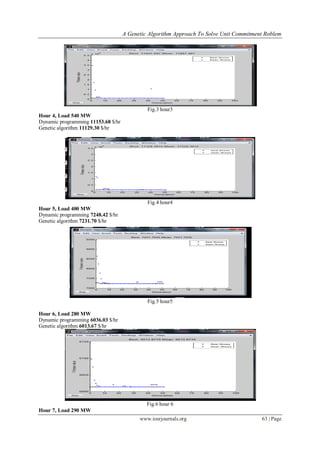
Dynamic programming 6207.00 $/hr
Genetic algorithm 6179.73 $/hr
Fig.7 hour7
Hour 8, Load 500 MW
Dynamic programming 10659.78 $/hr
Genetic algorithm 10617.89 $/hr
Fig.8 hour 8
Final cost table
Dynamic programming ($/hr) Genetic Algorithm ($/hr) Difference ($/hr)
74591.81 74336.54 255.27
V. Conclusion
The unit commitment problem can be solved by many methods to get optimal solution. The unit
commitment problem is nothing; it is the simple study of load required at different time schedule. In this paper
genetic algorithm can study and generated a better result to the dynamic programming method. A genetic
algorithm can be used to solve unit commitment problem and reduced the total production cost of power
generation.
References
Journal Pape$/hr:
[1]. R. K. Santhi, S. Subramanian, "Adaptive Binary PSO based Unit Commitment",International Journal of Computer Applications
(0975 – 8887)Volume 15– No.4, February 2011.
[2]. C. Christopher Columbus, Sishaj P. "Simon, Hybrid Particle swarm approach for Securityconstrained unit commitment",International
Conference on Computing, Electronics and Electrical Technologies [ICCEET],2012.
[3]. T.Logenthiran,DiptiSrinivasan,"LRGAfo$/hrolving Profit based GenerationScheduling Problem in Competitive Environment", 978-
1-4244-7835-4/11/$26.00 ©2011 IEEE.
[4]. M.Sudhakaran,P.Ajay-D-Vimal Raj „Integrating genetic algorithms and tabu search for unit commitment problem „,IJEST
Vol.2,no.1,2010,pp.57-69.
[5]. S. A. Kazarlis, A. G. Bakirtzis, and V. Petridis, “A genetic algorithmsolution to the unit commitment problem,” IEEE Transaction
onPower System, vol. 11, pp. 83–92, Feburary 1996.
[6]. K. S. Swarup and S. Yamashiro," Unit Commitment Solution MethodologyUsing Genetic Algorithm", IEEE TRANSACTIONS ON
POWER SYSTEMS, VOL. 17, NO. 1, FEBRUARY 2002
[7]. JorgeValenzuela &AliceE.Smith „A seeded mimetic for larg unit commitment problem‟.
[8]. C.Christober Asir Rajan, M.R.Mohan,K.Manivannan ," Improved GeneticAlgorithm Solution to UnitCommitment Problem",0-7803-
7525-4/02/$17.00 0 2002 IEEE.
Books:
[10] A.J. Wood and B. Wollenberg, “Power Generation, Operation and Control”, , 2nd
edition, John Wiley, New York, 1996.
Journal Pape$/hr:
[11] Structured Genetic Algorithm Technique for Unit Commitment Problem by Kaveh Abookazemi*, Mohd Wazir Mustafa, Hussein
Ahmad International Journal of Recent Trends in Engineering, Vol 1, No. 3, May 2009
[12] Rahul Garg, A.K.Sharma “Economic Generation and Scheduling of Power by Genetic Algorithm” Journal of Theoretical and
Applied Information Technology, Vol. 4, No.12, pp-1142-1149, December-2008](https://image.slidesharecdn.com/i0736064-140507051251-phpapp01/85/A-Genetic-Algorithm-Approach-to-Solve-Unit-Commitment-Problem-5-320.jpg)

This document describes a study that uses a genetic algorithm approach to solve the unit commitment problem of scheduling generation units in a power system over an 8-hour period. The genetic algorithm approach is able to find near-optimal solutions to the unit commitment problem and results in lower total operating costs than the traditional dynamic programming approach. The genetic algorithm approach encodes potential solutions as strings that are evaluated and evolved over generations to find low-cost solutions that satisfy constraints. The results show the genetic algorithm approach finds schedules with total costs that are $255 lower than those found by dynamic programming for the test power system.


