


Benha University Hospital, EGYPT 
Aboubakr ElnasharAboubakr Elnashar 
Hysteroscopy overview
Aboubakr ElnasharAboubakr Elnashar
In 1869: Pantaleoni performed the first hysteroscopy, but it did not achieve routine gynecologic use due to its poor optic system. In 1970s: improvements in optics, distension media, light system and instruments. In 1980s and 90s: Office hysteroscopy without anesthesia or cervical dilatation Today: Many hysteroscopic procedures have replaced older, more invasive techniques. 
Aboubakr ElnasharAboubakr Elnashar
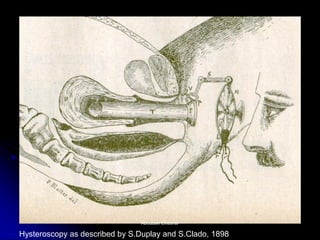
Hysteroscopy as described by S.Duplay and S.Clado, 1898 
Aboubakr ElnasharAboubakr Elnashar
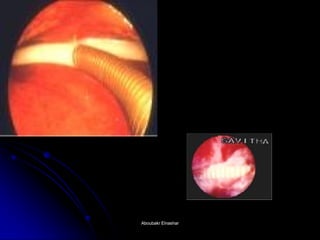
The hysteroscope is a telescope (eyepiece, barrel, and objective lens) attached to a light source. Optical systems: Optical systems are either rigid or flexible. 
Aboubakr ElnasharAboubakr Elnashar
Rigid hysteroscope The rigid hysteroscope is available in a range of diameters. 
•3 mm (Office hysteroscopy). Cervical dilatation: Rarely required (paracervical block) 
•>5 mm more specific surgical instruments through separate ports. 
•8-10 mm continuous flow of media. 
Aboubakr ElnasharAboubakr Elnashar
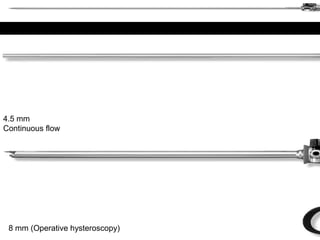
3 mm (Office hysteroscopy) 
4.5 mm 
Continuous flow 
8 mm (Operative hysteroscopy) 
Aboubakr Elnashar
Flexible hysteroscope (Office hysteroscope) 
•The tip is flexible (120-160 degrees). The outer diameter: 3-3.7 mm 
• Cervical dilatation: rarely required (Paracervical analgesia) Appropriate for the irregularly shaped uterus. Discomfort is less than rigid office hysteroscopy 
•The view (ground glass quality) less than the rigid scopes . 
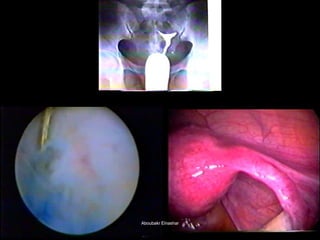
•Biopsy Tubal catheterization 
Aboubakr ElnasharAboubakr Elnashar
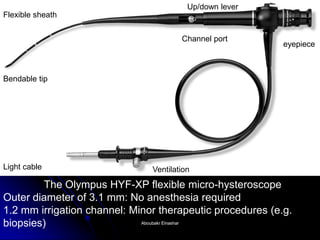
The Olympus HYF-XP flexible micro-hysteroscope Outer diameter of 3.1 mm: No anesthesia required 1.2 mm irrigation channel: Minor therapeutic procedures (e.g. biopsies) 
Light cable 
eyepiece 
Channel port 
Flexible sheath 
Up/down lever 
Bendable tip 
Ventilation 
Aboubakr ElnasharAboubakr Elnashar
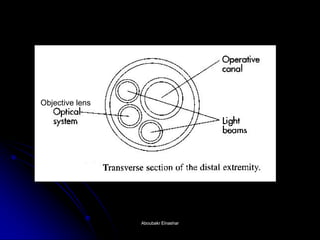
Objective lens 
Aboubakr ElnasharAboubakr Elnashar
Light Source: 
•Halogen or xenon lamps. 
•The power:100- 300 W. 
•A fiber optic cable transmits light from the source to the endoscope. 
•A videocamera: allow colleagues and the patient to participate and to make video recordings and training. 
Aboubakr ElnasharAboubakr Elnashar
Distension media: It is necessary to distend the uterine cavity to obtain a panoramic view. 
•Carbon dioxide. 
•Low viscosity fluids: dextrose, saline, lactated Ringer’s, glycine, sorbitol. Saline offers advantages (shorter and less discomfort) over Co2 instillation 
•High viscosity fluids: Dextran 70 (Hyskon) 
Aboubakr ElnasharAboubakr Elnashar
Diagnostic 
Abnormal uterine bleeding 
Recurrent pregnancy loss 
Unexplained infertility 
Amenorrhea 
Assisted conception 
Abnormal HSG 
Chronic pelvic pain 
Postoperative evaluation 
Pregnancy 
Operative 
•Endometrial biopsy 
•Removal of IUCD 
•Removal of polyps 
•Myomectomy 
•Lysis of IU adhesions 
•Resection of uterine septum 
•Endometrial ablation 
•Tubal cannulation 
•Tubal sterilization. 
•Removal of retained products of conception 
Aboubakr ElnasharAboubakr Elnashar
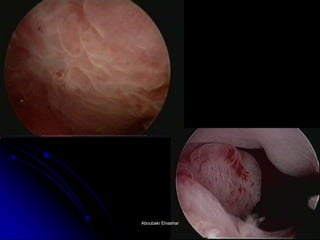
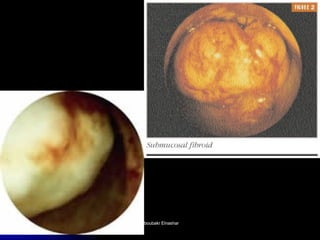
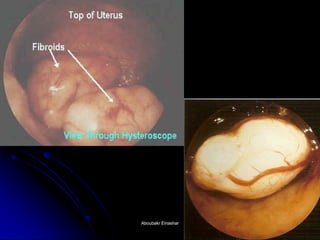
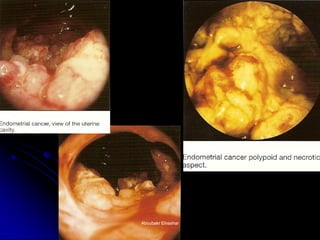
I. Abnormal uterine bleedingAbnormal bleeding Findings: 1. Endometrial hyperplasia. 2. Submucous/intramural fibroid: (Wamsteaker et al,1993) Type 0: pedunculated Type 1: < 50% intramural Type 2: > 50% intramural 3. Endometrial polyps. 4. Endometrial cancer. 5. IUCD 
Aboubakr ElnasharAboubakr Elnashar
15 
36 
38 
Aboubakr ElnasharAboubakr Elnashar
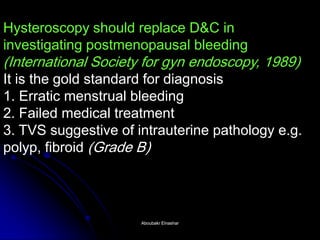
Hysteroscopy should replace D&C in investigating postmenopausal bleeding (International Society for gyn endoscopy, 1989) It is the gold standard for diagnosis 1. Erratic menstrual bleeding 2. Failed medical treatment 3. TVS suggestive of intrauterine pathology e.g. polyp, fibroid (Grade B) 
Aboubakr ElnasharAboubakr Elnashar
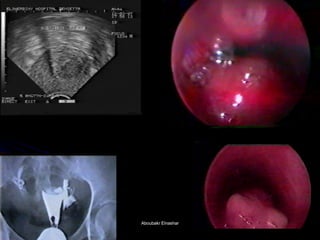
*Curettage or biopsy may miss: Small polyp Submucous fibroid Focal hyperplasia Focal endometrial carcinoma *Transvaginal ultrasound is accurate in excluding endometrial hyperplasia but is often unable to distinguish submucosal fibroids and polyps (New Zealand Guidelines Group : 1998-2002 Level A) 
Aboubakr ElnasharAboubakr Elnashar
Advantages of hysteroscopy over D &C 1.The whole uterine cavity & the endocervix can be directly visualized 2.Very small lesions such as polyps can be identified & biopsed or removed 3.Bleeding from ruptured venules & echymoses can be readily identified & treated 4.The sensitivity in detecting intrauterine pathology is 98% (Loffer,1989) 5.Outpatient procedure 6. Treatment modality. 
Aboubakr ElnasharAboubakr Elnashar
Disadvantages of hysteroscopy: 1.Cost of the apparatus 2.Lack of availability or experience 3. Hysteroscopy without biopsy is unreliable in D.D. between pre-malignant & malignant endometrium (Karlssson et al, 1994). 
Aboubakr ElnasharAboubakr Elnashar
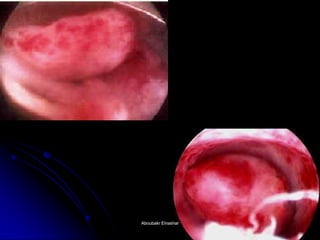
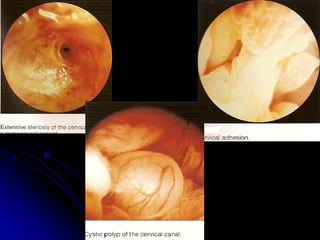
Cervical Polyp 
Aboubakr ElnasharAboubakr Elnashar
) 
Aboubakr ElnasharAboubakr Elnashar
II. Recurrent pregnancy loss. Anatomic:(10%) 1. Congenital uterine malformation. 2. Submucous fibroid 3. Cervical incompetence 4. Severe IU synechiae 
Aboubakr ElnasharAboubakr Elnashar
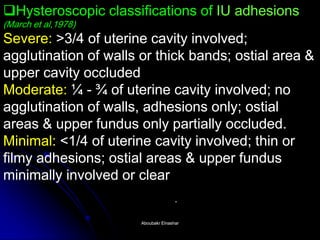
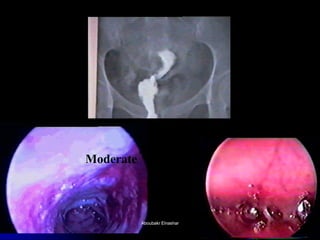
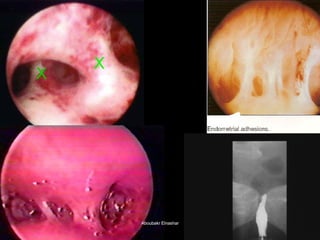
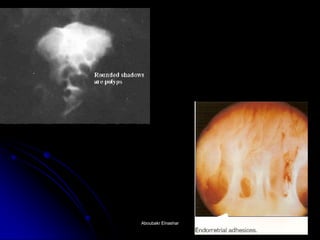
HysteroscopicHysteroscopic classifications of IU adhesionsIU adhesions (March et al,(al,1978) Severe: >3/4 of uterine cavity involved; agglutination of walls or thick bands; ostialostial area & upper cavity occluded Moderate: ¼ - ¾ of uterine cavity involved; no agglutination of walls, adhesions only; ostialostial areas & upper fundusfundus only partially occluded. Minimal: <1/4 of uterine cavity involved; thin or filmy adhesions; ostialostial areas & upper fundusfundus minimally involved or clearminimally clear . 
Aboubakr ElnasharAboubakr Elnashar
63 
Severe 
Moderate 
Aboubakr ElnasharAboubakr Elnashar
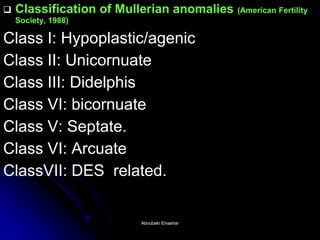
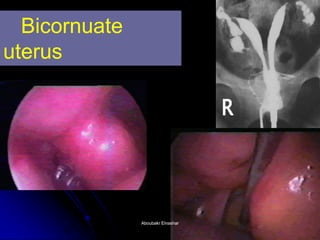
Classification of Mullerian anomalies (American Fertility Society, 1988) 
Class I: Hypoplastic/agenic 
Class II: Unicornuate 
Class III: Didelphis 
Class VI: bicornuate 
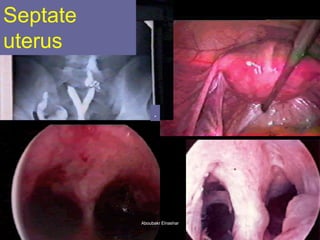
Class V: Septate. 
Class VI: Arcuate 
ClassVII: DES related. 
Aboubakr ElnasharAboubakr Elnashar
Septate uterus 
. 
Aboubakr ElnasharAboubakr Elnashar
Bicornuate uterus 
Aboubakr ElnasharAboubakr Elnashar
Cervical incompetence: It is suspected if the resistance of internal os is < that of the cervical canal Opening of the int. os without passing through it . Internal os does not close after removing the optics (Traver et al., 2000) 
Dilators or balloons to determine cervical resistance and/or HSG to measure the width of the cervical canal between pregnancies are neither sensitive nor specific. 
Aboubakr ElnasharAboubakr Elnashar
III. Unexplained infertility 
•Small endometrial polyp 
•Small cervical polyp 
•Adhesion at cornual cones 
•Cornual polyp 
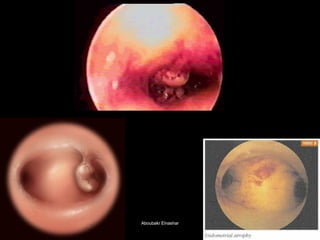
•Endometrial dystrophies (atrophy or hyperplasia) that may affect receptivity or implantation especially in ART. 
Aboubakr ElnasharAboubakr Elnashar
55 
52 
Cornual polyp 
Aboubakr ElnasharAboubakr Elnashar
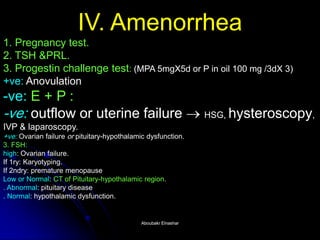
IV. Amenorrhea 1. Pregnancy test. 2. TSH &PRL. 3. Progestin challenge test: (MPA 5mgX5d or P in oil 100 mg /3dX 3) +ve: Anovulation -ve: E + P : -ve: outflow or uterine failure  HSG, hysteroscopy, IVP & laparoscopy. +ve: Ovarian failure or pituitary-hypothalamic dysfunction. 3. FSH: high: Ovarian failure. If 1ry: Karyotyping. If 2ndry: premature menopause Low or Normal: CT of Pituitary-hypothalamic region. . Abnormal: pituitary disease . Normal: hypothalamic dysfunction. 
Aboubakr ElnasharAboubakr Elnashar
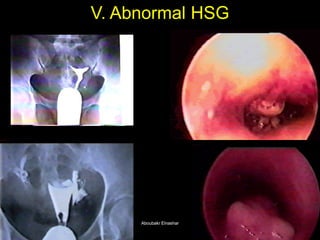
V. Abnormal HSG 
Aboubakr ElnasharAboubakr Elnashar
VI. Assisted conception 1. After repeated implantation failure Abnormalities of the endometrium & organic IU pathologies are important causes of failed IVF-ET cycles (Dicker,1992) 
Aboubakr ElnasharAboubakr Elnashar
2. Pre IVF evaluation: Hysteroscopy is an integral part of the pre IVF evaluation, to avoid unnecessary & expensive treatment failures (Shamma et al,1992; Shushan et al, 1999) Cost-effective analysis indicates that hysteroscopy, as a universal screening test even before the first IVF treatment , is well justified (La Sala et al, 1998) 
Aboubakr ElnasharAboubakr Elnashar
VII. Postoperative evaluation= 2nd look hysteroscopy 
•Hysteroscopic myomectomy 
•Abdominal myomectomy 
•Cesarean section 
•Septum resection 
•Asherman TT 
•Endometrial ablation or resction 
•Tubal reimplantation 
Aboubakr ElnasharAboubakr Elnashar
Findings 
•De novo or recurrent IU adhesions 
•Incomplete myoma resection 
Aboubakr ElnasharAboubakr Elnashar
VII. Pregnancy Rarely indicated 
•IUD in pregnancy 
•Embryoscopy 
•Evaluate the disturbed pregnancy 
Aboubakr ElnasharAboubakr Elnashar
Absolute 
. Acute pelvic infection 
Relative 
. Active uterine bleeding 
. Pregnancy 
. Recent uterine perforation 
. Invasive cervical cancer 
. Inability to distend the uterus 
. Cervical/vaginal infection 
. Medical contraindication or intolerance of anesthesia 
Aboubakr ElnasharAboubakr Elnashar
Thank You 
Aboubakr Elnashar 
Aboubakr ElnasharAboubakr Elnashar

Hysteroscopy overview

  • 1.
    Benha University Hospital,EGYPT Aboubakr ElnasharAboubakr Elnashar Hysteroscopy overview
  • 2.
  • 3.
    In 1869: Pantaleoniperformed the first hysteroscopy, but it did not achieve routine gynecologic use due to its poor optic system. In 1970s: improvements in optics, distension media, light system and instruments. In 1980s and 90s: Office hysteroscopy without anesthesia or cervical dilatation Today: Many hysteroscopic procedures have replaced older, more invasive techniques. Aboubakr ElnasharAboubakr Elnashar
  • 4.
    Hysteroscopy as describedby S.Duplay and S.Clado, 1898 Aboubakr ElnasharAboubakr Elnashar
  • 5.
  • 6.
    The hysteroscope isa telescope (eyepiece, barrel, and objective lens) attached to a light source. Optical systems: Optical systems are either rigid or flexible. Aboubakr ElnasharAboubakr Elnashar
  • 7.
    Rigid hysteroscope Therigid hysteroscope is available in a range of diameters. •3 mm (Office hysteroscopy). Cervical dilatation: Rarely required (paracervical block) •>5 mm more specific surgical instruments through separate ports. •8-10 mm continuous flow of media. Aboubakr ElnasharAboubakr Elnashar
  • 8.
    3 mm (Officehysteroscopy) 4.5 mm Continuous flow 8 mm (Operative hysteroscopy) Aboubakr Elnashar
  • 9.
    Flexible hysteroscope (Officehysteroscope) •The tip is flexible (120-160 degrees). The outer diameter: 3-3.7 mm • Cervical dilatation: rarely required (Paracervical analgesia) Appropriate for the irregularly shaped uterus. Discomfort is less than rigid office hysteroscopy •The view (ground glass quality) less than the rigid scopes . •Biopsy Tubal catheterization Aboubakr ElnasharAboubakr Elnashar
  • 10.
  • 11.
    The Olympus HYF-XPflexible micro-hysteroscope Outer diameter of 3.1 mm: No anesthesia required 1.2 mm irrigation channel: Minor therapeutic procedures (e.g. biopsies) Light cable eyepiece Channel port Flexible sheath Up/down lever Bendable tip Ventilation Aboubakr ElnasharAboubakr Elnashar
  • 12.
    Objective lens AboubakrElnasharAboubakr Elnashar
  • 13.
    Light Source: •Halogenor xenon lamps. •The power:100- 300 W. •A fiber optic cable transmits light from the source to the endoscope. •A videocamera: allow colleagues and the patient to participate and to make video recordings and training. Aboubakr ElnasharAboubakr Elnashar
  • 14.
    Distension media: Itis necessary to distend the uterine cavity to obtain a panoramic view. •Carbon dioxide. •Low viscosity fluids: dextrose, saline, lactated Ringer’s, glycine, sorbitol. Saline offers advantages (shorter and less discomfort) over Co2 instillation •High viscosity fluids: Dextran 70 (Hyskon) Aboubakr ElnasharAboubakr Elnashar
  • 15.
  • 16.
  • 17.
  • 18.
  • 19.
    Diagnostic Abnormal uterinebleeding Recurrent pregnancy loss Unexplained infertility Amenorrhea Assisted conception Abnormal HSG Chronic pelvic pain Postoperative evaluation Pregnancy Operative •Endometrial biopsy •Removal of IUCD •Removal of polyps •Myomectomy •Lysis of IU adhesions •Resection of uterine septum •Endometrial ablation •Tubal cannulation •Tubal sterilization. •Removal of retained products of conception Aboubakr ElnasharAboubakr Elnashar
  • 20.
    I. Abnormal uterinebleedingAbnormal bleeding Findings: 1. Endometrial hyperplasia. 2. Submucous/intramural fibroid: (Wamsteaker et al,1993) Type 0: pedunculated Type 1: < 50% intramural Type 2: > 50% intramural 3. Endometrial polyps. 4. Endometrial cancer. 5. IUCD Aboubakr ElnasharAboubakr Elnashar
  • 21.
  • 22.
  • 23.
  • 24.
    15 36 38 Aboubakr ElnasharAboubakr Elnashar
  • 25.
    Hysteroscopy should replaceD&C in investigating postmenopausal bleeding (International Society for gyn endoscopy, 1989) It is the gold standard for diagnosis 1. Erratic menstrual bleeding 2. Failed medical treatment 3. TVS suggestive of intrauterine pathology e.g. polyp, fibroid (Grade B) Aboubakr ElnasharAboubakr Elnashar
  • 26.
    *Curettage or biopsymay miss: Small polyp Submucous fibroid Focal hyperplasia Focal endometrial carcinoma *Transvaginal ultrasound is accurate in excluding endometrial hyperplasia but is often unable to distinguish submucosal fibroids and polyps (New Zealand Guidelines Group : 1998-2002 Level A) Aboubakr ElnasharAboubakr Elnashar
  • 27.
    Advantages of hysteroscopyover D &C 1.The whole uterine cavity & the endocervix can be directly visualized 2.Very small lesions such as polyps can be identified & biopsed or removed 3.Bleeding from ruptured venules & echymoses can be readily identified & treated 4.The sensitivity in detecting intrauterine pathology is 98% (Loffer,1989) 5.Outpatient procedure 6. Treatment modality. Aboubakr ElnasharAboubakr Elnashar
  • 28.
    Disadvantages of hysteroscopy:1.Cost of the apparatus 2.Lack of availability or experience 3. Hysteroscopy without biopsy is unreliable in D.D. between pre-malignant & malignant endometrium (Karlssson et al, 1994). Aboubakr ElnasharAboubakr Elnashar
  • 29.
    Cervical Polyp AboubakrElnasharAboubakr Elnashar
  • 30.
  • 31.
  • 32.
    II. Recurrent pregnancyloss. Anatomic:(10%) 1. Congenital uterine malformation. 2. Submucous fibroid 3. Cervical incompetence 4. Severe IU synechiae Aboubakr ElnasharAboubakr Elnashar
  • 33.
    HysteroscopicHysteroscopic classifications ofIU adhesionsIU adhesions (March et al,(al,1978) Severe: >3/4 of uterine cavity involved; agglutination of walls or thick bands; ostialostial area & upper cavity occluded Moderate: ¼ - ¾ of uterine cavity involved; no agglutination of walls, adhesions only; ostialostial areas & upper fundusfundus only partially occluded. Minimal: <1/4 of uterine cavity involved; thin or filmy adhesions; ostialostial areas & upper fundusfundus minimally involved or clearminimally clear . Aboubakr ElnasharAboubakr Elnashar
  • 34.
    63 Severe Moderate Aboubakr ElnasharAboubakr Elnashar
  • 35.
  • 36.
    Classification of Mulleriananomalies (American Fertility Society, 1988) Class I: Hypoplastic/agenic Class II: Unicornuate Class III: Didelphis Class VI: bicornuate Class V: Septate. Class VI: Arcuate ClassVII: DES related. Aboubakr ElnasharAboubakr Elnashar
  • 37.
    Septate uterus . Aboubakr ElnasharAboubakr Elnashar
  • 38.
    Bicornuate uterus AboubakrElnasharAboubakr Elnashar
  • 39.
    Cervical incompetence: Itis suspected if the resistance of internal os is < that of the cervical canal Opening of the int. os without passing through it . Internal os does not close after removing the optics (Traver et al., 2000) Dilators or balloons to determine cervical resistance and/or HSG to measure the width of the cervical canal between pregnancies are neither sensitive nor specific. Aboubakr ElnasharAboubakr Elnashar
  • 40.
    III. Unexplained infertility •Small endometrial polyp •Small cervical polyp •Adhesion at cornual cones •Cornual polyp •Endometrial dystrophies (atrophy or hyperplasia) that may affect receptivity or implantation especially in ART. Aboubakr ElnasharAboubakr Elnashar
  • 41.
    55 52 Cornualpolyp Aboubakr ElnasharAboubakr Elnashar
  • 42.
  • 43.
    IV. Amenorrhea 1.Pregnancy test. 2. TSH &PRL. 3. Progestin challenge test: (MPA 5mgX5d or P in oil 100 mg /3dX 3) +ve: Anovulation -ve: E + P : -ve: outflow or uterine failure  HSG, hysteroscopy, IVP & laparoscopy. +ve: Ovarian failure or pituitary-hypothalamic dysfunction. 3. FSH: high: Ovarian failure. If 1ry: Karyotyping. If 2ndry: premature menopause Low or Normal: CT of Pituitary-hypothalamic region. . Abnormal: pituitary disease . Normal: hypothalamic dysfunction. Aboubakr ElnasharAboubakr Elnashar
  • 44.
    V. Abnormal HSG Aboubakr ElnasharAboubakr Elnashar
  • 45.
  • 46.
    VI. Assisted conception1. After repeated implantation failure Abnormalities of the endometrium & organic IU pathologies are important causes of failed IVF-ET cycles (Dicker,1992) Aboubakr ElnasharAboubakr Elnashar
  • 47.
    2. Pre IVFevaluation: Hysteroscopy is an integral part of the pre IVF evaluation, to avoid unnecessary & expensive treatment failures (Shamma et al,1992; Shushan et al, 1999) Cost-effective analysis indicates that hysteroscopy, as a universal screening test even before the first IVF treatment , is well justified (La Sala et al, 1998) Aboubakr ElnasharAboubakr Elnashar
  • 48.
    VII. Postoperative evaluation=2nd look hysteroscopy •Hysteroscopic myomectomy •Abdominal myomectomy •Cesarean section •Septum resection •Asherman TT •Endometrial ablation or resction •Tubal reimplantation Aboubakr ElnasharAboubakr Elnashar
  • 49.
    Findings •De novoor recurrent IU adhesions •Incomplete myoma resection Aboubakr ElnasharAboubakr Elnashar
  • 50.
    VII. Pregnancy Rarelyindicated •IUD in pregnancy •Embryoscopy •Evaluate the disturbed pregnancy Aboubakr ElnasharAboubakr Elnashar
  • 51.
  • 52.
    Absolute . Acutepelvic infection Relative . Active uterine bleeding . Pregnancy . Recent uterine perforation . Invasive cervical cancer . Inability to distend the uterus . Cervical/vaginal infection . Medical contraindication or intolerance of anesthesia Aboubakr ElnasharAboubakr Elnashar
  • 53.
    Thank You AboubakrElnashar Aboubakr ElnasharAboubakr Elnashar