A. Prof. Dr Aisha Mohamed El-Bareg
MBBS, DGO, MMedSci (ART,Nottingham University-
UK), ABOG, (MD), PhD (Manchester University-UK)
Consultant Obstetrician & Gynecologist
With subspecialty in Endoscopic Surgery, Reproductive
& Stem Cell Medicine
Al-Amal Hospital for Obstetrics & Gynaecology,Infertility
Treatments and Genetic Research
Faculty of Medicine , Misurata University /Libya
Auditing of our complication
& Learning from some ones
else’s complication
however good the car
with its safety features
and however good the
road, the driver still has
to drive carefully to
complete the journey
safely.
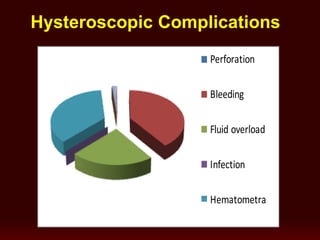
Perforation
Bleeding
Fluid overload
Infection
Hematometra
Hysteroscopic Complications
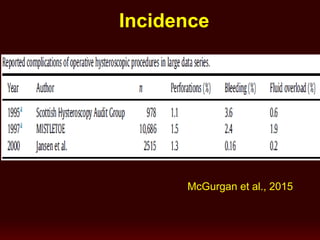
Incidence
McGurgan et al., 2015
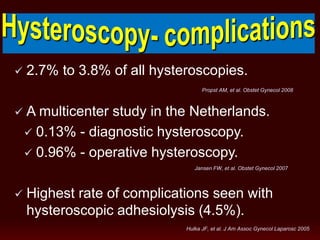
 2.7% to 3.8% of all hysteroscopies.
 A multicenter study in the Netherlands.
 0.13% - diagnostic hysteroscopy.
 0.96% - operative hysteroscopy.
 Highest rate of complications seen with
hysteroscopic adhesiolysis (4.5%).
Propst AM, et al. Obstet Gynecol 2008
Jansen FW, et al. Obstet Gynecol 2007
Hulka JF, et al. J Am Assoc Gynecol Laparosc 2005
Incidence
 Complications have reduced significantly over
the years:
Improved equipment.
Better understanding of the risk factors.
Proper training and better experience of the
operating surgeons.
Operative Hysteroscopy
• Operative Hysteroscopy is not for the novice,
but should be an extension of basic skill learnt
at diagnostic hysteroscopy.
• It is recommended by one author that unless
you have done 500 diagnostic hysteroscopy,
you should not venture operative hysteroscopy.
Peri-operative Complications
Patient positioning.
vasovagal attack (pain)
 Anesthesia complications
 Access to the endometrial cavity:
 Cervical trauma, false passage.
 Uterine perforation.
Intraoperative bleeding.
Thermal injury, air or gas emboli
Fluid overload.
Post-operative complications
EARLY
Infection.
Post-operative bleeding.
LATE – sequale
Persistent complain.
Intrauterine adhesions, hematometria.
Uterine rupture during pregnancy.
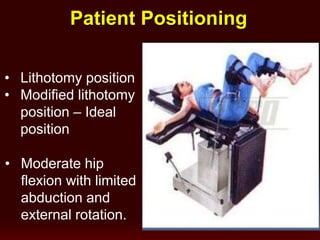
Patient Positioning
• Lithotomy position
• Modified lithotomy
position – Ideal
position
• Moderate hip
flexion with limited
abduction and
external rotation.
Incorrect Patient Positioning:
Nerve injuries
Back injuries
Damage to soft tissue
(Compartment syndrome)
Deep venous thrombosis (DVT)
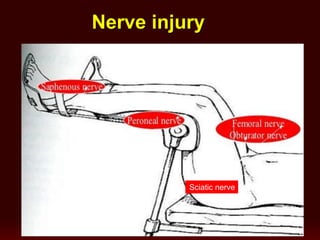
Nerve injury
Sciatic nerve
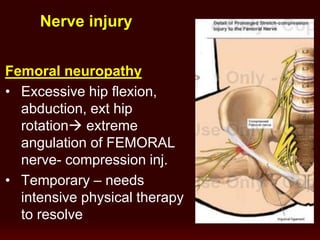
Femoral neuropathy
• Excessive hip flexion,
abduction, ext hip
rotation extreme
angulation of FEMORAL
nerve- compression inj.
• Temporary – needs
intensive physical therapy
to resolve
Nerve injury
Sciatic nerve injury : At sciatic notch
Nerve injury
Common peroneal injury
• At neck of fibula – foot drop/ lower lateral
paraesthesia.
Brachial plexus
Brachial plexus injury may result from
incorrectly placed shoulder restraints or from
leaving the patient's arm abducted on an arm
board. A non-slip mattress is preferable to
restraints that compress the patient's
shoulders. Injury can result from 15 minutes in
a faulty position
erve injuryN
The anaesthetized patient is defenseless
against traction injury to the lumbar spine.
 The legs should always be lifted
simultaneously and kept together until they are
at the appropriate height when they should be
abducted gently and placed in the supports.
They should never be over-abducted as this
can lead to damage to the sacro-iliac joints.
Back injuries.
Pressure on the muscle of an osteofascial
compartment-- ischemia + reperfusion inj.
Sequelae:
Rhabdomyolysis
Permanent disability
Events facilitating it:
Leg holders
Pneumatic compression stockings
Any direct pressure
Compartment syndrome in the lower legs
Risk reduction & Management
Ideal lithotomy position- moderate flexion
with limited abduction and external rotation.
Avoid pressure on prone areas.
Avoid leaning on the thigh of the patient.
Early identification and management
Vasovagal attack
Proper evaluation to role out preexisting heart
disease.
Instillation of LA in cervical canal may reduce
incidence.
Routine administration of intracervical or
paracervical LA is not indicated.
Local anesthesia related:
Allergic reactions
Cardiovascular complications
Awareness and avoiding:
Fluid overload
Electrolyte disturbance
Anesthesia complications
 Cervical laceration
 False passage
 Perforation
 Bleeding
Injury to genital tract
Cervical Lacerations
Due to:
Excessive traction on cervix by tenaculum.
When cervix is forcefully dilated.
Predisposing factors:
Nulliparity, Menopause, Cervical hypoplasia
Diagnosis:
Dilatation itself can also cause bleeding from
the cervix.
Diagnosis is usually easy and immediate.
TT:
• Bleeding is less: expectant.
• Sutures can be placed if necessary.
Prevention:
Preoperative preparation of cervix with
prostaglandin gel or vaginal misoprostol(200
microgms) kept 2 h prior to surgery.
Cervical Lacerations
If cervical stenosis is encountered, and
misoprostol have not been used or were
ineffective:
 Deep intra cervical injection of dilute vasopressin at 4
and 8 o’clock on the cervix): reduces the force
required for cervical dilation.
 In cases of previous access failure, adhesions or
synechiae in the canal frequently exist:
Use of mechanical scissors passed through the
operating channel to divide the adhesions under
direct vision.
A false passage…
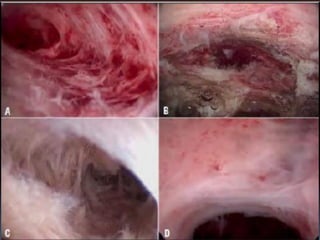
 If muscle fibers are visible and the tubal ostia
are not, assume the passage is false.
 Slowly remove the hysteroscopy and identify
the true cavity for confirmation.
Discontinue the procedure— even if no
perforation is detected—to prevent distention
fluid from being absorbed into the circulation
through the injury.
To Avoid Creating A False Passage…
Dilate the cervix with slow, steady pressure and
stop as soon as the internal os opens; do not
attempt to push the dilator to the uterine
fundus.
Often the external os opens, but the internal os
cannot be dilated. The extra 1 to 2 mm
necessary to accommodate the 27- French
resectoscope, Rather than exert more force and
risk perforation or laceration
To Avoid Creating A False Passage…
Simply turn on the resectoscope’s inflow with
the outflow shut off, and let the fluid pressure
dilate the cervix.
Always insert the hysteroscope or
resectoscope under direct vision rather than
use an obturator.
 Keep the “dark circle” in the center of the field
and slowly advance the hysteroscope toward it
until the cavity is reached
Uterine perforation
The incidence of perforation was 14 per 1,000.
It was even higher during resection of lateral
and fundal adhesions: 2 to 3 per 100.
Although perforation is more common with
thermal energy sources, it may occur
mechanically with dilators or when scissors
are used to resect a uterine septum,
synechiae, or polyps.
Uterine Perforation
Predisposing factors:
• acute ante or retroversion of uterus
• cervical stenosis, uterine synechiae
• endometrial malignancy
• uterine malformation.
 Recognition of perforation:
• Loss of uterine distension.
• Rapid increasing in fluid deficit.
• Intestinal loops or omentum is seen.
Management:
1.Procedure should be stopped immediately.
2.If perforation is of small caliber and is not
caused by electric current : Expectant tt,
observed for signs of hge
3.Tachycardia and hypotension indicates
ongoing hge:
Uterine Perforation
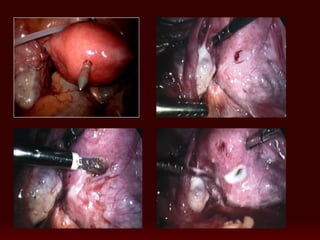
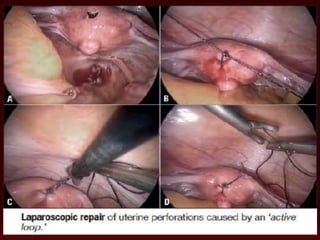
 Laparoscopy: stop bleeding by endocoag-
ulation or sutures.
 Laparotomy if adjacent organs injury
 Broad spectrum antibiotics
Hysteroscopy can be repeated after 6 weeks
Uterine Perforation
Prevention:
Pelvic examination to determine uterine, size,
position.
Stop when Pink myometrium becomes visible.
Resection to be done till both ostia seen
simultaneously.
Laparoscopic guidance or USG guidance.
Uterine Perforation
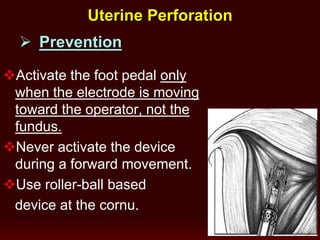
 Prevention
Activate the foot pedal only
when the electrode is moving
toward the operator, not the
fundus.
Never activate the device
during a forward movement.
Use roller-ball based
device at the cornu.
Uterine Perforation
Intra-op/Post-op bleeding
Most common complications:
Cervical laceration, Perforation.
Myoma or endometrial resection.
Depends on the form of energy used for
resection. With loop and roller ball or loop
alone the incidence is 2.57% and 3.53%
respectively whereas with laser or roller ball it
is 1.17% and 0.97% (Maresh 1996).
op bleeding-op/Post-Intra
Management:
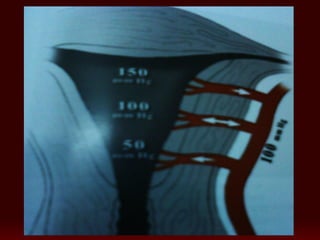
Clear the field by opening the outflow channel.
Increase the distension pressure above the
mean arterial pressure (100mmHg) which
compresses the uterine wall sufficiently to stop
the bleeding.
Then the bleeding vessels can be coagulated
with a 3mm ball electrode.
if the distension pressure is relaxed at the end
of the procedure, the bleeding continue:
hemostasisTo achieve
1) Insert a Foley balloon into the uterine cavity,
inflate 30-50 mL (or more for a larger cavity) of
fluid into the balloon, and observe the patient.
The balloon left for 6-12hrs.
2) Pack the uterus.
1/2-inch–gauge packing that has been soaked
in a dilute vasopressin solution.
(20 U [1 mL] in 60 mL Normal Saline).
If fails---------------
In very rare cases when the bleeding is arterial
and is not controlled by the above techniques
the procedure is abandoned:
Vital sign monitoring
 UAE/ Hysterectomy
Benefits of Vasopressin
Before balloon tamponade or Packing the
uterus, Inject very dilute vasopressin :
(4 U [0.2 mL] in 60 mL normal saline)
directly into the cervix 2 cm deep,
at the 4 and 8 o’clock positions.
43
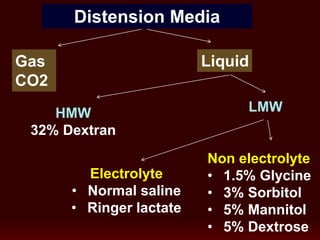
Gas
CO2
Liquid
HMW
32% Dextran
LMW
Distension Media
Non electrolyte
• 1.5% Glycine
• 3% Sorbitol
• 5% Mannitol
• 5% Dextrose
Electrolyte
• Normal saline
• Ringer lactate
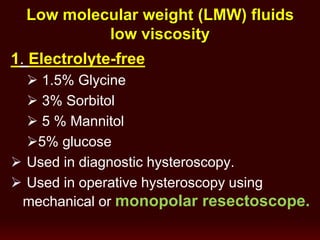
Low molecular weight (LMW) fluids
low viscosity
1. Electrolyte-free
 1.5% Glycine
 3% Sorbitol
 5 % Mannitol
5% glucose
 Used in diagnostic hysteroscopy.
 Used in operative hysteroscopy using
mechanical or monopolar resectoscope.
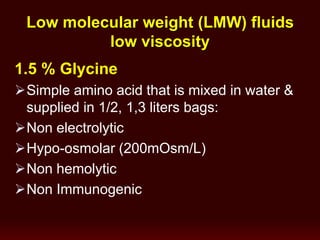
1.5 % Glycine
Simple amino acid that is mixed in water &
supplied in 1/2, 1,3 liters bags:
Non electrolytic
Hypo-osmolar (200mOsm/L)
Non hemolytic
Non Immunogenic
Low molecular weight (LMW) fluids
low viscosity
Intravascular absorption syndrome
Occurs with electrolytes free medium (Glycine
1.5%).
More in premenopausal women
Female sex steriods – inhibits Na-K+/
ATPase pump thus water and sodium not
thrown out of cells.
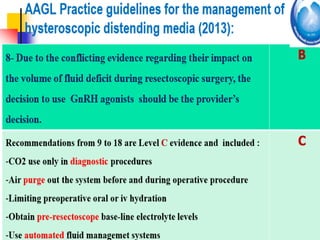
GnRH agonists inhibits such hormones
action – may prevent this complication to
occur.
• For diagnostic and simple procedure:
 Rare
• For operative procedures:
• Glycine can gain access to the systemic
circulation if the integrity of the uterine
vasculature is breached
• In the extreme:
• Fluid overload & electrolyte disturbances
Intravascular absorption syndrome
 Electrolyte disturbance:
• Hypervolemia
• Severe hyponatremia
• Decreased osmolarity.
 Hazards:
• Right heart failure
• Pulmonary and cerebral edema
• Death.
Rate:0.2-2%
Intravascular absorption syndrome
Mechanism and CP
Rapid intravascular absorption of glycine
through exposed venous sinuses:
 Dilutional hyponatremia
 Acute fluid overload
 High blood pressure, reflex bradycardia.
 Cerebral odema, pulmonary oedema.
This is followed by Hypotension, nausea,
vomiting, headache, visual disturbance,
agitation, confusion and lethargy.
Intravascular absorption syndrome
Glycine is metabolized into
1. Amonia: higher concentration in the brain
decreases the visual acuity.
Glyoxylic acid: form oxalate.
Glycine is contraindicated in patients with
renal impairments.
Intravascular absorption syndrome
The severity depends on:
 Amount of fluid absorbed
 Number of vascular apertures,
 Duration of procedure
 Flow pressure
It can present intra or postoperatively.
Intravascular absorption syndrome
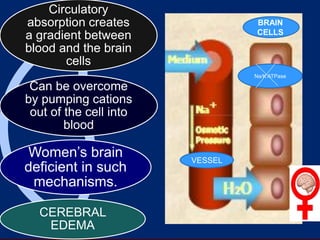
Women’s brain
deficient in such
mechanisms.
Circulatory
absorption creates
a gradient between
blood and the brain
cells
Can be overcome
by pumping cations
out of the cell into
blood
CEREBRAL
EDEMA
BRAIN
CELLS
VESSEL
Na/K ATPase
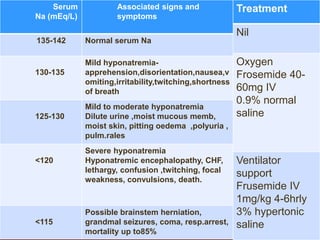
Serum
Na (mEq/L)
Associated signs and
symptoms
135-142 Normal serum Na
130-135
Mild hyponatremia-
apprehension,disorientation,nausea,v
omiting,irritability,twitching,shortness
of breath
125-130
Mild to moderate hyponatremia
Dilute urine ,moist mucous memb,
moist skin, pitting oedema ,polyuria ,
pulm.rales
<120
Severe hyponatremia
Hyponatremic encephalopathy, CHF,
lethargy, confusion ,twitching, focal
weakness, convulsions, death.
<115
Possible brainstem herniation,
grandmal seizures, coma, resp.arrest,
mortality up to85%
Treatment
Nil
Oxygen
Frosemide 40-
60mg IV
0.9% normal
saline
Ventilator
support
Frusemide IV
1mg/kg 4-6hrly
3% hypertonic
saline
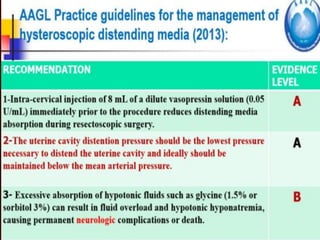
Preoperative prevention
GnRHa:
 Decreases volume of systemically absorbed
distension media.
Dilute Vasopressin:
Immediate before cervical dilatation
8 ml (0.1U/ml)injected deeply about 4 and 8
o’clock in the cervix.
Before using the resectoscope
Baseline serum electrolyte levels should be
measured.
Women with cardiopulmonary disease should
be evaluated carefully for shifts in fluid volume.
Operating at the lowest effective IU pressure
(50–80 mm Hg), always trying to keep this at
less than the mean arterial pressure
Intra-operative Fluid Media Management
Completing the procedure as quickly as
possible.
Measurement of fluid inflow and outflow in a
closed system: precise calculation of the
absorbed volume.
Bulk vaporizing electrodes: reduced systemic
absorption compared with the resection loops
{greater degree of electrocoagulation: collateral
vessel sealing}.
Intra-operative Fluid Media Management
Deficit should b calculated frequently:
If the deficit reaches a predetermined limit
(depending on the patient’s baseline status,
could be 750–1500 ml)
serum electrolytes are measured.
Furosemide: IV, 10-40 mg, depending on
renal function.
Termination of procedure:
Serum sodium decrease to < 125 mEq/L,
Deficit: 1500 to 2000 ml for glycine
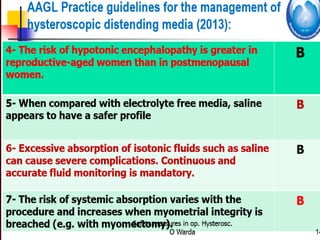
For saline double
Normal saline (0.9% NaCl)
 Safest, widespread availability.
Low operative cost
Physiological disposal by peritoneal absorption.
 Excessive vascular absorption fluid overload
pulmonary odema.
 NOT SUITABLE FOR MONOPOLAR SYSTEM : good
conductor of electrons.
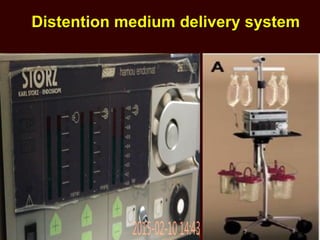
Distention medium delivery system
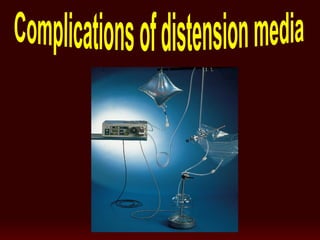
Air or Gas Embolism
The risk of gas embolism is the primary
complication associated with the use of carbon
dioxide as the distention medium.
Carbon dioxide is a soluble gas, so these
emboli generally resolve rapidly.
In contrast, room air emboli are more likely to
be fatal.
Gas Embolus
Faulty methods
Use of laparoscopic insufflator to infuse CO2
in uterus.
Diagnosis:
Tachycardia , desaturation & Hypotension
Cog-wheel murmur (10% cases) –
disappearance once the hysteroscopy stops
Rapid fall in expired CO2.
Precautions to prevent embolism
 Avoid Trendelenburg positioning.
Remove last dilator just before inserting the
resectoscope. Minimize cervical trauma.
Limit repeated removal-reinsertion of the
resectoscope.
Maintaining intrauterine pressures below 100
mm Hg and flow rates below 100 mL/min .
OT assistant must keep a watch on fluid bottle
and inform surgeon before changing it to
prevent entry of air bubble into the uterus.
Vaporizing myomas eliminates the need to
remove fibroid chips.
Intracervical injection of vasopressin may
block gas from entering circulation.
Precautions to prevent embolism
 Management
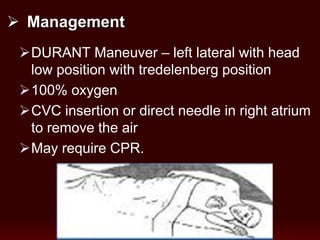
DURANT Maneuver – left lateral with head
low position with tredelenberg position
100% oxygen
CVC insertion or direct needle in right atrium
to remove the air
May require CPR.
Late onset complications
1. Infection
Avoid hysteroscopy in gross cervical infection,
uterine infection & salpingitis.
Role of antibiotics controversial.
Supportive studies in cases with RHD, CHD.
Suspected chronic endometritis
Submucous myomas procedure
Imbedded IUDs.
ACOG guidelines do not recommend routine prophylactic
antibiotics for hysteroscopy.
2. Vaginal Discharge,
Vaginal discharge is common after any ablative
procedure and is usually self limiting.
3. Hematometria
If obstruction of the internal OS secondary to
adhesion due to hysteroscopic surgery.
Isthmus region and cervical canal should be
avoided during resection.
Late onset complications
3. Adhesion Formation
Intrauterine adhesions are common especially
after myomectomy when two fibroids are
situated on opposing uterine walls.
After lysis of IU adhesion, excessive endomet-
rial resection.
Prevention:
Cyclical hormone tablest to facilitate the
growth of the endometrium
Insertion of IUCD
Late onset complications
Conclusion
Hysteroscopic surgery
Safe and effective
Specific risks due to the distension media
and surgical technologies used.
Most new technologies avoid the use of
nonionic distension media and hence many
of the complications of fluid overload.
Conclusion
To minimize the risk of complication.
1.Appropriate case selection
2.Recognition of the learning phase.
3.Patient and surgical team preparation.
4.knowledge of distension media used
5.Knowledge of hysteroscopic equipment used
Hysteroscopy complications

Hysteroscopy complications

  • 1.
    A. Prof. DrAisha Mohamed El-Bareg MBBS, DGO, MMedSci (ART,Nottingham University- UK), ABOG, (MD), PhD (Manchester University-UK) Consultant Obstetrician & Gynecologist With subspecialty in Endoscopic Surgery, Reproductive & Stem Cell Medicine Al-Amal Hospital for Obstetrics & Gynaecology,Infertility Treatments and Genetic Research Faculty of Medicine , Misurata University /Libya
  • 2.
    Auditing of ourcomplication & Learning from some ones else’s complication however good the car with its safety features and however good the road, the driver still has to drive carefully to complete the journey safely.
  • 3.
  • 4.
  • 5.
     2.7% to3.8% of all hysteroscopies.  A multicenter study in the Netherlands.  0.13% - diagnostic hysteroscopy.  0.96% - operative hysteroscopy.  Highest rate of complications seen with hysteroscopic adhesiolysis (4.5%). Propst AM, et al. Obstet Gynecol 2008 Jansen FW, et al. Obstet Gynecol 2007 Hulka JF, et al. J Am Assoc Gynecol Laparosc 2005
  • 6.
    Incidence  Complications havereduced significantly over the years: Improved equipment. Better understanding of the risk factors. Proper training and better experience of the operating surgeons.
  • 7.
    Operative Hysteroscopy • OperativeHysteroscopy is not for the novice, but should be an extension of basic skill learnt at diagnostic hysteroscopy. • It is recommended by one author that unless you have done 500 diagnostic hysteroscopy, you should not venture operative hysteroscopy.
  • 8.
    Peri-operative Complications Patient positioning. vasovagalattack (pain)  Anesthesia complications  Access to the endometrial cavity:  Cervical trauma, false passage.  Uterine perforation. Intraoperative bleeding. Thermal injury, air or gas emboli Fluid overload.
  • 9.
    Post-operative complications EARLY Infection. Post-operative bleeding. LATE– sequale Persistent complain. Intrauterine adhesions, hematometria. Uterine rupture during pregnancy.
  • 10.
    Patient Positioning • Lithotomyposition • Modified lithotomy position – Ideal position • Moderate hip flexion with limited abduction and external rotation.
  • 11.
    Incorrect Patient Positioning: Nerveinjuries Back injuries Damage to soft tissue (Compartment syndrome) Deep venous thrombosis (DVT)
  • 12.
  • 13.
    Femoral neuropathy • Excessivehip flexion, abduction, ext hip rotation extreme angulation of FEMORAL nerve- compression inj. • Temporary – needs intensive physical therapy to resolve Nerve injury
  • 14.
    Sciatic nerve injury: At sciatic notch Nerve injury Common peroneal injury • At neck of fibula – foot drop/ lower lateral paraesthesia.
  • 15.
    Brachial plexus Brachial plexusinjury may result from incorrectly placed shoulder restraints or from leaving the patient's arm abducted on an arm board. A non-slip mattress is preferable to restraints that compress the patient's shoulders. Injury can result from 15 minutes in a faulty position erve injuryN
  • 16.
    The anaesthetized patientis defenseless against traction injury to the lumbar spine.  The legs should always be lifted simultaneously and kept together until they are at the appropriate height when they should be abducted gently and placed in the supports. They should never be over-abducted as this can lead to damage to the sacro-iliac joints. Back injuries.
  • 17.
    Pressure on themuscle of an osteofascial compartment-- ischemia + reperfusion inj. Sequelae: Rhabdomyolysis Permanent disability Events facilitating it: Leg holders Pneumatic compression stockings Any direct pressure Compartment syndrome in the lower legs
  • 18.
    Risk reduction &Management Ideal lithotomy position- moderate flexion with limited abduction and external rotation. Avoid pressure on prone areas. Avoid leaning on the thigh of the patient. Early identification and management
  • 19.
    Vasovagal attack Proper evaluationto role out preexisting heart disease. Instillation of LA in cervical canal may reduce incidence. Routine administration of intracervical or paracervical LA is not indicated.
  • 20.
    Local anesthesia related: Allergicreactions Cardiovascular complications Awareness and avoiding: Fluid overload Electrolyte disturbance Anesthesia complications
  • 21.
     Cervical laceration False passage  Perforation  Bleeding Injury to genital tract
  • 22.
    Cervical Lacerations Due to: Excessivetraction on cervix by tenaculum. When cervix is forcefully dilated. Predisposing factors: Nulliparity, Menopause, Cervical hypoplasia Diagnosis: Dilatation itself can also cause bleeding from the cervix. Diagnosis is usually easy and immediate.
  • 23.
    TT: • Bleeding isless: expectant. • Sutures can be placed if necessary. Prevention: Preoperative preparation of cervix with prostaglandin gel or vaginal misoprostol(200 microgms) kept 2 h prior to surgery. Cervical Lacerations
  • 24.
    If cervical stenosisis encountered, and misoprostol have not been used or were ineffective:  Deep intra cervical injection of dilute vasopressin at 4 and 8 o’clock on the cervix): reduces the force required for cervical dilation.  In cases of previous access failure, adhesions or synechiae in the canal frequently exist: Use of mechanical scissors passed through the operating channel to divide the adhesions under direct vision.
  • 25.
    A false passage… If muscle fibers are visible and the tubal ostia are not, assume the passage is false.  Slowly remove the hysteroscopy and identify the true cavity for confirmation. Discontinue the procedure— even if no perforation is detected—to prevent distention fluid from being absorbed into the circulation through the injury.
  • 27.
    To Avoid CreatingA False Passage… Dilate the cervix with slow, steady pressure and stop as soon as the internal os opens; do not attempt to push the dilator to the uterine fundus. Often the external os opens, but the internal os cannot be dilated. The extra 1 to 2 mm necessary to accommodate the 27- French resectoscope, Rather than exert more force and risk perforation or laceration
  • 28.
    To Avoid CreatingA False Passage… Simply turn on the resectoscope’s inflow with the outflow shut off, and let the fluid pressure dilate the cervix. Always insert the hysteroscope or resectoscope under direct vision rather than use an obturator.  Keep the “dark circle” in the center of the field and slowly advance the hysteroscope toward it until the cavity is reached
  • 29.
    Uterine perforation The incidenceof perforation was 14 per 1,000. It was even higher during resection of lateral and fundal adhesions: 2 to 3 per 100. Although perforation is more common with thermal energy sources, it may occur mechanically with dilators or when scissors are used to resect a uterine septum, synechiae, or polyps.
  • 30.
    Uterine Perforation Predisposing factors: •acute ante or retroversion of uterus • cervical stenosis, uterine synechiae • endometrial malignancy • uterine malformation.  Recognition of perforation: • Loss of uterine distension. • Rapid increasing in fluid deficit. • Intestinal loops or omentum is seen.
  • 31.
    Management: 1.Procedure should bestopped immediately. 2.If perforation is of small caliber and is not caused by electric current : Expectant tt, observed for signs of hge 3.Tachycardia and hypotension indicates ongoing hge: Uterine Perforation
  • 32.
     Laparoscopy: stopbleeding by endocoag- ulation or sutures.  Laparotomy if adjacent organs injury  Broad spectrum antibiotics Hysteroscopy can be repeated after 6 weeks Uterine Perforation
  • 35.
    Prevention: Pelvic examination todetermine uterine, size, position. Stop when Pink myometrium becomes visible. Resection to be done till both ostia seen simultaneously. Laparoscopic guidance or USG guidance. Uterine Perforation
  • 36.
     Prevention Activate thefoot pedal only when the electrode is moving toward the operator, not the fundus. Never activate the device during a forward movement. Use roller-ball based device at the cornu. Uterine Perforation
  • 37.
    Intra-op/Post-op bleeding Most commoncomplications: Cervical laceration, Perforation. Myoma or endometrial resection. Depends on the form of energy used for resection. With loop and roller ball or loop alone the incidence is 2.57% and 3.53% respectively whereas with laser or roller ball it is 1.17% and 0.97% (Maresh 1996).
  • 38.
    op bleeding-op/Post-Intra Management: Clear thefield by opening the outflow channel. Increase the distension pressure above the mean arterial pressure (100mmHg) which compresses the uterine wall sufficiently to stop the bleeding. Then the bleeding vessels can be coagulated with a 3mm ball electrode. if the distension pressure is relaxed at the end of the procedure, the bleeding continue:
  • 40.
    hemostasisTo achieve 1) Inserta Foley balloon into the uterine cavity, inflate 30-50 mL (or more for a larger cavity) of fluid into the balloon, and observe the patient. The balloon left for 6-12hrs. 2) Pack the uterus. 1/2-inch–gauge packing that has been soaked in a dilute vasopressin solution. (20 U [1 mL] in 60 mL Normal Saline).
  • 41.
    If fails--------------- In veryrare cases when the bleeding is arterial and is not controlled by the above techniques the procedure is abandoned: Vital sign monitoring  UAE/ Hysterectomy
  • 42.
    Benefits of Vasopressin Beforeballoon tamponade or Packing the uterus, Inject very dilute vasopressin : (4 U [0.2 mL] in 60 mL normal saline) directly into the cervix 2 cm deep, at the 4 and 8 o’clock positions. 43
  • 44.
    Gas CO2 Liquid HMW 32% Dextran LMW Distension Media Nonelectrolyte • 1.5% Glycine • 3% Sorbitol • 5% Mannitol • 5% Dextrose Electrolyte • Normal saline • Ringer lactate
  • 45.
    Low molecular weight(LMW) fluids low viscosity 1. Electrolyte-free  1.5% Glycine  3% Sorbitol  5 % Mannitol 5% glucose  Used in diagnostic hysteroscopy.  Used in operative hysteroscopy using mechanical or monopolar resectoscope.
  • 46.
    1.5 % Glycine Simpleamino acid that is mixed in water & supplied in 1/2, 1,3 liters bags: Non electrolytic Hypo-osmolar (200mOsm/L) Non hemolytic Non Immunogenic Low molecular weight (LMW) fluids low viscosity
  • 47.
    Intravascular absorption syndrome Occurswith electrolytes free medium (Glycine 1.5%). More in premenopausal women Female sex steriods – inhibits Na-K+/ ATPase pump thus water and sodium not thrown out of cells. GnRH agonists inhibits such hormones action – may prevent this complication to occur.
  • 48.
    • For diagnosticand simple procedure:  Rare • For operative procedures: • Glycine can gain access to the systemic circulation if the integrity of the uterine vasculature is breached • In the extreme: • Fluid overload & electrolyte disturbances Intravascular absorption syndrome
  • 49.
     Electrolyte disturbance: •Hypervolemia • Severe hyponatremia • Decreased osmolarity.  Hazards: • Right heart failure • Pulmonary and cerebral edema • Death. Rate:0.2-2% Intravascular absorption syndrome
  • 50.
    Mechanism and CP Rapidintravascular absorption of glycine through exposed venous sinuses:  Dilutional hyponatremia  Acute fluid overload  High blood pressure, reflex bradycardia.  Cerebral odema, pulmonary oedema. This is followed by Hypotension, nausea, vomiting, headache, visual disturbance, agitation, confusion and lethargy. Intravascular absorption syndrome
  • 51.
    Glycine is metabolizedinto 1. Amonia: higher concentration in the brain decreases the visual acuity. Glyoxylic acid: form oxalate. Glycine is contraindicated in patients with renal impairments. Intravascular absorption syndrome
  • 52.
    The severity dependson:  Amount of fluid absorbed  Number of vascular apertures,  Duration of procedure  Flow pressure It can present intra or postoperatively. Intravascular absorption syndrome
  • 53.
    Women’s brain deficient insuch mechanisms. Circulatory absorption creates a gradient between blood and the brain cells Can be overcome by pumping cations out of the cell into blood CEREBRAL EDEMA BRAIN CELLS VESSEL Na/K ATPase
  • 54.
    Serum Na (mEq/L) Associated signsand symptoms 135-142 Normal serum Na 130-135 Mild hyponatremia- apprehension,disorientation,nausea,v omiting,irritability,twitching,shortness of breath 125-130 Mild to moderate hyponatremia Dilute urine ,moist mucous memb, moist skin, pitting oedema ,polyuria , pulm.rales <120 Severe hyponatremia Hyponatremic encephalopathy, CHF, lethargy, confusion ,twitching, focal weakness, convulsions, death. <115 Possible brainstem herniation, grandmal seizures, coma, resp.arrest, mortality up to85% Treatment Nil Oxygen Frosemide 40- 60mg IV 0.9% normal saline Ventilator support Frusemide IV 1mg/kg 4-6hrly 3% hypertonic saline
  • 55.
    Preoperative prevention GnRHa:  Decreasesvolume of systemically absorbed distension media. Dilute Vasopressin: Immediate before cervical dilatation 8 ml (0.1U/ml)injected deeply about 4 and 8 o’clock in the cervix.
  • 56.
    Before using theresectoscope Baseline serum electrolyte levels should be measured. Women with cardiopulmonary disease should be evaluated carefully for shifts in fluid volume. Operating at the lowest effective IU pressure (50–80 mm Hg), always trying to keep this at less than the mean arterial pressure Intra-operative Fluid Media Management
  • 57.
    Completing the procedureas quickly as possible. Measurement of fluid inflow and outflow in a closed system: precise calculation of the absorbed volume. Bulk vaporizing electrodes: reduced systemic absorption compared with the resection loops {greater degree of electrocoagulation: collateral vessel sealing}. Intra-operative Fluid Media Management
  • 58.
    Deficit should bcalculated frequently: If the deficit reaches a predetermined limit (depending on the patient’s baseline status, could be 750–1500 ml) serum electrolytes are measured. Furosemide: IV, 10-40 mg, depending on renal function. Termination of procedure: Serum sodium decrease to < 125 mEq/L, Deficit: 1500 to 2000 ml for glycine For saline double
  • 59.
    Normal saline (0.9%NaCl)  Safest, widespread availability. Low operative cost Physiological disposal by peritoneal absorption.  Excessive vascular absorption fluid overload pulmonary odema.  NOT SUITABLE FOR MONOPOLAR SYSTEM : good conductor of electrons.
  • 60.
  • 64.
    Air or GasEmbolism The risk of gas embolism is the primary complication associated with the use of carbon dioxide as the distention medium. Carbon dioxide is a soluble gas, so these emboli generally resolve rapidly. In contrast, room air emboli are more likely to be fatal.
  • 65.
    Gas Embolus Faulty methods Useof laparoscopic insufflator to infuse CO2 in uterus. Diagnosis: Tachycardia , desaturation & Hypotension Cog-wheel murmur (10% cases) – disappearance once the hysteroscopy stops Rapid fall in expired CO2.
  • 66.
    Precautions to preventembolism  Avoid Trendelenburg positioning. Remove last dilator just before inserting the resectoscope. Minimize cervical trauma. Limit repeated removal-reinsertion of the resectoscope. Maintaining intrauterine pressures below 100 mm Hg and flow rates below 100 mL/min .
  • 67.
    OT assistant mustkeep a watch on fluid bottle and inform surgeon before changing it to prevent entry of air bubble into the uterus. Vaporizing myomas eliminates the need to remove fibroid chips. Intracervical injection of vasopressin may block gas from entering circulation. Precautions to prevent embolism
  • 68.
     Management DURANT Maneuver– left lateral with head low position with tredelenberg position 100% oxygen CVC insertion or direct needle in right atrium to remove the air May require CPR.
  • 69.
    Late onset complications 1.Infection Avoid hysteroscopy in gross cervical infection, uterine infection & salpingitis. Role of antibiotics controversial. Supportive studies in cases with RHD, CHD. Suspected chronic endometritis Submucous myomas procedure Imbedded IUDs. ACOG guidelines do not recommend routine prophylactic antibiotics for hysteroscopy.
  • 70.
    2. Vaginal Discharge, Vaginaldischarge is common after any ablative procedure and is usually self limiting. 3. Hematometria If obstruction of the internal OS secondary to adhesion due to hysteroscopic surgery. Isthmus region and cervical canal should be avoided during resection. Late onset complications
  • 71.
    3. Adhesion Formation Intrauterineadhesions are common especially after myomectomy when two fibroids are situated on opposing uterine walls. After lysis of IU adhesion, excessive endomet- rial resection. Prevention: Cyclical hormone tablest to facilitate the growth of the endometrium Insertion of IUCD Late onset complications
  • 72.
    Conclusion Hysteroscopic surgery Safe andeffective Specific risks due to the distension media and surgical technologies used. Most new technologies avoid the use of nonionic distension media and hence many of the complications of fluid overload.
  • 73.
    Conclusion To minimize therisk of complication. 1.Appropriate case selection 2.Recognition of the learning phase. 3.Patient and surgical team preparation. 4.knowledge of distension media used 5.Knowledge of hysteroscopic equipment used