Diagnostic tools in obstetrics and
gynecology
By.
Ytbarek T.
OB-GYN Dept
List of tools.
• Speculum.
• Colposcopy.
• Uterine sound.
• Cervical punch biopsy forceps.
• Cervical dilators.
• Endometrial curettes.
• Culdo-centesis.
• Laparoscopy.
• Hysteroscopy.
• Hysterography and sonohysterography.
• Computed tomography.
• Magnetic resonance imaging.
• Ultrasonography.
• LEEP
1. speculum
• Types are-
Sims,Cuscos,Graves,Pederson,Auvards,Huffman,nasal
speculum largeotoscope….
• Commonly used in OPD.
• Uses
Vaginal operations-D&C,E&C,D&E colporaphy,vaginal
hysterectomy.
To visualize the cervix, VVF,RVF,punch biopsy, surface
cauterization
To collect materials from vaginal pool for exfoliative
cytology, gram stain and culture.
To insert or to remove IUCD or to check the threads.
2.colposcopy
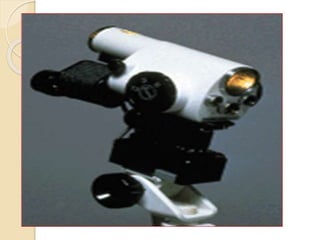
 Binocular microscopy for direct visualization of
the cervix with magnification up to 60 times.
 For common clinical practice magnification of
13.5 is used.
 Some are equipped with camera for
photographic recording.
 Colposcopy is useful for
1,patiens with abnormal pap smear.
2,dietylstelbestrol exposed babies
 Colposcopy helps visualize cellular dysplasia
and vascular abnormalities and take biopsy.
 Colposcopy has decreased the need for cone
biopsy of the cervix which carries higher
morbidity and mortality.
Introduction cont’d
 Objective - To confirm or rule out invasive cancer
in patients with abnormal smear
 Indications
1. Abnormal Pap smear or HPV testing
2. Pap smear with repeated unexplained inflammation
3. Abnormal appearing cervix
4. Unexplained intermenstrual or post coital bleeding
5. Vulvar or vaginal neoplasia
6. In utero DES exposure
7. Sexual assault victims
8. Therapeutic applications
 Contraindication
Acute cervicitis !
3.Uterine sound.
• Malleable graduated metallic uterine
sound.
• To confirm the position of the uterus.
• To measure utero-cervical canal length.
• To sound the uterine cavity in a case of
IUCD with missing threads.
• To differentiate a polyp from inversion.
• To act as a first dilator.
4.hysterosopy
 Fiber optic instrument for direct
visualization of endometrial cavity.
 For visualization the uterine cavity must
filled with saline ,dextran or carbon
dioxide insufflations.
 Sedation and Para cervical block is
usually needed.
• Application
1 evaluation of abnormal uterine bleeding
2 resection of uterine synchea or septum
3 removal of endometrial polyp
4 removal of IUCD
5 resection of submucose myoma
6 endometrial ablation
• Needs special training
 Complication
1 perforation
2 bleeding
3 infection
4.Hysterosalphngography
 Institution of contrast media through the cervix
to visualize the endometrial cavity and fallopian
tube.
 Dye is followed by fluoroscopy
 Used to diagnose tubal blockage
 It also helps to diagnose abnormalities of the
uterus
1.Congenital malformation
2. sub mucosa myoma
3. Endometrial polyp
4. Endometrial synchea
 Indications' are-
investigation of infertility to note tubal
patency or following tuboplasty,
recurrent mid trimester abortions to detect
uterine malformations,
to diagnose cervical incompetence,
to diagnose uterine synechia,
to confirm the diagnosis of secondary
abdominal pregnancy.
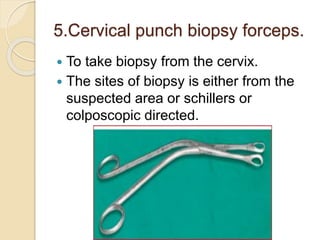
5.Cervical punch biopsy forceps.
 To take biopsy from the cervix.
 The sites of biopsy is either from the
suspected area or schillers or
colposcopic directed.
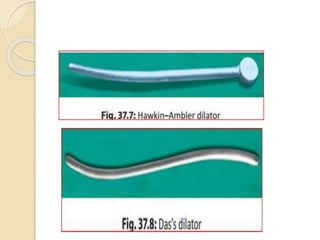
6.Cervical dilators.
 Hawkin-Ambler-16 sets starting from 3
and ends with 18
 Hegars-there are 12 sets (1-2mm to
12mm).
 Uses-
◦ To dilate the cervix to drain hematometra,
pyometra--.
◦ To confirm patency of cervical canal after
amputation.
7.Uterine curette
 Types-
• sharp at one end,
• blunt at the other,
• sharp or blunt at both ends,
• flushing curette,
• Sharman's curette.
 Uses.
◦ work up of infertility,
◦ DUB,
◦ endometrites,
◦ suspected ca,
◦ D&C,E&C.
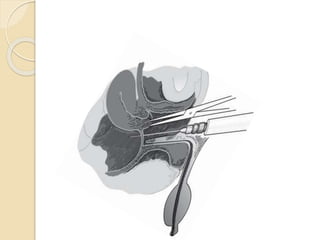
8.Culdocentesis.
• Definition-transvaginal aspiration of
peritoneal fluid from the cul-de-sac or pouch
of douglas.
• Indication-suspected ruptured ectopic preg,
pelvic abscess.
• Steps-done under sedation,pt in dorso
lithtomy position,vagina cleaned with
bethadine, vaginal speculum inserted,
posterior lip of cervix held with Allis
forceps,18 guage spinal needle fitted with
syringe is inserted 1cm below cervico -
vaginal junction in posterior fornix, after 2cm
insertion suction is applied.
• Interpretation-positive, negative, inconclusive.
9.Laparascopy.
• Visualization of peritoneal cavity by means
of fiber optic endoscope introduced through
abdominal wall.
• Indications:
• 1 –diagnostic=infertility,CPP,pelvic mass,to
diagnos acute pelvic
lesion,amenorrhea,mulleria
abnormalities,uterine perforation.
• 2-therapuetic=tubal
ligation,adhesiolysis,ovarian
bx,salpingostomy,salpingectomy salpingo-
oophorectomy…..
Indications
Diagnosis
1. Pelvic mass differentiation Eg. Ectopic,myoma
2. Pelvic pain causes Eg. Adhesion, endometriosis
twisted ovarian cyst, ectopic
Disorders of the liver---Cirrhosis ,hepatoma
3. Genital anomalies Eg .Ovarian dysgenesis
4. Secondary amenorrhea Eg. Polycystic ovarian
syndrome
5. Pelvic injury assessment.
6. Staging of Hodgkin's disease
7. Diagnosis of occult cancer.
Evaluation
 Infertility_ tubal pattency ,ovarian biopsy
 Second look often tubal surgery or
treatment of endometriosis
 Assessment of pelvic & abdominal trauma
 Evaluation of uterine perforation
 Peritoneal washing for cytology
Therapy
 Tuba sterilization –electrical, mechanical Eg.
Siliastic bands.
 Adhesolysis
 Fulguration of endometriosis using laser
 Aspiration of small ovarian cyst
 Removal of extruded IUCD in to peritoneal
cavity
 Utero sacral ligament division denervation
 Treatment of ectopic pregnancy
Therapy continued……
 Ova collection for IVF-ET
 GIFT ( gamet intra fallopian transfer )
 Mini wedge resection of ovary
 Biopsy of tumors
 Oophorectomy
 Ovarian cystectomy
 Lysis of adhesions
Contraindications
 Absolute ---Intestinal obstruction
---Generalized peritonitis.
 Relative ---Sever cardio pulmonary
disorder
--- Previous periumblical
surgery
---Shock
---Cancer involving anterior
abdominal wall.
Complications
 For tubal sterilization 1.6/1000 procedures
 For diagnostic laparoscopy 3.1/1000
procedures
 Complications include
1. Pain –chest or shoulder due to an absorbed
gas
2. Bleeding – small arteries and veins
,echmosis of the skin, injury to big vessels
3. Puncture injury to the bowel and stomach
Complications continued
4.Misplacement of gas into rectus sheath
5. Thermal injury – when cauterry is used
6. Vague unexplained lower abdominal pain
or discomfort
10.Salpingoscopy,falloposcopy
 Through laparoscope –abdominal-ostium
of the uterine tube for IVF
selection.salpingoscopy.
 To study entire length of tubal lumen
through the uterine cavity using
hysteroscope,falloposcopy.

11.Ultrasound.
 Common diagnostic modality in gynecology.
 Trans abdominal(2.5-3.5MHZ) or trans
vaginal(5- 8MHZ).
 Uses-
◦ infertility workup,
◦ correct timing of ovulation, guide for oocyte
retrieval,
◦ ectopic pregnancy,
◦ pelvic mass,
◦ endometrial diseases.
 Obstetrics' ultrasound.-------.
Indication for obstetric ultrasound
 Estimation of gestational age
 Evaluation of fetal growth
 Vaginal bleeding
 Determination of fetal presentation
 Suspected multiple pregnancy
 Adjunct to amniocentesis
 Discrepancy b/n GA by date fundal height
Indications continued
 Pelvic mass
 Suspected molar pregnancy
 Suspected ectopic pregnancy
 Suspected IUFD
 Suspected uterine anomalies
 IUCD localization
 Biophysical evaluation of fetal well being
 Assessment of amniotic fluid
Obs indications continued
 Adjunct to external cephalic version
 Estimation of fetal weight
 Abnormal serum alpha feto protein value
 Placental evaluation –localization, grading for
maturity.
 Screening for congenital anomalies-anencephaly
 Adjunct to Percutaneous umbilical blood
sampling
 Adjunct to intrauterine transfusion.
Gynecologic indication
 Pelvic pain including dysmenorrheal
 Pelvic mass
 Abnormal vaginal bleeding
 Amenorrhea, Infertility
 Confirm presence & check position of IUCD
 Diffuse abdominal pain
 Genital tract developmental abnormality
 Urinary or bladder symptoms
 Follicular monitoring in investigation of
infertility.
Computed tomography (CT scan).
11.
 Provides high resolution two di-mentional
images.
 Most useful in the diagnosis of lymph node
metastasis, depth of myometrial invasion.
 Cerebral metastasis of chorioca, micro adenoma
of pituitary.
 Has chance of surface radiation(2-10 CGY ).
 Locating pelvic absesses.pelvic
thrombophlebites,myometrial invasions by
endometrial ca.
12.Magnetic resonance imaging(MRI).
 Cross-sectional images of the body using combination of radio-
waves and magnetic fields.
 MRI is superior to CT in gynecology in delineation of pelvic organs
in multiple planes.
 Uses none ionized radiation no harm-full effect on body
 Excellent to diagnose congenital malformations of genital tract,f etal
congenital mal-formationes and morbid placental adherences.

THANK YOU !!!!
2/8/2024 ytbark T. 38

Diagnostic tools in OB-GYN.pptx

  • 1.
    Diagnostic tools inobstetrics and gynecology By. Ytbarek T. OB-GYN Dept
  • 2.
    List of tools. •Speculum. • Colposcopy. • Uterine sound. • Cervical punch biopsy forceps. • Cervical dilators. • Endometrial curettes. • Culdo-centesis. • Laparoscopy. • Hysteroscopy. • Hysterography and sonohysterography. • Computed tomography. • Magnetic resonance imaging. • Ultrasonography. • LEEP
  • 3.
    1. speculum • Typesare- Sims,Cuscos,Graves,Pederson,Auvards,Huffman,nasal speculum largeotoscope…. • Commonly used in OPD. • Uses Vaginal operations-D&C,E&C,D&E colporaphy,vaginal hysterectomy. To visualize the cervix, VVF,RVF,punch biopsy, surface cauterization To collect materials from vaginal pool for exfoliative cytology, gram stain and culture. To insert or to remove IUCD or to check the threads.
  • 5.
    2.colposcopy  Binocular microscopyfor direct visualization of the cervix with magnification up to 60 times.  For common clinical practice magnification of 13.5 is used.  Some are equipped with camera for photographic recording.  Colposcopy is useful for 1,patiens with abnormal pap smear. 2,dietylstelbestrol exposed babies
  • 6.
     Colposcopy helpsvisualize cellular dysplasia and vascular abnormalities and take biopsy.  Colposcopy has decreased the need for cone biopsy of the cervix which carries higher morbidity and mortality.
  • 7.
    Introduction cont’d  Objective- To confirm or rule out invasive cancer in patients with abnormal smear  Indications 1. Abnormal Pap smear or HPV testing 2. Pap smear with repeated unexplained inflammation 3. Abnormal appearing cervix 4. Unexplained intermenstrual or post coital bleeding 5. Vulvar or vaginal neoplasia 6. In utero DES exposure 7. Sexual assault victims 8. Therapeutic applications  Contraindication Acute cervicitis !
  • 9.
    3.Uterine sound. • Malleablegraduated metallic uterine sound. • To confirm the position of the uterus. • To measure utero-cervical canal length. • To sound the uterine cavity in a case of IUCD with missing threads. • To differentiate a polyp from inversion. • To act as a first dilator.

  • 10.
    4.hysterosopy  Fiber opticinstrument for direct visualization of endometrial cavity.  For visualization the uterine cavity must filled with saline ,dextran or carbon dioxide insufflations.  Sedation and Para cervical block is usually needed.
  • 11.
    • Application 1 evaluationof abnormal uterine bleeding 2 resection of uterine synchea or septum 3 removal of endometrial polyp 4 removal of IUCD 5 resection of submucose myoma 6 endometrial ablation • Needs special training
  • 12.
  • 13.
    4.Hysterosalphngography  Institution ofcontrast media through the cervix to visualize the endometrial cavity and fallopian tube.  Dye is followed by fluoroscopy  Used to diagnose tubal blockage  It also helps to diagnose abnormalities of the uterus 1.Congenital malformation 2. sub mucosa myoma 3. Endometrial polyp 4. Endometrial synchea
  • 14.
     Indications' are- investigationof infertility to note tubal patency or following tuboplasty, recurrent mid trimester abortions to detect uterine malformations, to diagnose cervical incompetence, to diagnose uterine synechia, to confirm the diagnosis of secondary abdominal pregnancy.
  • 15.
    5.Cervical punch biopsyforceps.  To take biopsy from the cervix.  The sites of biopsy is either from the suspected area or schillers or colposcopic directed.
  • 16.
    6.Cervical dilators.  Hawkin-Ambler-16sets starting from 3 and ends with 18  Hegars-there are 12 sets (1-2mm to 12mm).  Uses- ◦ To dilate the cervix to drain hematometra, pyometra--. ◦ To confirm patency of cervical canal after amputation.
  • 18.
    7.Uterine curette  Types- •sharp at one end, • blunt at the other, • sharp or blunt at both ends, • flushing curette, • Sharman's curette.  Uses. ◦ work up of infertility, ◦ DUB, ◦ endometrites, ◦ suspected ca, ◦ D&C,E&C.
  • 20.
    8.Culdocentesis. • Definition-transvaginal aspirationof peritoneal fluid from the cul-de-sac or pouch of douglas. • Indication-suspected ruptured ectopic preg, pelvic abscess. • Steps-done under sedation,pt in dorso lithtomy position,vagina cleaned with bethadine, vaginal speculum inserted, posterior lip of cervix held with Allis forceps,18 guage spinal needle fitted with syringe is inserted 1cm below cervico - vaginal junction in posterior fornix, after 2cm insertion suction is applied. • Interpretation-positive, negative, inconclusive.
  • 22.
    9.Laparascopy. • Visualization ofperitoneal cavity by means of fiber optic endoscope introduced through abdominal wall. • Indications: • 1 –diagnostic=infertility,CPP,pelvic mass,to diagnos acute pelvic lesion,amenorrhea,mulleria abnormalities,uterine perforation. • 2-therapuetic=tubal ligation,adhesiolysis,ovarian bx,salpingostomy,salpingectomy salpingo- oophorectomy…..
  • 23.
    Indications Diagnosis 1. Pelvic massdifferentiation Eg. Ectopic,myoma 2. Pelvic pain causes Eg. Adhesion, endometriosis twisted ovarian cyst, ectopic Disorders of the liver---Cirrhosis ,hepatoma 3. Genital anomalies Eg .Ovarian dysgenesis 4. Secondary amenorrhea Eg. Polycystic ovarian syndrome 5. Pelvic injury assessment. 6. Staging of Hodgkin's disease 7. Diagnosis of occult cancer.
  • 24.
    Evaluation  Infertility_ tubalpattency ,ovarian biopsy  Second look often tubal surgery or treatment of endometriosis  Assessment of pelvic & abdominal trauma  Evaluation of uterine perforation  Peritoneal washing for cytology
  • 25.
    Therapy  Tuba sterilization–electrical, mechanical Eg. Siliastic bands.  Adhesolysis  Fulguration of endometriosis using laser  Aspiration of small ovarian cyst  Removal of extruded IUCD in to peritoneal cavity  Utero sacral ligament division denervation  Treatment of ectopic pregnancy
  • 26.
    Therapy continued……  Ovacollection for IVF-ET  GIFT ( gamet intra fallopian transfer )  Mini wedge resection of ovary  Biopsy of tumors  Oophorectomy  Ovarian cystectomy  Lysis of adhesions
  • 27.
    Contraindications  Absolute ---Intestinalobstruction ---Generalized peritonitis.  Relative ---Sever cardio pulmonary disorder --- Previous periumblical surgery ---Shock ---Cancer involving anterior abdominal wall.
  • 28.
    Complications  For tubalsterilization 1.6/1000 procedures  For diagnostic laparoscopy 3.1/1000 procedures  Complications include 1. Pain –chest or shoulder due to an absorbed gas 2. Bleeding – small arteries and veins ,echmosis of the skin, injury to big vessels 3. Puncture injury to the bowel and stomach
  • 29.
    Complications continued 4.Misplacement ofgas into rectus sheath 5. Thermal injury – when cauterry is used 6. Vague unexplained lower abdominal pain or discomfort
  • 30.
    10.Salpingoscopy,falloposcopy  Through laparoscope–abdominal-ostium of the uterine tube for IVF selection.salpingoscopy.  To study entire length of tubal lumen through the uterine cavity using hysteroscope,falloposcopy. 
  • 31.
    11.Ultrasound.  Common diagnosticmodality in gynecology.  Trans abdominal(2.5-3.5MHZ) or trans vaginal(5- 8MHZ).  Uses- ◦ infertility workup, ◦ correct timing of ovulation, guide for oocyte retrieval, ◦ ectopic pregnancy, ◦ pelvic mass, ◦ endometrial diseases.  Obstetrics' ultrasound.-------.
  • 32.
    Indication for obstetricultrasound  Estimation of gestational age  Evaluation of fetal growth  Vaginal bleeding  Determination of fetal presentation  Suspected multiple pregnancy  Adjunct to amniocentesis  Discrepancy b/n GA by date fundal height
  • 33.
    Indications continued  Pelvicmass  Suspected molar pregnancy  Suspected ectopic pregnancy  Suspected IUFD  Suspected uterine anomalies  IUCD localization  Biophysical evaluation of fetal well being  Assessment of amniotic fluid
  • 34.
    Obs indications continued Adjunct to external cephalic version  Estimation of fetal weight  Abnormal serum alpha feto protein value  Placental evaluation –localization, grading for maturity.  Screening for congenital anomalies-anencephaly  Adjunct to Percutaneous umbilical blood sampling  Adjunct to intrauterine transfusion.
  • 35.
    Gynecologic indication  Pelvicpain including dysmenorrheal  Pelvic mass  Abnormal vaginal bleeding  Amenorrhea, Infertility  Confirm presence & check position of IUCD  Diffuse abdominal pain  Genital tract developmental abnormality  Urinary or bladder symptoms  Follicular monitoring in investigation of infertility.
  • 36.
    Computed tomography (CTscan). 11.  Provides high resolution two di-mentional images.  Most useful in the diagnosis of lymph node metastasis, depth of myometrial invasion.  Cerebral metastasis of chorioca, micro adenoma of pituitary.  Has chance of surface radiation(2-10 CGY ).  Locating pelvic absesses.pelvic thrombophlebites,myometrial invasions by endometrial ca.
  • 37.
    12.Magnetic resonance imaging(MRI). Cross-sectional images of the body using combination of radio- waves and magnetic fields.  MRI is superior to CT in gynecology in delineation of pelvic organs in multiple planes.  Uses none ionized radiation no harm-full effect on body  Excellent to diagnose congenital malformations of genital tract,f etal congenital mal-formationes and morbid placental adherences. 
  • 38.