Hypoxia
By
(Dr. Taher F T Elshami)
2016
Matric number:
G1515929
Outline
 Definition of hypoxia
 Causes of Hypoxia
 Effects of Hypoxia
 Types of Hypoxia
 Hypercapnia
 Oxygen therapy
 HYPOXIA: A condition in which the oxygen available is
inadequate at the tissue level
 A pathological condition in which the body as a whole
(generalized hypoxia) or a region of the body
(regional hypoxia) is deprived of adequate oxygen
supply
Causes of Hypoxia
 Inadequate oxygenation
-Deficiency of oxygen in atmosphere
- Hypoventilation (neuromuscular disorders)
 Venous-to-arterial shunts (right-left cardiac shunts)
- Eisenmenger's syndrome
 Pulmonary disease
- Hypoventilation due to increased airway resistance or decreased
compliance
- Abnormal VA/Q ratio
- Diminished respiratory membrane diffusion
 Inadequate oxygen transport to tissues
- Anaemia or abnormal Hb
- General circulatory deficiency
- Localized circulatory deficiency
- Tissue oedema
 Inadequate tissue capability of using oxygen
- Poisoning of cellular oxidation enzymes
- Diminished cellular metabolic capacity for using oxygen, because of toxicity,
vitamin deficiency or other factors
Effects of Hypoxia on body
• Hypoxia, if severe
- can cause death of cells throughout the body
• In less severe degrees
- Depressed mental activity, sometimes results in coma
- Reduced work capacity of muscles
Types of Hypoxia
1. Atmospheric Hypoxia (Hypoxic Hypoxia)
2. Hypoventilation Hypoxia
3. Anemic Hypoxia
4. Circulatory or ischemic Hypoxia
5. Histotoxic or cytotoxic Hypoxia
Atmospheric Hypoxia (Hypoxic Hypoxia)
 • An insufficient O2 supply reaches the blood
 • Due to:
- Decreased atmospheric PO2 at high altitudes
- Reduced alveolar ventilation like Chronic obstructive pulmonary disease
(COPD)
- Impaired alveolar gas exchange
 The PaO2 will be lower in all cases, but the PCO2 may or may
not be increased.
 Treatment: Compensatory actions to reduce inequalities,
supplemental oxygen
Hypoventilation Hypoxia
 A reduced amount of air enters the alveoli in your lungs,
resulting in hypoxia and hypercapnia
 COPD
 Scoliosis, nasal septum deformation
 Weakened respiratory muscles - motor neurone disease
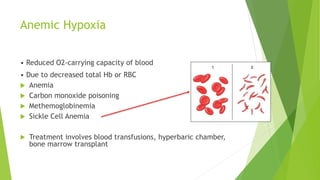
Anemic Hypoxia
• Reduced O2-carrying capacity of blood
• Due to decreased total Hb or RBC
 Anemia
 Carbon monoxide poisoning
 Methemoglobinemia
 Sickle Cell Anemia
 Treatment involves blood transfusions, hyperbaric chamber,
bone marrow transplant
Circulatory or ischemic Hypoxia
 Insufficient O2 reaches the tissue due to reduced blood flow
 Systemic or local
 A decrease in cardiac output results in a low BP and a prolonged
systemic transit time
 The PaO2 can be high, but because of the time it takes to get
to the tissues, the patient is hypoxic
 Cardiovascular instability or failure
 Shock
 Arrhythmias
 Treatment include increasing cardiac output with use of
cardiovascular drugs and therapy, supplemental oxygen
Histotoxic or cytotoxic Hypoxia
 Impaired utilization of O2 by the tissues despite a sufficient
supply of O2 in the mitochondria
 Cyanide Poisoning will inhibit cellular metabolism from
occuring; the cells can not process the O2
 Treatment: Reversal of poisoning, supplemental oxygen and/or
ventilation
 In some disease states the body requires a slight increase in
metabolism (i.e. – wound healing requires 5% increase)
 Extensive burns and some cancers will cause large increases
metabolism to the point that supplemental O2 is required
 Treatment: Supplemental O2.
Hypercapnia
 Excess carbon dioxide (CO2) in the body (> 45 mm Hg in blood)
 Associated with hypoxia
- Hypoventilation
- Circulatory deficiency
 Hypoxia caused by reduced availability of O2
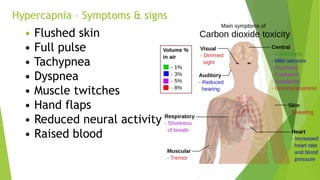
• Flushed skin
• Full pulse
• Tachypnea
• Dyspnea
• Muscle twitches
• Hand flaps
• Reduced neural activity
• Raised blood
Hypercapnia – Symptoms & signs
Raised PCO2
 • 60 to 75 mm Hg – air hunger (rapidly & deeply)
- Dyspnea
 • 80 to 100 mm Hg – lethargic & semicomatose
 • 120 to 150 mm Hg – anesthesia and death
Oxygen therapy
Goals of oxygen therapy:
1. Correcting Hypoxemia
By raising Alveolar and Blood levels of
Oxygen
Easiest objective to attain and measure
2. Decreasing symptoms of Hypoxemia
Supplemental O2 can help relieve symptoms
of hypoxia
Lessen dyspnoea/work of breathing
Improve mental function
3. Minimizing Cardiopulmonary workload
 Cardiopulmonary system will compensate for
Hypoxemia by:
 Increasing ventilation to get more O2 in the lungs and to the
Blood
 Increased work of breathing
 Increasing Cardiac Output to get more oxygenated blood to
tissues
 Hard on the heart, especially if diseased
 Hypoxia causes Pulmonary vasoconstritcion and
Pulmonary Hypertension
 These cause an increased workload on the right side of heart
 Over time the right heart will become more muscular and
then eventually fail (Cor Pulmonale)
 Supplemental O2 can relieve hypoxemia and relieve pulmonary
vasoconstriction and Hypertension, reducing right ventricular
workload!!
 At our institution, minimal acceptable saturation for post
surgical patients who are cared for in non critical setup is 92%
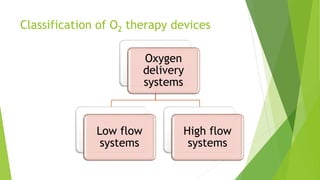
Classification of O2 therapy devices
Oxygen
delivery
systems
Low flow
systems
High flow
systems
Low flow O2 delivery system
 Flow does not meet inspiratory demand
 Oxygen is diluted with air on inspiration
 These devices have limited reservoir to store oxygen and are
unable to deliver consistent inspired oxygen concentrations in
settings of varying respiratory rates & tidal volumes.
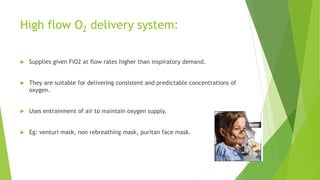
High flow O2 delivery system:
 Supplies given FiO2 at flow rates higher than inspiratory demand.
 They are suitable for delivering consistent and predictable concentrations of
oxygen.
 Uses entrainment of air to maintain oxygen supply.
 Eg: venturi mask, non rebreathing mask, puritan face mask.
Indications for O2 therapy:
 Arterial PO2 < 60 mmHg or SaO2 < 90%
 Cardiac & respiratory arrest
 Respiratory failure
 Cardiac failure or myocardial infarction
 Shock of any cause
 Increased metabolic demands (eg. Burns, multiple injuries,
severe sepsis)
 Post operative state
 Carbon monoxide poisoning.
Precautions and Hazards
 O2 Toxicity
Primarily affects Lungs and CNS
2 determining factors of O2 toxicity
PO2
Time of exposure
i.e., higher the PO2 and exposure time the greater
the toxicity.
CNS effects occur with Hyperbaric Pressures
Pulmonary effects can occur clinical PO2 levels
Patchy infiltrates on x-ray, prominent in lower lung
fields
Major alveolar injury
Pathophysiology
High PO2 damages capillary endothelium
Followed by interstitial edema and AC
membrane thickening
Type I cells are destroyed (cells that create
new lung tissue, gas exchange cells)
Type II cells proliferate (trigger inflamatory
response)
Exudative phase
Alveolar fluid buildup (from inflamatory
response) leads to
low ventilation/perfusion ratio (shunting)
hypoxemia
Hyaline membranes form alveolar level
Proteinaceous eosinophilic (basic)
material
Composed of cellular debris and
condensed plasma proteins.
Pulmonary fibrosis develop
Pulmonary Hypertension develops
Treatment:
Try to keep patient alive while reducing FiO2
Cause:
Overproduction of O2 free radicals
By products of cellular metabolism
Toxic in excessive amounts
Normally antioxidants and other special enzymes
dispose of excess free radicals
Neutrophils (WBC’s) and macrophages flood the
infiltrate the tissue and mediate inflammation
response, leading to more free radicals
References
 Ganong, W. F. (2005) Singapore .The MacGrow-Hill Companies, Inc
 Sherwood, L. (2015). Human physiology: from cells to systems. Cengage
learning.
 Patel, D. N., Goel, A., Agarwal, S., Garg, P., & Lakhani, K. K. (2003). Oxygen
Toxicity. JIACM, 4(3), 234–7.
 COLLEGE OF RESPIRATORY THERAPISTS OF ONTARIO C L I N I C A L B E S T P R A
C T I C E G U I D E L I N E O x y g e n T h e r a p y Oxygen Therapy Clinical Best
Practice Guideline. (2013).
hypoxia.pptx

hypoxia.pptx

  • 1.
    Hypoxia By (Dr. Taher FT Elshami) 2016 Matric number: G1515929
  • 2.
    Outline  Definition ofhypoxia  Causes of Hypoxia  Effects of Hypoxia  Types of Hypoxia  Hypercapnia  Oxygen therapy
  • 3.
     HYPOXIA: Acondition in which the oxygen available is inadequate at the tissue level  A pathological condition in which the body as a whole (generalized hypoxia) or a region of the body (regional hypoxia) is deprived of adequate oxygen supply
  • 4.
    Causes of Hypoxia Inadequate oxygenation -Deficiency of oxygen in atmosphere - Hypoventilation (neuromuscular disorders)  Venous-to-arterial shunts (right-left cardiac shunts) - Eisenmenger's syndrome  Pulmonary disease - Hypoventilation due to increased airway resistance or decreased compliance - Abnormal VA/Q ratio - Diminished respiratory membrane diffusion
  • 5.
     Inadequate oxygentransport to tissues - Anaemia or abnormal Hb - General circulatory deficiency - Localized circulatory deficiency - Tissue oedema  Inadequate tissue capability of using oxygen - Poisoning of cellular oxidation enzymes - Diminished cellular metabolic capacity for using oxygen, because of toxicity, vitamin deficiency or other factors
  • 6.
    Effects of Hypoxiaon body • Hypoxia, if severe - can cause death of cells throughout the body • In less severe degrees - Depressed mental activity, sometimes results in coma - Reduced work capacity of muscles
  • 7.
    Types of Hypoxia 1.Atmospheric Hypoxia (Hypoxic Hypoxia) 2. Hypoventilation Hypoxia 3. Anemic Hypoxia 4. Circulatory or ischemic Hypoxia 5. Histotoxic or cytotoxic Hypoxia
  • 8.
    Atmospheric Hypoxia (HypoxicHypoxia)  • An insufficient O2 supply reaches the blood  • Due to: - Decreased atmospheric PO2 at high altitudes - Reduced alveolar ventilation like Chronic obstructive pulmonary disease (COPD) - Impaired alveolar gas exchange  The PaO2 will be lower in all cases, but the PCO2 may or may not be increased.  Treatment: Compensatory actions to reduce inequalities, supplemental oxygen
  • 9.
    Hypoventilation Hypoxia  Areduced amount of air enters the alveoli in your lungs, resulting in hypoxia and hypercapnia  COPD  Scoliosis, nasal septum deformation  Weakened respiratory muscles - motor neurone disease
  • 10.
    Anemic Hypoxia • ReducedO2-carrying capacity of blood • Due to decreased total Hb or RBC  Anemia  Carbon monoxide poisoning  Methemoglobinemia  Sickle Cell Anemia  Treatment involves blood transfusions, hyperbaric chamber, bone marrow transplant
  • 11.
    Circulatory or ischemicHypoxia  Insufficient O2 reaches the tissue due to reduced blood flow  Systemic or local  A decrease in cardiac output results in a low BP and a prolonged systemic transit time  The PaO2 can be high, but because of the time it takes to get to the tissues, the patient is hypoxic  Cardiovascular instability or failure  Shock  Arrhythmias  Treatment include increasing cardiac output with use of cardiovascular drugs and therapy, supplemental oxygen
  • 12.
    Histotoxic or cytotoxicHypoxia  Impaired utilization of O2 by the tissues despite a sufficient supply of O2 in the mitochondria  Cyanide Poisoning will inhibit cellular metabolism from occuring; the cells can not process the O2  Treatment: Reversal of poisoning, supplemental oxygen and/or ventilation  In some disease states the body requires a slight increase in metabolism (i.e. – wound healing requires 5% increase)  Extensive burns and some cancers will cause large increases metabolism to the point that supplemental O2 is required  Treatment: Supplemental O2.
  • 13.
    Hypercapnia  Excess carbondioxide (CO2) in the body (> 45 mm Hg in blood)  Associated with hypoxia - Hypoventilation - Circulatory deficiency  Hypoxia caused by reduced availability of O2
  • 14.
    • Flushed skin •Full pulse • Tachypnea • Dyspnea • Muscle twitches • Hand flaps • Reduced neural activity • Raised blood Hypercapnia – Symptoms & signs
  • 15.
    Raised PCO2  •60 to 75 mm Hg – air hunger (rapidly & deeply) - Dyspnea  • 80 to 100 mm Hg – lethargic & semicomatose  • 120 to 150 mm Hg – anesthesia and death
  • 16.
    Oxygen therapy Goals ofoxygen therapy: 1. Correcting Hypoxemia By raising Alveolar and Blood levels of Oxygen Easiest objective to attain and measure 2. Decreasing symptoms of Hypoxemia Supplemental O2 can help relieve symptoms of hypoxia Lessen dyspnoea/work of breathing Improve mental function
  • 17.
    3. Minimizing Cardiopulmonaryworkload  Cardiopulmonary system will compensate for Hypoxemia by:  Increasing ventilation to get more O2 in the lungs and to the Blood  Increased work of breathing  Increasing Cardiac Output to get more oxygenated blood to tissues  Hard on the heart, especially if diseased  Hypoxia causes Pulmonary vasoconstritcion and Pulmonary Hypertension  These cause an increased workload on the right side of heart  Over time the right heart will become more muscular and then eventually fail (Cor Pulmonale)
  • 18.
     Supplemental O2can relieve hypoxemia and relieve pulmonary vasoconstriction and Hypertension, reducing right ventricular workload!!  At our institution, minimal acceptable saturation for post surgical patients who are cared for in non critical setup is 92%
  • 19.
    Classification of O2therapy devices Oxygen delivery systems Low flow systems High flow systems
  • 20.
    Low flow O2delivery system  Flow does not meet inspiratory demand  Oxygen is diluted with air on inspiration  These devices have limited reservoir to store oxygen and are unable to deliver consistent inspired oxygen concentrations in settings of varying respiratory rates & tidal volumes.
  • 21.
    High flow O2delivery system:  Supplies given FiO2 at flow rates higher than inspiratory demand.  They are suitable for delivering consistent and predictable concentrations of oxygen.  Uses entrainment of air to maintain oxygen supply.  Eg: venturi mask, non rebreathing mask, puritan face mask.
  • 22.
    Indications for O2therapy:  Arterial PO2 < 60 mmHg or SaO2 < 90%  Cardiac & respiratory arrest  Respiratory failure  Cardiac failure or myocardial infarction  Shock of any cause  Increased metabolic demands (eg. Burns, multiple injuries, severe sepsis)  Post operative state  Carbon monoxide poisoning.
  • 23.
    Precautions and Hazards O2 Toxicity Primarily affects Lungs and CNS 2 determining factors of O2 toxicity PO2 Time of exposure i.e., higher the PO2 and exposure time the greater the toxicity. CNS effects occur with Hyperbaric Pressures Pulmonary effects can occur clinical PO2 levels Patchy infiltrates on x-ray, prominent in lower lung fields Major alveolar injury
  • 24.
    Pathophysiology High PO2 damagescapillary endothelium Followed by interstitial edema and AC membrane thickening Type I cells are destroyed (cells that create new lung tissue, gas exchange cells) Type II cells proliferate (trigger inflamatory response)
  • 25.
    Exudative phase Alveolar fluidbuildup (from inflamatory response) leads to low ventilation/perfusion ratio (shunting) hypoxemia Hyaline membranes form alveolar level Proteinaceous eosinophilic (basic) material Composed of cellular debris and condensed plasma proteins. Pulmonary fibrosis develop Pulmonary Hypertension develops
  • 26.
    Treatment: Try to keeppatient alive while reducing FiO2 Cause: Overproduction of O2 free radicals By products of cellular metabolism Toxic in excessive amounts Normally antioxidants and other special enzymes dispose of excess free radicals Neutrophils (WBC’s) and macrophages flood the infiltrate the tissue and mediate inflammation response, leading to more free radicals
  • 27.
    References  Ganong, W.F. (2005) Singapore .The MacGrow-Hill Companies, Inc  Sherwood, L. (2015). Human physiology: from cells to systems. Cengage learning.  Patel, D. N., Goel, A., Agarwal, S., Garg, P., & Lakhani, K. K. (2003). Oxygen Toxicity. JIACM, 4(3), 234–7.  COLLEGE OF RESPIRATORY THERAPISTS OF ONTARIO C L I N I C A L B E S T P R A C T I C E G U I D E L I N E O x y g e n T h e r a p y Oxygen Therapy Clinical Best Practice Guideline. (2013).