OXYGEN
THERAPY
Presenter : Vinitha.A
• Definitionoftheoxygentherapy
• Typesofoxygen therapy
• purposesofusingtheoxygen therapy
• Administrationofoxygen therapy
• Complicationofoxygentherapy
 Hypoxia, condition of the body in which the
tissues are starved
of oxygen. In its extreme form, where oxygen is
entirely absent, the condition is called anoxia.
 There are four types of hypoxia:
 (1)Hypoxemic type, in which the oxygen
pressure in the blood going to the tissues is too
low to saturate the hemoglobin;
 (2)Anemic type, in which the amount of
functional hemoglobin is too small, and hence
the capacity of the blood to carry oxygen is too
low;
 3) Stagnant type, in which the blood is or may
be normal but the flow of blood to the tissues
is reduced or unevenly distributed; and
 (4)Histotoxic type, in which the tissue cells are
poisoned and are therefore unable to make
proper use of oxygen.
 Diseases of the blood, the heart and
circulation, and the lungs may all produce
some form of hypoxia.
⦁ The hypoxemic type of hypoxia is due to
one of two mechanisms:
⦁ (1) a decrease in the amount of breathable
oxygen—often encountered in pilots,
mountain climbers, and people living at
high altitudes —due to the reduced
barometric pressure (see altitude sickness),
or
(2) cardiopulmonary failure in which the
lungs are unable to efficiently transfer
oxygen from the alveoli to the blood.
⦁ In the case of anemic hypoxia, either the total
amount of hemoglobin is too small to supply
the body’s oxygen needs, as in anemia or
after severe bleeding, or hemoglobin that is
present is rendered nonfunctional.
⦁ Examples of the latter case are carbon
monoxide poisoning and metho-globinuria, in
both of which the hemoglobin is so altered
by toxic agents that it becomes unavailable
for oxygen transport, and thus of no
respiratory value.
• Stagnant hypoxia, in which blood flow
through the capillaries is insufficient to
supply the tissues, may be general or
local.
• If general, it may result from heart
disease that impairs the circulation,
impairment of veinous return of blood,
or trauma that induces shock.
• Local stagnant hypoxia may be due to
any condition that reduces or prevents
the circulation of the blood in any area
of the body.
⦁ In histotoxic hypoxia the cells of the body are
unable to use the oxygen, although the
amount in the blood may be normal and under
normal tension.
⦁ Although characteristically produced by
cyanide, any agent that decreases cellular
respiration may cause it.
⦁ Some of these agents are narcotics, alcohol,
formaldehyde, acetone, and certain anesthetic
agents.
⦁ Hypoxemia is an inadequate partial pressure
of oxygen in arterial blood.
• Hypoxemia has many causes,
often respiratory disorders, and can cause
tissue hypoxia as the blood is not supplying
enough oxygen to the body.
• Extreme hypoxia can be called anoxia,
extreme hypoxemia can be called anoxemia
⦁ Hypoxemia is usually defined in
terms of reduced partial pressure
of oxygen (mm Hg) in arterial
blood when the partial pressure of
oxygen in blood is less than 60 mm
Hg, then hemoglobin oxygen
saturation is less than 90%.
• Hypoxemia refers to low oxygen in the
blood, and the more general term hypoxia
is an abnormally low oxygen content in any
tissue or organ, or the body as a whole.
• Hypoxemia can cause hypoxia (hypoxemic
hypoxia), but hypoxia can also occur via
other mechanisms, such
as anemia.
• There are 5 phyiological causes of
⦁ HIGH ALTITUDE
⦁ DIFFUSION
⦁ HYPOVENTILATION
⦁ SHUNTING
⦁ VENTILATION-PERFUSION MISMATCH
⦁ Use of pulse oximeter for early detection
desaturation
⦁ Check a-b-c
⦁ Increase inspired oxygen saturation by 100%
⦁ Check the integrity of the breathing system by manual
ventilation of the lungs
⦁ Confirm the position and potency of the tube
⦁ Check bilateral chest movement and breathing sounds
⦁ Peep for gentle lung hyperinflation
⦁ Measure and stabilize core temperature
Purpose
Oxygen therapy isa key treatment
inrespiratory care.
Thepurpose istoincrease oxygen
saturationintissueswherethe
saturationlevels are too low
due to illnessor injury.
oxygen therapy isused to treat
Example incase :-
Documented hypoxemia
Severe respiratorydistress(acute asthma
or pneumonia)
Severe trauma
Chronic obstructive pulmonary disease
(COPD, including chronic bronchitis,
emphysema, and chronic asthma)
oxygen therapy isused to
treat
Pulmonary hypertension
Acute myocardial infarction (heart
attack)
Short-termtherapy, such as post-
anesthesia recovery
Oxygen may also be used totreat
chronic lung disease patientsduring
exercise .
Preparation
• A physician's order isrequired for
oxygen therapy, except inemergency
use.
• Clinical observations.
• indicated inArtialBlood
Gas measurements,(ABGs)
• Pulse oximetery
Cautions ForOxygen Therapy
• Oxygen toxicity – can
occur with FIO2 - 5
0
%
longer than48 hrs
• Danger of fire
• Infection
Classification of Oxygen Delivery
Systems
• Lowflowsystems
1.contribute partially toinspired gas client
breathes
• Ex:nasal cannula, simple mask , non-re
breather mask , Partialrebreather
mask
• High flow systems
• deliver specific and constant percent of
oxygen independent ofclient’s
breathing
• Ex:Venturimask,, trach collar, T-piece
:Methods of oxygen
administration
Nasal cannula- 1
Nasal cannula
I
tisa disposable.
plastic devise withtwoprotruding
prongsforinsertionintothenostrils,
connected toan oxygen source.
Used forlow-medium concentrations of
Oxygen (24-44%).
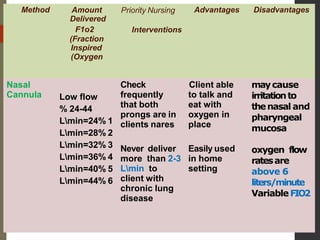
Method Amount
Delivered
F1o2
(Fraction
Inspired
(Oxygen
Priority Nursing
Interventions
Advantages Disadvantages
Nasal
Cannula Low flow
% 24-44
Lmin=24% 1
Lmin=28% 2
Lmin=32% 3
Lmin=36% 4
Lmin=40% 5
Lmin=44% 6
Check
frequently
that both
prongs are in
clients nares
Never deliver
more than 2-3
Lmin to
client with
chronic lung
disease
Client able
to talk and
eat with
oxygen in
place
Easily used
in home
setting
maycause
irritationto
thenasal and
pharyngeal
mucosa
oxygen flow
ratesare
above 6
liters/minute
Variable FIO2
Face mask
• The simple Oxygen mask
• Thepartial rebreathermask:
• Thenon rebreathermask:
• Theventurimask:
The simple Oxygen mask
Simplemask ismade of
clear, flexible , plastic or
rubberthatcan be molded
tofitthe face.
The simple Oxygen mask
It delivers 35% to 60% oxygen .
Aflow rate of 6 to 10 liters per minute.
Often it is used when an increased
delivery of oxygen is needed for short
periods
(i.e., less than 12 hours).
The partial rebreather mask
• Themask is witha reservoirbag must
remain inflated during both inspiration&
expiration
• I
tcollects partsof thepatients' exhaled
air.
• I
tisused todeliver oxygen concentrations
up to 8
0
%
.
Thepartial rebreather mask
• Theoxygen flowrate
mustbe maintained at
a minimumof 6L/min
to ensure thatthe
patient does not
rebreathe large
amountsofexhaled air.
• Theremaining
exhaled airexits
through vents.
T-piece
• Usedon end of
E
Ttube when
weaning from
ventilator
• Provides
accurate
FIO2
• Provides
good
humidity
Side effect &complication
of oxygen therapy
• Oxygen toxicity
• Retrolental fibroplasia
• Absorption atelectasis
oxygen toxicity
I
tisa condition inwhich ventilator failure
occurs due toinspiration of a high
concentration of oxygen fora
prolonged period of time.
Oxygen concentration greater than5
0
%
over 24to48hourscan cause
pathological changes inthe lungs.
:Signs and symptoms of
oxygen toxicity
. Non-productive cough
.Nausea and vomiting
.Substernal chest pain
.Fatigue
.Nasal stuffiness
.Headache
.Sore throat
.Hypoventilation
.Nasal congestion
.Dyspnea
.Inspiration pain
:Evaluation
• Breathingpatternregular and at
normal rate.
• pink color innail beds, lips, conjunctiva
of eyes.
• No confusion, disorientation, difficulty
withcognition.
• Arterialoxygen concentration
or hemoglobin
• Oxygen saturationwithinnormal limits.
:Documentation
• Date andtime oxygen started.
• Method of delivery.
• Oxygen concentration and
flow rate.
• Patient observation.
• Add oral&nasal care to the
nursing care plan
O2 DELIVERYDEVICES
EQUIPMENT FLOW FIO2 SPECIAL NOTES
NASAL CANNULA 1/2 - 6 L/M .24 – 44 6 L/M MAX.
SIMPLE O2 MASK
(WITHOUT BAG)
6 - 10 L/M .35 – 55 USE 5 L/M
MINIMUM
RESERVOIR MASK
(MASK WITH BAG)
10-15 L/M .60 -80 PAGE RT IF USED
(BAG TO NOT
COLLAPSE)
VENTI MASK 3 L/M
6 L/M
.24, 26, 31,
.35, .40, .50
READ ENCLOSED
INSTRUCTIONS
NEBULIZER 8 L/M OR > .28, .30, .35
.40, .50, 70
MIST MUST BE
VISIBLE
*** SHOWS THAT FIO2 VARIES WITH DIFFERENT
F, VT, INSPIRATORY FLOW RATES.
oxygen therapy.pptx

oxygen therapy.pptx

  • 1.
  • 2.
    • Definitionoftheoxygentherapy • Typesofoxygentherapy • purposesofusingtheoxygen therapy • Administrationofoxygen therapy • Complicationofoxygentherapy
  • 5.
     Hypoxia, conditionof the body in which the tissues are starved of oxygen. In its extreme form, where oxygen is entirely absent, the condition is called anoxia.  There are four types of hypoxia:  (1)Hypoxemic type, in which the oxygen pressure in the blood going to the tissues is too low to saturate the hemoglobin;  (2)Anemic type, in which the amount of functional hemoglobin is too small, and hence the capacity of the blood to carry oxygen is too low;
  • 6.
     3) Stagnanttype, in which the blood is or may be normal but the flow of blood to the tissues is reduced or unevenly distributed; and  (4)Histotoxic type, in which the tissue cells are poisoned and are therefore unable to make proper use of oxygen.  Diseases of the blood, the heart and circulation, and the lungs may all produce some form of hypoxia.
  • 7.
    ⦁ The hypoxemictype of hypoxia is due to one of two mechanisms: ⦁ (1) a decrease in the amount of breathable oxygen—often encountered in pilots, mountain climbers, and people living at high altitudes —due to the reduced barometric pressure (see altitude sickness), or (2) cardiopulmonary failure in which the lungs are unable to efficiently transfer oxygen from the alveoli to the blood.
  • 8.
    ⦁ In thecase of anemic hypoxia, either the total amount of hemoglobin is too small to supply the body’s oxygen needs, as in anemia or after severe bleeding, or hemoglobin that is present is rendered nonfunctional. ⦁ Examples of the latter case are carbon monoxide poisoning and metho-globinuria, in both of which the hemoglobin is so altered by toxic agents that it becomes unavailable for oxygen transport, and thus of no respiratory value.
  • 9.
    • Stagnant hypoxia,in which blood flow through the capillaries is insufficient to supply the tissues, may be general or local. • If general, it may result from heart disease that impairs the circulation, impairment of veinous return of blood, or trauma that induces shock. • Local stagnant hypoxia may be due to any condition that reduces or prevents the circulation of the blood in any area of the body.
  • 10.
    ⦁ In histotoxichypoxia the cells of the body are unable to use the oxygen, although the amount in the blood may be normal and under normal tension. ⦁ Although characteristically produced by cyanide, any agent that decreases cellular respiration may cause it. ⦁ Some of these agents are narcotics, alcohol, formaldehyde, acetone, and certain anesthetic agents.
  • 11.
    ⦁ Hypoxemia isan inadequate partial pressure of oxygen in arterial blood. • Hypoxemia has many causes, often respiratory disorders, and can cause tissue hypoxia as the blood is not supplying enough oxygen to the body. • Extreme hypoxia can be called anoxia, extreme hypoxemia can be called anoxemia
  • 12.
    ⦁ Hypoxemia isusually defined in terms of reduced partial pressure of oxygen (mm Hg) in arterial blood when the partial pressure of oxygen in blood is less than 60 mm Hg, then hemoglobin oxygen saturation is less than 90%.
  • 13.
    • Hypoxemia refersto low oxygen in the blood, and the more general term hypoxia is an abnormally low oxygen content in any tissue or organ, or the body as a whole. • Hypoxemia can cause hypoxia (hypoxemic hypoxia), but hypoxia can also occur via other mechanisms, such as anemia.
  • 14.
    • There are5 phyiological causes of ⦁ HIGH ALTITUDE ⦁ DIFFUSION ⦁ HYPOVENTILATION ⦁ SHUNTING ⦁ VENTILATION-PERFUSION MISMATCH
  • 16.
    ⦁ Use ofpulse oximeter for early detection desaturation ⦁ Check a-b-c ⦁ Increase inspired oxygen saturation by 100% ⦁ Check the integrity of the breathing system by manual ventilation of the lungs ⦁ Confirm the position and potency of the tube ⦁ Check bilateral chest movement and breathing sounds ⦁ Peep for gentle lung hyperinflation ⦁ Measure and stabilize core temperature
  • 17.
    Purpose Oxygen therapy isakey treatment inrespiratory care. Thepurpose istoincrease oxygen saturationintissueswherethe saturationlevels are too low due to illnessor injury.
  • 19.
    oxygen therapy isusedto treat Example incase :- Documented hypoxemia Severe respiratorydistress(acute asthma or pneumonia) Severe trauma Chronic obstructive pulmonary disease (COPD, including chronic bronchitis, emphysema, and chronic asthma)
  • 20.
    oxygen therapy isusedto treat Pulmonary hypertension Acute myocardial infarction (heart attack) Short-termtherapy, such as post- anesthesia recovery Oxygen may also be used totreat chronic lung disease patientsduring exercise .
  • 21.
    Preparation • A physician'sorder isrequired for oxygen therapy, except inemergency use. • Clinical observations. • indicated inArtialBlood Gas measurements,(ABGs) • Pulse oximetery
  • 23.
    Cautions ForOxygen Therapy •Oxygen toxicity – can occur with FIO2 - 5 0 % longer than48 hrs • Danger of fire • Infection
  • 26.
    Classification of OxygenDelivery Systems • Lowflowsystems 1.contribute partially toinspired gas client breathes • Ex:nasal cannula, simple mask , non-re breather mask , Partialrebreather mask • High flow systems • deliver specific and constant percent of oxygen independent ofclient’s breathing • Ex:Venturimask,, trach collar, T-piece
  • 27.
  • 28.
    Nasal cannula I tisa disposable. plasticdevise withtwoprotruding prongsforinsertionintothenostrils, connected toan oxygen source. Used forlow-medium concentrations of Oxygen (24-44%).
  • 29.
    Method Amount Delivered F1o2 (Fraction Inspired (Oxygen Priority Nursing Interventions AdvantagesDisadvantages Nasal Cannula Low flow % 24-44 Lmin=24% 1 Lmin=28% 2 Lmin=32% 3 Lmin=36% 4 Lmin=40% 5 Lmin=44% 6 Check frequently that both prongs are in clients nares Never deliver more than 2-3 Lmin to client with chronic lung disease Client able to talk and eat with oxygen in place Easily used in home setting maycause irritationto thenasal and pharyngeal mucosa oxygen flow ratesare above 6 liters/minute Variable FIO2
  • 31.
    Face mask • Thesimple Oxygen mask • Thepartial rebreathermask: • Thenon rebreathermask: • Theventurimask:
  • 32.
    The simple Oxygenmask Simplemask ismade of clear, flexible , plastic or rubberthatcan be molded tofitthe face.
  • 33.
    The simple Oxygenmask It delivers 35% to 60% oxygen . Aflow rate of 6 to 10 liters per minute. Often it is used when an increased delivery of oxygen is needed for short periods (i.e., less than 12 hours).
  • 35.
    The partial rebreathermask • Themask is witha reservoirbag must remain inflated during both inspiration& expiration • I tcollects partsof thepatients' exhaled air. • I tisused todeliver oxygen concentrations up to 8 0 % .
  • 36.
    Thepartial rebreather mask •Theoxygen flowrate mustbe maintained at a minimumof 6L/min to ensure thatthe patient does not rebreathe large amountsofexhaled air. • Theremaining exhaled airexits through vents.
  • 55.
    T-piece • Usedon endof E Ttube when weaning from ventilator • Provides accurate FIO2 • Provides good humidity
  • 57.
    Side effect &complication ofoxygen therapy • Oxygen toxicity • Retrolental fibroplasia • Absorption atelectasis
  • 58.
    oxygen toxicity I tisa conditioninwhich ventilator failure occurs due toinspiration of a high concentration of oxygen fora prolonged period of time. Oxygen concentration greater than5 0 % over 24to48hourscan cause pathological changes inthe lungs.
  • 59.
    :Signs and symptomsof oxygen toxicity . Non-productive cough .Nausea and vomiting .Substernal chest pain .Fatigue .Nasal stuffiness .Headache .Sore throat .Hypoventilation .Nasal congestion .Dyspnea .Inspiration pain
  • 65.
    :Evaluation • Breathingpatternregular andat normal rate. • pink color innail beds, lips, conjunctiva of eyes. • No confusion, disorientation, difficulty withcognition. • Arterialoxygen concentration or hemoglobin • Oxygen saturationwithinnormal limits.
  • 66.
    :Documentation • Date andtimeoxygen started. • Method of delivery. • Oxygen concentration and flow rate. • Patient observation. • Add oral&nasal care to the nursing care plan
  • 67.
    O2 DELIVERYDEVICES EQUIPMENT FLOWFIO2 SPECIAL NOTES NASAL CANNULA 1/2 - 6 L/M .24 – 44 6 L/M MAX. SIMPLE O2 MASK (WITHOUT BAG) 6 - 10 L/M .35 – 55 USE 5 L/M MINIMUM RESERVOIR MASK (MASK WITH BAG) 10-15 L/M .60 -80 PAGE RT IF USED (BAG TO NOT COLLAPSE) VENTI MASK 3 L/M 6 L/M .24, 26, 31, .35, .40, .50 READ ENCLOSED INSTRUCTIONS NEBULIZER 8 L/M OR > .28, .30, .35 .40, .50, 70 MIST MUST BE VISIBLE *** SHOWS THAT FIO2 VARIES WITH DIFFERENT F, VT, INSPIRATORY FLOW RATES.