UNIT XVI
ProfessIoNal NUrsINg
CoNCePTs aNd PraCTICes
 ToPIC: HealTH BelIef
ModelModel
BY:
Laishram Rushila Devi M.Sc (N)
Lecturer
Department of Medical and Surgical Nursing
Sri Satyalaxmi College of Nursing
Hyderabad
INTrodUCTIoN
 Health belief model (HBM) is a psychological
model that attempts to explain and predict health
behaviors. This is done by focusing on the
attitutes and beliefs of individuals. The HBM wasattitutes and beliefs of individuals. The HBM was
first developed in the 1950s by social
psychologists Hochbaum, Rosensock. It is one of
most widely used conceptual framework for
understanding health behavior. And it is also
based on motivational theory.
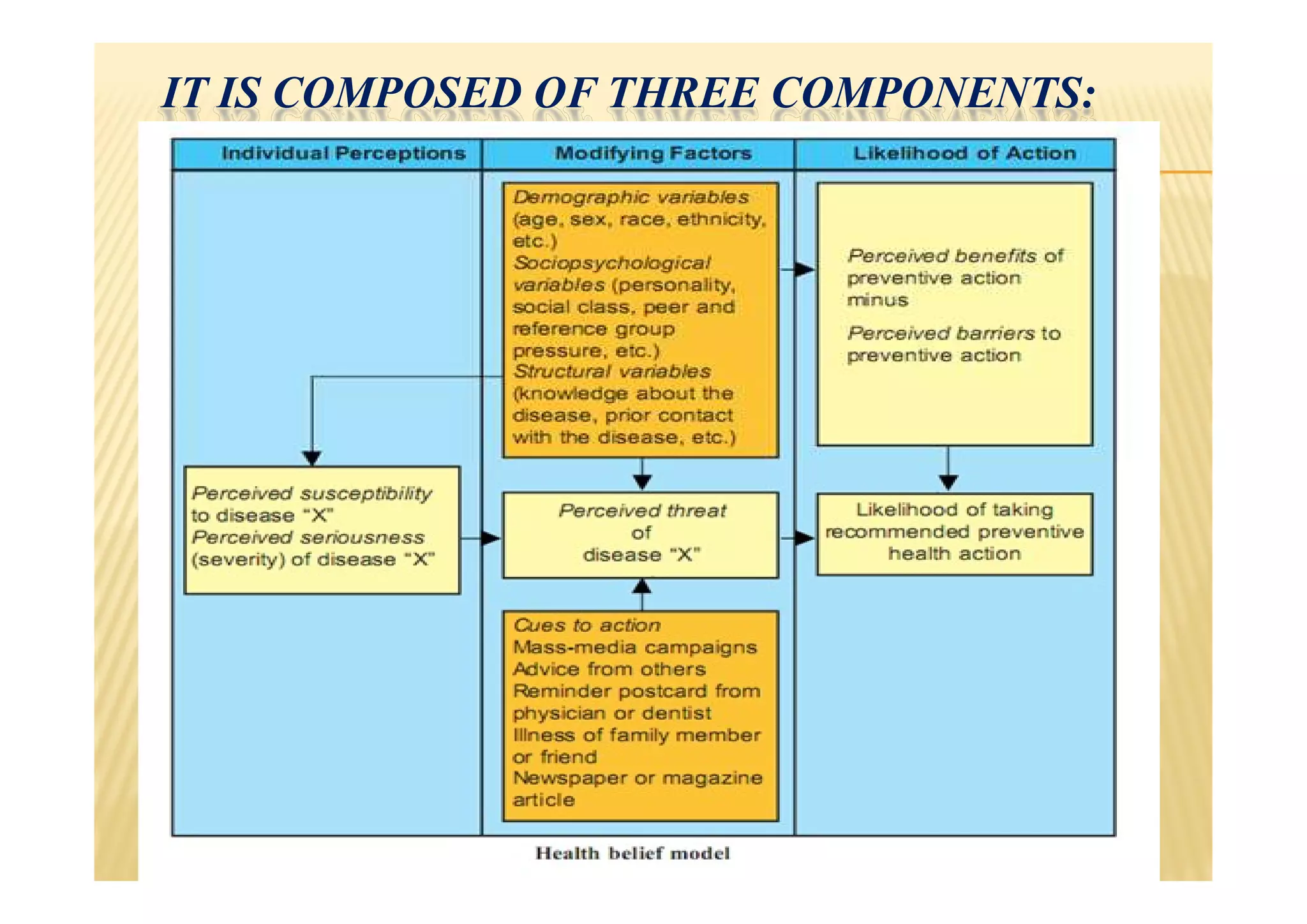
IT IS COMPOSED OF THREE COMPONENTS:
INdIVIdUal PerCePTIoNs
 Perceived susceptibility - A family history of a certain
disorder, such as diabetes or heart disease, may make the
individual feel at high risk.
 Perceived seriousness - In the perception of the individual,
does the illness cause death or has serious consequences? For
example - the spread of acquired immune deficiency syndrome
(AIDS) reflects the general public's perception of the(AIDS) reflects the general public's perception of the
seriousness of this illness.
 Perceived threat - perceived susceptibility and perceived
seriousness combine to determine the total perceived
threat of an illness to a specific individual. For example,
a person who perceives that many individuals in the
community have AIDS may not necessarily perceive acommunity have AIDS may not necessarily perceive a
threat of the disease; if the person is a drug addict or a
homosexual, however, the perceived threat of illness is
likely to increase because the susceptibility is combined
with seriousness.
ModIfyINg faCTors
 Demographic variables - Demographic variables include age,
sex, race, and ethnicity. For example, infant does not perceive
the importance of a healthy diet; an adolescent may perceive
peer approval as more important than family approval and as a
consequence may participate in hazardous activities or adopt
unhealthy eating and sleeping patterns.
 Sociopsychologic variables - Social pressure or influence from
peers or other reference groups (e.g., self-help or vocationalpeers or other reference groups (e.g., self-help or vocational
groups) may encourage preventive health behaviors even when
individual motivation is low. Expectations of others may
motivate people. For example, not to drive an automobile after
drinking alcohol.
 Structural variables - Knowledge about the target disease and
prior contact with it are structural variables that are presumed
to influence preventive behavior.
 Cues to action- Cues can be either internal or external.
 Internal cues include feelings of fatigue,
uncomfortable symptoms, or thoughts about the
condition of an ill person who is close.
 External cues are mass media campaigns, advice External cues are mass media campaigns, advice
from others, reminder postcard from a physician or
dentist, illness of family member or friend, newspaper
or magazine article.
lIkelIHood of aCTIoN
The likelihood of a person's taking recommended
preventive, health action depends on the
perceived benefits of the action minus the
perceived barriers to the action.
 Perceived benefits of the action - Examples
include refraining from smoking to preventinclude refraining from smoking to prevent
lung cancer, and eating nutritious foods and
avoiding snacks to maintain weight.
 Perceived barriers to action - Examples
include cost, inconvenience, unpleasantness,
and lifestyle changes.
role of NUrse
 Establish why the client is not following the regimen
 Demonstrate caring
 Encourage healthy behaviors through positive
reinforcementsreinforcements
 Use aids to reinforce teaching
 Establish a therapeutic relationship of freedom, mutual
understanding and mutual responsibility with the client
and support persons.

Health Belief Model

  • 1.
    UNIT XVI ProfessIoNal NUrsINg CoNCePTsaNd PraCTICes  ToPIC: HealTH BelIef ModelModel BY: Laishram Rushila Devi M.Sc (N) Lecturer Department of Medical and Surgical Nursing Sri Satyalaxmi College of Nursing Hyderabad
  • 2.
    INTrodUCTIoN  Health beliefmodel (HBM) is a psychological model that attempts to explain and predict health behaviors. This is done by focusing on the attitutes and beliefs of individuals. The HBM wasattitutes and beliefs of individuals. The HBM was first developed in the 1950s by social psychologists Hochbaum, Rosensock. It is one of most widely used conceptual framework for understanding health behavior. And it is also based on motivational theory.
  • 3.
    IT IS COMPOSEDOF THREE COMPONENTS:
  • 4.
    INdIVIdUal PerCePTIoNs  Perceivedsusceptibility - A family history of a certain disorder, such as diabetes or heart disease, may make the individual feel at high risk.  Perceived seriousness - In the perception of the individual, does the illness cause death or has serious consequences? For example - the spread of acquired immune deficiency syndrome (AIDS) reflects the general public's perception of the(AIDS) reflects the general public's perception of the seriousness of this illness.
  • 5.
     Perceived threat- perceived susceptibility and perceived seriousness combine to determine the total perceived threat of an illness to a specific individual. For example, a person who perceives that many individuals in the community have AIDS may not necessarily perceive acommunity have AIDS may not necessarily perceive a threat of the disease; if the person is a drug addict or a homosexual, however, the perceived threat of illness is likely to increase because the susceptibility is combined with seriousness.
  • 6.
    ModIfyINg faCTors  Demographicvariables - Demographic variables include age, sex, race, and ethnicity. For example, infant does not perceive the importance of a healthy diet; an adolescent may perceive peer approval as more important than family approval and as a consequence may participate in hazardous activities or adopt unhealthy eating and sleeping patterns.  Sociopsychologic variables - Social pressure or influence from peers or other reference groups (e.g., self-help or vocationalpeers or other reference groups (e.g., self-help or vocational groups) may encourage preventive health behaviors even when individual motivation is low. Expectations of others may motivate people. For example, not to drive an automobile after drinking alcohol.  Structural variables - Knowledge about the target disease and prior contact with it are structural variables that are presumed to influence preventive behavior.
  • 7.
     Cues toaction- Cues can be either internal or external.  Internal cues include feelings of fatigue, uncomfortable symptoms, or thoughts about the condition of an ill person who is close.  External cues are mass media campaigns, advice External cues are mass media campaigns, advice from others, reminder postcard from a physician or dentist, illness of family member or friend, newspaper or magazine article.
  • 8.
    lIkelIHood of aCTIoN Thelikelihood of a person's taking recommended preventive, health action depends on the perceived benefits of the action minus the perceived barriers to the action.  Perceived benefits of the action - Examples include refraining from smoking to preventinclude refraining from smoking to prevent lung cancer, and eating nutritious foods and avoiding snacks to maintain weight.  Perceived barriers to action - Examples include cost, inconvenience, unpleasantness, and lifestyle changes.
  • 9.
    role of NUrse Establish why the client is not following the regimen  Demonstrate caring  Encourage healthy behaviors through positive reinforcementsreinforcements  Use aids to reinforce teaching  Establish a therapeutic relationship of freedom, mutual understanding and mutual responsibility with the client and support persons.