

Hypothermia in newborn
Hypothermia
2
• It is defined as body temperature below 36.5
0c by axilla.
• Is a significant problem in neonates at birth
and beyond ( 15%)
• Cause of significant morbidity & mortality
• Mortality rate is twice in hypothermic babies
• Preventable
• Lack of professional alertness of healthcare
providers
■ Situations causing excessive heat loss
■ Poor ability to conserve
■ Poor metabolic heat production
Causes of hypothermia
3
■ cold environment,
■ wet or naked baby,
■ cold linen,
■ Inadequate coverage during transportation
■ procedures bath, blood sampling, infusion
Causes of hypothermia –
Situations causing excessive heat loss
4
Poor ability to conserve body heat —
 LBW,
■ IUGR
Poor metabolic heat production -deficiency
of brown fat,
■ Hypoxia
■ CNS damage,
■ hypoglycaemia,
■ sepsis*
Causes of hypothermia
5
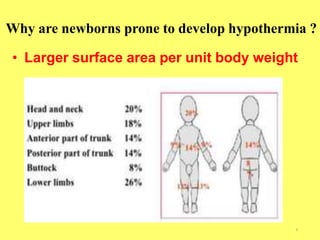
Why are newborns prone to develop hypothermia ?
6
• Larger surface area per unit body weight
Contd…
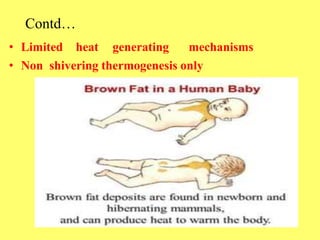
• Limited heat generating mechanisms
• Non shivering thermogenesis only
Contd…
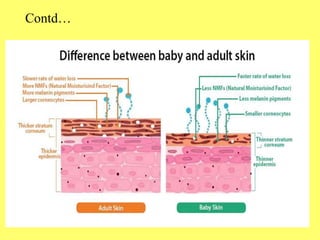
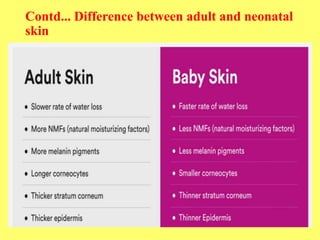
Contd... Difference between adult and neonatal
skin
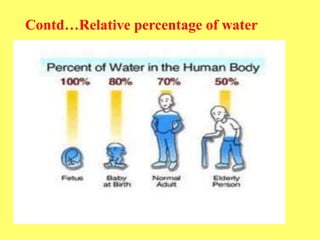
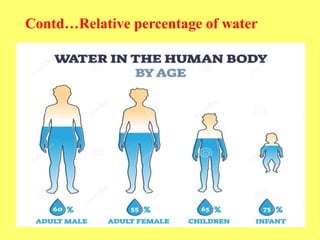
Contd…Relative percentage of water
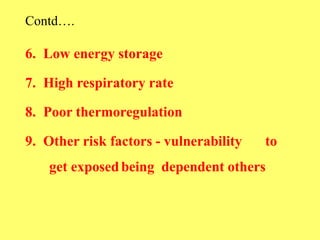
Contd….
6. Low energy storage
7. High respiratory rate
8. Poor thermoregulation
9. Other risk factors - vulnerability to
get exposed being dependent others
Risk factors specific to LBW/SFD
13
• Larger surface area than term babies
• Poor insulation (lower subcutaneous fat- Adipose tissue first appears at
around mid-gestation. Total adipose mass then increases through late gestation,
when it comprises a mixture of white and brown adipocytes. BAT possesses a
unique uncoupling protein, UCP1, which is responsible for the rapid generation
of large amounts of heat at birth. Then, during postnatal life most of, but not all,
depots are replaced by white fat)
• More permeable skin
• Decreased brown fat
• Poor physiological response to cold
• Early exhaustion of metabolic stores like
glucose
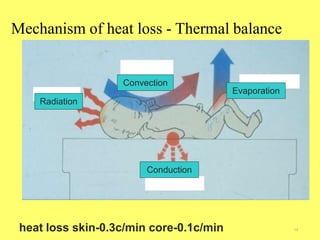
heat loss skin-0.3c/min core-0.1c/min
Mechanism of heat loss - Thermal balance
14
Conduction
Radiation
Convection
Evaporation
Response to cold / process of thermoregulation
15
• Non-shivering thermogenesis (NST)
• Metabolic processes
• Voluntary muscle activity
• Peripheral vasoconstriction
Non-shivering thermogenesis (NST)
16
NST is a cold-induced increase in heat production not associated with
shivering. It occurs mainly through metabolism of brown fat. Brown
fat differentiates in the human fetus between 20 and 30 weeks of
gestational age. It comprises only 2-6% of the infant's total body
weight and is present in between scapula, axilla, mediastinum, around
adrenal glands, internal mammary blood vessels.
Brown fat is a highly specialized tissue; the brown color is
secondary to the abundant content of mitochondria in the
cytoplasm of its multinucleated cells. They are unique in their
ability to uncouple oxidative phosphorylation, resulting in heat
production instead of generating adenosine triphosphate due to
presence of uncoupling protein 1 (UCP-1.
Contd…
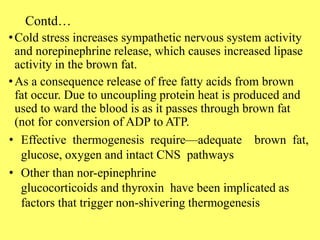
•Cold stress increases sympathetic nervous system activity
and norepinephrine release, which causes increased lipase
activity in the brown fat.
•As a consequence release of free fatty acids from brown
fat occur. Due to uncoupling protein heat is produced and
used to ward the blood is as it passes through brown fat
(not for conversion of ADP to ATP.
• Effective thermogenesis require—adequate brown fat,
glucose, oxygen and intact CNS pathways
• Other than nor-epinephrine
glucocorticoids and thyroxin have been implicated as
factors that trigger non-shivering thermogenesis
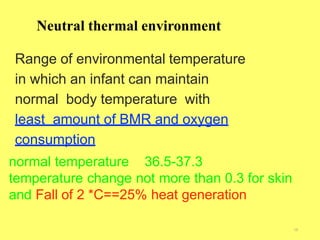
Neutral thermal environment
18
Range of environmental temperature
in which an infant can maintain
normal body temperature with
least amount of BMR and oxygen
consumption
normal temperature 36.5-37.3
temperature change not more than 0.3 for skin
and Fall of 2 *C==25% heat generation
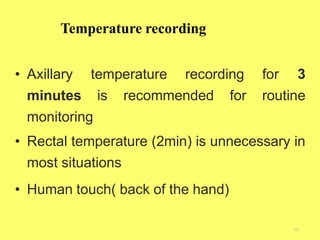
Temperature recording
19
• Axillary temperature recording for 3
minutes is recommended for routine
monitoring
• Rectal temperature (2min) is unnecessary in
most situations
• Human touch( back of the hand)
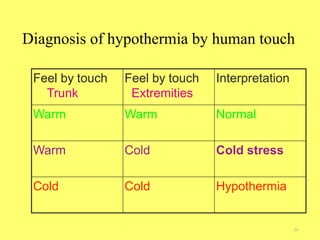
Diagnosis of hypothermia by human touch
20
Feel by touch
Trunk
Feel by touch
Extremities
Interpretation
Warm Warm Normal
Warm Cold Cold stress
Cold Cold Hypothermia
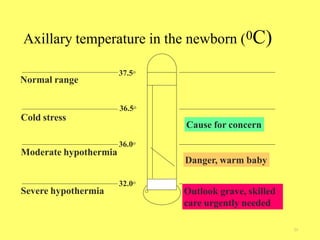
Normal range
Axillary temperature in the newborn (0C)
21
Cold stress
Moderate hypothermia
Severe hypothermia Outlook grave, skilled
care urgently needed
Danger, warm baby
Cause for concern
37.5o
36.5o
36.0o
32.0o
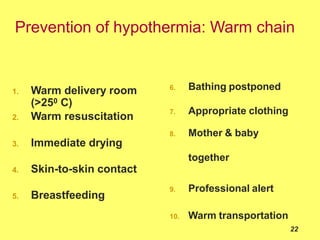
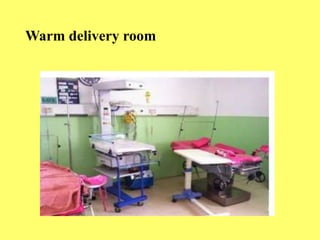
1. Warm delivery room
(>250 C)
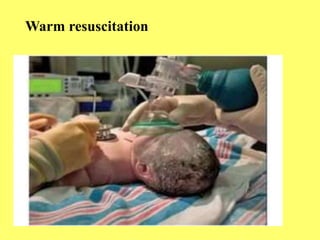
2. Warm resuscitation
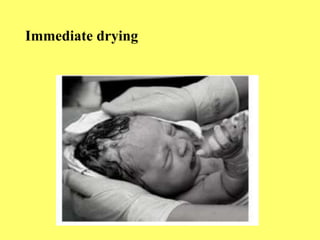
3. Immediate drying
4. Skin-to-skin contact
5. Breastfeeding
Prevention of hypothermia: Warm chain
22
6. Bathing postponed
7. Appropriate clothing
8. Mother & baby
together
9. Professional alert
10. Warm transportation
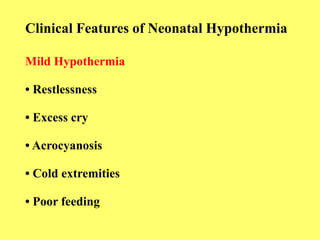
Clinical Features of Neonatal Hypothermia
Mild Hypothermia
• Restlessness
• Excess cry
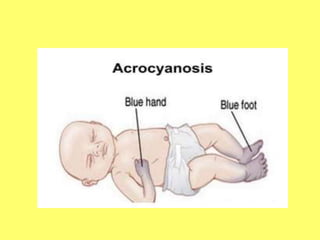
• Acrocyanosis
• Cold extremities
• Poor feeding
Contd…
Moderate Hypothermia
•Difficult breathing
•Bradycardia
•Poor or no feeding
•Lethargy, poor reflexes
•Cold to touch
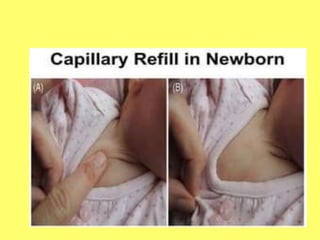
•Delay capillary refill time
•Oliguria
 Capillary Refill in Newborn
Contd….
Severe Hypothermia
•Breathing difficulty
•Poor or no feeding
•Hypoglycemia
•Lethargy
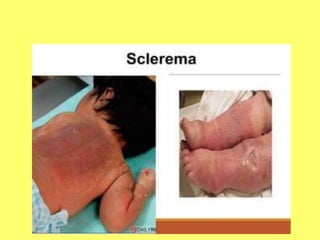
•Sclerema
•Slow, shallow and irregular respiration with
bradycardia
• Cold to touch
Management of Neonatal Hypothermia
A.Mild Hypothermia (cold stress)
• Remove the baby from the source that may be causing
hypothermia.
• Cover the baby adequately with warm clothes.
• Ensure skin to skin contact with mother, if not possible, kept
next to mother after fully covering the baby.
• Warm the environments including room / bed (28-32 C).
• Immediately breastfeed the baby.
Contd…
•Monitor axillary temperature every ½ hourly till it
reaches 36.5°C, then hourly for next 4 hours, 2 hourly for
12 hour thereafter.
•If the temperature of baby is not rising,
 Check if adequate amount of heat being provided.
 Sepsis should be suspected unresponsive hypothermia.
 Watch for apnea and hypoglycemia.
• Follow up
Moderate to Severe Hypothermia
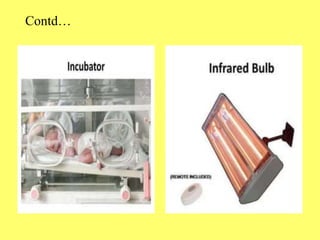
• Remove wet clothes and rapid rewarming by
incubator, preheated radiant warmer or
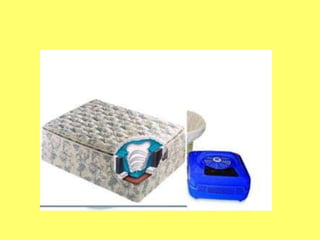
thermostatically controlled heated mattress.
• Room heater or 200 W bulb or infrared bulb can also
be used.
• Rapid rewarming is done up to 34°C, then slow
rewarming to 36.5°C by incubator or infrared Bulb
• Set skin temperature at 37 0C in skin servo mode in
radiant warmer or 1-1.50C higher than the body
temperature in an incubator and should be adjusted as
the newborn's temperature increases.
Contd…
Contd…
• Where radiant warmer or incubator is not available, KMC
may be the only option. Heating lamp, home based heating
methods may also be used under supervision
• Monitor temperature every ½ hourly till it reaches 36.50C.
• If rise of temperature has been by 0.5°C per hour then heating
is considered adequate, and temperature measurement is
continued every hourly for next 4 hours and 2 hourly for next
12 hour thereafter.
• If rise of temperature is not adequate, one should check the
heating technique.
Contd…
•If temperature doesn’t improve provide additional heat.
Sepsis should be suspected in unresponsive hypothermia.
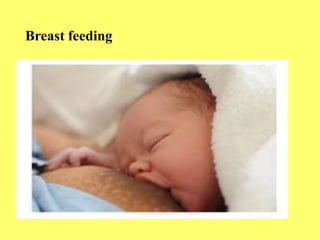
•Encourage mother to breast feed the baby more
frequently. If baby cannot breast fed, give expressed
breast milk using an alternative feeding method.
•Assess the baby: Look for emergency signs
•Parental support
•If feeding is well, temperature remains within the
normal range and there are no other problems requiring
hospitalization, discharge the baby.
•Advise the mother how to keep the baby warm at home.
Supportive Measures
• Prompt detection and management of hypoxia, hypoperfusion and
hypoglycemia.
• Measure blood glucose. If it is less than 45 mg/dl, treat for low
glucose.
• If perfusion is poor , give 20ml/kg of RL or NS over 5 minutes.
• Provide oxygen if moderate to severe hypothermia.
• Watch for apnea, hypoxia and hypoglycemia during rewarming.
• IV vitamin K 1 mg IM in term and 0.5mg in preterm babies , if not
given earlier.
• If hypothermia is associated with infection, start appropriate
antibiotics.
Prevention of hypothermia at birth
36
• Conduct delivery in a warm room( 27.C)
• Dry baby including head immediately with
warm clean towel
• Wrap baby in pre-warmed linen; cover the
head and the limbs
• Place the baby skin to skin on the mother
• Postpone bathing
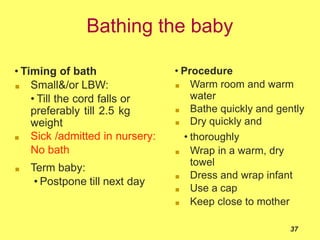
Bathing the baby
• Timing of bath
■ Small&/or LBW:
• Till the cord falls or
preferably till 2.5 kg
weight
■ Sick /admitted in nursery:
No bath
■ Term baby:
• Postpone till next day
• Procedure
■ Warm room and warm
water
■ Bathe quickly and gently
■ Dry quickly and
• thoroughly
■ Wrap in a warm, dry
towel
■ Dress and wrap infant
■ Use a cap
■ Keep close to mother
37
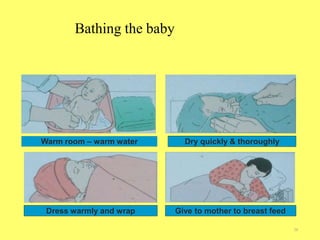
Bathing the baby
38
Warm room – warm water Dry quickly & thoroughly
Dress warmly and wrap Give to mother to breast feed
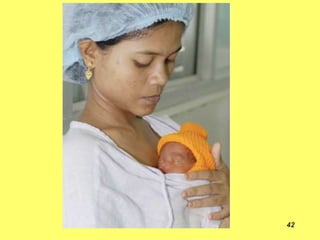
Kangaroo Mother care
• Assists in maintaining temperature
• reduces risk of apnea
• reduced risk of infections babies cry less and
sleeps better (better neurobehavioral development)
• Facilitates breastfeeding
• Increases duration of breastfeeding
• Improves mother-baby bonding
• better weight gain and early discharge
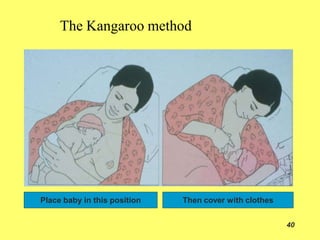
The Kangaroo method
Place baby in this position
40
Then cover with clothes
41
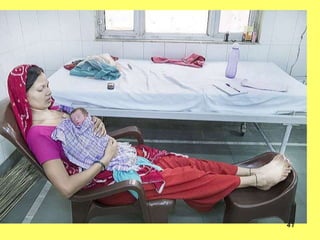
42
Cot-nursing in hospital (mother sick)
43
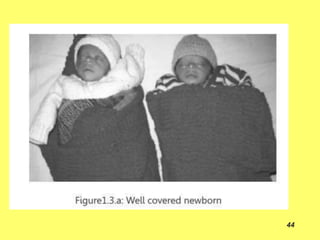
• Cover adequately in layering*
• adequate feeding( EBF/assisted)
• Keep in thermoneutral environment
• Monitor temperature 3 hourly during initial
postnatal days
44
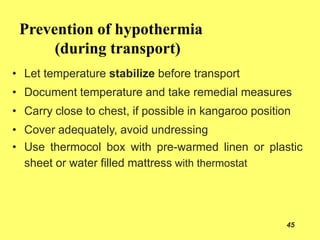
Prevention of hypothermia
(during transport)
45
• Let temperature stabilize before transport
• Document temperature and take remedial measures
• Carry close to chest, if possible in kangaroo position
• Cover adequately, avoid undressing
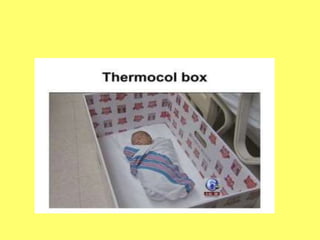
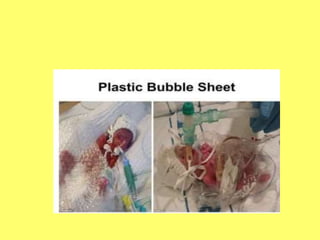
• Use thermocol box with pre-warmed linen or plastic
sheet or water filled mattress with thermostat
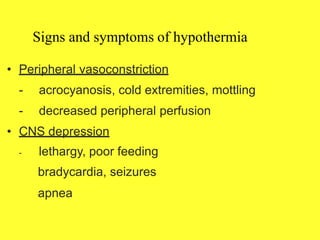
Signs and symptoms of hypothermia
• Peripheral vasoconstriction
- acrocyanosis, cold extremities, mottling
- decreased peripheral perfusion
• CNS depression
- lethargy, poor feeding
bradycardia, seizures
apnea
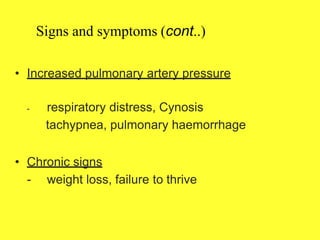
Signs and symptoms (cont..)
• Increased pulmonary artery pressure
- respiratory distress, Cynosis
tachypnea, pulmonary haemorrhage
• Chronic signs
- weight loss, failure to thrive
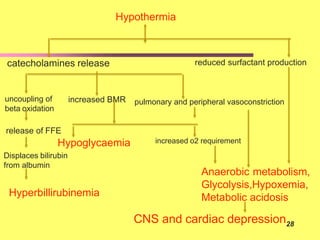
Hypothermia
catecholamines release reduced surfactant production
uncoupling of
beta oxidation
Hyperbillirubinemia
increased BMR
release of FFE
Hypoglycaemia
Displaces bilirubin
from albumin
increased o2 requirement
pulmonary and peripheral vasoconstriction
Anaerobic metabolism,
Glycolysis,Hypoxemia,
Metabolic acidosis
CNS and cardiac depression28
Complications
49
■ Hypoglycaemia
■ Bleeding ,DIC
■ Acidosis
■ Hypotension
■ Shock
■ Respiratory distress
■ Pulmonary haemorrhage
■ Apnea
■ Cardiac arrest
■ Death
Management: Cold stress
(<36.5)
50
• Cover adequately - remove cold clothes and replace with
warm clothes
• Warm room/bed
• Take measures to reduce heat loss
• Ensure skin-to-skin contact with mother; if not possible,
keep next to mother after fully covering the baby
• Breast feeding*
Monitor axillary temperature every ½ hour till it reaches 36.50 C, then hourly for
next 4 hours, 2 hourly for 12 hours thereafter and 3 hourly as a routine
Management: Moderate
hypothermia(32.0°C to 35.9°C )
51
• Skin to skin contact
• Feeding
• Warm room/ warmer
• Take measures to reduce heat loss
• Provide extra heat
- 200 W bulb
- Heater, warmer, incubator
- Apply warm towels
32
Management: Severe
hypothermia (<320C )
• Provide extra heat preferably under radiant warmer or
air heated incubator
- rapidly warm till 340C, then slow re-warming
• Take measures to reduce heat loss
• Manage T A B C*
• IV fluids: 60-80 ml/kg of 10% Dextrose
• Oxygen
• Inj.vitamin K 1mg in term & 0.5 mg in preterm
• If still hypothermic, consider antibiotics assuming sepsis
Monitor HR, BP, Glucose (if available)
Prevention of Neonatal Hypothermia
•The "warm chain " is a set of interlinked procedures to
be performed at birth and during the next few hours and
days after birth in order to minimize heat loss in all
newborns (WHO,1997).
Warm delivery room
Warm resuscitation
Immediate drying
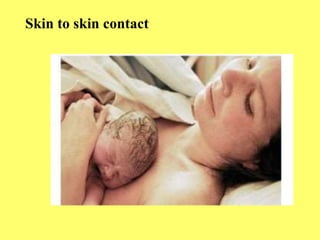
Skin to skin contact
Contd…
• While the newborn is being dried, place on the mother’s chest or
abdomen (skin to- skin contact) to prevent heat loss. If mother is
unable, the cold newborn may go skin-to-skin with the partner
• Cover the newborn with a second towel and put a cap on the head
to prevent heat loss from convection.
• Leave the newborn skin-to-skin on the mother and keep covered.
• Newborns should be uncovered as little as possible during
assessments and interventions.
• Newborns can be maintained in skin-to- skin contact with the
mother: while she is being attended to (placenta delivery,
suturing) . during transfer to the postnatal unit, recovery
roomduring assessments and initial interventions. for the first
hours after birth.
Breast feeding
Postpone Weighing and Bathing
• Weighing can be done following the period of uninterrupted skin-to-skin
contact and the first feed. Place a warm blanket on the scale.
• Bathing the newborn soon after birth causes a drop in the body
temperature and may propagate hypothermia and hypoglycemia.
• Don't bath the baby immediately after birth. Wait for at least 24 hours to
bath the baby.
• Bathing could be done when baby's temperature is stable or when cord
fall off or when baby's weight is 2.5 kg in warm, sunny room with warm
water. Wait longer if body temperature is below 360C ,LBW baby or baby
is unwell.
Contd…
• For preterm baby, bathing should be postponed until the baby's weight
reach up to 2.5 kg. At that time sponging is adequate.
• If a hypothermic newborn thick wet hair, consider drying the hair
thoroughly and then place a cap on the head.
• Bathing should be done quickly in a warm room, using warm water. Tub
bathing is the preferred method of bathing. • Note: Newborns with an
umbilical catheter should not be tub bathed.
• Immediately after the bath dry thoroughly from head to toe, immediately
diaper and apply dry cap on baby's head and place skin-to skin.
• If skin-to-skin is not possible double wrap the newborn with warm
blankets ensuring the head is covered.
• After skin-to-skin, dress and wrap the baby in dry warm blankets.
Appropriate Clothing/ Blanket
• • Dress newborn in loose clothing and blanket.
• • Cover baby's head with cap or cloth.
• • The baby should not be wrapped too tightly and too
loosely , it is better to have 2-3 layers of clothes rather than
one single thick layer.
• • When the clothing or the diaper is soiled , it should be
changed immediately.
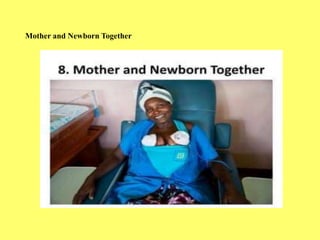
Mother and Newborn Together
Warm Transportation
• Always stabilize the baby's temperature before transport.
• Record temperature before transport and take remedial measures. If
temperature cannot be documented, use touch to judge temperature. Hands
and feet should be as warm as abdomen.
• Carry the baby close to the chest of mother, if possible in kangaroo
position.
• Dress the newborn and wrap in blankets if a transport. Cover head, legs
and hands.
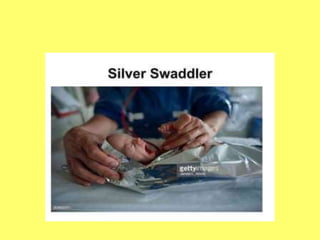
• Thermocol box with pre warmed linen or plastic bubble sheet or silver
swaddler may be used during transport.
• Water filled mattress with thermostat to control temperature may be used
for transport ,if available.
• For unstable baby, transport in incubator.
• What is swaddling?
As a traditional way to wrap a baby (mummy restraint like). It
has been practiced for thousands of years by parents across the
world. The technique uses a lightweight sheet to keep the baby
snug and secure. It’s believed to keep little one comforted in
the outside world.
• Silver swaddler is a sterile aluminum foil bag used to keep an
infant warm just after birth. It is standard equipment for
emergency medical services personnel and is used as a
precaution for most infants born in the field.
• These blankets are designed to reflect heat back to body or
deflect heat when used as a shelter from the sun, prevents
post accident shock by retaining the patient’s body heat.
• It is hooded and contain an adjustable adhesive closure to
preserve newborns body heat during transport to hospital.
Complications
•Pulmonary hemorrhage
•Hypovolemia
•Coagulopathy
•Acidaemia
•Scleroderma
•Jaundice and hypoglycemia
•Cardiac arrhythmia
•Even death may occur
• https://www.slideshare.net/TheShraddha/neonatal-hypothermia#2
Hyperthermia > 37.50C
73
• Problem in summer months
• May indicate infection in term babies
• Irritable, increased HR & RR
• Flushed face, hot & dry skin
• Apathetic, lethargic and pale
• Stupor, coma, convulsions if temperature > 410C
• Place the baby in a normal temperature
environment (25 to 280C), away from any source
of heat
• Undress the baby partially or fully, if necessary
• Give frequent breast feeds
• If temperature > 390C, sponge the baby with tap
water; don’t use cold / ice water for sponge
• Measure the temperature hourly till it becomes
normal
74
Management of hyperthermia
Conclusion
• Prevent hypothermia, maintain “Warm chain”
• Ensure closer monitoring and stricter preventive measures for LBW
and other at risk neonates
• Early detection and prompt remedial
measures are key for reducing this preventable morbidity
75

hypothermia in newborn.pptx

  • 1.
  • 2.
    Hypothermia 2 • It isdefined as body temperature below 36.5 0c by axilla. • Is a significant problem in neonates at birth and beyond ( 15%) • Cause of significant morbidity & mortality • Mortality rate is twice in hypothermic babies • Preventable • Lack of professional alertness of healthcare providers
  • 3.
    ■ Situations causingexcessive heat loss ■ Poor ability to conserve ■ Poor metabolic heat production Causes of hypothermia 3
  • 4.
    ■ cold environment, ■wet or naked baby, ■ cold linen, ■ Inadequate coverage during transportation ■ procedures bath, blood sampling, infusion Causes of hypothermia – Situations causing excessive heat loss 4
  • 5.
    Poor ability toconserve body heat —  LBW, ■ IUGR Poor metabolic heat production -deficiency of brown fat, ■ Hypoxia ■ CNS damage, ■ hypoglycaemia, ■ sepsis* Causes of hypothermia 5
  • 6.
    Why are newbornsprone to develop hypothermia ? 6 • Larger surface area per unit body weight
  • 7.
    Contd… • Limited heatgenerating mechanisms • Non shivering thermogenesis only
  • 8.
  • 9.
    Contd... Difference betweenadult and neonatal skin
  • 10.
  • 11.
  • 12.
    Contd…. 6. Low energystorage 7. High respiratory rate 8. Poor thermoregulation 9. Other risk factors - vulnerability to get exposed being dependent others
  • 13.
    Risk factors specificto LBW/SFD 13 • Larger surface area than term babies • Poor insulation (lower subcutaneous fat- Adipose tissue first appears at around mid-gestation. Total adipose mass then increases through late gestation, when it comprises a mixture of white and brown adipocytes. BAT possesses a unique uncoupling protein, UCP1, which is responsible for the rapid generation of large amounts of heat at birth. Then, during postnatal life most of, but not all, depots are replaced by white fat) • More permeable skin • Decreased brown fat • Poor physiological response to cold • Early exhaustion of metabolic stores like glucose
  • 14.
    heat loss skin-0.3c/mincore-0.1c/min Mechanism of heat loss - Thermal balance 14 Conduction Radiation Convection Evaporation
  • 15.
    Response to cold/ process of thermoregulation 15 • Non-shivering thermogenesis (NST) • Metabolic processes • Voluntary muscle activity • Peripheral vasoconstriction
  • 16.
    Non-shivering thermogenesis (NST) 16 NSTis a cold-induced increase in heat production not associated with shivering. It occurs mainly through metabolism of brown fat. Brown fat differentiates in the human fetus between 20 and 30 weeks of gestational age. It comprises only 2-6% of the infant's total body weight and is present in between scapula, axilla, mediastinum, around adrenal glands, internal mammary blood vessels. Brown fat is a highly specialized tissue; the brown color is secondary to the abundant content of mitochondria in the cytoplasm of its multinucleated cells. They are unique in their ability to uncouple oxidative phosphorylation, resulting in heat production instead of generating adenosine triphosphate due to presence of uncoupling protein 1 (UCP-1.
  • 17.
    Contd… •Cold stress increasessympathetic nervous system activity and norepinephrine release, which causes increased lipase activity in the brown fat. •As a consequence release of free fatty acids from brown fat occur. Due to uncoupling protein heat is produced and used to ward the blood is as it passes through brown fat (not for conversion of ADP to ATP. • Effective thermogenesis require—adequate brown fat, glucose, oxygen and intact CNS pathways • Other than nor-epinephrine glucocorticoids and thyroxin have been implicated as factors that trigger non-shivering thermogenesis
  • 18.
    Neutral thermal environment 18 Rangeof environmental temperature in which an infant can maintain normal body temperature with least amount of BMR and oxygen consumption normal temperature 36.5-37.3 temperature change not more than 0.3 for skin and Fall of 2 *C==25% heat generation
  • 19.
    Temperature recording 19 • Axillarytemperature recording for 3 minutes is recommended for routine monitoring • Rectal temperature (2min) is unnecessary in most situations • Human touch( back of the hand)
  • 20.
    Diagnosis of hypothermiaby human touch 20 Feel by touch Trunk Feel by touch Extremities Interpretation Warm Warm Normal Warm Cold Cold stress Cold Cold Hypothermia
  • 21.
    Normal range Axillary temperaturein the newborn (0C) 21 Cold stress Moderate hypothermia Severe hypothermia Outlook grave, skilled care urgently needed Danger, warm baby Cause for concern 37.5o 36.5o 36.0o 32.0o
  • 22.
    1. Warm deliveryroom (>250 C) 2. Warm resuscitation 3. Immediate drying 4. Skin-to-skin contact 5. Breastfeeding Prevention of hypothermia: Warm chain 22 6. Bathing postponed 7. Appropriate clothing 8. Mother & baby together 9. Professional alert 10. Warm transportation
  • 23.
    Clinical Features ofNeonatal Hypothermia Mild Hypothermia • Restlessness • Excess cry • Acrocyanosis • Cold extremities • Poor feeding
  • 25.
    Contd… Moderate Hypothermia •Difficult breathing •Bradycardia •Pooror no feeding •Lethargy, poor reflexes •Cold to touch •Delay capillary refill time •Oliguria  Capillary Refill in Newborn
  • 27.
    Contd…. Severe Hypothermia •Breathing difficulty •Pooror no feeding •Hypoglycemia •Lethargy •Sclerema •Slow, shallow and irregular respiration with bradycardia • Cold to touch
  • 29.
    Management of NeonatalHypothermia A.Mild Hypothermia (cold stress) • Remove the baby from the source that may be causing hypothermia. • Cover the baby adequately with warm clothes. • Ensure skin to skin contact with mother, if not possible, kept next to mother after fully covering the baby. • Warm the environments including room / bed (28-32 C). • Immediately breastfeed the baby.
  • 30.
    Contd… •Monitor axillary temperatureevery ½ hourly till it reaches 36.5°C, then hourly for next 4 hours, 2 hourly for 12 hour thereafter. •If the temperature of baby is not rising,  Check if adequate amount of heat being provided.  Sepsis should be suspected unresponsive hypothermia.  Watch for apnea and hypoglycemia. • Follow up
  • 31.
    Moderate to SevereHypothermia • Remove wet clothes and rapid rewarming by incubator, preheated radiant warmer or thermostatically controlled heated mattress. • Room heater or 200 W bulb or infrared bulb can also be used. • Rapid rewarming is done up to 34°C, then slow rewarming to 36.5°C by incubator or infrared Bulb • Set skin temperature at 37 0C in skin servo mode in radiant warmer or 1-1.50C higher than the body temperature in an incubator and should be adjusted as the newborn's temperature increases.
  • 32.
  • 33.
    Contd… • Where radiantwarmer or incubator is not available, KMC may be the only option. Heating lamp, home based heating methods may also be used under supervision • Monitor temperature every ½ hourly till it reaches 36.50C. • If rise of temperature has been by 0.5°C per hour then heating is considered adequate, and temperature measurement is continued every hourly for next 4 hours and 2 hourly for next 12 hour thereafter. • If rise of temperature is not adequate, one should check the heating technique.
  • 34.
    Contd… •If temperature doesn’timprove provide additional heat. Sepsis should be suspected in unresponsive hypothermia. •Encourage mother to breast feed the baby more frequently. If baby cannot breast fed, give expressed breast milk using an alternative feeding method. •Assess the baby: Look for emergency signs •Parental support •If feeding is well, temperature remains within the normal range and there are no other problems requiring hospitalization, discharge the baby. •Advise the mother how to keep the baby warm at home.
  • 35.
    Supportive Measures • Promptdetection and management of hypoxia, hypoperfusion and hypoglycemia. • Measure blood glucose. If it is less than 45 mg/dl, treat for low glucose. • If perfusion is poor , give 20ml/kg of RL or NS over 5 minutes. • Provide oxygen if moderate to severe hypothermia. • Watch for apnea, hypoxia and hypoglycemia during rewarming. • IV vitamin K 1 mg IM in term and 0.5mg in preterm babies , if not given earlier. • If hypothermia is associated with infection, start appropriate antibiotics.
  • 36.
    Prevention of hypothermiaat birth 36 • Conduct delivery in a warm room( 27.C) • Dry baby including head immediately with warm clean towel • Wrap baby in pre-warmed linen; cover the head and the limbs • Place the baby skin to skin on the mother • Postpone bathing
  • 37.
    Bathing the baby •Timing of bath ■ Small&/or LBW: • Till the cord falls or preferably till 2.5 kg weight ■ Sick /admitted in nursery: No bath ■ Term baby: • Postpone till next day • Procedure ■ Warm room and warm water ■ Bathe quickly and gently ■ Dry quickly and • thoroughly ■ Wrap in a warm, dry towel ■ Dress and wrap infant ■ Use a cap ■ Keep close to mother 37
  • 38.
    Bathing the baby 38 Warmroom – warm water Dry quickly & thoroughly Dress warmly and wrap Give to mother to breast feed
  • 39.
    Kangaroo Mother care •Assists in maintaining temperature • reduces risk of apnea • reduced risk of infections babies cry less and sleeps better (better neurobehavioral development) • Facilitates breastfeeding • Increases duration of breastfeeding • Improves mother-baby bonding • better weight gain and early discharge
  • 40.
    The Kangaroo method Placebaby in this position 40 Then cover with clothes
  • 41.
  • 42.
  • 43.
    Cot-nursing in hospital(mother sick) 43 • Cover adequately in layering* • adequate feeding( EBF/assisted) • Keep in thermoneutral environment • Monitor temperature 3 hourly during initial postnatal days
  • 44.
  • 45.
    Prevention of hypothermia (duringtransport) 45 • Let temperature stabilize before transport • Document temperature and take remedial measures • Carry close to chest, if possible in kangaroo position • Cover adequately, avoid undressing • Use thermocol box with pre-warmed linen or plastic sheet or water filled mattress with thermostat
  • 46.
    Signs and symptomsof hypothermia • Peripheral vasoconstriction - acrocyanosis, cold extremities, mottling - decreased peripheral perfusion • CNS depression - lethargy, poor feeding bradycardia, seizures apnea
  • 47.
    Signs and symptoms(cont..) • Increased pulmonary artery pressure - respiratory distress, Cynosis tachypnea, pulmonary haemorrhage • Chronic signs - weight loss, failure to thrive
  • 48.
    Hypothermia catecholamines release reducedsurfactant production uncoupling of beta oxidation Hyperbillirubinemia increased BMR release of FFE Hypoglycaemia Displaces bilirubin from albumin increased o2 requirement pulmonary and peripheral vasoconstriction Anaerobic metabolism, Glycolysis,Hypoxemia, Metabolic acidosis CNS and cardiac depression28
  • 49.
    Complications 49 ■ Hypoglycaemia ■ Bleeding,DIC ■ Acidosis ■ Hypotension ■ Shock ■ Respiratory distress ■ Pulmonary haemorrhage ■ Apnea ■ Cardiac arrest ■ Death
  • 50.
    Management: Cold stress (<36.5) 50 •Cover adequately - remove cold clothes and replace with warm clothes • Warm room/bed • Take measures to reduce heat loss • Ensure skin-to-skin contact with mother; if not possible, keep next to mother after fully covering the baby • Breast feeding* Monitor axillary temperature every ½ hour till it reaches 36.50 C, then hourly for next 4 hours, 2 hourly for 12 hours thereafter and 3 hourly as a routine
  • 51.
    Management: Moderate hypothermia(32.0°C to35.9°C ) 51 • Skin to skin contact • Feeding • Warm room/ warmer • Take measures to reduce heat loss • Provide extra heat - 200 W bulb - Heater, warmer, incubator - Apply warm towels
  • 52.
    32 Management: Severe hypothermia (<320C) • Provide extra heat preferably under radiant warmer or air heated incubator - rapidly warm till 340C, then slow re-warming • Take measures to reduce heat loss • Manage T A B C* • IV fluids: 60-80 ml/kg of 10% Dextrose • Oxygen • Inj.vitamin K 1mg in term & 0.5 mg in preterm • If still hypothermic, consider antibiotics assuming sepsis Monitor HR, BP, Glucose (if available)
  • 53.
    Prevention of NeonatalHypothermia •The "warm chain " is a set of interlinked procedures to be performed at birth and during the next few hours and days after birth in order to minimize heat loss in all newborns (WHO,1997).
  • 54.
  • 55.
  • 56.
  • 57.
    Skin to skincontact
  • 58.
    Contd… • While thenewborn is being dried, place on the mother’s chest or abdomen (skin to- skin contact) to prevent heat loss. If mother is unable, the cold newborn may go skin-to-skin with the partner • Cover the newborn with a second towel and put a cap on the head to prevent heat loss from convection. • Leave the newborn skin-to-skin on the mother and keep covered. • Newborns should be uncovered as little as possible during assessments and interventions. • Newborns can be maintained in skin-to- skin contact with the mother: while she is being attended to (placenta delivery, suturing) . during transfer to the postnatal unit, recovery roomduring assessments and initial interventions. for the first hours after birth.
  • 59.
  • 60.
    Postpone Weighing andBathing • Weighing can be done following the period of uninterrupted skin-to-skin contact and the first feed. Place a warm blanket on the scale. • Bathing the newborn soon after birth causes a drop in the body temperature and may propagate hypothermia and hypoglycemia. • Don't bath the baby immediately after birth. Wait for at least 24 hours to bath the baby. • Bathing could be done when baby's temperature is stable or when cord fall off or when baby's weight is 2.5 kg in warm, sunny room with warm water. Wait longer if body temperature is below 360C ,LBW baby or baby is unwell.
  • 61.
    Contd… • For pretermbaby, bathing should be postponed until the baby's weight reach up to 2.5 kg. At that time sponging is adequate. • If a hypothermic newborn thick wet hair, consider drying the hair thoroughly and then place a cap on the head. • Bathing should be done quickly in a warm room, using warm water. Tub bathing is the preferred method of bathing. • Note: Newborns with an umbilical catheter should not be tub bathed. • Immediately after the bath dry thoroughly from head to toe, immediately diaper and apply dry cap on baby's head and place skin-to skin. • If skin-to-skin is not possible double wrap the newborn with warm blankets ensuring the head is covered. • After skin-to-skin, dress and wrap the baby in dry warm blankets.
  • 62.
    Appropriate Clothing/ Blanket •• Dress newborn in loose clothing and blanket. • • Cover baby's head with cap or cloth. • • The baby should not be wrapped too tightly and too loosely , it is better to have 2-3 layers of clothes rather than one single thick layer. • • When the clothing or the diaper is soiled , it should be changed immediately.
  • 63.
  • 64.
    Warm Transportation • Alwaysstabilize the baby's temperature before transport. • Record temperature before transport and take remedial measures. If temperature cannot be documented, use touch to judge temperature. Hands and feet should be as warm as abdomen. • Carry the baby close to the chest of mother, if possible in kangaroo position. • Dress the newborn and wrap in blankets if a transport. Cover head, legs and hands. • Thermocol box with pre warmed linen or plastic bubble sheet or silver swaddler may be used during transport. • Water filled mattress with thermostat to control temperature may be used for transport ,if available. • For unstable baby, transport in incubator.
  • 68.
    • What isswaddling? As a traditional way to wrap a baby (mummy restraint like). It has been practiced for thousands of years by parents across the world. The technique uses a lightweight sheet to keep the baby snug and secure. It’s believed to keep little one comforted in the outside world. • Silver swaddler is a sterile aluminum foil bag used to keep an infant warm just after birth. It is standard equipment for emergency medical services personnel and is used as a precaution for most infants born in the field. • These blankets are designed to reflect heat back to body or deflect heat when used as a shelter from the sun, prevents post accident shock by retaining the patient’s body heat. • It is hooded and contain an adjustable adhesive closure to preserve newborns body heat during transport to hospital.
  • 71.
  • 72.
  • 73.
    Hyperthermia > 37.50C 73 •Problem in summer months • May indicate infection in term babies • Irritable, increased HR & RR • Flushed face, hot & dry skin • Apathetic, lethargic and pale • Stupor, coma, convulsions if temperature > 410C
  • 74.
    • Place thebaby in a normal temperature environment (25 to 280C), away from any source of heat • Undress the baby partially or fully, if necessary • Give frequent breast feeds • If temperature > 390C, sponge the baby with tap water; don’t use cold / ice water for sponge • Measure the temperature hourly till it becomes normal 74 Management of hyperthermia
  • 75.
    Conclusion • Prevent hypothermia,maintain “Warm chain” • Ensure closer monitoring and stricter preventive measures for LBW and other at risk neonates • Early detection and prompt remedial measures are key for reducing this preventable morbidity 75