ASTHMA
INTRODUCTION
• There are two pathophysiological features of the disease are generally
agreed.
Airway Inflammation
increased airway reactivity
DEFINITION
• ASTHMA IS CONSIDERED TO BE A CHRONIC
INFLAMMATORY DISEASE OF THE AIRWAY
ASSOCIATED WITH HYPERRESPONSIVENESS TO
ENVIRONMENTAL STIMULI CAUSING REVERSIBLE
AIRFLOW, OBSTRUCTION AND RESPIRATORY
DISTRESS.
ETIOLOGY
✔ GENETICS
✔ EVIDENCE FOR PRENATAL SENSITATION TO AEROALLERGENS
✔ OTHER PRENATAL FACTORS
✔ BREAST FEEDING AND WHEEZING ILLNESS
✔ EXPOSURE TO HOUSE DUST, MITES AND PETS
✔ THE HYGIENE HYPOTHESIS
✔ BRONCHO PULMONARY DYSLASIA
✔ BRONCHIOLITIS
CLASSIFICATION
It is classified based on the degree of severity. It is classified into
MILD
MODERATE
SEVERE
MILD :
Occasional attack of wheezing or coughing with no symptoms
between attack.
MORERATE :
More frequent episodes, more persistent symptoms after an
exacerbation and often chronic cough, exercise tolerance may be
reduced.
CLASSIFICATION ctnd
SEVERE :
❖ Requiring frequent emergency attention and hospitalization.
❖ Wear med-alert bracelet and to carry a crisis plan
❖ For evaluating scoring system is helpful
❖ Greater than 10 indicates a high probability for hospital admission
❖ Greater than 12 or an arterial oxygen saturation less than 92 % on
room air should be admitted
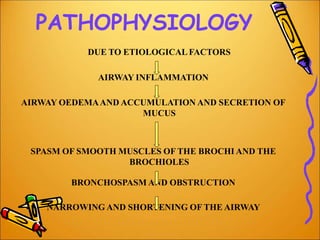
PATHOPHYSIOLOGY
DUE TO ETIOLOGICAL FACTORS
AIRWAY INFLAMMATION
AIRWAY OEDEMAAND ACCUMULATION AND SECRETION OF
MUCUS
SPASM OF SMOOTH MUSCLES OF THE BROCHI AND THE
BROCHIOLES
BRONCHOSPASM AND OBSTRUCTION
NARROWING AND SHORTENING OF THE AIRWAY
PATHOPHYSIOLOGY ctnd
INCREASES AIRWAY RESISTANCE TO AIRFLOW
FATIGUE DECREASED RESPIRATORY EFFECTIVENESS AND
INCREASED OXYGEN CONSUMPTION
CHRONIC INFLAMMATION
PERMAMENT DAMAGE TO AIRWAY STRUCTURES
CLINICAL
MANIFESTAIONS
• ACUTE ATTACK
✔ Sudden or gradual onset of shortness of breath
✔ Chest tightness
✔ Wheezing
✔ Coughing
✔ Hyperinflation
✔ Sputum production
✔ Nasal discharges
✔ Sinus headaches
✔ Unable to speak
✔ Decreased breath sound
✔ Presence of allergy
✔ Oedema of the nasal turbinates
✔ Middle ear effusions
✔ Conjunctivitis
• CHRONIC ASTHMA
✔ Chest deformities
✔ Weight loss
✔ Chronic illness
✔ Eczema
DIAGNOSTIC
EVALUATION
✔ DYSPNOEA
✔ WHEEZING AND COUGHING
✔ ACUTE EXPISODES OF SHORTNESS OF BREATH
✔ HISTORY COLLECTION
✔ PHYSICAL EXAMINATION
✔ PULMONARY FUNCTION TEST
✔ PEAK EXPIRATORY FLOW RATE {PEFR}
✔ BRONCHOPROVOCATION TESTINY
✔ SKIN TESTING
✔ RADIO ALLERGOSORBENT TEST [RAST]
✔ BLOOD COUNT CHEST RADIOGRAPHS
TREATMENT
• ACUTE ASTHMA
❑ Bronchodilators And Anti-inflammatory Agents
❑ Beta-adrenergic agonist
❑ Beta-2 agonist inhalation
❑ Inhale steroids
A severe attack may require 3 – 4 inhalation from a nebulizer.
During the first hour or three puffs or a equivalent of albuterol
from a mestored dose inhaler (MDI) and spacer every 5
minutes.
TREATMENT ctnd
• INTENSIVE CARE MANAGEMENT
✔ INRAVENOUS TERBUTALINE
✔ INTUBATION AND MECHANICALVENTILATION
• CHRONIC ASTHMA CARE
✔ INHALATION OF STEROIDS
Eg: BECLOMETHASONE
FLUONISOLIDE = 2 – 4 Times/ day
• SEVERE
✔ INHALED STEROIDS
✔ THEOPHYLLINE
MANAGEMENT
Mild/Moderate Episode
✔ Sit the child up
✔ Give 100% humidified oxygen to maintain sa o2 > 93%
✔ Give inhaled salbutamol via inhaler and spacer with face mask if
required
1 -5 yrs salbutamol 6 puffs x 3 times > 5 years salbutamol 12 puffs x 3 times
give prednisolone 1 – 2 mg/kg by mouth
Prognosis
yes some improvement no improvement
NURSING DIAGNOSIS
✔ Ineffective breathing pattern dyspnoea
related to bronchial constriction as
evidenced by increased respiratory rate.
✔ Ineffective airway clearance related to excessive secretion of sputum
as evidenced by increased respiratory rate
✔ Acute chest pain related to frequent cough as evidenced by facial
grimace.
✔ Imbalanced nutritional status less than body requirement related to
loss of appetite as evidenced by weight loss.
✔ Disturbed sleep pattern related to frequent cough as evidenced by
drowsiness of eye.
PPT_Asthma_Respiratory.pptx

PPT_Asthma_Respiratory.pptx

  • 1.
  • 2.
    INTRODUCTION • There aretwo pathophysiological features of the disease are generally agreed. Airway Inflammation increased airway reactivity
  • 3.
    DEFINITION • ASTHMA ISCONSIDERED TO BE A CHRONIC INFLAMMATORY DISEASE OF THE AIRWAY ASSOCIATED WITH HYPERRESPONSIVENESS TO ENVIRONMENTAL STIMULI CAUSING REVERSIBLE AIRFLOW, OBSTRUCTION AND RESPIRATORY DISTRESS.
  • 4.
    ETIOLOGY ✔ GENETICS ✔ EVIDENCEFOR PRENATAL SENSITATION TO AEROALLERGENS ✔ OTHER PRENATAL FACTORS ✔ BREAST FEEDING AND WHEEZING ILLNESS ✔ EXPOSURE TO HOUSE DUST, MITES AND PETS ✔ THE HYGIENE HYPOTHESIS ✔ BRONCHO PULMONARY DYSLASIA ✔ BRONCHIOLITIS
  • 5.
    CLASSIFICATION It is classifiedbased on the degree of severity. It is classified into MILD MODERATE SEVERE MILD : Occasional attack of wheezing or coughing with no symptoms between attack. MORERATE : More frequent episodes, more persistent symptoms after an exacerbation and often chronic cough, exercise tolerance may be reduced.
  • 6.
    CLASSIFICATION ctnd SEVERE : ❖Requiring frequent emergency attention and hospitalization. ❖ Wear med-alert bracelet and to carry a crisis plan ❖ For evaluating scoring system is helpful ❖ Greater than 10 indicates a high probability for hospital admission ❖ Greater than 12 or an arterial oxygen saturation less than 92 % on room air should be admitted
  • 7.
    PATHOPHYSIOLOGY DUE TO ETIOLOGICALFACTORS AIRWAY INFLAMMATION AIRWAY OEDEMAAND ACCUMULATION AND SECRETION OF MUCUS SPASM OF SMOOTH MUSCLES OF THE BROCHI AND THE BROCHIOLES BRONCHOSPASM AND OBSTRUCTION NARROWING AND SHORTENING OF THE AIRWAY
  • 8.
    PATHOPHYSIOLOGY ctnd INCREASES AIRWAYRESISTANCE TO AIRFLOW FATIGUE DECREASED RESPIRATORY EFFECTIVENESS AND INCREASED OXYGEN CONSUMPTION CHRONIC INFLAMMATION PERMAMENT DAMAGE TO AIRWAY STRUCTURES
  • 9.
    CLINICAL MANIFESTAIONS • ACUTE ATTACK ✔Sudden or gradual onset of shortness of breath ✔ Chest tightness ✔ Wheezing ✔ Coughing ✔ Hyperinflation ✔ Sputum production ✔ Nasal discharges ✔ Sinus headaches
  • 10.
    ✔ Unable tospeak ✔ Decreased breath sound ✔ Presence of allergy ✔ Oedema of the nasal turbinates ✔ Middle ear effusions ✔ Conjunctivitis • CHRONIC ASTHMA ✔ Chest deformities ✔ Weight loss ✔ Chronic illness ✔ Eczema
  • 11.
    DIAGNOSTIC EVALUATION ✔ DYSPNOEA ✔ WHEEZINGAND COUGHING ✔ ACUTE EXPISODES OF SHORTNESS OF BREATH ✔ HISTORY COLLECTION ✔ PHYSICAL EXAMINATION ✔ PULMONARY FUNCTION TEST ✔ PEAK EXPIRATORY FLOW RATE {PEFR} ✔ BRONCHOPROVOCATION TESTINY ✔ SKIN TESTING ✔ RADIO ALLERGOSORBENT TEST [RAST] ✔ BLOOD COUNT CHEST RADIOGRAPHS
  • 12.
    TREATMENT • ACUTE ASTHMA ❑Bronchodilators And Anti-inflammatory Agents ❑ Beta-adrenergic agonist ❑ Beta-2 agonist inhalation ❑ Inhale steroids A severe attack may require 3 – 4 inhalation from a nebulizer. During the first hour or three puffs or a equivalent of albuterol from a mestored dose inhaler (MDI) and spacer every 5 minutes.
  • 13.
    TREATMENT ctnd • INTENSIVECARE MANAGEMENT ✔ INRAVENOUS TERBUTALINE ✔ INTUBATION AND MECHANICALVENTILATION • CHRONIC ASTHMA CARE ✔ INHALATION OF STEROIDS Eg: BECLOMETHASONE FLUONISOLIDE = 2 – 4 Times/ day • SEVERE ✔ INHALED STEROIDS ✔ THEOPHYLLINE
  • 14.
    MANAGEMENT Mild/Moderate Episode ✔ Sitthe child up ✔ Give 100% humidified oxygen to maintain sa o2 > 93% ✔ Give inhaled salbutamol via inhaler and spacer with face mask if required 1 -5 yrs salbutamol 6 puffs x 3 times > 5 years salbutamol 12 puffs x 3 times give prednisolone 1 – 2 mg/kg by mouth Prognosis yes some improvement no improvement
  • 15.
    NURSING DIAGNOSIS ✔ Ineffectivebreathing pattern dyspnoea related to bronchial constriction as evidenced by increased respiratory rate. ✔ Ineffective airway clearance related to excessive secretion of sputum as evidenced by increased respiratory rate ✔ Acute chest pain related to frequent cough as evidenced by facial grimace. ✔ Imbalanced nutritional status less than body requirement related to loss of appetite as evidenced by weight loss. ✔ Disturbed sleep pattern related to frequent cough as evidenced by drowsiness of eye.