Unit 5 :Digestive system
Cleft lip cleft palate
Definition
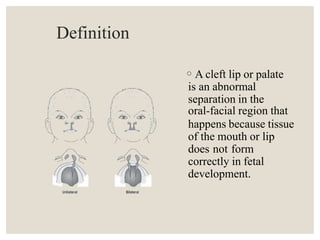
◦A cleft lip or palate
is an abnormal
separation in the
oral-facial region that
happens because tissue
of the mouth or lip
does not form
correctly in fetal
development.
Causes
◦Other birth defects
may cause cleft lip or
palate
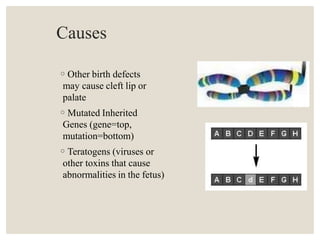
◦Mutated Inherited
Genes (gene=top,
mutation=bottom)
◦Teratogens (viruses or
other toxins that cause
abnormalities in the fetus)
Symptoms
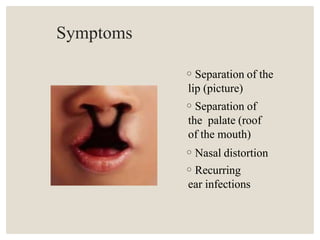
◦Separation of the
lip (picture)
◦Separation of
the palate (roof
of the mouth)
◦Nasal distortion
◦Recurring
ear infections
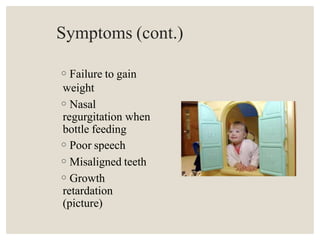
Symptoms (cont.)
◦Failure to gain
weight
◦Nasal
regurgitation when
bottle feeding
◦Poor speech
◦Misaligned teeth
◦Growth
retardation
(picture)
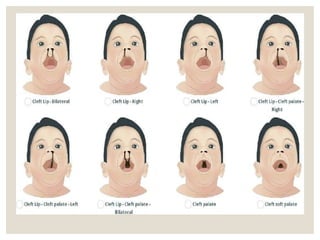
TYPES
◦GROUP- 1 .PREALVEOLAR
◦GROUP- 2 . POST
ALVEOLAR
◦GROUP- 3 . COMBINED
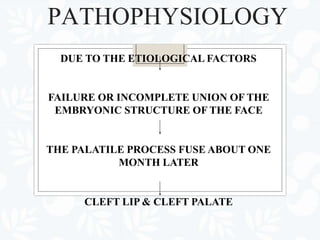
PATHOPHYSIOLOGY
DUE TO THE ETIOLOGICAL FACTORS
FAILURE OR INCOMPLETE UNION OF THE
EMBRYONIC STRUCTURE OF THE FACE
THE PALATILE PROCESS FUSE ABOUT ONE
MONTH LATER
CLEFT LIP & CLEFT PALATE
Diagnostic evaluation
◦ULTRA SONOGRAPHY
◦THOROUGH ASSESSMENT OF
MOUTH
◦IMPAIRED FEEDING
◦DEGREE OF NASAL DEFORMITY
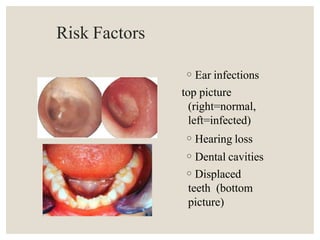
Risk Factors
◦Ear infections
top picture
(right=normal,
left=infected)
◦Hearing loss
◦Dental cavities
◦Displaced
teeth (bottom
picture)
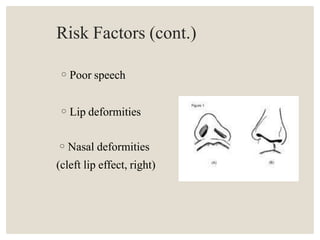
Risk Factors (cont.)
◦Poor speech
◦Lip deformities
◦Nasal deformities
(cleft lip effect, right)
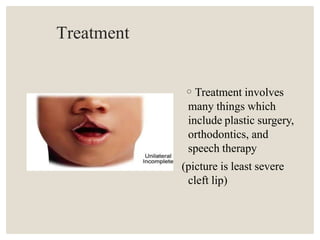
Treatment
◦Treatment involves
many things which
include plastic surgery,
orthodontics, and
speech therapy
(picture is least severe
cleft lip)
First Stage-treatment
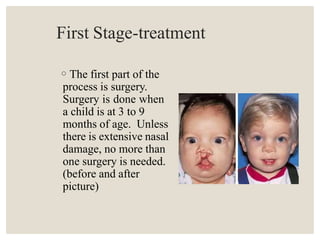
◦The first part of the
process is surgery.
Surgery is done when
a child is at 3 to 9
months of age. Unless
there is extensive nasal
damage, no more than
one surgery is needed.
(before and after
picture)
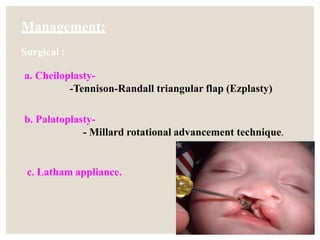
Management:
Surgical :
a. Cheiloplasty-
-Tennison-Randall triangular flap (Ezplasty)
b. Palatoplasty-
- Millard rotational advancement technique.
c. Latham appliance.
Second Stage-therapy
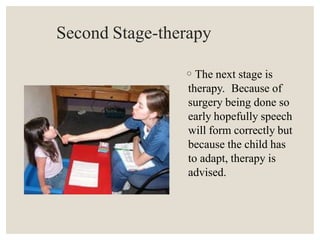
◦The next stage is
therapy. Because of
surgery being done so
early hopefully speech
will form correctly but
because the child has
to adapt, therapy is
advised.
Final Stage-orthodontics
◦The final stage of
treatment is
orthodontics. If as the
child gets older teeth
are not straight you
should see an
orthodontist for
treatment (braces).
Airway Problems
◦More common in Cleft Palate patients with concomitant structural or
functional anomalies.
◦e.g. Pierre-Robin Sequence
◦Micrognathia, Cleft Palate, Glossoptosis
◦May develop airway distress from tongue becoming lodged in palatal defect
Surgical Repair- Cleft Lip
◦Lip Adhesions-
◦2 weeks of age
◦Converts complete cleft into incomplete cleft
◦Serves as temporizing measure for those with feeding problems
◦May interfere with definitive lip repair
◦Less often needed in recent years due to wider variety of specialty feeding
nipples
Surgical Repair- Cleft Lip
◦Cleft lip repaired at 10 weeks
◦Rotation-advancement method- Most common in the
U.S.
◦Nine Landmarks
◦Rotation Flap cuts made first
◦Advancement cuts made next
◦Cleft side nasal ala cuts made last
Surgical Repair- Cleft Palate
◦Several Techniques- Trend is towards less scarring and less tension on palate
◦Scarring of palate may cause impaired mid-facial growth(alveolar
arch collapse, midface retrusion, malocclusion)
◦Facial growth may be less affected if surgery is delayed until 18-24 months,
but feeding, speech, socialization may suffer.
Surgical Repair- Cleft Palate
◦Bardach Method- Two Flap technique
◦Medial incisions made, which separate oral and nasal
mucosa
◦Lateral incisions made at junction of palate and alveolar
ridge
◦Elevate flaps, preserve greater palatine artery.
◦Detach velar muscles from posterior palate
◦Close in 3 layers
Non-Surgical Treatment
◦Dental Obturator
◦For high-risk patients or those that refuse surgery.
◦Advantage- High rate of closure
◦Disadvantage- Need to wear a prosthesis, and need to modify prosthesis as
child grows.
Nursing management:
□Main problems in this condition is feeding and risk
for aspiration.
Feeding:
□Use soft nipples with large hole feeding bottles (Aseptosyringe,
Medicine broker ,spoons ect ).
□Always keep Childs head elevated while feeding
□Use ESSR technique:
E Enlarge nipple.
S Stimulate sucking reflex.
S Swallow the fluid appropriately.
R Rest after feeding.
Conclusions
◦Cleft Lip and Palate are common congenital deformities that often affect
speech, hearing, and cosmesis; and may at times lead to airway compromise.
◦The otolaryngologist is a key member of the cleft palate team, and is in
a unique position to identify and manage many of these problems .

PPT_Cleftlip cleft palate_GI.pptx

  • 1.
    Unit 5 :Digestivesystem Cleft lip cleft palate
  • 2.
    Definition ◦A cleft lipor palate is an abnormal separation in the oral-facial region that happens because tissue of the mouth or lip does not form correctly in fetal development.
  • 3.
    Causes ◦Other birth defects maycause cleft lip or palate ◦Mutated Inherited Genes (gene=top, mutation=bottom) ◦Teratogens (viruses or other toxins that cause abnormalities in the fetus)
  • 4.
    Symptoms ◦Separation of the lip(picture) ◦Separation of the palate (roof of the mouth) ◦Nasal distortion ◦Recurring ear infections
  • 5.
    Symptoms (cont.) ◦Failure togain weight ◦Nasal regurgitation when bottle feeding ◦Poor speech ◦Misaligned teeth ◦Growth retardation (picture)
  • 6.
    TYPES ◦GROUP- 1 .PREALVEOLAR ◦GROUP-2 . POST ALVEOLAR ◦GROUP- 3 . COMBINED
  • 8.
    PATHOPHYSIOLOGY DUE TO THEETIOLOGICAL FACTORS FAILURE OR INCOMPLETE UNION OF THE EMBRYONIC STRUCTURE OF THE FACE THE PALATILE PROCESS FUSE ABOUT ONE MONTH LATER CLEFT LIP & CLEFT PALATE
  • 9.
    Diagnostic evaluation ◦ULTRA SONOGRAPHY ◦THOROUGHASSESSMENT OF MOUTH ◦IMPAIRED FEEDING ◦DEGREE OF NASAL DEFORMITY
  • 10.
    Risk Factors ◦Ear infections toppicture (right=normal, left=infected) ◦Hearing loss ◦Dental cavities ◦Displaced teeth (bottom picture)
  • 11.
    Risk Factors (cont.) ◦Poorspeech ◦Lip deformities ◦Nasal deformities (cleft lip effect, right)
  • 12.
    Treatment ◦Treatment involves many thingswhich include plastic surgery, orthodontics, and speech therapy (picture is least severe cleft lip)
  • 13.
    First Stage-treatment ◦The firstpart of the process is surgery. Surgery is done when a child is at 3 to 9 months of age. Unless there is extensive nasal damage, no more than one surgery is needed. (before and after picture)
  • 14.
    Management: Surgical : a. Cheiloplasty- -Tennison-Randalltriangular flap (Ezplasty) b. Palatoplasty- - Millard rotational advancement technique. c. Latham appliance.
  • 15.
    Second Stage-therapy ◦The nextstage is therapy. Because of surgery being done so early hopefully speech will form correctly but because the child has to adapt, therapy is advised.
  • 16.
    Final Stage-orthodontics ◦The finalstage of treatment is orthodontics. If as the child gets older teeth are not straight you should see an orthodontist for treatment (braces).
  • 17.
    Airway Problems ◦More commonin Cleft Palate patients with concomitant structural or functional anomalies. ◦e.g. Pierre-Robin Sequence ◦Micrognathia, Cleft Palate, Glossoptosis ◦May develop airway distress from tongue becoming lodged in palatal defect
  • 18.
    Surgical Repair- CleftLip ◦Lip Adhesions- ◦2 weeks of age ◦Converts complete cleft into incomplete cleft ◦Serves as temporizing measure for those with feeding problems ◦May interfere with definitive lip repair ◦Less often needed in recent years due to wider variety of specialty feeding nipples
  • 19.
    Surgical Repair- CleftLip ◦Cleft lip repaired at 10 weeks ◦Rotation-advancement method- Most common in the U.S. ◦Nine Landmarks ◦Rotation Flap cuts made first ◦Advancement cuts made next ◦Cleft side nasal ala cuts made last
  • 20.
    Surgical Repair- CleftPalate ◦Several Techniques- Trend is towards less scarring and less tension on palate ◦Scarring of palate may cause impaired mid-facial growth(alveolar arch collapse, midface retrusion, malocclusion) ◦Facial growth may be less affected if surgery is delayed until 18-24 months, but feeding, speech, socialization may suffer.
  • 21.
    Surgical Repair- CleftPalate ◦Bardach Method- Two Flap technique ◦Medial incisions made, which separate oral and nasal mucosa ◦Lateral incisions made at junction of palate and alveolar ridge ◦Elevate flaps, preserve greater palatine artery. ◦Detach velar muscles from posterior palate ◦Close in 3 layers
  • 23.
    Non-Surgical Treatment ◦Dental Obturator ◦Forhigh-risk patients or those that refuse surgery. ◦Advantage- High rate of closure ◦Disadvantage- Need to wear a prosthesis, and need to modify prosthesis as child grows.
  • 24.
    Nursing management: □Main problemsin this condition is feeding and risk for aspiration. Feeding: □Use soft nipples with large hole feeding bottles (Aseptosyringe, Medicine broker ,spoons ect ). □Always keep Childs head elevated while feeding □Use ESSR technique: E Enlarge nipple. S Stimulate sucking reflex. S Swallow the fluid appropriately. R Rest after feeding.
  • 25.
    Conclusions ◦Cleft Lip andPalate are common congenital deformities that often affect speech, hearing, and cosmesis; and may at times lead to airway compromise. ◦The otolaryngologist is a key member of the cleft palate team, and is in a unique position to identify and manage many of these problems .