HYPOSPADIAS
PRESENTED BY-
MR.SANTOSH PANDA
CONTENT
• DEFINITION
• INCIDENT
• ETILOGY
• RISK FACTOR
• SIGN AND SYMPTOMS
• CLASSIFICATION
• DIAGNOSTIC EVALUATION
• MANAGEMENT
• DEFINITION OF HYPOSPADIAS :-
• “ Hypospadias is a congenital
defect of the penis in which
the penis in which the urinary
tract. Opening or urethral
meatus, is abnormally located
on under surface of penis”.
• INCIDENT:-
● Hypospadias occurs in 1
in every 300 male new
born/children.
●There is an increased
incidence of Undescended
testicles in children with
hypospadias.
● RISK FACTORS FOR HYPOSPADIAS:
-
● Maternal:
~ maternal age
~ primiparity
● Paternal:
~ Abnormality of testes and
scrotum.
~ Low spermatozoa motility.
~ Abnormal sperm morphology.
● Fetal:
~ Low birth weight baby.
• ETIOLOGY OF HYPSPADIAS:-
● Hypospadias is present at birth
[congenital]. As the penis
Develops in a male fetus,
certain
Hormones stimulate the
Formation of the urethra and
Foreskin. Hypospadias results
When a malfunction occurs in
The action of these hormones,
Causing the urethra to
• Conti...
● In most cases, the exact
Cause of hypospadias is
Unknown. Sometimes,
Hypospadias is genetic,
but environment also
may
Play a role.
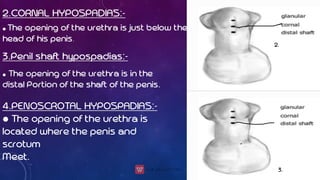
• CLASSIFICATION OF HYPOSPADIAS:-
- There are 5 types of classification in hypospadias:
1.GLANULAR HYPOSPADIAS.
2. CORONAL HYPOSPADIAS.
3.PENIL SHAFT HYPOSPADIAS.
4.PENOSCROTAL
HYPOSPADIAS.
5.PERINEAL HYPOSPADIAS.
1.GLANULAR HYPOSPADIAS:-
● The urethra is within the head of his
penis[glans].
1.
2.CORNAL HYPOSPADIAS:-
● The opening of the urethra is just below the
head of his penis.
3.Penil shaft hypospadias:-
● The opening of the urethra is in the
distal Portion of the shaft of the penis.
4.PENOSCROTAL HYPOSPADIAS:-
● The opening of the urethra is
located where the penis and
scrotum
Meet.
2.
3.
4.
5.
5.PERINEAL HYPOSPADIAS:-
● The urethral meatus open in the
Perineum near the anus ; the scrotum
Is usually cleft.
• SIGN AND SYMPTOMS:-
●Newborns and young children.
●Older children and young adult:
~ May complain of difficulty
directing the urinary stream and
stream spraying.
●Chodee[curvature of the penis]:
-
~ Causes ventral Bending and
bowing of the penile shaft,which
can prevent sexual intercourse.
●Penscrotal and perineal:-
~ Necessitates voiding in the
• Conti...
●Abnormal appearance of penis:-
~caused by deficient or absent ventral
foreskin.
• DIAGNISTIC EVALUATION:-
-
-
-
-
History taking And physical
examination.
Urethroscopy and cystoscopy.
Excretory Urography.
Bladder Usg. 1.
2.
3.
* Urethroscopy procedure
4.
*Cystoscopy procedure
Excretory urography Bladder USG
MANAGEMENT
1.Pharmacological management
2.Medical management
3.Surgical
management
4.Nursing management
1. Pharmacological management:-
● There is no any medicine is available because
hypospadias is the congenital disformity.
2.
~Minor cases of hypospadias, In which the meatus is
located up toward the tip of the glans, may not
require surgical repair and may simply be managed
with observation.
3.Surgical management
●Management begins in the newborn period.
● Circumcision should be avoided, because the foreskin often is
used in the repair.
● The ideal age for repair in a healthy infant is 6-12 months.
~There is no greater risk of general anesthesia at this age
Compared to 2-3year.
~ Penile growth over the next several years is slow.
~ The child not remember the surgical procedure.
~Postoperative analgesic needs are less than in older children.
4.
A. Acute pain.
Goal- To reduce the pain.
Intervantion-Apply the ice compress.
~ provided to the like drugs.
B.Risk for infection.
Goal- To prevent from infection.
Intervantion- Evaluate the patient for
Urinary tract infection.
~ Adequate fluid intake.
~ Administer antibiotics
medication.
C.Impaired Urinary elimination.
Goal- To maintain normal urinary elimination.
Intervantion- Monitor urinary obstruction.
~ Supply adequate fluid orally.
1.Definition.
2.Incident.
3.Risk factor.
4.Etiology.
5.Classification.
6.Sign and symptoms.
7.Diagnostic Evaluation.
8.Management.
ɱ
ٌWrite an Assignment on difference name of
surgery in hypospadias.

hypospadiasis presentation.pdf

  • 1.
  • 2.
    CONTENT • DEFINITION • INCIDENT •ETILOGY • RISK FACTOR • SIGN AND SYMPTOMS • CLASSIFICATION • DIAGNOSTIC EVALUATION • MANAGEMENT
  • 4.
    • DEFINITION OFHYPOSPADIAS :- • “ Hypospadias is a congenital defect of the penis in which the penis in which the urinary tract. Opening or urethral meatus, is abnormally located on under surface of penis”.
  • 5.
    • INCIDENT:- ● Hypospadiasoccurs in 1 in every 300 male new born/children. ●There is an increased incidence of Undescended testicles in children with hypospadias.
  • 6.
    ● RISK FACTORSFOR HYPOSPADIAS: - ● Maternal: ~ maternal age ~ primiparity ● Paternal: ~ Abnormality of testes and scrotum. ~ Low spermatozoa motility. ~ Abnormal sperm morphology. ● Fetal: ~ Low birth weight baby.
  • 7.
    • ETIOLOGY OFHYPSPADIAS:- ● Hypospadias is present at birth [congenital]. As the penis Develops in a male fetus, certain Hormones stimulate the Formation of the urethra and Foreskin. Hypospadias results When a malfunction occurs in The action of these hormones, Causing the urethra to
  • 8.
    • Conti... ● Inmost cases, the exact Cause of hypospadias is Unknown. Sometimes, Hypospadias is genetic, but environment also may Play a role.
  • 9.
    • CLASSIFICATION OFHYPOSPADIAS:- - There are 5 types of classification in hypospadias: 1.GLANULAR HYPOSPADIAS. 2. CORONAL HYPOSPADIAS. 3.PENIL SHAFT HYPOSPADIAS. 4.PENOSCROTAL HYPOSPADIAS. 5.PERINEAL HYPOSPADIAS. 1.GLANULAR HYPOSPADIAS:- ● The urethra is within the head of his penis[glans]. 1.
  • 11.
    2.CORNAL HYPOSPADIAS:- ● Theopening of the urethra is just below the head of his penis. 3.Penil shaft hypospadias:- ● The opening of the urethra is in the distal Portion of the shaft of the penis. 4.PENOSCROTAL HYPOSPADIAS:- ● The opening of the urethra is located where the penis and scrotum Meet. 2. 3.
  • 12.
    4. 5. 5.PERINEAL HYPOSPADIAS:- ● Theurethral meatus open in the Perineum near the anus ; the scrotum Is usually cleft.
  • 14.
    • SIGN ANDSYMPTOMS:- ●Newborns and young children. ●Older children and young adult: ~ May complain of difficulty directing the urinary stream and stream spraying. ●Chodee[curvature of the penis]: - ~ Causes ventral Bending and bowing of the penile shaft,which can prevent sexual intercourse. ●Penscrotal and perineal:- ~ Necessitates voiding in the
  • 15.
    • Conti... ●Abnormal appearanceof penis:- ~caused by deficient or absent ventral foreskin.
  • 17.
    • DIAGNISTIC EVALUATION:- - - - - Historytaking And physical examination. Urethroscopy and cystoscopy. Excretory Urography. Bladder Usg. 1. 2.
  • 18.
  • 19.
  • 20.
  • 21.
  • 22.
  • 23.
    ● There isno any medicine is available because hypospadias is the congenital disformity. 2.
  • 24.
    ~Minor cases ofhypospadias, In which the meatus is located up toward the tip of the glans, may not require surgical repair and may simply be managed with observation. 3.Surgical management
  • 25.
    ●Management begins inthe newborn period. ● Circumcision should be avoided, because the foreskin often is used in the repair. ● The ideal age for repair in a healthy infant is 6-12 months. ~There is no greater risk of general anesthesia at this age Compared to 2-3year. ~ Penile growth over the next several years is slow. ~ The child not remember the surgical procedure. ~Postoperative analgesic needs are less than in older children.
  • 26.
  • 27.
    A. Acute pain. Goal-To reduce the pain. Intervantion-Apply the ice compress. ~ provided to the like drugs. B.Risk for infection. Goal- To prevent from infection. Intervantion- Evaluate the patient for Urinary tract infection. ~ Adequate fluid intake.
  • 28.
    ~ Administer antibiotics medication. C.ImpairedUrinary elimination. Goal- To maintain normal urinary elimination. Intervantion- Monitor urinary obstruction. ~ Supply adequate fluid orally.
  • 29.
  • 31.
    ٌWrite an Assignmenton difference name of surgery in hypospadias.