PAEDIATRICS AND CHILD HEALTH
• NEONATOLOGY
• Hypoglycaemia
Dr. Chongo Shapi (Bsc. HB, MBChB)
- Medical Doctor
3/20/2022 Dr. Chongo Shapi, BSc.HB, MBChB, CUZ. 1
Introduction
• Hypoglycemia is an emergency
- Term babies: < 2.5 mmol/L
- Preterm babies: < 2.2 mmol/L
• Incidence varies with the category of fetal growth and the
nursery feeding protocols
• Early feeding decreases the incidence
• Factors that increase incidence are:
1. Prematurity
2. Hypothermia
3. Hypoxia
4. Maternal diabetes
5. Maternal glucose infusion in labor
6. Intrauterine growth restriction (IUGR)
3/20/2022 Dr. Chongo Shapi, BSc.HB, MBChB, CUZ. 2
• Serum glucose levels decline after birth until 1–3 hr
of age, when levels spontaneously increase in
normal infants
• In healthy term infants, serum glucose values are:
- Rarely <35 mg/dL between 1 and 3 hr of life
- Rarely < 40 mg/dL from 3 to 24 hr
- Rarely <45 mg/dL (2.5 mmol/L) after 24 hr
• Both premature and full-term infants are at risk for
serious neurodevelopmental deficits from equally
low glucose levels
• This risk is related to the depth and duration of the
hypoglycemia
3/20/2022 Dr. Chongo Shapi, BSc.HB, MBChB, CUZ. 3
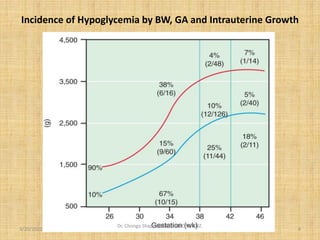
Incidence of Hypoglycemia by BW, GA and Intrauterine Growth
3/20/2022
Dr. Chongo Shapi, BSc.HB, MBChB, CUZ.
.
4
Clinical Manifestations
• In contrast to the frequency of chemical
hypoglycemia, the incidence of symptomatic
hypoglycemia is highest in small for gestational
age infants
• The incidence of symptomatic hypoglycemia
probably varies between 1 and 3 per 1,000 live
births and affects about 5–15% of growth-
restricted infants
• The onset of symptoms varies from a few hours
to a week after birth
3/20/2022 Dr. Chongo Shapi, BSc.HB, MBChB, CUZ. 5
Symptoms:
- Jitteriness or tremors
- Apathy
- Episodes of cyanosis
- Convulsions
- Intermittent apneic
spells or tachypnea
- Weak or high-pitched
cry
- Limpness or lethargy
- Difficulty feeding
- Eye rolling
- Sweating
- Sudden pallor
- Hypothermia
- Cardiac arrest and failure
3/20/2022
Dr. Chongo Shapi, BSc.HB, MBChB, CUZ.
.
6
• These clinical manifestations may result from
various causes
• It is critical therefore to measure serum glucose
levels and determine whether they disappear
with the administration of sufficient glucose to
raise the blood sugar to normal levels
• If they do not, other diagnoses must be
considered
3/20/2022
Dr. Chongo Shapi, BSc.HB, MBChB, CUZ.
.
7
Treatment
• Symptoms other than seizures:
- IV bolus of 200 mg/kg (2 mL/kg) of 10% glucose
• Convulsions:
- 5 mL/kg of 10% glucose as a bolus injection
• After initial therapy, a glucose infusion should be
given at 8 mg/kg/min
3/20/2022
Dr. Chongo Shapi, BSc.HB, MBChB, CUZ.
.
8
• If hypoglycemia recurs, increase the infusion rate
and concentration until 15–20% glucose is used
• If IV infusions of 20% glucose are inadequate to
eliminate symptoms and maintain constant
normal serum glucose concentrations,
hyperinsulinemia is probably present
- Administer diazoxide
• If the diazoxide is unsuccessful, give octreotide
• Infants with severe persistent hyperinsulinemic
hypoglycemia may eventually need to undergo
subtotal pancreatectomy
3/20/2022
Dr. Chongo Shapi, BSc.HB, MBChB, CUZ.
.
9
• Measure serum glucose every 2 hr after initiating
therapy until several determinations are above 40
mg/dL
• Subsequently, measure every 4–6 hr and reduce
treatment gradually
• Finally discontinue when the serum glucose value
has been in the normal range and the baby
asymptomatic for 24–48 hr
• Treatment is usually necessary for a few days to a
week, rarely for several weeks
3/20/2022
Dr. Chongo Shapi, BSc.HB, MBChB, CUZ.
.
10
• Measure serum glucose in infants at increased risk
for hypoglycemia:
- Within 1 hr of birth
- Every 1–2 hr for the 1st 6–8 hr
- Then every 4–6 hr until 24 hr of life
• Normoglycemic high-risk infants should receive oral
or gavage feeding with human milk or formula
started at 1–3 hr of age and continued at 2–3 hr
intervals for 24–48 hr
• An IV infusion of glucose at 4 mg/kg/min should be
provided if oral feedings are poorly tolerated or if
asymptomatic transient neonatal hypoglycemia
develops
3/20/2022 Dr. Chongo Shapi, BSc.HB, MBChB, CUZ. 11
Prognosis
• Good in asymptomatic patients with
hypoglycemia of short duration
• Recurs in 10–15% of infants after adequate
treatment
• Recurrence is more common if IVFs are
extravasated or discontinued too rapidly before
oral feedings are well tolerated
• Children in whom ketotic hypoglycemia later
develops have an increased incidence of neonatal
hypoglycemia
3/20/2022 Dr. Chongo Shapi, BSc.HB, MBChB, CUZ. 12
Prognosis
• The prognosis for normal intellectual function must
be guarded
• This is because prolonged, recurrent, and severe
symptomatic hypoglycemia is associated with
neurologic sequelae
• Symptomatic infants with hypoglycemia, have a
poorer prognosis for subsequent normal intellectual
development than asymptomatic infants do
• This is especially in:
- LBW infants
- Persistent hyperinsulinemic hypoglycemia, and
- Infants of diabetic mothers
3/20/2022 Dr. Chongo Shapi, BSc.HB, MBChB, CUZ. 13
Thanks
3/20/2022
Dr. Chongo Shapi, BSc.HB, MBChB, CUZ.
.
14

Hypoglycemia.pdf

  • 1.
    PAEDIATRICS AND CHILDHEALTH • NEONATOLOGY • Hypoglycaemia Dr. Chongo Shapi (Bsc. HB, MBChB) - Medical Doctor 3/20/2022 Dr. Chongo Shapi, BSc.HB, MBChB, CUZ. 1
  • 2.
    Introduction • Hypoglycemia isan emergency - Term babies: < 2.5 mmol/L - Preterm babies: < 2.2 mmol/L • Incidence varies with the category of fetal growth and the nursery feeding protocols • Early feeding decreases the incidence • Factors that increase incidence are: 1. Prematurity 2. Hypothermia 3. Hypoxia 4. Maternal diabetes 5. Maternal glucose infusion in labor 6. Intrauterine growth restriction (IUGR) 3/20/2022 Dr. Chongo Shapi, BSc.HB, MBChB, CUZ. 2
  • 3.
    • Serum glucoselevels decline after birth until 1–3 hr of age, when levels spontaneously increase in normal infants • In healthy term infants, serum glucose values are: - Rarely <35 mg/dL between 1 and 3 hr of life - Rarely < 40 mg/dL from 3 to 24 hr - Rarely <45 mg/dL (2.5 mmol/L) after 24 hr • Both premature and full-term infants are at risk for serious neurodevelopmental deficits from equally low glucose levels • This risk is related to the depth and duration of the hypoglycemia 3/20/2022 Dr. Chongo Shapi, BSc.HB, MBChB, CUZ. 3
  • 4.
    Incidence of Hypoglycemiaby BW, GA and Intrauterine Growth 3/20/2022 Dr. Chongo Shapi, BSc.HB, MBChB, CUZ. . 4
  • 5.
    Clinical Manifestations • Incontrast to the frequency of chemical hypoglycemia, the incidence of symptomatic hypoglycemia is highest in small for gestational age infants • The incidence of symptomatic hypoglycemia probably varies between 1 and 3 per 1,000 live births and affects about 5–15% of growth- restricted infants • The onset of symptoms varies from a few hours to a week after birth 3/20/2022 Dr. Chongo Shapi, BSc.HB, MBChB, CUZ. 5
  • 6.
    Symptoms: - Jitteriness ortremors - Apathy - Episodes of cyanosis - Convulsions - Intermittent apneic spells or tachypnea - Weak or high-pitched cry - Limpness or lethargy - Difficulty feeding - Eye rolling - Sweating - Sudden pallor - Hypothermia - Cardiac arrest and failure 3/20/2022 Dr. Chongo Shapi, BSc.HB, MBChB, CUZ. . 6
  • 7.
    • These clinicalmanifestations may result from various causes • It is critical therefore to measure serum glucose levels and determine whether they disappear with the administration of sufficient glucose to raise the blood sugar to normal levels • If they do not, other diagnoses must be considered 3/20/2022 Dr. Chongo Shapi, BSc.HB, MBChB, CUZ. . 7
  • 8.
    Treatment • Symptoms otherthan seizures: - IV bolus of 200 mg/kg (2 mL/kg) of 10% glucose • Convulsions: - 5 mL/kg of 10% glucose as a bolus injection • After initial therapy, a glucose infusion should be given at 8 mg/kg/min 3/20/2022 Dr. Chongo Shapi, BSc.HB, MBChB, CUZ. . 8
  • 9.
    • If hypoglycemiarecurs, increase the infusion rate and concentration until 15–20% glucose is used • If IV infusions of 20% glucose are inadequate to eliminate symptoms and maintain constant normal serum glucose concentrations, hyperinsulinemia is probably present - Administer diazoxide • If the diazoxide is unsuccessful, give octreotide • Infants with severe persistent hyperinsulinemic hypoglycemia may eventually need to undergo subtotal pancreatectomy 3/20/2022 Dr. Chongo Shapi, BSc.HB, MBChB, CUZ. . 9
  • 10.
    • Measure serumglucose every 2 hr after initiating therapy until several determinations are above 40 mg/dL • Subsequently, measure every 4–6 hr and reduce treatment gradually • Finally discontinue when the serum glucose value has been in the normal range and the baby asymptomatic for 24–48 hr • Treatment is usually necessary for a few days to a week, rarely for several weeks 3/20/2022 Dr. Chongo Shapi, BSc.HB, MBChB, CUZ. . 10
  • 11.
    • Measure serumglucose in infants at increased risk for hypoglycemia: - Within 1 hr of birth - Every 1–2 hr for the 1st 6–8 hr - Then every 4–6 hr until 24 hr of life • Normoglycemic high-risk infants should receive oral or gavage feeding with human milk or formula started at 1–3 hr of age and continued at 2–3 hr intervals for 24–48 hr • An IV infusion of glucose at 4 mg/kg/min should be provided if oral feedings are poorly tolerated or if asymptomatic transient neonatal hypoglycemia develops 3/20/2022 Dr. Chongo Shapi, BSc.HB, MBChB, CUZ. 11
  • 12.
    Prognosis • Good inasymptomatic patients with hypoglycemia of short duration • Recurs in 10–15% of infants after adequate treatment • Recurrence is more common if IVFs are extravasated or discontinued too rapidly before oral feedings are well tolerated • Children in whom ketotic hypoglycemia later develops have an increased incidence of neonatal hypoglycemia 3/20/2022 Dr. Chongo Shapi, BSc.HB, MBChB, CUZ. 12
  • 13.
    Prognosis • The prognosisfor normal intellectual function must be guarded • This is because prolonged, recurrent, and severe symptomatic hypoglycemia is associated with neurologic sequelae • Symptomatic infants with hypoglycemia, have a poorer prognosis for subsequent normal intellectual development than asymptomatic infants do • This is especially in: - LBW infants - Persistent hyperinsulinemic hypoglycemia, and - Infants of diabetic mothers 3/20/2022 Dr. Chongo Shapi, BSc.HB, MBChB, CUZ. 13
  • 14.
    Thanks 3/20/2022 Dr. Chongo Shapi,BSc.HB, MBChB, CUZ. . 14