Baurillard & hyperreality
L/O: to understand (the theory of)
hyperreality and be able to apply this
theory to case studies
Baudrillard
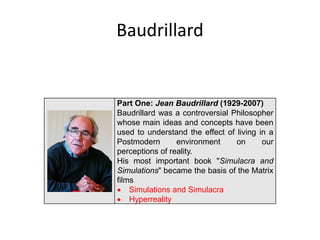
Part One: Jean Baudrillard (1929-2007)
Baudrillard was a controversial Philosopher
whose main ideas and concepts have been
used to understand the effect of living in a
Postmodern environment on our
perceptions of reality.
His most important book "Simulacra and
Simulations" became the basis of the Matrix
films
 Simulations and Simulacra
 Hyperreality
Hyperreality – good definition
• In semiotics and postmodernism, hyperreality is an inability of
consciousness to distinguish reality from a simulation of reality,
especially in technologically advanced postmodern societies.
– In other words: you can’t tell the difference between what’s real and
what’s a simulation of real
• The effect of Postmodernism on the Audience can be extensive
and can alter our perceptions of the media and reality as the
media and reality merge.
• Baudrillard defined ``hyperreality'' as ``the generation by models of
a real without origin or reality ``, it is a representation, a sign,
without an original referent.
• There is no truth
• Hyperreality: it’s more real than real, to the
extreme!
• Baurillard argues there is nothing underneath
illusion, just other illusions.
– Copy, copy, copy
Some main ideas
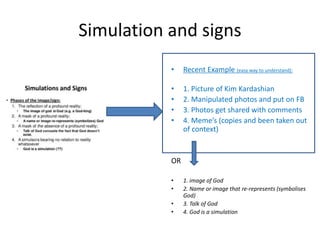
Simulation and signs
• Recent Example (easy way to understand):
• 1. Picture of Kim Kardashian
• 2. Manipulated photos and put on FB
• 3. Photos get shared with comments
• 4. Meme’s (copies and been taken out
of context)
OR
• 1. image of God
• 2. Name or image that re-represents (symbolises
God)
• 3. Talk of God
• 4. God is a simulation
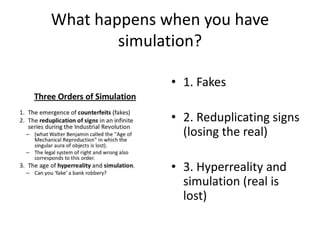
What happens when you have
simulation?
• 1. Fakes
• 2. Reduplicating signs
(losing the real)
• 3. Hyperreality and
simulation (real is
lost)
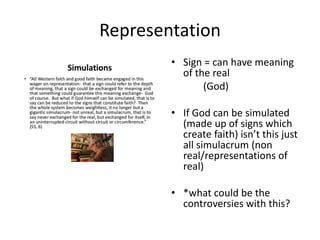
Representation
• Sign = can have meaning
of the real
(God)
• If God can be simulated
(made up of signs which
create faith) isn’t this just
all simulacrum (non
real/representations of
real)
• *what could be the
controversies with this?
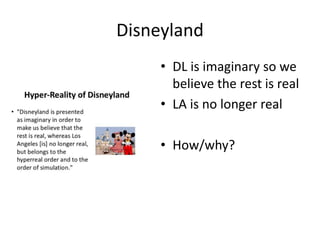
Disneyland
• DL is imaginary so we
believe the rest is real
• LA is no longer real
• How/why?
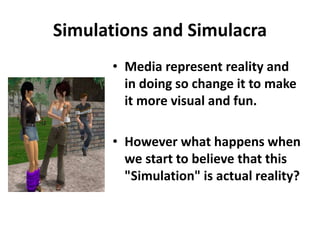
Simulations and Simulacra
• Media represent reality and
in doing so change it to make
it more visual and fun.
• However what happens when
we start to believe that this
"Simulation" is actual reality?
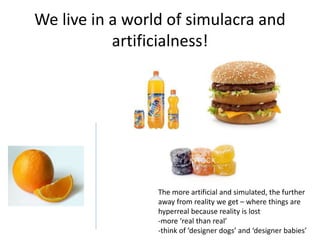
We live in a world of simulacra and
artificialness!
The more artificial and simulated, the further
away from reality we get – where things are
hyperreal because reality is lost
-more ‘real than real’
-think of ‘designer dogs’ and ‘designer babies’
• The effect of living in Simulacra is……..
a distorted sense of reality or Hyperreality.
Activity: Chinese Drawings
• You will each get told to draw an object, then
you pass it on and that person draws that
object, you pass it on again…..
• How far from the original are the 2, 3, 4
drawings?
Hyperreality
Key Term: Hyperreality
Was first described by the
Philosopher Jean Baudrillard were
he suggested that the media can
now create such idealistic
representations of reality that out
perform actual reality.
The audience is left feeling
depressed as they're own life
doesn't live up to artificial reality.
Baudrillard and Aspirational TV
http://www.youtube.com/watch?v=59OJ17raqWw
• How can we see the hyperreal world of TV
advertising as a simulation of Reality?
• What effects will this have on the public?
– How has aspirational tv/media changed?
– What was difference in 80’s vs now? Examples?
– What’s the effect of this type of media?
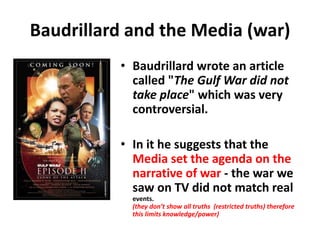
Baudrillard and the Media (war)
• Baudrillard wrote an article
called "The Gulf War did not
take place" which was very
controversial.
• In it he suggests that the
Media set the agenda on the
narrative of war - the war we
saw on TV did not match real
events.
(they don’t show all truths (restricted truths) therefore
this limits knowledge/power)
War and hyperreality
• Fact/reality: US lost the
Vietnam war
• Films represent it as though
they won
– Representation of
determination
– Representation of
defeat/stregth
• The more we see these re-
representations the further the
truth is (hyperreality!!!!)
•
How does this relate to idea
about recreation of stories in
film and new target audiences?
Other war events?
• How can we use Baudrillard's ideas to
understand recent events such as ISIS?
Marilyn Manson
Bowling for Columbine
• https://www.youtube.com/watch?v=cYApo2d
8o_A
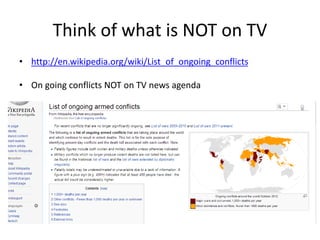
Think of what is NOT on TV
• http://en.wikipedia.org/wiki/List_of_ongoing_conflicts
• On going conflicts NOT on TV news agenda
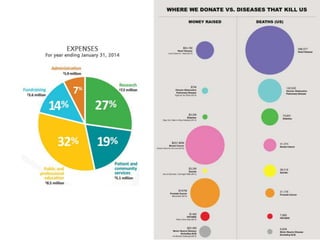
Social Media & Charity
• ALS ice bucket challenge and no make up selfie’s
• What is the agenda of these charities?
• How do they represent/portray the ‘victims’?
• What do they encourage you to do and why?
• What are the positives/negatives of the campaigns?
• Do they make a difference?
• What was the backlash of the campaigns? (debate)
• How can we link these to pomo?
• Are these campaigns positive or negative? Why?
Baudrillard and Hyper-sexuality
• Watch the following news links on the recent report into
Media representations of gender.
• http://news.bbc.co.uk/today/hi/today/newsid_8538000/85
38207.stm (the whole of society is hyper-sexualized’)
• http://news.bbc.co.uk/1/hi/uk/8538179.stm (children of
both genders are over-exposed to sexual imagery’)
• http://news.bbc.co.uk/1/hi/uk/8537757.stm(media blamed
for sexualization of young girls’)
Discussion points
• NATURE vs NUTURE DEBATE!!!
• Sexuality in media?
• Music videos?
• How has it changed?
• Institution or personal responsibility?
• What would you do to protect your children?
• What are positive and negative sides of the argument?
• How has it changed over time? How does it compare
to sexuality previously?
• What campaigns go against the ideologies ? (to try to
end these values/ideals)
More debates…..documentaries
• http://www.bbc.co.uk/programmes/b0441whb
• Documentary is called ‘Porn on the brain’ by channel 4
which explores the issue of exposure of porn to young
people in UK
• http://www.dailymail.co.uk/video/news/video-
1040803/Documentary-investigates-effect-online-porn-
teens.html
• Institutional responsibility?
• Personal responsibility?
The debate = should this happen?
• Using the concept of Hyperreality apply it to the
ongoing debates of sexual imagery and children:
– Should the media represent hyper-sexual/hyper-
beauty (idealistic) representations?
• Yes? = why? – free speech, democracy, money/profit
• No? = why? – sets up false expectations/aspirations that
people cannot reach = they feel inadequate
– How can you apply Baudrillards ideas to virtual
worlds like The Sims?
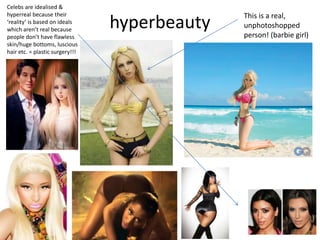
hyperbeauty
This is a real,
unphotoshopped
person! (barbie girl)
Celebs are idealised &
hyperreal because their
‘reality’ is based on ideals
which aren’t real because
people don’t have flawless
skin/huge bottoms, luscious
hair etc. = plastic surgery!!!
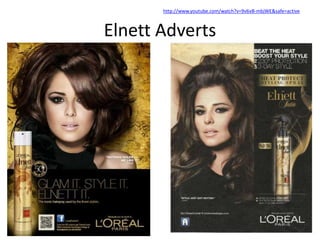
Elnett Adverts
http://www.youtube.com/watch?v=9v6vB-mbjWE&safe=active
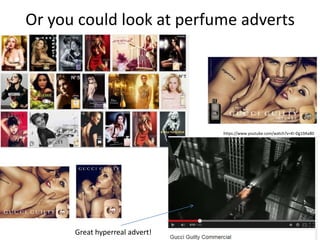
Or you could look at perfume adverts
Great hyperreal advert!
https://www.youtube.com/watch?v=KI-Dg19Aa80
Dove evolution advert
• Hyperreal beauty (evolution) was one of the first ones
http://www.nextnature.net/2007/03/simulacra-for-
dummies/
Simulacra for Dummies
• ….it seems appropriate to post (above website) this
movie as an ultimate “Simulacra for Dummies”. This
movie is quite known and probably already posted on
this blog. But just in case, here it is once more: the
“Evolution” movie made by Dove.
The construction of reality.
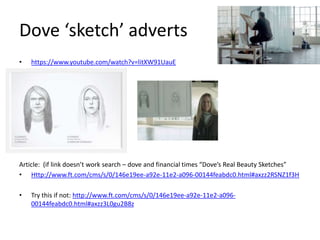
Dove ‘sketch’ adverts
• https://www.youtube.com/watch?v=litXW91UauE
Article: (if link doesn’t work search – dove and financial times “Dove’s Real Beauty Sketches”
• Http://www.ft.com/cms/s/0/146e19ee-a92e-11e2-a096-00144feabdc0.html#axzz2RSNZ1f3H
• Try this if not: http://www.ft.com/cms/s/0/146e19ee-a92e-11e2-a096-
00144feabdc0.html#axzz3L0gu2B8z
How does the sketch campaign differ
from traditional media/traditional
adverts/theory of representation?
• Non product advertising
• Non product display
• More about ‘trust’ or belief in ‘dove’ as a company
– Changing audiences – we are almost ‘guilted’ into buying into companies that are ‘ethical’
(zizek theory:
– https://www.youtube.com/watch?v=P18UK5IMRDI
– We buy into LIFESTYLE rather than products (similar to john lewis/m&s christmas adverts – not
about products!!!)
• Linear narrative (not enigmatic
• Counter stereotypes (not typical representation/stereotypes/archetypes)
• What else???????
• But still binary opposition/solution based (like traditional media/adverts)
Controversy with dove
• http://www.youtube.com/watch?v=pKLDEj73gGQ&safe=active
• Article:
• http://www.businessinsider.com/why-people-hate-doves-real-beauty-ad-2013-4
• People fighting back??? https://www.youtube.com/watch?v=GXoZLPSw8U8 (try - music video)
•
-what do you think about this music video/artist in response to ‘hyperbeauty’????
• Is it progressive?
dove
2013 – sketch artist idea for advert (to show
pretty/ugly……seems positive to reflect that everyone
is beautiful
BUT
Emphasis on beauty – outer beauty/image (let’s face
it – they wouldn’t have a model with a deformity
would they?)
Extension – dove parody
Dove parody
• https://www.youtube.com/watch?v=MFvNNSTwN_4
• Article:
• http://www.huffingtonpost.co.uk/2013/04/22/dove-real-beauty-sketches-reactions-parody-
video-blog-critics_n_3130929.html?utm_hp_ref=uk
Debate with dove
How is it positive? Is it progressive? How is it negative? What are the
controversies?
This girl can
• https://www.youtube.com/watch?v=MkLUyhmJbto
• http://www.thisgirlcan.co.uk/ (lottery + sport england charity)
Like a girl
Aired during superbowl
• https://www.youtube.com/watch?v=XjJQBjWYDTs
• https://www.youtube.com/watch?v=E1xGVYA5Aqo boy interview
• More about the campaign: http://www.always.com/en-us/likeagirl.aspx (always
P&G)
• Huffington post article: http://www.huffingtonpost.com/2015/01/29/like-a-girl-
super-bowl_n_6572568.html
• Article: http://www.dailymail.co.uk/news/article-2936819/Backlash-empowering-
Like-Girl-Super-Bowl-commercial-sparks-likeaboy-hashtag-Twitter.html
New 2016 one…..(emoji’s)
• https://www.youtube.com/watch?v=L3BjUvjO
UMc
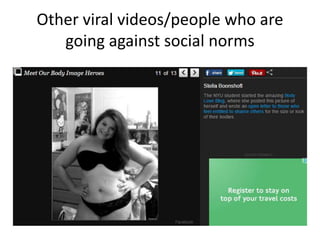
Other viral videos/people who are
going against social norms
Other videos/campaigns?
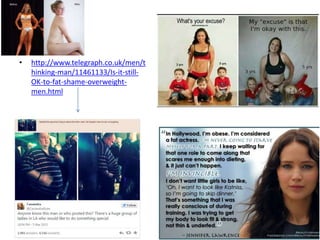
• Fat shaming?
• Ugly shaming?
• Does it still happen? Why?
• How does audiences perpetuate this?
• How do audiences challenge it?
• HOW and WHY?
• Are we truly progressive about body image?
• http://www.telegraph.co.uk/men/t
hinking-man/11461133/Is-it-still-
OK-to-fat-shame-overweight-
men.html
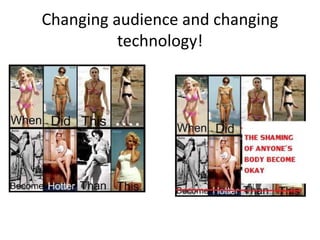
Changing audience and changing
technology!
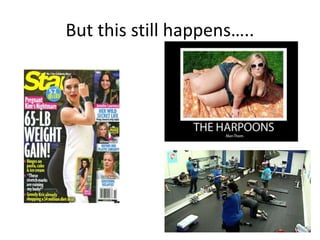
But this still happens…..
But there’s more controversy!!!
• https://www.youtube.com/watch?v=A2QB00ZXb
pA
• ‘the truth about
‘fat shaming’
and wider political
issues…
• Shouldn’t it be
about CHOICE?
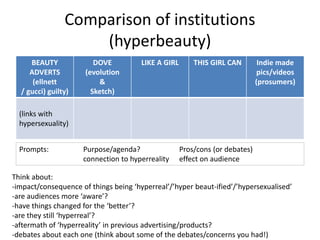
Comparison of institutions
(hyperbeauty)
BEAUTY
ADVERTS
(ellnett
/ gucci) guilty)
DOVE
(evolution
&
Sketch)
LIKE A GIRL THIS GIRL CAN Indie made
pics/videos
(prosumers)
(links with
hypersexuality)
Think about:
-impact/consequence of things being ‘hyperreal’/’hyper beaut-ified’/’hypersexualised’
-are audiences more ‘aware’?
-have things changed for the ‘better’?
-are they still ‘hyperreal’?
-aftermath of ‘hyperreality’ in previous advertising/products?
-debates about each one (think about some of the debates/concerns you had!)
Prompts: Purpose/agenda? Pros/cons (or debates)
connection to hyperreality effect on audience
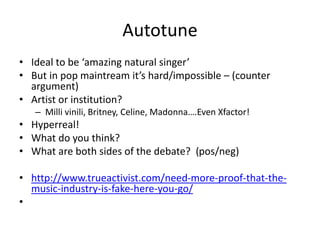
Autotune
• Ideal to be ‘amazing natural singer’
• But in pop maintream it’s hard/impossible – (counter
argument)
• Artist or institution?
– Milli vinili, Britney, Celine, Madonna….Even Xfactor!
• Hyperreal!
• What do you think?
• What are both sides of the debate? (pos/neg)
• http://www.trueactivist.com/need-more-proof-that-the-
music-industry-is-fake-here-you-go/
•
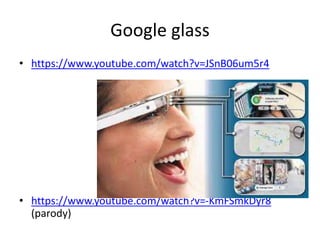
Google glass
• https://www.youtube.com/watch?v=JSnB06um5r4
• https://www.youtube.com/watch?v=-KmFSmkDyr8
(parody)
Oculus Rift
• Virtual reality
• Immersive
• Easy to lose touch with reality (blurring reality and simulation of reality)
• Issues?
– Addiction?
– Forget/lose touch with reality?
– Physical effects/damage?
– Laziness – not having to exercise or socialise – FLATTENING OF EFFECT!! (meet
up with friends online)
– Arguments for: new/advanced/interesting/engaging, creativity amongst
developers (however, creativity is taken away among the consumer/players)
– Connection with 360 videos on youtube?
Comparison to traditional media
• It’s nothing new? (still hyperreal in printed media – such as
newspapers)
• Traditional advertising: less digital? Still aspire to represent
in idealised way
• Role of technology?
– Gives us the means or channels to ‘construct’ reality / reshape
reality (simulate!)
– Advanced so far that it’s SO real (more real than real –
outperforming reality)
– Simulate senses – (so it’s so realistic)
– i.e. 4D printing – simulating organic materials
BLACK MIRROR: (be right back) – simulating a human (like ash on the
episode – you can never fully construct reality)
– Dependence
– Devalue ‘authenticity’ or ‘realness’ (ie face-to-face relationships)
(FLATTENING OF EFFECT!)
representation
• Ideology – hyper-beauty/sexuality etc
Summary
Baudrillard
 The media presents a simulation of the world
that is artificial and hyperreal
 Some audiences read the hyperreal
representation as reality - hyper-sexuality
 The representation of reality is mediated
through the media - war reporting
Hyperreal Case study checklist
• Simulation video games (oculus rift…)
• Simulation technology (virtual reality…..google glass)
• ALS ice bucket challenge
• No make up selfie
• War in the news (tv/print)
• Kim Kardashian meme
• Genetically modified food/organisms (GMO)
• Barbie girl/Nicki Minaj
• Dove (sketches campaign)
– Dove parody
• This Girl Can campaign
• Like a girl campaign (like a girl and emoji one)
• Ellnett hairspray OR Gucci guilty perfume advert
• Autotuning
• Black mirror
• RAG each one….
Homework
• REVISE CASE STUDIES
• Make notes on:
– How they’re postmodern
– Debates within them, are they useful?
• Arguments for/against
– How they are similar/different to other case studies
– How they compare to traditional media
– Impact on audiences
– Are they controversial? How/why?
– Representation: how are people/places/things represented? Do
they challenge traditional theories of representation?
Next lesson
• Mark scheme
• Then…..Looking at past papers

Hyperreality

  • 1.
    Baurillard & hyperreality L/O:to understand (the theory of) hyperreality and be able to apply this theory to case studies
  • 2.
    Baudrillard Part One: JeanBaudrillard (1929-2007) Baudrillard was a controversial Philosopher whose main ideas and concepts have been used to understand the effect of living in a Postmodern environment on our perceptions of reality. His most important book "Simulacra and Simulations" became the basis of the Matrix films  Simulations and Simulacra  Hyperreality
  • 3.
    Hyperreality – gooddefinition • In semiotics and postmodernism, hyperreality is an inability of consciousness to distinguish reality from a simulation of reality, especially in technologically advanced postmodern societies. – In other words: you can’t tell the difference between what’s real and what’s a simulation of real • The effect of Postmodernism on the Audience can be extensive and can alter our perceptions of the media and reality as the media and reality merge. • Baudrillard defined ``hyperreality'' as ``the generation by models of a real without origin or reality ``, it is a representation, a sign, without an original referent.
  • 4.
    • There isno truth • Hyperreality: it’s more real than real, to the extreme! • Baurillard argues there is nothing underneath illusion, just other illusions. – Copy, copy, copy Some main ideas
  • 5.
    Simulation and signs •Recent Example (easy way to understand): • 1. Picture of Kim Kardashian • 2. Manipulated photos and put on FB • 3. Photos get shared with comments • 4. Meme’s (copies and been taken out of context) OR • 1. image of God • 2. Name or image that re-represents (symbolises God) • 3. Talk of God • 4. God is a simulation
  • 6.
    What happens whenyou have simulation? • 1. Fakes • 2. Reduplicating signs (losing the real) • 3. Hyperreality and simulation (real is lost)
  • 7.
    Representation • Sign =can have meaning of the real (God) • If God can be simulated (made up of signs which create faith) isn’t this just all simulacrum (non real/representations of real) • *what could be the controversies with this?
  • 8.
    Disneyland • DL isimaginary so we believe the rest is real • LA is no longer real • How/why?
  • 9.
    Simulations and Simulacra •Media represent reality and in doing so change it to make it more visual and fun. • However what happens when we start to believe that this "Simulation" is actual reality?
  • 10.
    We live ina world of simulacra and artificialness! The more artificial and simulated, the further away from reality we get – where things are hyperreal because reality is lost -more ‘real than real’ -think of ‘designer dogs’ and ‘designer babies’
  • 11.
    • The effectof living in Simulacra is…….. a distorted sense of reality or Hyperreality.
  • 12.
    Activity: Chinese Drawings •You will each get told to draw an object, then you pass it on and that person draws that object, you pass it on again….. • How far from the original are the 2, 3, 4 drawings?
  • 13.
    Hyperreality Key Term: Hyperreality Wasfirst described by the Philosopher Jean Baudrillard were he suggested that the media can now create such idealistic representations of reality that out perform actual reality. The audience is left feeling depressed as they're own life doesn't live up to artificial reality.
  • 14.
    Baudrillard and AspirationalTV http://www.youtube.com/watch?v=59OJ17raqWw • How can we see the hyperreal world of TV advertising as a simulation of Reality? • What effects will this have on the public? – How has aspirational tv/media changed? – What was difference in 80’s vs now? Examples? – What’s the effect of this type of media?
  • 15.
    Baudrillard and theMedia (war) • Baudrillard wrote an article called "The Gulf War did not take place" which was very controversial. • In it he suggests that the Media set the agenda on the narrative of war - the war we saw on TV did not match real events. (they don’t show all truths (restricted truths) therefore this limits knowledge/power)
  • 16.
    War and hyperreality •Fact/reality: US lost the Vietnam war • Films represent it as though they won – Representation of determination – Representation of defeat/stregth • The more we see these re- representations the further the truth is (hyperreality!!!!) • How does this relate to idea about recreation of stories in film and new target audiences?
  • 17.
    Other war events? •How can we use Baudrillard's ideas to understand recent events such as ISIS?
  • 18.
    Marilyn Manson Bowling forColumbine • https://www.youtube.com/watch?v=cYApo2d 8o_A
  • 19.
    Think of whatis NOT on TV • http://en.wikipedia.org/wiki/List_of_ongoing_conflicts • On going conflicts NOT on TV news agenda
  • 20.
    Social Media &Charity • ALS ice bucket challenge and no make up selfie’s • What is the agenda of these charities? • How do they represent/portray the ‘victims’? • What do they encourage you to do and why? • What are the positives/negatives of the campaigns? • Do they make a difference? • What was the backlash of the campaigns? (debate) • How can we link these to pomo? • Are these campaigns positive or negative? Why?
  • 22.
    Baudrillard and Hyper-sexuality •Watch the following news links on the recent report into Media representations of gender. • http://news.bbc.co.uk/today/hi/today/newsid_8538000/85 38207.stm (the whole of society is hyper-sexualized’) • http://news.bbc.co.uk/1/hi/uk/8538179.stm (children of both genders are over-exposed to sexual imagery’) • http://news.bbc.co.uk/1/hi/uk/8537757.stm(media blamed for sexualization of young girls’)
  • 23.
    Discussion points • NATUREvs NUTURE DEBATE!!! • Sexuality in media? • Music videos? • How has it changed? • Institution or personal responsibility? • What would you do to protect your children? • What are positive and negative sides of the argument? • How has it changed over time? How does it compare to sexuality previously? • What campaigns go against the ideologies ? (to try to end these values/ideals)
  • 24.
    More debates…..documentaries • http://www.bbc.co.uk/programmes/b0441whb •Documentary is called ‘Porn on the brain’ by channel 4 which explores the issue of exposure of porn to young people in UK • http://www.dailymail.co.uk/video/news/video- 1040803/Documentary-investigates-effect-online-porn- teens.html • Institutional responsibility? • Personal responsibility?
  • 25.
    The debate =should this happen? • Using the concept of Hyperreality apply it to the ongoing debates of sexual imagery and children: – Should the media represent hyper-sexual/hyper- beauty (idealistic) representations? • Yes? = why? – free speech, democracy, money/profit • No? = why? – sets up false expectations/aspirations that people cannot reach = they feel inadequate – How can you apply Baudrillards ideas to virtual worlds like The Sims?
  • 26.
    hyperbeauty This is areal, unphotoshopped person! (barbie girl) Celebs are idealised & hyperreal because their ‘reality’ is based on ideals which aren’t real because people don’t have flawless skin/huge bottoms, luscious hair etc. = plastic surgery!!!
  • 27.
  • 28.
    Or you couldlook at perfume adverts Great hyperreal advert! https://www.youtube.com/watch?v=KI-Dg19Aa80
  • 29.
    Dove evolution advert •Hyperreal beauty (evolution) was one of the first ones http://www.nextnature.net/2007/03/simulacra-for- dummies/ Simulacra for Dummies • ….it seems appropriate to post (above website) this movie as an ultimate “Simulacra for Dummies”. This movie is quite known and probably already posted on this blog. But just in case, here it is once more: the “Evolution” movie made by Dove. The construction of reality.
  • 30.
    Dove ‘sketch’ adverts •https://www.youtube.com/watch?v=litXW91UauE Article: (if link doesn’t work search – dove and financial times “Dove’s Real Beauty Sketches” • Http://www.ft.com/cms/s/0/146e19ee-a92e-11e2-a096-00144feabdc0.html#axzz2RSNZ1f3H • Try this if not: http://www.ft.com/cms/s/0/146e19ee-a92e-11e2-a096- 00144feabdc0.html#axzz3L0gu2B8z
  • 31.
    How does thesketch campaign differ from traditional media/traditional adverts/theory of representation? • Non product advertising • Non product display • More about ‘trust’ or belief in ‘dove’ as a company – Changing audiences – we are almost ‘guilted’ into buying into companies that are ‘ethical’ (zizek theory: – https://www.youtube.com/watch?v=P18UK5IMRDI – We buy into LIFESTYLE rather than products (similar to john lewis/m&s christmas adverts – not about products!!!) • Linear narrative (not enigmatic • Counter stereotypes (not typical representation/stereotypes/archetypes) • What else??????? • But still binary opposition/solution based (like traditional media/adverts)
  • 32.
    Controversy with dove •http://www.youtube.com/watch?v=pKLDEj73gGQ&safe=active • Article: • http://www.businessinsider.com/why-people-hate-doves-real-beauty-ad-2013-4 • People fighting back??? https://www.youtube.com/watch?v=GXoZLPSw8U8 (try - music video) • -what do you think about this music video/artist in response to ‘hyperbeauty’???? • Is it progressive? dove 2013 – sketch artist idea for advert (to show pretty/ugly……seems positive to reflect that everyone is beautiful BUT Emphasis on beauty – outer beauty/image (let’s face it – they wouldn’t have a model with a deformity would they?)
  • 33.
    Extension – doveparody Dove parody • https://www.youtube.com/watch?v=MFvNNSTwN_4 • Article: • http://www.huffingtonpost.co.uk/2013/04/22/dove-real-beauty-sketches-reactions-parody- video-blog-critics_n_3130929.html?utm_hp_ref=uk
  • 34.
    Debate with dove Howis it positive? Is it progressive? How is it negative? What are the controversies?
  • 35.
    This girl can •https://www.youtube.com/watch?v=MkLUyhmJbto • http://www.thisgirlcan.co.uk/ (lottery + sport england charity)
  • 36.
    Like a girl Airedduring superbowl • https://www.youtube.com/watch?v=XjJQBjWYDTs • https://www.youtube.com/watch?v=E1xGVYA5Aqo boy interview • More about the campaign: http://www.always.com/en-us/likeagirl.aspx (always P&G) • Huffington post article: http://www.huffingtonpost.com/2015/01/29/like-a-girl- super-bowl_n_6572568.html • Article: http://www.dailymail.co.uk/news/article-2936819/Backlash-empowering- Like-Girl-Super-Bowl-commercial-sparks-likeaboy-hashtag-Twitter.html
  • 37.
    New 2016 one…..(emoji’s) •https://www.youtube.com/watch?v=L3BjUvjO UMc
  • 38.
    Other viral videos/peoplewho are going against social norms
  • 39.
    Other videos/campaigns? • Fatshaming? • Ugly shaming? • Does it still happen? Why? • How does audiences perpetuate this? • How do audiences challenge it? • HOW and WHY? • Are we truly progressive about body image?
  • 40.
  • 41.
    Changing audience andchanging technology!
  • 42.
    But this stillhappens…..
  • 43.
    But there’s morecontroversy!!! • https://www.youtube.com/watch?v=A2QB00ZXb pA • ‘the truth about ‘fat shaming’ and wider political issues… • Shouldn’t it be about CHOICE?
  • 44.
    Comparison of institutions (hyperbeauty) BEAUTY ADVERTS (ellnett /gucci) guilty) DOVE (evolution & Sketch) LIKE A GIRL THIS GIRL CAN Indie made pics/videos (prosumers) (links with hypersexuality) Think about: -impact/consequence of things being ‘hyperreal’/’hyper beaut-ified’/’hypersexualised’ -are audiences more ‘aware’? -have things changed for the ‘better’? -are they still ‘hyperreal’? -aftermath of ‘hyperreality’ in previous advertising/products? -debates about each one (think about some of the debates/concerns you had!) Prompts: Purpose/agenda? Pros/cons (or debates) connection to hyperreality effect on audience
  • 45.
    Autotune • Ideal tobe ‘amazing natural singer’ • But in pop maintream it’s hard/impossible – (counter argument) • Artist or institution? – Milli vinili, Britney, Celine, Madonna….Even Xfactor! • Hyperreal! • What do you think? • What are both sides of the debate? (pos/neg) • http://www.trueactivist.com/need-more-proof-that-the- music-industry-is-fake-here-you-go/ •
  • 46.
    Google glass • https://www.youtube.com/watch?v=JSnB06um5r4 •https://www.youtube.com/watch?v=-KmFSmkDyr8 (parody)
  • 47.
    Oculus Rift • Virtualreality • Immersive • Easy to lose touch with reality (blurring reality and simulation of reality) • Issues? – Addiction? – Forget/lose touch with reality? – Physical effects/damage? – Laziness – not having to exercise or socialise – FLATTENING OF EFFECT!! (meet up with friends online) – Arguments for: new/advanced/interesting/engaging, creativity amongst developers (however, creativity is taken away among the consumer/players) – Connection with 360 videos on youtube?
  • 48.
    Comparison to traditionalmedia • It’s nothing new? (still hyperreal in printed media – such as newspapers) • Traditional advertising: less digital? Still aspire to represent in idealised way • Role of technology? – Gives us the means or channels to ‘construct’ reality / reshape reality (simulate!) – Advanced so far that it’s SO real (more real than real – outperforming reality) – Simulate senses – (so it’s so realistic) – i.e. 4D printing – simulating organic materials BLACK MIRROR: (be right back) – simulating a human (like ash on the episode – you can never fully construct reality) – Dependence – Devalue ‘authenticity’ or ‘realness’ (ie face-to-face relationships) (FLATTENING OF EFFECT!)
  • 49.
    representation • Ideology –hyper-beauty/sexuality etc
  • 50.
    Summary Baudrillard  The mediapresents a simulation of the world that is artificial and hyperreal  Some audiences read the hyperreal representation as reality - hyper-sexuality  The representation of reality is mediated through the media - war reporting
  • 51.
    Hyperreal Case studychecklist • Simulation video games (oculus rift…) • Simulation technology (virtual reality…..google glass) • ALS ice bucket challenge • No make up selfie • War in the news (tv/print) • Kim Kardashian meme • Genetically modified food/organisms (GMO) • Barbie girl/Nicki Minaj • Dove (sketches campaign) – Dove parody • This Girl Can campaign • Like a girl campaign (like a girl and emoji one) • Ellnett hairspray OR Gucci guilty perfume advert • Autotuning • Black mirror • RAG each one….
  • 52.
    Homework • REVISE CASESTUDIES • Make notes on: – How they’re postmodern – Debates within them, are they useful? • Arguments for/against – How they are similar/different to other case studies – How they compare to traditional media – Impact on audiences – Are they controversial? How/why? – Representation: how are people/places/things represented? Do they challenge traditional theories of representation?
  • 53.
    Next lesson • Markscheme • Then…..Looking at past papers