BAUDRILLARD – 
MEDIA THEORY 
Mary Medrana
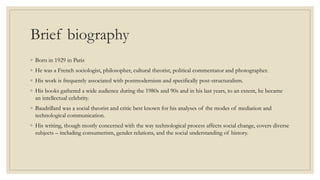
Brief biography 
◦ Born in 1929 in Paris 
◦ He was a French sociologist, philosopher, cultural theorist, political commentator and photographer. 
◦ His work is frequently associated with postmodernism and specifically post-structuralism. 
◦ His books gathered a wide audience during the 1980s and 90s and in his last years, to an extent, he became 
an intellectual celebrity. 
◦ Baudrillard was a social theorist and critic best known for his analyses of the modes of mediation and 
technological communication. 
◦ His writing, though mostly concerned with the way technological process affects social change, covers diverse 
subjects – including consumerism, gender relations, and the social understanding of history.
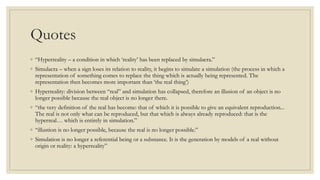
Quotes 
◦ “Hyperreality – a condition in which ‘reality’ has been replaced by simulacra.” 
◦ Simulacra – when a sign loses its relation to reality, it begins to simulate a simulation (the process in which a 
representation of something comes to replace the thing which is actually being represented. The 
representation then becomes more important than ‘the real thing’) 
◦ Hyperreality: division between “real” and simulation has collapsed, therefore an illusion of an object is no 
longer possible because the real object is no longer there. 
◦ “the very definition of the real has become: that of which it is possible to give an equivalent reproduction... 
The real is not only what can be reproduced, but that which is always already reproduced: that is the 
hyperreal… which is entirely in simulation.” 
◦ “illustion is no longer possible, because the real is no longer possible.” 
◦ Simulation is no longer a referential being or a substance. It is the generation by models of a real without 
origin or reality: a hyperreality”
Understanding hyperreality 
◦ Celebrity culture: celebrities who reach a point at every aspect of their lives is taken care of by someone else 
are said to live in a hyperreal world. 
◦ They lose the ability to interact with people on a normal level and are cocooned in hyperreality. Normal 
people often try to copy this, for example one man who is obsessed with Britney Speares and every aspect of 
his life relates to her, he genuinely believes that he lives in the same world as her. 
◦ This is a common case in which someone has become more engaged in the hyperreal world than the actual 
real world.
◦ Video games: play station games which have a lot of violence in them often have a lot of bad press, the 
media believe that people will copy the actions they see in the video game. This actually happens very rarely, 
only a small percentage of the people who play the violent video games actually copy the actions which they 
see on them. 
◦ One prime example is of a man who believed he was in a game and would therefore gain points by carrying 
out illegal tasks, the worst crime which he committed was killing his best friend. His argument was that he 
had been told to do it, meaning that he genuinely thought he was taking part in the game when in fact it was 
real life. This showed that he could no longer distinguish the difference between game play and real life.
Circular referentiality 
◦ Baudrillard admires the Mobius strip as an image of hyperreality – “it is never ending, it is a product of itself, 
it looks like a circle but is not”
Simulation 
◦ Is the active process of replacement of the real 
◦ Whereas dissimulation (pretending) “leaves the principle of reality intact… simulation threatens the 
difference between true and false, the real and the imaginary.”
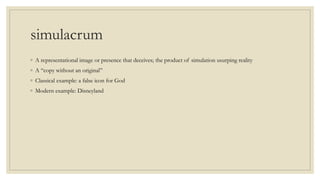
simulacrum 
◦ A representational image or presence that deceives; the product of simulation usurping reality 
◦ A “copy without an original” 
◦ Classical example: a false icon for God 
◦ Modern example: Disneyland
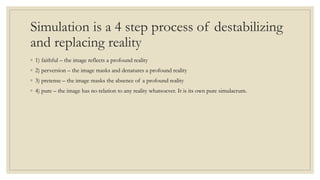
Simulation is a 4 step process of destabilizing 
and replacing reality 
◦ 1) faithful – the image reflects a profound reality 
◦ 2) perversion – the image masks and denatures a profound reality 
◦ 3) pretense – the image masks the absence of a profound reality 
◦ 4) pure – the image has no relation to any reality whatsoever. It is its own pure simulacrum.

Baudrillard – media theory

  • 1.
    BAUDRILLARD – MEDIATHEORY Mary Medrana
  • 2.
    Brief biography ◦Born in 1929 in Paris ◦ He was a French sociologist, philosopher, cultural theorist, political commentator and photographer. ◦ His work is frequently associated with postmodernism and specifically post-structuralism. ◦ His books gathered a wide audience during the 1980s and 90s and in his last years, to an extent, he became an intellectual celebrity. ◦ Baudrillard was a social theorist and critic best known for his analyses of the modes of mediation and technological communication. ◦ His writing, though mostly concerned with the way technological process affects social change, covers diverse subjects – including consumerism, gender relations, and the social understanding of history.
  • 3.
    Quotes ◦ “Hyperreality– a condition in which ‘reality’ has been replaced by simulacra.” ◦ Simulacra – when a sign loses its relation to reality, it begins to simulate a simulation (the process in which a representation of something comes to replace the thing which is actually being represented. The representation then becomes more important than ‘the real thing’) ◦ Hyperreality: division between “real” and simulation has collapsed, therefore an illusion of an object is no longer possible because the real object is no longer there. ◦ “the very definition of the real has become: that of which it is possible to give an equivalent reproduction... The real is not only what can be reproduced, but that which is always already reproduced: that is the hyperreal… which is entirely in simulation.” ◦ “illustion is no longer possible, because the real is no longer possible.” ◦ Simulation is no longer a referential being or a substance. It is the generation by models of a real without origin or reality: a hyperreality”
  • 4.
    Understanding hyperreality ◦Celebrity culture: celebrities who reach a point at every aspect of their lives is taken care of by someone else are said to live in a hyperreal world. ◦ They lose the ability to interact with people on a normal level and are cocooned in hyperreality. Normal people often try to copy this, for example one man who is obsessed with Britney Speares and every aspect of his life relates to her, he genuinely believes that he lives in the same world as her. ◦ This is a common case in which someone has become more engaged in the hyperreal world than the actual real world.
  • 5.
    ◦ Video games:play station games which have a lot of violence in them often have a lot of bad press, the media believe that people will copy the actions they see in the video game. This actually happens very rarely, only a small percentage of the people who play the violent video games actually copy the actions which they see on them. ◦ One prime example is of a man who believed he was in a game and would therefore gain points by carrying out illegal tasks, the worst crime which he committed was killing his best friend. His argument was that he had been told to do it, meaning that he genuinely thought he was taking part in the game when in fact it was real life. This showed that he could no longer distinguish the difference between game play and real life.
  • 6.
    Circular referentiality ◦Baudrillard admires the Mobius strip as an image of hyperreality – “it is never ending, it is a product of itself, it looks like a circle but is not”
  • 7.
    Simulation ◦ Isthe active process of replacement of the real ◦ Whereas dissimulation (pretending) “leaves the principle of reality intact… simulation threatens the difference between true and false, the real and the imaginary.”
  • 8.
    simulacrum ◦ Arepresentational image or presence that deceives; the product of simulation usurping reality ◦ A “copy without an original” ◦ Classical example: a false icon for God ◦ Modern example: Disneyland
  • 9.
    Simulation is a4 step process of destabilizing and replacing reality ◦ 1) faithful – the image reflects a profound reality ◦ 2) perversion – the image masks and denatures a profound reality ◦ 3) pretense – the image masks the absence of a profound reality ◦ 4) pure – the image has no relation to any reality whatsoever. It is its own pure simulacrum.