MEDIA LANGUAGE MEDIA LANGUAGE
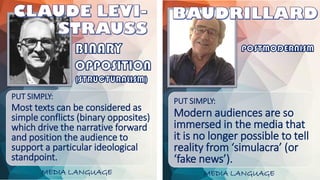
PUT SIMPLY:
Most texts can be considered as
simple conflicts (binary opposites)
which drive the narrative forward
and position the audience to
support a particular ideological
standpoint.
PUT SIMPLY:
Modern audiences are so
immersed in the media that
it is no longer possible to tell
reality from ‘simulacra’ (or
‘fake news’).
MEDIA LANGUAGE MEDIA LANGUAGE
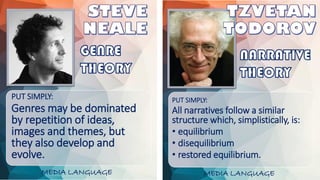
PUT SIMPLY:
Genres may be dominated
by repetition of ideas,
images and themes, but
they also develop and
evolve.
PUT SIMPLY:
All narratives follow a similar
structure which, simplistically, is:
• equilibrium
• disequilibrium
• restored equilibrium.
MEDIA LANGUAGE
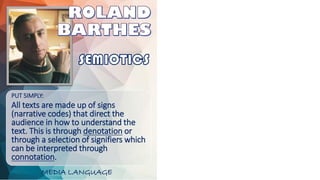
PUT SIMPLY:
All texts are made up of signs
(narrative codes) that direct the
audience in how to understand the
text. This is through denotation or
through a selection of signifiers which
can be interpreted through
connotation.
AUDIENCE THEORY AUDIENCE THEORY
PUT SIMPLY:
Producers encode a text,
audiences decode it in one of
three ways:
• Dominant
• Negotiated
• Oppositional
PUT SIMPLY:
‘Deviant’ behaviour
(violence / drug-taking etc.)
encourages copycat
behaviour in the viewer.
AUDIENCE THEORY AUDIENCE THEORY
PUT SIMPLY:
Due to technological
advances, audiences can no
longer be thought of as
passive consumers.
PUT SIMPLY:
Fandoms provide a sense of
identity for audiences.
Fans are increasingly influential
in the creation of textual
meaning.
REPRESENTATION THEORY
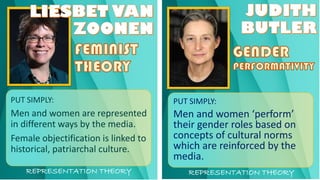
PUT SIMPLY:
Men and women are represented
in different ways by the media.
Female objectification is linked to
historical, patriarchal culture.
REPRESENTATION THEORY
PUT SIMPLY:
Men and women ‘perform’
their gender roles based on
concepts of cultural norms
which are reinforced by the
media.
REPRESENTATION THEORY
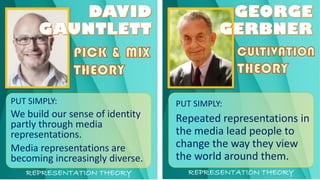
PUT SIMPLY:
We build our sense of identity
partly through media
representations.
Media representations are
becoming increasingly diverse.
REPRESENTATION THEORY
PUT SIMPLY:
Repeated representations in
the media lead people to
change the way they view
the world around them.
REPRESENTATION THEORY
PUT SIMPLY:
Modern ideas about race and ethnicity
are bound up in historical ideas of
colonialism.
Ethnicity and race is often represented
as being different or ‘other’.
REPRESENTATION THEORY
PUT SIMPLY:
Stereotypes are used in the
media, often to represent
minority groups.
The media creates stereotypes
through a system of signification.
*bell hooks (lower case) is the pen name for Gloria Jean Watkins
PUT SIMPLY:
Feminism is a political aim rather
than an individual lifestyle.
Gender, class and race determine
the extent to which individuals are
discriminated against.
REPRESENTATION THEORY
MEDIA INSTITUTIONSMEDIA INSTITUTIONS
PUT SIMPLY:
The media is owned and
controlled by a small
number of companies who
are driven by profit and
power.
PUT SIMPLY:
The largest media companies
use vertical and horizontal
integration across a range of
industries in order to increase
profits.
MEDIA INSTITUTIONSMEDIA INSTITUTIONS
PUT SIMPLY:
There is constant conflict
between the freedoms of
speech and expression and the
need to restrict views that
could incite hatred or violence.

Simplified theory posters

  • 1.
    MEDIA LANGUAGE MEDIALANGUAGE PUT SIMPLY: Most texts can be considered as simple conflicts (binary opposites) which drive the narrative forward and position the audience to support a particular ideological standpoint. PUT SIMPLY: Modern audiences are so immersed in the media that it is no longer possible to tell reality from ‘simulacra’ (or ‘fake news’).
  • 2.
    MEDIA LANGUAGE MEDIALANGUAGE PUT SIMPLY: Genres may be dominated by repetition of ideas, images and themes, but they also develop and evolve. PUT SIMPLY: All narratives follow a similar structure which, simplistically, is: • equilibrium • disequilibrium • restored equilibrium.
  • 3.
    MEDIA LANGUAGE PUT SIMPLY: Alltexts are made up of signs (narrative codes) that direct the audience in how to understand the text. This is through denotation or through a selection of signifiers which can be interpreted through connotation.
  • 4.
    AUDIENCE THEORY AUDIENCETHEORY PUT SIMPLY: Producers encode a text, audiences decode it in one of three ways: • Dominant • Negotiated • Oppositional PUT SIMPLY: ‘Deviant’ behaviour (violence / drug-taking etc.) encourages copycat behaviour in the viewer.
  • 5.
    AUDIENCE THEORY AUDIENCETHEORY PUT SIMPLY: Due to technological advances, audiences can no longer be thought of as passive consumers. PUT SIMPLY: Fandoms provide a sense of identity for audiences. Fans are increasingly influential in the creation of textual meaning.
  • 6.
    REPRESENTATION THEORY PUT SIMPLY: Menand women are represented in different ways by the media. Female objectification is linked to historical, patriarchal culture. REPRESENTATION THEORY PUT SIMPLY: Men and women ‘perform’ their gender roles based on concepts of cultural norms which are reinforced by the media.
  • 7.
    REPRESENTATION THEORY PUT SIMPLY: Webuild our sense of identity partly through media representations. Media representations are becoming increasingly diverse. REPRESENTATION THEORY PUT SIMPLY: Repeated representations in the media lead people to change the way they view the world around them.
  • 8.
    REPRESENTATION THEORY PUT SIMPLY: Modernideas about race and ethnicity are bound up in historical ideas of colonialism. Ethnicity and race is often represented as being different or ‘other’. REPRESENTATION THEORY PUT SIMPLY: Stereotypes are used in the media, often to represent minority groups. The media creates stereotypes through a system of signification.
  • 9.
    *bell hooks (lowercase) is the pen name for Gloria Jean Watkins PUT SIMPLY: Feminism is a political aim rather than an individual lifestyle. Gender, class and race determine the extent to which individuals are discriminated against. REPRESENTATION THEORY
  • 10.
    MEDIA INSTITUTIONSMEDIA INSTITUTIONS PUTSIMPLY: The media is owned and controlled by a small number of companies who are driven by profit and power. PUT SIMPLY: The largest media companies use vertical and horizontal integration across a range of industries in order to increase profits.
  • 11.
    MEDIA INSTITUTIONSMEDIA INSTITUTIONS PUTSIMPLY: There is constant conflict between the freedoms of speech and expression and the need to restrict views that could incite hatred or violence.