



Quick, Ugly PPT
Reminders!
Amalgam day
Since we didn’t physically meet last week, we
have a number of things to address. I’m going to
start today with discussing Baudrillard, have you
do some work together, and we’ll see where that
leaves us.
Next meeting we’ll catch up what was listed for
today. Also, since I’m feeling like a nice guy,
anyone who needs an extension until Thursday to
finish their first 3 Lynda tutorials can have it. I will
grade them Friday afternoon at about 1 pm. Be
done by then and I won’t check your time
stamps.
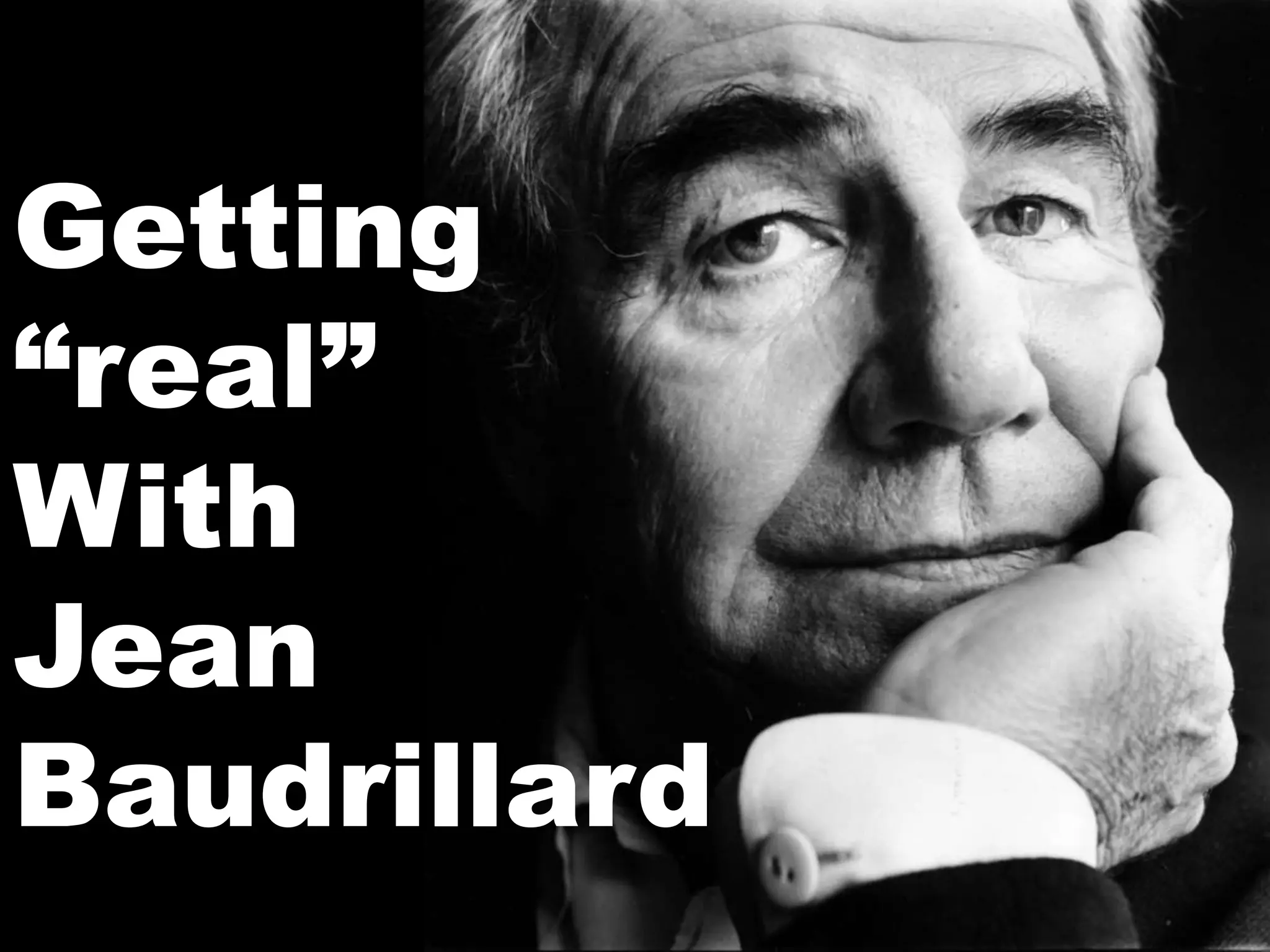
Getting
“real”
With
Jean
Baudrillard
Let’s play the theory game. On the next several
slides are quotes from Baudrillard. Most are
from your reading ,but some aren’t.
We’re going to dissect them, re-think them, and
then use the discussion of them to define why
Baudrillard matters to us as we consider design
and visual rhetoric.
Baudrillard’s comments are in light green.
Dr. Phill’s talk-back to him is white.
Note before we start: Baudrillard is a bit of an
agitator. He’s going to at times say things about
religion, gender, life or terrorism that might be
upsetting.
I do not endorse his opinions, and I don’t expect
any of you to. What I want you to be able to do is
understand the thought-work he is doing.
If anything here offends you and you’d like to point
that out, we will all respect that. My goal is not to
create discussion of things beyond the thought
work being done. Sadly, I cannot control an author’s
content.
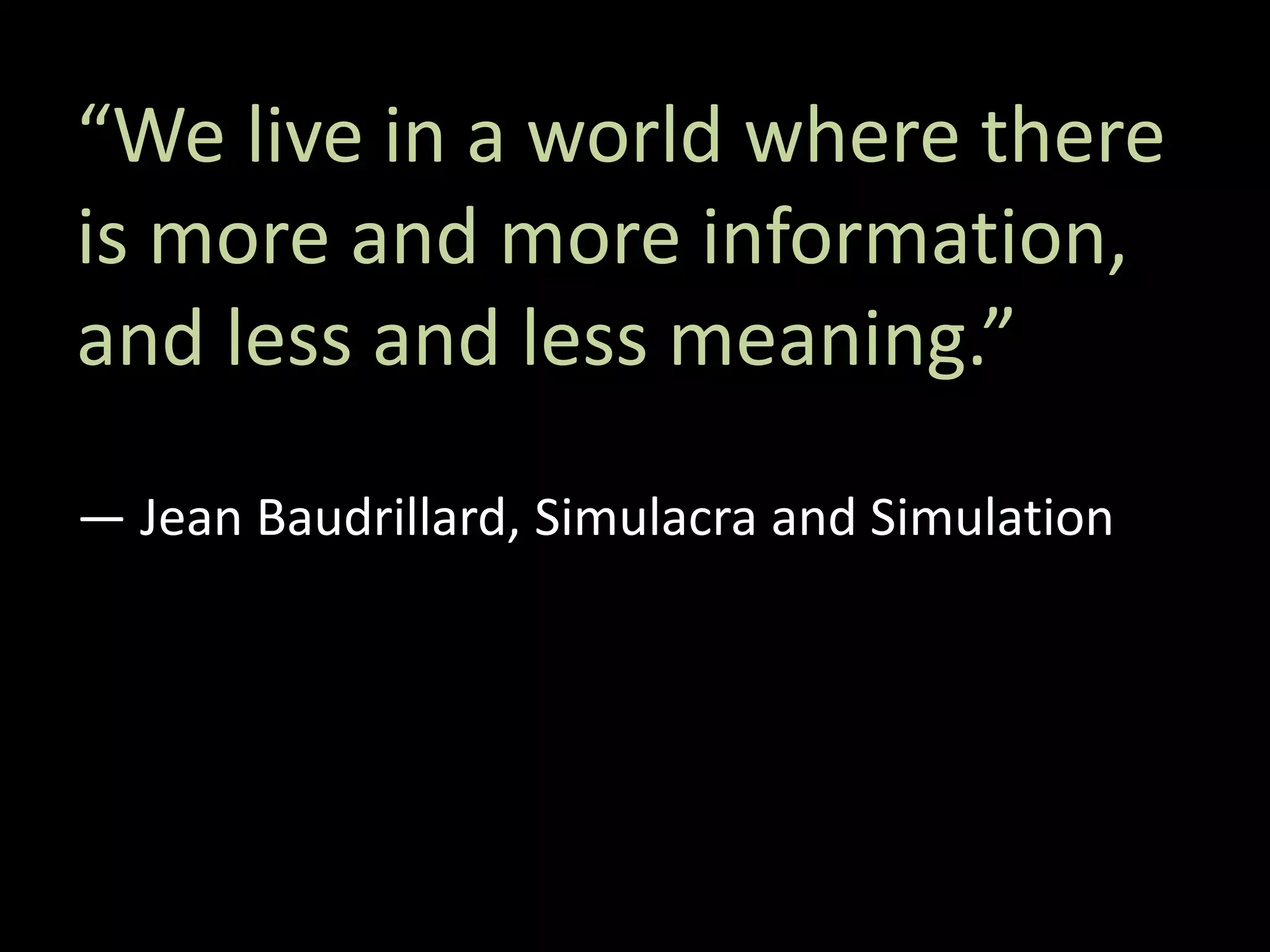
“We live in a world where there
is more and more information,
and less and less meaning.”
― Jean Baudrillard, Simulacra and Simulation
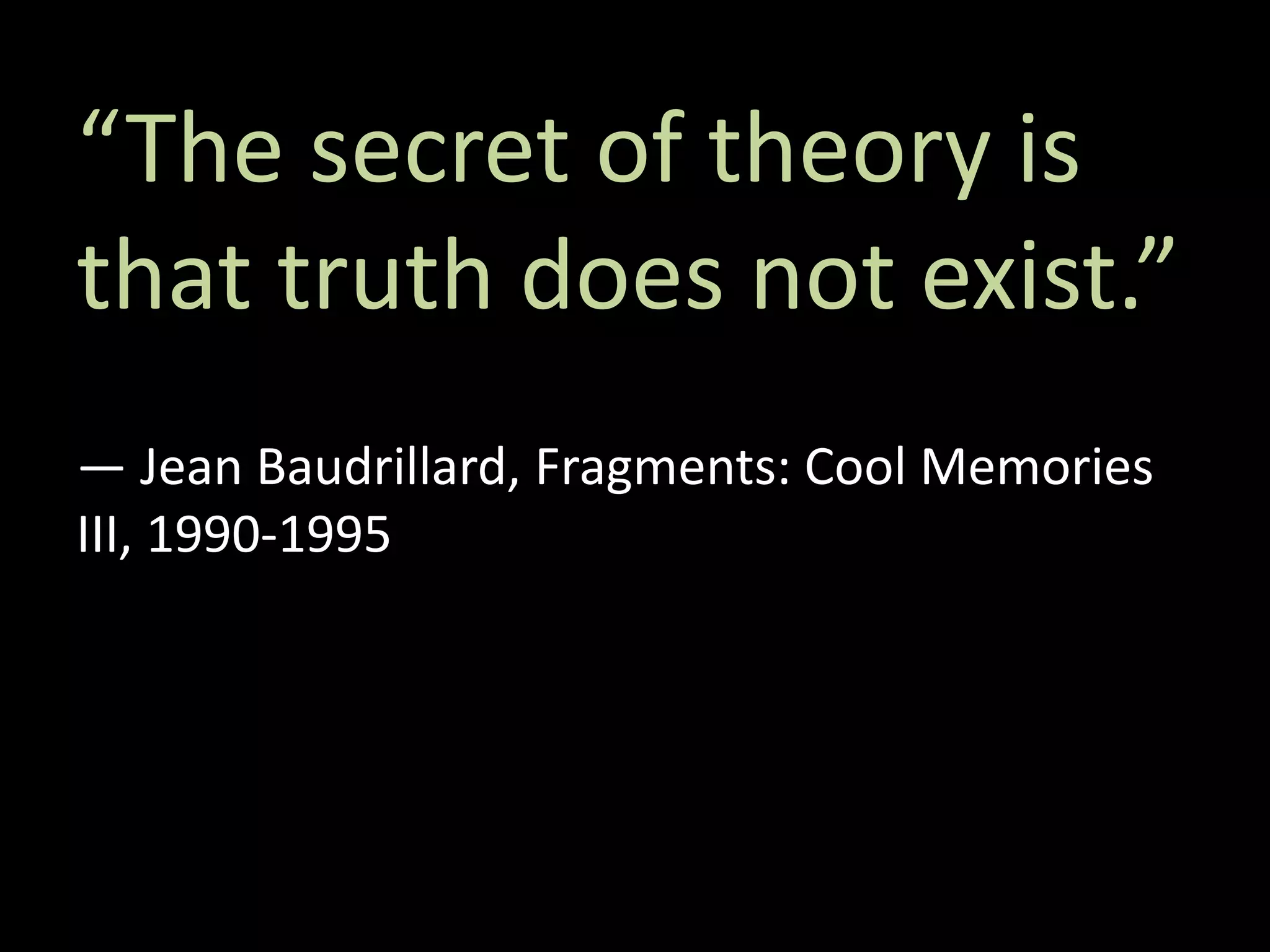
“The secret of theory is
that truth does not exist.”
― Jean Baudrillard, Fragments: Cool Memories
III, 1990-1995
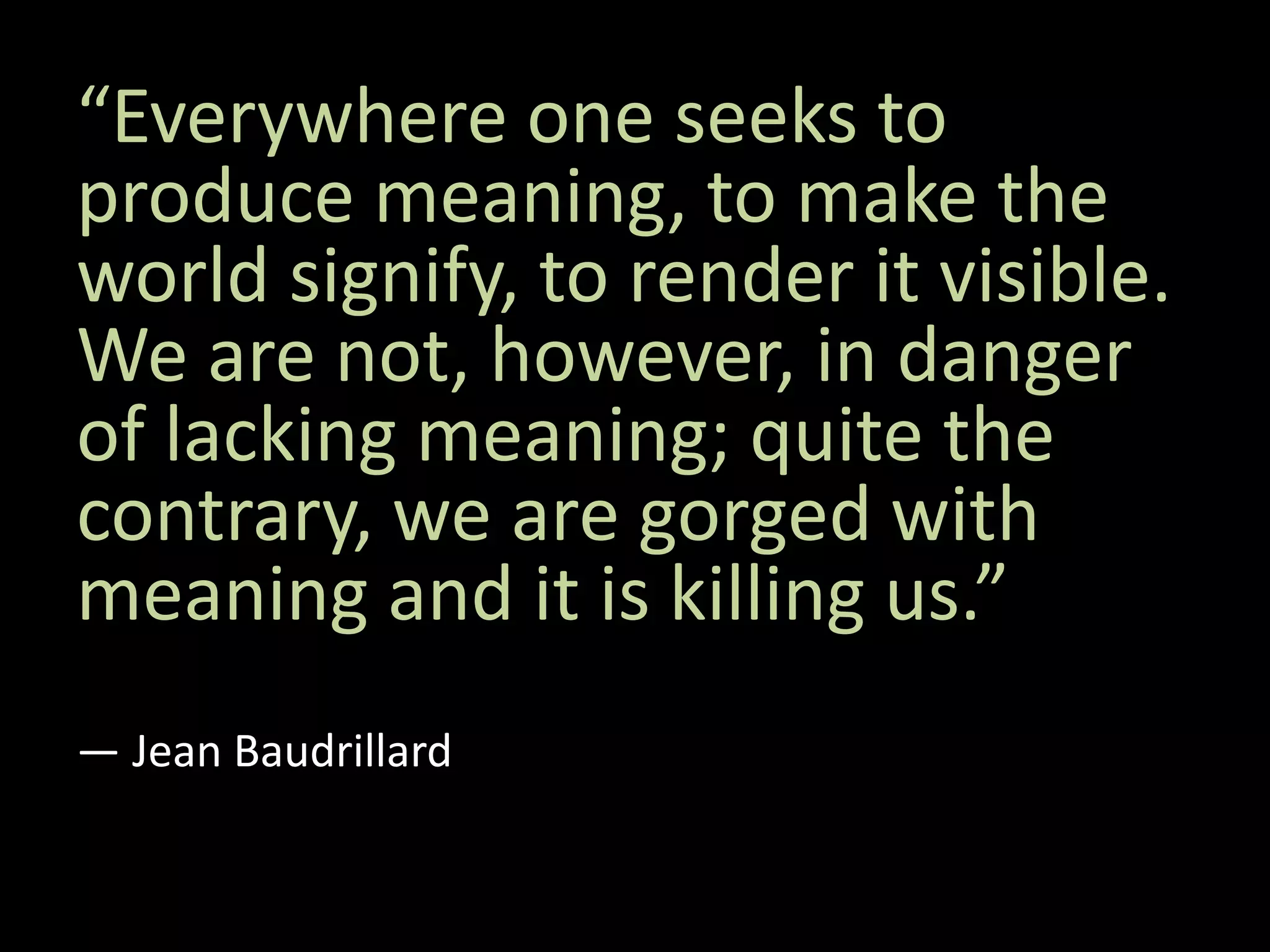
“Everywhere one seeks to
produce meaning, to make the
world signify, to render it visible.
We are not, however, in danger
of lacking meaning; quite the
contrary, we are gorged with
meaning and it is killing us.”
― Jean Baudrillard
“Postmodernity is said to be a culture
of fragmentary sensations, eclectic
nostalgia, disposable simulacra, and
promiscuous superficiality, in which
the traditionally valued qualities of
depth, coherence, meaning,
originality, and authenticity are
evacuated or dissolved amid the
random swirl of empty signals.”
― Jean Baudrillard
“Postmodernity is said to be a culture
of fragmentary sensations, eclectic
nostalgia, disposable simulacra, and
promiscuous superficiality, in which
the traditionally valued qualities of
depth, coherence, meaning,
originality, and authenticity are
evacuated or dissolved amid the
random swirl of empty signals.”
― Jean Baudrillard
“But what if God himself can be
simulated, that is to say can be reduced
to signs that constitute faith? Then the
whole system becomes weightless, it is
no longer anything but a gigantic
simulacrum - not unreal, but simulacrum,
that is to say never exchanged for the
real, but exchanged for itself, in an
uninterrupted circuit without reference
or circumference.”
― Jean Baudrillard, Simulacra and Simulation
“How many faces, how many bodies can
you recognize, with your eyes closed,
only by touching them? Have you ever
closed your eyes and acted
unconsciously? Or loved someone so
blindly, you could almost feel their
energy in a dark room and be moved by
the powerful touch of their ideas?”
― Jean Baudrillard
“How many faces, how many bodies can
you recognize, with your eyes closed,
only by touching them? Have you ever
closed your eyes and acted
unconsciously? Or loved someone so
blindly, you could almost feel their
energy in a dark room and be moved by
the powerful touch of their ideas?”
― Jean Baudrillard
“If being a nihilist, is carrying, to the
unbearable limit of hegemonic systems,
this radical trait of derision and of
violence, this challenge that the system is
summoned to answer through its own
death, then I am a terrorist and nihilist in
theory as the others are with their
weapons. Theoretical violence, not truth,
is the only resource left us.”
― Jean Baudrillard, Simulacra and Simulation
“The very definition of the real becomes:
that of which it is possible to give an
equivalent reproduction. The real is not
only what can be reproduced, but that
which is always already reproduced. The
hyper real.”
― Jean Baudrillard, Simulacra and Simulation
The world has become so real that this
reality is only bearable at the expense of
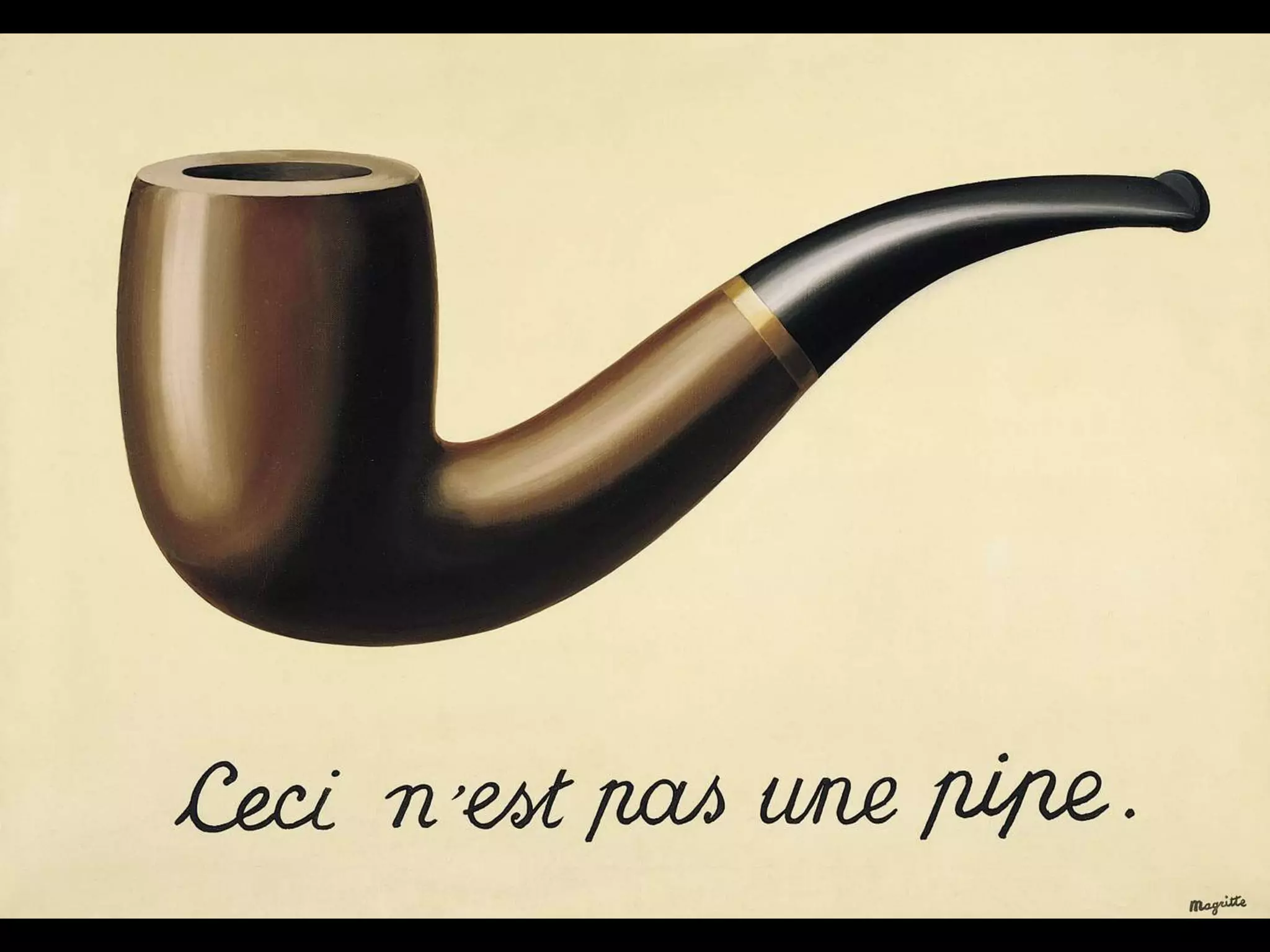
perpetual denial. “This is not a world,” after
“this is not a pipe,” Magritte’s surrealist
denial of evidence itself – this double
movement of, on one hand, the absolute
and definite evidence of the world and, on
the other hand, the radical denial of this
evidence – dominates the trajectory of
modern art, not only of art but also of all our
deeper…
perceptions, of all our apprehensions of the
world...The world is the way it is. Once
transcendence is gone, things are nothing
but what they are and, as they are, they are
unbearable. They have lost every illusion
and have become immediately and entirely
real, shadowless, without commentary. At
the same time this unsurpassable reality
does not exist anymore. It has no reason to
exist for it cannot be exchanged for
anything. It has no exchange value.”
― Jean Baudrillard, "Violence of the Virtual and Integral
Reality."
What it all means:
Baudrillard in Dr. Phill’s terms…
While I’m not sure how I feel about the
person, I am very fond of Baudrillard’s
theoretical work. He is occasionally a bit
to playful, and he and I disagree on love,
on the rights of women, on personal
faith, etc. but…
Here’s what he tells us:
• There is no real anymore. We can’t get to
it.
• It doesn’t matter that there is no real.
What matters is that we recognize that
we’re divided from it and how we are
divided from it.
• Those who design/create have the power
to mimic and essentially “make” real (since
there is no real), we must “see” while
knowing we do not see.
• Since there is no real, nothing is more
real or less real, really.
• It’s okay not to understand everything;
people who claim they do are just
deceiving themselves
• We– designers and creators– have
more control than we ever thought
How does this lead back to our work as a
class? What can Baudrillard do for us?
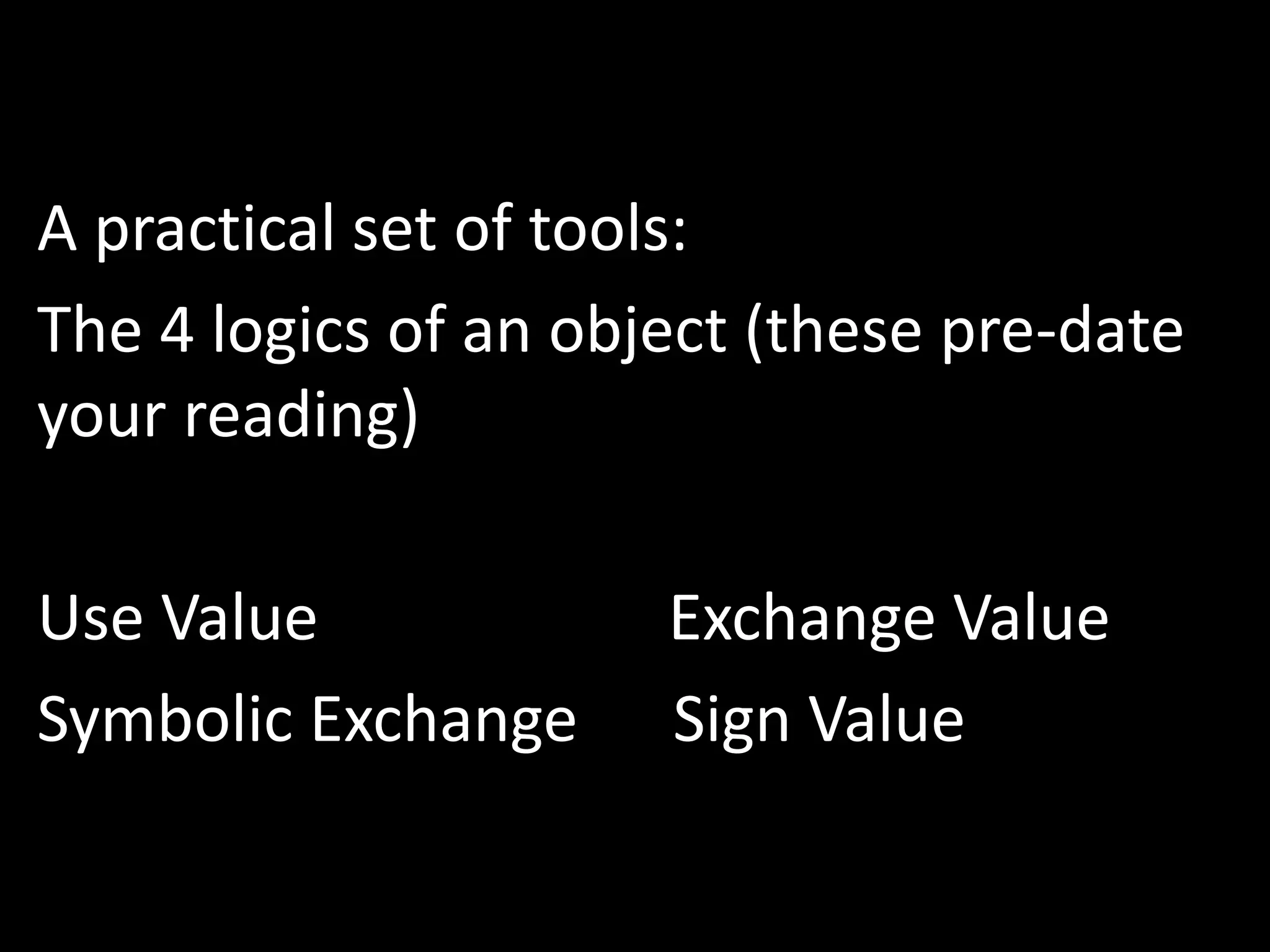
A practical set of tools:
The 4 logics of an object (these pre-date
your reading)
Use Value Exchange Value
Symbolic Exchange Sign Value
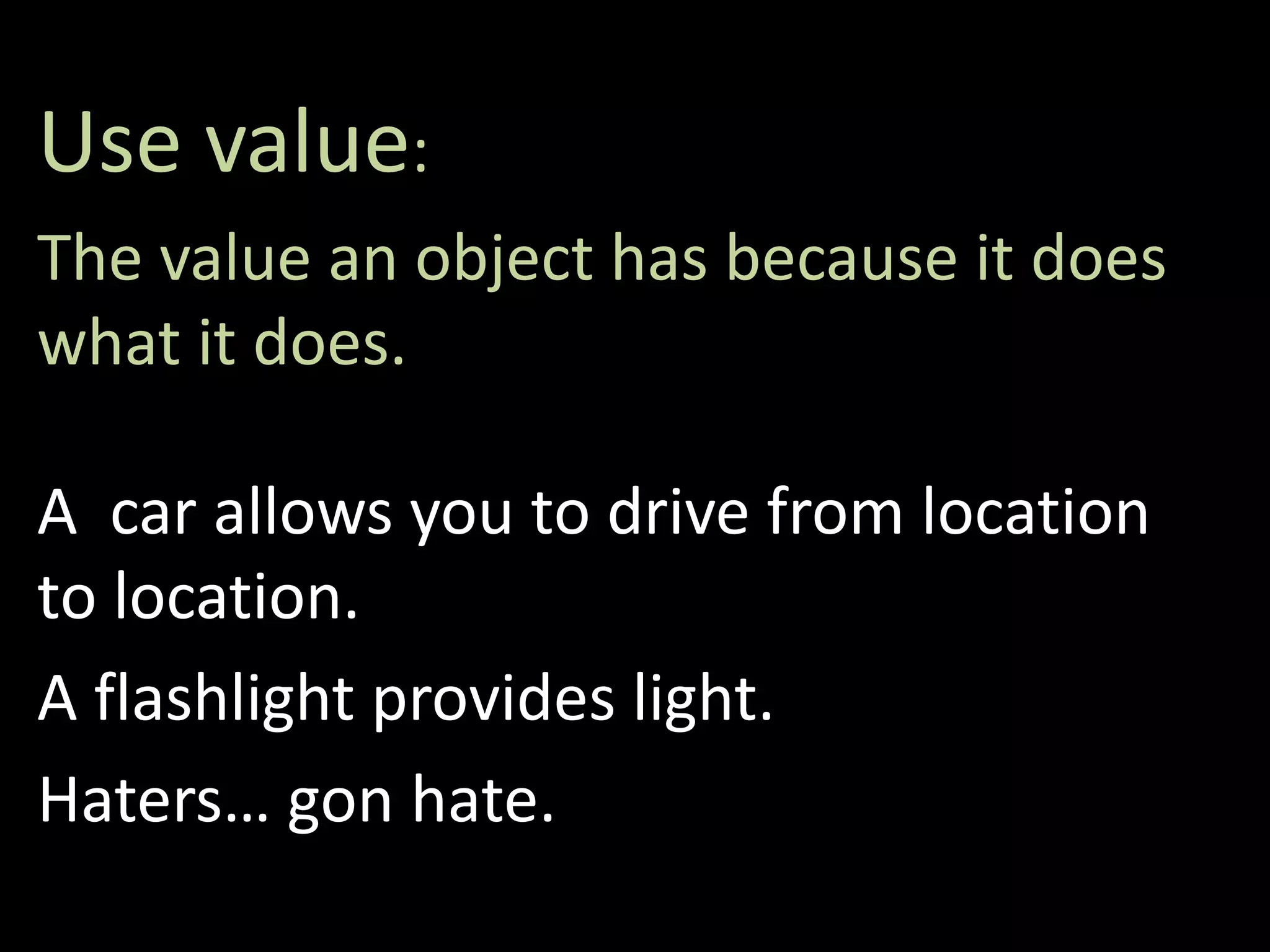
Use value:
The value an object has because it does
what it does.
A car allows you to drive from location
to location.
A flashlight provides light.
Haters… gon hate.
Exchange value:
The value an object has because someone
else would want it/buy it.
A Corvette has more exchange value than a
Hyundai, generally, because the ‘Vette is
more highly desired.
A certain audience would prefer an led-in-
the-foot Hello Kitty flashlight key-ring to an
expensive maglight.
Haters… have no exchange value.
Symbolic value:
The value an object has because someone has assigned it
that value within a small social system.
If that’s the Hyundai your deceased father taught you to
drive in, it might mean more to you than a shiny new
Corvette.
Likewise if that Hello Kitty flashlight was a gift from your
boyfriend during a three day power outage that he brought
with flowers, bottles of water and a pizza… it might mean
more than it did.
Haters… well, they’re hating over something!
Sign value:
The value an object in relation to other objects. This is
often about status (e.g. my iPhone 6 is cooler than my
mom’s old Motorola flip phone, even if technically hers
works better as an actual phone).
We know that a Hyundai represents specific things (frugality, desire to be
eco-friendly if not hybrid, thick skin around car haters).
Likewise if you’re a cop or an outdoorsman, you better bet you want the
tough, rugged MagLite that can endure being used as hammer and still
work. If you’re me, buying a flashlight for your van, you want the MagLite
because you’ve seen cops on TV fend off villians with them and you sort of
want to be Batman. But you’d never admit that on a PPT slide.
Haters… if Kanye West comes in and interrupts my lecture to tell you all he
feels me, and he’s gonna let me finish, but Cornell West is the best lecturer
of all time, how much did MY status just go up?
Baudrillard claims the first two are
easy to understand: what it does and
what it’s worth. It is adding the other
two highly social elements that
confounds us.
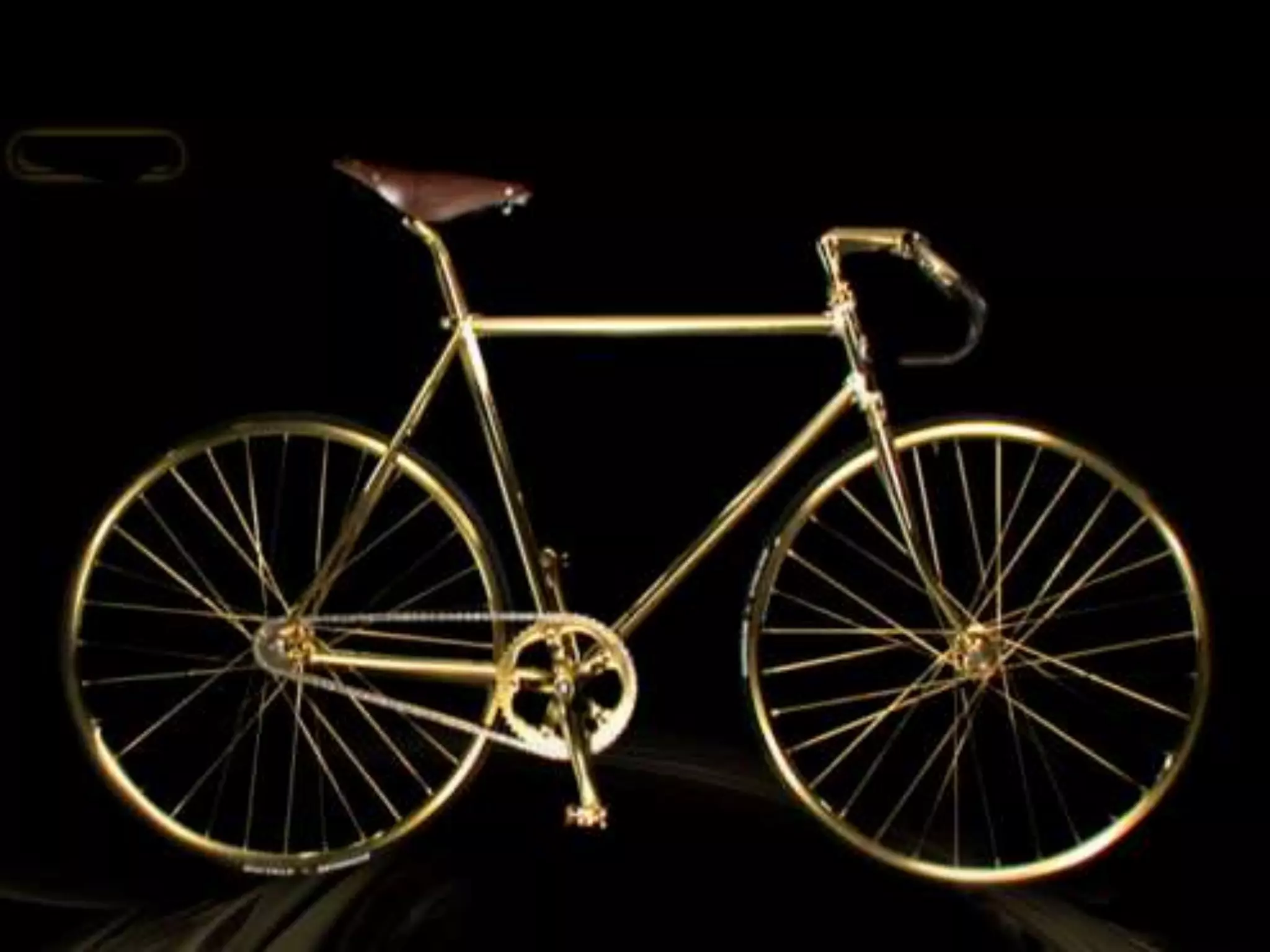
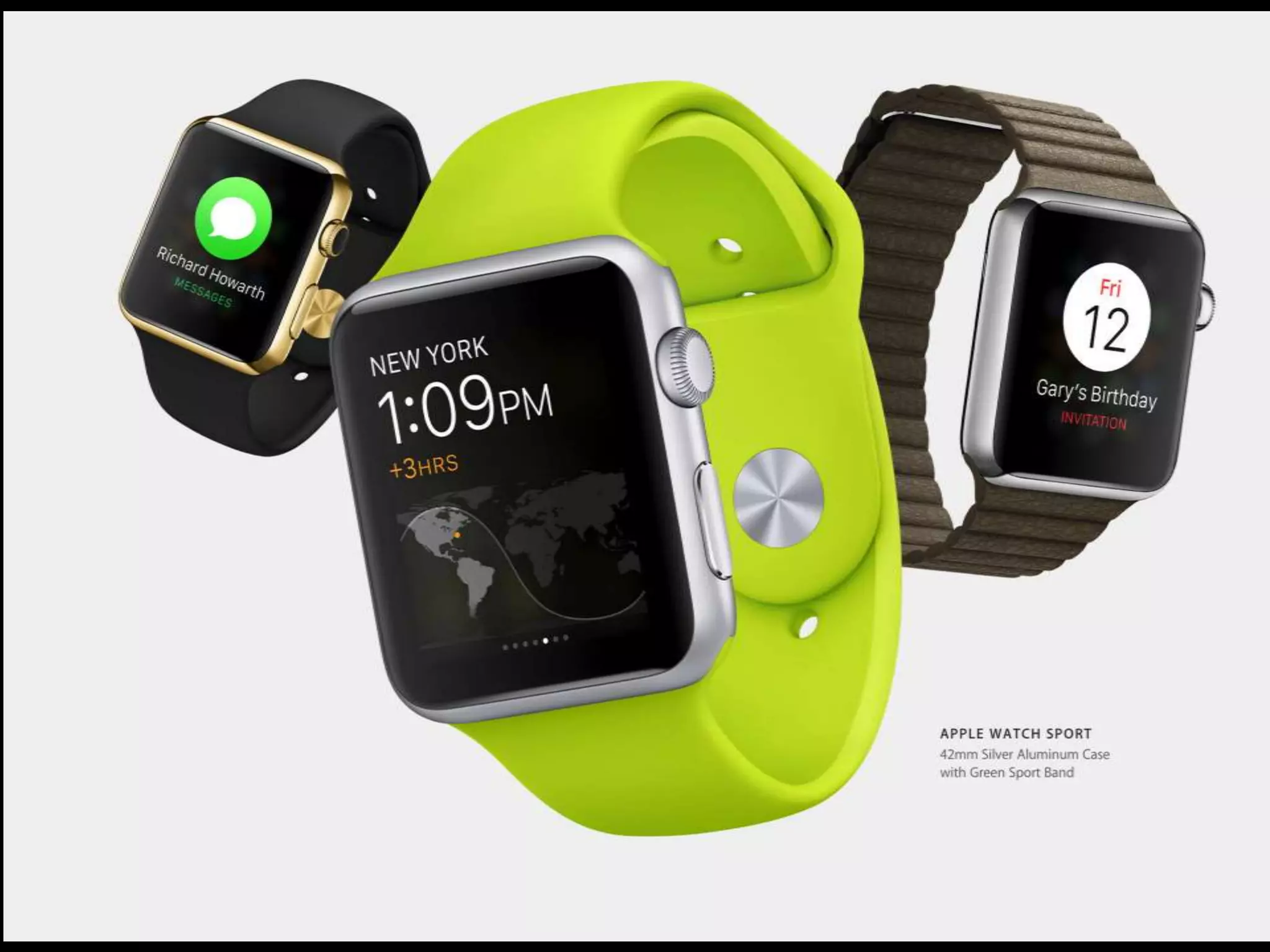
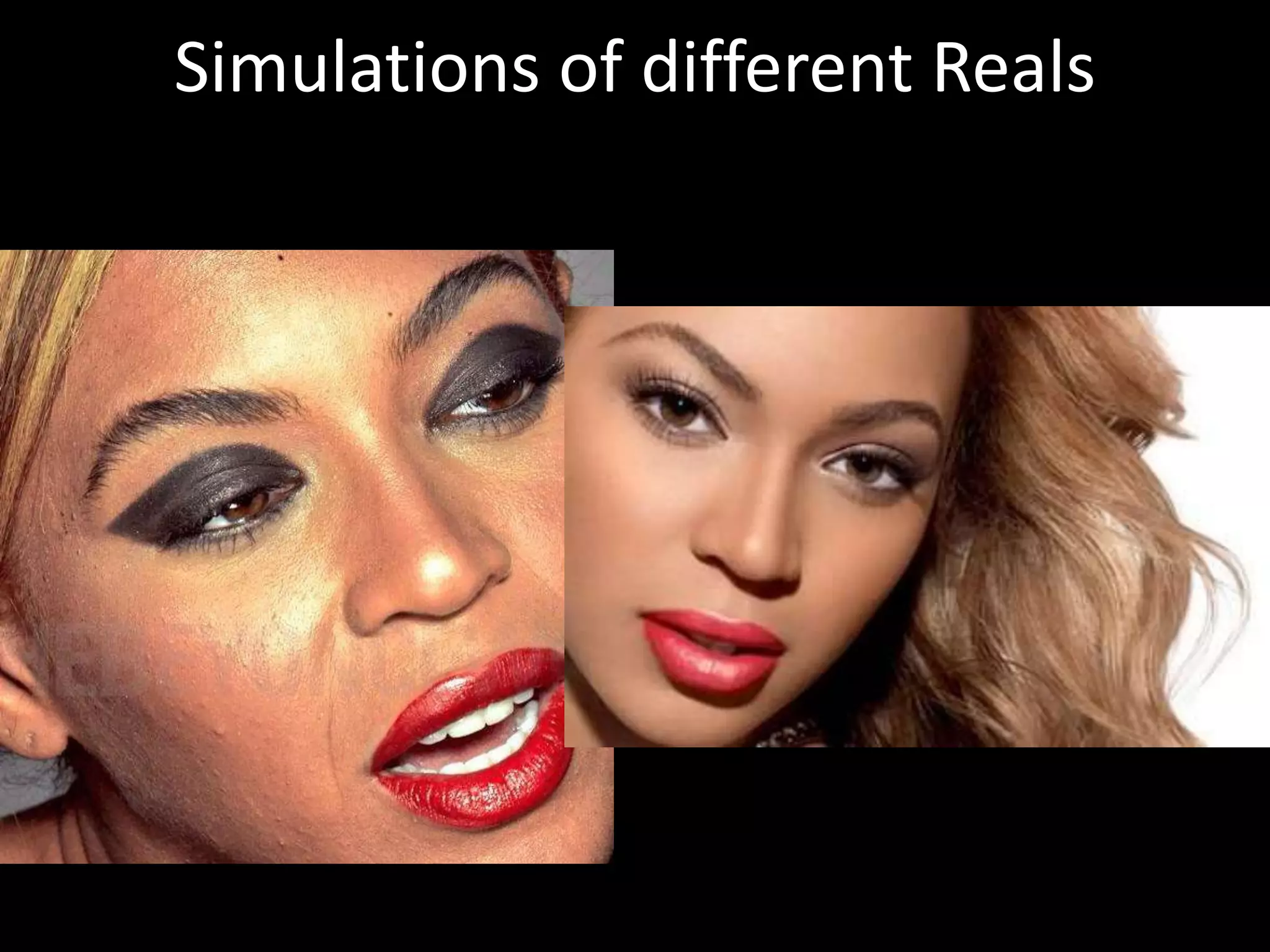
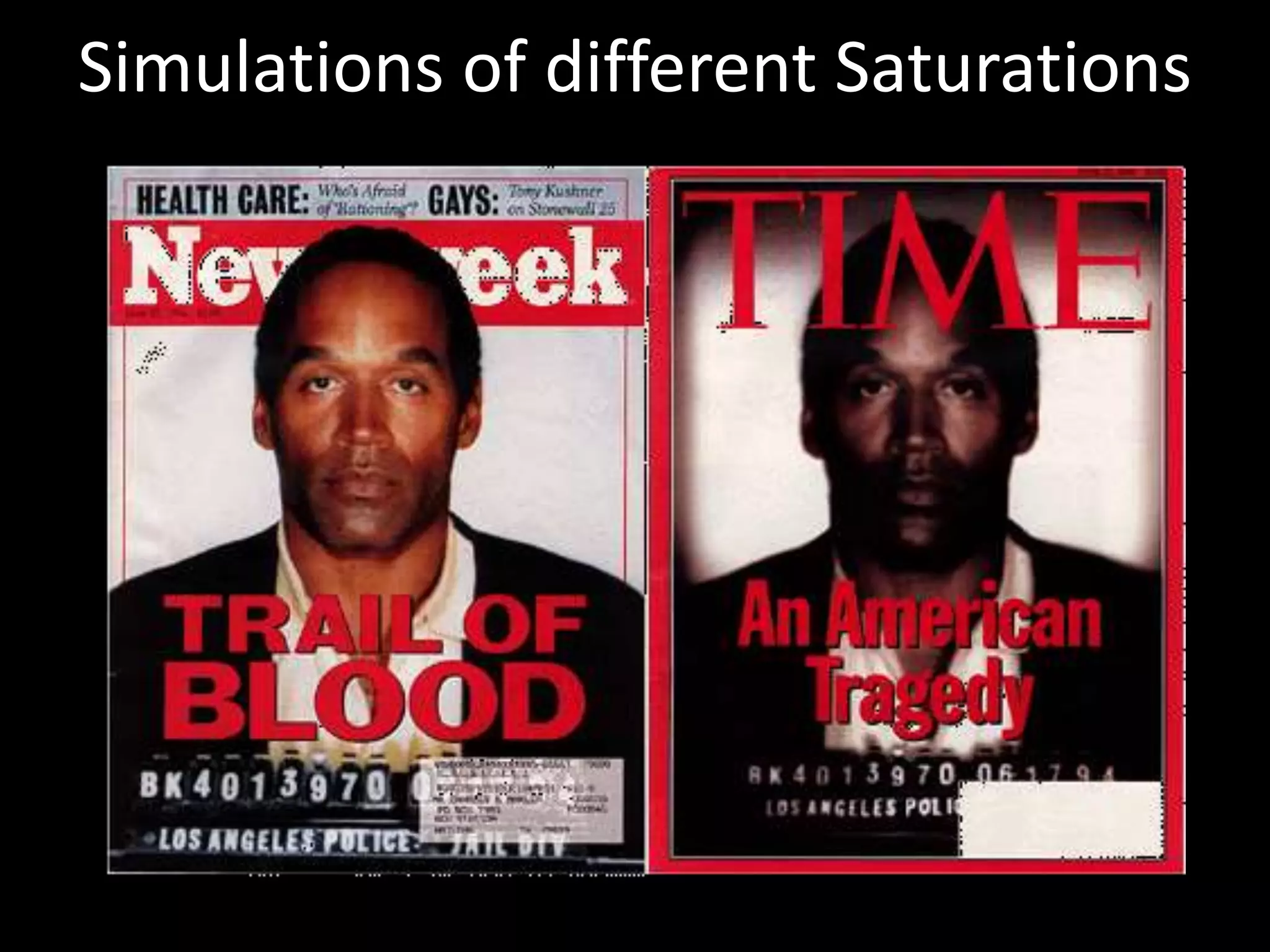
Let’s try it on some objects.
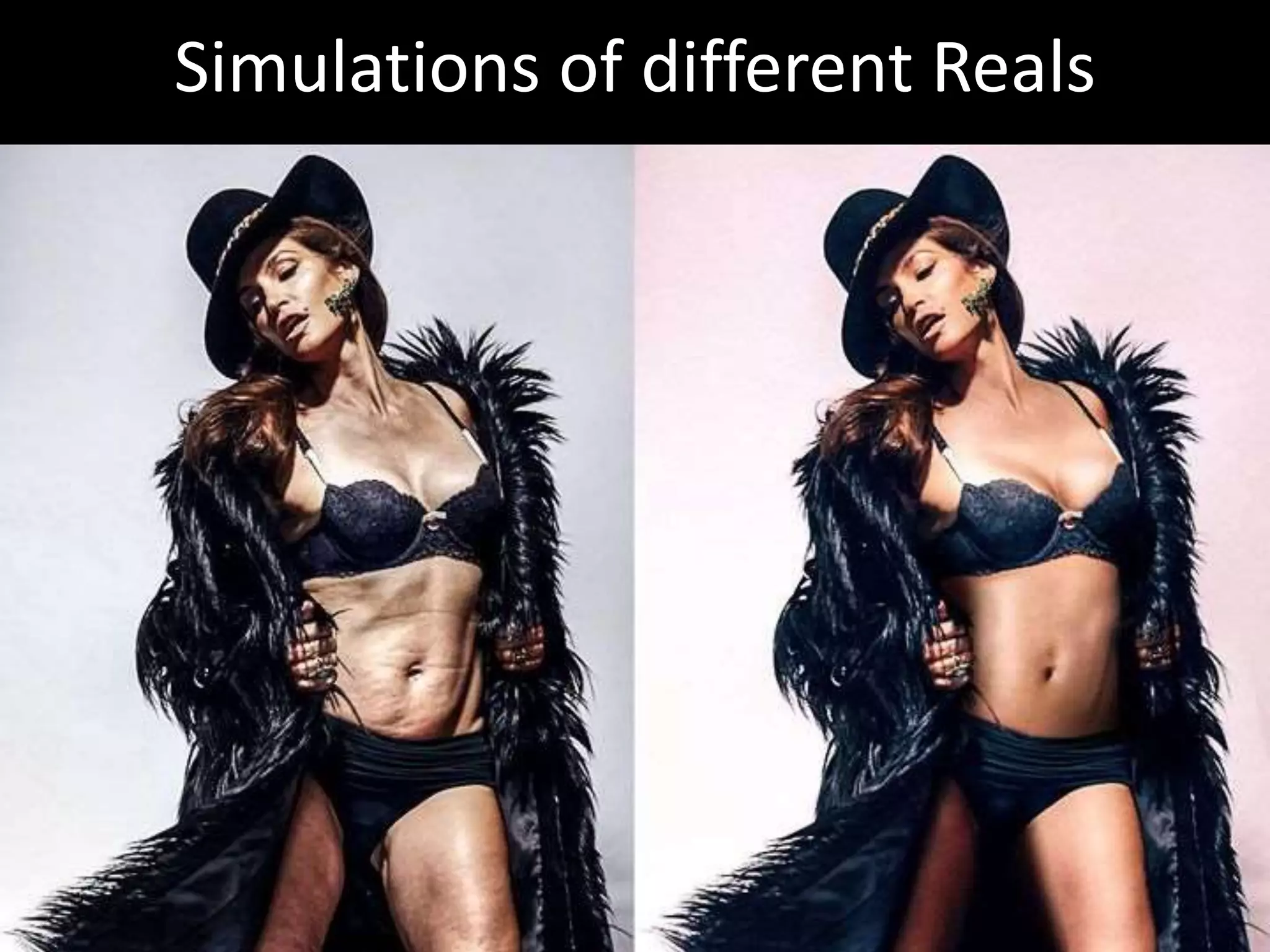
Simulations of different Reals
Simulations of different Saturations
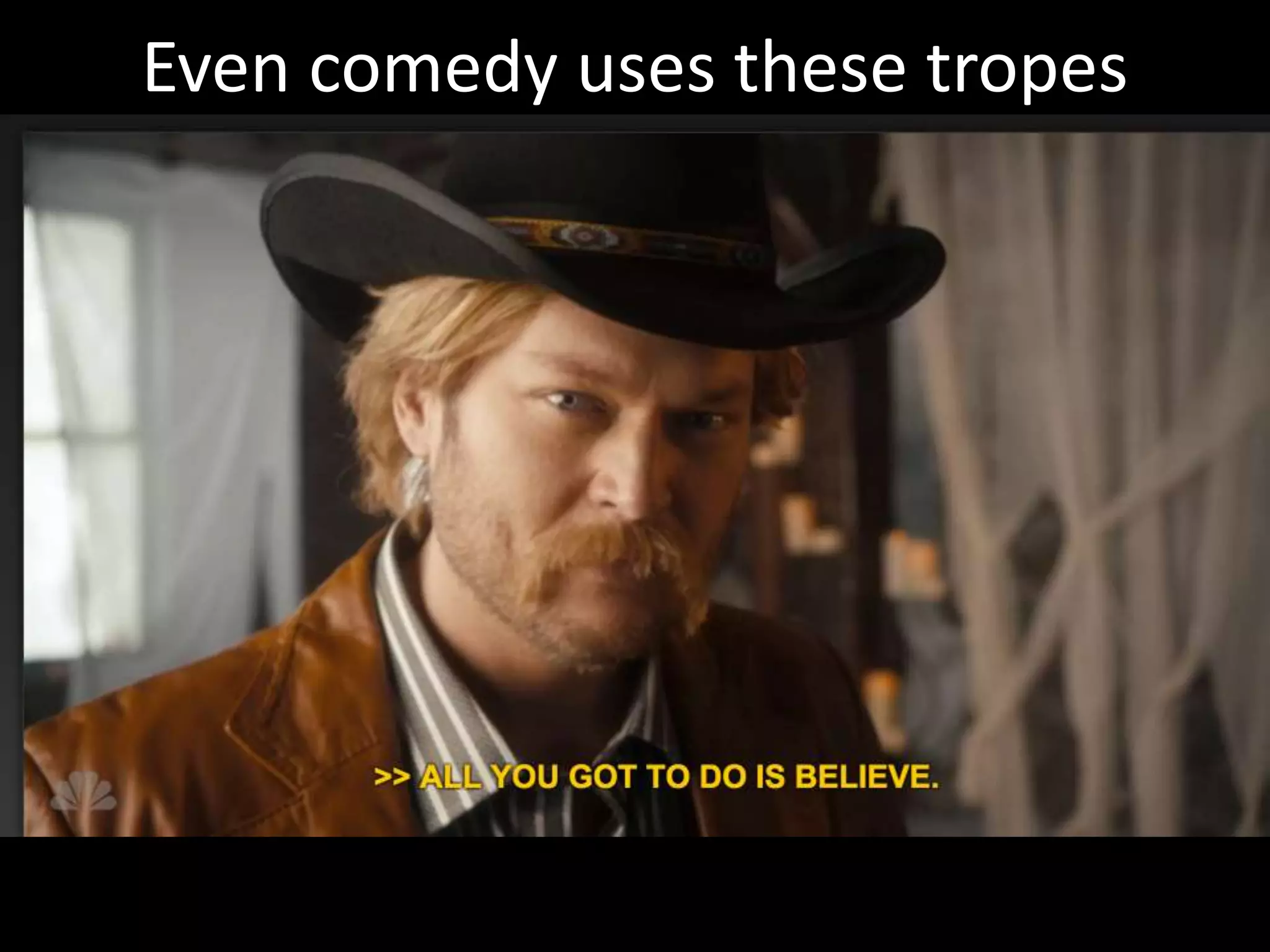
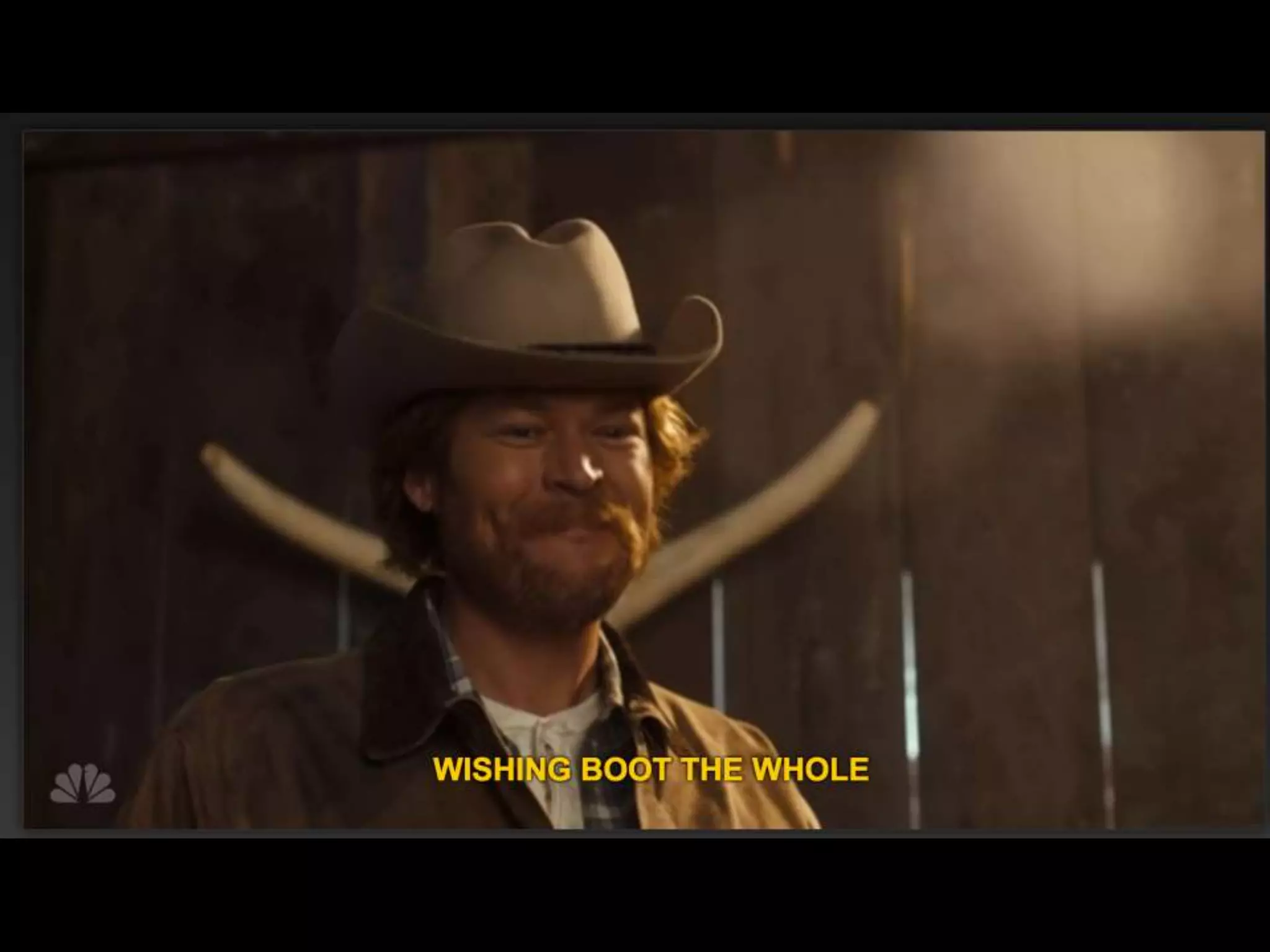
Even comedy uses these tropes
Activity
In pairs, or groups of 3, I want you to look at all
the stuff we’ve just discussed and, if you need,
re-watch the video I just showed.
It’s meant to be funny, and I hope it made you
all chuckle as much as I did the first time I saw it.
But now I want you to look at it seriously as an
object of discourse and think about how
complex we can make it. How does it fit the
object types, the values, the ideas on
simulation?
Think about it, come up with ideas to share, jot
them down, and email them to me.
What do we have to know—bare minimum– to
“get” the joke? How many different bits of
cultural knowledge make it… let’s not judge
“more amusing” but more inter-connected?
Why is it funny?
How is it like reality?
How is it NOT like reality?
See, Baudrillard isn’t that hard.
My question to all of you, to see if the dots
connected… why is all of this important to visual
rhetoric?
The short answer:
With the “real” gone, inaccessible, it is left to
those who create the symbols and simulations
to wield the power of shaping “reality” as we
know it.
YOU as designers are the architects of the real.
If there’s time we’ll briefly talk Helvetica.
If not, for Thursday:
we will address the tagging stuff assigned for
today, talk through the tagging assignment, and
discuss fonts.
Keep up on the reading, but we won’t discuss
Hegemonic Visualism until next Tuesday.

Baudrillard Make Up Day PPT

  • 1.
  • 2.
    Amalgam day Since wedidn’t physically meet last week, we have a number of things to address. I’m going to start today with discussing Baudrillard, have you do some work together, and we’ll see where that leaves us. Next meeting we’ll catch up what was listed for today. Also, since I’m feeling like a nice guy, anyone who needs an extension until Thursday to finish their first 3 Lynda tutorials can have it. I will grade them Friday afternoon at about 1 pm. Be done by then and I won’t check your time stamps.
  • 3.
  • 4.
    Let’s play thetheory game. On the next several slides are quotes from Baudrillard. Most are from your reading ,but some aren’t. We’re going to dissect them, re-think them, and then use the discussion of them to define why Baudrillard matters to us as we consider design and visual rhetoric. Baudrillard’s comments are in light green. Dr. Phill’s talk-back to him is white.
  • 5.
    Note before westart: Baudrillard is a bit of an agitator. He’s going to at times say things about religion, gender, life or terrorism that might be upsetting. I do not endorse his opinions, and I don’t expect any of you to. What I want you to be able to do is understand the thought-work he is doing. If anything here offends you and you’d like to point that out, we will all respect that. My goal is not to create discussion of things beyond the thought work being done. Sadly, I cannot control an author’s content.
  • 6.
    “We live ina world where there is more and more information, and less and less meaning.” ― Jean Baudrillard, Simulacra and Simulation
  • 7.
    “The secret oftheory is that truth does not exist.” ― Jean Baudrillard, Fragments: Cool Memories III, 1990-1995
  • 8.
    “Everywhere one seeksto produce meaning, to make the world signify, to render it visible. We are not, however, in danger of lacking meaning; quite the contrary, we are gorged with meaning and it is killing us.” ― Jean Baudrillard
  • 9.
    “Postmodernity is saidto be a culture of fragmentary sensations, eclectic nostalgia, disposable simulacra, and promiscuous superficiality, in which the traditionally valued qualities of depth, coherence, meaning, originality, and authenticity are evacuated or dissolved amid the random swirl of empty signals.” ― Jean Baudrillard
  • 10.
    “Postmodernity is saidto be a culture of fragmentary sensations, eclectic nostalgia, disposable simulacra, and promiscuous superficiality, in which the traditionally valued qualities of depth, coherence, meaning, originality, and authenticity are evacuated or dissolved amid the random swirl of empty signals.” ― Jean Baudrillard
  • 11.
    “But what ifGod himself can be simulated, that is to say can be reduced to signs that constitute faith? Then the whole system becomes weightless, it is no longer anything but a gigantic simulacrum - not unreal, but simulacrum, that is to say never exchanged for the real, but exchanged for itself, in an uninterrupted circuit without reference or circumference.” ― Jean Baudrillard, Simulacra and Simulation
  • 12.
    “How many faces,how many bodies can you recognize, with your eyes closed, only by touching them? Have you ever closed your eyes and acted unconsciously? Or loved someone so blindly, you could almost feel their energy in a dark room and be moved by the powerful touch of their ideas?” ― Jean Baudrillard
  • 13.
    “How many faces,how many bodies can you recognize, with your eyes closed, only by touching them? Have you ever closed your eyes and acted unconsciously? Or loved someone so blindly, you could almost feel their energy in a dark room and be moved by the powerful touch of their ideas?” ― Jean Baudrillard
  • 14.
    “If being anihilist, is carrying, to the unbearable limit of hegemonic systems, this radical trait of derision and of violence, this challenge that the system is summoned to answer through its own death, then I am a terrorist and nihilist in theory as the others are with their weapons. Theoretical violence, not truth, is the only resource left us.” ― Jean Baudrillard, Simulacra and Simulation
  • 15.
    “The very definitionof the real becomes: that of which it is possible to give an equivalent reproduction. The real is not only what can be reproduced, but that which is always already reproduced. The hyper real.” ― Jean Baudrillard, Simulacra and Simulation
  • 16.
    The world hasbecome so real that this reality is only bearable at the expense of perpetual denial. “This is not a world,” after “this is not a pipe,” Magritte’s surrealist denial of evidence itself – this double movement of, on one hand, the absolute and definite evidence of the world and, on the other hand, the radical denial of this evidence – dominates the trajectory of modern art, not only of art but also of all our deeper…
  • 17.
    perceptions, of allour apprehensions of the world...The world is the way it is. Once transcendence is gone, things are nothing but what they are and, as they are, they are unbearable. They have lost every illusion and have become immediately and entirely real, shadowless, without commentary. At the same time this unsurpassable reality does not exist anymore. It has no reason to exist for it cannot be exchanged for anything. It has no exchange value.” ― Jean Baudrillard, "Violence of the Virtual and Integral Reality."
  • 18.
    What it allmeans: Baudrillard in Dr. Phill’s terms…
  • 19.
    While I’m notsure how I feel about the person, I am very fond of Baudrillard’s theoretical work. He is occasionally a bit to playful, and he and I disagree on love, on the rights of women, on personal faith, etc. but…
  • 20.
    Here’s what hetells us: • There is no real anymore. We can’t get to it. • It doesn’t matter that there is no real. What matters is that we recognize that we’re divided from it and how we are divided from it. • Those who design/create have the power to mimic and essentially “make” real (since there is no real), we must “see” while knowing we do not see.
  • 21.
    • Since thereis no real, nothing is more real or less real, really. • It’s okay not to understand everything; people who claim they do are just deceiving themselves • We– designers and creators– have more control than we ever thought
  • 22.
    How does thislead back to our work as a class? What can Baudrillard do for us?
  • 23.
    A practical setof tools: The 4 logics of an object (these pre-date your reading) Use Value Exchange Value Symbolic Exchange Sign Value
  • 24.
    Use value: The valuean object has because it does what it does. A car allows you to drive from location to location. A flashlight provides light. Haters… gon hate.
  • 25.
    Exchange value: The valuean object has because someone else would want it/buy it. A Corvette has more exchange value than a Hyundai, generally, because the ‘Vette is more highly desired. A certain audience would prefer an led-in- the-foot Hello Kitty flashlight key-ring to an expensive maglight. Haters… have no exchange value.
  • 26.
    Symbolic value: The valuean object has because someone has assigned it that value within a small social system. If that’s the Hyundai your deceased father taught you to drive in, it might mean more to you than a shiny new Corvette. Likewise if that Hello Kitty flashlight was a gift from your boyfriend during a three day power outage that he brought with flowers, bottles of water and a pizza… it might mean more than it did. Haters… well, they’re hating over something!
  • 27.
    Sign value: The valuean object in relation to other objects. This is often about status (e.g. my iPhone 6 is cooler than my mom’s old Motorola flip phone, even if technically hers works better as an actual phone). We know that a Hyundai represents specific things (frugality, desire to be eco-friendly if not hybrid, thick skin around car haters). Likewise if you’re a cop or an outdoorsman, you better bet you want the tough, rugged MagLite that can endure being used as hammer and still work. If you’re me, buying a flashlight for your van, you want the MagLite because you’ve seen cops on TV fend off villians with them and you sort of want to be Batman. But you’d never admit that on a PPT slide. Haters… if Kanye West comes in and interrupts my lecture to tell you all he feels me, and he’s gonna let me finish, but Cornell West is the best lecturer of all time, how much did MY status just go up?
  • 28.
    Baudrillard claims thefirst two are easy to understand: what it does and what it’s worth. It is adding the other two highly social elements that confounds us.
  • 29.
    Let’s try iton some objects.
  • 36.
  • 37.
  • 38.
  • 39.
    Even comedy usesthese tropes
  • 40.
    Activity In pairs, orgroups of 3, I want you to look at all the stuff we’ve just discussed and, if you need, re-watch the video I just showed. It’s meant to be funny, and I hope it made you all chuckle as much as I did the first time I saw it. But now I want you to look at it seriously as an object of discourse and think about how complex we can make it. How does it fit the object types, the values, the ideas on simulation? Think about it, come up with ideas to share, jot them down, and email them to me.
  • 41.
    What do wehave to know—bare minimum– to “get” the joke? How many different bits of cultural knowledge make it… let’s not judge “more amusing” but more inter-connected?
  • 42.
    Why is itfunny?
  • 43.
    How is itlike reality?
  • 44.
    How is itNOT like reality?
  • 45.
  • 47.
    My question toall of you, to see if the dots connected… why is all of this important to visual rhetoric?
  • 48.
    The short answer: Withthe “real” gone, inaccessible, it is left to those who create the symbols and simulations to wield the power of shaping “reality” as we know it. YOU as designers are the architects of the real.
  • 49.
    If there’s timewe’ll briefly talk Helvetica. If not, for Thursday: we will address the tagging stuff assigned for today, talk through the tagging assignment, and discuss fonts. Keep up on the reading, but we won’t discuss Hegemonic Visualism until next Tuesday.