HYPERPARATHYROIDISM &
HYPOPARATHYROIDISM
PRESENTED BY:
RITIKA RANA
MSC NSG
NEUROSCIENCES
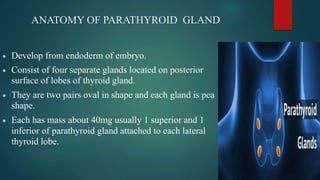
ANATOMY OF PARATHYROID GLAND
 Develop from endoderm of embryo.
 Consist of four separate glands located on posterior
surface of lobes of thyroid gland.
 They are two pairs oval in shape and each gland is pea
shape.
 Each has mass about 40mg usually 1 superior and 1
inferior of parathyroid gland attached to each lateral
thyroid lobe.
FUNCTION OF PARATHYROID GLAND
 Secrete PTH(parathyroid hormone) and secretion is regulated by blood calcium
level.
 Main function of PTH is to increase blood calcium level when it is low.
 PTH on kidney is to promote formation of hormone calcitriol, active form of
vitamin D.
 Increases rate of calcium, phosphate and magnesium from GI tract into blood.
 It helps in muscle contraction, nerve transmission, blood clotting.
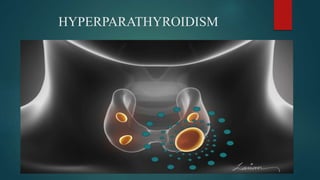
HYPERPARATHYROIDISM
INTRODUCTION
 When calcium level is too low, body response increasing production of
pararthyroid hormone and calcium to be take from bone and more calcium to
be reabsorbed by intestines and kidney.
DEFINITION
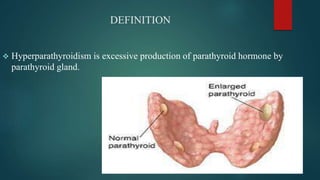
 Hyperparathyroidism is excessive production of parathyroid hormone by
parathyroid gland.
TYPES
1) Primary Hyperparathyroidism.
2) Secondary Hyperparathyroidism.
3) Tertiary Hyperparathyroidism.
CAUSES/RISK FACTORS
 Due to excessive hormone production.
 Menopause.
 Vitamin-D deficiency.
 Chronic kidney failure.
 Severe calcium deficiency.
 Genetic factors.
 Hyperplasia of parathyroid tissues.
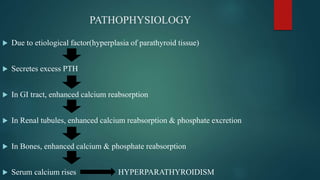
PATHOPHYSIOLOGY
 Due to etiological factor(hyperplasia of parathyroid tissue)
 Secretes excess PTH
 In GI tract, enhanced calcium reabsorption
 In Renal tubules, enhanced calcium reabsorption & phosphate excretion
 In Bones, enhanced calcium & phosphate reabsorption
 Serum calcium rises HYPERPARATHYROIDISM
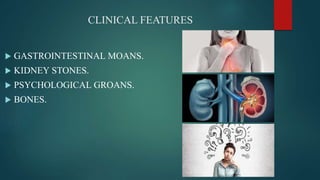
CLINICAL FEATURES
 GASTROINTESTINAL MOANS.
 KIDNEY STONES.
 PSYCHOLOGICAL GROANS.
 BONES.
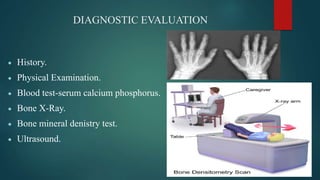
DIAGNOSTIC EVALUATION
 History.
 Physical Examination.
 Blood test-serum calcium phosphorus.
 Bone X-Ray.
 Bone mineral denistry test.
 Ultrasound.
MANAGEMENT
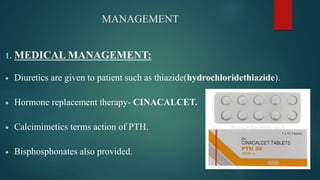
1. MEDICAL MANAGEMENT:
 Diuretics are given to patient such as thiazide(hydrochloridethiazide).
 Hormone replacement therapy- CINACALCET.
 Calcimimetics terms action of PTH.
 Bisphosphonates also provided.
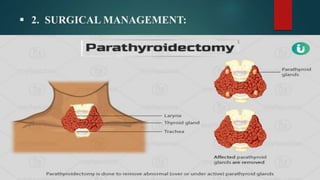
 2. SURGICAL MANAGEMENT:
PREVENTIVE MEASURES:
 Limit intake of calcium (less than 1200mg/day).
 Plenty of water.
 Avoid smoking.
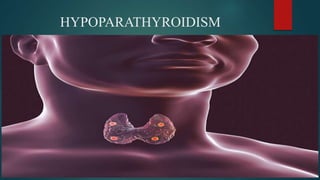
HYPOPARATHYROIDISM
DEFINITION
 Hypoparathyroidism is a condition occurs when either insufficient level of
PTH or release by parathyroid gland in neck leads to low level of calcium and
high level of phosphorus in blood.
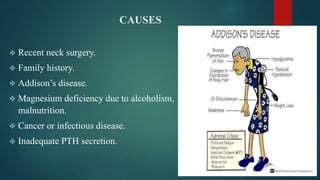
CAUSES
 Recent neck surgery.
 Family history.
 Addison’s disease.
 Magnesium deficiency due to alcoholism,
malnutrition.
 Cancer or infectious disease.
 Inadequate PTH secretion.
TYPES
 Acquired hypoparathyroidism
 Inherited or Autoimmune hypoparathyroidism
 Transient hypoparathyroidism
 Congenital hypoparathyroidism.
 Pseudo- hypoparathyroidism
PATHOPHYSIOLOGY
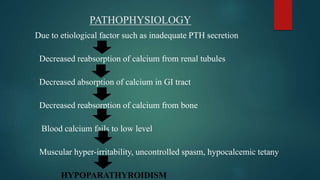
Due to etiological factor such as inadequate PTH secretion
Decreased reabsorption of calcium from renal tubules
Decreased absorption of calcium in GI tract
Decreased reabsorption of calcium from bone
Blood calcium fails to low level
Muscular hyper-irritability, uncontrolled spasm, hypocalcemic tetany
HYPOPARATHYROIDISM
CLINICAL FEATURES
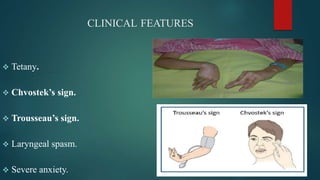
 Tetany.
 Chvostek’s sign.
 Trousseau’s sign.
 Laryngeal spasm.
 Severe anxiety.
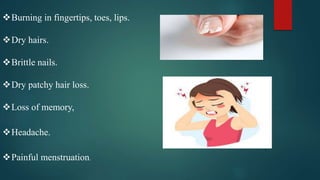
Burning in fingertips, toes, lips.
Dry hairs.
Brittle nails.
Dry patchy hair loss.
Loss of memory,
Headache.
Painful menstruation.
DIAGNOSTIC FEATURES
 History.
 Physical examination.
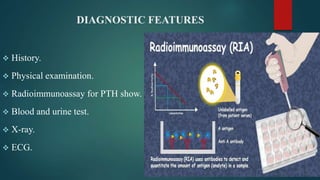
 Radioimmunoassay for PTH show.
 Blood and urine test.
 X-ray.
 ECG.
MANAGEMENT
 Calcium chloride and calcium gluconate- 500mg to 1g.
 Vitamin D supplement.
 Low phosphorus diet.
 Diuretics- Lasix given to patient.
 To prevent tetany I.V calcium can be given.
COMPLICATION
 Blocked airway due to muscle spasm.
 Stunted growth.
 Cataract.
 Calcium deposit in brain.
CONCLUSION
 When calcium level is too low, body response increasing production of
pararthyroid hormone and calcium to be take from bone and more calcium to be
reabsorbed by intestines and kidney.
 Hypoparathyroidism is a condition occurs when either insufficient level of PTH
or release by parathyroid gland in neck leads to low level of calcium and high
level of phosphorus in blood.
HYPERPARATHYROIDISM & HYPOPARATHYROIDISM.pptx

HYPERPARATHYROIDISM & HYPOPARATHYROIDISM.pptx

  • 1.
  • 2.
    ANATOMY OF PARATHYROIDGLAND  Develop from endoderm of embryo.  Consist of four separate glands located on posterior surface of lobes of thyroid gland.  They are two pairs oval in shape and each gland is pea shape.  Each has mass about 40mg usually 1 superior and 1 inferior of parathyroid gland attached to each lateral thyroid lobe.
  • 3.
    FUNCTION OF PARATHYROIDGLAND  Secrete PTH(parathyroid hormone) and secretion is regulated by blood calcium level.  Main function of PTH is to increase blood calcium level when it is low.  PTH on kidney is to promote formation of hormone calcitriol, active form of vitamin D.  Increases rate of calcium, phosphate and magnesium from GI tract into blood.  It helps in muscle contraction, nerve transmission, blood clotting.
  • 4.
  • 5.
    INTRODUCTION  When calciumlevel is too low, body response increasing production of pararthyroid hormone and calcium to be take from bone and more calcium to be reabsorbed by intestines and kidney.
  • 6.
    DEFINITION  Hyperparathyroidism isexcessive production of parathyroid hormone by parathyroid gland.
  • 7.
    TYPES 1) Primary Hyperparathyroidism. 2)Secondary Hyperparathyroidism. 3) Tertiary Hyperparathyroidism.
  • 8.
    CAUSES/RISK FACTORS  Dueto excessive hormone production.  Menopause.  Vitamin-D deficiency.  Chronic kidney failure.  Severe calcium deficiency.  Genetic factors.  Hyperplasia of parathyroid tissues.
  • 9.
    PATHOPHYSIOLOGY  Due toetiological factor(hyperplasia of parathyroid tissue)  Secretes excess PTH  In GI tract, enhanced calcium reabsorption  In Renal tubules, enhanced calcium reabsorption & phosphate excretion  In Bones, enhanced calcium & phosphate reabsorption  Serum calcium rises HYPERPARATHYROIDISM
  • 10.
    CLINICAL FEATURES  GASTROINTESTINALMOANS.  KIDNEY STONES.  PSYCHOLOGICAL GROANS.  BONES.
  • 11.
    DIAGNOSTIC EVALUATION  History. Physical Examination.  Blood test-serum calcium phosphorus.  Bone X-Ray.  Bone mineral denistry test.  Ultrasound.
  • 12.
    MANAGEMENT 1. MEDICAL MANAGEMENT: Diuretics are given to patient such as thiazide(hydrochloridethiazide).  Hormone replacement therapy- CINACALCET.  Calcimimetics terms action of PTH.  Bisphosphonates also provided.
  • 13.
     2. SURGICALMANAGEMENT:
  • 14.
    PREVENTIVE MEASURES:  Limitintake of calcium (less than 1200mg/day).  Plenty of water.  Avoid smoking.
  • 15.
  • 16.
    DEFINITION  Hypoparathyroidism isa condition occurs when either insufficient level of PTH or release by parathyroid gland in neck leads to low level of calcium and high level of phosphorus in blood.
  • 17.
    CAUSES  Recent necksurgery.  Family history.  Addison’s disease.  Magnesium deficiency due to alcoholism, malnutrition.  Cancer or infectious disease.  Inadequate PTH secretion.
  • 18.
    TYPES  Acquired hypoparathyroidism Inherited or Autoimmune hypoparathyroidism  Transient hypoparathyroidism  Congenital hypoparathyroidism.  Pseudo- hypoparathyroidism
  • 19.
    PATHOPHYSIOLOGY Due to etiologicalfactor such as inadequate PTH secretion Decreased reabsorption of calcium from renal tubules Decreased absorption of calcium in GI tract Decreased reabsorption of calcium from bone Blood calcium fails to low level Muscular hyper-irritability, uncontrolled spasm, hypocalcemic tetany HYPOPARATHYROIDISM
  • 20.
    CLINICAL FEATURES  Tetany. Chvostek’s sign.  Trousseau’s sign.  Laryngeal spasm.  Severe anxiety.
  • 21.
    Burning in fingertips,toes, lips. Dry hairs. Brittle nails. Dry patchy hair loss. Loss of memory, Headache. Painful menstruation.
  • 22.
    DIAGNOSTIC FEATURES  History. Physical examination.  Radioimmunoassay for PTH show.  Blood and urine test.  X-ray.  ECG.
  • 23.
    MANAGEMENT  Calcium chlorideand calcium gluconate- 500mg to 1g.  Vitamin D supplement.  Low phosphorus diet.  Diuretics- Lasix given to patient.  To prevent tetany I.V calcium can be given.
  • 24.
    COMPLICATION  Blocked airwaydue to muscle spasm.  Stunted growth.  Cataract.  Calcium deposit in brain.
  • 25.
    CONCLUSION  When calciumlevel is too low, body response increasing production of pararthyroid hormone and calcium to be take from bone and more calcium to be reabsorbed by intestines and kidney.  Hypoparathyroidism is a condition occurs when either insufficient level of PTH or release by parathyroid gland in neck leads to low level of calcium and high level of phosphorus in blood.