1.Introduction
Hyper loop offers a potential revolution in transport. It could transform how we perceive
distance by enabling aircraft speeds at ground level in an on-demand point-to-point transport
system.
Hyper loop refers to the concept described by Elon Musk in his paper, Hyper loop Alpha1, which
is a new, very high speed, intercity transportation mode, published in 2013 and involves either
passenger or freight carrying vehicles that operate inside tubes with air evacuated to create a
low-pressure environment. The reduced air resistance resulting from the low-pressure
environment could enable the vehicles to reach very high speeds; 2-3 times faster than high
speed rail. Proponents also claim that the system can enable direct, on-demand travel rather than
a scheduled service as provided by other forms of public transport, could be more
environmentally friendly than other modes and could be cheaper than high-speed rail.
This report provide a high-level evaluation of hyper loop in terms of its commercial potential,
environmental impact, costs, safety issues, and regulatory issues.
1.1 BackgroundContext
The idea of a mass transport system that involves propelling vehicles along low pressure tubes
was discussed as long ago as the late 17th century following the invention of the world’s first
artificial vacuum. Many subsequent configurations have been attempted for transporting both
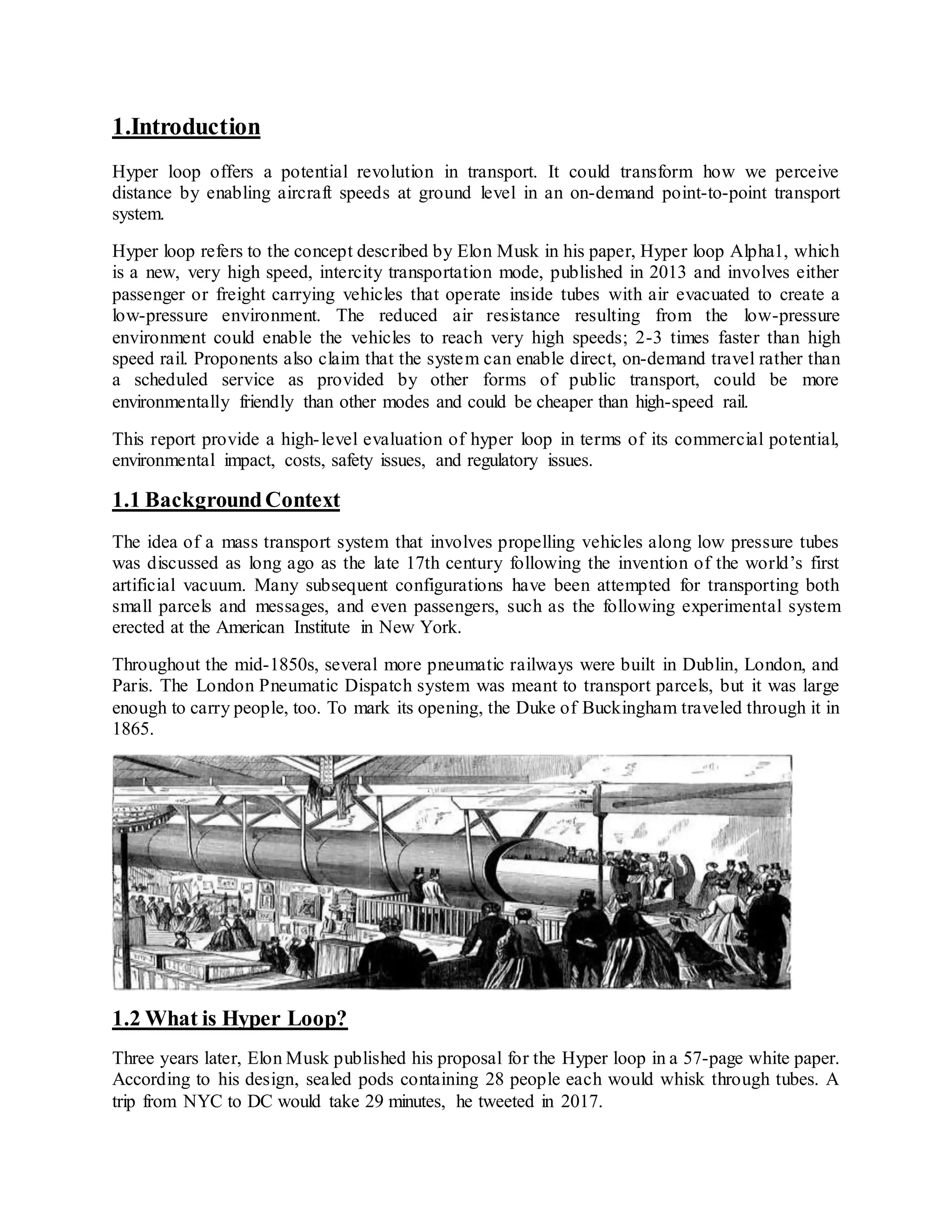
small parcels and messages, and even passengers, such as the following experimental system
erected at the American Institute in New York.
Throughout the mid-1850s, several more pneumatic railways were built in Dublin, London, and
Paris. The London Pneumatic Dispatch system was meant to transport parcels, but it was large
enough to carry people, too. To mark its opening, the Duke of Buckingham traveled through it in
1865.
1.2 What is Hyper Loop?
Three years later, Elon Musk published his proposal for the Hyper loop in a 57-page white paper.
According to his design, sealed pods containing 28 people each would whisk through tubes. A
trip from NYC to DC would take 29 minutes, he tweeted in 2017.
1.3 Objectives
The purpose of hyper loop are reducing construction, great distance in short amount of
time, travel at high speed and maintained costs of the rail, compared to the alternatives, it should
ideally be:
1. Safer
2. Faster
3. Lower cost
4. More suitable
5. protected to weather
6. Sustainably self powering
7. Resistant to earthquakes
8. Controllability
1.4 Why The Need?
Conventional means of transportation (road, water, air, and rail) tend to be some mix of
expensive, slow, and environmentally harmful. Road travel is particularly problematic, given
carbon emissions and the fluctuating price of oil. As the environmental dangers of energy
consumption continue to worsen, mass transit will be crucial in the years to come.
Rail travel is relatively energy efficient and offers the most environmentally friendly option, but
is too slow and expensive to be massively adopted. At distances less than 900 miles, supersonic
travel is unfeasible, as most of the journey would be spent ascending and descending (the slowest
parts of a flight.) Given these issues, the Hyper loop aims to make a cost-effective, high speed
transportation system for use at moderate distances. As an example of the right type of distance,
Musk uses the route from San Francisco to L.A. (a route the high-speed rail system will also
cover). The Hyper loop tubes would have solar panels installed on the roof, allowing for a clean
and self-powering system.
2. Scope and Project Charter
2.1 Scope
Hyper loop is expected to be the fifth mode of transport in the future. At present, hyper
loop is in a development stage, and a number of companies have started testing this technology.
The scope of the study covers segmentation by system type and by carriage type. The system
type segmentation includes capsule, tube, propulsion system and other systems while the carriage
type includes passenger and cargo/freight.
2.2 How does the hyper loop work?
The speed of conventional trains and all land based transport is limited by friction, both against the
air ahead and the ground beneath. Hyper loop significantly reduces friction in both of these areas.
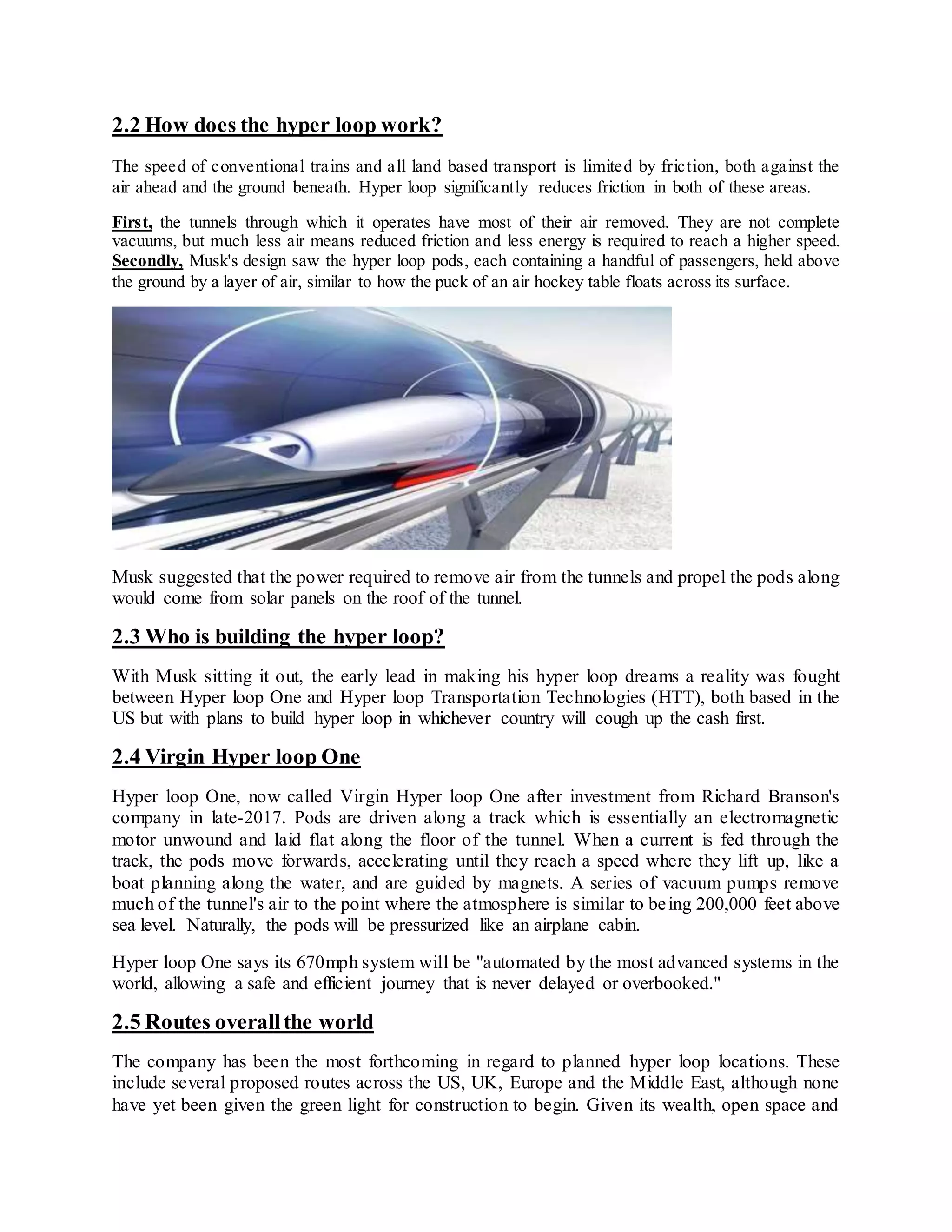
First, the tunnels through which it operates have most of their air removed. They are not complete
vacuums, but much less air means reduced friction and less energy is required to reach a higher speed.
Secondly, Musk's design saw the hyper loop pods, each containing a handful of passengers, held above
the ground by a layer of air, similar to how the puck of an air hockey table floats across its surface.
Musk suggested that the power required to remove air from the tunnels and propel the pods along
would come from solar panels on the roof of the tunnel.
2.3 Who is building the hyper loop?
With Musk sitting it out, the early lead in making his hyper loop dreams a reality was fought
between Hyper loop One and Hyper loop Transportation Technologies (HTT), both based in the
US but with plans to build hyper loop in whichever country will cough up the cash first.
2.4 Virgin Hyper loop One
Hyper loop One, now called Virgin Hyper loop One after investment from Richard Branson's
company in late-2017. Pods are driven along a track which is essentially an electromagnetic
motor unwound and laid flat along the floor of the tunnel. When a current is fed through the
track, the pods move forwards, accelerating until they reach a speed where they lift up, like a
boat planning along the water, and are guided by magnets. A series of vacuum pumps remove
much of the tunnel's air to the point where the atmosphere is similar to being 200,000 feet above
sea level. Naturally, the pods will be pressurized like an airplane cabin.
Hyper loop One says its 670mph system will be "automated by the most advanced systems in the
world, allowing a safe and efficient journey that is never delayed or overbooked."
2.5 Routes overallthe world
The company has been the most forthcoming in regard to planned hyper loop locations. These
include several proposed routes across the US, UK, Europe and the Middle East, although none
have yet been given the green light for construction to begin. Given its wealth, open space and
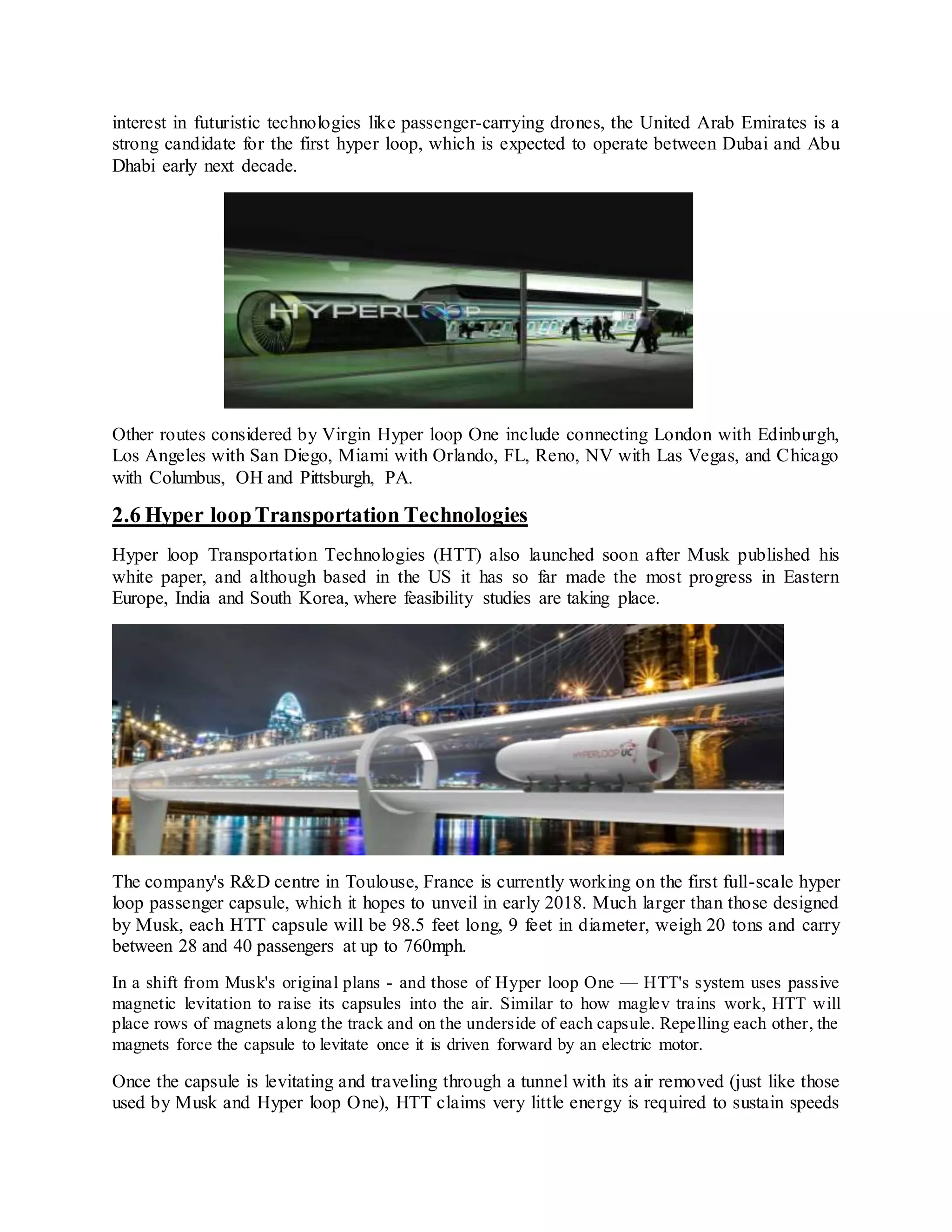
interest in futuristic technologies like passenger-carrying drones, the United Arab Emirates is a
strong candidate for the first hyper loop, which is expected to operate between Dubai and Abu
Dhabi early next decade.
Other routes considered by Virgin Hyper loop One include connecting London with Edinburgh,
Los Angeles with San Diego, Miami with Orlando, FL, Reno, NV with Las Vegas, and Chicago
with Columbus, OH and Pittsburgh, PA.
2.6 Hyper loopTransportation Technologies
Hyper loop Transportation Technologies (HTT) also launched soon after Musk published his
white paper, and although based in the US it has so far made the most progress in Eastern
Europe, India and South Korea, where feasibility studies are taking place.
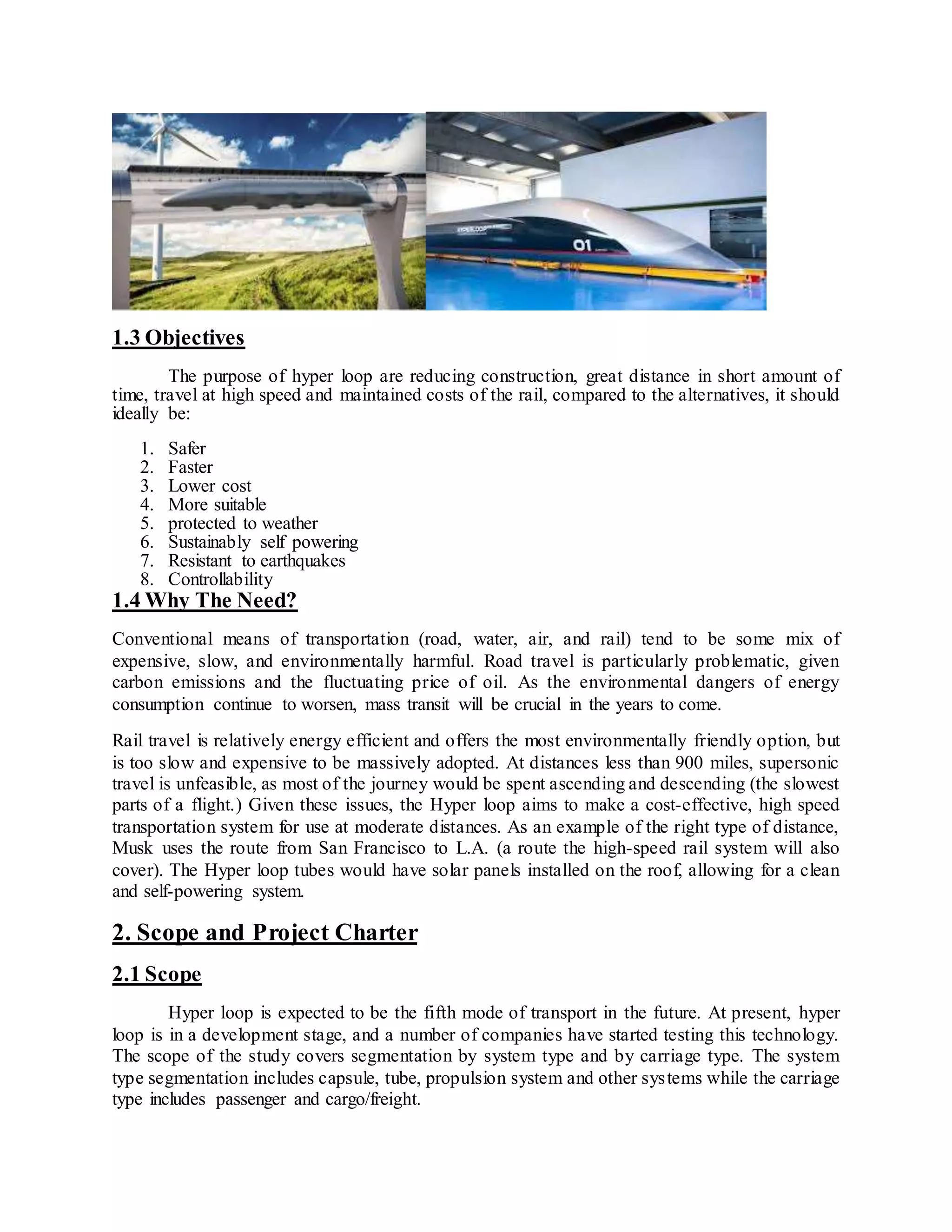
The company's R&D centre in Toulouse, France is currently working on the first full-scale hyper
loop passenger capsule, which it hopes to unveil in early 2018. Much larger than those designed
by Musk, each HTT capsule will be 98.5 feet long, 9 feet in diameter, weigh 20 tons and carry
between 28 and 40 passengers at up to 760mph.
In a shift from Musk's original plans - and those of Hyper loop One — HTT's system uses passive
magnetic levitation to raise its capsules into the air. Similar to how maglev trains work, HTT will
place rows of magnets along the track and on the underside of each capsule. Repelling each other, the
magnets force the capsule to levitate once it is driven forward by an electric motor.
Once the capsule is levitating and traveling through a tunnel with its air removed (just like those
used by Musk and Hyper loop One), HTT claims very little energy is required to sustain speeds
of over 700mph. So far, HTT has agreements with Abu Dhabi, Slovakia and the Czech Republic
for potential hyper loop installations.
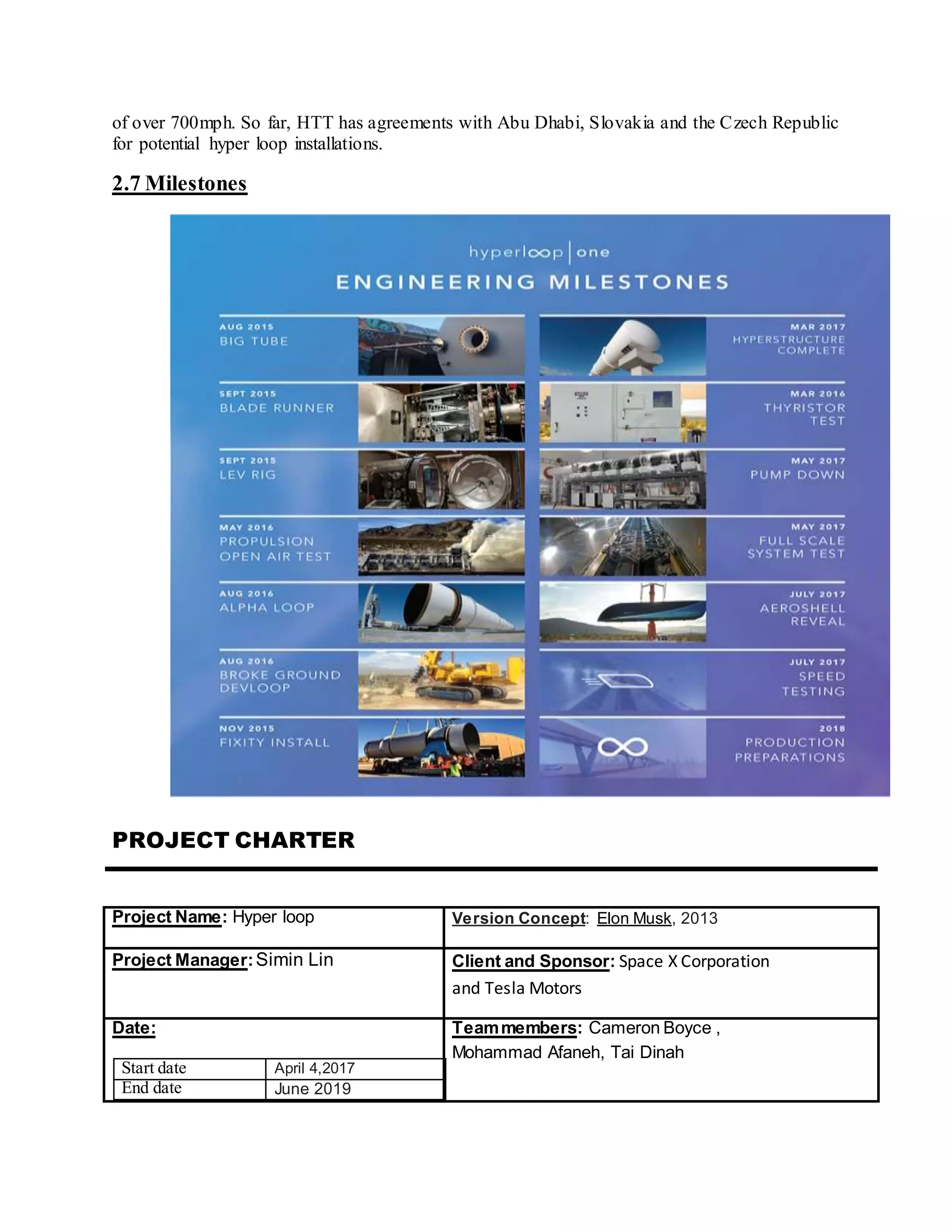
2.7 Milestones
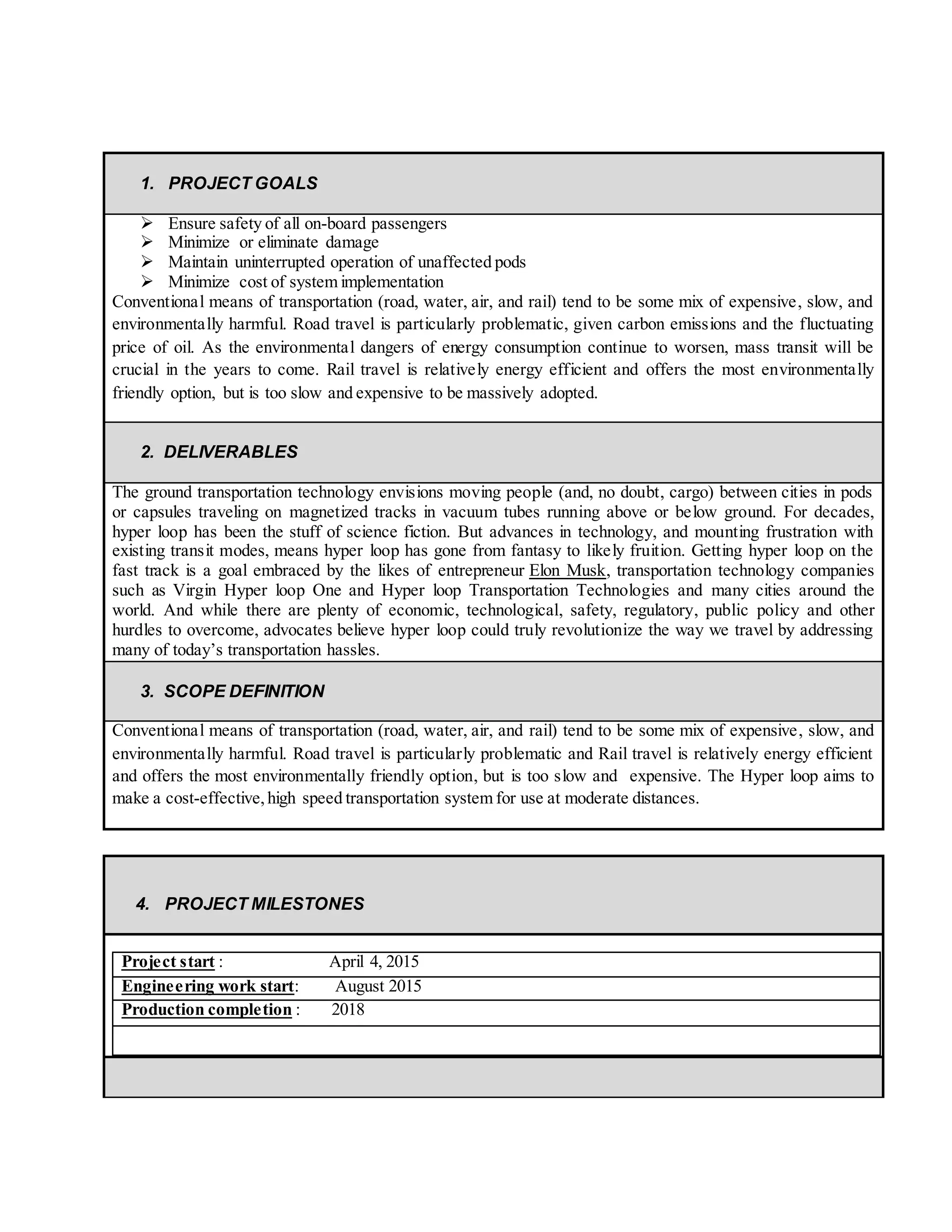
PROJECT CHARTER
Project Name: Hyper loop Version Concept: Elon Musk, 2013
Project Manager:Simin Lin Client and Sponsor: Space X Corporation
and Tesla Motors
Date:
Start date April 4,2017
End date June 2019
Teammembers: Cameron Boyce ,
Mohammad Afaneh, Tai Dinah
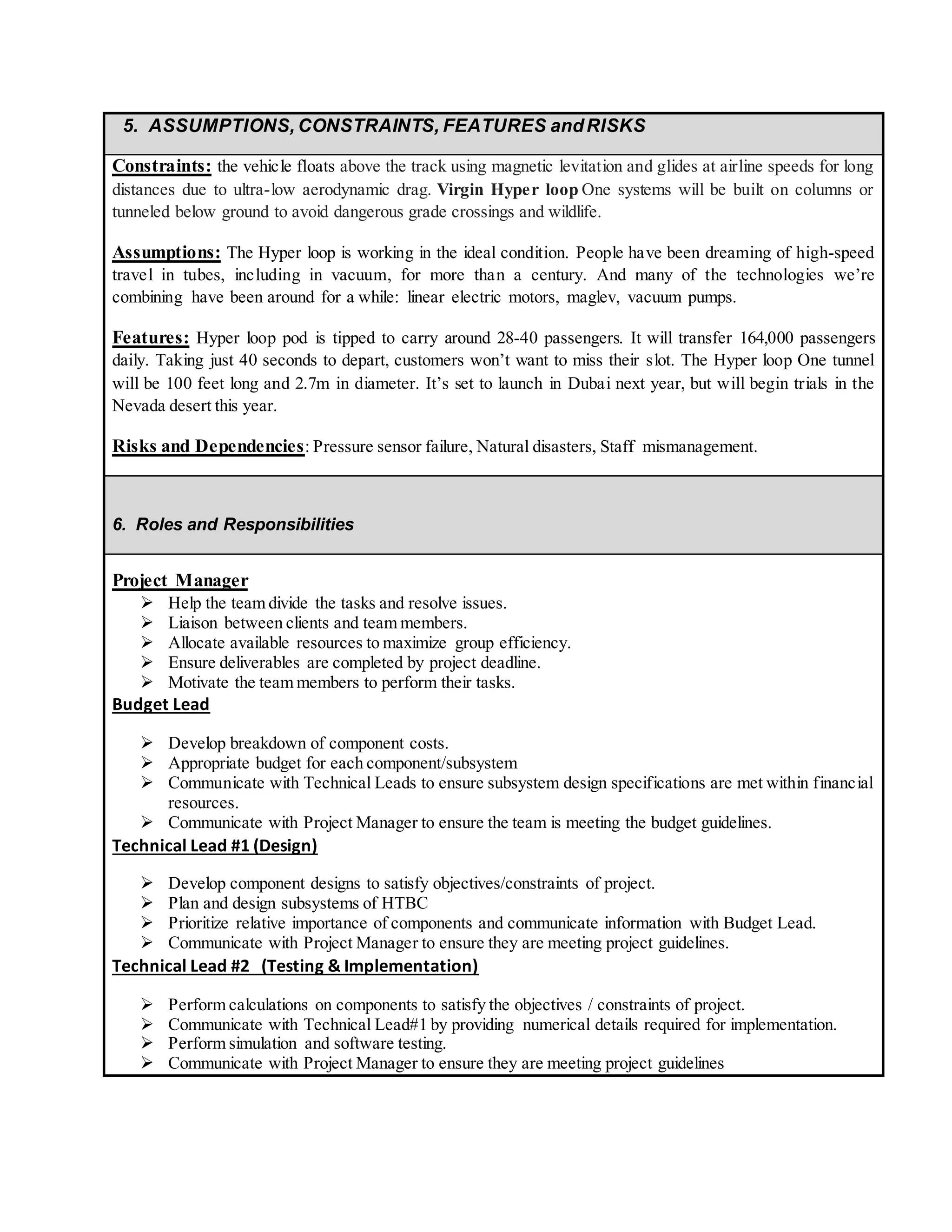
1. PROJECT GOALS
 Ensure safety of all on-board passengers
 Minimize or eliminate damage
 Maintain uninterrupted operation of unaffected pods
 Minimize cost of system implementation
Conventional means of transportation (road, water, air, and rail) tend to be some mix of expensive, slow, and
environmentally harmful. Road travel is particularly problematic, given carbon emissions and the fluctuating
price of oil. As the environmental dangers of energy consumption continue to worsen, mass transit will be
crucial in the years to come. Rail travel is relatively energy efficient and offers the most environmentally
friendly option, but is too slow and expensive to be massively adopted.
2. DELIVERABLES
The ground transportation technology envisions moving people (and, no doubt, cargo) between cities in pods
or capsules traveling on magnetized tracks in vacuum tubes running above or below ground. For decades,
hyper loop has been the stuff of science fiction. But advances in technology, and mounting frustration with
existing transit modes, means hyper loop has gone from fantasy to likely fruition. Getting hyper loop on the
fast track is a goal embraced by the likes of entrepreneur Elon Musk, transportation technology companies
such as Virgin Hyper loop One and Hyper loop Transportation Technologies and many cities around the
world. And while there are plenty of economic, technological, safety, regulatory, public policy and other
hurdles to overcome, advocates believe hyper loop could truly revolutionize the way we travel by addressing
many of today’s transportation hassles.
3. SCOPE DEFINITION
Conventional means of transportation (road, water, air, and rail) tend to be some mix of expensive, slow, and
environmentally harmful. Road travel is particularly problematic and Rail travel is relatively energy efficient
and offers the most environmentally friendly option, but is too slow and expensive. The Hyper loop aims to
make a cost-effective,high speed transportation system for use at moderate distances.
4. PROJECT MILESTONES
Project start : April 4, 2015
Engineering work start: August 2015
Production completion : 2018
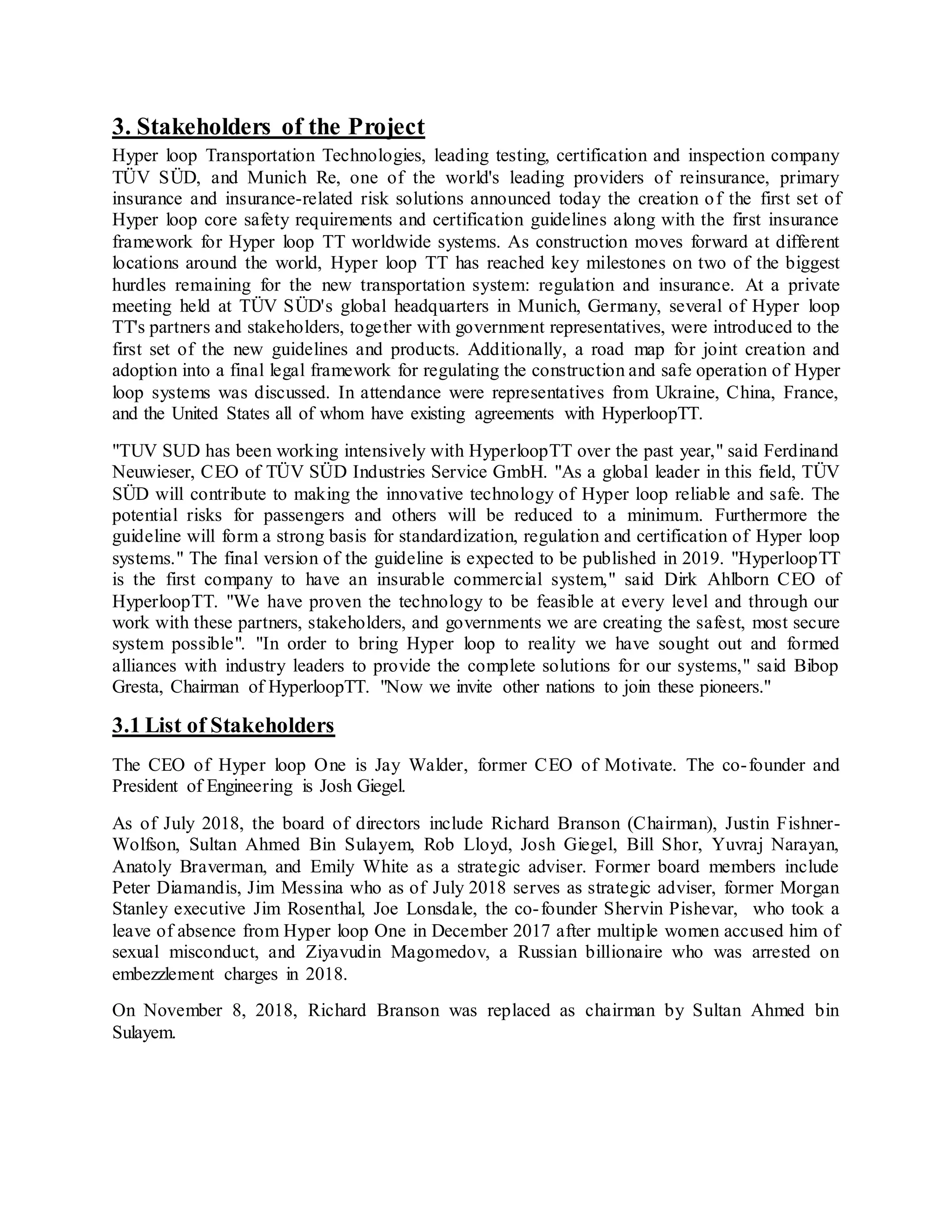
5. ASSUMPTIONS, CONSTRAINTS, FEATURES andRISKS
Constraints: the vehicle floats above the track using magnetic levitation and glides at airline speeds for long
distances due to ultra-low aerodynamic drag. Virgin Hyper loop One systems will be built on columns or
tunneled below ground to avoid dangerous grade crossings and wildlife.
Assumptions: The Hyper loop is working in the ideal condition. People have been dreaming of high-speed
travel in tubes, including in vacuum, for more than a century. And many of the technologies we’re
combining have been around for a while: linear electric motors, maglev, vacuum pumps.
Features: Hyper loop pod is tipped to carry around 28-40 passengers. It will transfer 164,000 passengers
daily. Taking just 40 seconds to depart, customers won’t want to miss their slot. The Hyper loop One tunnel
will be 100 feet long and 2.7m in diameter. It’s set to launch in Dubai next year, but will begin trials in the
Nevada desert this year.
Risks and Dependencies: Pressure sensor failure, Natural disasters, Staff mismanagement.
6. Roles and Responsibilities
Project Manager
 Help the team divide the tasks and resolve issues.
 Liaison between clients and team members.
 Allocate available resources to maximize group efficiency.
 Ensure deliverables are completed by project deadline.
 Motivate the team members to perform their tasks.
Budget Lead
 Develop breakdown of component costs.
 Appropriate budget for each component/subsystem
 Communicate with Technical Leads to ensure subsystem design specifications are met within financial
resources.
 Communicate with Project Manager to ensure the team is meeting the budget guidelines.
Technical Lead #1 (Design)
 Develop component designs to satisfy objectives/constraints of project.
 Plan and design subsystems of HTBC
 Prioritize relative importance of components and communicate information with Budget Lead.
 Communicate with Project Manager to ensure they are meeting project guidelines.
Technical Lead #2 (Testing & Implementation)
 Perform calculations on components to satisfy the objectives / constraints of project.
 Communicate with Technical Lead#1 by providing numerical details required for implementation.
 Perform simulation and software testing.
 Communicate with Project Manager to ensure they are meeting project guidelines
3. Stakeholders of the Project
Hyper loop Transportation Technologies, leading testing, certification and inspection company
TÜV SÜD, and Munich Re, one of the world's leading providers of reinsurance, primary
insurance and insurance-related risk solutions announced today the creation of the first set of
Hyper loop core safety requirements and certification guidelines along with the first insurance
framework for Hyper loop TT worldwide systems. As construction moves forward at different
locations around the world, Hyper loop TT has reached key milestones on two of the biggest
hurdles remaining for the new transportation system: regulation and insurance. At a private
meeting held at TÜV SÜD's global headquarters in Munich, Germany, several of Hyper loop
TT's partners and stakeholders, together with government representatives, were introduced to the
first set of the new guidelines and products. Additionally, a road map for joint creation and
adoption into a final legal framework for regulating the construction and safe operation of Hyper
loop systems was discussed. In attendance were representatives from Ukraine, China, France,
and the United States all of whom have existing agreements with HyperloopTT.
"TUV SUD has been working intensively with HyperloopTT over the past year," said Ferdinand
Neuwieser, CEO of TÜV SÜD Industries Service GmbH. "As a global leader in this field, TÜV
SÜD will contribute to making the innovative technology of Hyper loop reliable and safe. The
potential risks for passengers and others will be reduced to a minimum. Furthermore the
guideline will form a strong basis for standardization, regulation and certification of Hyper loop
systems." The final version of the guideline is expected to be published in 2019. "HyperloopTT
is the first company to have an insurable commercial system," said Dirk Ahlborn CEO of
HyperloopTT. "We have proven the technology to be feasible at every level and through our
work with these partners, stakeholders, and governments we are creating the safest, most secure
system possible". "In order to bring Hyper loop to reality we have sought out and formed
alliances with industry leaders to provide the complete solutions for our systems," said Bibop
Gresta, Chairman of HyperloopTT. "Now we invite other nations to join these pioneers."
3.1 List of Stakeholders
The CEO of Hyper loop One is Jay Walder, former CEO of Motivate. The co-founder and
President of Engineering is Josh Giegel.
As of July 2018, the board of directors include Richard Branson (Chairman), Justin Fishner-
Wolfson, Sultan Ahmed Bin Sulayem, Rob Lloyd, Josh Giegel, Bill Shor, Yuvraj Narayan,
Anatoly Braverman, and Emily White as a strategic adviser. Former board members include
Peter Diamandis, Jim Messina who as of July 2018 serves as strategic adviser, former Morgan
Stanley executive Jim Rosenthal, Joe Lonsdale, the co-founder Shervin Pishevar, who took a
leave of absence from Hyper loop One in December 2017 after multiple women accused him of
sexual misconduct, and Ziyavudin Magomedov, a Russian billionaire who was arrested on
embezzlement charges in 2018.
On November 8, 2018, Richard Branson was replaced as chairman by Sultan Ahmed bin
Sulayem.
4. Cost and scheduling
4.1 cost
The total cost of the Hyper loop passenger transportation system as outlined is less than $6 billion USD.
The passenger plus vehicle version of Hyper loop is including both passenger and cargo capsules and the
total cost is outlined as $7.5 billion USD. Hyper loop One has received investment of $245M to date and
hopes to begin construction of its first route in 2019, with commercial services starting in 2021. And its
founders also claimed that ticket prices for the Los Angeles to San Francisco route would be as low as
$20, and the journey would take just 35 minutes.
4.2 Scheduling
Project start : April 4, 2015
Engineering work start: August 2015
Production completion : 2018
5. Risk management
Although in theory it sounds fantastic, it is important to consider the several challenges hyper
loop faces in both construction and its impact on society. The biggest speed bump hyper loop
faces is the cost of the technology and elaborate tube system, estimated to cost millions of
dollars.
The vehicle is transported by electric propulsion1 through a low-pressure tube and floats above
the track using magnetic levitation. The long vacuum chamber manufacturing requires advanced
technical skills which are costly and also risky to maintain. High risk to life, limited space in the
train and land use rights are some other concerns and challenges that hyperloop will face, not to
mention the installation would require a large number of trees to be cut down, leading to
environmental loss.
6. Conclusion
The development of Hyper loop as the 5th mode of travel has the potential to provide a
revolutionary transportation alternative in the rapidly evolving modern world. Hyper loop has
many inherent safety and performance advantages over existing transportation methods, however
like all modes of transportation it has associated risks and hazards. This paper has discussed
some of the development efforts at HTT to identify those risks and hazards and mitigate them
through careful capsule design and operational procedures. These and other efforts will continue
through the design, verification and certification stages of this new transportation technology.
This process along with on-going development of new standards and regulatory activities will
result in Hyper loop installations that exceed the expectations for modern transportation systems.

Hyperloop

  • 1.
    1.Introduction Hyper loop offersa potential revolution in transport. It could transform how we perceive distance by enabling aircraft speeds at ground level in an on-demand point-to-point transport system. Hyper loop refers to the concept described by Elon Musk in his paper, Hyper loop Alpha1, which is a new, very high speed, intercity transportation mode, published in 2013 and involves either passenger or freight carrying vehicles that operate inside tubes with air evacuated to create a low-pressure environment. The reduced air resistance resulting from the low-pressure environment could enable the vehicles to reach very high speeds; 2-3 times faster than high speed rail. Proponents also claim that the system can enable direct, on-demand travel rather than a scheduled service as provided by other forms of public transport, could be more environmentally friendly than other modes and could be cheaper than high-speed rail. This report provide a high-level evaluation of hyper loop in terms of its commercial potential, environmental impact, costs, safety issues, and regulatory issues. 1.1 BackgroundContext The idea of a mass transport system that involves propelling vehicles along low pressure tubes was discussed as long ago as the late 17th century following the invention of the world’s first artificial vacuum. Many subsequent configurations have been attempted for transporting both small parcels and messages, and even passengers, such as the following experimental system erected at the American Institute in New York. Throughout the mid-1850s, several more pneumatic railways were built in Dublin, London, and Paris. The London Pneumatic Dispatch system was meant to transport parcels, but it was large enough to carry people, too. To mark its opening, the Duke of Buckingham traveled through it in 1865. 1.2 What is Hyper Loop? Three years later, Elon Musk published his proposal for the Hyper loop in a 57-page white paper. According to his design, sealed pods containing 28 people each would whisk through tubes. A trip from NYC to DC would take 29 minutes, he tweeted in 2017.
  • 2.
    1.3 Objectives The purposeof hyper loop are reducing construction, great distance in short amount of time, travel at high speed and maintained costs of the rail, compared to the alternatives, it should ideally be: 1. Safer 2. Faster 3. Lower cost 4. More suitable 5. protected to weather 6. Sustainably self powering 7. Resistant to earthquakes 8. Controllability 1.4 Why The Need? Conventional means of transportation (road, water, air, and rail) tend to be some mix of expensive, slow, and environmentally harmful. Road travel is particularly problematic, given carbon emissions and the fluctuating price of oil. As the environmental dangers of energy consumption continue to worsen, mass transit will be crucial in the years to come. Rail travel is relatively energy efficient and offers the most environmentally friendly option, but is too slow and expensive to be massively adopted. At distances less than 900 miles, supersonic travel is unfeasible, as most of the journey would be spent ascending and descending (the slowest parts of a flight.) Given these issues, the Hyper loop aims to make a cost-effective, high speed transportation system for use at moderate distances. As an example of the right type of distance, Musk uses the route from San Francisco to L.A. (a route the high-speed rail system will also cover). The Hyper loop tubes would have solar panels installed on the roof, allowing for a clean and self-powering system. 2. Scope and Project Charter 2.1 Scope Hyper loop is expected to be the fifth mode of transport in the future. At present, hyper loop is in a development stage, and a number of companies have started testing this technology. The scope of the study covers segmentation by system type and by carriage type. The system type segmentation includes capsule, tube, propulsion system and other systems while the carriage type includes passenger and cargo/freight.
  • 3.
    2.2 How doesthe hyper loop work? The speed of conventional trains and all land based transport is limited by friction, both against the air ahead and the ground beneath. Hyper loop significantly reduces friction in both of these areas. First, the tunnels through which it operates have most of their air removed. They are not complete vacuums, but much less air means reduced friction and less energy is required to reach a higher speed. Secondly, Musk's design saw the hyper loop pods, each containing a handful of passengers, held above the ground by a layer of air, similar to how the puck of an air hockey table floats across its surface. Musk suggested that the power required to remove air from the tunnels and propel the pods along would come from solar panels on the roof of the tunnel. 2.3 Who is building the hyper loop? With Musk sitting it out, the early lead in making his hyper loop dreams a reality was fought between Hyper loop One and Hyper loop Transportation Technologies (HTT), both based in the US but with plans to build hyper loop in whichever country will cough up the cash first. 2.4 Virgin Hyper loop One Hyper loop One, now called Virgin Hyper loop One after investment from Richard Branson's company in late-2017. Pods are driven along a track which is essentially an electromagnetic motor unwound and laid flat along the floor of the tunnel. When a current is fed through the track, the pods move forwards, accelerating until they reach a speed where they lift up, like a boat planning along the water, and are guided by magnets. A series of vacuum pumps remove much of the tunnel's air to the point where the atmosphere is similar to being 200,000 feet above sea level. Naturally, the pods will be pressurized like an airplane cabin. Hyper loop One says its 670mph system will be "automated by the most advanced systems in the world, allowing a safe and efficient journey that is never delayed or overbooked." 2.5 Routes overallthe world The company has been the most forthcoming in regard to planned hyper loop locations. These include several proposed routes across the US, UK, Europe and the Middle East, although none have yet been given the green light for construction to begin. Given its wealth, open space and
  • 4.
    interest in futuristictechnologies like passenger-carrying drones, the United Arab Emirates is a strong candidate for the first hyper loop, which is expected to operate between Dubai and Abu Dhabi early next decade. Other routes considered by Virgin Hyper loop One include connecting London with Edinburgh, Los Angeles with San Diego, Miami with Orlando, FL, Reno, NV with Las Vegas, and Chicago with Columbus, OH and Pittsburgh, PA. 2.6 Hyper loopTransportation Technologies Hyper loop Transportation Technologies (HTT) also launched soon after Musk published his white paper, and although based in the US it has so far made the most progress in Eastern Europe, India and South Korea, where feasibility studies are taking place. The company's R&D centre in Toulouse, France is currently working on the first full-scale hyper loop passenger capsule, which it hopes to unveil in early 2018. Much larger than those designed by Musk, each HTT capsule will be 98.5 feet long, 9 feet in diameter, weigh 20 tons and carry between 28 and 40 passengers at up to 760mph. In a shift from Musk's original plans - and those of Hyper loop One — HTT's system uses passive magnetic levitation to raise its capsules into the air. Similar to how maglev trains work, HTT will place rows of magnets along the track and on the underside of each capsule. Repelling each other, the magnets force the capsule to levitate once it is driven forward by an electric motor. Once the capsule is levitating and traveling through a tunnel with its air removed (just like those used by Musk and Hyper loop One), HTT claims very little energy is required to sustain speeds
  • 5.
    of over 700mph.So far, HTT has agreements with Abu Dhabi, Slovakia and the Czech Republic for potential hyper loop installations. 2.7 Milestones PROJECT CHARTER Project Name: Hyper loop Version Concept: Elon Musk, 2013 Project Manager:Simin Lin Client and Sponsor: Space X Corporation and Tesla Motors Date: Start date April 4,2017 End date June 2019 Teammembers: Cameron Boyce , Mohammad Afaneh, Tai Dinah
  • 6.
    1. PROJECT GOALS Ensure safety of all on-board passengers  Minimize or eliminate damage  Maintain uninterrupted operation of unaffected pods  Minimize cost of system implementation Conventional means of transportation (road, water, air, and rail) tend to be some mix of expensive, slow, and environmentally harmful. Road travel is particularly problematic, given carbon emissions and the fluctuating price of oil. As the environmental dangers of energy consumption continue to worsen, mass transit will be crucial in the years to come. Rail travel is relatively energy efficient and offers the most environmentally friendly option, but is too slow and expensive to be massively adopted. 2. DELIVERABLES The ground transportation technology envisions moving people (and, no doubt, cargo) between cities in pods or capsules traveling on magnetized tracks in vacuum tubes running above or below ground. For decades, hyper loop has been the stuff of science fiction. But advances in technology, and mounting frustration with existing transit modes, means hyper loop has gone from fantasy to likely fruition. Getting hyper loop on the fast track is a goal embraced by the likes of entrepreneur Elon Musk, transportation technology companies such as Virgin Hyper loop One and Hyper loop Transportation Technologies and many cities around the world. And while there are plenty of economic, technological, safety, regulatory, public policy and other hurdles to overcome, advocates believe hyper loop could truly revolutionize the way we travel by addressing many of today’s transportation hassles. 3. SCOPE DEFINITION Conventional means of transportation (road, water, air, and rail) tend to be some mix of expensive, slow, and environmentally harmful. Road travel is particularly problematic and Rail travel is relatively energy efficient and offers the most environmentally friendly option, but is too slow and expensive. The Hyper loop aims to make a cost-effective,high speed transportation system for use at moderate distances. 4. PROJECT MILESTONES Project start : April 4, 2015 Engineering work start: August 2015 Production completion : 2018
  • 7.
    5. ASSUMPTIONS, CONSTRAINTS,FEATURES andRISKS Constraints: the vehicle floats above the track using magnetic levitation and glides at airline speeds for long distances due to ultra-low aerodynamic drag. Virgin Hyper loop One systems will be built on columns or tunneled below ground to avoid dangerous grade crossings and wildlife. Assumptions: The Hyper loop is working in the ideal condition. People have been dreaming of high-speed travel in tubes, including in vacuum, for more than a century. And many of the technologies we’re combining have been around for a while: linear electric motors, maglev, vacuum pumps. Features: Hyper loop pod is tipped to carry around 28-40 passengers. It will transfer 164,000 passengers daily. Taking just 40 seconds to depart, customers won’t want to miss their slot. The Hyper loop One tunnel will be 100 feet long and 2.7m in diameter. It’s set to launch in Dubai next year, but will begin trials in the Nevada desert this year. Risks and Dependencies: Pressure sensor failure, Natural disasters, Staff mismanagement. 6. Roles and Responsibilities Project Manager  Help the team divide the tasks and resolve issues.  Liaison between clients and team members.  Allocate available resources to maximize group efficiency.  Ensure deliverables are completed by project deadline.  Motivate the team members to perform their tasks. Budget Lead  Develop breakdown of component costs.  Appropriate budget for each component/subsystem  Communicate with Technical Leads to ensure subsystem design specifications are met within financial resources.  Communicate with Project Manager to ensure the team is meeting the budget guidelines. Technical Lead #1 (Design)  Develop component designs to satisfy objectives/constraints of project.  Plan and design subsystems of HTBC  Prioritize relative importance of components and communicate information with Budget Lead.  Communicate with Project Manager to ensure they are meeting project guidelines. Technical Lead #2 (Testing & Implementation)  Perform calculations on components to satisfy the objectives / constraints of project.  Communicate with Technical Lead#1 by providing numerical details required for implementation.  Perform simulation and software testing.  Communicate with Project Manager to ensure they are meeting project guidelines
  • 8.
    3. Stakeholders ofthe Project Hyper loop Transportation Technologies, leading testing, certification and inspection company TÜV SÜD, and Munich Re, one of the world's leading providers of reinsurance, primary insurance and insurance-related risk solutions announced today the creation of the first set of Hyper loop core safety requirements and certification guidelines along with the first insurance framework for Hyper loop TT worldwide systems. As construction moves forward at different locations around the world, Hyper loop TT has reached key milestones on two of the biggest hurdles remaining for the new transportation system: regulation and insurance. At a private meeting held at TÜV SÜD's global headquarters in Munich, Germany, several of Hyper loop TT's partners and stakeholders, together with government representatives, were introduced to the first set of the new guidelines and products. Additionally, a road map for joint creation and adoption into a final legal framework for regulating the construction and safe operation of Hyper loop systems was discussed. In attendance were representatives from Ukraine, China, France, and the United States all of whom have existing agreements with HyperloopTT. "TUV SUD has been working intensively with HyperloopTT over the past year," said Ferdinand Neuwieser, CEO of TÜV SÜD Industries Service GmbH. "As a global leader in this field, TÜV SÜD will contribute to making the innovative technology of Hyper loop reliable and safe. The potential risks for passengers and others will be reduced to a minimum. Furthermore the guideline will form a strong basis for standardization, regulation and certification of Hyper loop systems." The final version of the guideline is expected to be published in 2019. "HyperloopTT is the first company to have an insurable commercial system," said Dirk Ahlborn CEO of HyperloopTT. "We have proven the technology to be feasible at every level and through our work with these partners, stakeholders, and governments we are creating the safest, most secure system possible". "In order to bring Hyper loop to reality we have sought out and formed alliances with industry leaders to provide the complete solutions for our systems," said Bibop Gresta, Chairman of HyperloopTT. "Now we invite other nations to join these pioneers." 3.1 List of Stakeholders The CEO of Hyper loop One is Jay Walder, former CEO of Motivate. The co-founder and President of Engineering is Josh Giegel. As of July 2018, the board of directors include Richard Branson (Chairman), Justin Fishner- Wolfson, Sultan Ahmed Bin Sulayem, Rob Lloyd, Josh Giegel, Bill Shor, Yuvraj Narayan, Anatoly Braverman, and Emily White as a strategic adviser. Former board members include Peter Diamandis, Jim Messina who as of July 2018 serves as strategic adviser, former Morgan Stanley executive Jim Rosenthal, Joe Lonsdale, the co-founder Shervin Pishevar, who took a leave of absence from Hyper loop One in December 2017 after multiple women accused him of sexual misconduct, and Ziyavudin Magomedov, a Russian billionaire who was arrested on embezzlement charges in 2018. On November 8, 2018, Richard Branson was replaced as chairman by Sultan Ahmed bin Sulayem.
  • 9.
    4. Cost andscheduling 4.1 cost The total cost of the Hyper loop passenger transportation system as outlined is less than $6 billion USD. The passenger plus vehicle version of Hyper loop is including both passenger and cargo capsules and the total cost is outlined as $7.5 billion USD. Hyper loop One has received investment of $245M to date and hopes to begin construction of its first route in 2019, with commercial services starting in 2021. And its founders also claimed that ticket prices for the Los Angeles to San Francisco route would be as low as $20, and the journey would take just 35 minutes. 4.2 Scheduling Project start : April 4, 2015 Engineering work start: August 2015 Production completion : 2018 5. Risk management Although in theory it sounds fantastic, it is important to consider the several challenges hyper loop faces in both construction and its impact on society. The biggest speed bump hyper loop faces is the cost of the technology and elaborate tube system, estimated to cost millions of dollars. The vehicle is transported by electric propulsion1 through a low-pressure tube and floats above the track using magnetic levitation. The long vacuum chamber manufacturing requires advanced technical skills which are costly and also risky to maintain. High risk to life, limited space in the train and land use rights are some other concerns and challenges that hyperloop will face, not to mention the installation would require a large number of trees to be cut down, leading to environmental loss. 6. Conclusion The development of Hyper loop as the 5th mode of travel has the potential to provide a revolutionary transportation alternative in the rapidly evolving modern world. Hyper loop has many inherent safety and performance advantages over existing transportation methods, however like all modes of transportation it has associated risks and hazards. This paper has discussed some of the development efforts at HTT to identify those risks and hazards and mitigate them through careful capsule design and operational procedures. These and other efforts will continue through the design, verification and certification stages of this new transportation technology. This process along with on-going development of new standards and regulatory activities will result in Hyper loop installations that exceed the expectations for modern transportation systems.