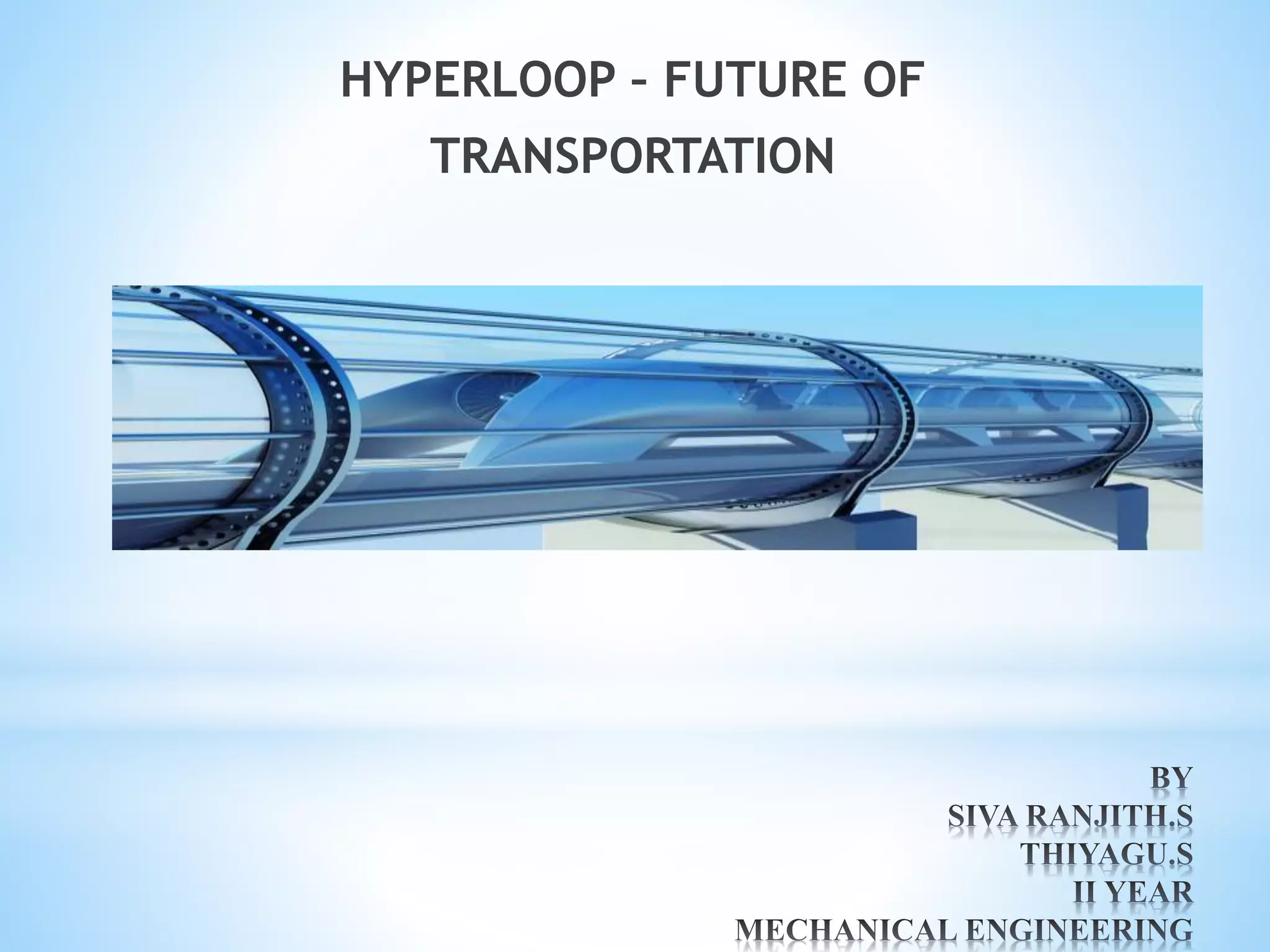
HYPERLOOP – FUTURE OF
TRANSPORTATION
CONTENT
Abstract
Introduction
Conventional mode of transportation
Components of Hyperloop transportation system
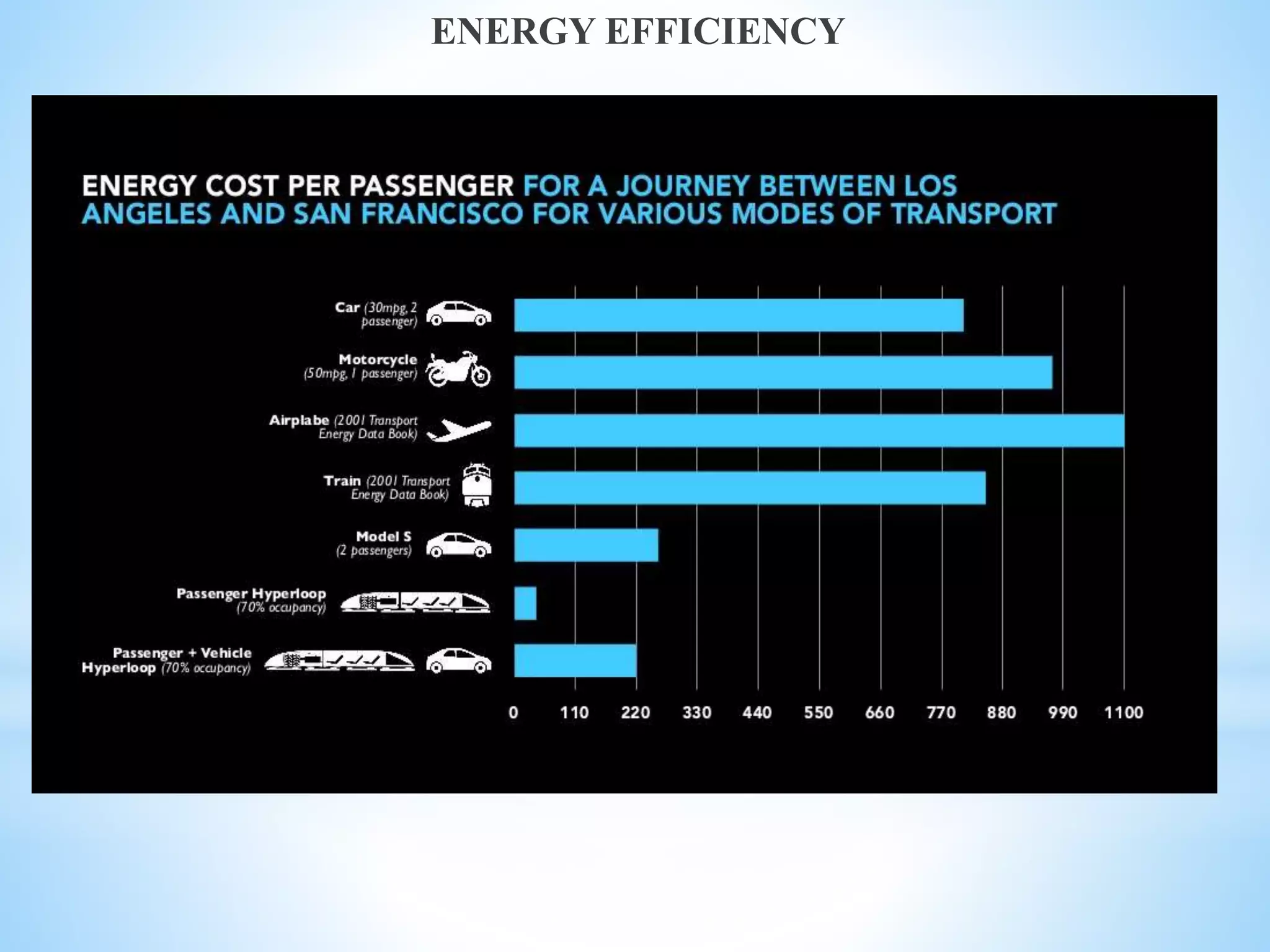
Energy efficiency
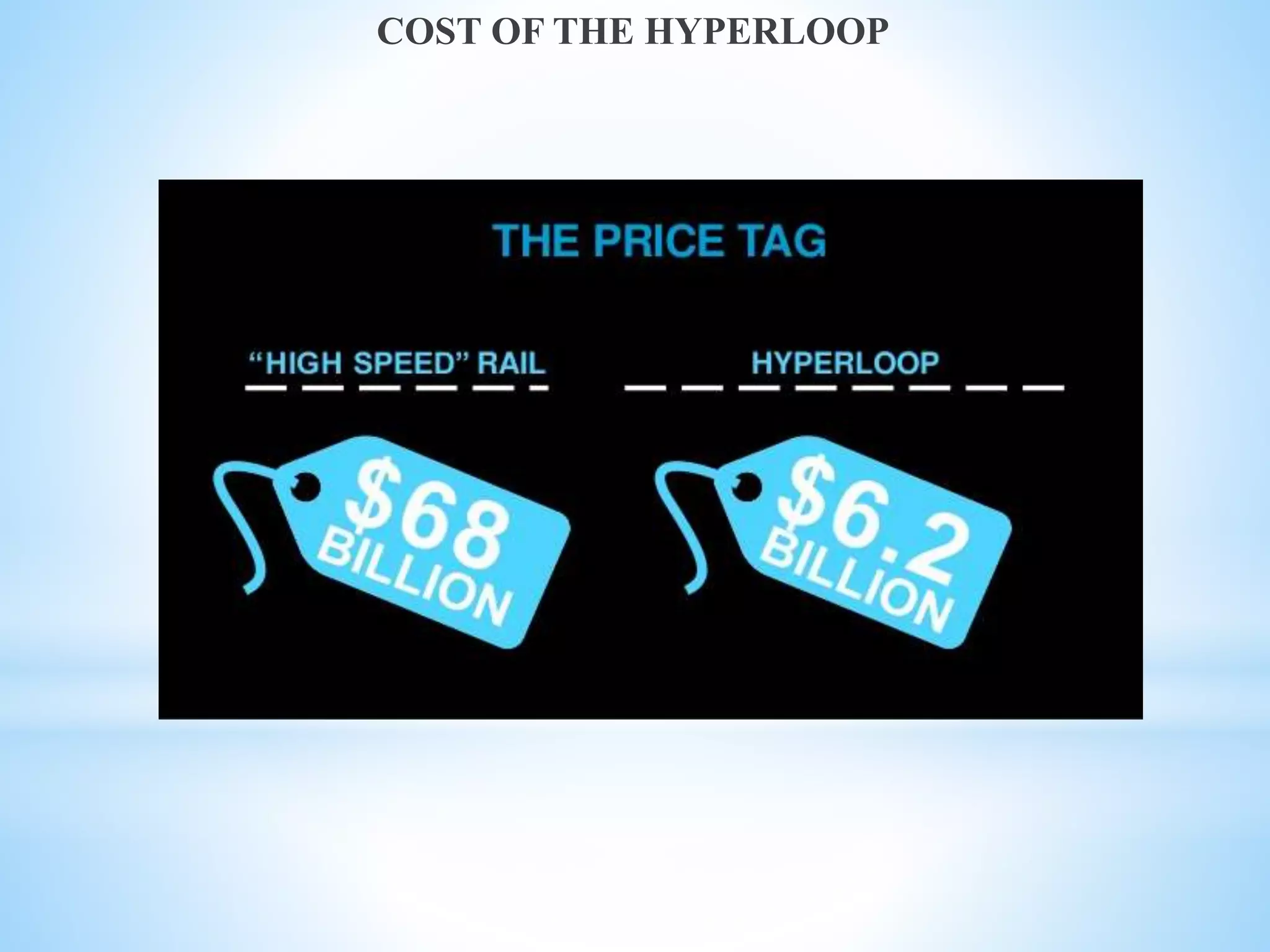
Cost of the Hyperloop
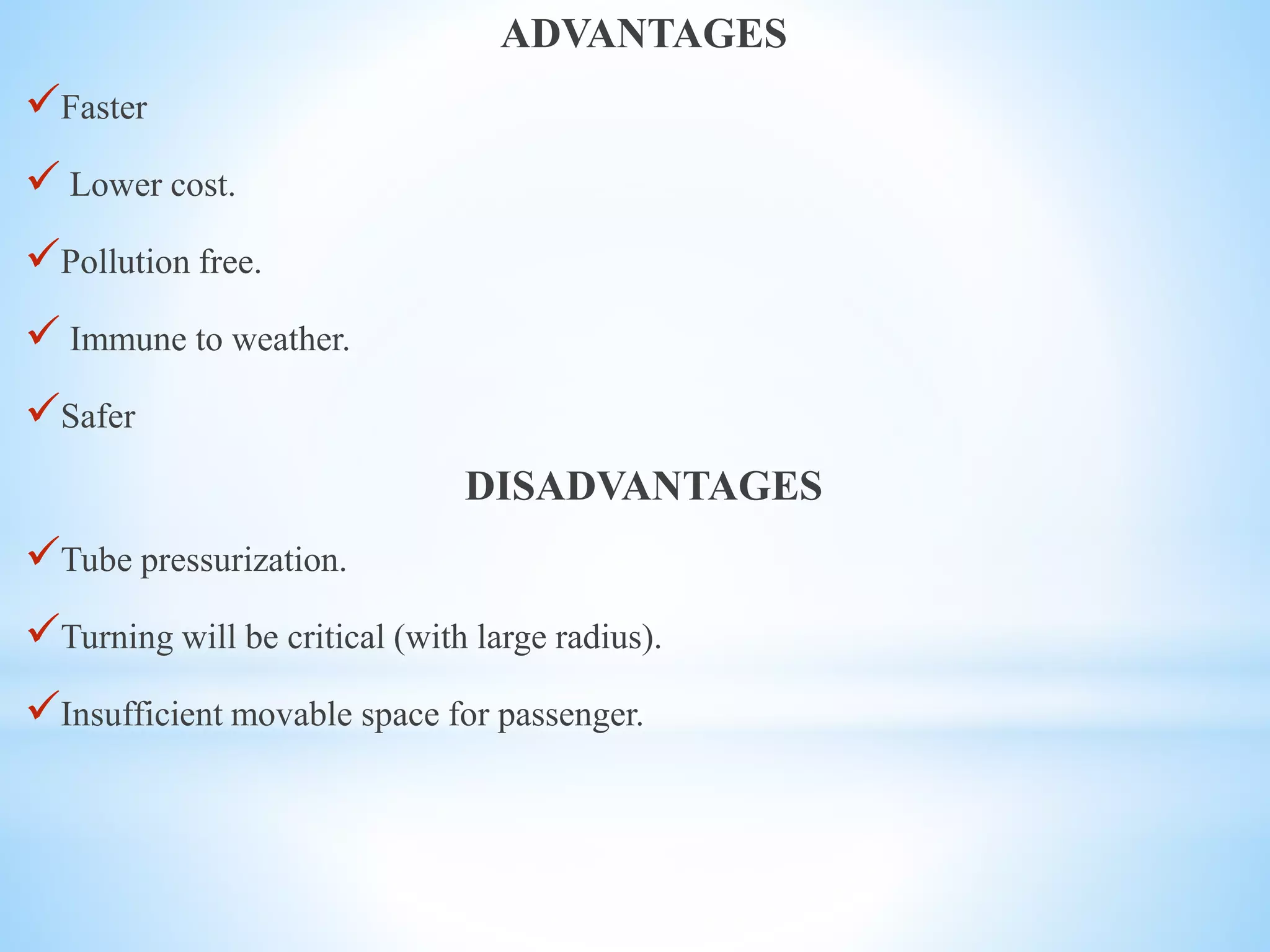
Advantages
Disadvantages
Conclusion
ABSTRACT
Transportation consists of four unique types: rail, road, water, and air. These modes of
transport tend to be existing conventional modes of transportation of either relatively
slow (i.e., road and water), expensive (i.e., air), or a combination of relatively slow and
expensive (i.e., rail). Hyper loop is a new mode of transport that seeks to change this
paradigm by being both fast and inexpensive for people and goods. Hyper loop is also
unique in that it is an open design concept, similar to Linux. Hyper loop consists of a
low pressure tube with capsules that are transported at both low and high speeds
throughout the length of the tube. The capsules are supported on a cushion of air,
featuring pressurized air and aerodynamic lift. The capsules are accelerated via a
magnetic linear accelerator affixed at various stations on the low pressure tube with
rotors contained in each capsule. Passengers may enter and exit Hyper loop at stations
located either at the ends of the tube, or branches along the tube length. In the initial
route, preliminary design, and logistics of the Hyper loop transportation system have
been derived.
INTRODUTION
Hyperloop is a new mode of transport ?
Proposed by ELON MUSK American business magnate, investor, and inventor. He
is currently the CEO & CTO of SpaceX and CEO & Chief Product Architect of Tesla
Motors.
A high-speed train that promises travel at twice the speed of a commercial aircraft,
transporting passengers from Los Angeles to San Francisco in just 30 minutes.
A high-level alpha design for the system was published on August 12, 2013, in a
whitepaper posted to the Tesla and SpaceX blogs.
A Hyperloop would be "an elevated, reduced-pressure tube that contains pressurized
capsules driven within the tube by a number of linear electric motors.”
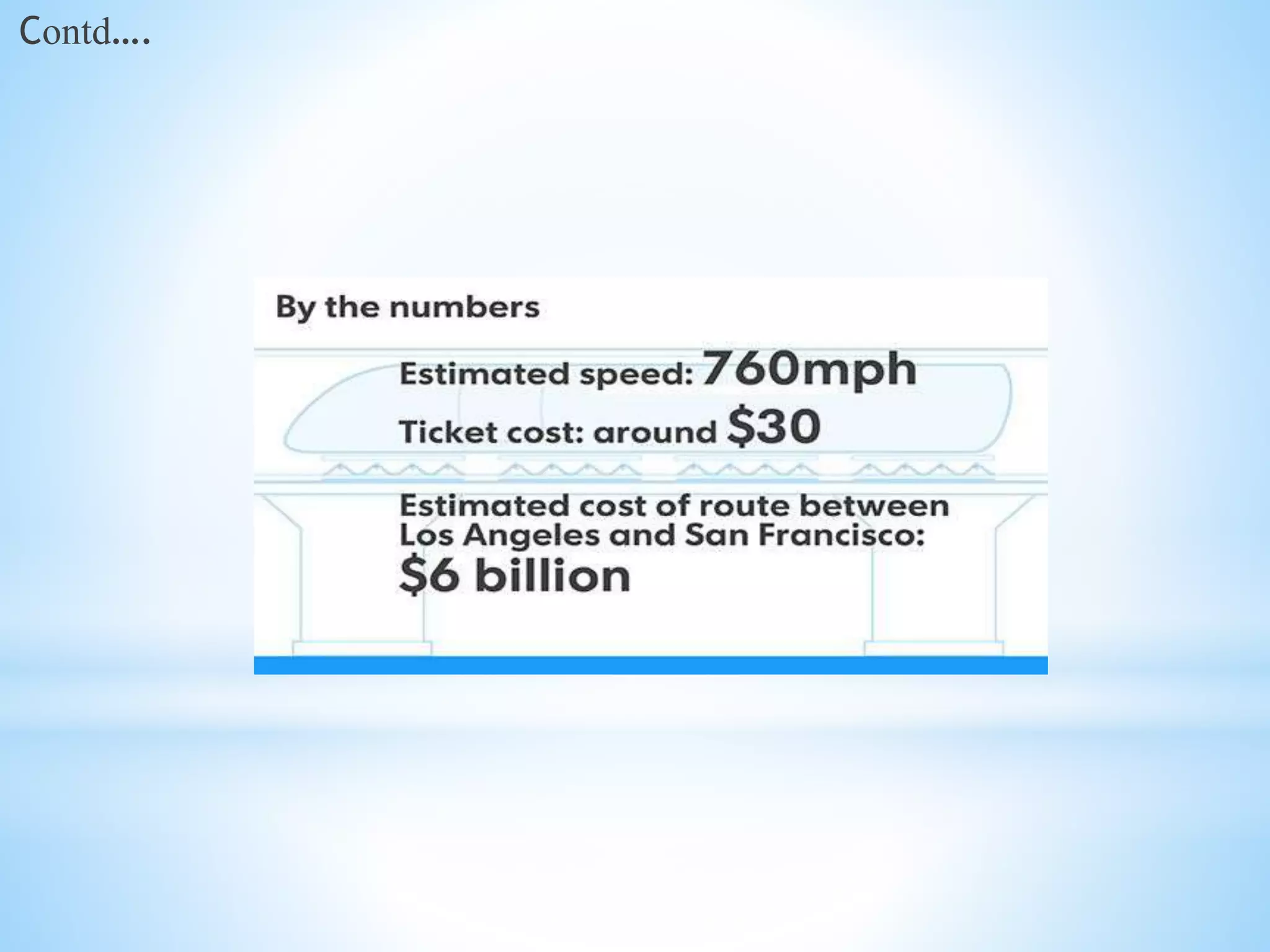
This system can achieve an average speed of 598 mph (962 km/h), and a top speed
of 760 mph (1,220 km/h).
Contd…
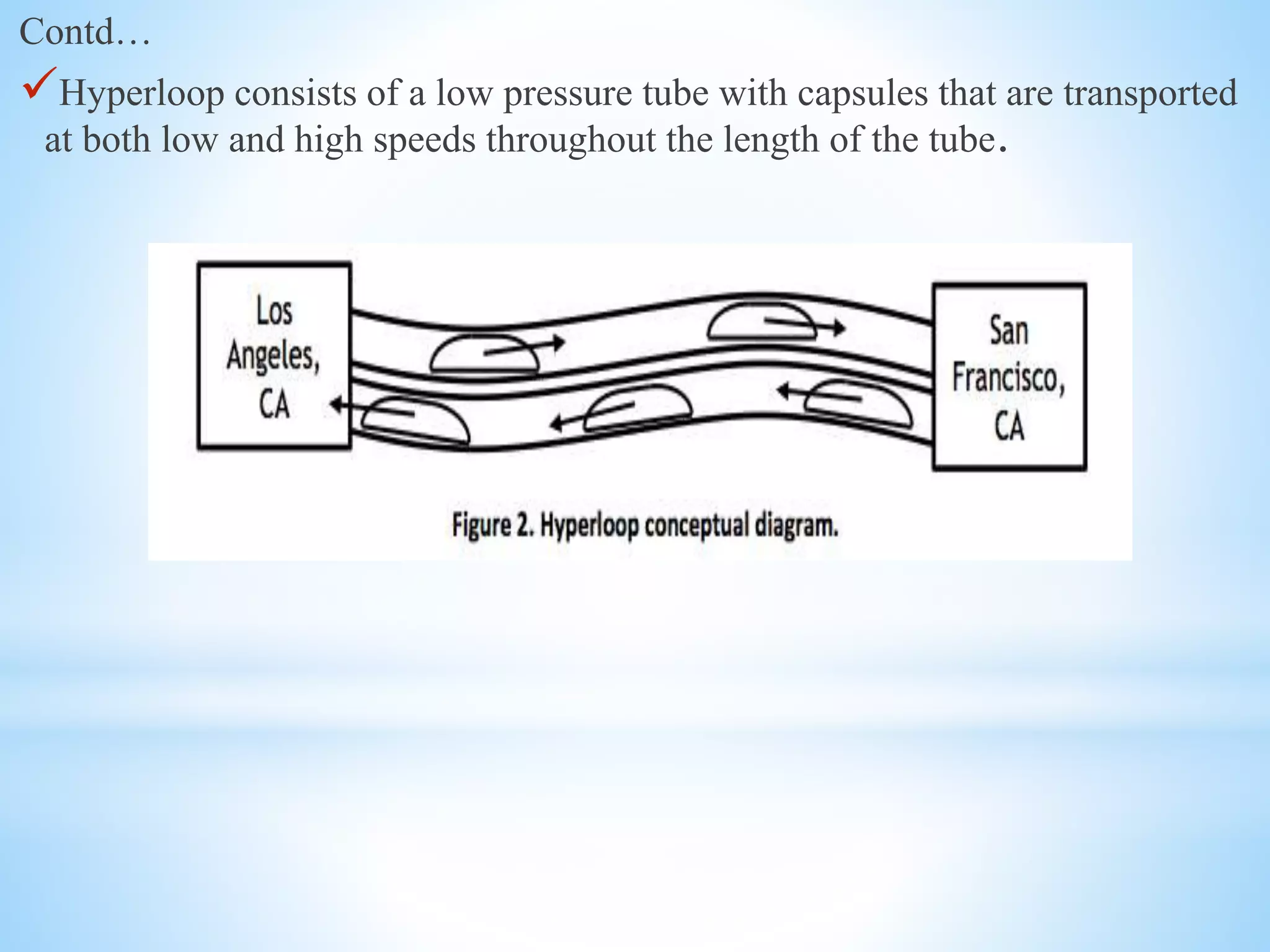
Hyperloop consists of a low pressure tube with capsules that are transported
at both low and high speeds throughout the length of the tube.
Contd….
CONVENTIONAL MODE OF TRANSPORTATION
1. RAIL relatively slow and expensive
2. ROAD relatively slow
3. WATER relatively slow
4. AIR expensive
COMPONENTS OF HYPERLOOP TRANSPORTION SYSTEM
1. Capsule
2. Tube
3. Propulsion
4. Route
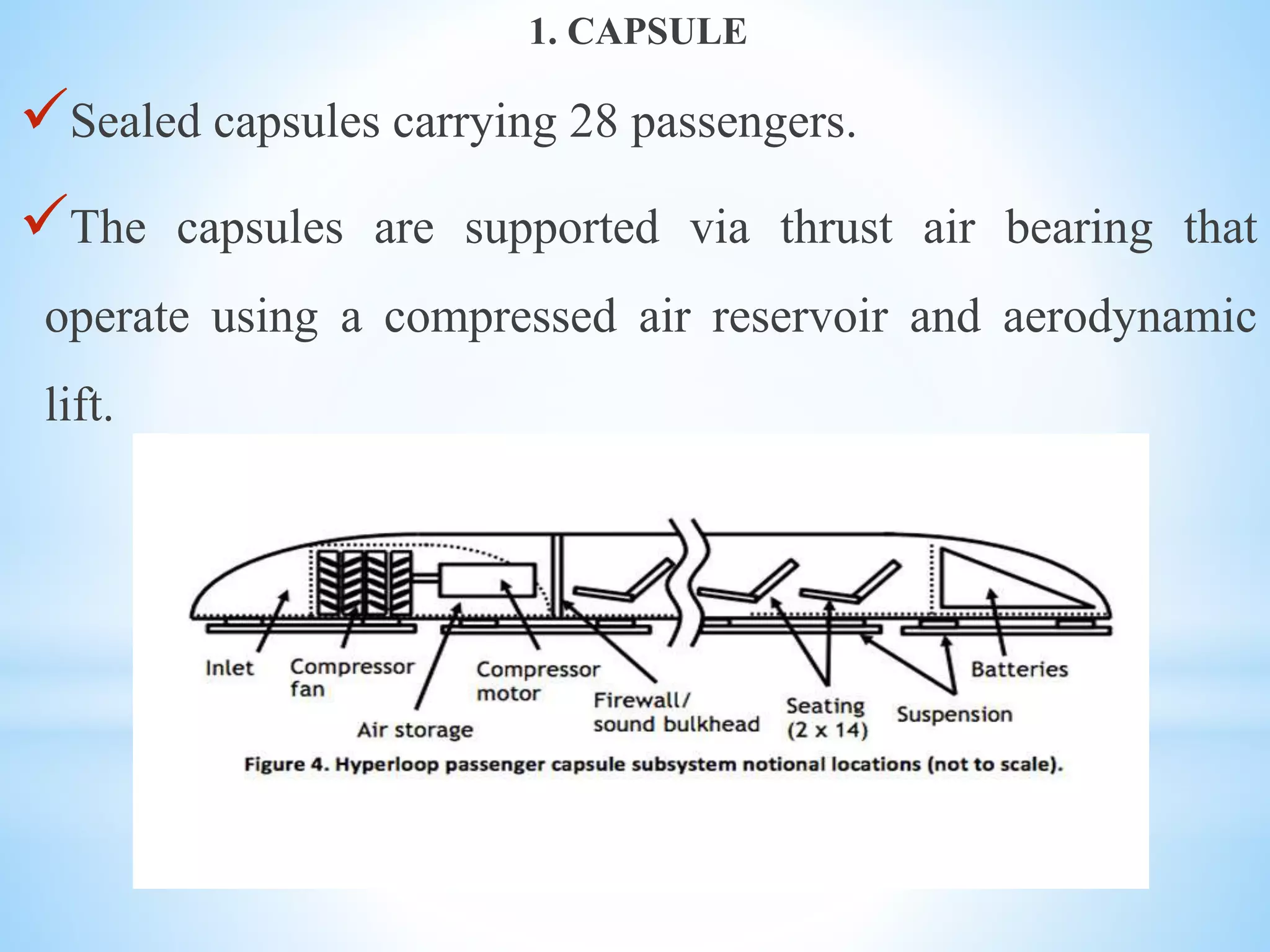
1. CAPSULE
Sealed capsules carrying 28 passengers.
The capsules are supported via thrust air bearing that
operate using a compressed air reservoir and aerodynamic
lift.
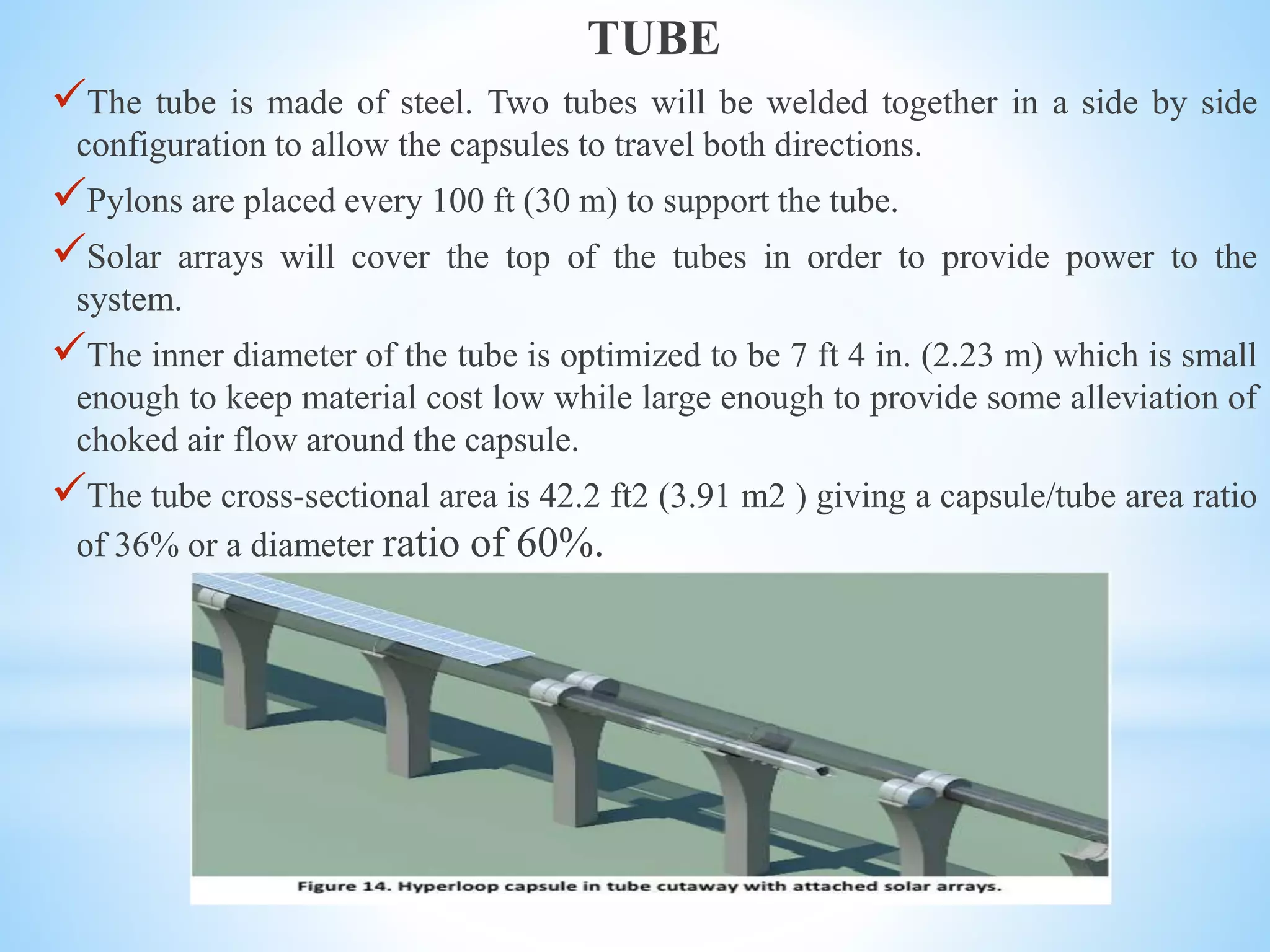
TUBE
The tube is made of steel. Two tubes will be welded together in a side by side
configuration to allow the capsules to travel both directions.
Pylons are placed every 100 ft (30 m) to support the tube.
Solar arrays will cover the top of the tubes in order to provide power to the
system.
The inner diameter of the tube is optimized to be 7 ft 4 in. (2.23 m) which is small
enough to keep material cost low while large enough to provide some alleviation of
choked air flow around the capsule.
The tube cross-sectional area is 42.2 ft2 (3.91 m2 ) giving a capsule/tube area ratio
of 36% or a diameter ratio of 60%.
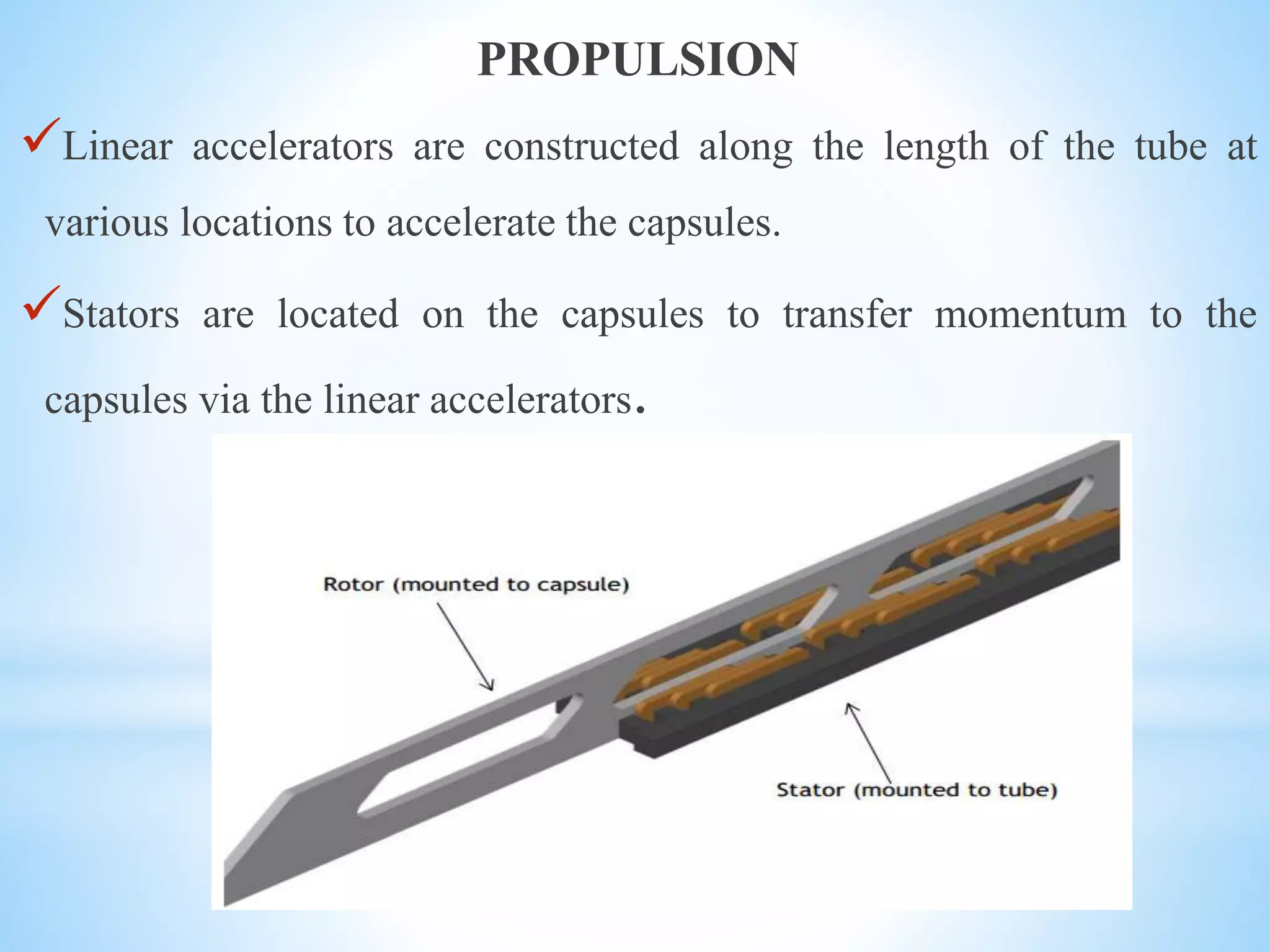
PROPULSION
Linear accelerators are constructed along the length of the tube at
various locations to accelerate the capsules.
Stators are located on the capsules to transfer momentum to the
capsules via the linear accelerators.
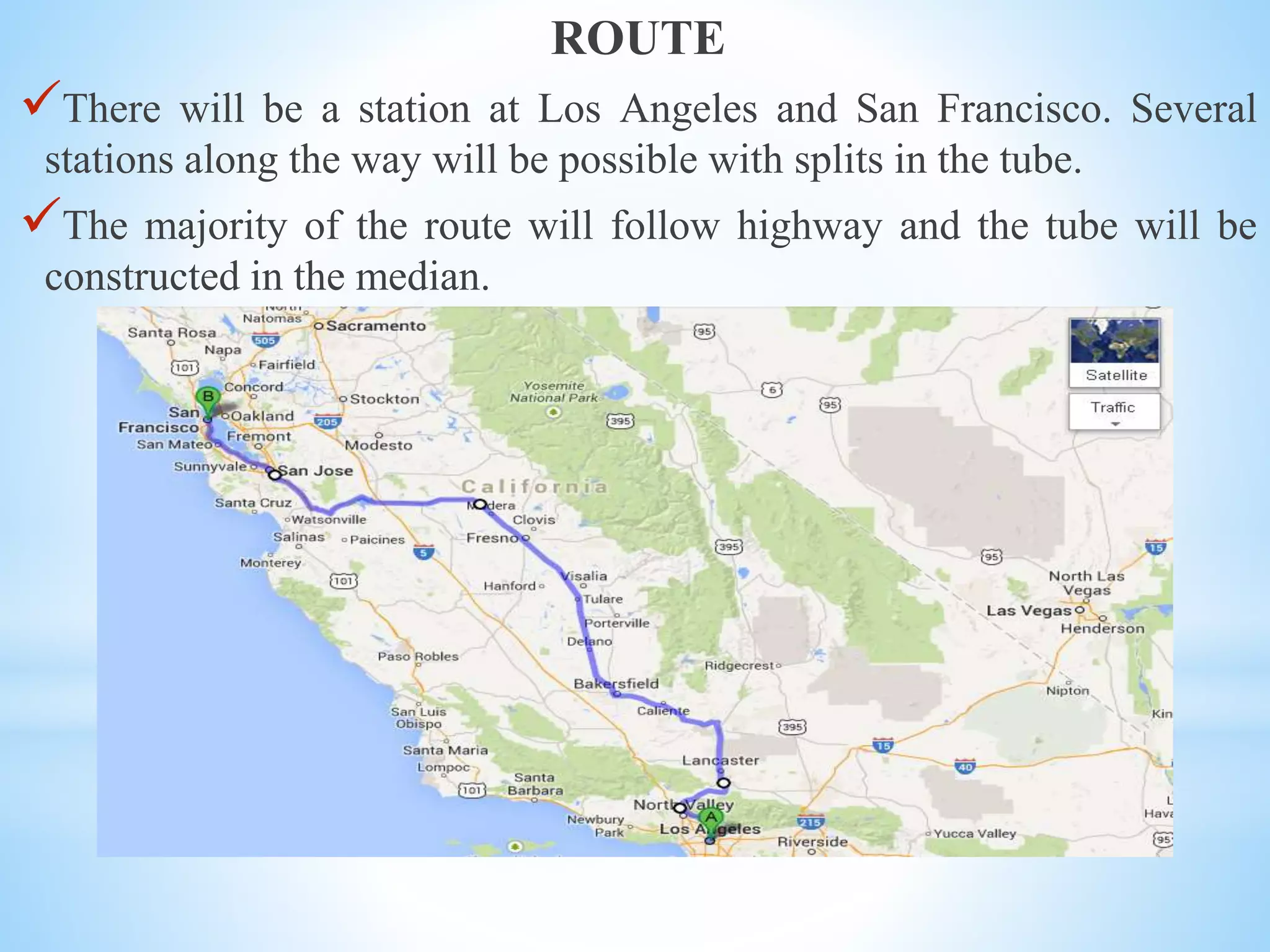
ROUTE
There will be a station at Los Angeles and San Francisco. Several
stations along the way will be possible with splits in the tube.
The majority of the route will follow highway and the tube will be
constructed in the median.
ENERGY EFFICIENCY
COST OF THE HYPERLOOP
ADVANTAGES
Faster
 Lower cost.
Pollution free.
 Immune to weather.
Safer
DISADVANTAGES
Tube pressurization.
Turning will be critical (with large radius).
Insufficient movable space for passenger.
CONCLUSION
As it has number of advantages it will very help full for transport public as well as
goods in a very short period of time (at a top speed of 1220 kmph) and also in lower
cost.
It is a new concept so there is some future work will be required for development of
this project.
THANK
YOU……….

Ppt hyperloop (1).pptx 333

  • 1.
    HYPERLOOP – FUTUREOF TRANSPORTATION
  • 2.
    CONTENT Abstract Introduction Conventional mode oftransportation Components of Hyperloop transportation system Energy efficiency Cost of the Hyperloop Advantages Disadvantages Conclusion
  • 3.
    ABSTRACT Transportation consists offour unique types: rail, road, water, and air. These modes of transport tend to be existing conventional modes of transportation of either relatively slow (i.e., road and water), expensive (i.e., air), or a combination of relatively slow and expensive (i.e., rail). Hyper loop is a new mode of transport that seeks to change this paradigm by being both fast and inexpensive for people and goods. Hyper loop is also unique in that it is an open design concept, similar to Linux. Hyper loop consists of a low pressure tube with capsules that are transported at both low and high speeds throughout the length of the tube. The capsules are supported on a cushion of air, featuring pressurized air and aerodynamic lift. The capsules are accelerated via a magnetic linear accelerator affixed at various stations on the low pressure tube with rotors contained in each capsule. Passengers may enter and exit Hyper loop at stations located either at the ends of the tube, or branches along the tube length. In the initial route, preliminary design, and logistics of the Hyper loop transportation system have been derived.
  • 4.
    INTRODUTION Hyperloop is anew mode of transport ? Proposed by ELON MUSK American business magnate, investor, and inventor. He is currently the CEO & CTO of SpaceX and CEO & Chief Product Architect of Tesla Motors. A high-speed train that promises travel at twice the speed of a commercial aircraft, transporting passengers from Los Angeles to San Francisco in just 30 minutes. A high-level alpha design for the system was published on August 12, 2013, in a whitepaper posted to the Tesla and SpaceX blogs. A Hyperloop would be "an elevated, reduced-pressure tube that contains pressurized capsules driven within the tube by a number of linear electric motors.” This system can achieve an average speed of 598 mph (962 km/h), and a top speed of 760 mph (1,220 km/h).
  • 5.
    Contd… Hyperloop consists ofa low pressure tube with capsules that are transported at both low and high speeds throughout the length of the tube.
  • 6.
  • 7.
    CONVENTIONAL MODE OFTRANSPORTATION 1. RAIL relatively slow and expensive 2. ROAD relatively slow 3. WATER relatively slow 4. AIR expensive
  • 8.
    COMPONENTS OF HYPERLOOPTRANSPORTION SYSTEM 1. Capsule 2. Tube 3. Propulsion 4. Route
  • 9.
    1. CAPSULE Sealed capsulescarrying 28 passengers. The capsules are supported via thrust air bearing that operate using a compressed air reservoir and aerodynamic lift.
  • 10.
    TUBE The tube ismade of steel. Two tubes will be welded together in a side by side configuration to allow the capsules to travel both directions. Pylons are placed every 100 ft (30 m) to support the tube. Solar arrays will cover the top of the tubes in order to provide power to the system. The inner diameter of the tube is optimized to be 7 ft 4 in. (2.23 m) which is small enough to keep material cost low while large enough to provide some alleviation of choked air flow around the capsule. The tube cross-sectional area is 42.2 ft2 (3.91 m2 ) giving a capsule/tube area ratio of 36% or a diameter ratio of 60%.
  • 11.
    PROPULSION Linear accelerators areconstructed along the length of the tube at various locations to accelerate the capsules. Stators are located on the capsules to transfer momentum to the capsules via the linear accelerators.
  • 12.
    ROUTE There will bea station at Los Angeles and San Francisco. Several stations along the way will be possible with splits in the tube. The majority of the route will follow highway and the tube will be constructed in the median.
  • 13.
  • 14.
    COST OF THEHYPERLOOP
  • 15.
    ADVANTAGES Faster  Lower cost. Pollutionfree.  Immune to weather. Safer DISADVANTAGES Tube pressurization. Turning will be critical (with large radius). Insufficient movable space for passenger.
  • 16.
    CONCLUSION As it hasnumber of advantages it will very help full for transport public as well as goods in a very short period of time (at a top speed of 1220 kmph) and also in lower cost. It is a new concept so there is some future work will be required for development of this project.
  • 17.