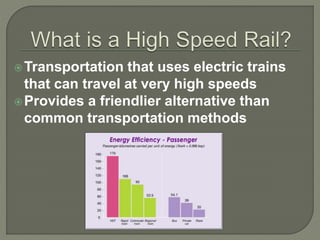
Transportation that uses electric trains
that can travel at very high speeds
Provides a friendlier alternative than
common transportation methods
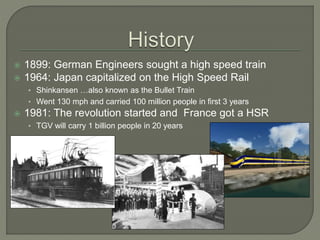
 1899: German Engineers sought a high speed train
 1964: Japan capitalized on the High Speed Rail
• Shinkansen …also known as the Bullet Train
• Went 130 mph and carried 100 million people in first 3 years
 1981: The revolution started and France got a HSR
• TGV will carry 1 billion people in 20 years
Opens more space on highways and
interstates
By 2035, the Midwest Network will create
42,000 jobs and generate $6.1 billion in
sales
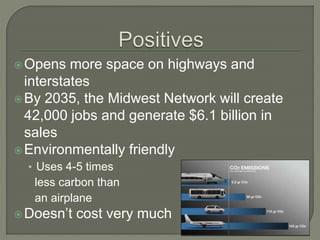
Environmentally friendly
• Uses 4-5 times
less carbon than
an airplane
Doesn’t cost very much
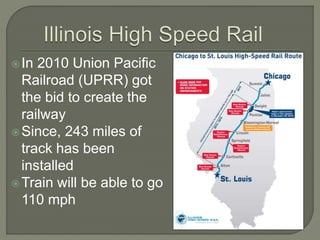
In 2010 Union Pacific
Railroad (UPRR) got
the bid to create the
railway
Since, 243 miles of
track has been
installed
Train will be able to go
110 mph
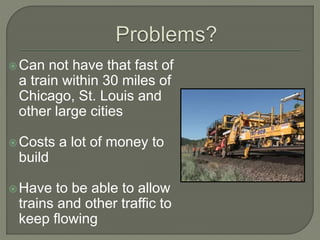
Can not have that fast of
a train within 30 miles of
Chicago, St. Louis and
other large cities
Costs a lot of money to
build
Have to be able to allow
trains and other traffic to
keep flowing
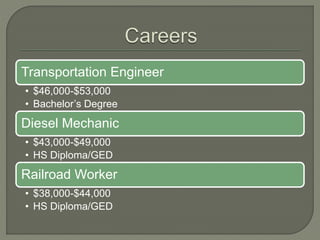
Transportation Engineer
• $46,000-$53,000
• Bachelor’s Degree
Diesel Mechanic
• $43,000-$49,000
• HS Diploma/GED
Railroad Worker
• $38,000-$44,000
• HS Diploma/GED
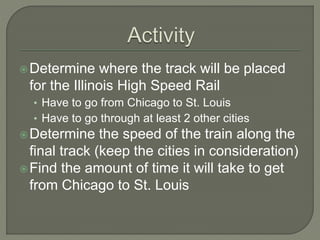
Determine where the track will be placed
for the Illinois High Speed Rail
• Have to go from Chicago to St. Louis
• Have to go through at least 2 other cities
Determine the speed of the train along the
final track (keep the cities in consideration)
Find the amount of time it will take to get
from Chicago to St. Louis

Introduction to the High Speed Rail

  • 2.
    Transportation that useselectric trains that can travel at very high speeds Provides a friendlier alternative than common transportation methods
  • 3.
     1899: GermanEngineers sought a high speed train  1964: Japan capitalized on the High Speed Rail • Shinkansen …also known as the Bullet Train • Went 130 mph and carried 100 million people in first 3 years  1981: The revolution started and France got a HSR • TGV will carry 1 billion people in 20 years
  • 4.
    Opens more spaceon highways and interstates By 2035, the Midwest Network will create 42,000 jobs and generate $6.1 billion in sales Environmentally friendly • Uses 4-5 times less carbon than an airplane Doesn’t cost very much
  • 9.
    In 2010 UnionPacific Railroad (UPRR) got the bid to create the railway Since, 243 miles of track has been installed Train will be able to go 110 mph
  • 10.
    Can not havethat fast of a train within 30 miles of Chicago, St. Louis and other large cities Costs a lot of money to build Have to be able to allow trains and other traffic to keep flowing
  • 11.
    Transportation Engineer • $46,000-$53,000 •Bachelor’s Degree Diesel Mechanic • $43,000-$49,000 • HS Diploma/GED Railroad Worker • $38,000-$44,000 • HS Diploma/GED
  • 12.
    Determine where thetrack will be placed for the Illinois High Speed Rail • Have to go from Chicago to St. Louis • Have to go through at least 2 other cities Determine the speed of the train along the final track (keep the cities in consideration) Find the amount of time it will take to get from Chicago to St. Louis

Editor's Notes

  • #7 Why do you think there are only some possible places where there can be a high speed rail?
  • #10 300 miles between Chicago and St. Louis 110 miles an hour 2.7 hours by HSR 4.5 hours by car 1 hour by plane