CRICOS Provider Number 00103D
Unit BUACC5933: Cost and
Management Accounting
Topic 4: Activity-based costing
CRICOS Provider Number 00103D2
Learning objectives
At the completion of this lecture, students should:
• Understand the nature and purpose of activity-
based costing (ABC).
• Be aware that ABC is a modification to (rather
than replacement of) traditional costing
systems.
• Appreciate that the focus of ABC is on a more
accurate assignment of overhead costs.
• Comprehend the basic procedures of ABC.
• Appreciate the advantages and disadvantages of
ABC.
• Be able to apply ABC.
• Comprehend the basic concepts of Just-in-Time
(JIT) processing.
CRICOS Provider Number 00103D3
What is activity-based costing?
• ABC is a modification to the traditional approach of
accounting for overhead costs.
• Under traditional costing systems, all overhead
costs are assigned on the basis of a single activity
measure (e.g. direct labour hours, direct labour cost,
machine hours).
• Thus, traditional costing systems assume that a
single activity measure can explain the incurrence of
all of the diverse costs comprising overhead.
• ABC attempts to overcome this weakness by using
multiple activity measures to assign overhead.
• Modern manufacturing processes (with more
complex processes and less reliance on direct
labour) favour the use of ABC.
CRICOS Provider Number 00103D4
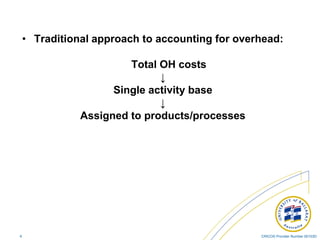
• Traditional approach to accounting for overhead:
Total OH costs
↓
Single activity base
↓
Assigned to products/processes
CRICOS Provider Number 00103D5
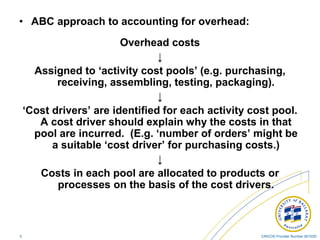
• ABC approach to accounting for overhead:
Overhead costs
↓
Assigned to ‘activity cost pools’ (e.g. purchasing,
receiving, assembling, testing, packaging).
↓
‘Cost drivers’ are identified for each activity cost pool.
A cost driver should explain why the costs in that
pool are incurred. (E.g. ‘number of orders’ might be
a suitable ‘cost driver’ for purchasing costs.)
↓
Costs in each pool are allocated to products or
processes on the basis of the cost drivers.
CRICOS Provider Number 00103D6
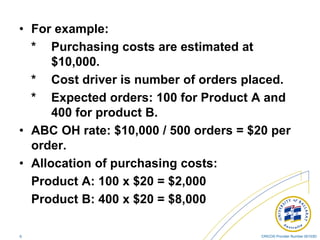
• For example:
* Purchasing costs are estimated at
$10,000.
* Cost driver is number of orders placed.
* Expected orders: 100 for Product A and
400 for product B.
• ABC OH rate: $10,000 / 500 orders = $20 per
order.
• Allocation of purchasing costs:
Product A: 100 x $20 = $2,000
Product B: 400 x $20 = $8,000
CRICOS Provider Number 00103D7
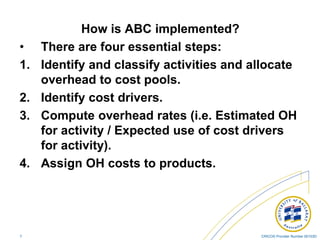
How is ABC implemented?
• There are four essential steps:
1. Identify and classify activities and allocate
overhead to cost pools.
2. Identify cost drivers.
3. Compute overhead rates (i.e. Estimated OH
for activity / Expected use of cost drivers
for activity).
4. Assign OH costs to products.
CRICOS Provider Number 00103D8
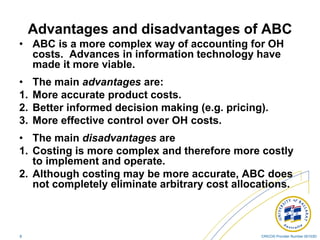
Advantages and disadvantages of ABC
• ABC is a more complex way of accounting for OH
costs. Advances in information technology have
made it more viable.
• The main advantages are:
1. More accurate product costs.
2. Better informed decision making (e.g. pricing).
3. More effective control over OH costs.
• The main disadvantages are
1. Costing is more complex and therefore more costly
to implement and operate.
2. Although costing may be more accurate, ABC does
not completely eliminate arbitrary cost allocations.
CRICOS Provider Number 00103D9
Just-in-Time (JIT) processing
• JIT is an inventory processing system that seeks to
decrease the costs of holding inventories.
• As the name suggests, JIT seeks to have inventories
(raw materials, assembled sub-components and
finished goods) arrive ‘just-in-time’ to be used.
• When working ‘perfectly’, inventory holding costs
(such as storage and finance costs) are largely
eliminated.
• Practical difficulties may arise in attempting to
implement JIT. These may include, for example:
supplier delays, transport problems, and machinery
breakdowns.
• Under JIT, the raw materials and WIP accounts may
be replaced by a single ‘Raw and In-Process
Inventory’ account.

Cost and Management Accounting _____Topic Activity-based costing

  • 1.
    CRICOS Provider Number00103D Unit BUACC5933: Cost and Management Accounting Topic 4: Activity-based costing
  • 2.
    CRICOS Provider Number00103D2 Learning objectives At the completion of this lecture, students should: • Understand the nature and purpose of activity- based costing (ABC). • Be aware that ABC is a modification to (rather than replacement of) traditional costing systems. • Appreciate that the focus of ABC is on a more accurate assignment of overhead costs. • Comprehend the basic procedures of ABC. • Appreciate the advantages and disadvantages of ABC. • Be able to apply ABC. • Comprehend the basic concepts of Just-in-Time (JIT) processing.
  • 3.
    CRICOS Provider Number00103D3 What is activity-based costing? • ABC is a modification to the traditional approach of accounting for overhead costs. • Under traditional costing systems, all overhead costs are assigned on the basis of a single activity measure (e.g. direct labour hours, direct labour cost, machine hours). • Thus, traditional costing systems assume that a single activity measure can explain the incurrence of all of the diverse costs comprising overhead. • ABC attempts to overcome this weakness by using multiple activity measures to assign overhead. • Modern manufacturing processes (with more complex processes and less reliance on direct labour) favour the use of ABC.
  • 4.
    CRICOS Provider Number00103D4 • Traditional approach to accounting for overhead: Total OH costs ↓ Single activity base ↓ Assigned to products/processes
  • 5.
    CRICOS Provider Number00103D5 • ABC approach to accounting for overhead: Overhead costs ↓ Assigned to ‘activity cost pools’ (e.g. purchasing, receiving, assembling, testing, packaging). ↓ ‘Cost drivers’ are identified for each activity cost pool. A cost driver should explain why the costs in that pool are incurred. (E.g. ‘number of orders’ might be a suitable ‘cost driver’ for purchasing costs.) ↓ Costs in each pool are allocated to products or processes on the basis of the cost drivers.
  • 6.
    CRICOS Provider Number00103D6 • For example: * Purchasing costs are estimated at $10,000. * Cost driver is number of orders placed. * Expected orders: 100 for Product A and 400 for product B. • ABC OH rate: $10,000 / 500 orders = $20 per order. • Allocation of purchasing costs: Product A: 100 x $20 = $2,000 Product B: 400 x $20 = $8,000
  • 7.
    CRICOS Provider Number00103D7 How is ABC implemented? • There are four essential steps: 1. Identify and classify activities and allocate overhead to cost pools. 2. Identify cost drivers. 3. Compute overhead rates (i.e. Estimated OH for activity / Expected use of cost drivers for activity). 4. Assign OH costs to products.
  • 8.
    CRICOS Provider Number00103D8 Advantages and disadvantages of ABC • ABC is a more complex way of accounting for OH costs. Advances in information technology have made it more viable. • The main advantages are: 1. More accurate product costs. 2. Better informed decision making (e.g. pricing). 3. More effective control over OH costs. • The main disadvantages are 1. Costing is more complex and therefore more costly to implement and operate. 2. Although costing may be more accurate, ABC does not completely eliminate arbitrary cost allocations.
  • 9.
    CRICOS Provider Number00103D9 Just-in-Time (JIT) processing • JIT is an inventory processing system that seeks to decrease the costs of holding inventories. • As the name suggests, JIT seeks to have inventories (raw materials, assembled sub-components and finished goods) arrive ‘just-in-time’ to be used. • When working ‘perfectly’, inventory holding costs (such as storage and finance costs) are largely eliminated. • Practical difficulties may arise in attempting to implement JIT. These may include, for example: supplier delays, transport problems, and machinery breakdowns. • Under JIT, the raw materials and WIP accounts may be replaced by a single ‘Raw and In-Process Inventory’ account.