Hyperloop offers a potential new mode of high-speed transport that could revolutionize how we perceive distance. It involves levitation pods traveling inside low-pressure tubes at aircraft speeds. Proponents claim it could be faster, cheaper, and more environmentally friendly than other transport modes. This report evaluates Hyperloop's commercial potential, costs, safety, and regulatory issues to assess its feasibility. It consulted with developers and experts to investigate technical requirements and challenges, and how the UK supply chain could support Hyperloop development.
Introduction of Hyperloop as a transport system; discusses speed, environmental benefits, and UK's potential and involvement.Investigates system types, testing progress, and companies like Virgin Hyperloop and HTT working on Hyperloop.Discussion on safety guidelines, partnerships, and the importance of regulation for Hyperloop's future.
Introduction
Hyperloop offers apotential revolution in transport. It could transform how we perceive distance by
enabling aircraft speeds at ground level in an on-demand point-to-point transport system. Bristol could
become a suburb of Edinburgh! Frankfurt, Schiphol, Heathrow and Charlies de Gaulle could become a
newsuper-hubairportanditwouldopenupopportunitieswe can’tevenconceiveof yet.
Hyperloop refers to the concept described by Elon Musk in his paper, Hyperloop Alpha1, which is a new,
very high speed, intercity transportation mode, published in 2013 and involves either passenger or
freight carrying vehicles that operate inside tubes with air evacuated to create a low-pressure
environment. The reduced air resistance resulting from the low-pressure environment could enable the
vehicles to reach very high speeds; 2-3 times faster than high speed rail. Proponents also claim that the
system can enable direct, on-demand travel rather than a scheduled service as provided by other forms
of public transport, could be more environmentally friendly than other modes and could be cheaper
than high-speedrail.
This report provide a high-level evaluation of hyperloop in terms of its commercial potential,
environmental impact, costs, safety issues, and regulatory issues and to identify hurdles to its
commercial and/oroperational feasibility.
The project team consulted with hyperloop developers, industry and academia to investigate the
technical requirements and challenges of hyperloop. These challenges were mapped onto the capability
of the UK supply chain, and prioritisation of those key areas where investment of public funding will
stimulate UK Industry to provide future support to hyperloop and associated technology applications to
the benefitof the UK economy.
BackgroundCONTEXT
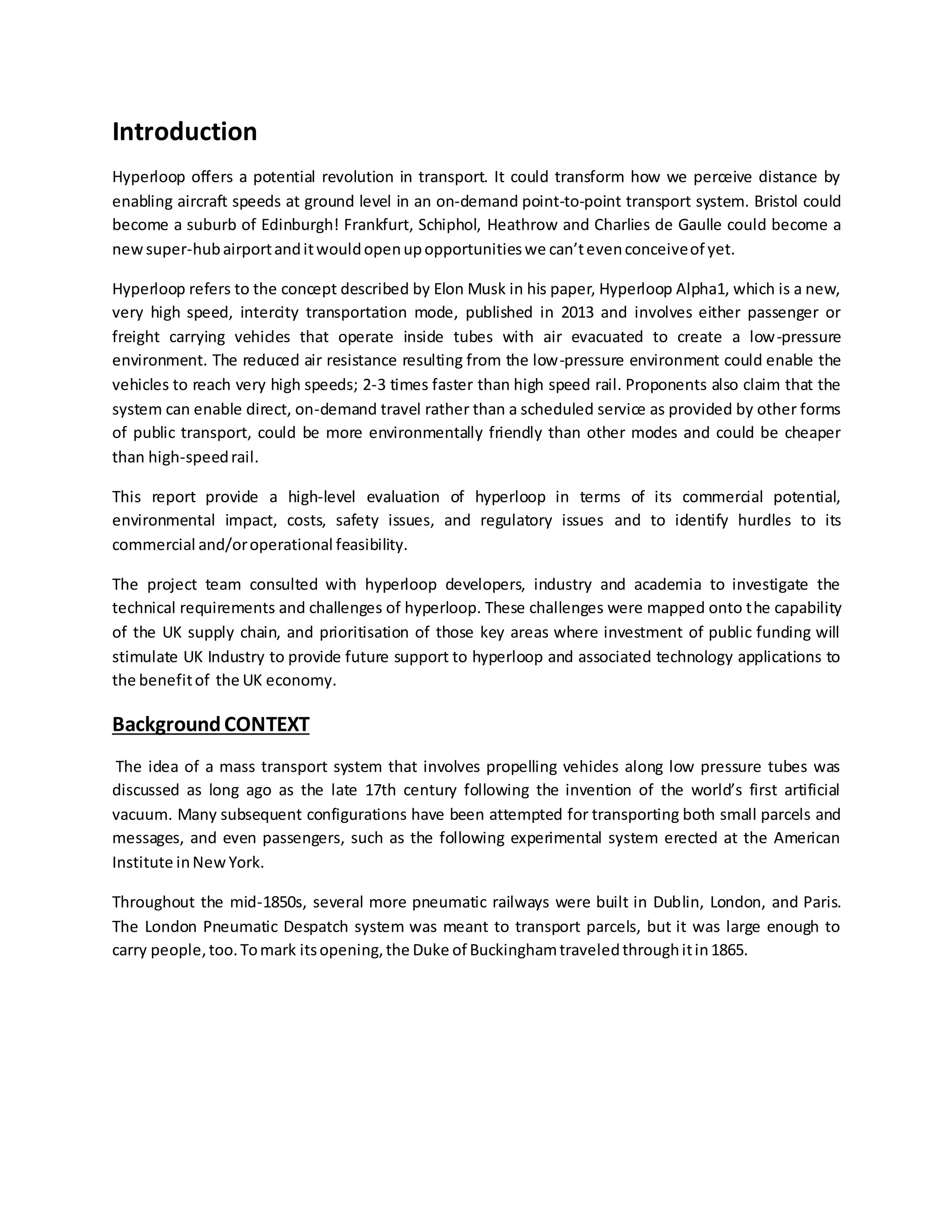
The idea of a mass transport system that involves propelling vehicles along low pressure tubes was
discussed as long ago as the late 17th century following the invention of the world’s first artificial
vacuum. Many subsequent configurations have been attempted for transporting both small parcels and
messages, and even passengers, such as the following experimental system erected at the American
Institute inNewYork.
Throughout the mid-1850s, several more pneumatic railways were built in Dublin, London, and Paris.
The London Pneumatic Despatch system was meant to transport parcels, but it was large enough to
carry people,too.Tomark itsopening,the Duke of Buckinghamtraveledthroughitin1865.
2.
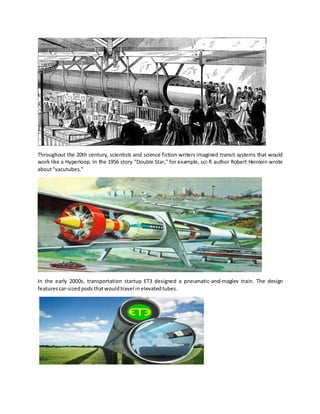
Throughout the 20thcentury, scientists and science fiction writers imagined transit systems that would
work like a Hyperloop. In the 1956 story "Double Star," for example, sci-fi author Robert Heinlein wrote
about"vacutubes."
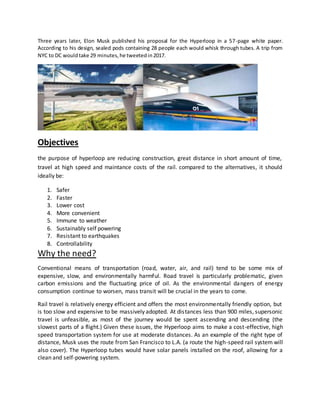
In the early 2000s, transportation startup ET3 designed a pneumatic-and-maglev train. The design
featurescar-sizedpodsthatwouldtravel inelevatedtubes.
3.
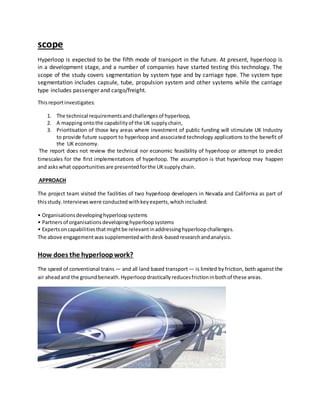
Three years later,Elon Musk published his proposal for the Hyperloop in a 57-page white paper.
According to his design, sealed pods containing 28 people each would whisk through tubes. A trip from
NYC to DC wouldtake 29 minutes,he tweetedin2017.
Objectives
the purpose of hyperloop are reducing construction, great distance in short amount of time,
travel at high speed and maintance costs of the rail. compared to the alternatives, it should
ideally be:
1. Safer
2. Faster
3. Lower cost
4. More convenient
5. Immune to weather
6. Sustainably self powering
7. Resistant to earthquakes
8. Controllability
Why the need?
Conventional means of transportation (road, water, air, and rail) tend to be some mix of
expensive, slow, and environmentally harmful. Road travel is particularly problematic, given
carbon emissions and the fluctuating price of oil. As the environmental dangers of energy
consumption continue to worsen, mass transit will be crucial in the years to come.
Rail travel is relatively energy efficient and offers the most environmentally friendly option, but
is too slow and expensive to be massively adopted. At distances less than 900 miles, supersonic
travel is unfeasible, as most of the journey would be spent ascending and descending (the
slowest parts of a flight.) Given these issues, the Hyperloop aims to make a cost-effective, high
speed transportation system for use at moderate distances. As an example of the right type of
distance, Musk uses the route from San Francisco to L.A. (a route the high-speed rail system will
also cover). The Hyperloop tubes would have solar panels installed on the roof, allowing for a
clean and self-powering system.
4.
scope
Hyperloop is expectedto be the fifth mode of transport in the future. At present, hyperloop is
in a development stage, and a number of companies have started testing this technology. The
scope of the study covers segmentation by system type and by carriage type. The system type
segmentation includes capsule, tube, propulsion system and other systems while the carriage
type includes passenger and cargo/freight.
Thisreportinvestigates:
1. The technical requirementsandchallengesof hyperloop,
2. A mappingontothe capabilityof the UK supplychain,
3. Prioritisation of those key areas where investment of public funding will stimulate UK Industry
to provide future support to hyperloop and associated technology applications to the benefit of
the UK economy.
The report does not review the technical nor economic feasibility of hyperloop or attempt to predict
timescales for the first implementations of hyperloop. The assumption is that hyperloop may happen
and askswhat opportunitiesare presentedforthe UKsupplychain.
APPROACH
The project team visited the facilities of two hyperloop developers in Nevada and California as part of
thisstudy.Interviewswere conductedwithkeyexperts,whichincluded:
• Organisationsdevelopinghyperloopsystems
• Partnersof organisationsdevelopinghyperloopsystems
• Expertsoncapabilitiesthatmightbe relevantinaddressinghyperloopchallenges.
The above engagementwassupplementedwithdesk-basedresearchandanalysis.
How does the hyperloopwork?
The speed of conventional trains — and all land based transport — is limited byfriction, both against the
air aheadand the groundbeneath.Hyperloopdrasticallyreducesfrictioninbothof these areas.
5.
First, the tunnelsthrough which it operates have most of their air removed. They are not complete
vacuums, but much less air means reduced friction and less energy is required to reach a higher speed.
Secondly, Musk's design saw the hyperloop pods, each containing a handful of passengers, held above
the groundby a layerof air,similartohow the puckof an air hockeytable floatsacrossitssurface.
Musk suggested that the power required to remove air from the tunnels and propel the pods along
would come from solar panels on the roof of the tunnel. He also claimed that ticket prices for the Los
AngelestoSanFranciscoroute wouldbe as low as $20, and the journeywouldtake just35 minutes.
Who is building the hyperloop?
With Musk sitting it out, the early lead in making his hyperloop dreams a reality was fought between
Hyperloop One and Hyperloop Transportation Technologies (HTT), both based in the US but with plans
to buildhyperloopinwhichevercountrywillcoughupthe cash first.
VirginHyperloopOne
Hyperloop One, now called Virgin Hyperloop One after investment from Richard Branson's company in
late-2017. Pods are driven along a track whichis essentially an electromagnetic motor unwound and laid
flat along the floor of the tunnel. When a current is fed through the track, the pods move forwards,
accelerating until they reach a speed where they lift up, like a boat planing along the water, and are
guided by magnets. A series of vacuum pumps remove much of the tunnel's air to the point where the
atmosphere is similar to being 200,000 feet above sea level. Naturally, the pods will be pressurized like
an airplane cabin.
Hyperloop One says its 670mph system will be "automated by the most advanced systems in the world,
allowingasafe andefficientjourneythatisneverdelayedoroverbooked."
Routes overall the world
The company has been the most forthcoming in regard to planned hyperloop locations. These include
several proposed routes across the US, UK, Europe and the Middle East, although none have yet been
given the green light for construction to begin. Given its wealth, open space and interest in futuristic
technologies like passenger-carrying drones, the United Arab Emirates is a strong candidate for the first
hyperloop,whichisexpectedtooperate betweenDubai andAbuDhabi earlynextdecade.
6.
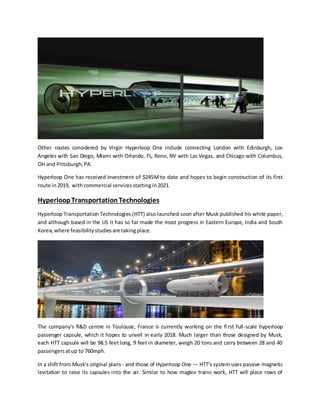
Other routes consideredby Virgin Hyperloop One include connecting London with Edinburgh, Los
Angeles with San Diego, Miami with Orlando, FL, Reno, NV with Las Vegas, and Chicago with Columbus,
OH and Pittsburgh,PA.
Hyperloop One has received investment of $245M to date and hopes to begin construction of its first
route in2019, withcommercial servicesstartingin2021.
HyperloopTransportationTechnologies
Hyperloop Transportation Technologies (HTT) also launched soon after Musk published his white paper,
and although based in the US it has so far made the most progress in Eastern Europe, India and South
Korea,where feasibilitystudiesare takingplace.
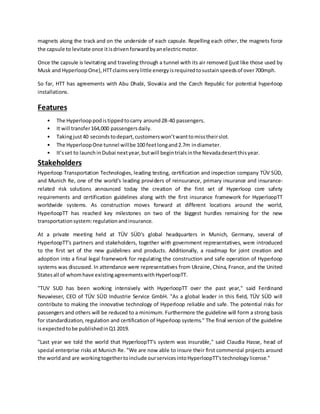
The company's R&D centre in Toulouse, France is currently working on the first full-scale hyperloop
passenger capsule, which it hopes to unveil in early 2018. Much larger than those designed by Musk,
each HTT capsule will be 98.5 feet long, 9 feet in diameter, weigh 20 tons and carry between 28 and 40
passengersatup to 760mph.
In a shift from Musk's original plans - and those of Hyperloop One — HTT's system uses passive magnetic
levitation to raise its capsules into the air. Similar to how maglev trains work, HTT will place rows of
7.
magnets along thetrack and on the underside of each capsule. Repelling each other, the magnets force
the capsule to levitate once itisdrivenforwardbyanelectricmotor.
Once the capsule is levitating and traveling through a tunnel with its air removed (just like those used by
Musk and HyperloopOne),HTTclaimsverylittle energyisrequiredtosustainspeedsof over700mph.
So far, HTT has agreements with Abu Dhabi, Slovakia and the Czech Republic for potential hyperloop
installations.
Features
• The Hyperlooppodistippedtocarry around28-40 passengers.
• It will transfer164,000 passengersdaily.
• Takingjust40 secondstodepart,customerswon’twanttomisstheirslot.
• The HyperloopOne tunnel willbe 100 feetlongand2.7m indiameter.
• It’sset to launchinDubai nextyear,butwill begintrialsinthe Nevadadesertthisyear.
Stakeholders
Hyperloop Transportation Technologies, leading testing, certification and inspection company TÜV SÜD,
and Munich Re, one of the world's leading providers of reinsurance, primary insurance and insurance-
related risk solutions announced today the creation of the first set of Hyperloop core safety
requirements and certification guidelines along with the first insurance framework for HyperloopTT
worldwide systems. As construction moves forward at different locations around the world,
HyperloopTT has reached key milestones on two of the biggest hurdles remaining for the new
transportationsystem:regulationandinsurance.
At a private meeting held at TÜV SÜD's global headquarters in Munich, Germany, several of
HyperloopTT's partners and stakeholders, together with government representatives, were introduced
to the first set of the new guidelines and products. Additionally, a roadmap for joint creation and
adoption into a final legal framework for regulating the construction and safe operation of Hyperloop
systems was discussed. In attendance were representatives from Ukraine, China, France, and the United
Statesall of whomhave existingagreementswithHyperloopTT.
"TUV SUD has been working intensively with HyperloopTT over the past year," said Ferdinand
Neuwieser, CEO of TÜV SÜD Industrie Service GmbH. "As a global leader in this field, TÜV SÜD will
contribute to making the innovative technology of Hyperloop reliable and safe. The potential risks for
passengers and others will be reduced to a minimum. Furthermore the guideline will form a strong basis
for standardization, regulation and certification of Hyperloop systems." The final version of the guideline
isexpectedtobe publishedinQ1 2019.
"Last year we told the world that HyperloopTT's system was insurable," said Claudia Hasse, head of
special enterprise risks at Munich Re. "We are now able to insure their first commercial projects around
the worldand are workingtogethertoinclude ourservicesintoHyperloopTT'stechnologylicense."
8.
"Hyperloop will changetransportation as we know it," said Volodymyr Omelyan, minister of
infrastructure of Ukraine. "It is our responsibility to make sure that future technologies are regulated
and safe,andtodayrepresentsthe foundationof asafe and reliable commercial Hyperloopsystem."
"The creation of regulations and legal frameworks are critical components to our ongoing feasibility
study between Chicago and Cleveland," said Grace Gallucci, executive director of Northeast Ohio
Areawide Coordinating Agency. "We look forward to continuing to work alongside HyperloopTT and
their partners to implement these guidelines and policies into a framework specific to the Great Lakes
Hyperloop."
"HyperloopTT is the first company to have an insurable commercial system," said Dirk Ahlborn CEO of
HyperloopTT. "We have proven the technology to be feasible at every level and through our work with
these partners, stakeholders, and governments we are creating the safest, most secure system
possible."
"In order to bring Hyperloop to reality we have sought out and formed alliances with industry leaders to
provide the complete solutions for our systems," said Bibop Gresta, Chairman of HyperloopTT. "Now we
invite othernationstojointhese pioneers."
The CEO of Hyperloop One is Jay Walder, former CEO of Motivate. The co-founder and President of
EngineeringisJoshGiegel.
As of July 2018, the board of directors include Richard Branson (Chairman), Justin Fishner-Wolfson,
Sultan Ahmed Bin Sulayem, Rob Lloyd, Josh Giegel, Bill Shor, Yuvraj Narayan, Anatoly Braverman, and
Emily White as a strategic adviser. Former board members include Peter Diamandis, Jim Messina who as
of July 2018 serves as strategic adviser, former Morgan Stanley executive Jim Rosenthal, Joe Lonsdale,
the co-founder Shervin Pishevar, who took a leave of absence from Hyperloop One in December 2017
after multiple women accused him of sexual misconduct, and Ziyavudin Magomedov, a Russian
billionaire whowasarrestedonembezzlementchargesin2018.
On November8,2018, Richard Bransonwas replacedaschairmanby SultanAhmedbinSulayem.