Hyperbolic
Image
Embeddings
CVPR 2020
이미지처리팀
류채은, 강인하, 김병현, 김선옥, 김준철, 김현진, 남종우, 안종식, 이찬혁, 이희재, 조경민, 최승준, 현청천
Table of Contents
Introduction
Related Works
01
02
Methods
Experiments
Conclusion
03
04
05
Application
06
Introduction
01
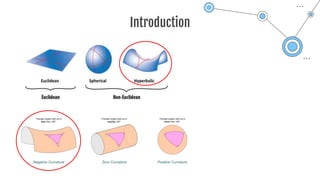
Introduction
Introduction
Introduction
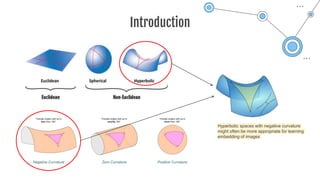
Hyperbolic spaces with negative curvature
might often be more appropriate for learning
embedding of images
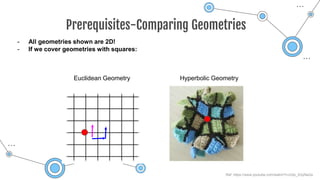
Prerequisites-Comparing Geometries
- All geometries shown are 2D!
- If we cover geometries with squares:
Ref: https://www.youtube.com/watch?v=zQo_S3yNa2w
Euclidean Geometry Hyperbolic Geometry
Prerequisites-Comparing Geometries
- All geometries shown are 2D!
- If we cover geometries with squares:
Ref: https://www.youtube.com/watch?v=zQo_S3yNa2w
Euclidean Geometry Hyperbolic Geometry
Prerequisites-Comparing Geometries
- All geometries shown are 2D!
- If we cover geometries with squares:
Ref: https://www.youtube.com/watch?v=zQo_S3yNa2w
Euclidean Geometry Hyperbolic Geometry
Prerequisites-Comparing Geometries
- All geometries shown are 2D!
- If we cover geometries with squares:
Ref: https://www.youtube.com/watch?v=zQo_S3yNa2w
Euclidean Geometry Hyperbolic Geometry
Prerequisites-Comparing Geometries
- All geometries shown are 2D!
- If we cover geometries with squares:
Ref: https://www.youtube.com/watch?v=zQo_S3yNa2w
Euclidean Geometry Hyperbolic Geometry
Area of Hyperbolic plane grows rapidly than Euclidean plane!
Prerequisites-Comparing Geometries
- All geometries shown are 2D!
- If we cover geometries with squares:
Ref: https://www.youtube.com/watch?v=zQo_S3yNa2w
Euclidean Geometry Hyperbolic Geometry
Prerequisites-Comparing Geometries
- All geometries shown are 2D!
- If we cover geometries with squares:
Ref: https://www.youtube.com/watch?v=zQo_S3yNa2w
Euclidean Geometry Hyperbolic Geometry
Prerequisites-Comparing Geometries
- All geometries shown are 2D!
- If we cover geometries with squares:
Ref: https://www.youtube.com/watch?v=zQo_S3yNa2w
Euclidean Geometry Hyperbolic Geometry
Prerequisites-Comparing Geometries
- All geometries shown are 2D!
- If we cover geometries with squares:
Ref: https://www.youtube.com/watch?v=zQo_S3yNa2w
Euclidean Geometry Hyperbolic Geometry
Prerequisites-Comparing Geometries
- All geometries shown are 2D!
- If we cover geometries with squares:
Ref: https://www.youtube.com/watch?v=zQo_S3yNa2w
Euclidean Geometry Hyperbolic Geometry
Prerequisites-Comparing Geometries
- All geometries shown are 2D!
- If we cover geometries with squares:
Ref: https://www.youtube.com/watch?v=zQo_S3yNa2w
Euclidean Geometry Hyperbolic Geometry
Prerequisites-Comparing Geometries
- All geometries shown are 2D!
- If we cover geometries with squares:
Ref: https://www.youtube.com/watch?v=zQo_S3yNa2w
Euclidean Geometry Hyperbolic Geometry
Prerequisites-Comparing Geometries
- All geometries shown are 2D!
- If we cover geometries with squares:
Ref: https://www.youtube.com/watch?v=zQo_S3yNa2w
Euclidean Geometry Hyperbolic Geometry
Prerequisites-Comparing Geometries
- All geometries shown are 2D!
- If we cover geometries with squares:
Ref: https://www.youtube.com/watch?v=zQo_S3yNa2w
Euclidean Geometry Hyperbolic Geometry
Prerequisites-Comparing Geometries
- All geometries shown are 2D!
- If we cover geometries with squares:
Ref: https://www.youtube.com/watch?v=zQo_S3yNa2w
Euclidean Geometry Hyperbolic Geometry
Basic euclidean operations not defined in hyperbolic geometry!
Introduction
How can images have hierarchies?
Example 1) Image Retrieval
Whole
Fragment
Example 2) Recognition tasks
Low resolution
High resolution
Introduction
Why is hyperbolic space useful for embedding hierarchy?
Example 1) Image Retrieval
Whole
Fragment
Example 2) Recognition tasks
Low
resolution
High
resolution
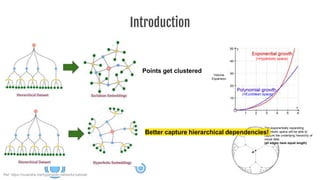
The exponentially expanding
hyperbolic space will be able to
capture the underlying hierarchy of
visual data
(all edges have equal length)
Volume
Expansion
(=Hyperbolic space)
(=Euclidean space)
Given h depth, number of total Nodes in binary
tree = 2^h+1
= the number of tree nodes grows exponentially
with tree depth
r
Introduction
Volume
Expansion
(=Hyperbolic space)
(=Euclidean space)
The exponentially expanding
hyperbolic space will be able to
capture the underlying hierarchy of
visual data
(all edges have equal length)
Ref: https://nurendra.me/hyperbolic-networks-tutorial/
Points get clustered
Introduction
Volume
Expansion
(=Hyperbolic space)
(=Euclidean space)
The exponentially expanding
hyperbolic space will be able to
capture the underlying hierarchy of
visual data
(all edges have equal length)
Ref: https://nurendra.me/hyperbolic-networks-tutorial/
Points get clustered
Better capture hierarchical dependencies!
Introduction
Hierarchy in this paper
Uncertain
Certain
Network: “I have 0.1 confident score that this is 7”
Network: “I have 0.9 confident score that this is 7”
∝ P(y=c|x)
Related Work
02
Related Works
Few-shot Learning
Natural Language
Preprocessing
Person re-
identification
WordNet Hierarchy
The overall ability of the model to generalize to
unseen data during training
Similarity score
Similarity score
To match pedestrian images captured by possibly
non-overlapping surveillance cameras
While the previous methods employ either Euclidean or
spherical geometries, there was no extension to
hyperbolic spaces.
Our work is inspired by the recent body of works that
demonstrate the advantage of learning hyperbolic
embeddings for language entities such as taxonomy
entries, common words, phrases, and for other NLP
tasks, such as neural machine translation
Papers adopt the pairwise models that accept pairs of
images and output their similarity scores. The resulting
similarity scores are used to classify the input pairs as
being matching or non-matching.
sentence entailment classification task
Ref: Hyperbolic Neural Networks (Advances in Neural Information Processing Systems,2018)
Methodology
03
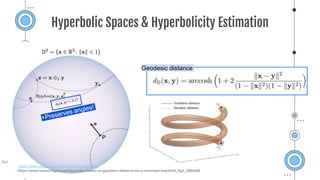
Hyperbolic Spaces & Hyperbolicity Estimation
Geodesic distance
Ref: https://www.youtube.com/watch?v=nu4mkwBEB0Y
Hyperbolic Spaces & Hyperbolicity Estimation
Geodesic distance
Ref:
- https://www.youtube.com/watch?v=nu4mkwBEB0Y
- https://www.researchgate.net/figure/Euclidean-vs-geodesic-distance-on-a-nonlinear-manifold_fig3_2894469
Hyperbolic Spaces & Hyperbolicity Estimation
Geodesic distance
Ref:
- https://www.youtube.com/watch?v=nu4mkwBEB0Y
- https://www.researchgate.net/figure/Euclidean-vs-geodesic-distance-on-a-nonlinear-manifold_fig3_2894469
Hyperbolic Spaces & Hyperbolicity Estimation
Geodesic distance
Ref: https://www.youtube.com/watch?v=nu4mkwBEB0Y
Hyperbolic Spaces & Hyperbolicity Estimation
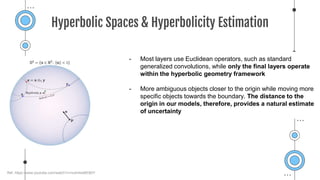
Ref: https://www.youtube.com/watch?v=nu4mkwBEB0Y
- Most layers use Euclidean operators, such as standard
generalized convolutions, while only the final layers operate
within the hyperbolic geometry framework
- More ambiguous objects closer to the origin while moving more
specific objects towards the boundary. The distance to the
origin in our models, therefore, provides a natural estimate
of uncertainty
Gromov 𝛿-Hyperbolicity
: a property that measures how "curved" or "bendy" a space is
𝜹-Hyperbolicity
A metric space (X,d) is 𝛿 hyperbolic if there exists a 𝛿>0 such that four
points a,b,c,v in X:
Ref: Hyperbolic Deep Neural Networks: A Survey (IEEE
TRANSACTIONS ON PATTERN ANALYSIS AND MACHINE
INTELLIGENCE, VOL. 44, NO. 12, DECEMBER 2022)
d: distance function
Minimal value given the
constraints!
𝜹-Hyperbolicity
Ref: Hyperbolic Deep Neural Networks: A Survey (IEEE
TRANSACTIONS ON PATTERN ANALYSIS AND MACHINE
INTELLIGENCE, VOL. 44, NO. 12, DECEMBER 2022)
Gromov 𝛿-Hyperbolicity
: a property that measures how "curved" or "bendy" a space is
the longest distance between any two points within that set
= specifies how close is a dataset X to a hyperbolic space
scale-invariant metric
Strong
hyperbolicity
Non
hyperbolicity
𝜹-Hyperbolicity
Ref: Hyperbolic Deep Neural Networks: A Survey (IEEE
TRANSACTIONS ON PATTERN ANALYSIS AND MACHINE
INTELLIGENCE, VOL. 44, NO. 12, DECEMBER 2022)
Gromov 𝛿-Hyperbolicity
: a property that measures how "curved" or "bendy" a space is
the longest distance between any two points within that set
= specifies how close is a dataset X to a hyperbolic space
scale-invariant metric
Strong
hyperbolicity
Non
hyperbolicity
The degree of hyperbolicity in image datasets are quite high
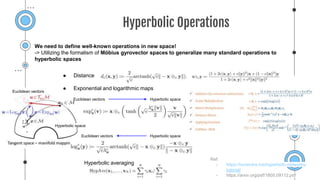
Hyperbolic Operations
We need to define well-known operations in new space!
-> Utilizing the formalism of Mӧbius gyrovector spaces to generalize many standard operations to
hyperbolic spaces
● Distance
● Exponential and logarithmic maps
Euclidean vectors
Hyperbolic space
Euclidean vectors Hyperbolic space
Hyperbolic averaging
Ref:
- https://nurendra.me/hyperbolic-networks-
tutorial/
- https://arxiv.org/pdf/1805.09112.pdf
Experiments
04
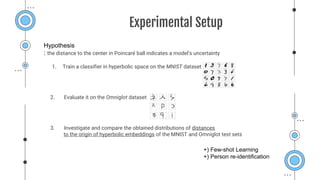
Experimental Setup
Hypothesis
: the distance to the center in Poincaré ball indicates a model’s uncertainty
1. Train a classifier in hyperbolic space on the MNIST dataset
2. Evaluate it on the Omniglot dataset
3. Investigate and compare the obtained distributions of distances
to the origin of hyperbolic embeddings of the MNIST and Omniglot test sets
+) Few-shot Learning
+) Person re-identification
Distance to the origin as the measure of uncertainty
Validate Hypothesis
(=the distance to the center in Poincaré ball indicates a model’s uncertainty)
the distance to the center in Poincaré ball will correspond to visual ambiguity of images
The output of the last hidden layer was mapped to the Poincaré ball using the
exponential map
Distance to the origin as the measure of uncertainty
Validate Hypothesis
(=the distance to the center in Poincaré ball indicates a model’s uncertainty)
the distance to the center in Poincaré ball will correspond to visual ambiguity of images
followed by the hyperbolic multi-linear regression (MLR) layer
Distance to the origin as the measure of uncertainty
Validate Hypothesis
(=the distance to the center in Poincaré ball indicates a model’s uncertainty)
the distance to the center in Poincaré ball will correspond to visual ambiguity of images
Train the model to ~ 99% test accuracy
Uncertain
Certain
Network: “I have 0.1 confident score that this is 7”
Network: “I have 0.9 confident score that this is 7”
∝ P(y=c|x)
Distance to the origin as the measure of uncertainty
Validate Hypothesis
(=the distance to the center in Poincaré ball indicates a model’s uncertainty)
Train Evaluate
.
Omniglot Omniglot
Omniglot
Omniglot
Distance to the origin as the measure of uncertainty
Validate Hypothesis
(=the distance to the center in Poincaré ball indicates a model’s uncertainty)
observe that more “unclear” images
are located near the center, while
the images that are easy to classify
are located closer to the boundary
Certain
Uncertain
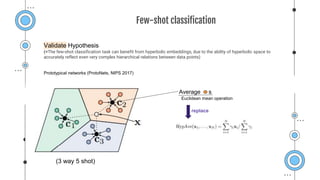
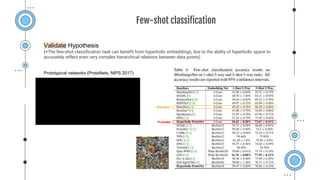
Few-shot classification
Validate Hypothesis
(=The few-shot classification task can benefit from hyperbolic embeddings, due to the ability of hyperbolic space to
accurately reflect even very complex hierarchical relations between data points)
Few-shot classification
Validate Hypothesis
(=The few-shot classification task can benefit from hyperbolic embeddings, due to the ability of hyperbolic space to
accurately reflect even very complex hierarchical relations between data points)
Few-shot classification
Validate Hypothesis
(=The few-shot classification task can benefit from hyperbolic embeddings, due to the ability of hyperbolic space to
accurately reflect even very complex hierarchical relations between data points)
Prototypical networks (ProtoNets, NIPS 2017)
Euclidean mean operation
Average s
replace
(3 way 5 shot)
Few-shot classification
Validate Hypothesis
(=The few-shot classification task can benefit from hyperbolic embeddings, due to the ability of hyperbolic space to
accurately reflect even very complex hierarchical relations between data points)
Prototypical networks (ProtoNets, NIPS 2017)
Standard
ProtoNet
Few-shot classification
Validate Hypothesis
(=The few-shot classification task can benefit from hyperbolic embeddings, due to the ability of hyperbolic space to
accurately reflect even very complex hierarchical relations between data points)
Prototypical networks (ProtoNets, NIPS 2017)
Standard
ProtoNet
Person re-identification
DukeMTMC-reID
Market-1501
The hyperbolic version generally performs better than the Euclidean baseline
ResNet-50 Conv
GAP
FC
Embedding
Embedding
Embedding
Conclusion
04
Discussion and Conclusion
● Shown that across a number of tasks, in particular in the few-shot image classification,
learning hyperbolic embeddings can result in a substantial boost in accuracy.
● Speculate that the negative curvature of the hyperbolic spaces allows for embeddings that are
better conforming to the intrinsic geometry of at least some image manifolds with their
hierarchical structure.
● A better understanding of when and why the use of hyperbolic geometry is warranted is
therefore needed.
Thank
you!

Hyperbolic Image Embedding.pptx

  • 1.
    Hyperbolic Image Embeddings CVPR 2020 이미지처리팀 류채은, 강인하,김병현, 김선옥, 김준철, 김현진, 남종우, 안종식, 이찬혁, 이희재, 조경민, 최승준, 현청천
  • 2.
    Table of Contents Introduction RelatedWorks 01 02 Methods Experiments Conclusion 03 04 05 Application 06
  • 3.
  • 4.
  • 5.
  • 6.
    Introduction Hyperbolic spaces withnegative curvature might often be more appropriate for learning embedding of images
  • 7.
    Prerequisites-Comparing Geometries - Allgeometries shown are 2D! - If we cover geometries with squares: Ref: https://www.youtube.com/watch?v=zQo_S3yNa2w Euclidean Geometry Hyperbolic Geometry
  • 8.
    Prerequisites-Comparing Geometries - Allgeometries shown are 2D! - If we cover geometries with squares: Ref: https://www.youtube.com/watch?v=zQo_S3yNa2w Euclidean Geometry Hyperbolic Geometry
  • 9.
    Prerequisites-Comparing Geometries - Allgeometries shown are 2D! - If we cover geometries with squares: Ref: https://www.youtube.com/watch?v=zQo_S3yNa2w Euclidean Geometry Hyperbolic Geometry
  • 10.
    Prerequisites-Comparing Geometries - Allgeometries shown are 2D! - If we cover geometries with squares: Ref: https://www.youtube.com/watch?v=zQo_S3yNa2w Euclidean Geometry Hyperbolic Geometry
  • 11.
    Prerequisites-Comparing Geometries - Allgeometries shown are 2D! - If we cover geometries with squares: Ref: https://www.youtube.com/watch?v=zQo_S3yNa2w Euclidean Geometry Hyperbolic Geometry Area of Hyperbolic plane grows rapidly than Euclidean plane!
  • 12.
    Prerequisites-Comparing Geometries - Allgeometries shown are 2D! - If we cover geometries with squares: Ref: https://www.youtube.com/watch?v=zQo_S3yNa2w Euclidean Geometry Hyperbolic Geometry
  • 13.
    Prerequisites-Comparing Geometries - Allgeometries shown are 2D! - If we cover geometries with squares: Ref: https://www.youtube.com/watch?v=zQo_S3yNa2w Euclidean Geometry Hyperbolic Geometry
  • 14.
    Prerequisites-Comparing Geometries - Allgeometries shown are 2D! - If we cover geometries with squares: Ref: https://www.youtube.com/watch?v=zQo_S3yNa2w Euclidean Geometry Hyperbolic Geometry
  • 15.
    Prerequisites-Comparing Geometries - Allgeometries shown are 2D! - If we cover geometries with squares: Ref: https://www.youtube.com/watch?v=zQo_S3yNa2w Euclidean Geometry Hyperbolic Geometry
  • 16.
    Prerequisites-Comparing Geometries - Allgeometries shown are 2D! - If we cover geometries with squares: Ref: https://www.youtube.com/watch?v=zQo_S3yNa2w Euclidean Geometry Hyperbolic Geometry
  • 17.
    Prerequisites-Comparing Geometries - Allgeometries shown are 2D! - If we cover geometries with squares: Ref: https://www.youtube.com/watch?v=zQo_S3yNa2w Euclidean Geometry Hyperbolic Geometry
  • 18.
    Prerequisites-Comparing Geometries - Allgeometries shown are 2D! - If we cover geometries with squares: Ref: https://www.youtube.com/watch?v=zQo_S3yNa2w Euclidean Geometry Hyperbolic Geometry
  • 19.
    Prerequisites-Comparing Geometries - Allgeometries shown are 2D! - If we cover geometries with squares: Ref: https://www.youtube.com/watch?v=zQo_S3yNa2w Euclidean Geometry Hyperbolic Geometry
  • 20.
    Prerequisites-Comparing Geometries - Allgeometries shown are 2D! - If we cover geometries with squares: Ref: https://www.youtube.com/watch?v=zQo_S3yNa2w Euclidean Geometry Hyperbolic Geometry
  • 21.
    Prerequisites-Comparing Geometries - Allgeometries shown are 2D! - If we cover geometries with squares: Ref: https://www.youtube.com/watch?v=zQo_S3yNa2w Euclidean Geometry Hyperbolic Geometry Basic euclidean operations not defined in hyperbolic geometry!
  • 22.
    Introduction How can imageshave hierarchies? Example 1) Image Retrieval Whole Fragment Example 2) Recognition tasks Low resolution High resolution
  • 23.
    Introduction Why is hyperbolicspace useful for embedding hierarchy? Example 1) Image Retrieval Whole Fragment Example 2) Recognition tasks Low resolution High resolution The exponentially expanding hyperbolic space will be able to capture the underlying hierarchy of visual data (all edges have equal length) Volume Expansion (=Hyperbolic space) (=Euclidean space) Given h depth, number of total Nodes in binary tree = 2^h+1 = the number of tree nodes grows exponentially with tree depth r
  • 24.
    Introduction Volume Expansion (=Hyperbolic space) (=Euclidean space) Theexponentially expanding hyperbolic space will be able to capture the underlying hierarchy of visual data (all edges have equal length) Ref: https://nurendra.me/hyperbolic-networks-tutorial/ Points get clustered
  • 25.
    Introduction Volume Expansion (=Hyperbolic space) (=Euclidean space) Theexponentially expanding hyperbolic space will be able to capture the underlying hierarchy of visual data (all edges have equal length) Ref: https://nurendra.me/hyperbolic-networks-tutorial/ Points get clustered Better capture hierarchical dependencies!
  • 26.
    Introduction Hierarchy in thispaper Uncertain Certain Network: “I have 0.1 confident score that this is 7” Network: “I have 0.9 confident score that this is 7” ∝ P(y=c|x)
  • 27.
  • 28.
    Related Works Few-shot Learning NaturalLanguage Preprocessing Person re- identification WordNet Hierarchy The overall ability of the model to generalize to unseen data during training Similarity score Similarity score To match pedestrian images captured by possibly non-overlapping surveillance cameras While the previous methods employ either Euclidean or spherical geometries, there was no extension to hyperbolic spaces. Our work is inspired by the recent body of works that demonstrate the advantage of learning hyperbolic embeddings for language entities such as taxonomy entries, common words, phrases, and for other NLP tasks, such as neural machine translation Papers adopt the pairwise models that accept pairs of images and output their similarity scores. The resulting similarity scores are used to classify the input pairs as being matching or non-matching. sentence entailment classification task Ref: Hyperbolic Neural Networks (Advances in Neural Information Processing Systems,2018)
  • 29.
  • 30.
    Hyperbolic Spaces &Hyperbolicity Estimation Geodesic distance Ref: https://www.youtube.com/watch?v=nu4mkwBEB0Y
  • 31.
    Hyperbolic Spaces &Hyperbolicity Estimation Geodesic distance Ref: - https://www.youtube.com/watch?v=nu4mkwBEB0Y - https://www.researchgate.net/figure/Euclidean-vs-geodesic-distance-on-a-nonlinear-manifold_fig3_2894469
  • 32.
    Hyperbolic Spaces &Hyperbolicity Estimation Geodesic distance Ref: - https://www.youtube.com/watch?v=nu4mkwBEB0Y - https://www.researchgate.net/figure/Euclidean-vs-geodesic-distance-on-a-nonlinear-manifold_fig3_2894469
  • 33.
    Hyperbolic Spaces &Hyperbolicity Estimation Geodesic distance Ref: https://www.youtube.com/watch?v=nu4mkwBEB0Y
  • 34.
    Hyperbolic Spaces &Hyperbolicity Estimation Ref: https://www.youtube.com/watch?v=nu4mkwBEB0Y - Most layers use Euclidean operators, such as standard generalized convolutions, while only the final layers operate within the hyperbolic geometry framework - More ambiguous objects closer to the origin while moving more specific objects towards the boundary. The distance to the origin in our models, therefore, provides a natural estimate of uncertainty
  • 35.
    Gromov 𝛿-Hyperbolicity : aproperty that measures how "curved" or "bendy" a space is 𝜹-Hyperbolicity A metric space (X,d) is 𝛿 hyperbolic if there exists a 𝛿>0 such that four points a,b,c,v in X: Ref: Hyperbolic Deep Neural Networks: A Survey (IEEE TRANSACTIONS ON PATTERN ANALYSIS AND MACHINE INTELLIGENCE, VOL. 44, NO. 12, DECEMBER 2022) d: distance function Minimal value given the constraints!
  • 36.
    𝜹-Hyperbolicity Ref: Hyperbolic DeepNeural Networks: A Survey (IEEE TRANSACTIONS ON PATTERN ANALYSIS AND MACHINE INTELLIGENCE, VOL. 44, NO. 12, DECEMBER 2022) Gromov 𝛿-Hyperbolicity : a property that measures how "curved" or "bendy" a space is the longest distance between any two points within that set = specifies how close is a dataset X to a hyperbolic space scale-invariant metric Strong hyperbolicity Non hyperbolicity
  • 37.
    𝜹-Hyperbolicity Ref: Hyperbolic DeepNeural Networks: A Survey (IEEE TRANSACTIONS ON PATTERN ANALYSIS AND MACHINE INTELLIGENCE, VOL. 44, NO. 12, DECEMBER 2022) Gromov 𝛿-Hyperbolicity : a property that measures how "curved" or "bendy" a space is the longest distance between any two points within that set = specifies how close is a dataset X to a hyperbolic space scale-invariant metric Strong hyperbolicity Non hyperbolicity The degree of hyperbolicity in image datasets are quite high
  • 38.
    Hyperbolic Operations We needto define well-known operations in new space! -> Utilizing the formalism of Mӧbius gyrovector spaces to generalize many standard operations to hyperbolic spaces ● Distance ● Exponential and logarithmic maps Euclidean vectors Hyperbolic space Euclidean vectors Hyperbolic space Euclidean vectors Hyperbolic space Hyperbolic averaging Ref: - https://nurendra.me/hyperbolic-networks- tutorial/ - https://arxiv.org/pdf/1805.09112.pdf
  • 39.
  • 40.
    Experimental Setup Hypothesis : thedistance to the center in Poincaré ball indicates a model’s uncertainty 1. Train a classifier in hyperbolic space on the MNIST dataset 2. Evaluate it on the Omniglot dataset 3. Investigate and compare the obtained distributions of distances to the origin of hyperbolic embeddings of the MNIST and Omniglot test sets +) Few-shot Learning +) Person re-identification
  • 41.
    Distance to theorigin as the measure of uncertainty Validate Hypothesis (=the distance to the center in Poincaré ball indicates a model’s uncertainty) the distance to the center in Poincaré ball will correspond to visual ambiguity of images The output of the last hidden layer was mapped to the Poincaré ball using the exponential map
  • 42.
    Distance to theorigin as the measure of uncertainty Validate Hypothesis (=the distance to the center in Poincaré ball indicates a model’s uncertainty) the distance to the center in Poincaré ball will correspond to visual ambiguity of images followed by the hyperbolic multi-linear regression (MLR) layer
  • 43.
    Distance to theorigin as the measure of uncertainty Validate Hypothesis (=the distance to the center in Poincaré ball indicates a model’s uncertainty) the distance to the center in Poincaré ball will correspond to visual ambiguity of images Train the model to ~ 99% test accuracy Uncertain Certain Network: “I have 0.1 confident score that this is 7” Network: “I have 0.9 confident score that this is 7” ∝ P(y=c|x)
  • 44.
    Distance to theorigin as the measure of uncertainty Validate Hypothesis (=the distance to the center in Poincaré ball indicates a model’s uncertainty) Train Evaluate . Omniglot Omniglot Omniglot Omniglot
  • 45.
    Distance to theorigin as the measure of uncertainty Validate Hypothesis (=the distance to the center in Poincaré ball indicates a model’s uncertainty) observe that more “unclear” images are located near the center, while the images that are easy to classify are located closer to the boundary Certain Uncertain
  • 46.
    Few-shot classification Validate Hypothesis (=Thefew-shot classification task can benefit from hyperbolic embeddings, due to the ability of hyperbolic space to accurately reflect even very complex hierarchical relations between data points)
  • 47.
    Few-shot classification Validate Hypothesis (=Thefew-shot classification task can benefit from hyperbolic embeddings, due to the ability of hyperbolic space to accurately reflect even very complex hierarchical relations between data points)
  • 48.
    Few-shot classification Validate Hypothesis (=Thefew-shot classification task can benefit from hyperbolic embeddings, due to the ability of hyperbolic space to accurately reflect even very complex hierarchical relations between data points) Prototypical networks (ProtoNets, NIPS 2017) Euclidean mean operation Average s replace (3 way 5 shot)
  • 49.
    Few-shot classification Validate Hypothesis (=Thefew-shot classification task can benefit from hyperbolic embeddings, due to the ability of hyperbolic space to accurately reflect even very complex hierarchical relations between data points) Prototypical networks (ProtoNets, NIPS 2017) Standard ProtoNet
  • 50.
    Few-shot classification Validate Hypothesis (=Thefew-shot classification task can benefit from hyperbolic embeddings, due to the ability of hyperbolic space to accurately reflect even very complex hierarchical relations between data points) Prototypical networks (ProtoNets, NIPS 2017) Standard ProtoNet
  • 51.
    Person re-identification DukeMTMC-reID Market-1501 The hyperbolicversion generally performs better than the Euclidean baseline ResNet-50 Conv GAP FC Embedding Embedding Embedding
  • 52.
  • 53.
    Discussion and Conclusion ●Shown that across a number of tasks, in particular in the few-shot image classification, learning hyperbolic embeddings can result in a substantial boost in accuracy. ● Speculate that the negative curvature of the hyperbolic spaces allows for embeddings that are better conforming to the intrinsic geometry of at least some image manifolds with their hierarchical structure. ● A better understanding of when and why the use of hyperbolic geometry is warranted is therefore needed.
  • 54.

Editor's Notes

  • #31 ArcCosh is the inverse hyperbolic cosine function.
  • #32 ArcCosh is the inverse hyperbolic cosine function.
  • #33 ArcCosh is the inverse hyperbolic cosine function.
  • #34 ArcCosh is the inverse hyperbolic cosine function.
  • #35 ArcCosh is the inverse hyperbolic cosine function.
  • #36 ArcCosh is the inverse hyperbolic cosine function.
  • #37 ArcCosh is the inverse hyperbolic cosine function. Relative delta
  • #38 ArcCosh is the inverse hyperbolic cosine function. Relative delta
  • #39 ArcCosh is the inverse hyperbolic cosine function. Relative delta
  • #41 ArcCosh is the inverse hyperbolic cosine function. Relative delta Evaluate it on the Omniglot dataset Investigate and compare the obtained distributions of distances to the origin of hyperbolic embeddings of the MNIST and Omniglot test sets
  • #42 ArcCosh is the inverse hyperbolic cosine function. Relative delta Evaluate it on the Omniglot dataset Investigate and compare the obtained distributions of distances to the origin of hyperbolic embeddings of the MNIST and Omniglot test sets
  • #43 ArcCosh is the inverse hyperbolic cosine function. Relative delta Evaluate it on the Omniglot dataset Investigate and compare the obtained distributions of distances to the origin of hyperbolic embeddings of the MNIST and Omniglot test sets
  • #44 ArcCosh is the inverse hyperbolic cosine function. Relative delta Evaluate it on the Omniglot dataset Investigate and compare the obtained distributions of distances to the origin of hyperbolic embeddings of the MNIST and Omniglot test sets
  • #45 ArcCosh is the inverse hyperbolic cosine function. Relative delta Evaluate it on the Omniglot dataset Investigate and compare the obtained distributions of distances to the origin of hyperbolic embeddings of the MNIST and Omniglot test sets
  • #46 ArcCosh is the inverse hyperbolic cosine function. Relative delta Evaluate it on the Omniglot dataset Investigate and compare the obtained distributions of distances to the origin of hyperbolic embeddings of the MNIST and Omniglot test sets
  • #47 ArcCosh is the inverse hyperbolic cosine function. Relative delta Evaluate it on the Omniglot dataset Investigate and compare the obtained distributions of distances to the origin of hyperbolic embeddings of the MNIST and Omniglot test sets
  • #48 ArcCosh is the inverse hyperbolic cosine function. Relative delta Evaluate it on the Omniglot dataset Investigate and compare the obtained distributions of distances to the origin of hyperbolic embeddings of the MNIST and Omniglot test sets
  • #49 ArcCosh is the inverse hyperbolic cosine function. Relative delta Evaluate it on the Omniglot dataset Investigate and compare the obtained distributions of distances to the origin of hyperbolic embeddings of the MNIST and Omniglot test sets
  • #50 ArcCosh is the inverse hyperbolic cosine function. Relative delta Evaluate it on the Omniglot dataset Investigate and compare the obtained distributions of distances to the origin of hyperbolic embeddings of the MNIST and Omniglot test sets
  • #51 ArcCosh is the inverse hyperbolic cosine function. Relative delta Evaluate it on the Omniglot dataset Investigate and compare the obtained distributions of distances to the origin of hyperbolic embeddings of the MNIST and Omniglot test sets
  • #52 ArcCosh is the inverse hyperbolic cosine function. Relative delta Evaluate it on the Omniglot dataset Investigate and compare the obtained distributions of distances to the origin of hyperbolic embeddings of the MNIST and Omniglot test sets
  • #53 듣는 입장에서 이해 쉽게 Introduction 설명 충분하게 Ambiguity를 Hierarchy로 mapping한 것을 강조
  • #54 ArcCosh is the inverse hyperbolic cosine function. Relative delta Evaluate it on the Omniglot dataset Investigate and compare the obtained distributions of distances to the origin of hyperbolic embeddings of the MNIST and Omniglot test sets