


Topics:
Annual world water budget
Hydrologic cycle
Definition of precipitation
Forms of precipitation
Types of precipitation
Rainfall characteristics
Annual World Water Budget
Hydrologic Cycle
Most of the earth’s water sources such as
rivers, lakes, oceans and underground
sources, get their supplies from the rains,
while the rain water in itself is the
evaporation from these sources. Water is
lost to the atmosphere as vapour from the
earth, which is then precipitated back in
Hydrologic Cycle
the form of rain, snow, hail(frozen rain
drop, rain hail stone), dew, sleet or frost,
etc. This evaporation and precipitation
continues till forever and thereby, a
balance is maintained between the two, this
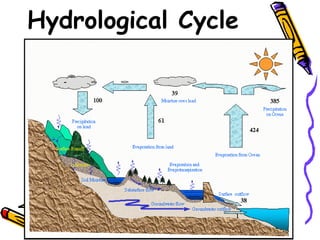
process is known as hydrological cycle. It
can be represented graphically as shown in
figures.
Hydrological Cycle
Hydrological Cycle
PrecipitationPrecipitation
Water reaches to EarthWater reaches to Earth
surface from the atmospheresurface from the atmosphere
in any form.in any form.
Precipitation
Forms of Precipitation
Liquid Precipitation
1. Rain Fall: Rainfall is common form of precipitation..
Droplet size = 0.5 ~ 6.25 mm
2. Drizzle: Droplet size < 0.5 mm, and
Intensity < 0.01 mm/hr
Frozen Precipitation
1. Glaze: frozen drizzle and rain.
2. Sleet: frozen rain drops cooled to ice stage through air at sub-
freeing temperature.
3. Snow: fall of ice crystals formed by sulimation.
4. Snow flakes: no. of ice crystals fused together form snow flakes.
5. Hail: lumps or bulbs of ice crystals > 5 mm dia. Formed by
alternate freezing and melting as they are carried up and
down in highly turbulent air currents.
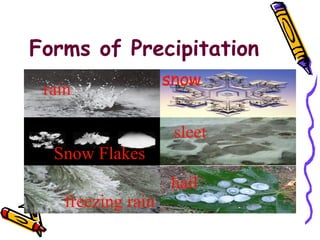
Forms of Precipitation
snow
rain
Snow Flakes
sleet
freezing rain
hail
Types of Precipitation
1. Cyclonic Precipitation:
When air masses rise up with vapors and travel
towards low pressure areas resulting into
Cyclonic precipitation.
i. Frontal precipitation
It is due to flow of warm air mass into a cold
region.
ii. Non-Frontal precipitation
When cold air meets with stationary warm air
then Non-Frontal Precipitation occurs.
2. Convective Precipitation:
It occurs due to natural rising of warm lighter
air with vapors into the colder and denser
region.
3. Orographic Precipitation
hen heavily moisture-laden air stops due to
topographic conditions (mountains) and
precipitation occurs then it is called
orographic precipitation. Just like in Himalayan
regions.
4. Precipitation due to Turbulent Ascent.
When turbulence in the velocity of clouds
occur due to land surface after long travel on
the ocean surface then there will be risen up
of clouds into colder regions and precipitation
occurs.
Types of Precipitation
3. Orographic Precipitation
It is the most important precipitation and is
caused by air masses which strike some
natural topographic barriers like mountains
and can not move forward and hence rise up,
causing condensation and precipitation, such
precipitation is called orographic precipitation.
Just like in Himalayan regions.
Types of Precipitation
Rainfall
Characteristics
1. Size and Shape
 Rainfall occurs when moisture
in the atmosphere condenses
into drops.
 Raindrops occur in any shape
up to approximately 9 mm mean
diameter after which they tend
to break up.
Rainfall
Characteristics
2. Intensity and Duration
 Amount of water that reaches to
ground surface per unit area is
called intensity.
 Intensity and duration are usually
inversely related, i.e., high
intensity storms are likely to be of
short duration and low intensity
storms can have a long duration.
Any questions?Any questions?
Thanks
and
Have a great day!

Hydrology ( Hydro-logic cycle and precipitation )

  • 2.
    Topics: Annual world waterbudget Hydrologic cycle Definition of precipitation Forms of precipitation Types of precipitation Rainfall characteristics
  • 3.
  • 4.
    Hydrologic Cycle Most ofthe earth’s water sources such as rivers, lakes, oceans and underground sources, get their supplies from the rains, while the rain water in itself is the evaporation from these sources. Water is lost to the atmosphere as vapour from the earth, which is then precipitated back in
  • 5.
    Hydrologic Cycle the formof rain, snow, hail(frozen rain drop, rain hail stone), dew, sleet or frost, etc. This evaporation and precipitation continues till forever and thereby, a balance is maintained between the two, this process is known as hydrological cycle. It can be represented graphically as shown in figures.
  • 7.
  • 8.
  • 9.
    PrecipitationPrecipitation Water reaches toEarthWater reaches to Earth surface from the atmospheresurface from the atmosphere in any form.in any form.
  • 10.
    Precipitation Forms of Precipitation LiquidPrecipitation 1. Rain Fall: Rainfall is common form of precipitation.. Droplet size = 0.5 ~ 6.25 mm 2. Drizzle: Droplet size < 0.5 mm, and Intensity < 0.01 mm/hr
  • 11.
    Frozen Precipitation 1. Glaze:frozen drizzle and rain. 2. Sleet: frozen rain drops cooled to ice stage through air at sub- freeing temperature. 3. Snow: fall of ice crystals formed by sulimation. 4. Snow flakes: no. of ice crystals fused together form snow flakes. 5. Hail: lumps or bulbs of ice crystals > 5 mm dia. Formed by alternate freezing and melting as they are carried up and down in highly turbulent air currents.
  • 12.
    Forms of Precipitation snow rain SnowFlakes sleet freezing rain hail
  • 13.
    Types of Precipitation 1.Cyclonic Precipitation: When air masses rise up with vapors and travel towards low pressure areas resulting into Cyclonic precipitation. i. Frontal precipitation It is due to flow of warm air mass into a cold region. ii. Non-Frontal precipitation When cold air meets with stationary warm air then Non-Frontal Precipitation occurs. 2. Convective Precipitation: It occurs due to natural rising of warm lighter air with vapors into the colder and denser region.
  • 14.
    3. Orographic Precipitation henheavily moisture-laden air stops due to topographic conditions (mountains) and precipitation occurs then it is called orographic precipitation. Just like in Himalayan regions. 4. Precipitation due to Turbulent Ascent. When turbulence in the velocity of clouds occur due to land surface after long travel on the ocean surface then there will be risen up of clouds into colder regions and precipitation occurs. Types of Precipitation
  • 15.
    3. Orographic Precipitation Itis the most important precipitation and is caused by air masses which strike some natural topographic barriers like mountains and can not move forward and hence rise up, causing condensation and precipitation, such precipitation is called orographic precipitation. Just like in Himalayan regions. Types of Precipitation
  • 16.
    Rainfall Characteristics 1. Size andShape  Rainfall occurs when moisture in the atmosphere condenses into drops.  Raindrops occur in any shape up to approximately 9 mm mean diameter after which they tend to break up.
  • 17.
    Rainfall Characteristics 2. Intensity andDuration  Amount of water that reaches to ground surface per unit area is called intensity.  Intensity and duration are usually inversely related, i.e., high intensity storms are likely to be of short duration and low intensity storms can have a long duration.
  • 18.
  • 19.