Precipitation
Grade – 9
Geography
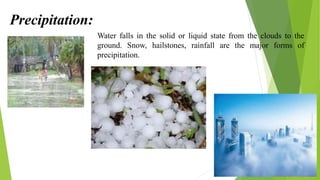
Water falls in the solid or liquid state from the clouds to the
ground. Snow, hailstones, rainfall are the major forms of
precipitation.
Precipitation:
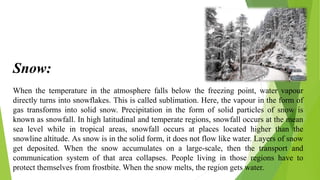
When the temperature in the atmosphere falls below the freezing point, water vapour
directly turns into snowflakes. This is called sublimation. Here, the vapour in the form of
gas transforms into solid snow. Precipitation in the form of solid particles of snow is
known as snowfall. In high latitudinal and temperate regions, snowfall occurs at the mean
sea level while in tropical areas, snowfall occurs at places located higher than the
snowline altitude. As snow is in the solid form, it does not flow like water. Layers of snow
get deposited. When the snow accumulates on a large-scale, then the transport and
communication system of that area collapses. People living in those regions have to
protect themselves from frostbite. When the snow melts, the region gets water.
Snow:
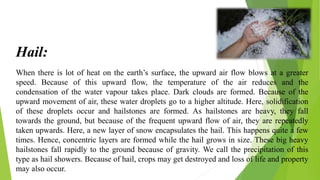
When there is lot of heat on the earth’s surface, the upward air flow blows at a greater
speed. Because of this upward flow, the temperature of the air reduces and the
condensation of the water vapour takes place. Dark clouds are formed. Because of the
upward movement of air, these water droplets go to a higher altitude. Here, solidification
of these droplets occur and hailstones are formed. As hailstones are heavy, they fall
towards the ground, but because of the frequent upward flow of air, they are repeatedly
taken upwards. Here, a new layer of snow encapsulates the hail. This happens quite a few
times. Hence, concentric layers are formed while the hail grows in size. These big heavy
hailstones fall rapidly to the ground because of gravity. We call the precipitation of this
type as hail showers. Because of hail, crops may get destroyed and loss of life and property
may also occur.
Hail:
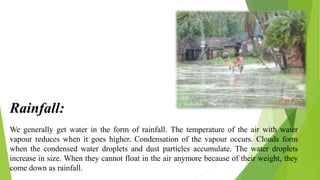
We generally get water in the form of rainfall. The temperature of the air with water
vapour reduces when it goes higher. Condensation of the vapour occurs. Clouds form
when the condensed water droplets and dust particles accumulate. The water droplets
increase in size. When they cannot float in the air anymore because of their weight, they
come down as rainfall.
Rainfall:
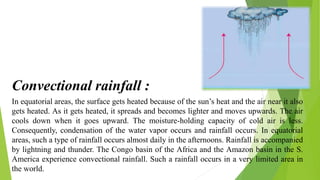
In equatorial areas, the surface gets heated because of the sun’s heat and the air near it also
gets heated. As it gets heated, it spreads and becomes lighter and moves upwards. The air
cools down when it goes upward. The moisture-holding capacity of cold air is less.
Consequently, condensation of the water vapor occurs and rainfall occurs. In equatorial
areas, such a type of rainfall occurs almost daily in the afternoons. Rainfall is accompanied
by lightning and thunder. The Congo basin of the Africa and the Amazon basin in the S.
America experience convectional rainfall. Such a rainfall occurs in a very limited area in
the world.
Convectional rainfall :
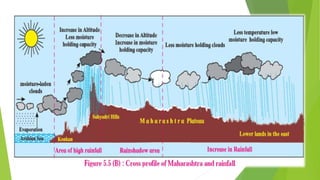
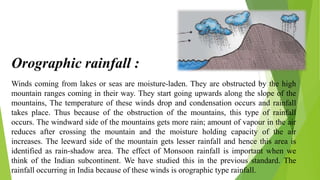
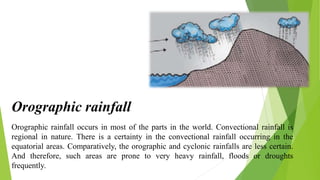
Winds coming from lakes or seas are moisture-laden. They are obstructed by the high
mountain ranges coming in their way. They start going upwards along the slope of the
mountains, The temperature of these winds drop and condensation occurs and rainfall
takes place. Thus because of the obstruction of the mountains, this type of rainfall
occurs. The windward side of the mountains gets more rain; amount of vapour in the air
reduces after crossing the mountain and the moisture holding capacity of the air
increases. The leeward side of the mountain gets lesser rainfall and hence this area is
identified as rain-shadow area. The effect of Monsoon rainfall is important when we
think of the Indian subcontinent. We have studied this in the previous standard. The
rainfall occurring in India because of these winds is orographic type rainfall.
Orographic rainfall :
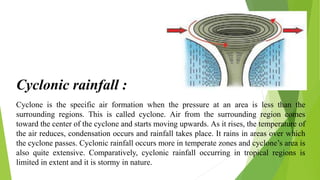
Cyclone is the specific air formation when the pressure at an area is less than the
surrounding regions. This is called cyclone. Air from the surrounding region comes
toward the center of the cyclone and starts moving upwards. As it rises, the temperature of
the air reduces, condensation occurs and rainfall takes place. It rains in areas over which
the cyclone passes. Cyclonic rainfall occurs more in temperate zones and cyclone’s area is
also quite extensive. Comparatively, cyclonic rainfall occurring in tropical regions is
limited in extent and it is stormy in nature.
Cyclonic rainfall :
Orographic rainfall occurs in most of the parts in the world. Convectional rainfall is
regional in nature. There is a certainty in the convectional rainfall occurring in the
equatorial areas. Comparatively, the orographic and cyclonic rainfalls are less certain.
And therefore, such areas are prone to very heavy rainfall, floods or droughts
frequently.
Orographic rainfall
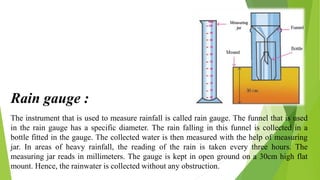
The instrument that is used to measure rainfall is called rain gauge. The funnel that is used
in the rain gauge has a specific diameter. The rain falling in this funnel is collected in a
bottle fitted in the gauge. The collected water is then measured with the help of measuring
jar. In areas of heavy rainfall, the reading of the rain is taken every three hours. The
measuring jar reads in millimeters. The gauge is kept in open ground on a 30cm high flat
mount. Hence, the rainwater is collected without any obstruction.
Rain gauge :
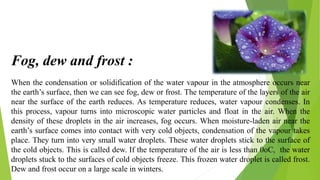
When the condensation or solidification of the water vapour in the atmosphere occurs near
the earth’s surface, then we can see fog, dew or frost. The temperature of the layers of the air
near the surface of the earth reduces. As temperature reduces, water vapour condenses. In
this process, vapour turns into microscopic water particles and float in the air. When the
density of these droplets in the air increases, fog occurs. When moisture-laden air near the
earth’s surface comes into contact with very cold objects, condensation of the vapour takes
place. They turn into very small water droplets. These water droplets stick to the surface of
the cold objects. This is called dew. If the temperature of the air is less than 0oC, the water
droplets stuck to the surfaces of cold objects freeze. This frozen water droplet is called frost.
Dew and frost occur on a large scale in winters.
Fog, dew and frost :
The main source of potable water available on the earth is precipitation. As excessive rainfall
is destructive so is the absence of rain. Floods may occur because of heavy rainfall causing
loss of life and property. If precipitation does not take place, then conditions of drought arise.
There is a shortfall of food and food may have to be imported. Farmers’ condition becomes
grave. A country’s economy gets affected. Economy of an agrarian country like India is
dependent on agriculture. Agriculture in India to a large extent is dependent on the
Monsoons. Hence, the rainfall in India is important to the whole country. A good rainfall at
the right time increases crop production while untimely rain can cause damage to the crops.
The rainfall in India is quite erratic. Visibility reduces because of highly dense fog. It affects
the means of transportation like roads, railways, waterways and the airways. Accidents may
take place in such conditions. Trains, flights and other transport services may have to be
cancelled. Frost is harmful to crops and causes accident if spread on the road. Fog and dew
damage some crops by spreading diseases while it may be beneficial to some crops.
Effects of precipitation :
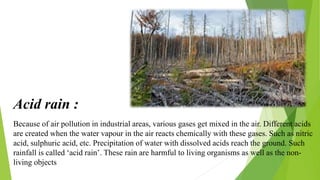
Because of air pollution in industrial areas, various gases get mixed in the air. Different acids
are created when the water vapour in the air reacts chemically with these gases. Such as nitric
acid, sulphuric acid, etc. Precipitation of water with dissolved acids reach the ground. Such
rainfall is called ‘acid rain’. These rain are harmful to living organisms as well as the non-
living objects
Acid rain :
Content Compiled by,
D. B. Naga Muruga

Precipitation

  • 1.
  • 2.
    Water falls inthe solid or liquid state from the clouds to the ground. Snow, hailstones, rainfall are the major forms of precipitation. Precipitation:
  • 3.
    When the temperaturein the atmosphere falls below the freezing point, water vapour directly turns into snowflakes. This is called sublimation. Here, the vapour in the form of gas transforms into solid snow. Precipitation in the form of solid particles of snow is known as snowfall. In high latitudinal and temperate regions, snowfall occurs at the mean sea level while in tropical areas, snowfall occurs at places located higher than the snowline altitude. As snow is in the solid form, it does not flow like water. Layers of snow get deposited. When the snow accumulates on a large-scale, then the transport and communication system of that area collapses. People living in those regions have to protect themselves from frostbite. When the snow melts, the region gets water. Snow:
  • 4.
    When there islot of heat on the earth’s surface, the upward air flow blows at a greater speed. Because of this upward flow, the temperature of the air reduces and the condensation of the water vapour takes place. Dark clouds are formed. Because of the upward movement of air, these water droplets go to a higher altitude. Here, solidification of these droplets occur and hailstones are formed. As hailstones are heavy, they fall towards the ground, but because of the frequent upward flow of air, they are repeatedly taken upwards. Here, a new layer of snow encapsulates the hail. This happens quite a few times. Hence, concentric layers are formed while the hail grows in size. These big heavy hailstones fall rapidly to the ground because of gravity. We call the precipitation of this type as hail showers. Because of hail, crops may get destroyed and loss of life and property may also occur. Hail:
  • 6.
    We generally getwater in the form of rainfall. The temperature of the air with water vapour reduces when it goes higher. Condensation of the vapour occurs. Clouds form when the condensed water droplets and dust particles accumulate. The water droplets increase in size. When they cannot float in the air anymore because of their weight, they come down as rainfall. Rainfall:
  • 7.
    In equatorial areas,the surface gets heated because of the sun’s heat and the air near it also gets heated. As it gets heated, it spreads and becomes lighter and moves upwards. The air cools down when it goes upward. The moisture-holding capacity of cold air is less. Consequently, condensation of the water vapor occurs and rainfall occurs. In equatorial areas, such a type of rainfall occurs almost daily in the afternoons. Rainfall is accompanied by lightning and thunder. The Congo basin of the Africa and the Amazon basin in the S. America experience convectional rainfall. Such a rainfall occurs in a very limited area in the world. Convectional rainfall :
  • 8.
    Winds coming fromlakes or seas are moisture-laden. They are obstructed by the high mountain ranges coming in their way. They start going upwards along the slope of the mountains, The temperature of these winds drop and condensation occurs and rainfall takes place. Thus because of the obstruction of the mountains, this type of rainfall occurs. The windward side of the mountains gets more rain; amount of vapour in the air reduces after crossing the mountain and the moisture holding capacity of the air increases. The leeward side of the mountain gets lesser rainfall and hence this area is identified as rain-shadow area. The effect of Monsoon rainfall is important when we think of the Indian subcontinent. We have studied this in the previous standard. The rainfall occurring in India because of these winds is orographic type rainfall. Orographic rainfall :
  • 9.
    Cyclone is thespecific air formation when the pressure at an area is less than the surrounding regions. This is called cyclone. Air from the surrounding region comes toward the center of the cyclone and starts moving upwards. As it rises, the temperature of the air reduces, condensation occurs and rainfall takes place. It rains in areas over which the cyclone passes. Cyclonic rainfall occurs more in temperate zones and cyclone’s area is also quite extensive. Comparatively, cyclonic rainfall occurring in tropical regions is limited in extent and it is stormy in nature. Cyclonic rainfall :
  • 10.
    Orographic rainfall occursin most of the parts in the world. Convectional rainfall is regional in nature. There is a certainty in the convectional rainfall occurring in the equatorial areas. Comparatively, the orographic and cyclonic rainfalls are less certain. And therefore, such areas are prone to very heavy rainfall, floods or droughts frequently. Orographic rainfall
  • 11.
    The instrument thatis used to measure rainfall is called rain gauge. The funnel that is used in the rain gauge has a specific diameter. The rain falling in this funnel is collected in a bottle fitted in the gauge. The collected water is then measured with the help of measuring jar. In areas of heavy rainfall, the reading of the rain is taken every three hours. The measuring jar reads in millimeters. The gauge is kept in open ground on a 30cm high flat mount. Hence, the rainwater is collected without any obstruction. Rain gauge :
  • 12.
    When the condensationor solidification of the water vapour in the atmosphere occurs near the earth’s surface, then we can see fog, dew or frost. The temperature of the layers of the air near the surface of the earth reduces. As temperature reduces, water vapour condenses. In this process, vapour turns into microscopic water particles and float in the air. When the density of these droplets in the air increases, fog occurs. When moisture-laden air near the earth’s surface comes into contact with very cold objects, condensation of the vapour takes place. They turn into very small water droplets. These water droplets stick to the surface of the cold objects. This is called dew. If the temperature of the air is less than 0oC, the water droplets stuck to the surfaces of cold objects freeze. This frozen water droplet is called frost. Dew and frost occur on a large scale in winters. Fog, dew and frost :
  • 13.
    The main sourceof potable water available on the earth is precipitation. As excessive rainfall is destructive so is the absence of rain. Floods may occur because of heavy rainfall causing loss of life and property. If precipitation does not take place, then conditions of drought arise. There is a shortfall of food and food may have to be imported. Farmers’ condition becomes grave. A country’s economy gets affected. Economy of an agrarian country like India is dependent on agriculture. Agriculture in India to a large extent is dependent on the Monsoons. Hence, the rainfall in India is important to the whole country. A good rainfall at the right time increases crop production while untimely rain can cause damage to the crops. The rainfall in India is quite erratic. Visibility reduces because of highly dense fog. It affects the means of transportation like roads, railways, waterways and the airways. Accidents may take place in such conditions. Trains, flights and other transport services may have to be cancelled. Frost is harmful to crops and causes accident if spread on the road. Fog and dew damage some crops by spreading diseases while it may be beneficial to some crops. Effects of precipitation :
  • 14.
    Because of airpollution in industrial areas, various gases get mixed in the air. Different acids are created when the water vapour in the air reacts chemically with these gases. Such as nitric acid, sulphuric acid, etc. Precipitation of water with dissolved acids reach the ground. Such rainfall is called ‘acid rain’. These rain are harmful to living organisms as well as the non- living objects Acid rain :
  • 16.