
GREEN HYDROGEN
Tuğçe ARSLAN
Hydrogen can help convert products into no–emission and low–emission forms through emis-
sion–intensive applications. Therefore, hydrogen is an essential technology for climate protec-
tion. But we are pretending that hydrogen could solve all climate problems and be the ultimate
technology. Because first, there are cheaper alternatives in many areas in terms of emission
savings, and secondly, hydrogen is only available on a limited basis for economic and techni-
cal reasons.
Green electricity produces “Green” Hydrogen.
Second: Green electricity can be “stored” in hydrogen.
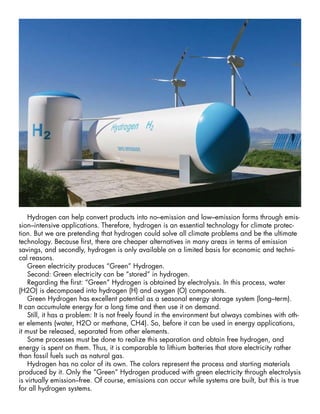
Regarding the first: “Green” Hydrogen is obtained by electrolysis. In this process, water
(H2O) is decomposed into hydrogen (H) and oxygen (O) components.
Green Hydrogen has excellent potential as a seasonal energy storage system (long–term).
It can accumulate energy for a long time and then use it on demand.
Still, it has a problem: It is not freely found in the environment but always combines with oth-
er elements (water, H2O or methane, CH4). So, before it can be used in energy applications,
it must be released, separated from other elements.
Some processes must be done to realize this separation and obtain free hydrogen, and
energy is spent on them. Thus, it is comparable to lithium batteries that store electricity rather
than fossil fuels such as natural gas.
Hydrogen has no color of its own. The colors represent the process and starting materials
produced by it. Only the “Green” Hydrogen produced with green electricity through electrolysis
is virtually emission–free. Of course, emissions can occur while systems are built, but this is true
for all hydrogen systems.
The truth is that as a colorless gas when we
talk about hydrogen, we often use multicolored
terms to refer to it. Many of you like hydrogen
green, gray, blue, etc., you have heard. In oth-
er words, an easy way to tell how “clean” it is:
•	 Blue Hydrogen: “Blue” Hydrogen is
based on natural gas, just like “grey” Hy-
drogen. In the production of Blue Hydrogen,
this Blue Hydrogen is also called climate–
neutral because the CO2 does not (immedi-
ately) reach the atmosphere and is “stored”
underground. However, there is controversy
over this name, as the natural gas used in
this process results in more emissions.
•	 Gray Hydrogen: Obtained from the con-
version of natural gas.
•	 Brown Hydrogen: It is obtained by
coal gasification, and carbon dioxide is
released. Therefore, it is sometimes called
Black Hydrogen.
•	 Green Hydrogen: This is obtained by
electrolysis of water using electricity from
renewable energy sources. It is the most
expensive, but its price is expected to
gradually decrease as the cost of renewable
energy and electrolyzers falls.
The real challenge is to be competitive,
which requires lots of cheap renewable electric-
ity.
Uses of Green Hydrogen
However, battery and electrical technologies
are not possible, depending on the application.
In many, green hydrogen can replace fossil
fuels, although not all of them are very mature
or simple:
Use brown and gray hydrogen instead. The
first step should be replacing all fossil hydro-
gen currently used in industry, using advanced
technologies, and reducing costs. However,
the challenge is not negligible. Global hydro-
gen demand from electricity generation will
consume 3,600 TWh, more than the EU’s total
annual electricity production.
These are the primary uses of green
hydrogen:
•	 Transportation: Transport is undoubtedly
one of the most promising hydrogen applica-
tions. Batteries are winning the competition in
today’s light transport.
•	 Energy Store: This is undoubtedly one of
the most promising hydrogen applications
of a seasonal energy storage system. We
will see that the cost of electricity is cheap
and will be redundant as there is no place to
consume it. They are used for applications,
on–demand electricity generation, or other
applications.
•	 Heating: Domestic and industrial heating is
not always an electrified sector. In addition,
existing infrastructure (such as natural gas
grids) can increase demand.
•	
For example, mixing up to 20% by volume of
hydrogen in an existing natural gas network re-
quires minimal changes to the end–user network
or appliances.
Advantages and Disadvantages of Green Hydrogen
So let’s take a look at some of its most important positive features:
•	 100% Sustainable: Green Hydrogen does not emit polluting gases during combustion or
production.
•	 Storable: Hydrogen is easy to store. This allows it to be used later for other purposes and
after manufacture. They are also easier to use than lithium–ion batteries because they are
lighter.
•	 Portable: It can be transported up to 20% like natural gas, which can be transported with
the existing natural gas infrastructure. Increasing this percentage will require replacing dif-
ferent elements in existing gas infrastructures to bring them into line.
However, Green Hydrogen also has downsides to keep in mind:
•	 High Energy Consumption: In general, hydrogen production in general and Green
Hydrogen require more energy than other fuels.
•	 Safety Considerations: Hydrogen is a volatile and flammable element, and therefore
extensive safety measures are necessary to prevent leakage and explosions.
How much does green hydrogen cost?
It’s still expensive today. For Green Hydrogen prices to fall, renewable energy prices and elec-
trolysis prices must fall. Reducing the cost of electrolysis is critical to lowering the price of Green
Hydrogen, but this will take time.
What should be considered about hydrogen imports?
Geographically and physically, there are perfect conditions for Green Hydrogen produc-
tion in countries with a large area, plenty of sun, and wind. These are countries located in the
relative Global South. However, there is a risk of adverse effects on humans and nature when
large–scale (Green) Hydrogen export production is carried out in exporting countries.
There are currently no binding regulations for hydrogen imports. Therefore, Germany and
Europe have the opportunity to take the lead in this regard and develop strict and controllable
standards with the strength of their markets. When such regulations are coupled with robust
sanctions, hydrogen can create a sustainable, global enterprise, a socially just, ecologically
harmless, and economically successful enterprise.
ANUMAK & COMPANY
aNumak & Company is a global management consulting firm, an India private company
limited by warranty. It is a company with expertise in creating scalable business models for
different industry verticals. The Company strives to provide solutions through consulting, digital
transformation, and innovative products that solve modern business problems. Offering on–
site and offshore support and unique strategies, aNumak & Company transforms traditional
business models into high–performance, dynamic, and distinctive business enterprises.
It brings insights from core domain experts to deliver the best possible solutions to drive
growth. aNumak & Company and each of its member firms are legally separate and
independent entities. For more detailed information about aNumak & Company and its
member companies, please visit https://www.anumak.com
This material was prepared by aNumak & Company. This material (including any information
it contains) is intended to provide general information on a particular topic(s). This material
may contain information obtained from publicly available information or other third–party
sources. aNumak & Company does not independently verify such sources and is not
responsible for any loss resulting from reliance on information obtained from such sources.
aNumak & Company does not provide any investment, legal, or other professional advice or
services through this material. You should seek specific advice from the relevant
specialist(s) for such services. This material or information is not intended to be considered
the sole basis for any decision that could affect you, your business, or the operations of the
company. Before making any decision or taking any action that could affect your finances or
business, you should consult a professional.
No institution at aNumak & Company can be held responsible for any loss suffered by any
person or institution due to access to, use, or reliance on this material. By using this material or
any information it contains, the user accepts he entirety of this notice and the terms of use.
©2022 aNumak & Company
anumak.ai
CONTACTS
Amith Kumar
Chief Executive Officer,
aNumak & Company
amith@anumak.com
Neha Anush
Chief Operating Officer,
aNumak & Company
neha.anush@anumak.com
Cesibel Rodriguez
Chief Branding Officer,
aNumak & Company
cesi@anumak.com
Ricky Devaya
Chief Human Resource Officer – India,
aNumak & Company
ricky@anumak.com
Vilas Khole
Chief Delivery Officer – India,
aNumak & Company
vilas@anumak.com
Karthik Reddy
Chief Sales Officer – UAE,
aNumak & Company
karthik@anumak.in
Iván Muñiz Rothgiesser
Sales Director,
aNumak & Company
ivan@anumak.com
aNumak & Company
marketing@anumak.com
Pr@anumak.in - info@anumak.com
CONTRIBUTORS
Gino Mori Valenzuela
Client Partner – Retail,
aNumak & Company
gino@anumak.in
Diana Marcela Rios
Client Partner – Retail,
aNumak & Company
diana@anumak.in
Víctor Freundt
Client Partner – Education,
aNumak & Company
victor@anumak.in
Agyemang Mensah Kwadwo
Graphic Designer,
aNumak & Company
agyemang@anumak.in
Author: Tuǧçe ARSLAN
arslan@anumak.in
anumak.ai

Green hydrogen

  • 1.
  • 2.
    Hydrogen can helpconvert products into no–emission and low–emission forms through emis- sion–intensive applications. Therefore, hydrogen is an essential technology for climate protec- tion. But we are pretending that hydrogen could solve all climate problems and be the ultimate technology. Because first, there are cheaper alternatives in many areas in terms of emission savings, and secondly, hydrogen is only available on a limited basis for economic and techni- cal reasons. Green electricity produces “Green” Hydrogen. Second: Green electricity can be “stored” in hydrogen. Regarding the first: “Green” Hydrogen is obtained by electrolysis. In this process, water (H2O) is decomposed into hydrogen (H) and oxygen (O) components. Green Hydrogen has excellent potential as a seasonal energy storage system (long–term). It can accumulate energy for a long time and then use it on demand. Still, it has a problem: It is not freely found in the environment but always combines with oth- er elements (water, H2O or methane, CH4). So, before it can be used in energy applications, it must be released, separated from other elements. Some processes must be done to realize this separation and obtain free hydrogen, and energy is spent on them. Thus, it is comparable to lithium batteries that store electricity rather than fossil fuels such as natural gas. Hydrogen has no color of its own. The colors represent the process and starting materials produced by it. Only the “Green” Hydrogen produced with green electricity through electrolysis is virtually emission–free. Of course, emissions can occur while systems are built, but this is true for all hydrogen systems.
  • 3.
    The truth isthat as a colorless gas when we talk about hydrogen, we often use multicolored terms to refer to it. Many of you like hydrogen green, gray, blue, etc., you have heard. In oth- er words, an easy way to tell how “clean” it is: • Blue Hydrogen: “Blue” Hydrogen is based on natural gas, just like “grey” Hy- drogen. In the production of Blue Hydrogen, this Blue Hydrogen is also called climate– neutral because the CO2 does not (immedi- ately) reach the atmosphere and is “stored” underground. However, there is controversy over this name, as the natural gas used in this process results in more emissions. • Gray Hydrogen: Obtained from the con- version of natural gas. • Brown Hydrogen: It is obtained by coal gasification, and carbon dioxide is released. Therefore, it is sometimes called Black Hydrogen. • Green Hydrogen: This is obtained by electrolysis of water using electricity from renewable energy sources. It is the most expensive, but its price is expected to gradually decrease as the cost of renewable energy and electrolyzers falls. The real challenge is to be competitive, which requires lots of cheap renewable electric- ity. Uses of Green Hydrogen However, battery and electrical technologies are not possible, depending on the application. In many, green hydrogen can replace fossil fuels, although not all of them are very mature or simple: Use brown and gray hydrogen instead. The first step should be replacing all fossil hydro- gen currently used in industry, using advanced technologies, and reducing costs. However, the challenge is not negligible. Global hydro- gen demand from electricity generation will consume 3,600 TWh, more than the EU’s total annual electricity production. These are the primary uses of green hydrogen: • Transportation: Transport is undoubtedly one of the most promising hydrogen applica- tions. Batteries are winning the competition in today’s light transport. • Energy Store: This is undoubtedly one of the most promising hydrogen applications of a seasonal energy storage system. We will see that the cost of electricity is cheap and will be redundant as there is no place to consume it. They are used for applications, on–demand electricity generation, or other applications. • Heating: Domestic and industrial heating is not always an electrified sector. In addition, existing infrastructure (such as natural gas grids) can increase demand. • For example, mixing up to 20% by volume of hydrogen in an existing natural gas network re- quires minimal changes to the end–user network or appliances.
  • 4.
    Advantages and Disadvantagesof Green Hydrogen So let’s take a look at some of its most important positive features: • 100% Sustainable: Green Hydrogen does not emit polluting gases during combustion or production. • Storable: Hydrogen is easy to store. This allows it to be used later for other purposes and after manufacture. They are also easier to use than lithium–ion batteries because they are lighter. • Portable: It can be transported up to 20% like natural gas, which can be transported with the existing natural gas infrastructure. Increasing this percentage will require replacing dif- ferent elements in existing gas infrastructures to bring them into line. However, Green Hydrogen also has downsides to keep in mind: • High Energy Consumption: In general, hydrogen production in general and Green Hydrogen require more energy than other fuels. • Safety Considerations: Hydrogen is a volatile and flammable element, and therefore extensive safety measures are necessary to prevent leakage and explosions. How much does green hydrogen cost? It’s still expensive today. For Green Hydrogen prices to fall, renewable energy prices and elec- trolysis prices must fall. Reducing the cost of electrolysis is critical to lowering the price of Green Hydrogen, but this will take time. What should be considered about hydrogen imports? Geographically and physically, there are perfect conditions for Green Hydrogen produc- tion in countries with a large area, plenty of sun, and wind. These are countries located in the relative Global South. However, there is a risk of adverse effects on humans and nature when large–scale (Green) Hydrogen export production is carried out in exporting countries. There are currently no binding regulations for hydrogen imports. Therefore, Germany and Europe have the opportunity to take the lead in this regard and develop strict and controllable standards with the strength of their markets. When such regulations are coupled with robust sanctions, hydrogen can create a sustainable, global enterprise, a socially just, ecologically harmless, and economically successful enterprise.
  • 5.
    ANUMAK & COMPANY aNumak& Company is a global management consulting firm, an India private company limited by warranty. It is a company with expertise in creating scalable business models for different industry verticals. The Company strives to provide solutions through consulting, digital transformation, and innovative products that solve modern business problems. Offering on– site and offshore support and unique strategies, aNumak & Company transforms traditional business models into high–performance, dynamic, and distinctive business enterprises. It brings insights from core domain experts to deliver the best possible solutions to drive growth. aNumak & Company and each of its member firms are legally separate and independent entities. For more detailed information about aNumak & Company and its member companies, please visit https://www.anumak.com This material was prepared by aNumak & Company. This material (including any information it contains) is intended to provide general information on a particular topic(s). This material may contain information obtained from publicly available information or other third–party sources. aNumak & Company does not independently verify such sources and is not responsible for any loss resulting from reliance on information obtained from such sources. aNumak & Company does not provide any investment, legal, or other professional advice or services through this material. You should seek specific advice from the relevant specialist(s) for such services. This material or information is not intended to be considered the sole basis for any decision that could affect you, your business, or the operations of the company. Before making any decision or taking any action that could affect your finances or business, you should consult a professional. No institution at aNumak & Company can be held responsible for any loss suffered by any person or institution due to access to, use, or reliance on this material. By using this material or any information it contains, the user accepts he entirety of this notice and the terms of use. ©2022 aNumak & Company anumak.ai
  • 6.
    CONTACTS Amith Kumar Chief ExecutiveOfficer, aNumak & Company amith@anumak.com Neha Anush Chief Operating Officer, aNumak & Company neha.anush@anumak.com Cesibel Rodriguez Chief Branding Officer, aNumak & Company cesi@anumak.com Ricky Devaya Chief Human Resource Officer – India, aNumak & Company ricky@anumak.com Vilas Khole Chief Delivery Officer – India, aNumak & Company vilas@anumak.com Karthik Reddy Chief Sales Officer – UAE, aNumak & Company karthik@anumak.in Iván Muñiz Rothgiesser Sales Director, aNumak & Company ivan@anumak.com aNumak & Company marketing@anumak.com Pr@anumak.in - info@anumak.com CONTRIBUTORS Gino Mori Valenzuela Client Partner – Retail, aNumak & Company gino@anumak.in Diana Marcela Rios Client Partner – Retail, aNumak & Company diana@anumak.in Víctor Freundt Client Partner – Education, aNumak & Company victor@anumak.in Agyemang Mensah Kwadwo Graphic Designer, aNumak & Company agyemang@anumak.in Author: Tuǧçe ARSLAN arslan@anumak.in anumak.ai