Hydroelectric power
plants
How does it work
The volume of water flow and change in
elevation or fall, and often reffered to as head
from one point to another determine the
amount of available energy in moving water. In
general, the greater the water flow and the
higher the head, the more electricity a
hydropower plant can produce.
How does it work
At hydropower plants water flows through
a pipe, or penstock, then pushes against
and turns blades in a turbine that spin to
power a generator to produce electricity
It’s parts:
1.) Forebay
Is a basin area of Hydropower plant where water is a
temporarily stored before going into intake chamber.
The storage of water in forebay is decided based on
required water demand in that area. This is also used
when the load requirement in intake is less.
The water stored on the upstream side of the dam
can be carried by penstocks to the powerhouse. In
this case, the reservoir itself acts as a forebay
2.) Intake structure
Is a structure which collects the water from the forebay
an directs it into the penstocks
Selections and types depends on various local conditions
Contains some important components of which trash racks
plays a vital role
Trash racks – are provided at the entrance of penstock to
trap the debris in the water
o If the debris flow into the penstock with the water it will
cause severe to the wicket gates, turbine runners, nozzles
of turbines etc.
These trash racks are made of steel in rod shape
These gaps are arranged with a gap of 10 to 30 cm part
and these racks will separate the debris from the flowing
water whose permissible velocity is limited 0.6 m/s to 1,6
m/s
3.)Penstock
Are large pipes laid with some slope which carries water
from intake structure or reservoir to the turbines.
They run with some pressure so, sudden closing or
opening penstock gates can cause water hammer effect to
the penstocks
Are designed to resist the water hammer effect apart
from this penstock is similar to normal pipe.
To overcome this pressure, heavy wall is provided for
short length penstock and surge tank is provided in
case of long length penstocks.
Steel or reinforced concrete is used for making
penstocks.
If the length is small, separate penstock is used and
at the end is separated into branches
4.)Surge chamber/surge tank
Is a cylindrical tank and is open at the top tocontrol
the pressure in penstock.
It is connected to the penstock and as close as
possible to the power house.
Has different types available and they are selected
based on the requirement of plant, length
5.)hydraulic turbines
A device which can convert the hydraulic energy into
mechanical energy which can again converted into
electrical energy b y coupling the shaft of the
turbine to the generator.
Rotates the shaft provided at the center when the
water coming from the penstock strike the circular
blades with high pressure causing the generator to
produce electrical power
Two types of hydraulic turbine
 Impulse turbine-also called velocity turbine
ex: pelton wheel turbine
 Reaction turbine-also called pressure turbine
Ex:Kaplan and Francis
6.)power house
Is a building provided to protect hydraulic and
electrical equipment
 in case of reaction turbines some machine like draft
tubes, scroll casing etc. are fixed with in the
foundation while laying it.
When it comes to super structure, generators are
provided on the ground floor under which vertical
turbines are provided.
7.) Draft tube
If reaction turbines are used, then draft tube is a
necessary component which connects turbine outlet
to the trailrace.
Contains gradually increasing diameter so that the
water discharged into the trailrace with safe velocity
At the end of the draft tube, outlet gates are
provided which can be closed during repair works
Is the flow of water from turbines to stream
It’s good if the powerhouse is located nearer the stream,
but if not then it is necessary to build channel for carrying
water into the stream
Otherwise the water flow may damage the plant in many
ways like lowering turbine efficiency, cavitation, Damage
to turbine blades etc.
This is because of silting caused by unnecessary flow of
water from power house.
Hence, proper design of trailrace should be more
important.
mechanism
A conventional dam holds water in a man-made
lake, or reservoir, behind it. When water is
released through the dam, it spins a turbine
connected to a generator that produces
electricity. The water returns to the river on the
downstream side of the dam
How much power does a
hydroelectric
powerplant generates
There are 3 types of hydropower facilities: impoundment,
diversion, and pumped storage. Some hydropower plants
use dams and some do not.
Although not all dams were built for hydropower, they
have proven useful for pumping tons of renewable energy
to the grid.
Hydropower plants range in size from small systems
suitable for a single home or village to large projects
producing electricity for utilities.
In the United States, there are more than 90,000 dams, of
which less than 2,300 produce power as of 2020. The
other dams are used for recreation, stock/farm ponds,
flood control water supply, and irrigation.
Here in the Philippines there are more than 70 power
plants in operation, the Philippines has a total
installed hydropower capacity about 3,701 MW. That
represents about 16% of the national total which is
Based on DOE’s definition:
Large hydropower plants, defined as facilities that
have a capacity of more than 30 megawatts(MW)
Meanwhile small hydropower plants defined as
projects that generates between 100 kilowatts to 10
megawatts
Advantages of
Hydroelectric power
plant
Hydropower is a renewable source of energy. The
energy generated through hydropower relies on the
water cycle, which is driven by the sun, making it
renewable.
It allows each state to produce its own energy
without being reliant on international fuel sources.
It creates reservoirs that offer recreational
opportunities such as fishing, swimming and boating.
It can generate power to the grid immediately they
provide essential backup power during major
electricity outages or disruptions
Provides flood-control, irrigation support and clean
drinking water.
It provides low cost electricity over time compared
to other sources of energy.
Construction cost can even be migitated by using
pre-existing structures such as bridges, tunnels and
dams
Hydropower creates jobs in rural locations and boosts
local economies
disadvantages of
Hydroelectric power
plant
1.)Environmental impact
One of the largest impact of a hydroelectric power
plant
Dams can damage or otherwise impact the
environment upstream and downstream through their
construction
To build dams, new roads and power lines must be
installed, that disrupt the environment
Dams also often form reservoirs that flood large
areas and displace natural habitats
Dams flood areas that creates sections of still or
stagnant water that kills vegetation which emits
greenhouse gasses as it rots
Blockage also seriously impact fish migration
especially for species like salmon who relies on river
to spawn
Dams impact biological triggers that tell fish where
to migrate
Limits flow of water which causes downstream of
oxygen levels
2.) it displaces people
Reservoirs not only displace animals but it displace
people too
People were forced to move and though they are
typically compensated for moving it doesn’t make up
for what they lost
People who refused move out have been forced to
move with the threat of violence
In 1982, one instance in Guatemals resulted in the
deaths of 369 mayans who refused to move out
during the construction of the Chixoy dam
Millions of people have been displaced over the years
due to construction of dams
Hydroelectric power plants are increase flooding in
lower elevations
3.)It’s expensive
Hydroelectric energy don’t cost too much to operate
but the time it takes for a dam to pay for itself can
vary widely
Some take 2-5 years to construct leading to
increased cost
Everything totaled, the Itaipu Dam took 18 years and $18
billion dollars to build
Since 1950’s, an estimated $2000 billion ha spent on dam
construction around the world.
4.) There are limited reservoirs
Although water is an unlimited resource, the conditions
necessary to build a dam are limited.
In fact most locations suitable for building dams have
already been used for this purpose
Even if locations can support hydroelectric dams, it may
not generate enough profit for the project to be
worthwhile
5.) There are dought
Water can and goes through cycles of abundance and
drought
Lower than normal water levels can heavily impact
energy production
Hydroelectric power plant can cause drought
conditions downstream if they don’t allow sufficient
water to pass through
This can be especially detrimental if a dam is located
along a river or reservoir that allows water passage
in another country
6.)it’s not always safe
Dams still offer dangers and harm on their own
Dam failures and construction accidents can result to
injury or death
For example: The hoover dam claimed as many as
112 deaths during it’s construction, the Banqiao
reservoir Dam in China was destroyed by a typhoon in
1975 leading to an estimate deaths of 171,000 people
Examples in the Philippines
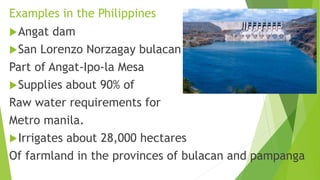
Angat dam
San Lorenzo Norzagay bulacan
Part of Angat-Ipo-la Mesa
Supplies about 90% of
Raw water requirements for
Metro manila.
Irrigates about 28,000 hectares
Of farmland in the provinces of bulacan and pampanga
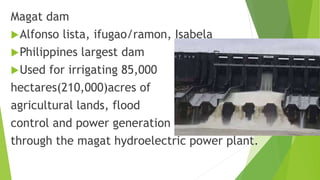
Magat dam
Alfonso lista, ifugao/ramon, Isabela
Philippines largest dam
Used for irrigating 85,000
hectares(210,000)acres of
agricultural lands, flood
control and power generation
through the magat hydroelectric power plant.
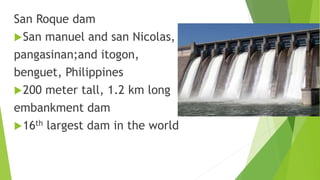
San Roque dam
San manuel and san Nicolas,
pangasinan;and itogon,
benguet, Philippines
200 meter tall, 1.2 km long
embankment dam
16th largest dam in the world

hydroelectric power plant.pptx

  • 1.
  • 2.
    How does itwork The volume of water flow and change in elevation or fall, and often reffered to as head from one point to another determine the amount of available energy in moving water. In general, the greater the water flow and the higher the head, the more electricity a hydropower plant can produce.
  • 3.
    How does itwork At hydropower plants water flows through a pipe, or penstock, then pushes against and turns blades in a turbine that spin to power a generator to produce electricity
  • 4.
    It’s parts: 1.) Forebay Isa basin area of Hydropower plant where water is a temporarily stored before going into intake chamber. The storage of water in forebay is decided based on required water demand in that area. This is also used when the load requirement in intake is less. The water stored on the upstream side of the dam can be carried by penstocks to the powerhouse. In this case, the reservoir itself acts as a forebay
  • 5.
    2.) Intake structure Isa structure which collects the water from the forebay an directs it into the penstocks Selections and types depends on various local conditions Contains some important components of which trash racks plays a vital role Trash racks – are provided at the entrance of penstock to trap the debris in the water o If the debris flow into the penstock with the water it will cause severe to the wicket gates, turbine runners, nozzles of turbines etc.
  • 6.
    These trash racksare made of steel in rod shape These gaps are arranged with a gap of 10 to 30 cm part and these racks will separate the debris from the flowing water whose permissible velocity is limited 0.6 m/s to 1,6 m/s 3.)Penstock Are large pipes laid with some slope which carries water from intake structure or reservoir to the turbines. They run with some pressure so, sudden closing or opening penstock gates can cause water hammer effect to the penstocks
  • 7.
    Are designed toresist the water hammer effect apart from this penstock is similar to normal pipe. To overcome this pressure, heavy wall is provided for short length penstock and surge tank is provided in case of long length penstocks. Steel or reinforced concrete is used for making penstocks. If the length is small, separate penstock is used and at the end is separated into branches
  • 8.
    4.)Surge chamber/surge tank Isa cylindrical tank and is open at the top tocontrol the pressure in penstock. It is connected to the penstock and as close as possible to the power house. Has different types available and they are selected based on the requirement of plant, length
  • 9.
    5.)hydraulic turbines A devicewhich can convert the hydraulic energy into mechanical energy which can again converted into electrical energy b y coupling the shaft of the turbine to the generator.
  • 10.
    Rotates the shaftprovided at the center when the water coming from the penstock strike the circular blades with high pressure causing the generator to produce electrical power Two types of hydraulic turbine  Impulse turbine-also called velocity turbine ex: pelton wheel turbine  Reaction turbine-also called pressure turbine Ex:Kaplan and Francis
  • 11.
    6.)power house Is abuilding provided to protect hydraulic and electrical equipment  in case of reaction turbines some machine like draft tubes, scroll casing etc. are fixed with in the foundation while laying it. When it comes to super structure, generators are provided on the ground floor under which vertical turbines are provided.
  • 12.
    7.) Draft tube Ifreaction turbines are used, then draft tube is a necessary component which connects turbine outlet to the trailrace. Contains gradually increasing diameter so that the water discharged into the trailrace with safe velocity At the end of the draft tube, outlet gates are provided which can be closed during repair works
  • 13.
    Is the flowof water from turbines to stream It’s good if the powerhouse is located nearer the stream, but if not then it is necessary to build channel for carrying water into the stream Otherwise the water flow may damage the plant in many ways like lowering turbine efficiency, cavitation, Damage to turbine blades etc. This is because of silting caused by unnecessary flow of water from power house. Hence, proper design of trailrace should be more important.
  • 14.
    mechanism A conventional damholds water in a man-made lake, or reservoir, behind it. When water is released through the dam, it spins a turbine connected to a generator that produces electricity. The water returns to the river on the downstream side of the dam
  • 15.
    How much powerdoes a hydroelectric powerplant generates
  • 16.
    There are 3types of hydropower facilities: impoundment, diversion, and pumped storage. Some hydropower plants use dams and some do not. Although not all dams were built for hydropower, they have proven useful for pumping tons of renewable energy to the grid. Hydropower plants range in size from small systems suitable for a single home or village to large projects producing electricity for utilities. In the United States, there are more than 90,000 dams, of which less than 2,300 produce power as of 2020. The other dams are used for recreation, stock/farm ponds, flood control water supply, and irrigation.
  • 17.
    Here in thePhilippines there are more than 70 power plants in operation, the Philippines has a total installed hydropower capacity about 3,701 MW. That represents about 16% of the national total which is Based on DOE’s definition: Large hydropower plants, defined as facilities that have a capacity of more than 30 megawatts(MW) Meanwhile small hydropower plants defined as projects that generates between 100 kilowatts to 10 megawatts
  • 18.
  • 19.
    Hydropower is arenewable source of energy. The energy generated through hydropower relies on the water cycle, which is driven by the sun, making it renewable. It allows each state to produce its own energy without being reliant on international fuel sources. It creates reservoirs that offer recreational opportunities such as fishing, swimming and boating. It can generate power to the grid immediately they provide essential backup power during major electricity outages or disruptions
  • 20.
    Provides flood-control, irrigationsupport and clean drinking water. It provides low cost electricity over time compared to other sources of energy. Construction cost can even be migitated by using pre-existing structures such as bridges, tunnels and dams Hydropower creates jobs in rural locations and boosts local economies
  • 21.
  • 22.
    1.)Environmental impact One ofthe largest impact of a hydroelectric power plant Dams can damage or otherwise impact the environment upstream and downstream through their construction To build dams, new roads and power lines must be installed, that disrupt the environment Dams also often form reservoirs that flood large areas and displace natural habitats
  • 23.
    Dams flood areasthat creates sections of still or stagnant water that kills vegetation which emits greenhouse gasses as it rots Blockage also seriously impact fish migration especially for species like salmon who relies on river to spawn Dams impact biological triggers that tell fish where to migrate Limits flow of water which causes downstream of oxygen levels
  • 24.
    2.) it displacespeople Reservoirs not only displace animals but it displace people too People were forced to move and though they are typically compensated for moving it doesn’t make up for what they lost People who refused move out have been forced to move with the threat of violence In 1982, one instance in Guatemals resulted in the deaths of 369 mayans who refused to move out during the construction of the Chixoy dam
  • 25.
    Millions of peoplehave been displaced over the years due to construction of dams Hydroelectric power plants are increase flooding in lower elevations 3.)It’s expensive Hydroelectric energy don’t cost too much to operate but the time it takes for a dam to pay for itself can vary widely Some take 2-5 years to construct leading to increased cost
  • 26.
    Everything totaled, theItaipu Dam took 18 years and $18 billion dollars to build Since 1950’s, an estimated $2000 billion ha spent on dam construction around the world. 4.) There are limited reservoirs Although water is an unlimited resource, the conditions necessary to build a dam are limited. In fact most locations suitable for building dams have already been used for this purpose Even if locations can support hydroelectric dams, it may not generate enough profit for the project to be worthwhile
  • 27.
    5.) There aredought Water can and goes through cycles of abundance and drought Lower than normal water levels can heavily impact energy production Hydroelectric power plant can cause drought conditions downstream if they don’t allow sufficient water to pass through This can be especially detrimental if a dam is located along a river or reservoir that allows water passage in another country
  • 28.
    6.)it’s not alwayssafe Dams still offer dangers and harm on their own Dam failures and construction accidents can result to injury or death For example: The hoover dam claimed as many as 112 deaths during it’s construction, the Banqiao reservoir Dam in China was destroyed by a typhoon in 1975 leading to an estimate deaths of 171,000 people
  • 29.
    Examples in thePhilippines Angat dam San Lorenzo Norzagay bulacan Part of Angat-Ipo-la Mesa Supplies about 90% of Raw water requirements for Metro manila. Irrigates about 28,000 hectares Of farmland in the provinces of bulacan and pampanga
  • 30.
    Magat dam Alfonso lista,ifugao/ramon, Isabela Philippines largest dam Used for irrigating 85,000 hectares(210,000)acres of agricultural lands, flood control and power generation through the magat hydroelectric power plant.
  • 31.
    San Roque dam Sanmanuel and san Nicolas, pangasinan;and itogon, benguet, Philippines 200 meter tall, 1.2 km long embankment dam 16th largest dam in the world