Tips on using my ppt.
1. You can freely download, edit, modify and put your
name etc.
2. Don’t be concerned about number of slides. Half the
slides are blanks except for the title.
3. First show the blank slides (eg. Aetiology ) > Ask
students what they already know about ethology of
today's topic. > Then show next slide which enumerates
aetiologies.
4. At the end rerun the show – show blank> ask questions >
show next slide.
5. This will be an ACTIVE LEARNING SESSION x
three revisions.
6. Good for self study also.
7. See notes for bibliography.
Introduction & History.
• Hydatid disease is a parasitic infestation by
a tapeworm of the genusEchinococcus.
Etiology
Etiology
• Human echinococcosis is a zoonotic
infection caused by the tapeworm of the
genusEchinococcus.
– Echinococcus granulosus, causing cystic
echinococcosis (CE)
– Echinococcus multilocularis, causing alveolar
echinococcosis (AE)
– Echinococcus vogeli.
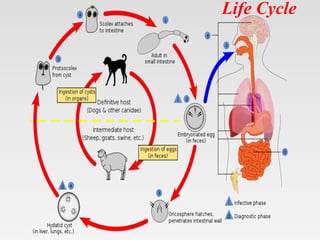
Life Cycle
Life Cycle
Life Cycle
• 2 hosts, definitive and intermediate.
Humans act as an accidental intermediate
host.
• 3stages
– (1) the adult tapeworm in the definitive host
– (2) eggs in the environment,
– (3) the metacestode in the intermediate host.
Life Cycle
• Metacestodes are ingested by the definitive host.
The metacestodes mature into the tapeworm in the
definitive host and, in turn, release eggs into the
environment. The intermediate host ingests the
eggs, which hatch into metacestodes, which infest
the liver, lungs, muscles, and other organs of the
intermediate host.
Clinical Features
Clinical Features
• Rare in Europe and US.
• The cysts grow slowly, and a cyst is rarely
diagnosed during childhood or adolescence
unless the brain is affected.
• CE is a disease of younger adults, with an
average age at diagnosis of 30-40 years.
Symptoms
Symptoms
• Many hydatid cysts remain asymptomatic,
even into advanced age.
• Symptoms can be produced by mass effect
or cyst complications.
• Nonspecific pain, cough, low-grade fever,
and the sensation of abdominal fullness.
Symptoms
• Echinococcosis can involve any organ. The
liver is the most common organ involved,
followed by the lungs. These 2 organs
account for 90% of cases of echinococcosis
• Others -muscles (5%), bones (3%), kidneys
(2%), brain (1%), and spleen (1%)..
Mass effects
Mass effects
Liver-Abdominal lump, obstructive jaundice
and abdominal pain.
With biliary rupture, the classic triad of biliary
colic, jaundice, and urticaria.
Passage of hydatid membranes in the emesis
(hydatid emesia) and passage of membranes
in the stools (hydatid enterica) may occur
rarely.
Lungs
• Chronic cough,
• dyspnea,
• pleuritic chest pain,
• hemoptysis.
• Expectoration of cyst
membranes and fluid is
observed with intrabronchial
rupture.
Brain-SOL.
Brain-SOL.
• Headache,
• dizziness,
• decreased level of
consciousness.
• Specific neurologic deficits
may occur depending on the
location of the cyst in the brain.
Secondary Complications
• Infection
–mild fever to full-blown sepsis.
• Leakage
Leakage
–
Leakage
– increased pain
– flushing and urticaria.
–Anaphylactic reaction,
–A rupture into the biliary tree can
lead to obstruction by the
daughter cysts,
producing cholangitis.
–Rupture into the bronchi can lead
to expectoration of cyst fluid.
Pathology
Pathology
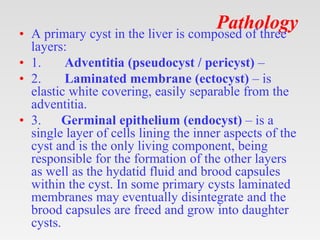
• A primary cyst in the liver is composed of three
layers:
• 1. Adventitia (pseudocyst / pericyst) –
• 2. Laminated membrane (ectocyst) – is
elastic white covering, easily separable from the
adventitia.
• 3. Germinal epithelium (endocyst) – is a
single layer of cells lining the inner aspects of the
cyst and is the only living component, being
responsible for the formation of the other layers
as well as the hydatid fluid and brood capsules
within the cyst. In some primary cysts laminated
membranes may eventually disintegrate and the
brood capsules are freed and grow into daughter
cysts.
Diagnostic Studies
Diagnostic Studies
• Laboratory Tests
• Imaging
– X-ray
– USG
– CT
– MRI
– Nuclear Scan
• Other Tests
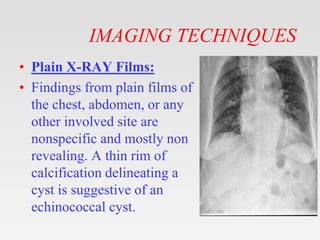
IMAGING TECHNIQUES
• Plain X-RAY Films:
• Findings from plain films of
the chest, abdomen, or any
other involved site are
nonspecific and mostly non
revealing. A thin rim of
calcification delineating a
cyst is suggestive of an
echinococcal cyst.
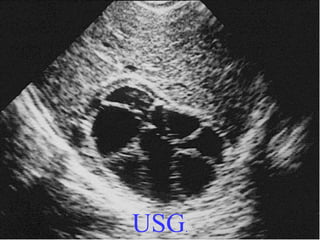
USG.
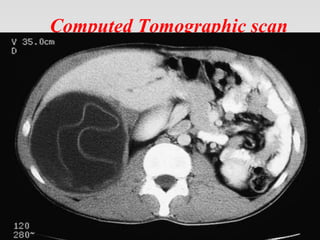
Computed Tomographic scan
Other Tests
Other Tests
• Casoni test
– Historically, an intradermal skin test
– It is now largely abandoned because of its low
sensitivity, low accuracy, and potential for
severe local allergic reaction.
Other Tests
• ERCP -Endoscopic retrograde
cholangiopancreatography:
• It is both diagnostic and therapeutic in
patients with intrabiliary rupture of a
hydatid cyst,.
Differential Diagnosis
• Long list
– Abscess
– Cysts.
Management
• Surgery is preferred
Operative Therapy
•
Operative Therapy
• Radical surgery (total pericystectomy or
partial affected organ resection,
• Conservative surgery (open cystectomy),
• Simple tube drainage-PAIR- Puncture,
Aspiration , Injection ,Reaspiration.
Chemotherapy
• Albendazole
• Mebendazole
• Praziquantel
– In inoperable
MCQs
MCQs
• Hydatid disease is caused by
– Echinococcus granulosus
– Echinococcus multilocularis
– Echinococcus vogeli.
MCQs
• Hydatid disease is caused by
– Echinococcus granulosus
– Echinococcus multilocularis
– Echinococcus vogeli.
MCQs
• Hydatid disease is a
– Fungal infection
– parasitic infestation
– Viral infection
MCQs
• Hydatid disease is a
– Fungal infection
– parasitic infestation
– Viral infection
MCQs
• Hydatid disease is caused by
– Ring worm
– Hook worm
– Tape worm
MCQs
• Hydatid disease is caused by
– Ring worm
– Hook worm
– Tape worm
MCQs
• Hydatid disease is caused by
– Ring worm
– Hook worm
– Tape worm
MCQs
• Man is definitive host of Hydatid disease .
• Man is intermediate host of Hydatid
disease.
MCQs
• Man is definitive host of Hydatid disease .
• Man is intermediate host of Hydatid
disease.
MCQs
• Most common site for Hydatid disease is
– Lung
– Liver
– Muscle
– Brain
– Bone.
MCQs
• Most common site for Hydatid disease is
– Lung
– Liver
– Muscle
– Brain
– Bone.
MCQs
• The only living part of Hydatid cyst is
– Pericyst.
– Ectocyst
– Endocyst
MCQs
• The only living part of Hydatid cyst is
– Pericyst.
– Ectocyst
– Endocyst
Get this ppt in mobile
1. Download Microsoft
PowerPoint from play
store.
2. Open Google assistant
3. Open Google lens.
4. Scan qr code from
next slide.
Get this ppt in mobile
Get my ppt collection
• https://www.slideshare.net/drpradeeppande/
edit_my_uploads
• https://www.dropbox.com/sh/x600md3cvj8
5woy/AACVMHuQtvHvl_K8ehc3ltkEa?dl
=0
• https://www.facebook.com/doctorpradeeppa
nde/?ref=pages_you_manage

Hydatid Cyst.pptx

  • 1.
    Tips on usingmy ppt. 1. You can freely download, edit, modify and put your name etc. 2. Don’t be concerned about number of slides. Half the slides are blanks except for the title. 3. First show the blank slides (eg. Aetiology ) > Ask students what they already know about ethology of today's topic. > Then show next slide which enumerates aetiologies. 4. At the end rerun the show – show blank> ask questions > show next slide. 5. This will be an ACTIVE LEARNING SESSION x three revisions. 6. Good for self study also. 7. See notes for bibliography.
  • 2.
  • 3.
    Introduction & History. •Hydatid disease is a parasitic infestation by a tapeworm of the genusEchinococcus.
  • 4.
  • 5.
    Etiology • Human echinococcosisis a zoonotic infection caused by the tapeworm of the genusEchinococcus. – Echinococcus granulosus, causing cystic echinococcosis (CE) – Echinococcus multilocularis, causing alveolar echinococcosis (AE) – Echinococcus vogeli.
  • 6.
  • 7.
  • 8.
    Life Cycle • 2hosts, definitive and intermediate. Humans act as an accidental intermediate host. • 3stages – (1) the adult tapeworm in the definitive host – (2) eggs in the environment, – (3) the metacestode in the intermediate host.
  • 9.
    Life Cycle • Metacestodesare ingested by the definitive host. The metacestodes mature into the tapeworm in the definitive host and, in turn, release eggs into the environment. The intermediate host ingests the eggs, which hatch into metacestodes, which infest the liver, lungs, muscles, and other organs of the intermediate host.
  • 10.
  • 11.
    Clinical Features • Rarein Europe and US. • The cysts grow slowly, and a cyst is rarely diagnosed during childhood or adolescence unless the brain is affected. • CE is a disease of younger adults, with an average age at diagnosis of 30-40 years.
  • 12.
  • 13.
    Symptoms • Many hydatidcysts remain asymptomatic, even into advanced age. • Symptoms can be produced by mass effect or cyst complications. • Nonspecific pain, cough, low-grade fever, and the sensation of abdominal fullness.
  • 14.
    Symptoms • Echinococcosis caninvolve any organ. The liver is the most common organ involved, followed by the lungs. These 2 organs account for 90% of cases of echinococcosis • Others -muscles (5%), bones (3%), kidneys (2%), brain (1%), and spleen (1%)..
  • 15.
  • 16.
    Mass effects Liver-Abdominal lump,obstructive jaundice and abdominal pain. With biliary rupture, the classic triad of biliary colic, jaundice, and urticaria. Passage of hydatid membranes in the emesis (hydatid emesia) and passage of membranes in the stools (hydatid enterica) may occur rarely.
  • 17.
    Lungs • Chronic cough, •dyspnea, • pleuritic chest pain, • hemoptysis. • Expectoration of cyst membranes and fluid is observed with intrabronchial rupture.
  • 18.
  • 19.
    Brain-SOL. • Headache, • dizziness, •decreased level of consciousness. • Specific neurologic deficits may occur depending on the location of the cyst in the brain.
  • 20.
  • 21.
    Secondary Complications • Infection –mildfever to full-blown sepsis. • Leakage
  • 22.
  • 23.
    Leakage – increased pain –flushing and urticaria. –Anaphylactic reaction, –A rupture into the biliary tree can lead to obstruction by the daughter cysts, producing cholangitis. –Rupture into the bronchi can lead to expectoration of cyst fluid.
  • 24.
  • 25.
    Pathology • A primarycyst in the liver is composed of three layers: • 1. Adventitia (pseudocyst / pericyst) – • 2. Laminated membrane (ectocyst) – is elastic white covering, easily separable from the adventitia. • 3. Germinal epithelium (endocyst) – is a single layer of cells lining the inner aspects of the cyst and is the only living component, being responsible for the formation of the other layers as well as the hydatid fluid and brood capsules within the cyst. In some primary cysts laminated membranes may eventually disintegrate and the brood capsules are freed and grow into daughter cysts.
  • 26.
  • 27.
    Diagnostic Studies • LaboratoryTests • Imaging – X-ray – USG – CT – MRI – Nuclear Scan • Other Tests
  • 28.
    IMAGING TECHNIQUES • PlainX-RAY Films: • Findings from plain films of the chest, abdomen, or any other involved site are nonspecific and mostly non revealing. A thin rim of calcification delineating a cyst is suggestive of an echinococcal cyst.
  • 29.
  • 30.
  • 31.
  • 32.
    Other Tests • Casonitest – Historically, an intradermal skin test – It is now largely abandoned because of its low sensitivity, low accuracy, and potential for severe local allergic reaction.
  • 33.
    Other Tests • ERCP-Endoscopic retrograde cholangiopancreatography: • It is both diagnostic and therapeutic in patients with intrabiliary rupture of a hydatid cyst,.
  • 34.
    Differential Diagnosis • Longlist – Abscess – Cysts.
  • 35.
  • 36.
  • 37.
    Operative Therapy • Radicalsurgery (total pericystectomy or partial affected organ resection, • Conservative surgery (open cystectomy), • Simple tube drainage-PAIR- Puncture, Aspiration , Injection ,Reaspiration.
  • 38.
  • 39.
  • 40.
    MCQs • Hydatid diseaseis caused by – Echinococcus granulosus – Echinococcus multilocularis – Echinococcus vogeli.
  • 41.
    MCQs • Hydatid diseaseis caused by – Echinococcus granulosus – Echinococcus multilocularis – Echinococcus vogeli.
  • 42.
    MCQs • Hydatid diseaseis a – Fungal infection – parasitic infestation – Viral infection
  • 43.
    MCQs • Hydatid diseaseis a – Fungal infection – parasitic infestation – Viral infection
  • 44.
    MCQs • Hydatid diseaseis caused by – Ring worm – Hook worm – Tape worm
  • 45.
    MCQs • Hydatid diseaseis caused by – Ring worm – Hook worm – Tape worm
  • 46.
    MCQs • Hydatid diseaseis caused by – Ring worm – Hook worm – Tape worm
  • 47.
    MCQs • Man isdefinitive host of Hydatid disease . • Man is intermediate host of Hydatid disease.
  • 48.
    MCQs • Man isdefinitive host of Hydatid disease . • Man is intermediate host of Hydatid disease.
  • 49.
    MCQs • Most commonsite for Hydatid disease is – Lung – Liver – Muscle – Brain – Bone.
  • 50.
    MCQs • Most commonsite for Hydatid disease is – Lung – Liver – Muscle – Brain – Bone.
  • 51.
    MCQs • The onlyliving part of Hydatid cyst is – Pericyst. – Ectocyst – Endocyst
  • 52.
    MCQs • The onlyliving part of Hydatid cyst is – Pericyst. – Ectocyst – Endocyst
  • 53.
    Get this pptin mobile 1. Download Microsoft PowerPoint from play store. 2. Open Google assistant 3. Open Google lens. 4. Scan qr code from next slide.
  • 54.
    Get this pptin mobile
  • 55.
    Get my pptcollection • https://www.slideshare.net/drpradeeppande/ edit_my_uploads • https://www.dropbox.com/sh/x600md3cvj8 5woy/AACVMHuQtvHvl_K8ehc3ltkEa?dl =0 • https://www.facebook.com/doctorpradeeppa nde/?ref=pages_you_manage

Editor's Notes

  • #2 drpradeeppande@gmail.com 7697305442