Indian university commission -1902
• Causes of appointment-
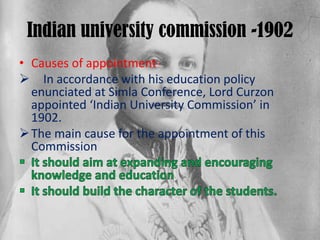
 In accordance with his education policy
enunciated at Simla Conference, Lord Curzon
appointed ‘Indian University Commission’ in
1902.
The main cause for the appointment of this
Commission
Terms of reference
Indian university commission was to investigate
the following:
1. Future prospects and the conditions of the
university in India established by the British
government.
2. To suggest ways and means for the organization
and working of Indian Universities.
3. To lay down the ways by which the standards of
Higher Education may go up at earliest.
MAJOR RECOMMENDATIONS
More new
universities should
be established, and
the prevailing
universities should
be reorganized.
1
The system of senate and
syndicate of universities
should be reorganized that
the senate should have the
members between 50 and
100. The term of a
particular senate should be
5 years while the number
of syndicate members
should be between 9 and
15
2
Proper
representation of
college teachers
and university
professors should
be ensured in the
university senate.
3
Affiliated colleges
should be strictly
supervised by the
Universities.
4
Proper
amendments
should be made in
the curriculum and
the examination
system of the
Universities.
5
Proper equipment
of libraries and
laboratories
should be
maintained.
6
The universities
should be teaching
universities.
7
Properly selected and
constituted governing
bodies should be
there for colleges.
8
Deserved and
meritorious students
should be awarded
scholarships.
9
A minimum rate of
fee for college
students was also
recommended by
the commission.
10
11
Hostels should be
built for the
students
12
The standard of
the Matric
examination
should be high and
while abolishing
the inter-
examination, the
curriculum of B.A.
should be of 3
years.
After Effect of
the
Commission
Report
As
As a result, Lord
Curzon accepted the
recommendations and
a new act called Indian
University act was
passed in 1904,which
is known as Indian
University Act of 1904.
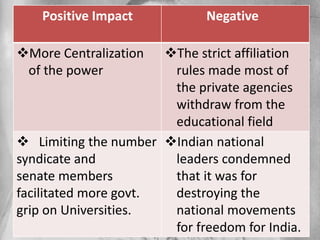
Positive Impact Negative
More Centralization
of the power
The strict affiliation
rules made most of
the private agencies
withdraw from the
educational field
 Limiting the number
syndicate and
senate members
facilitated more govt.
grip on Universities.
Indian national
leaders condemned
that it was for
destroying the
national movements
for freedom for India.
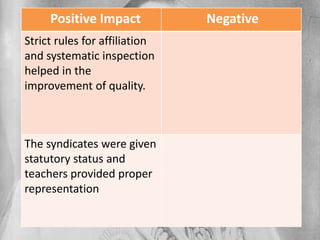
Positive Impact Negative
Strict rules for affiliation
and systematic inspection
helped in the
improvement of quality.
The syndicates were given
statutory status and
teachers provided proper
representation
Indian university commission 1902

Indian university commission 1902

  • 3.
    Indian university commission-1902 • Causes of appointment-  In accordance with his education policy enunciated at Simla Conference, Lord Curzon appointed ‘Indian University Commission’ in 1902. The main cause for the appointment of this Commission
  • 4.
    Terms of reference Indianuniversity commission was to investigate the following: 1. Future prospects and the conditions of the university in India established by the British government. 2. To suggest ways and means for the organization and working of Indian Universities. 3. To lay down the ways by which the standards of Higher Education may go up at earliest.
  • 5.
    MAJOR RECOMMENDATIONS More new universitiesshould be established, and the prevailing universities should be reorganized. 1
  • 6.
    The system ofsenate and syndicate of universities should be reorganized that the senate should have the members between 50 and 100. The term of a particular senate should be 5 years while the number of syndicate members should be between 9 and 15 2
  • 7.
    Proper representation of college teachers anduniversity professors should be ensured in the university senate. 3
  • 8.
    Affiliated colleges should bestrictly supervised by the Universities. 4
  • 9.
    Proper amendments should be madein the curriculum and the examination system of the Universities. 5
  • 10.
    Proper equipment of librariesand laboratories should be maintained. 6
  • 11.
    The universities should beteaching universities. 7
  • 12.
    Properly selected and constitutedgoverning bodies should be there for colleges. 8
  • 13.
    Deserved and meritorious students shouldbe awarded scholarships. 9
  • 14.
    A minimum rateof fee for college students was also recommended by the commission. 10
  • 15.
  • 16.
    12 The standard of theMatric examination should be high and while abolishing the inter- examination, the curriculum of B.A. should be of 3 years.
  • 17.
    After Effect of the Commission Report As Asa result, Lord Curzon accepted the recommendations and a new act called Indian University act was passed in 1904,which is known as Indian University Act of 1904.
  • 18.
    Positive Impact Negative MoreCentralization of the power The strict affiliation rules made most of the private agencies withdraw from the educational field  Limiting the number syndicate and senate members facilitated more govt. grip on Universities. Indian national leaders condemned that it was for destroying the national movements for freedom for India.
  • 19.
    Positive Impact Negative Strictrules for affiliation and systematic inspection helped in the improvement of quality. The syndicates were given statutory status and teachers provided proper representation