Interoperability for
Teaming and Autonomy
Gordon A. Hunt – AUVSI 2013 Wash DC
Chief Engineer, RTI • UCS WG CE interoperability • Commander USN-R
Agenda
• Swarming and Teaming
– Control versus Command
• Background
– Open Architecture and Current Approaches
• A Team is a System of Systems
– Definitions and Examples
• Interoperability Architecture
– It is all about the Data
– How to capture and define its meaning
– Interoperability by Design
Swarming and Teaming
What’s the difference?
How are they achieved?
© 2013 RTI
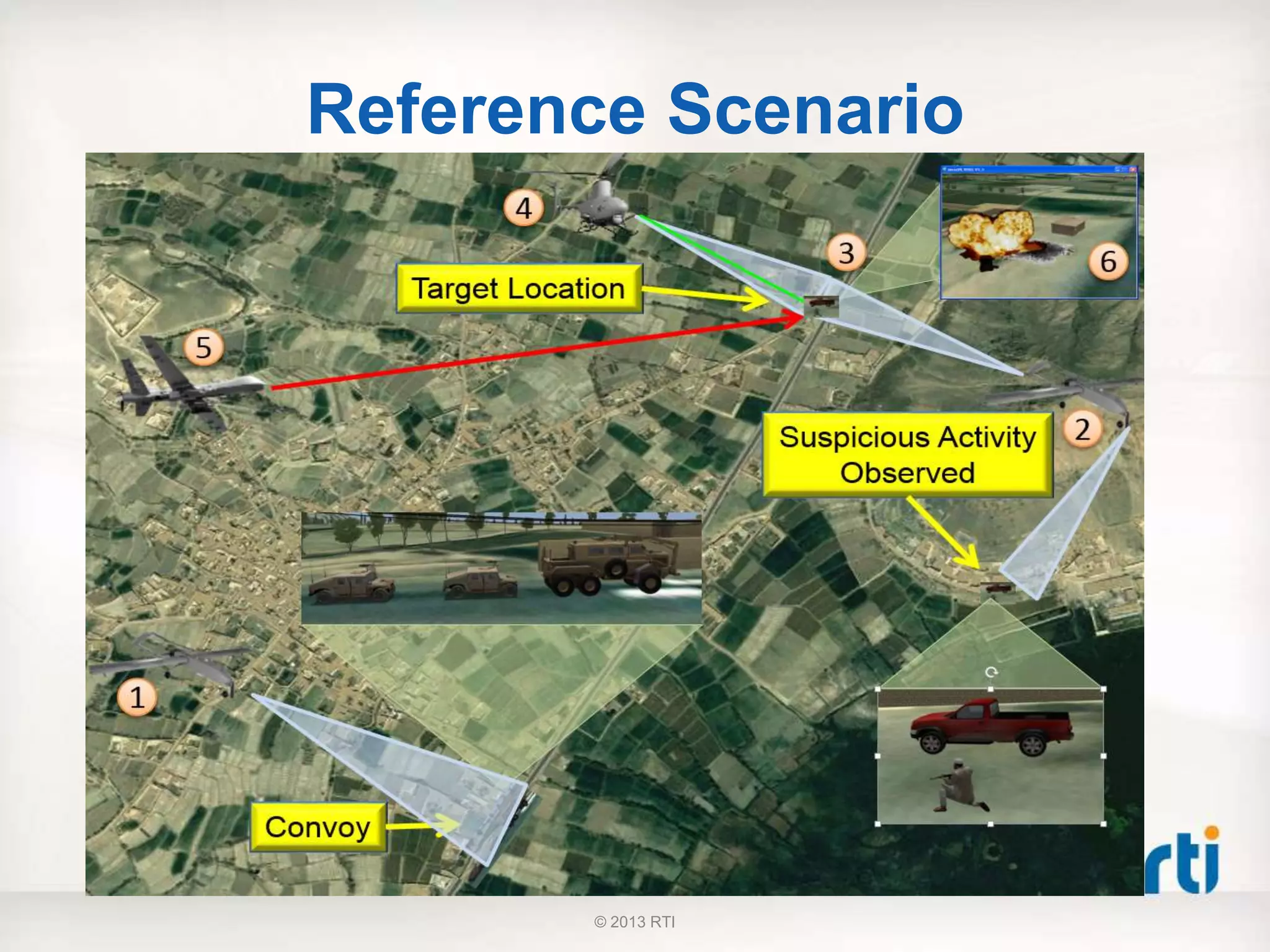
Reference Scenario
© 2013 RTI
What does this Scenario Take
• Close cooperation – obviously
• Awareness of each AUV’s objectives
– Leverage nearby assets seamlessly
• Shared and integrated mission
management
– Right capability, right place, right time
• Ability to react to dynamic changes
– Shared awareness of system state
© 2013 RTI
Team or a Swarm?
• Swarm
– Usually controlled an implemented by a single integration
agency / implementer on a common timescale
• Team
– Loose grouping of assets controlled and managed by
different agencies and implementers on variable
timescales
• However…
– Have really only seen machine to machine collaboration
with swarms
– Teams are typically formed by human powered intuition
– Need to move from human-enabled to machine-enabled
collaboration and cooperation.
© 2013 RTI
Background
How Do We ‘Do’ Interoperability?
What is labeled ‘Open’?
© 2013 RTI
Current Technical Approaches
• Protocol Definitions & Standards
– Tell me the messages
• Open Architecture Mandates
– Interoperability on Commonality
• (Implementation) Architecture of the Day
– Service Oriented Architecture
– RESTful Interfaces
– …
© 2013 RTI
Is Current Practice Working
• Recent studies have shown a growth in interoperability
policy issuance in DoD
– Thousands of pages of directives, instructions, and mandates
– Numerous standards and architecture bodies in the DoD
• No Correlation between Increased Interoperability and
Standards
– Standards are necessary, but not sufficient for interoperability
• Conventional means of developing platform, unit
command, and theater architectures are
complex, manpower intensive, and time consuming.
– Achieving Interoperability increases complexity
– Complexity of systems-of-systems not understood or well
managed
Can’t make complexity go
away, just move where it is
© 2013 RTI
Are these Approaches
Sufficient?
What is different and unique in
teaming operations?
© 2013 RTI
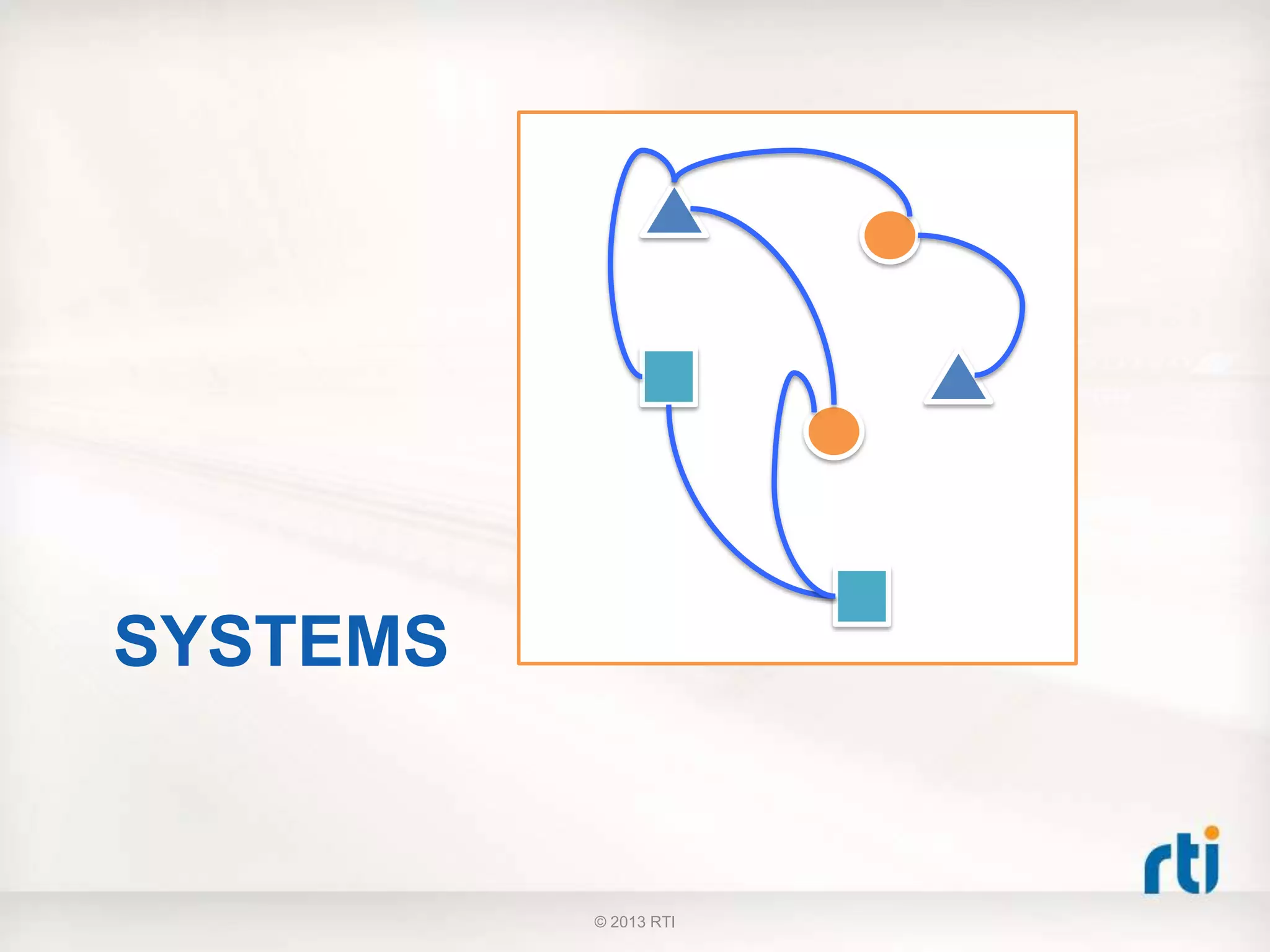
SYSTEMS
© 2013 RTI
System of Systems
System of Systems
• A system of systems
is a collection of task-
oriented or dedicated
systems that pool
their resources and
capabilities together
to create a new, more
complex system
which offers more
functionality and
performance than
simply the sum of the
constituent systems.
System
A
System
B
System
[n]
System
A
System
B
… System
[n]
Has a set of >[n+1] capabilities
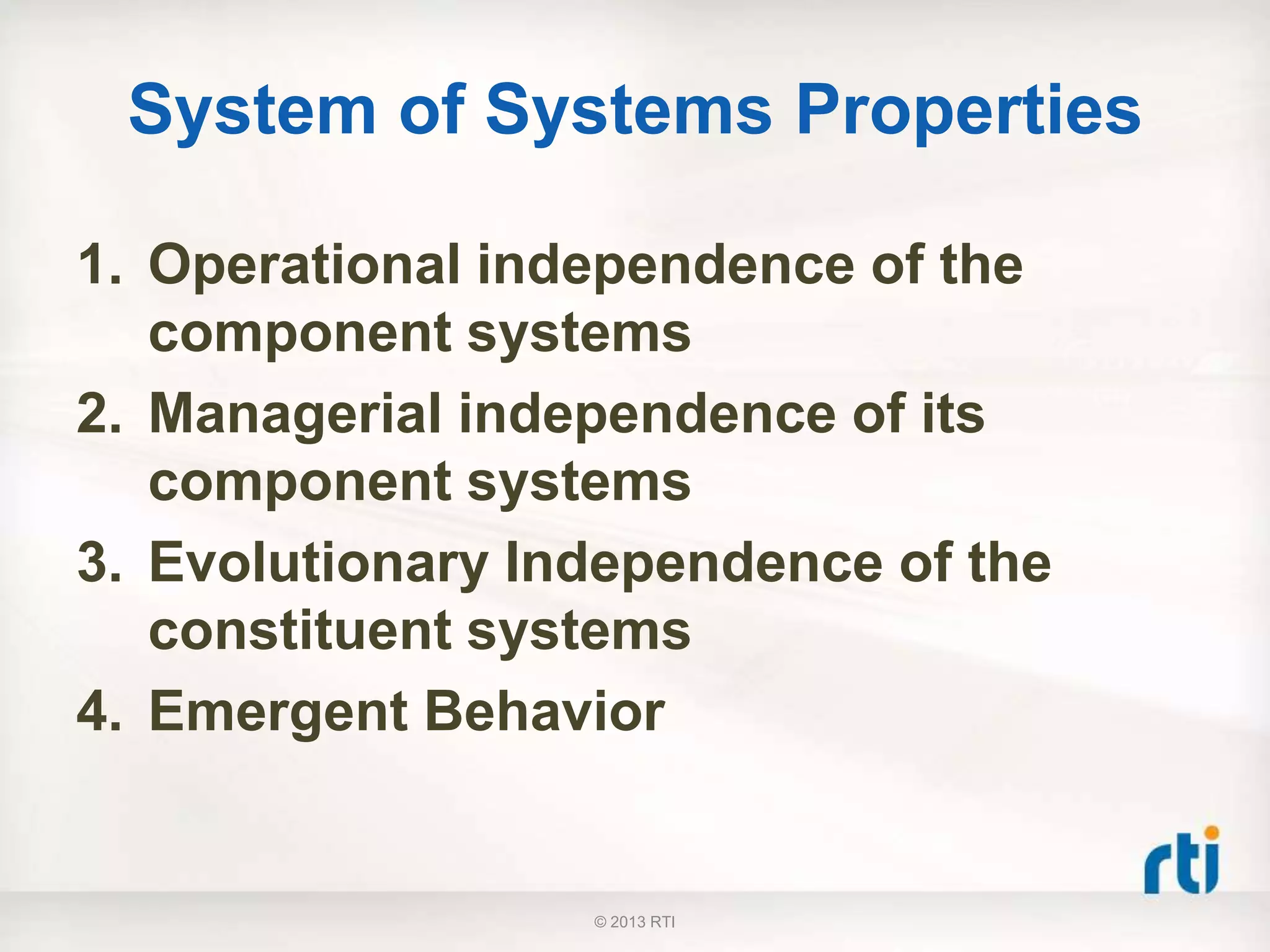
System of Systems Properties
1. Operational independence of the
component systems
2. Managerial independence of its
component systems
3. Evolutionary Independence of the
constituent systems
4. Emergent Behavior
© 2013 RTI
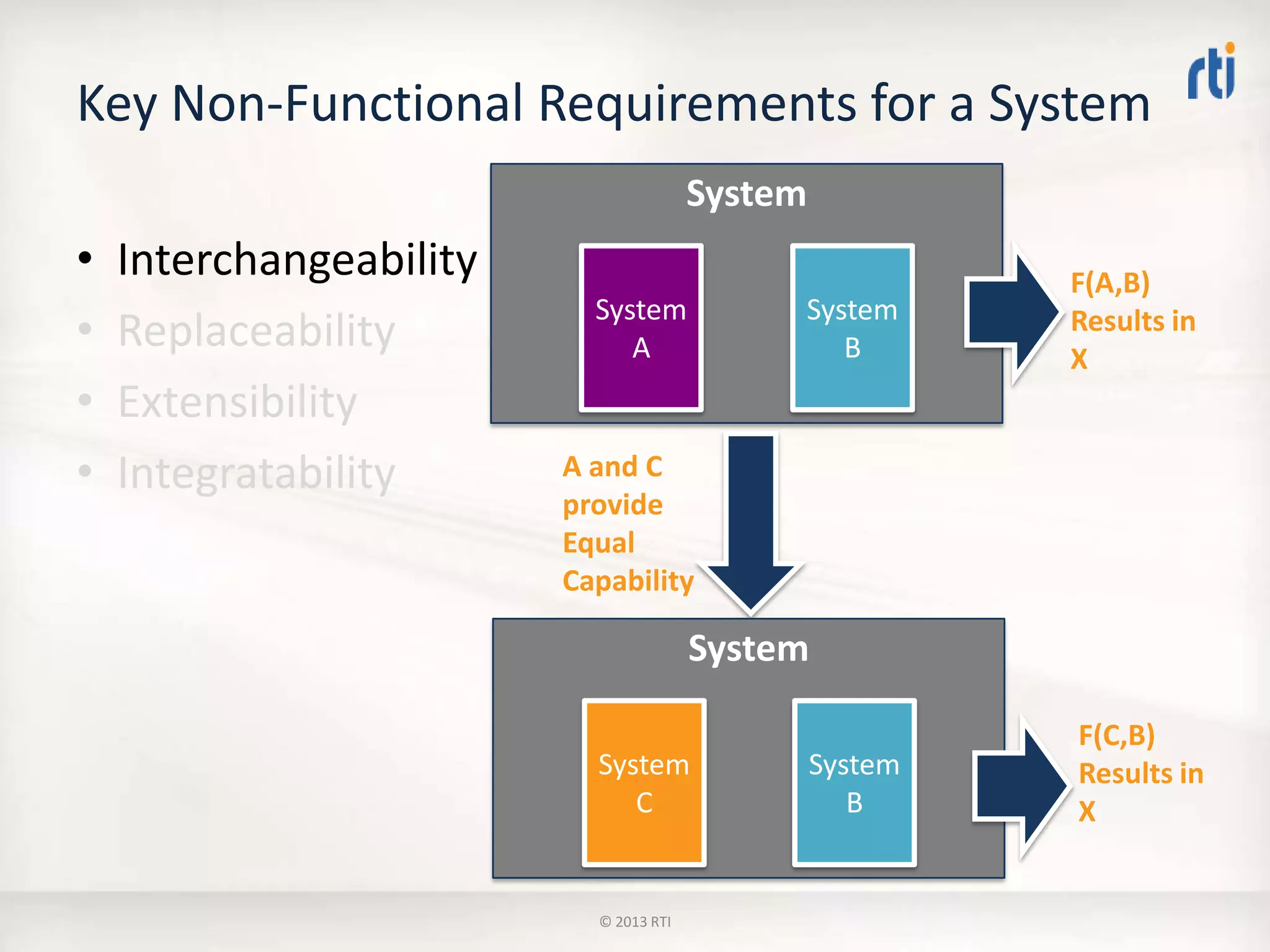
Key Non-Functional Requirements for a System
• Interchangeability
• Replaceability
• Extensibility
• Integratability
System
System
A
System
B
System
System
B
System
C
F(A,B)
Results in
X
F(C,B)
Results in
X
A and C
provide
Equal
Capability
© 2013 RTI
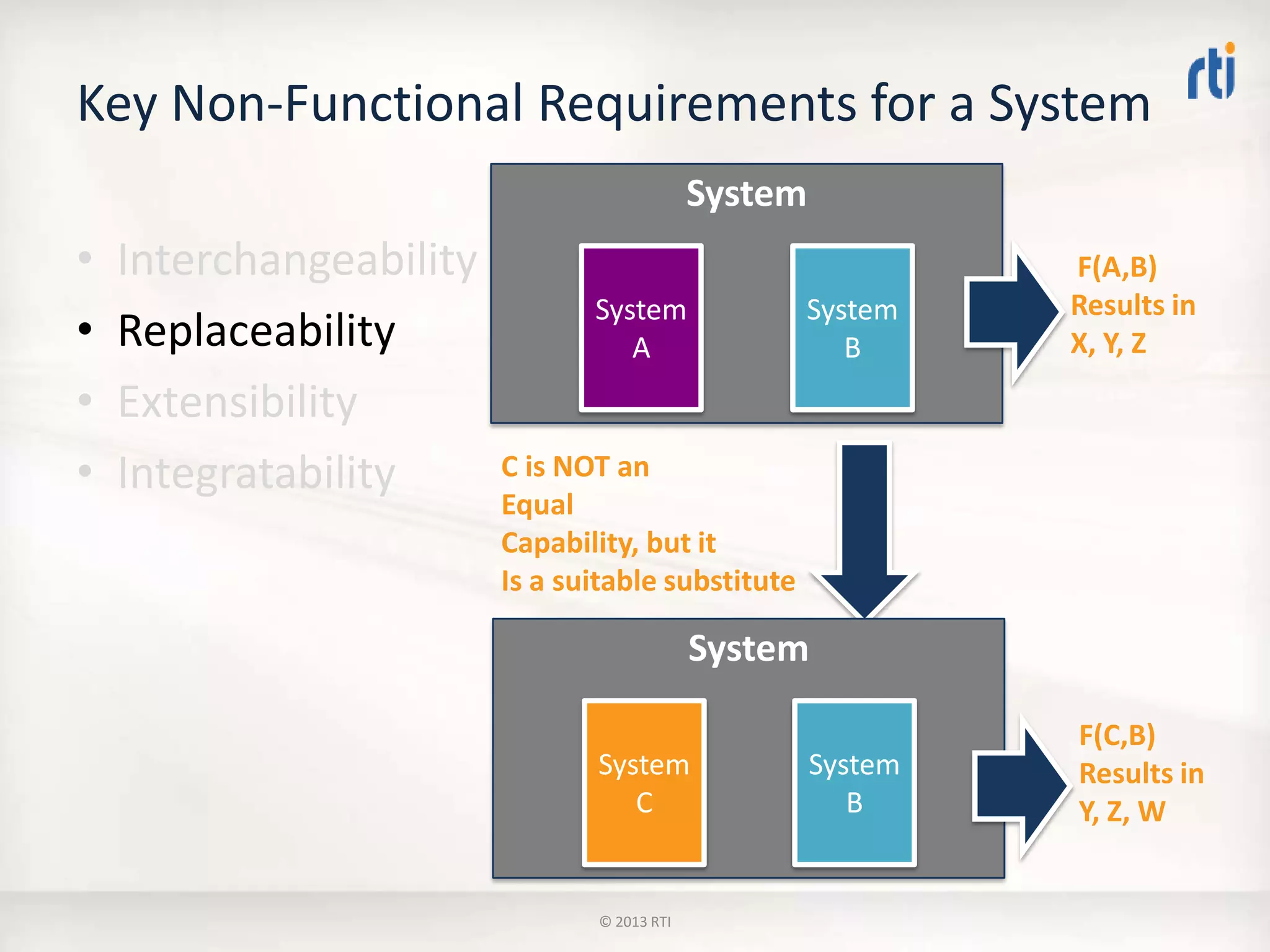
Key Non-Functional Requirements for a System
• Interchangeability
• Replaceability
• Extensibility
• Integratability
System
System
A
System
B
System
System
B
System
C
F(A,B)
Results in
X, Y, Z
F(C,B)
Results in
Y, Z, W
C is NOT an
Equal
Capability, but it
Is a suitable substitute
© 2013 RTI
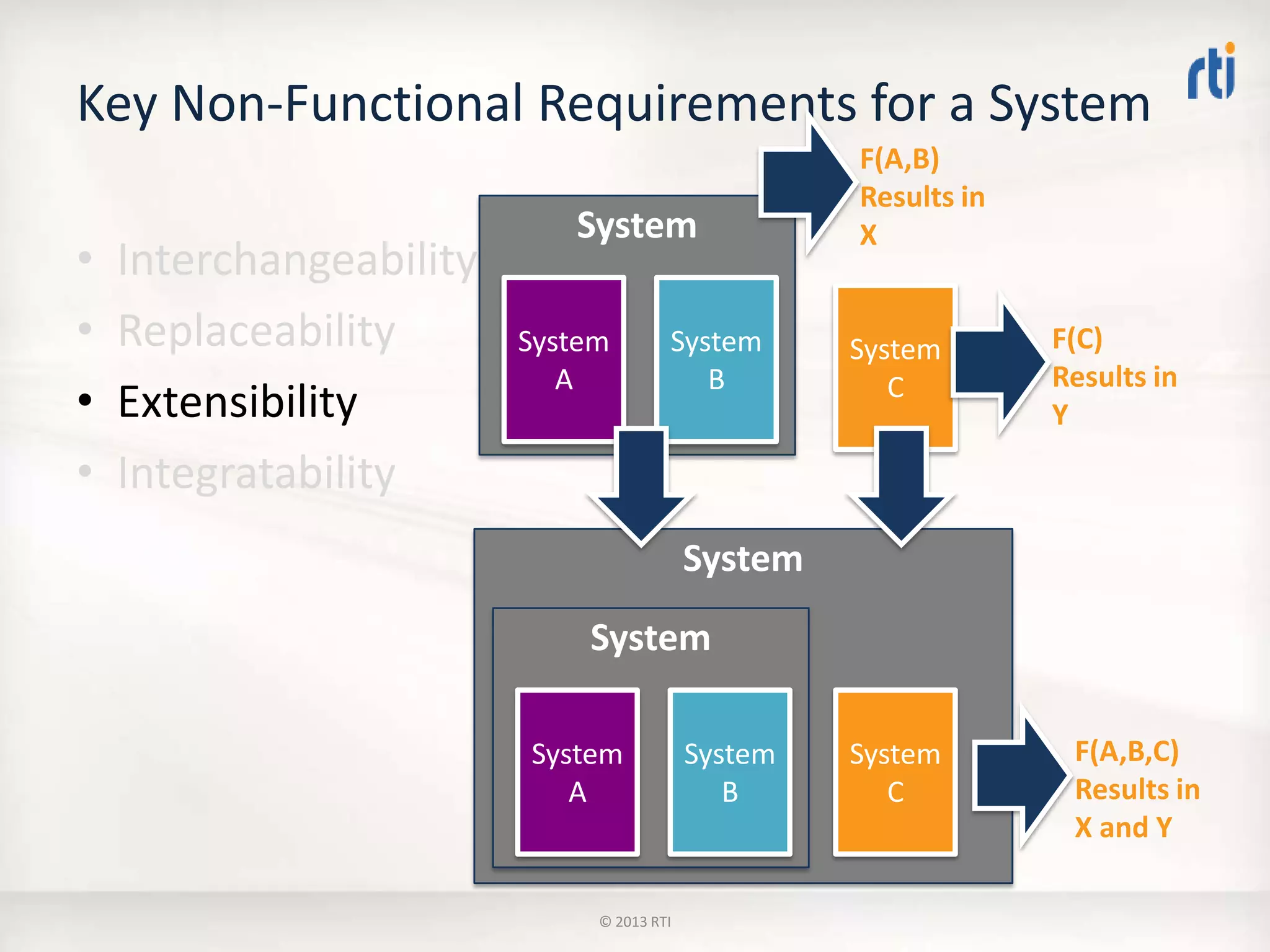
System
Key Non-Functional Requirements for a System
• Interchangeability
• Replaceability
• Extensibility
• Integratability
System
System
B
System
C
F(A,B)
Results in
X
F(A,B,C)
Results in
X and Y
System
A
System
System
B
System
A
System
C
F(C)
Results in
Y
© 2013 RTI
System C
Key Non-Functional Requirements for a System
• Interchangeability
• Replaceability
• Extensibility
• Integratability
System
B
F(A)
Results
In X
F(A,B)
Results in
Z, where
Z=G[f(X), g(Y)]
System
A
System
B
System
A
F(B)
Results
in Y
© 2013 RTI
The Key Non-Functional Requirement for a SoS
• Interoperability
the ability of
systems, units, or
forces to provide
services to and
accept services
from other
systems, units, or
forces, and to use
the services so
exchanged to
enable them to
operate effectively
together.
F(A) and G(B)
Become
G[F(A)] and
F[G(B)]
F(A)
Results
In X
System
B
System
A
G(B)
Results
In Y
System of Systems
System
B
System
A
© 2013 RTI
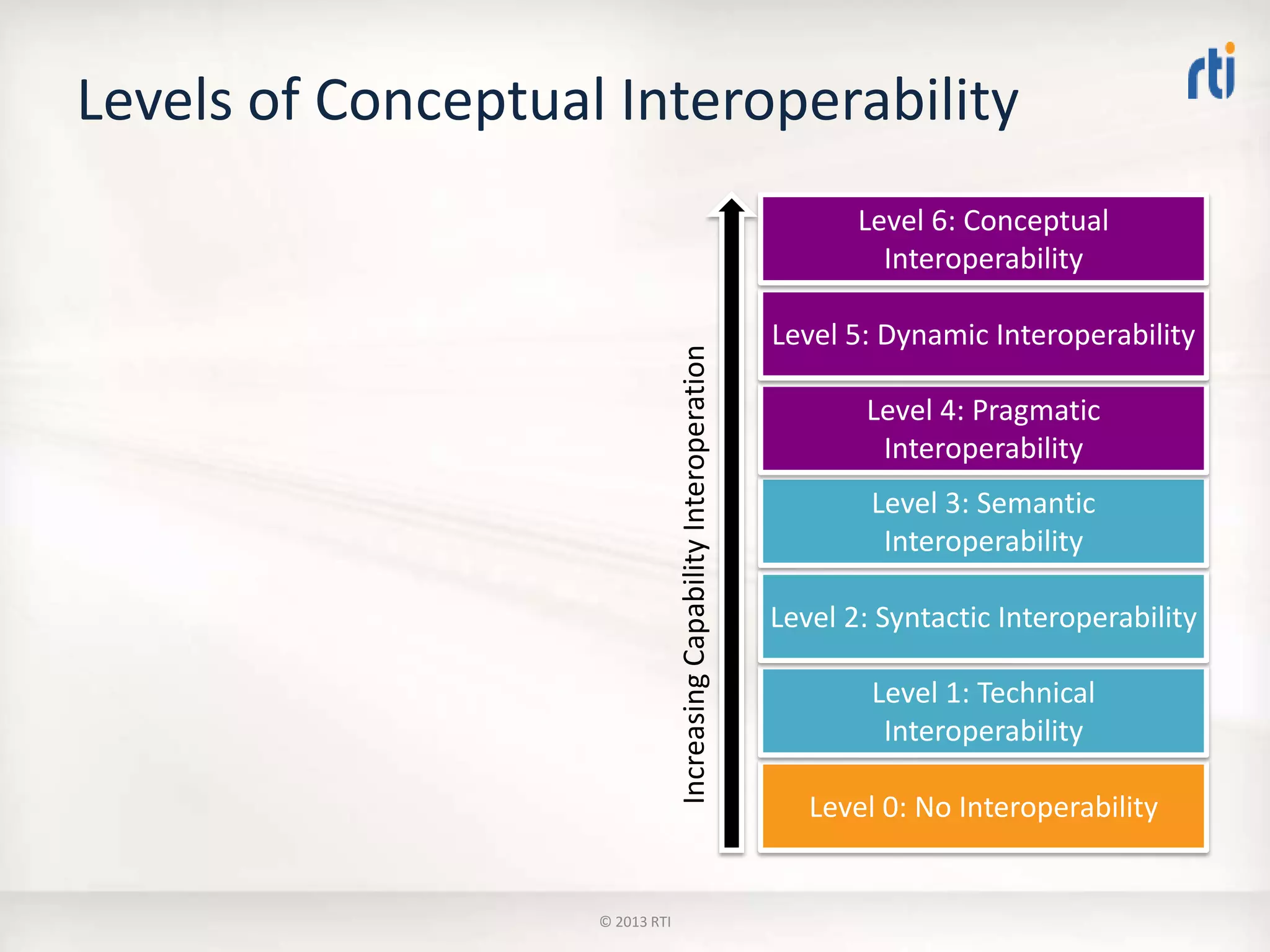
Levels of Conceptual Interoperability
Level 0: No Interoperability
Level 1: Technical
Interoperability
Level 2: Syntactic Interoperability
Level 3: Semantic
Interoperability
Level 4: Pragmatic
Interoperability
Level 5: Dynamic Interoperability
Level 6: Conceptual
Interoperability
IncreasingCapabilityInteroperation
© 2013 RTI
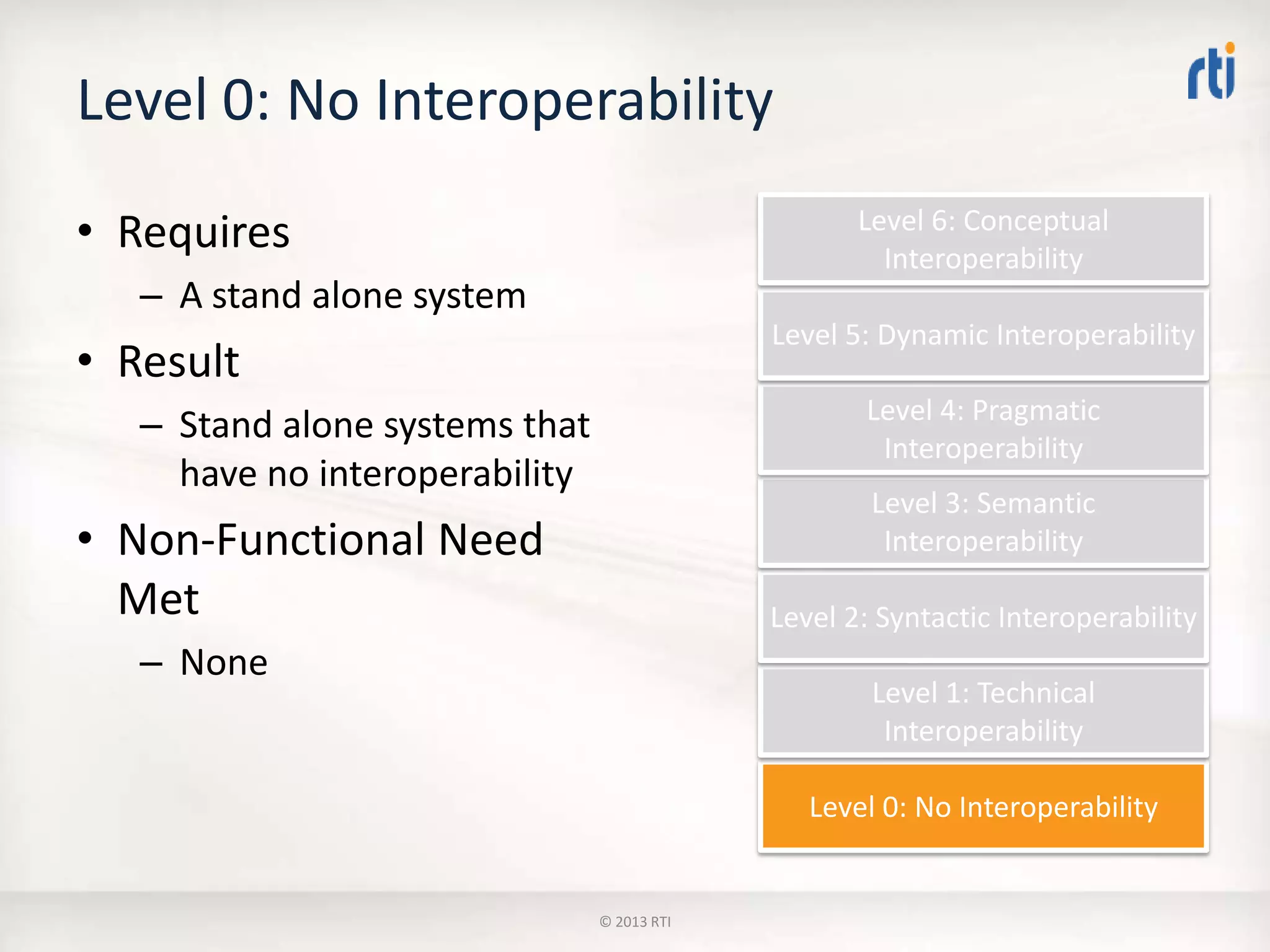
Level 0: No Interoperability
• Requires
– A stand alone system
• Result
– Stand alone systems that
have no interoperability
• Non-Functional Need
Met
– None
Level 0: No Interoperability
Level 1: Technical
Interoperability
Level 2: Syntactic Interoperability
Level 3: Semantic
Interoperability
Level 4: Pragmatic
Interoperability
Level 5: Dynamic Interoperability
Level 6: Conceptual
Interoperability
© 2013 RTI
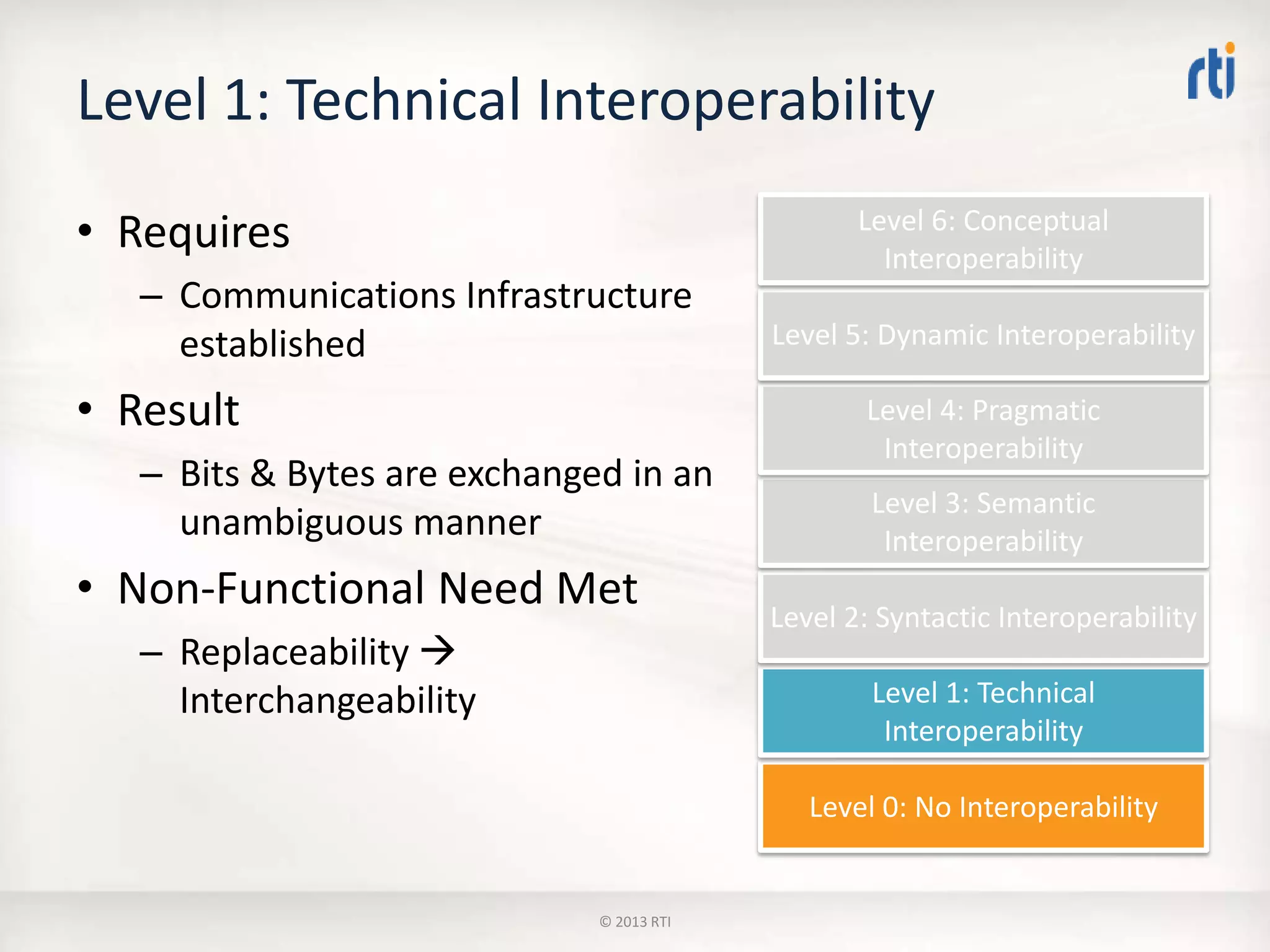
Level 1: Technical Interoperability
• Requires
– Communications Infrastructure
established
• Result
– Bits & Bytes are exchanged in an
unambiguous manner
• Non-Functional Need Met
– Replaceability 
Interchangeability
Level 0: No Interoperability
Level 1: Technical
Interoperability
Level 2: Syntactic Interoperability
Level 3: Semantic
Interoperability
Level 4: Pragmatic
Interoperability
Level 5: Dynamic Interoperability
Level 6: Conceptual
Interoperability
© 2013 RTI
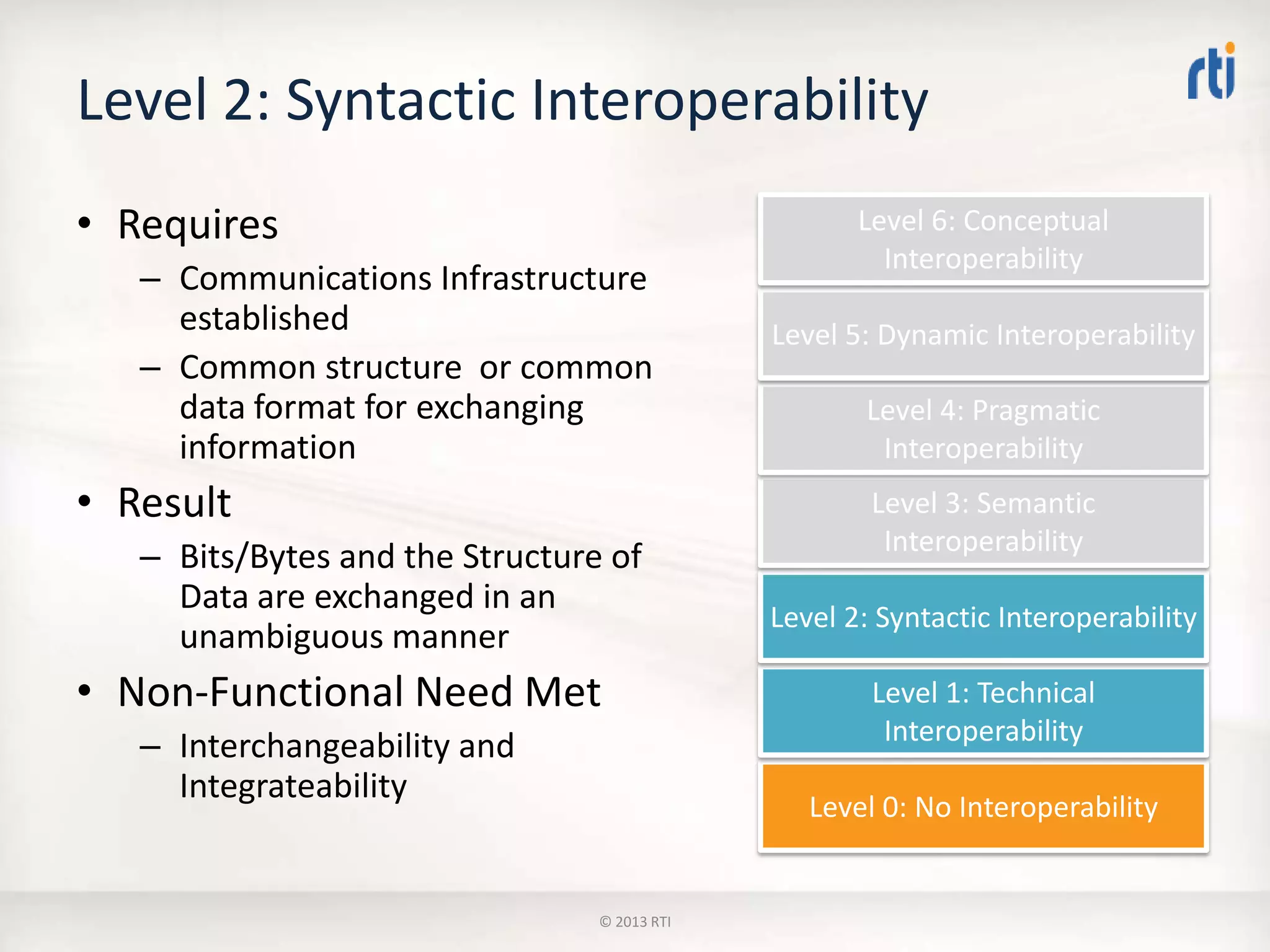
Level 2: Syntactic Interoperability
• Requires
– Communications Infrastructure
established
– Common structure or common
data format for exchanging
information
• Result
– Bits/Bytes and the Structure of
Data are exchanged in an
unambiguous manner
• Non-Functional Need Met
– Interchangeability and
Integrateability
Level 0: No Interoperability
Level 1: Technical
Interoperability
Level 2: Syntactic Interoperability
Level 3: Semantic
Interoperability
Level 4: Pragmatic
Interoperability
Level 5: Dynamic Interoperability
Level 6: Conceptual
Interoperability
© 2013 RTI
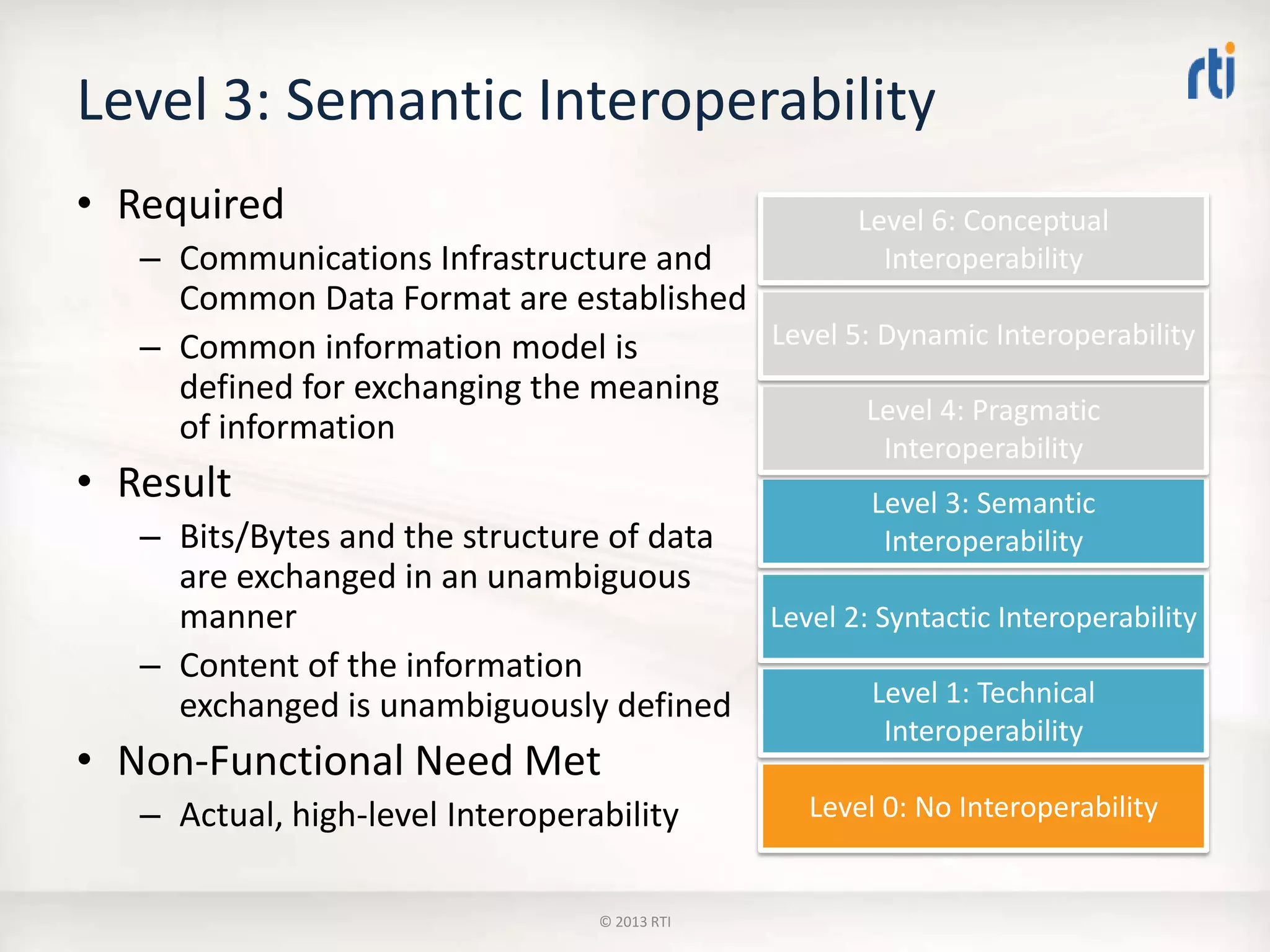
Level 3: Semantic Interoperability
Level 0: No Interoperability
Level 1: Technical
Interoperability
Level 2: Syntactic Interoperability
Level 3: Semantic
Interoperability
Level 4: Pragmatic
Interoperability
Level 5: Dynamic Interoperability
Level 6: Conceptual
Interoperability
• Required
– Communications Infrastructure and
Common Data Format are established
– Common information model is
defined for exchanging the meaning
of information
• Result
– Bits/Bytes and the structure of data
are exchanged in an unambiguous
manner
– Content of the information
exchanged is unambiguously defined
• Non-Functional Need Met
– Actual, high-level Interoperability
© 2013 RTI
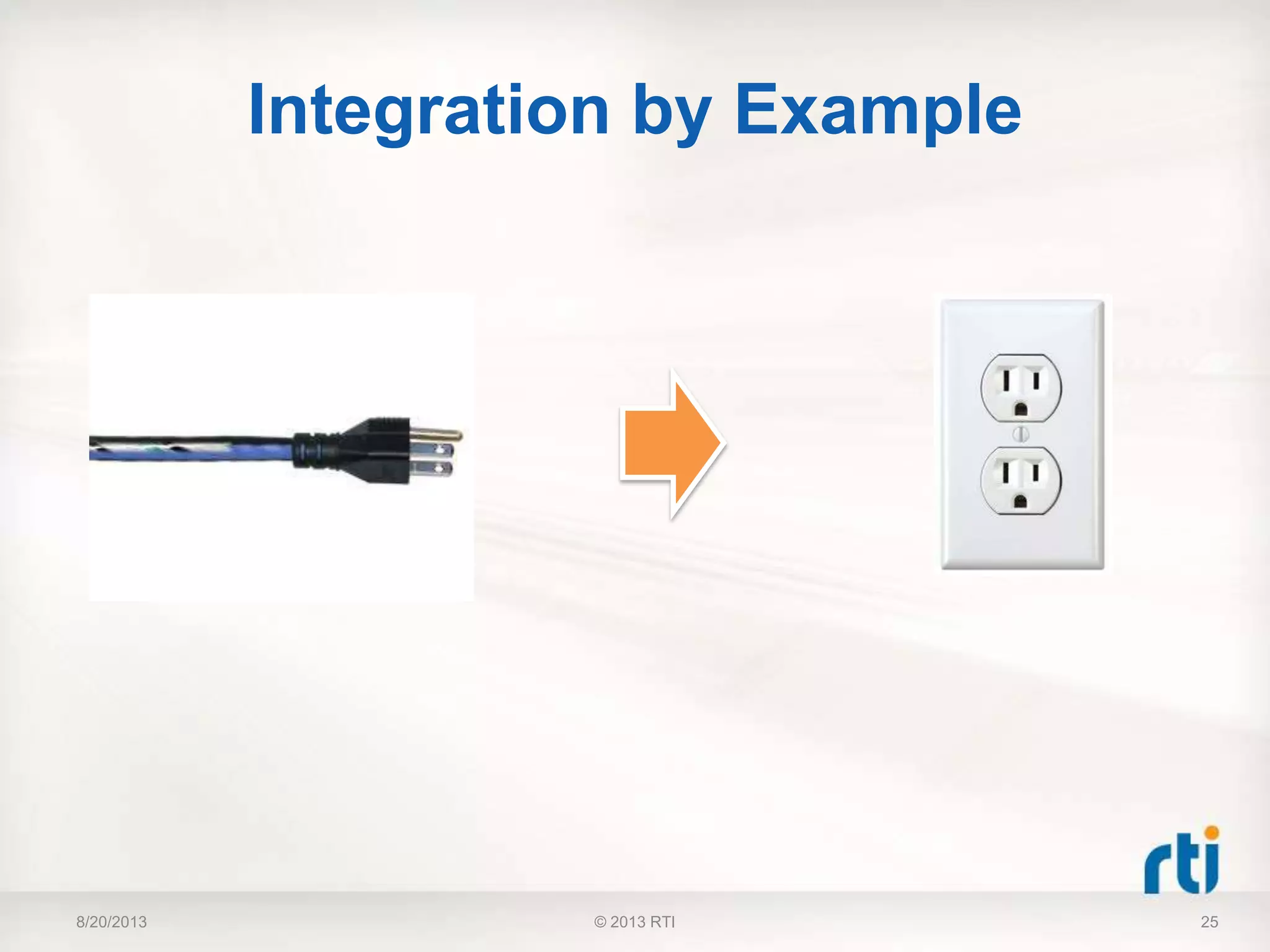
Integration by Example
8/20/2013 25© 2013 RTI
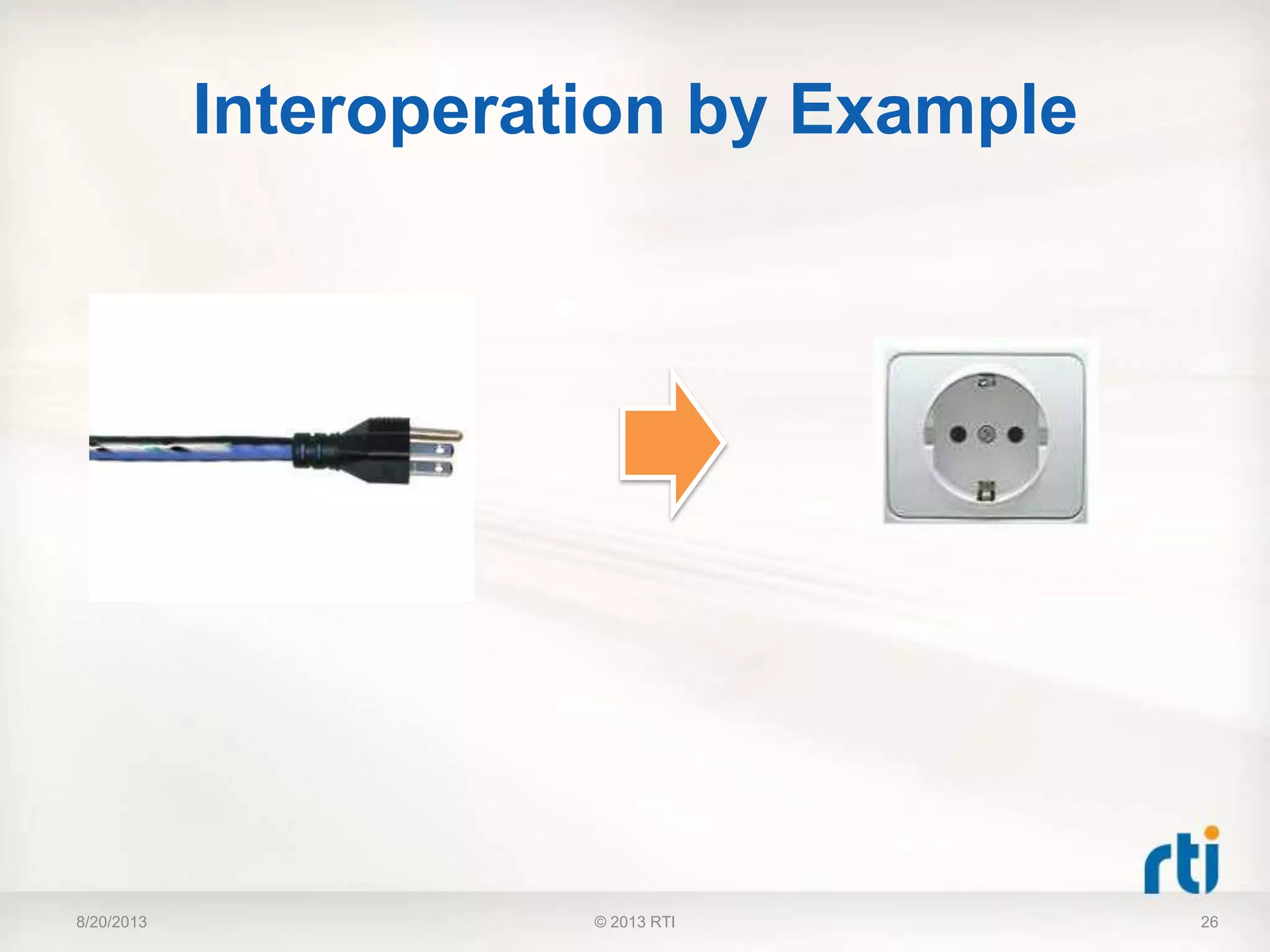
Interoperation by Example
8/20/2013 26© 2013 RTI
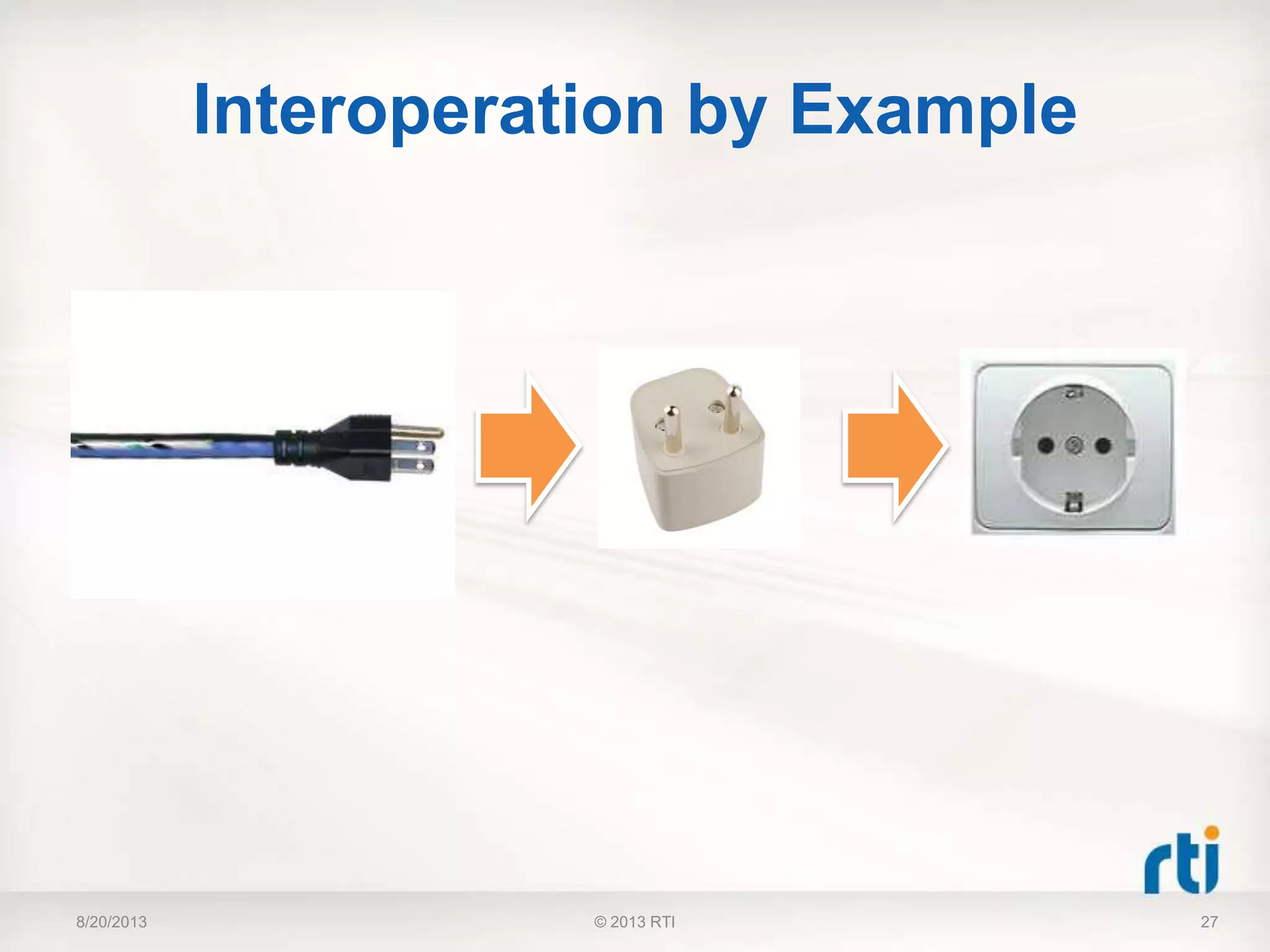
Interoperation by Example
8/20/2013 27© 2013 RTI
Interoperability by Example
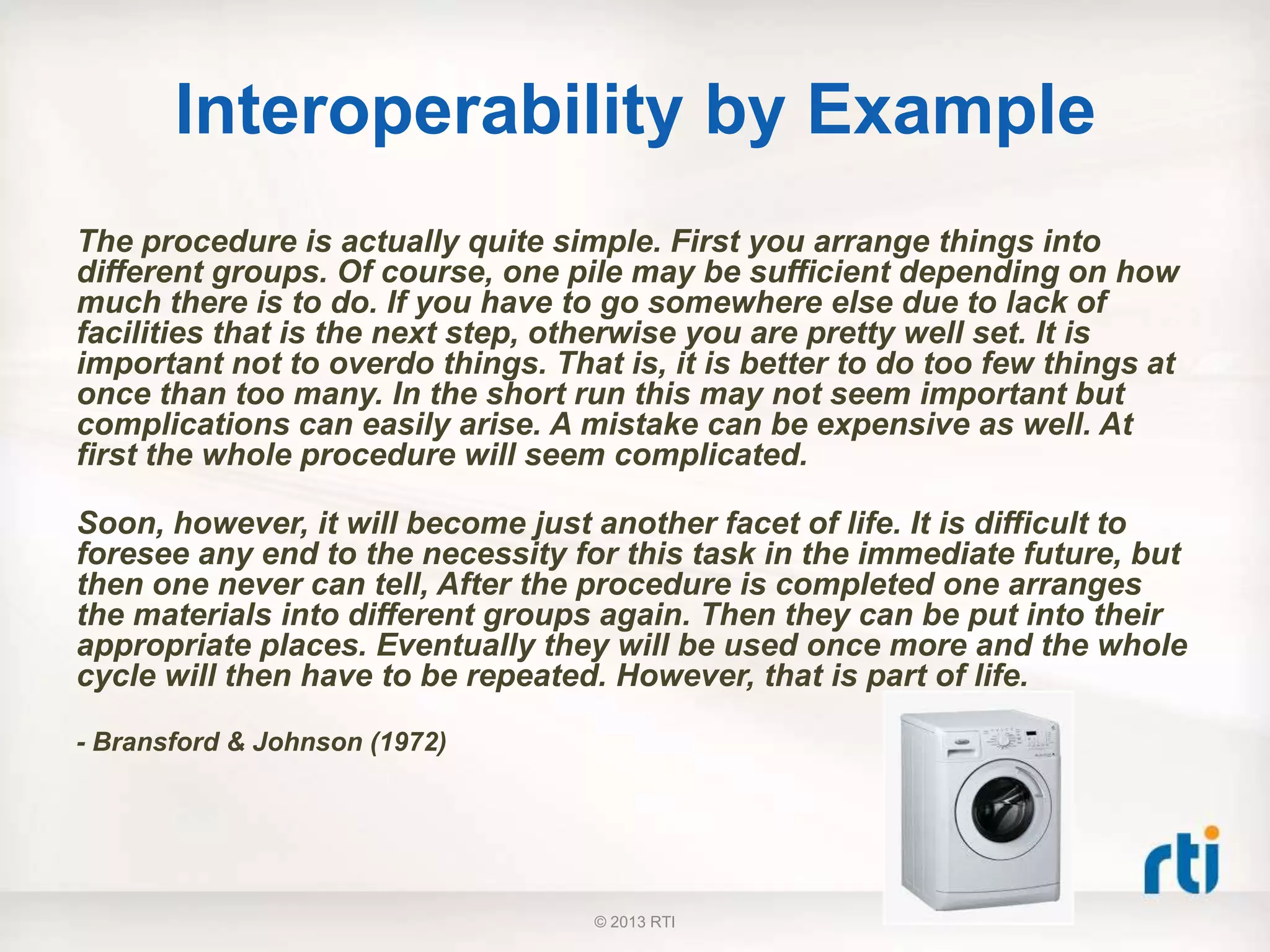
The procedure is actually quite simple. First you arrange things into
different groups. Of course, one pile may be sufficient depending on how
much there is to do. If you have to go somewhere else due to lack of
facilities that is the next step, otherwise you are pretty well set. It is
important not to overdo things. That is, it is better to do too few things at
once than too many. In the short run this may not seem important but
complications can easily arise. A mistake can be expensive as well. At
first the whole procedure will seem complicated.
Soon, however, it will become just another facet of life. It is difficult to
foresee any end to the necessity for this task in the immediate future, but
then one never can tell, After the procedure is completed one arranges
the materials into different groups again. Then they can be put into their
appropriate places. Eventually they will be used once more and the whole
cycle will then have to be repeated. However, that is part of life.
- Bransford & Johnson (1972)
© 2013 RTI
Interoperability by Example
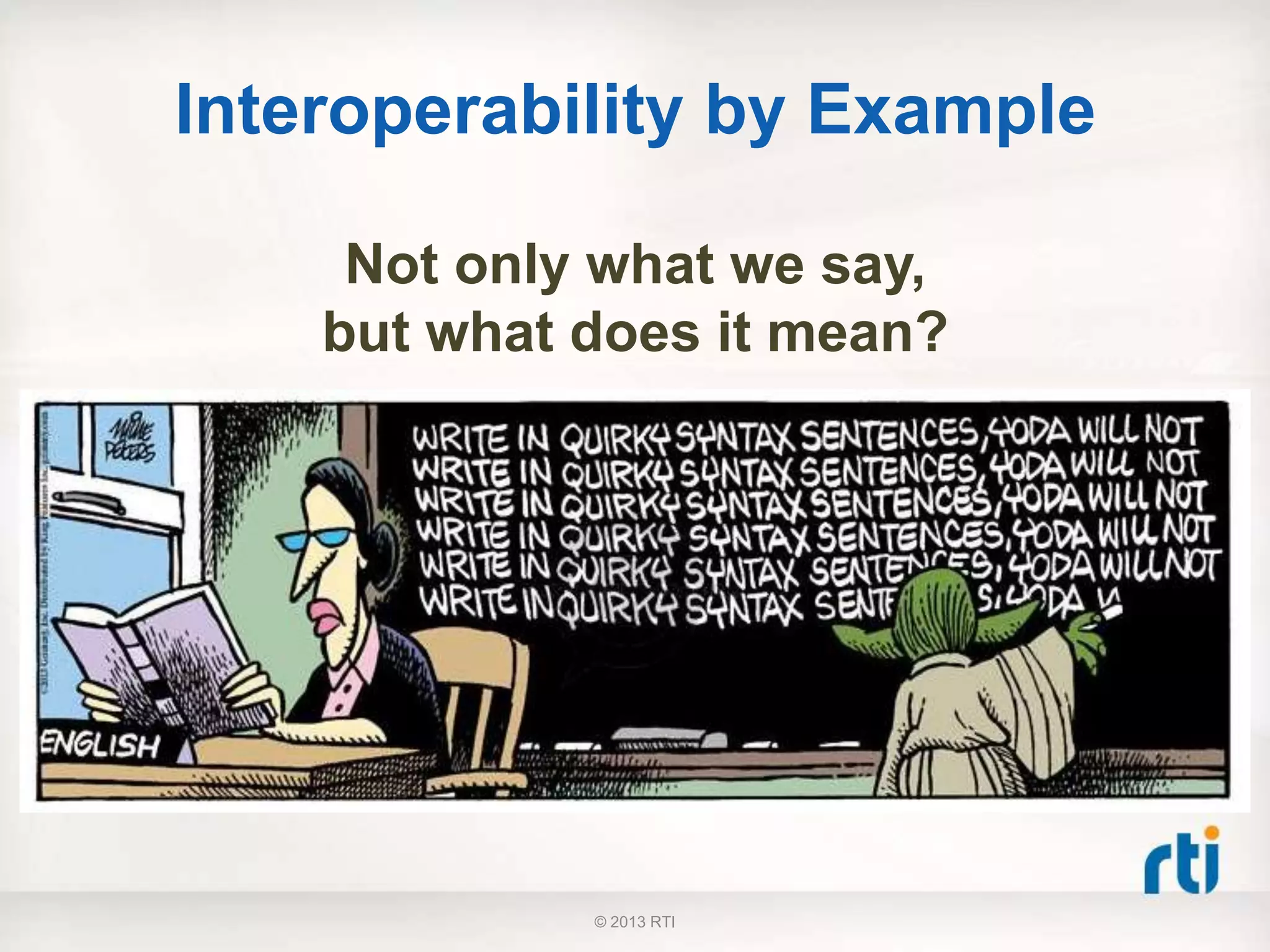
Not only what we say,
but what does it mean?
© 2013 RTI
It is the Data that Matters
How do you Define & Design it?
What does the Architecture look like?
© 2013 RTI
MODEL
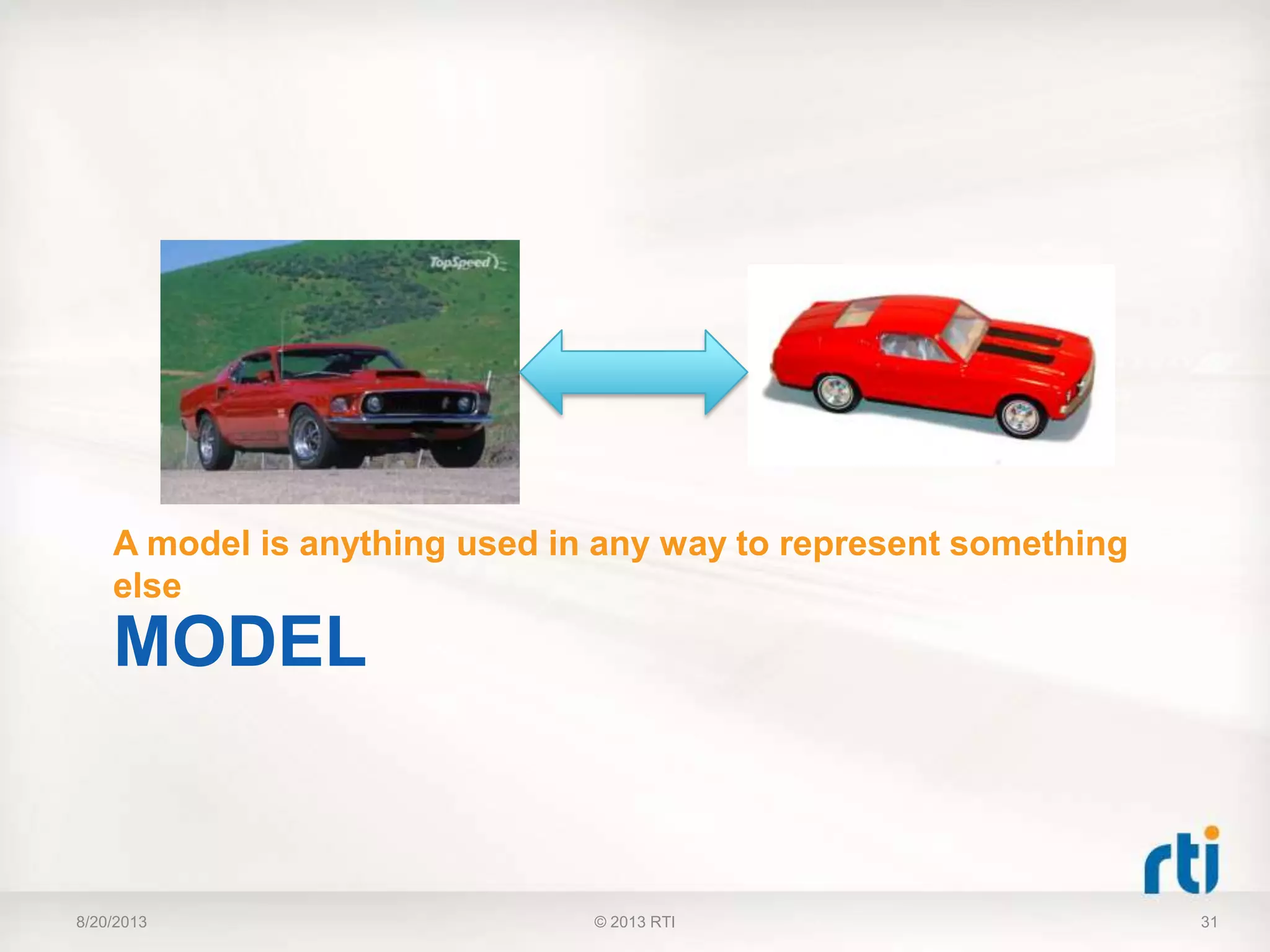
A model is anything used in any way to represent something
else
8/20/2013 31© 2013 RTI
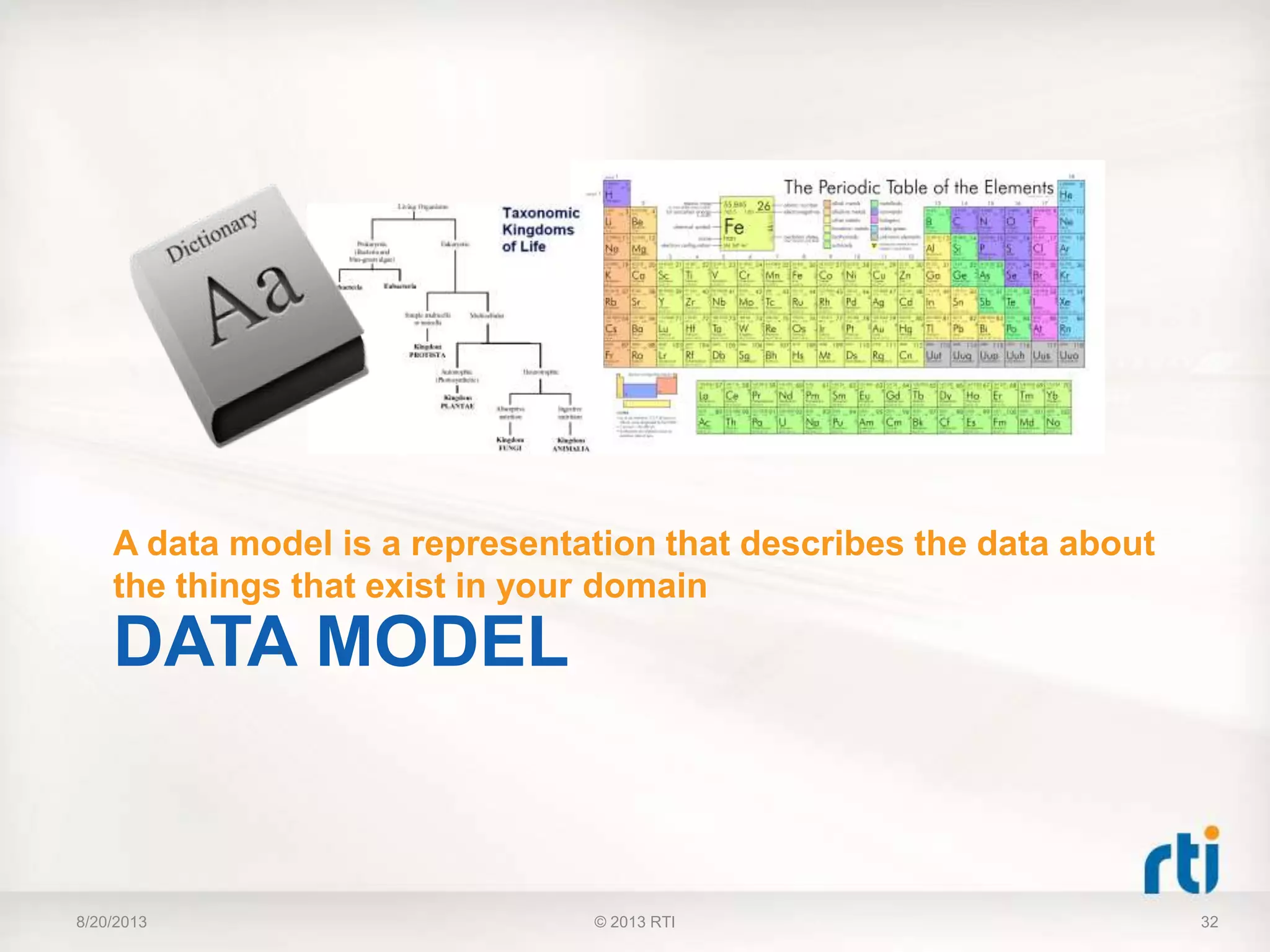
DATA MODEL
A data model is a representation that describes the data about
the things that exist in your domain
8/20/2013 32© 2013 RTI
Systems of Systems are
Different
8/20/2013 33
System
of
Systems
[n] types of
systems
[n]sets of
requirements +
the requirement
for Semantic
Interoperability
many things to
express
many different
representations of
those expressions
to achieve
interoperability
© 2013 RTI
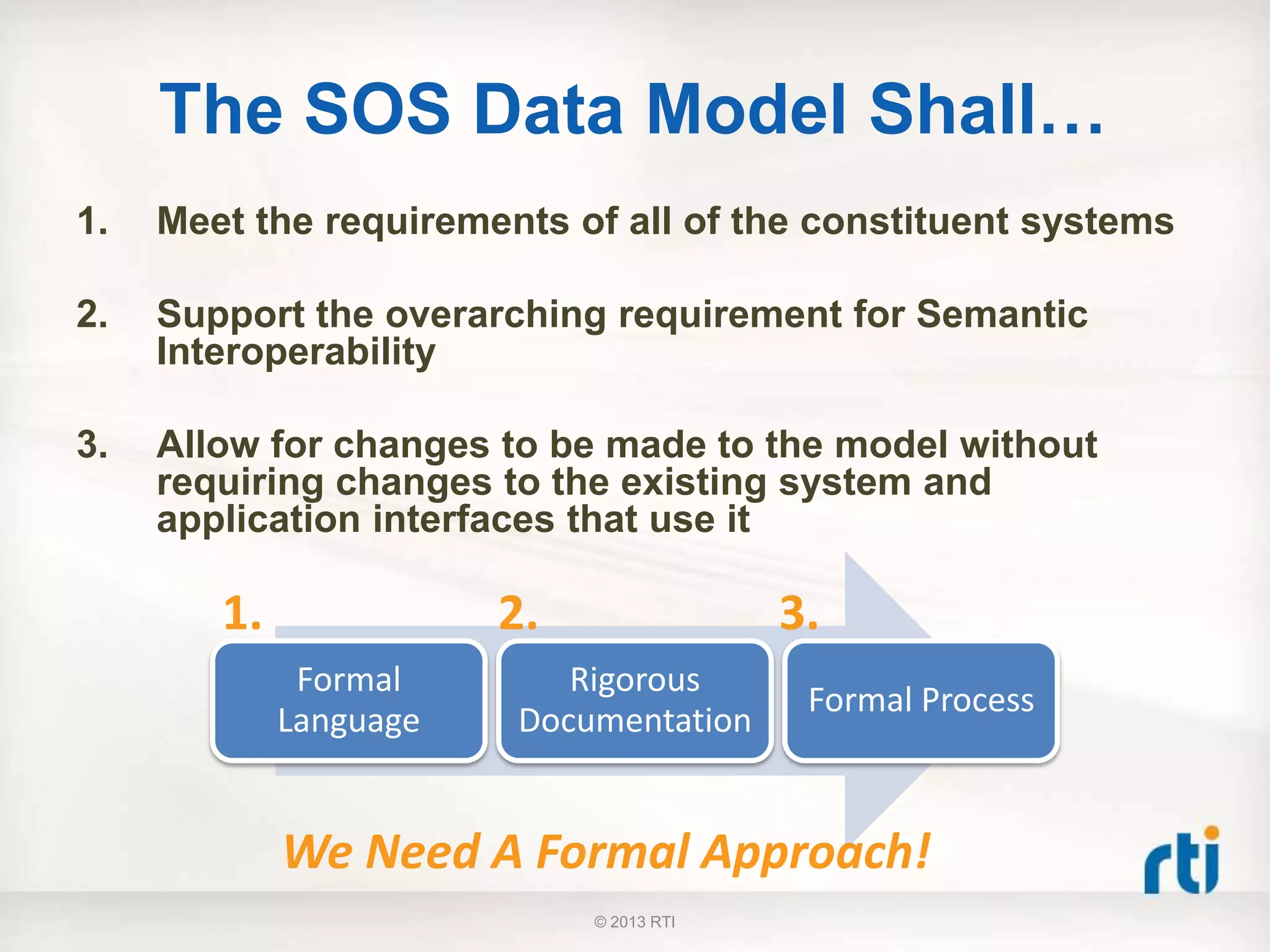
The SOS Data Model Shall…
1. Meet the requirements of all of the constituent systems
2. Support the overarching requirement for Semantic
Interoperability
3. Allow for changes to be made to the model without
requiring changes to the existing system and
application interfaces that use it
Formal
Language
Rigorous
Documentation
Formal Process
1. 2. 3.
We Need A Formal Approach!
© 2013 RTI
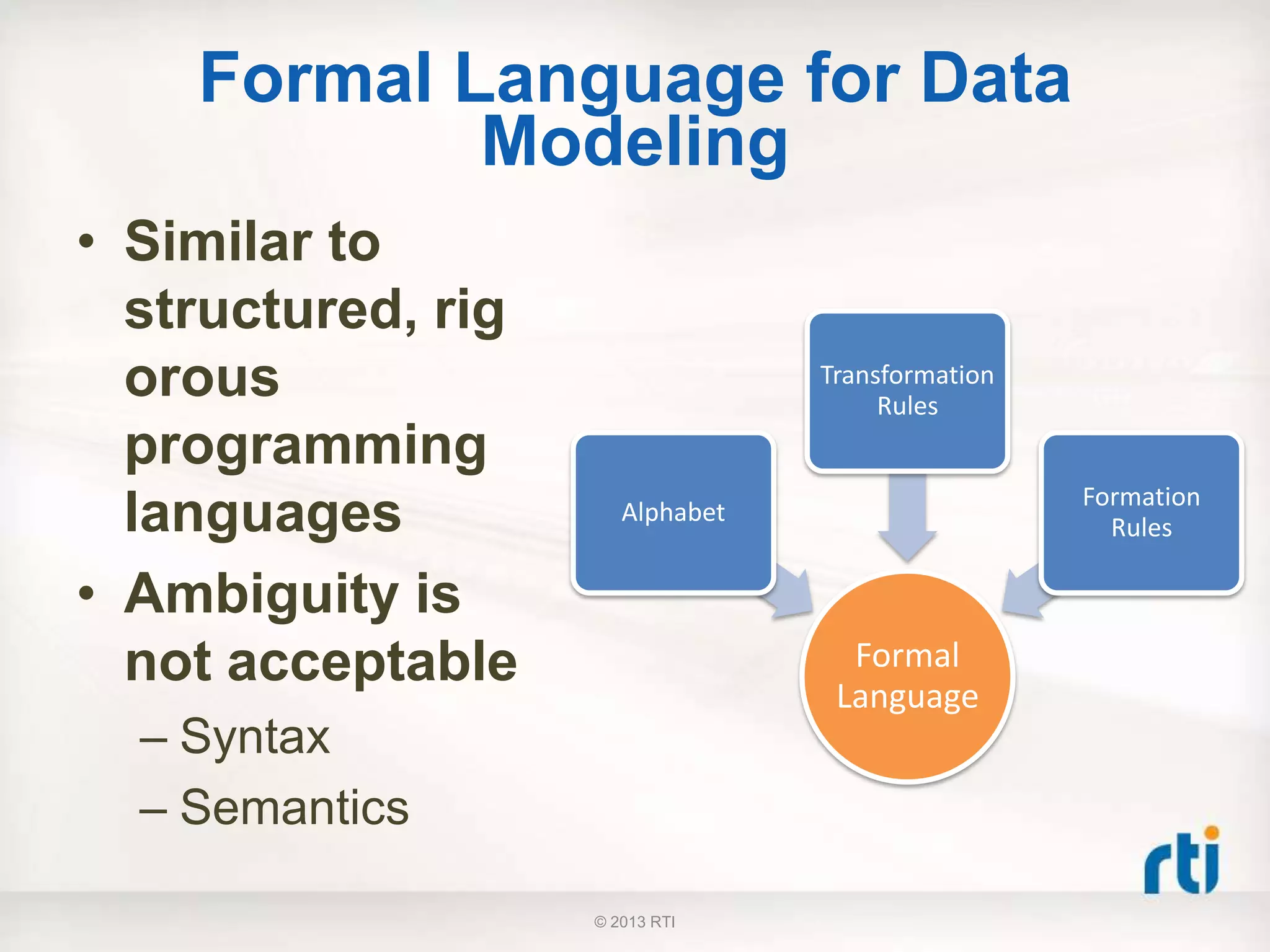
Formal Language for Data
Modeling
• Similar to
structured, rig
orous
programming
languages
• Ambiguity is
not acceptable
– Syntax
– Semantics
Formal
Language
Alphabet
Transformation
Rules
Formation
Rules
© 2013 RTI
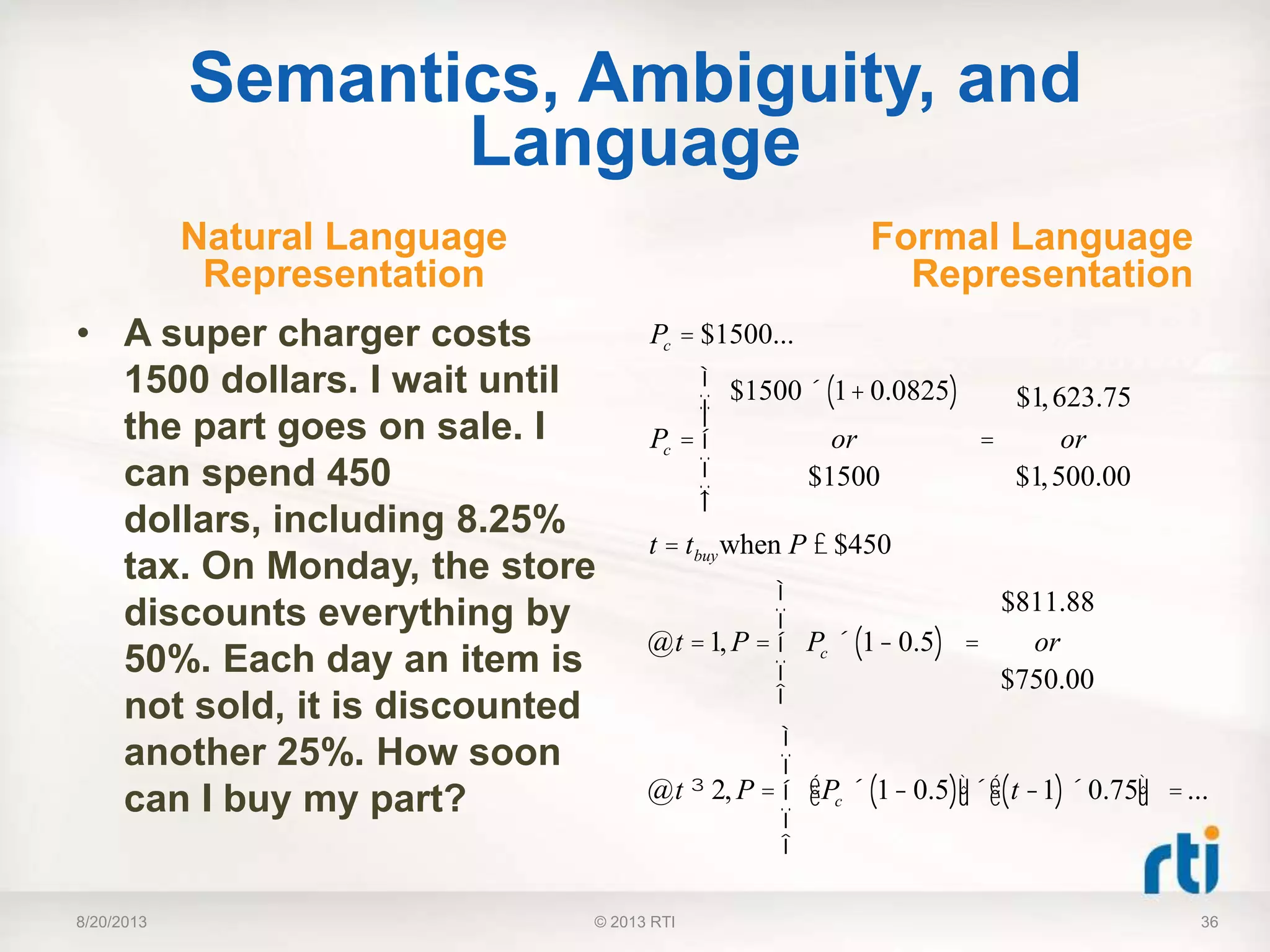
Semantics, Ambiguity, and
Language
Natural Language
Representation
• A super charger costs
1500 dollars. I wait until
the part goes on sale. I
can spend 450
dollars, including 8.25%
tax. On Monday, the store
discounts everything by
50%. Each day an item is
not sold, it is discounted
another 25%. How soon
can I buy my part?
Formal Language
Representation
8/20/2013 36
Pc = $1500...
Pc =
$1500´ 1+ 0.0825( )
or
$1500
ì
í
ïï
î
ï
ï
=
$1,623.75
or
$1,500.00
t = tbuywhen P £ $450
@t =1, P = Pc ´ 1- 0.5( )
ì
í
ï
î
ï
=
$811.88
or
$750.00
@t ³ 2, P = Pc ´ 1- 0.5( )éë ùû´ t -1( )´ 0.75éë ùû
ì
í
ï
î
ï
=...
© 2013 RTI
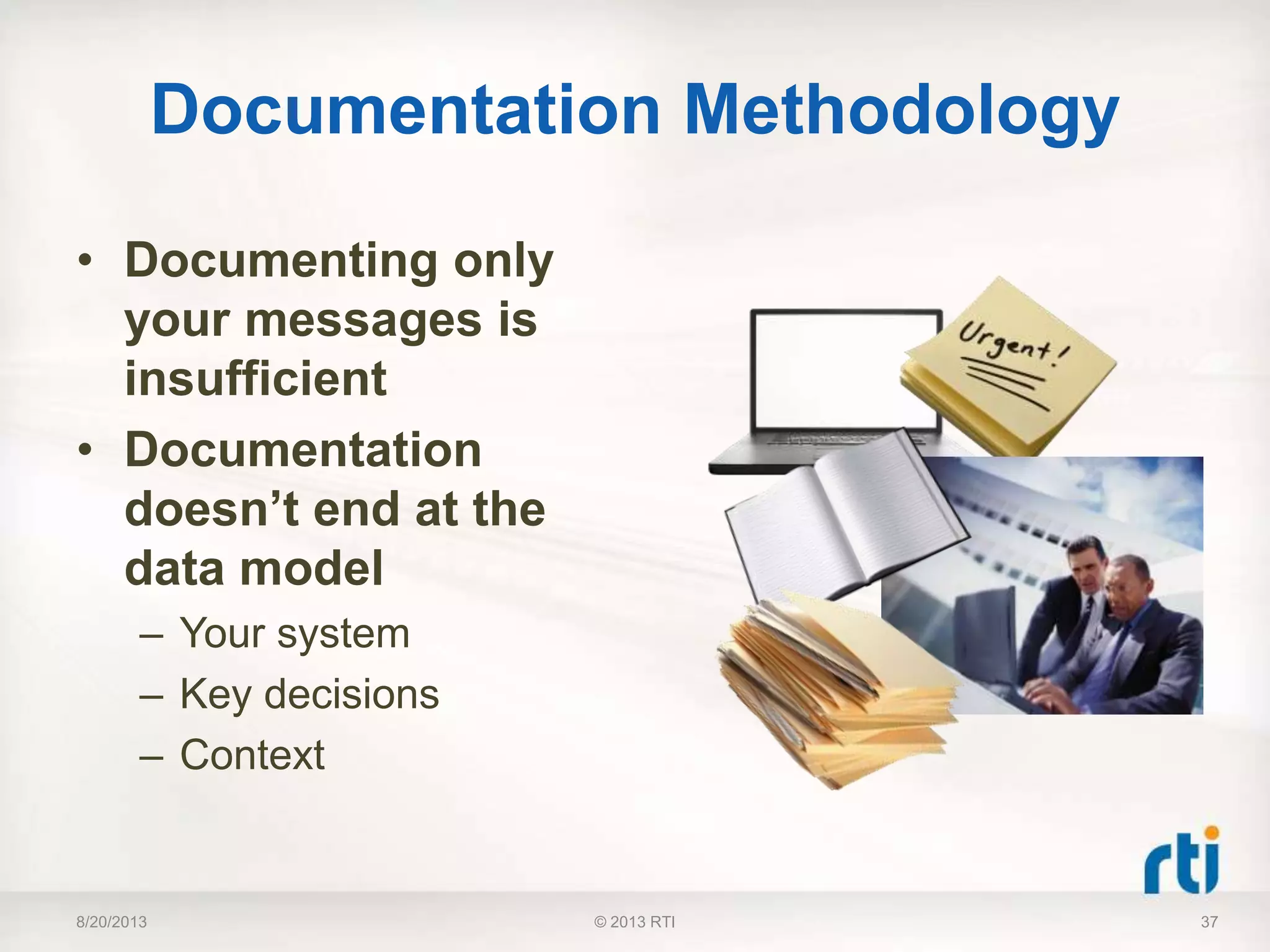
Documentation Methodology
• Documenting only
your messages is
insufficient
• Documentation
doesn’t end at the
data model
– Your system
– Key decisions
– Context
8/20/2013 37© 2013 RTI
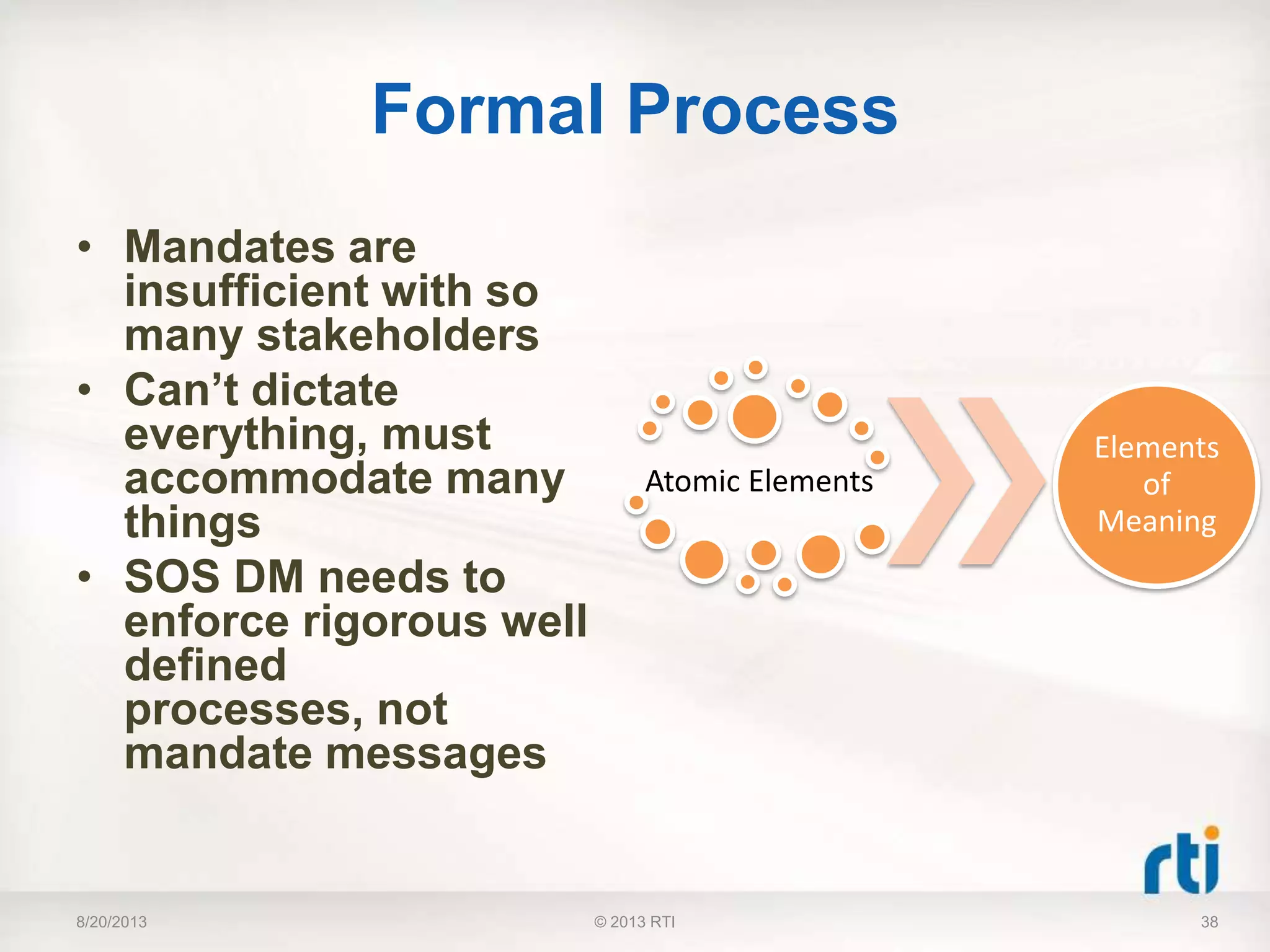
Formal Process
• Mandates are
insufficient with so
many stakeholders
• Can’t dictate
everything, must
accommodate many
things
• SOS DM needs to
enforce rigorous well
defined
processes, not
mandate messages
8/20/2013 38
Atomic Elements
Elements
of
Meaning
© 2013 RTI
Model and Implementation
• Model provides the Context and Semantics
– Containment and relationships
– May not necessarily be in the messages
• Messages can be compact
– Use the model for context
– ‘Know’ the relateability of a command to a status
• Using machine readable context
– Can generate the system appropriate mediation
– Really only need the ID of ‘what’ in the message
© 2013 RTI
Putting the Pieces Together
8/20/2013 41
Things to
Model from
System A
Data Model
Data Modeling Process
Structure
Behavior
Context
representation
A
representation
A
representation
[n]
per a
Rigorous and Formal
Approach
© 2013 RTI
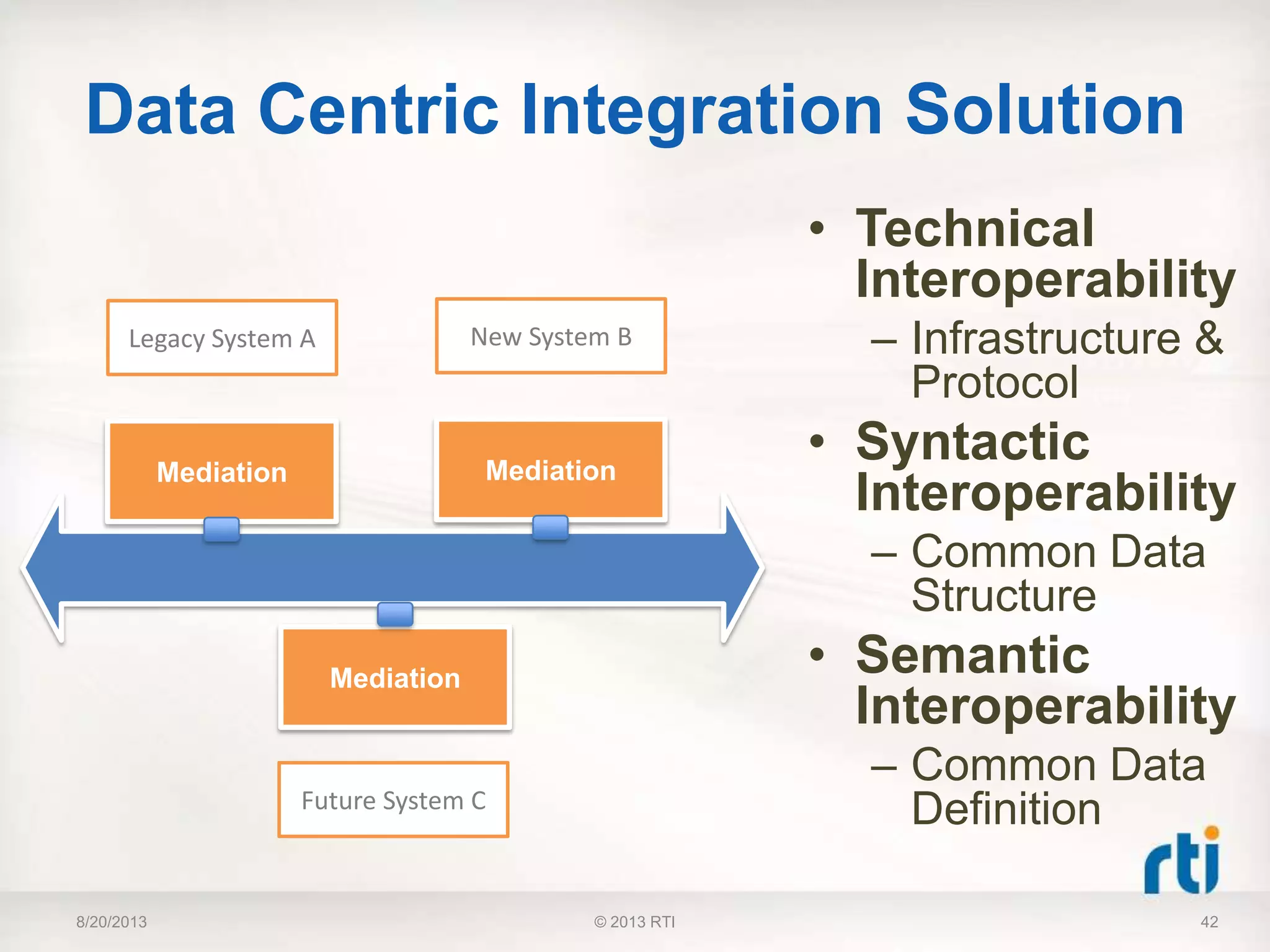
Data Centric Integration Solution
8/20/2013 42
Legacy System A
Mediation
Future System C
Mediation
New System B
Mediation
• Technical
Interoperability
– Infrastructure &
Protocol
• Syntactic
Interoperability
– Common Data
Structure
• Semantic
Interoperability
– Common Data
Definition
© 2013 RTI
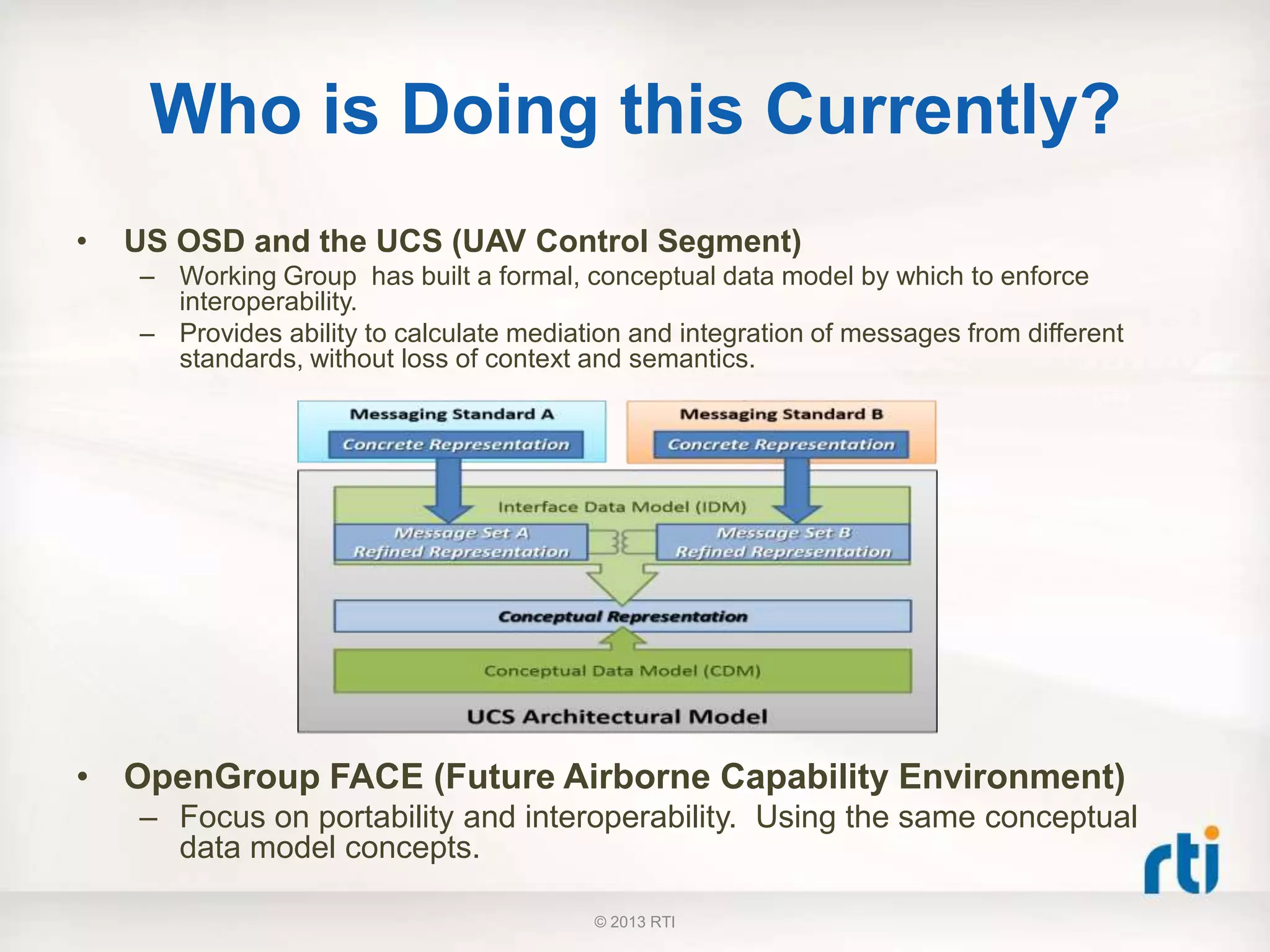
Who is Doing this Currently?
• US OSD and the UCS (UAV Control Segment)
– Working Group has built a formal, conceptual data model by which to enforce
interoperability.
– Provides ability to calculate mediation and integration of messages from different
standards, without loss of context and semantics.
• OpenGroup FACE (Future Airborne Capability Environment)
– Focus on portability and interoperability. Using the same conceptual
data model concepts.
© 2013 RTI
Thoughts On Where We Are and
Where We Have to Go…
• OA is an acquisition concept
– It is not a specific technical matter
• A large infrastructure to manage OA isn’t needed
– No Architecture solely for Architecture
• Interoperability has to be by design
– By specification works for small teams
• Processes need to remain flexible
– Systems are dynamic
• Need to own the most important aspect of a
system, the data.
– It content, context, and behavior….
© 2013 RTI

Interoperability for Teaming and Autonomy

  • 1.
    Interoperability for Teaming andAutonomy Gordon A. Hunt – AUVSI 2013 Wash DC Chief Engineer, RTI • UCS WG CE interoperability • Commander USN-R
  • 2.
    Agenda • Swarming andTeaming – Control versus Command • Background – Open Architecture and Current Approaches • A Team is a System of Systems – Definitions and Examples • Interoperability Architecture – It is all about the Data – How to capture and define its meaning – Interoperability by Design
  • 3.
    Swarming and Teaming What’sthe difference? How are they achieved? © 2013 RTI
  • 4.
  • 5.
    What does thisScenario Take • Close cooperation – obviously • Awareness of each AUV’s objectives – Leverage nearby assets seamlessly • Shared and integrated mission management – Right capability, right place, right time • Ability to react to dynamic changes – Shared awareness of system state © 2013 RTI
  • 6.
    Team or aSwarm? • Swarm – Usually controlled an implemented by a single integration agency / implementer on a common timescale • Team – Loose grouping of assets controlled and managed by different agencies and implementers on variable timescales • However… – Have really only seen machine to machine collaboration with swarms – Teams are typically formed by human powered intuition – Need to move from human-enabled to machine-enabled collaboration and cooperation. © 2013 RTI
  • 7.
    Background How Do We‘Do’ Interoperability? What is labeled ‘Open’? © 2013 RTI
  • 8.
    Current Technical Approaches •Protocol Definitions & Standards – Tell me the messages • Open Architecture Mandates – Interoperability on Commonality • (Implementation) Architecture of the Day – Service Oriented Architecture – RESTful Interfaces – … © 2013 RTI
  • 9.
    Is Current PracticeWorking • Recent studies have shown a growth in interoperability policy issuance in DoD – Thousands of pages of directives, instructions, and mandates – Numerous standards and architecture bodies in the DoD • No Correlation between Increased Interoperability and Standards – Standards are necessary, but not sufficient for interoperability • Conventional means of developing platform, unit command, and theater architectures are complex, manpower intensive, and time consuming. – Achieving Interoperability increases complexity – Complexity of systems-of-systems not understood or well managed Can’t make complexity go away, just move where it is © 2013 RTI
  • 10.
    Are these Approaches Sufficient? Whatis different and unique in teaming operations? © 2013 RTI
  • 11.
  • 12.
    System of Systems Systemof Systems • A system of systems is a collection of task- oriented or dedicated systems that pool their resources and capabilities together to create a new, more complex system which offers more functionality and performance than simply the sum of the constituent systems. System A System B System [n] System A System B … System [n] Has a set of >[n+1] capabilities
  • 13.
    System of SystemsProperties 1. Operational independence of the component systems 2. Managerial independence of its component systems 3. Evolutionary Independence of the constituent systems 4. Emergent Behavior © 2013 RTI
  • 14.
    Key Non-Functional Requirementsfor a System • Interchangeability • Replaceability • Extensibility • Integratability System System A System B System System B System C F(A,B) Results in X F(C,B) Results in X A and C provide Equal Capability © 2013 RTI
  • 15.
    Key Non-Functional Requirementsfor a System • Interchangeability • Replaceability • Extensibility • Integratability System System A System B System System B System C F(A,B) Results in X, Y, Z F(C,B) Results in Y, Z, W C is NOT an Equal Capability, but it Is a suitable substitute © 2013 RTI
  • 16.
    System Key Non-Functional Requirementsfor a System • Interchangeability • Replaceability • Extensibility • Integratability System System B System C F(A,B) Results in X F(A,B,C) Results in X and Y System A System System B System A System C F(C) Results in Y © 2013 RTI
  • 17.
    System C Key Non-FunctionalRequirements for a System • Interchangeability • Replaceability • Extensibility • Integratability System B F(A) Results In X F(A,B) Results in Z, where Z=G[f(X), g(Y)] System A System B System A F(B) Results in Y © 2013 RTI
  • 18.
    The Key Non-FunctionalRequirement for a SoS • Interoperability the ability of systems, units, or forces to provide services to and accept services from other systems, units, or forces, and to use the services so exchanged to enable them to operate effectively together. F(A) and G(B) Become G[F(A)] and F[G(B)] F(A) Results In X System B System A G(B) Results In Y System of Systems System B System A © 2013 RTI
  • 19.
    Levels of ConceptualInteroperability Level 0: No Interoperability Level 1: Technical Interoperability Level 2: Syntactic Interoperability Level 3: Semantic Interoperability Level 4: Pragmatic Interoperability Level 5: Dynamic Interoperability Level 6: Conceptual Interoperability IncreasingCapabilityInteroperation © 2013 RTI
  • 20.
    Level 0: NoInteroperability • Requires – A stand alone system • Result – Stand alone systems that have no interoperability • Non-Functional Need Met – None Level 0: No Interoperability Level 1: Technical Interoperability Level 2: Syntactic Interoperability Level 3: Semantic Interoperability Level 4: Pragmatic Interoperability Level 5: Dynamic Interoperability Level 6: Conceptual Interoperability © 2013 RTI
  • 21.
    Level 1: TechnicalInteroperability • Requires – Communications Infrastructure established • Result – Bits & Bytes are exchanged in an unambiguous manner • Non-Functional Need Met – Replaceability  Interchangeability Level 0: No Interoperability Level 1: Technical Interoperability Level 2: Syntactic Interoperability Level 3: Semantic Interoperability Level 4: Pragmatic Interoperability Level 5: Dynamic Interoperability Level 6: Conceptual Interoperability © 2013 RTI
  • 22.
    Level 2: SyntacticInteroperability • Requires – Communications Infrastructure established – Common structure or common data format for exchanging information • Result – Bits/Bytes and the Structure of Data are exchanged in an unambiguous manner • Non-Functional Need Met – Interchangeability and Integrateability Level 0: No Interoperability Level 1: Technical Interoperability Level 2: Syntactic Interoperability Level 3: Semantic Interoperability Level 4: Pragmatic Interoperability Level 5: Dynamic Interoperability Level 6: Conceptual Interoperability © 2013 RTI
  • 23.
    Level 3: SemanticInteroperability Level 0: No Interoperability Level 1: Technical Interoperability Level 2: Syntactic Interoperability Level 3: Semantic Interoperability Level 4: Pragmatic Interoperability Level 5: Dynamic Interoperability Level 6: Conceptual Interoperability • Required – Communications Infrastructure and Common Data Format are established – Common information model is defined for exchanging the meaning of information • Result – Bits/Bytes and the structure of data are exchanged in an unambiguous manner – Content of the information exchanged is unambiguously defined • Non-Functional Need Met – Actual, high-level Interoperability © 2013 RTI
  • 24.
  • 25.
  • 26.
  • 27.
    Interoperability by Example Theprocedure is actually quite simple. First you arrange things into different groups. Of course, one pile may be sufficient depending on how much there is to do. If you have to go somewhere else due to lack of facilities that is the next step, otherwise you are pretty well set. It is important not to overdo things. That is, it is better to do too few things at once than too many. In the short run this may not seem important but complications can easily arise. A mistake can be expensive as well. At first the whole procedure will seem complicated. Soon, however, it will become just another facet of life. It is difficult to foresee any end to the necessity for this task in the immediate future, but then one never can tell, After the procedure is completed one arranges the materials into different groups again. Then they can be put into their appropriate places. Eventually they will be used once more and the whole cycle will then have to be repeated. However, that is part of life. - Bransford & Johnson (1972) © 2013 RTI
  • 28.
    Interoperability by Example Notonly what we say, but what does it mean? © 2013 RTI
  • 29.
    It is theData that Matters How do you Define & Design it? What does the Architecture look like? © 2013 RTI
  • 30.
    MODEL A model isanything used in any way to represent something else 8/20/2013 31© 2013 RTI
  • 31.
    DATA MODEL A datamodel is a representation that describes the data about the things that exist in your domain 8/20/2013 32© 2013 RTI
  • 32.
    Systems of Systemsare Different 8/20/2013 33 System of Systems [n] types of systems [n]sets of requirements + the requirement for Semantic Interoperability many things to express many different representations of those expressions to achieve interoperability © 2013 RTI
  • 33.
    The SOS DataModel Shall… 1. Meet the requirements of all of the constituent systems 2. Support the overarching requirement for Semantic Interoperability 3. Allow for changes to be made to the model without requiring changes to the existing system and application interfaces that use it Formal Language Rigorous Documentation Formal Process 1. 2. 3. We Need A Formal Approach! © 2013 RTI
  • 34.
    Formal Language forData Modeling • Similar to structured, rig orous programming languages • Ambiguity is not acceptable – Syntax – Semantics Formal Language Alphabet Transformation Rules Formation Rules © 2013 RTI
  • 35.
    Semantics, Ambiguity, and Language NaturalLanguage Representation • A super charger costs 1500 dollars. I wait until the part goes on sale. I can spend 450 dollars, including 8.25% tax. On Monday, the store discounts everything by 50%. Each day an item is not sold, it is discounted another 25%. How soon can I buy my part? Formal Language Representation 8/20/2013 36 Pc = $1500... Pc = $1500´ 1+ 0.0825( ) or $1500 ì í ïï î ï ï = $1,623.75 or $1,500.00 t = tbuywhen P £ $450 @t =1, P = Pc ´ 1- 0.5( ) ì í ï î ï = $811.88 or $750.00 @t ³ 2, P = Pc ´ 1- 0.5( )éë ùû´ t -1( )´ 0.75éë ùû ì í ï î ï =... © 2013 RTI
  • 36.
    Documentation Methodology • Documentingonly your messages is insufficient • Documentation doesn’t end at the data model – Your system – Key decisions – Context 8/20/2013 37© 2013 RTI
  • 37.
    Formal Process • Mandatesare insufficient with so many stakeholders • Can’t dictate everything, must accommodate many things • SOS DM needs to enforce rigorous well defined processes, not mandate messages 8/20/2013 38 Atomic Elements Elements of Meaning © 2013 RTI
  • 38.
    Model and Implementation •Model provides the Context and Semantics – Containment and relationships – May not necessarily be in the messages • Messages can be compact – Use the model for context – ‘Know’ the relateability of a command to a status • Using machine readable context – Can generate the system appropriate mediation – Really only need the ID of ‘what’ in the message © 2013 RTI
  • 39.
    Putting the PiecesTogether 8/20/2013 41 Things to Model from System A Data Model Data Modeling Process Structure Behavior Context representation A representation A representation [n] per a Rigorous and Formal Approach © 2013 RTI
  • 40.
    Data Centric IntegrationSolution 8/20/2013 42 Legacy System A Mediation Future System C Mediation New System B Mediation • Technical Interoperability – Infrastructure & Protocol • Syntactic Interoperability – Common Data Structure • Semantic Interoperability – Common Data Definition © 2013 RTI
  • 41.
    Who is Doingthis Currently? • US OSD and the UCS (UAV Control Segment) – Working Group has built a formal, conceptual data model by which to enforce interoperability. – Provides ability to calculate mediation and integration of messages from different standards, without loss of context and semantics. • OpenGroup FACE (Future Airborne Capability Environment) – Focus on portability and interoperability. Using the same conceptual data model concepts. © 2013 RTI
  • 42.
    Thoughts On WhereWe Are and Where We Have to Go… • OA is an acquisition concept – It is not a specific technical matter • A large infrastructure to manage OA isn’t needed – No Architecture solely for Architecture • Interoperability has to be by design – By specification works for small teams • Processes need to remain flexible – Systems are dynamic • Need to own the most important aspect of a system, the data. – It content, context, and behavior…. © 2013 RTI