Your systems. Working as one.

DDS: Enabling Open Architecture

David Barnett | david@rti.com | @rtidavid
December 4, 2013
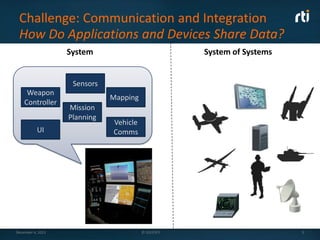
Challenge: Communication and Integration
How Do Applications and Devices Share Data?
System

System of Systems

Sensors
Weapon
Controller
UI

December 4, 2013

Mapping
Mission
Planning

Vehicle
Comms

© 2013 RTI

2
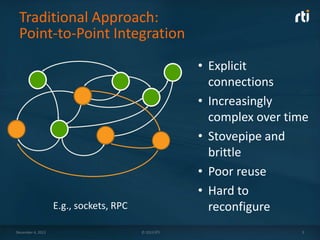
Traditional Approach:
Point-to-Point Integration
• Explicit
connections
• Increasingly
complex over time
• Stovepipe and
brittle
• Poor reuse
• Hard to
reconfigure

E.g., sockets, RPC
December 4, 2013

© 2013 RTI

3
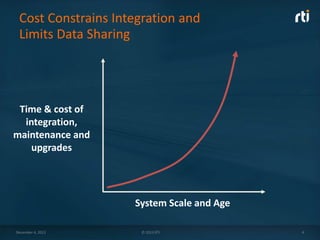
Cost Constrains Integration and
Limits Data Sharing

Time & cost of
integration,
maintenance and
upgrades

System Scale and Age
December 4, 2013

© 2013 RTI

4
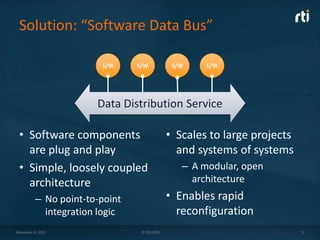
Solution: “Software Data Bus”
S/W

S/W

S/W

S/W

Data Distribution Service

• Software components
are plug and play
• Simple, loosely coupled
architecture
– No point-to-point
integration logic
December 4, 2013

© 2013 RTI

• Scales to large projects
and systems of systems
– A modular, open
architecture

• Enables rapid
reconfiguration
5
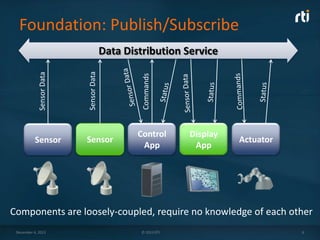
Foundation: Publish/Subscribe

Sensor

Sensor

Commands

Sensor Data

Sensor Data

Data Distribution Service

Control
App

Display
App

Actuator

Components are loosely-coupled, require no knowledge of each other
December 4, 2013

© 2013 RTI

6
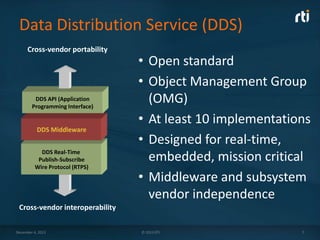
Data Distribution Service (DDS)
Cross-vendor portability

DDS API (Application
Programming Interface)

DDS Middleware
DDS Real-Time
Publish-Subscribe
Wire Protocol (RTPS)

• Open standard
• Object Management Group
(OMG)
• At least 10 implementations
• Designed for real-time,
embedded, mission critical
• Middleware and subsystem
vendor independence

Cross-vendor interoperability
December 4, 2013

© 2013 RTI

7
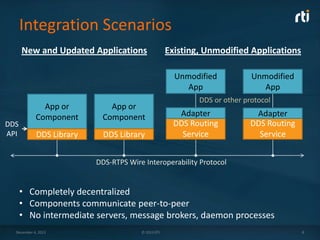
Integration Scenarios
New and Updated Applications

Existing, Unmodified Applications
Unmodified
App

DDS
API

App or
Component

App or
Component

DDS Library

DDS Library

Unmodified
App

DDS or other protocol

Adapter
DDS Routing
Service

Adapter
DDS Routing
Service

DDS-RTPS Wire Interoperability Protocol

• Completely decentralized
• Components communicate peer-to-peer
• No intermediate servers, message brokers, daemon processes
December 4, 2013

© 2013 RTI

8
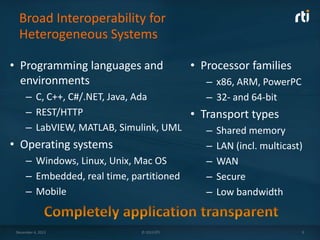
Broad Interoperability for
Heterogeneous Systems
• Programming languages and
environments

• Processor families
– x86, ARM, PowerPC
– 32- and 64-bit

– C, C++, C#/.NET, Java, Ada
– REST/HTTP
• Transport types
– LabVIEW, MATLAB, Simulink, UML
– Shared memory
• Operating systems
– LAN (incl. multicast)
– Windows, Linux, Unix, Mac OS
– WAN
– Embedded, real time, partitioned
– Secure
– Mobile
– Low bandwidth

December 4, 2013

© 2013 RTI

9
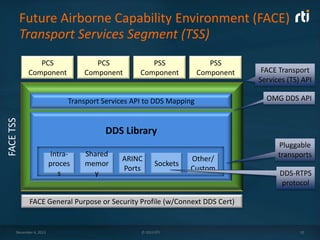
Future Airborne Capability Environment (FACE)
Transport Services Segment (TSS)
PCS
Component

PCS
Component

PSS
Component

PSS
Component

FACE TSS

Transport Services API to DDS Mapping

FACE Transport
Services (TS) API
OMG DDS API

DDS Library
Intraproces
s

Shared
memor
y

ARINC
Ports

Sockets

Other/
Custom

Pluggable
transports
DDS-RTPS
protocol

FACE General Purpose or Security Profile (w/Connext DDS Cert)

December 4, 2013

© 2013 RTI

10
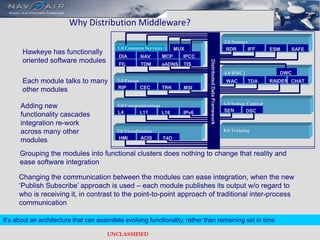
Why Distribution Middleware?

DIA
DIA
FIL
FIL

Each module talks to many
other modules

NAV
NAV
TDM
TDM

3.0 Fusion
CEC
RIP
CEC
RIP

MUX
MUX
MCP
IPCC
MCP
IPCC

aADNS

TRK
TRK

5.0 Communications
L4
L11
L16
L4
L11
L16

7.0 Visualization
ACIS
HMI
ACIS
HMI

TIS

MSI
MSI

IPv6

Distributed Data Framework

Hawkeye has functionally
oriented software modules

Adding new
functionality cascades
integration re-work
across many other
modules

2.0 Sensors
IFF
RDR
IFF
RDR

1.0 Common Services

ESM
ESM

DWC

4.0 BMC2
WAC
WAC

SAFE
SAFE

TDA
TDA

RAIDER CHAT

6.0 Sensor Control
SEN
DSC
SEN
DSC

8.0 Training
T4O

Grouping the modules into functional clusters does nothing to change that reality and
ease software integration
Changing the communication between the modules can ease integration, when the new
‘Publish Subscribe’ approach is used – each module publishes its output w/o regard to
who is receiving it, in contrast to the point-to-point approach of traditional inter-process
communication
It’s about an architecture that can assimilate evolving functionality, rather than remaining set in time
UNCLASSIFIED
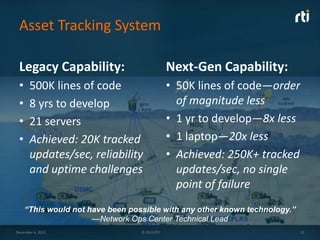
Asset Tracking System
Legacy Capability:

Next-Gen Capability:

•
•
•
•

• 50K lines of code—order
of magnitude less
• 1 yr to develop—8x less
• 1 laptop—20x less
• Achieved: 250K+ tracked
updates/sec, no single
point of failure

500K lines of code
8 yrs to develop
21 servers
Achieved: 20K tracked
updates/sec, reliability
and uptime challenges

“This would not have been possible with any other known technology.”
—Network Ops Center Technical Lead
December 4, 2013

© 2013 RTI

12
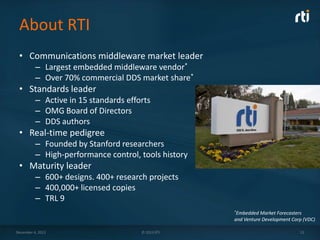
About RTI
• Communications middleware market leader
– Largest embedded middleware vendor*
– Over 70% commercial DDS market share*

• Standards leader
– Active in 15 standards efforts
– OMG Board of Directors
– DDS authors

• Real-time pedigree
– Founded by Stanford researchers
– High-performance control, tools history

• Maturity leader
– 600+ designs. 400+ research projects
– 400,000+ licensed copies
– TRL 9
*Embedded

Market Forecasters
and Venture Development Corp (VDC)
December 4, 2013

© 2013 RTI

13
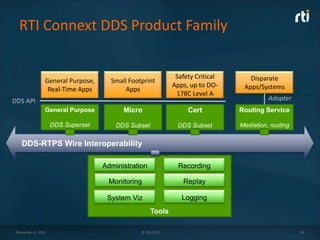
RTI Connext DDS Product Family

General Purpose,
Real-Time Apps

Small Footprint
Apps

Safety Critical
Apps, up to DO178C Level A

Disparate
Apps/Systems

DDS API

Adapter

General Purpose

Micro

Cert

Routing Service

DDS Superset

DDS Subset

DDS Subset

Mediation, routing

DDS-RTPS Wire Interoperability
Administration

Recording

Monitoring

Replay

System Viz

Logging
Tools

December 4, 2013

© 2013 RTI

14
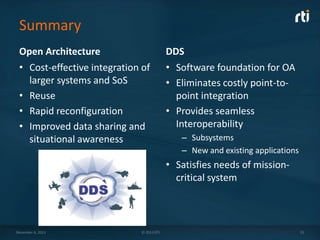
Summary
Open Architecture

DDS

• Cost-effective integration of
larger systems and SoS
• Reuse
• Rapid reconfiguration
• Improved data sharing and
situational awareness

• Software foundation for OA
• Eliminates costly point-topoint integration
• Provides seamless
Interoperability
– Subsystems
– New and existing applications

• Satisfies needs of missioncritical system

December 4, 2013

© 2013 RTI

15
Your systems. Working as one.

Thank You!

DDS Enabling Open Architecture

  • 1.
    Your systems. Workingas one. DDS: Enabling Open Architecture David Barnett | david@rti.com | @rtidavid December 4, 2013
  • 2.
    Challenge: Communication andIntegration How Do Applications and Devices Share Data? System System of Systems Sensors Weapon Controller UI December 4, 2013 Mapping Mission Planning Vehicle Comms © 2013 RTI 2
  • 3.
    Traditional Approach: Point-to-Point Integration •Explicit connections • Increasingly complex over time • Stovepipe and brittle • Poor reuse • Hard to reconfigure E.g., sockets, RPC December 4, 2013 © 2013 RTI 3
  • 4.
    Cost Constrains Integrationand Limits Data Sharing Time & cost of integration, maintenance and upgrades System Scale and Age December 4, 2013 © 2013 RTI 4
  • 5.
    Solution: “Software DataBus” S/W S/W S/W S/W Data Distribution Service • Software components are plug and play • Simple, loosely coupled architecture – No point-to-point integration logic December 4, 2013 © 2013 RTI • Scales to large projects and systems of systems – A modular, open architecture • Enables rapid reconfiguration 5
  • 6.
    Foundation: Publish/Subscribe Sensor Sensor Commands Sensor Data SensorData Data Distribution Service Control App Display App Actuator Components are loosely-coupled, require no knowledge of each other December 4, 2013 © 2013 RTI 6
  • 7.
    Data Distribution Service(DDS) Cross-vendor portability DDS API (Application Programming Interface) DDS Middleware DDS Real-Time Publish-Subscribe Wire Protocol (RTPS) • Open standard • Object Management Group (OMG) • At least 10 implementations • Designed for real-time, embedded, mission critical • Middleware and subsystem vendor independence Cross-vendor interoperability December 4, 2013 © 2013 RTI 7
  • 8.
    Integration Scenarios New andUpdated Applications Existing, Unmodified Applications Unmodified App DDS API App or Component App or Component DDS Library DDS Library Unmodified App DDS or other protocol Adapter DDS Routing Service Adapter DDS Routing Service DDS-RTPS Wire Interoperability Protocol • Completely decentralized • Components communicate peer-to-peer • No intermediate servers, message brokers, daemon processes December 4, 2013 © 2013 RTI 8
  • 9.
    Broad Interoperability for HeterogeneousSystems • Programming languages and environments • Processor families – x86, ARM, PowerPC – 32- and 64-bit – C, C++, C#/.NET, Java, Ada – REST/HTTP • Transport types – LabVIEW, MATLAB, Simulink, UML – Shared memory • Operating systems – LAN (incl. multicast) – Windows, Linux, Unix, Mac OS – WAN – Embedded, real time, partitioned – Secure – Mobile – Low bandwidth December 4, 2013 © 2013 RTI 9
  • 10.
    Future Airborne CapabilityEnvironment (FACE) Transport Services Segment (TSS) PCS Component PCS Component PSS Component PSS Component FACE TSS Transport Services API to DDS Mapping FACE Transport Services (TS) API OMG DDS API DDS Library Intraproces s Shared memor y ARINC Ports Sockets Other/ Custom Pluggable transports DDS-RTPS protocol FACE General Purpose or Security Profile (w/Connext DDS Cert) December 4, 2013 © 2013 RTI 10
  • 11.
    Why Distribution Middleware? DIA DIA FIL FIL Eachmodule talks to many other modules NAV NAV TDM TDM 3.0 Fusion CEC RIP CEC RIP MUX MUX MCP IPCC MCP IPCC aADNS TRK TRK 5.0 Communications L4 L11 L16 L4 L11 L16 7.0 Visualization ACIS HMI ACIS HMI TIS MSI MSI IPv6 Distributed Data Framework Hawkeye has functionally oriented software modules Adding new functionality cascades integration re-work across many other modules 2.0 Sensors IFF RDR IFF RDR 1.0 Common Services ESM ESM DWC 4.0 BMC2 WAC WAC SAFE SAFE TDA TDA RAIDER CHAT 6.0 Sensor Control SEN DSC SEN DSC 8.0 Training T4O Grouping the modules into functional clusters does nothing to change that reality and ease software integration Changing the communication between the modules can ease integration, when the new ‘Publish Subscribe’ approach is used – each module publishes its output w/o regard to who is receiving it, in contrast to the point-to-point approach of traditional inter-process communication It’s about an architecture that can assimilate evolving functionality, rather than remaining set in time UNCLASSIFIED
  • 12.
    Asset Tracking System LegacyCapability: Next-Gen Capability: • • • • • 50K lines of code—order of magnitude less • 1 yr to develop—8x less • 1 laptop—20x less • Achieved: 250K+ tracked updates/sec, no single point of failure 500K lines of code 8 yrs to develop 21 servers Achieved: 20K tracked updates/sec, reliability and uptime challenges “This would not have been possible with any other known technology.” —Network Ops Center Technical Lead December 4, 2013 © 2013 RTI 12
  • 13.
    About RTI • Communicationsmiddleware market leader – Largest embedded middleware vendor* – Over 70% commercial DDS market share* • Standards leader – Active in 15 standards efforts – OMG Board of Directors – DDS authors • Real-time pedigree – Founded by Stanford researchers – High-performance control, tools history • Maturity leader – 600+ designs. 400+ research projects – 400,000+ licensed copies – TRL 9 *Embedded Market Forecasters and Venture Development Corp (VDC) December 4, 2013 © 2013 RTI 13
  • 14.
    RTI Connext DDSProduct Family General Purpose, Real-Time Apps Small Footprint Apps Safety Critical Apps, up to DO178C Level A Disparate Apps/Systems DDS API Adapter General Purpose Micro Cert Routing Service DDS Superset DDS Subset DDS Subset Mediation, routing DDS-RTPS Wire Interoperability Administration Recording Monitoring Replay System Viz Logging Tools December 4, 2013 © 2013 RTI 14
  • 15.
    Summary Open Architecture DDS • Cost-effectiveintegration of larger systems and SoS • Reuse • Rapid reconfiguration • Improved data sharing and situational awareness • Software foundation for OA • Eliminates costly point-topoint integration • Provides seamless Interoperability – Subsystems – New and existing applications • Satisfies needs of missioncritical system December 4, 2013 © 2013 RTI 15
  • 16.
    Your systems. Workingas one. Thank You!