Yves Caseau – Business Process Enterprise Model - 2012 1/13
Operations Research for Managing BusinessOperations Research for Managing Business
Processes Communication and PerformanceProcesses Communication and Performance
BPEM : Business Process Enterprise ModelBPEM : Business Process Enterprise Model
ICORES
February 2012
Yves Caseau
Bouygues Telecom – Bouygues’s eLab
National French Academy of Technologies
Yves Caseau – Business Process Enterprise Model - 2012 2/13
MotivationsMotivations
 « Traditional » ICORES 
 Crisp, well-defined models corresponding to a clear issue
 Sophisticated optimization techniques that bring value 
(compared to human judgment)
 « Enterprise as a System » optimization
 Cumbersome and coarse models, multiple issues
 Simple optimization/simulation methods
 Part of management sciences, 
a tradition of models & simulation
 Why ?
 Structural issues (in addition to cultural, political, human …)
 How
 Enterprise modeling with operational semantics
 “As simple as possible but no simpler”
 White box model
 Complex system approach (rich interaction of various concerns)
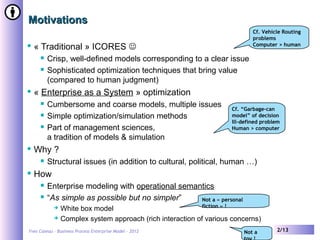
Cf. “Garbage-can
model” of decision
Ill-defined problem
Human > computer
Cf. Vehicle Routing
problems
Computer > human
Not a « personal
fiction » !
Not a
Yves Caseau – Business Process Enterprise Model - 2012 3/13
OutlineOutline
 Motivations 
Operations Research for Management Science
 First Part
Enterprise Models & Business Processes
 Second Part
BPEM: Business Process Enterprise Model
Four Dimensions of Enterprise Modeling
 Third Part
Applications – Two Examples
 Conclusion
Yves Caseau – Business Process Enterprise Model - 2012 4/13
Enterprise ModelsEnterprise Models
Part1:Motivations
Ressources
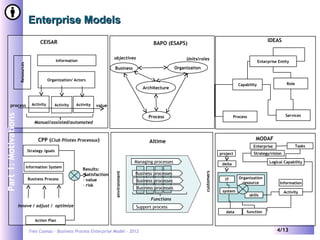
CEISAR BAPO (ESAPS)
IDEAS
CPP (Club Pilotes Processus) Altime
MODAF
Business Organization
Architecture
Process
Activity Activity Activityprocess
Manual/assisted/automated
value
Organization/ Actors
Information
objectives Units/roles
Enterprise Entity
Capability Role
ServicesProcess
Strategy /goals
Information System
Business Process
Action Plan
Innove / adjust / optimize
Results:
-Satisfaction
- value
- risk
Managing processes
Support process
Functions
Business processes
Business processes
Business processes
environment
customers
Logical Capability
project
delta
data function
Activity
Information
system
Organization
resource
skills
Strategy/vision
TasksEnterprise
IT
Yves Caseau – Business Process Enterprise Model - 2012 5/13
BPEM at a glanceBPEM at a glance
Part1:Motivations
Leadership Process KPI
people
Policy &
Strategy
Partnership
& resources
Leadership
Customer
results
Society
results
Innovation & Learning
enablers results
Left out
(long term)
Perimeter of
BPEM
Information Flows
activity activity
Environment
Management
Control
Coordination
customer
Production Factors
Products /
services
transfer
synchronization manage
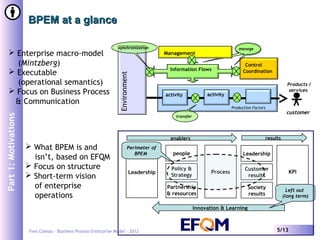
 Enterprise macro-model
(Mintzberg)
 Executable
(operational semantics)
 Focus on Business Process
& Communication
 What BPEM is and
isn’t, based on EFQM
 Focus on structure
 Short-term vision
of enterprise
operations
Yves Caseau – Business Process Enterprise Model - 2012 6/13
BPEM : Enterprise ModelBPEM : Enterprise Model
Part2:BPEM
H
T
Communication Matrix
C1 C2
Cn…
Information System IT
BusinessProcesses
Market
Requests
delivery
Management
Capabilities
Functiona
l mapping
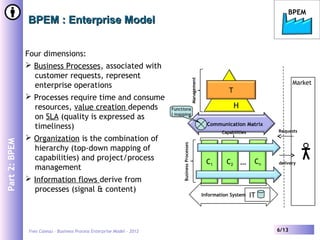
Four dimensions:
 Business Processes, associated with
customer requests, represent
enterprise operations
 Processes require time and consume
resources, value creation depends
on SLA (quality is expressed as
timeliness)
 Organization is the combination of
hierarchy (top-down mapping of
capabilities) and project/process
management
 Information flows derive from
processes (signal & content)
BPEM
Yves Caseau – Business Process Enterprise Model - 2012 7/13
BPEM Organization ModelBPEM Organization Model
Part2:BPEM
T
U
1
…
Hierarchical
Management
U
2
U
3 …
U
4
U
Un
-1
U
n
Process(Transverse)
Management
Functional
mapping
C1
C2 Cn…
Capabilities
R1(l1,l2, .. , lq)
Set of
Ressources
Activity
R2(l1,l2, .. , lq)
Rp(l1,l2, .. , lq)
WBS
Σ(skill, level, units)
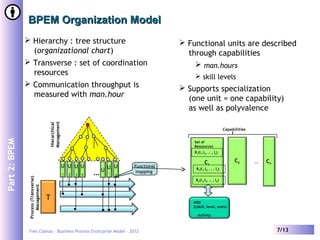
 Hierarchy : tree structure
(organizational chart)
 Transverse : set of coordination
resources
 Communication throughput is
measured with man.hour
 Functional units are described
through capabilities
 man.hours
 skill levels
 Supports specialization
(one unit = one capability)
as well as polyvalence
Yves Caseau – Business Process Enterprise Model - 2012 8/13
BPEM : Business Process ModelBPEM : Business Process Model
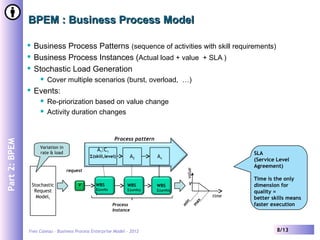
 Business Process Patterns (sequence of activities with skill requirements)
 Business Process Instances (Actual load + value + SLA )
 Stochastic Load Generation
 Cover multiple scenarios (burst, overload, …)
 Events:
 Re-priorization based on value change
 Activity duration changes
Part2:BPEM
A1:C1
Σ(skill,level) A2 An
Process pattern
Stochastic
Request
Model1
Process
Instance
value
time
WBS
Σ(units
)
WBS
Σ(units)
WBS
Σ(units)
Variation in
rate & load
request
VV m
in
m
ax
SLA
(Service Level
Agreement)
Time is the only
dimension for
quality =
better skills means
faster execution
Yves Caseau – Business Process Enterprise Model - 2012 9/13
BPEM : Communication ModelBPEM : Communication Model
Part2:BPEM
H
T
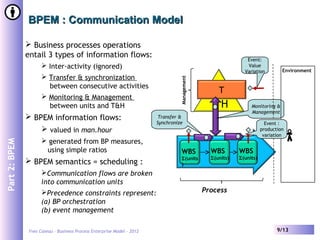
Management
Process
Monitoring &
Management
Transfer &
Synchronize
WBS
Σ(units
)
WBS
Σ(units)
WBS
Σ(units)
Environment
Event:
Value
Variation
Event :
production
variation
 Business processes operations
entail 3 types of information flows:
 Inter-activity (ignored)
 Transfer & synchronization
between consecutive activities
 Monitoring & Management
between units and T&H
 BPEM information flows:
 valued in man.hour
 generated from BP measures,
using simple ratios
 BPEM semantics = scheduling :
Communication flows are broken
into communication units
Precedence constraints represent:
(a) BP orchestration
(b) event management
Yves Caseau – Business Process Enterprise Model - 2012 10/13
Optimizing the use of communication channelsOptimizing the use of communication channels
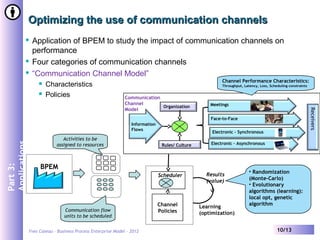
 Application of BPEM to study the impact of communication channels on
performance
 Four categories of communication channels
 “Communication Channel Model”
 Characteristics
 Policies
Part3:
Applications
Communication
Channel
Model
BPEM
Results
(value)
Learning
(optimization)
Activities to be
assigned to resources
Channel
PoliciesCommunication flow
units to be scheduled
Scheduler
Receivers
Organization
Rules/ Culture
Information
Flows
Meetings
Face-to-Face
Electronic – Synchronous
Electronic – Asynchronous
• Randomization
(Monte-Carlo)
• Evolutionary
algorithms (learning):
local opt, genetic
algorithm
Channel Performance Characteristics:
Throughput, Latency, Loss, Scheduling constraints
Yves Caseau – Business Process Enterprise Model - 2012 11/13
Simulation of Information FlowsSimulation of Information Flows
 Goals – How to ?
 Best use of multiple / new communication channels ?
 Study the resilience of organization w.r.t. load distribution and bursts
 Look at Organizational Architecture issues (e.g., flat hierarchies)
 Organization shapes communication channels (e.g., meetings)
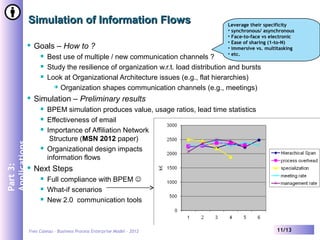
 Simulation – Preliminary results
 BPEM simulation produces value, usage ratios, lead time statistics
 Effectiveness of email
 Importance of Affiliation Network
Structure (MSN 2012 paper)
 Organizational design impacts
information flows
 Next Steps
 Full compliance with BPEM 
 What-if scenarios
 New 2.0 communication tools
Part3:
Applications Leverage their specificity
• synchronous/ asynchronous
• Face-to-face vs electronic
• Ease of sharing (1-to-N)
• immersive vs. multitasking
• etc.
Yves Caseau – Business Process Enterprise Model - 2012 12/13
Understanding lean management of processesUnderstanding lean management of processes
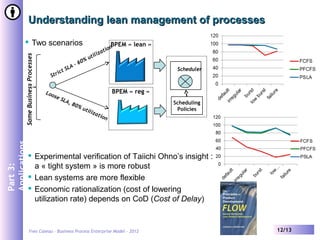
 Two scenarios
Part3:
Applications
 Experimental verification of Taiichi Ohno’s insight :
a « tight system » is more robust
 Lean systems are more flexible
 Economic rationalization (cost of lowering
utilization rate) depends on CoD (Cost of Delay)
Strict SLA – 60% utilization
BPEM « lean »
Scheduling
Policies
Scheduler
BPEM « reg »
SameBusinessProcesses
Loose SLA, 80% utilization
Yves Caseau – Business Process Enterprise Model - 2012 13/13
ConclusionsConclusions
 We need Enterprise Models
 Use OR for Management science
 Other applications : Information System
 BPEM is compatible with most conceptual models 
 We need computational Enterprise Models
 Complex issues : simulation as an investigation tool
 Structural issues are only one of the dimensions, but it is critical and
amenable to analysis though simulation
 Managing Information Flows is a key part of management
science
 An old idea (March & Simon)
 A modern idea (Enterprise 2.0 & information overload)
 Communication requires time:
scheduling & structure matters
Yves CASEAU

Managing Business Processes Communication and Performance

  • 1.
    Yves Caseau –Business Process Enterprise Model - 2012 1/13 Operations Research for Managing BusinessOperations Research for Managing Business Processes Communication and PerformanceProcesses Communication and Performance BPEM : Business Process Enterprise ModelBPEM : Business Process Enterprise Model ICORES February 2012 Yves Caseau Bouygues Telecom – Bouygues’s eLab National French Academy of Technologies
  • 2.
    Yves Caseau –Business Process Enterprise Model - 2012 2/13 MotivationsMotivations  « Traditional » ICORES   Crisp, well-defined models corresponding to a clear issue  Sophisticated optimization techniques that bring value  (compared to human judgment)  « Enterprise as a System » optimization  Cumbersome and coarse models, multiple issues  Simple optimization/simulation methods  Part of management sciences,  a tradition of models & simulation  Why ?  Structural issues (in addition to cultural, political, human …)  How  Enterprise modeling with operational semantics  “As simple as possible but no simpler”  White box model  Complex system approach (rich interaction of various concerns) Cf. “Garbage-can model” of decision Ill-defined problem Human > computer Cf. Vehicle Routing problems Computer > human Not a « personal fiction » ! Not a
  • 3.
    Yves Caseau –Business Process Enterprise Model - 2012 3/13 OutlineOutline  Motivations  Operations Research for Management Science  First Part Enterprise Models & Business Processes  Second Part BPEM: Business Process Enterprise Model Four Dimensions of Enterprise Modeling  Third Part Applications – Two Examples  Conclusion
  • 4.
    Yves Caseau –Business Process Enterprise Model - 2012 4/13 Enterprise ModelsEnterprise Models Part1:Motivations Ressources CEISAR BAPO (ESAPS) IDEAS CPP (Club Pilotes Processus) Altime MODAF Business Organization Architecture Process Activity Activity Activityprocess Manual/assisted/automated value Organization/ Actors Information objectives Units/roles Enterprise Entity Capability Role ServicesProcess Strategy /goals Information System Business Process Action Plan Innove / adjust / optimize Results: -Satisfaction - value - risk Managing processes Support process Functions Business processes Business processes Business processes environment customers Logical Capability project delta data function Activity Information system Organization resource skills Strategy/vision TasksEnterprise IT
  • 5.
    Yves Caseau –Business Process Enterprise Model - 2012 5/13 BPEM at a glanceBPEM at a glance Part1:Motivations Leadership Process KPI people Policy & Strategy Partnership & resources Leadership Customer results Society results Innovation & Learning enablers results Left out (long term) Perimeter of BPEM Information Flows activity activity Environment Management Control Coordination customer Production Factors Products / services transfer synchronization manage  Enterprise macro-model (Mintzberg)  Executable (operational semantics)  Focus on Business Process & Communication  What BPEM is and isn’t, based on EFQM  Focus on structure  Short-term vision of enterprise operations
  • 6.
    Yves Caseau –Business Process Enterprise Model - 2012 6/13 BPEM : Enterprise ModelBPEM : Enterprise Model Part2:BPEM H T Communication Matrix C1 C2 Cn… Information System IT BusinessProcesses Market Requests delivery Management Capabilities Functiona l mapping Four dimensions:  Business Processes, associated with customer requests, represent enterprise operations  Processes require time and consume resources, value creation depends on SLA (quality is expressed as timeliness)  Organization is the combination of hierarchy (top-down mapping of capabilities) and project/process management  Information flows derive from processes (signal & content) BPEM
  • 7.
    Yves Caseau –Business Process Enterprise Model - 2012 7/13 BPEM Organization ModelBPEM Organization Model Part2:BPEM T U 1 … Hierarchical Management U 2 U 3 … U 4 U Un -1 U n Process(Transverse) Management Functional mapping C1 C2 Cn… Capabilities R1(l1,l2, .. , lq) Set of Ressources Activity R2(l1,l2, .. , lq) Rp(l1,l2, .. , lq) WBS Σ(skill, level, units)  Hierarchy : tree structure (organizational chart)  Transverse : set of coordination resources  Communication throughput is measured with man.hour  Functional units are described through capabilities  man.hours  skill levels  Supports specialization (one unit = one capability) as well as polyvalence
  • 8.
    Yves Caseau –Business Process Enterprise Model - 2012 8/13 BPEM : Business Process ModelBPEM : Business Process Model  Business Process Patterns (sequence of activities with skill requirements)  Business Process Instances (Actual load + value + SLA )  Stochastic Load Generation  Cover multiple scenarios (burst, overload, …)  Events:  Re-priorization based on value change  Activity duration changes Part2:BPEM A1:C1 Σ(skill,level) A2 An Process pattern Stochastic Request Model1 Process Instance value time WBS Σ(units ) WBS Σ(units) WBS Σ(units) Variation in rate & load request VV m in m ax SLA (Service Level Agreement) Time is the only dimension for quality = better skills means faster execution
  • 9.
    Yves Caseau –Business Process Enterprise Model - 2012 9/13 BPEM : Communication ModelBPEM : Communication Model Part2:BPEM H T Management Process Monitoring & Management Transfer & Synchronize WBS Σ(units ) WBS Σ(units) WBS Σ(units) Environment Event: Value Variation Event : production variation  Business processes operations entail 3 types of information flows:  Inter-activity (ignored)  Transfer & synchronization between consecutive activities  Monitoring & Management between units and T&H  BPEM information flows:  valued in man.hour  generated from BP measures, using simple ratios  BPEM semantics = scheduling : Communication flows are broken into communication units Precedence constraints represent: (a) BP orchestration (b) event management
  • 10.
    Yves Caseau –Business Process Enterprise Model - 2012 10/13 Optimizing the use of communication channelsOptimizing the use of communication channels  Application of BPEM to study the impact of communication channels on performance  Four categories of communication channels  “Communication Channel Model”  Characteristics  Policies Part3: Applications Communication Channel Model BPEM Results (value) Learning (optimization) Activities to be assigned to resources Channel PoliciesCommunication flow units to be scheduled Scheduler Receivers Organization Rules/ Culture Information Flows Meetings Face-to-Face Electronic – Synchronous Electronic – Asynchronous • Randomization (Monte-Carlo) • Evolutionary algorithms (learning): local opt, genetic algorithm Channel Performance Characteristics: Throughput, Latency, Loss, Scheduling constraints
  • 11.
    Yves Caseau –Business Process Enterprise Model - 2012 11/13 Simulation of Information FlowsSimulation of Information Flows  Goals – How to ?  Best use of multiple / new communication channels ?  Study the resilience of organization w.r.t. load distribution and bursts  Look at Organizational Architecture issues (e.g., flat hierarchies)  Organization shapes communication channels (e.g., meetings)  Simulation – Preliminary results  BPEM simulation produces value, usage ratios, lead time statistics  Effectiveness of email  Importance of Affiliation Network Structure (MSN 2012 paper)  Organizational design impacts information flows  Next Steps  Full compliance with BPEM   What-if scenarios  New 2.0 communication tools Part3: Applications Leverage their specificity • synchronous/ asynchronous • Face-to-face vs electronic • Ease of sharing (1-to-N) • immersive vs. multitasking • etc.
  • 12.
    Yves Caseau –Business Process Enterprise Model - 2012 12/13 Understanding lean management of processesUnderstanding lean management of processes  Two scenarios Part3: Applications  Experimental verification of Taiichi Ohno’s insight : a « tight system » is more robust  Lean systems are more flexible  Economic rationalization (cost of lowering utilization rate) depends on CoD (Cost of Delay) Strict SLA – 60% utilization BPEM « lean » Scheduling Policies Scheduler BPEM « reg » SameBusinessProcesses Loose SLA, 80% utilization
  • 13.
    Yves Caseau –Business Process Enterprise Model - 2012 13/13 ConclusionsConclusions  We need Enterprise Models  Use OR for Management science  Other applications : Information System  BPEM is compatible with most conceptual models   We need computational Enterprise Models  Complex issues : simulation as an investigation tool  Structural issues are only one of the dimensions, but it is critical and amenable to analysis though simulation  Managing Information Flows is a key part of management science  An old idea (March & Simon)  A modern idea (Enterprise 2.0 & information overload)  Communication requires time: scheduling & structure matters Yves CASEAU

Editor's Notes

  • #3 Most important slide, if you do get my motivation, the rest of the talk will be lost since this is no cutting edge science Why: Big Enterprise efficiency issue ! White Box : simple, standard
  • #5 Deux messages: - ils existent (besoin pour IT et pour TQM) - ils utilisent une grammaire de concepts communs Key concepts: Business Processes Resource Organization Service / contracts -> value - Information
  • #6 Modèle (cf. Mintzberg – propre à la simulation - nanoéconomie) Focus on short-term operations, simple vue of value creation
  • #9 Parler de la probabilité Parler de la priorisation OCCAM’s razor: pas de qualité
  • #10 Principe clé de March & Simon “La capacité d’une organisation à maintenir un schéma complexe et fortement interdépendant d’activités est limitée pour partie par sa capacité à gérer les communications requise pour leur coordination” Le 21e siècle est celui du post-Taylorisme parce que la complexité de la coordination casse la logique du « séparation & spécialisation » Complexité des transferts de « contexte » (retour aux généralistes) Fréquence de la synchronisation avec l’environnement (aléas/incertitude)
  • #11 Characteristics: latency, throughput (one to M), sync/async of both ends, fidelity loss
  • #12 Rôle de l’organisation qui Façonne les canaux (comités, points) -> crée un « canal » de com Culture: donne les priorités et usage – ex: répondre au tel en réunion Efficacité du tel = fonction de la culture
  • #13 Comparons: « lean » IT : utilisation à 60% de la capacité, SLA serrés (50% lean ratio) « IT optimisé »: utilisation à 80% de la capacité, SLA plus “larges” (10-20% lean ratio = total des temps de service / temps de service global)