Interoperability 
A quick chat, a few war stories...
The OPF team 
Community Manager 
● Events (face-to-face/virtual) 
● Training (staff development) 
● Comms (web/email/social) 
Executive Director 
● Membership (engagement/value) 
● Open preservation advocacy 
● Operational management 
Technical Lead 
● Infrastructure (host/test) 
● Software stewardship (roadmap/maturity/packaging) 
● Data corpora
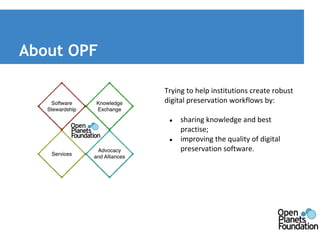
About OPF 
Trying to help institutions create robust 
digital preservation workflows by: 
● sharing knowledge and best 
practise; 
● improving the quality of digital 
preservation software.
Introduction 
Here to set the scene by: 
● Defining interoperability 
● Providing a personal perspective 
● Covering a few engineering fundamentals 
● Looking for an easier way
Interoperability 
“is the ability of making systems and 
organisations work together (inter-operate).” 
straight from Wikipedia
Origins? 
Coined in IT and system services to allow for 
information exchange.
But it’s not just an IT thing 
A broader definition also considers: 
● social issues 
● political & organisational factors 
that “impact system to system performance”
Another “definition” 
“Task of building coherent services for users 
when the individual components are technically 
difficult and managed by different 
organisations.” 
Wikipedia again
Who’s in the interoperability game? 
● Information professionals 
● Software engineers 
● Staff who work on distributed projects 
● People dealing with complexity
Sound like anyone we know? 
So those of us lucky enough to work in IT for 
Information professionals on collaborative projects 
it’s welcome to interoperability X 3…..
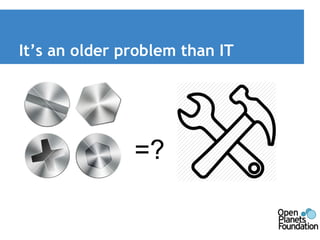
It’s an older problem than IT 
=?
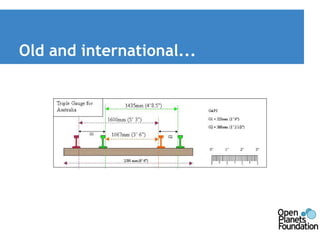
Old and international...
But IT does it better... 
The UK NHS National Program for IT 
● biggest civilian IT project of its kind 
● “mashups” for health records 
● in theory 2003 - 2007 costing £2.4 billion 
● in reality 2003 - 2011 costing £13 billion 
● incidentally it didn’t work…….
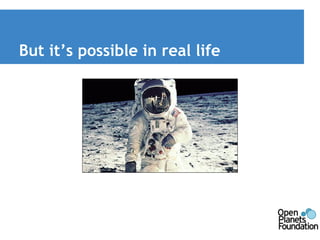
But it’s possible in real life
And it’s possible in IT….. 
Think of a system that is: 
● decentralised 
● fault tolerant 
● built on simple building blocks
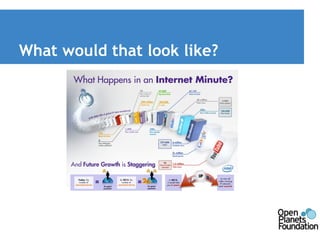
What would that look like?
Things to think about 
● simplicity 
● standards 
● clarity 
● test early 
● test often
Small is beautiful 
● small parts can build beautiful robust wholes 
● it’s one way of tackling complexity 
● BUT the parts need testable, tested and reliable
Standards are your friends 
It’s always worth checking if there’s a standard 
available and in use but: 
● there’s often more than one 
● they’re not always easy to understand 
● they’re hostage to commercial interests
Be clear in your intentions 
Again simplicity / small size helps here 
● Document clearly and publicly 
● Keep it up to date 
● If you’re not willing to explain how it works….
Test early and often 
And test the parts together rather than as well as 
separately 
Technologies to automate testing: 
● virtualisation 
● online public continuous integration
Interoperability is the future 
The Internet of Things is gathering pace 
Information exchange happening between more 
and more devices, more regularly. 
REST, XML, Json
But it’s NEVER finished 
Two aspects of interoperability: 
● Syntactically interoperable 
● Semantically interoperable 
That’s to say speaking the same language is one 
thing, understanding what the other is saying is 
another…..
Why data is a special problem 
In the cultural heritage sector 
● shared data == shared problems 
● legal issues (IPR) means we don’t share as we 
should
Moving the mountain 
Moving the large volume takes way too long…. 
● If I want to move > 5 TB for processing 
● THEN move the results back…..
A better way….. 
It’s now MUCH easier to move the application to 
the data: 
● It’s more secure 
● virtual machines are approx. 300 MB 
● Docker - application containers
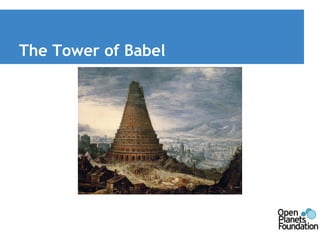
So the oldest interoperability story? 
● It might not be the oldest but it’s close, 
● about old school integration issues. 
● Something of a cautionary tale, 
● it didn’t end well…..
The Tower of Babel
My Details 
● Carl Wilson 
● Technical Lead 
● Open Planets Foundation 
● Email : carl@openplanetsfoundation.org 
● Skype : carl.f.wilson 
● GitHub : carlwilson 
● Twitter : @openplanets 
● Google+ : carl@openplanetsfoundation.org

1. 'Interoperability. A quick chat, a few war stories'. Carl Wilson, Open Planets Foundation.

  • 1.
    Interoperability A quickchat, a few war stories...
  • 2.
    The OPF team Community Manager ● Events (face-to-face/virtual) ● Training (staff development) ● Comms (web/email/social) Executive Director ● Membership (engagement/value) ● Open preservation advocacy ● Operational management Technical Lead ● Infrastructure (host/test) ● Software stewardship (roadmap/maturity/packaging) ● Data corpora
  • 3.
    About OPF Tryingto help institutions create robust digital preservation workflows by: ● sharing knowledge and best practise; ● improving the quality of digital preservation software.
  • 4.
    Introduction Here toset the scene by: ● Defining interoperability ● Providing a personal perspective ● Covering a few engineering fundamentals ● Looking for an easier way
  • 5.
    Interoperability “is theability of making systems and organisations work together (inter-operate).” straight from Wikipedia
  • 6.
    Origins? Coined inIT and system services to allow for information exchange.
  • 7.
    But it’s notjust an IT thing A broader definition also considers: ● social issues ● political & organisational factors that “impact system to system performance”
  • 8.
    Another “definition” “Taskof building coherent services for users when the individual components are technically difficult and managed by different organisations.” Wikipedia again
  • 9.
    Who’s in theinteroperability game? ● Information professionals ● Software engineers ● Staff who work on distributed projects ● People dealing with complexity
  • 10.
    Sound like anyonewe know? So those of us lucky enough to work in IT for Information professionals on collaborative projects it’s welcome to interoperability X 3…..
  • 11.
    It’s an olderproblem than IT =?
  • 12.
  • 13.
    But IT doesit better... The UK NHS National Program for IT ● biggest civilian IT project of its kind ● “mashups” for health records ● in theory 2003 - 2007 costing £2.4 billion ● in reality 2003 - 2011 costing £13 billion ● incidentally it didn’t work…….
  • 14.
    But it’s possiblein real life
  • 15.
    And it’s possiblein IT….. Think of a system that is: ● decentralised ● fault tolerant ● built on simple building blocks
  • 16.
    What would thatlook like?
  • 17.
    Things to thinkabout ● simplicity ● standards ● clarity ● test early ● test often
  • 18.
    Small is beautiful ● small parts can build beautiful robust wholes ● it’s one way of tackling complexity ● BUT the parts need testable, tested and reliable
  • 19.
    Standards are yourfriends It’s always worth checking if there’s a standard available and in use but: ● there’s often more than one ● they’re not always easy to understand ● they’re hostage to commercial interests
  • 20.
    Be clear inyour intentions Again simplicity / small size helps here ● Document clearly and publicly ● Keep it up to date ● If you’re not willing to explain how it works….
  • 21.
    Test early andoften And test the parts together rather than as well as separately Technologies to automate testing: ● virtualisation ● online public continuous integration
  • 22.
    Interoperability is thefuture The Internet of Things is gathering pace Information exchange happening between more and more devices, more regularly. REST, XML, Json
  • 23.
    But it’s NEVERfinished Two aspects of interoperability: ● Syntactically interoperable ● Semantically interoperable That’s to say speaking the same language is one thing, understanding what the other is saying is another…..
  • 24.
    Why data isa special problem In the cultural heritage sector ● shared data == shared problems ● legal issues (IPR) means we don’t share as we should
  • 25.
    Moving the mountain Moving the large volume takes way too long…. ● If I want to move > 5 TB for processing ● THEN move the results back…..
  • 26.
    A better way….. It’s now MUCH easier to move the application to the data: ● It’s more secure ● virtual machines are approx. 300 MB ● Docker - application containers
  • 27.
    So the oldestinteroperability story? ● It might not be the oldest but it’s close, ● about old school integration issues. ● Something of a cautionary tale, ● it didn’t end well…..
  • 28.
  • 29.
    My Details ●Carl Wilson ● Technical Lead ● Open Planets Foundation ● Email : carl@openplanetsfoundation.org ● Skype : carl.f.wilson ● GitHub : carlwilson ● Twitter : @openplanets ● Google+ : carl@openplanetsfoundation.org