KIND CHOICES
YOU CAN HELP PEOPLE
AND REDUCE
ANIMAL SUFFERING
VIVISECTION
Vivus – latin meaning for “alive”
Sectio – latin meaning for “cutting”
“The cutting of or operation on a living animal
usually for physiological or pathological
investigation; broadly : animal
experimentation especially if considered to
cause distress or result in injury or death to
the subject”
An estimated 115 to 127 million animals are currently used in experimental
research worldwide. But a growing number of scientists believe that animal
experimentation is scientifically flawed for physiological, genetic, and
procedural reasons. Answers to the most pressing human health
problems—heart disease, cancer, diabetes, and others—lie in understanding
human cells, human genes, and, in some cases, human habits.
“…the reality of experiments on animals is largely hidden from the
public and that many would consider what routinely happens to cats,
dogs and monkeys in labs to be torture. I explained that many current
experiments on animals have a tenuous link to improving human health.
I also offered that an oversight system in which animal experimenters
are charged with reviewing and approving the work of other animal
experimenters is seriously flawed.” Dr. Lawrence Hansen - professor in
the departments of neurosciences and pathology at the University of
California-San Diego School of Medicine in La Jolla, Calif.
UCSD’s Dr. Larry Hansen helped put an end to mandatory dog labs in
freshman physiology classes at the medical school in 2003
The question is not, ‘Can they reason?’
nor, ‘Can they talk?’ but, ‘Can they suffer?’
– Jeremy Bentham, British Philosopher 1823
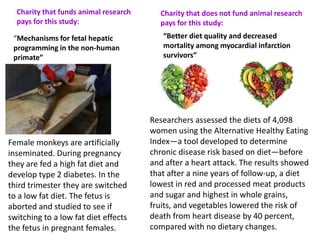
“Mechanisms for fetal hepatic
programming in the non-human
primate”
Charity that funds animal research
pays for this study:
Female monkeys are artificially
inseminated. During pregnancy
they are fed a high fat diet and
develop type 2 diabetes. In the
third trimester they are switched
to a low fat diet. The fetus is
aborted and studied to see if
switching to a low fat diet effects
the fetus in pregnant females.
Charity that does not fund animal research
pays for this study:
“Better diet quality and decreased
mortality among myocardial infarction
survivors”
Researchers assessed the diets of 4,098
women using the Alternative Healthy Eating
Index—a tool developed to determine
chronic disease risk based on diet—before
and after a heart attack. The results showed
that after a nine years of follow-up, a diet
lowest in red and processed meat products
and sugar and highest in whole grains,
fruits, and vegetables lowered the risk of
death from heart disease by 40 percent,
compared with no dietary changes.
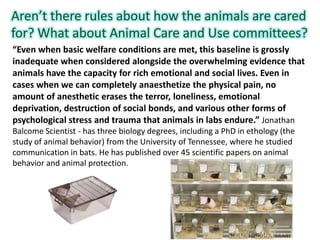
“Even when basic welfare conditions are met, this baseline is grossly
inadequate when considered alongside the overwhelming evidence that
animals have the capacity for rich emotional and social lives. Even in
cases when we can completely anaesthetize the physical pain, no
amount of anesthetic erases the terror, loneliness, emotional
deprivation, destruction of social bonds, and various other forms of
psychological stress and trauma that animals in labs endure.” Jonathan
Balcome Scientist - has three biology degrees, including a PhD in ethology (the
study of animal behavior) from the University of Tennessee, where he studied
communication in bats. He has published over 45 scientific papers on animal
behavior and animal protection.
Aren’t there rules about how the animals are cared
for? What about Animal Care and Use committees?
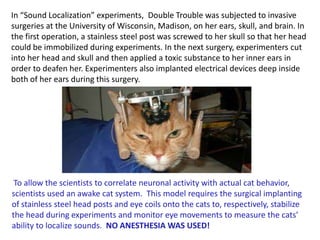
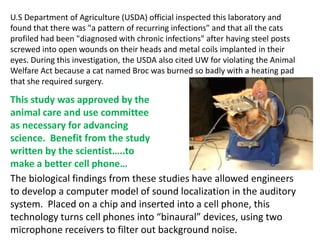
In “Sound Localization” experiments, Double Trouble was subjected to invasive
surgeries at the University of Wisconsin, Madison, on her ears, skull, and brain. In
the first operation, a stainless steel post was screwed to her skull so that her head
could be immobilized during experiments. In the next surgery, experimenters cut
into her head and skull and then applied a toxic substance to her inner ears in
order to deafen her. Experimenters also implanted electrical devices deep inside
both of her ears during this surgery.
To allow the scientists to correlate neuronal activity with actual cat behavior,
scientists used an awake cat system. This model requires the surgical implanting
of stainless steel head posts and eye coils onto the cats to, respectively, stabilize
the head during experiments and monitor eye movements to measure the cats’
ability to localize sounds. NO ANESTHESIA WAS USED!
The biological findings from these studies have allowed engineers
to develop a computer model of sound localization in the auditory
system. Placed on a chip and inserted into a cell phone, this
technology turns cell phones into “binaural” devices, using two
microphone receivers to filter out background noise.
U.S Department of Agriculture (USDA) official inspected this laboratory and
found that there was "a pattern of recurring infections" and that all the cats
profiled had been "diagnosed with chronic infections" after having steel posts
screwed into open wounds on their heads and metal coils implanted in their
eyes. During this investigation, the USDA also cited UW for violating the Animal
Welfare Act because a cat named Broc was burned so badly with a heating pad
that she required surgery.
This study was approved by the
animal care and use committee
as necessary for advancing
science. Benefit from the study
written by the scientist…..to
make a better cell phone…
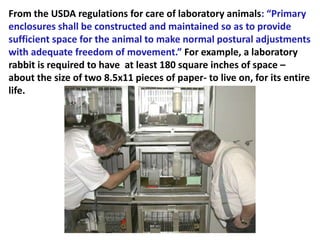
From the USDA regulations for care of laboratory animals: “Primary
enclosures shall be constructed and maintained so as to provide
sufficient space for the animal to make normal postural adjustments
with adequate freedom of movement.” For example, a laboratory
rabbit is required to have at least 180 square inches of space –
about the size of two 8.5x11 pieces of paper- to live on, for its entire
life.
But if we don’t use animals, how will we find
cures to diseases?
In Vitro Research – conducted in an external, controlled environment, such as a
test tube. Two to three times more accurate than tests on rats or mice. Penicillin,
which is toxic to guinea pigs, would not have passed a toxicity test if it had only
been tested on animals.
Epidemiology – the study and control of diseases within a human population. Has
linked diet to heart disease, smoking to lung disease, and has identified all known
environmental poisons.
Genetic Research – reveals which genes cause humans to be predisposed to
hereditary problems such as birth defects, cancer, and heart disease. Results of
DNA studies in animals are inapplicable to the treatment of humans.
Autopsies – the cause of virtually every disease has either been discovered or
clarified by performing autopsies on diseased patients.
Computer and Mathematical Modeling – have recently led to new treatments
for breast cancer, AIDS, and high blood pressure. They also allow scientists to
predict toxicity and analyze toxic chemicals.
These are just a few alternatives to using animals in research!
TRITONCARE
We can
make
cruelty free
choices!

Humane charity presentation

  • 1.
    KIND CHOICES YOU CANHELP PEOPLE AND REDUCE ANIMAL SUFFERING
  • 2.
    VIVISECTION Vivus – latinmeaning for “alive” Sectio – latin meaning for “cutting” “The cutting of or operation on a living animal usually for physiological or pathological investigation; broadly : animal experimentation especially if considered to cause distress or result in injury or death to the subject”
  • 3.
    An estimated 115to 127 million animals are currently used in experimental research worldwide. But a growing number of scientists believe that animal experimentation is scientifically flawed for physiological, genetic, and procedural reasons. Answers to the most pressing human health problems—heart disease, cancer, diabetes, and others—lie in understanding human cells, human genes, and, in some cases, human habits. “…the reality of experiments on animals is largely hidden from the public and that many would consider what routinely happens to cats, dogs and monkeys in labs to be torture. I explained that many current experiments on animals have a tenuous link to improving human health. I also offered that an oversight system in which animal experimenters are charged with reviewing and approving the work of other animal experimenters is seriously flawed.” Dr. Lawrence Hansen - professor in the departments of neurosciences and pathology at the University of California-San Diego School of Medicine in La Jolla, Calif. UCSD’s Dr. Larry Hansen helped put an end to mandatory dog labs in freshman physiology classes at the medical school in 2003
  • 4.
    The question isnot, ‘Can they reason?’ nor, ‘Can they talk?’ but, ‘Can they suffer?’ – Jeremy Bentham, British Philosopher 1823
  • 5.
    “Mechanisms for fetalhepatic programming in the non-human primate” Charity that funds animal research pays for this study: Female monkeys are artificially inseminated. During pregnancy they are fed a high fat diet and develop type 2 diabetes. In the third trimester they are switched to a low fat diet. The fetus is aborted and studied to see if switching to a low fat diet effects the fetus in pregnant females. Charity that does not fund animal research pays for this study: “Better diet quality and decreased mortality among myocardial infarction survivors” Researchers assessed the diets of 4,098 women using the Alternative Healthy Eating Index—a tool developed to determine chronic disease risk based on diet—before and after a heart attack. The results showed that after a nine years of follow-up, a diet lowest in red and processed meat products and sugar and highest in whole grains, fruits, and vegetables lowered the risk of death from heart disease by 40 percent, compared with no dietary changes.
  • 6.
    “Even when basicwelfare conditions are met, this baseline is grossly inadequate when considered alongside the overwhelming evidence that animals have the capacity for rich emotional and social lives. Even in cases when we can completely anaesthetize the physical pain, no amount of anesthetic erases the terror, loneliness, emotional deprivation, destruction of social bonds, and various other forms of psychological stress and trauma that animals in labs endure.” Jonathan Balcome Scientist - has three biology degrees, including a PhD in ethology (the study of animal behavior) from the University of Tennessee, where he studied communication in bats. He has published over 45 scientific papers on animal behavior and animal protection. Aren’t there rules about how the animals are cared for? What about Animal Care and Use committees?
  • 7.
    In “Sound Localization”experiments, Double Trouble was subjected to invasive surgeries at the University of Wisconsin, Madison, on her ears, skull, and brain. In the first operation, a stainless steel post was screwed to her skull so that her head could be immobilized during experiments. In the next surgery, experimenters cut into her head and skull and then applied a toxic substance to her inner ears in order to deafen her. Experimenters also implanted electrical devices deep inside both of her ears during this surgery. To allow the scientists to correlate neuronal activity with actual cat behavior, scientists used an awake cat system. This model requires the surgical implanting of stainless steel head posts and eye coils onto the cats to, respectively, stabilize the head during experiments and monitor eye movements to measure the cats’ ability to localize sounds. NO ANESTHESIA WAS USED!
  • 8.
    The biological findingsfrom these studies have allowed engineers to develop a computer model of sound localization in the auditory system. Placed on a chip and inserted into a cell phone, this technology turns cell phones into “binaural” devices, using two microphone receivers to filter out background noise. U.S Department of Agriculture (USDA) official inspected this laboratory and found that there was "a pattern of recurring infections" and that all the cats profiled had been "diagnosed with chronic infections" after having steel posts screwed into open wounds on their heads and metal coils implanted in their eyes. During this investigation, the USDA also cited UW for violating the Animal Welfare Act because a cat named Broc was burned so badly with a heating pad that she required surgery. This study was approved by the animal care and use committee as necessary for advancing science. Benefit from the study written by the scientist…..to make a better cell phone…
  • 9.
    From the USDAregulations for care of laboratory animals: “Primary enclosures shall be constructed and maintained so as to provide sufficient space for the animal to make normal postural adjustments with adequate freedom of movement.” For example, a laboratory rabbit is required to have at least 180 square inches of space – about the size of two 8.5x11 pieces of paper- to live on, for its entire life.
  • 10.
    But if wedon’t use animals, how will we find cures to diseases? In Vitro Research – conducted in an external, controlled environment, such as a test tube. Two to three times more accurate than tests on rats or mice. Penicillin, which is toxic to guinea pigs, would not have passed a toxicity test if it had only been tested on animals. Epidemiology – the study and control of diseases within a human population. Has linked diet to heart disease, smoking to lung disease, and has identified all known environmental poisons. Genetic Research – reveals which genes cause humans to be predisposed to hereditary problems such as birth defects, cancer, and heart disease. Results of DNA studies in animals are inapplicable to the treatment of humans. Autopsies – the cause of virtually every disease has either been discovered or clarified by performing autopsies on diseased patients. Computer and Mathematical Modeling – have recently led to new treatments for breast cancer, AIDS, and high blood pressure. They also allow scientists to predict toxicity and analyze toxic chemicals. These are just a few alternatives to using animals in research!
  • 11.