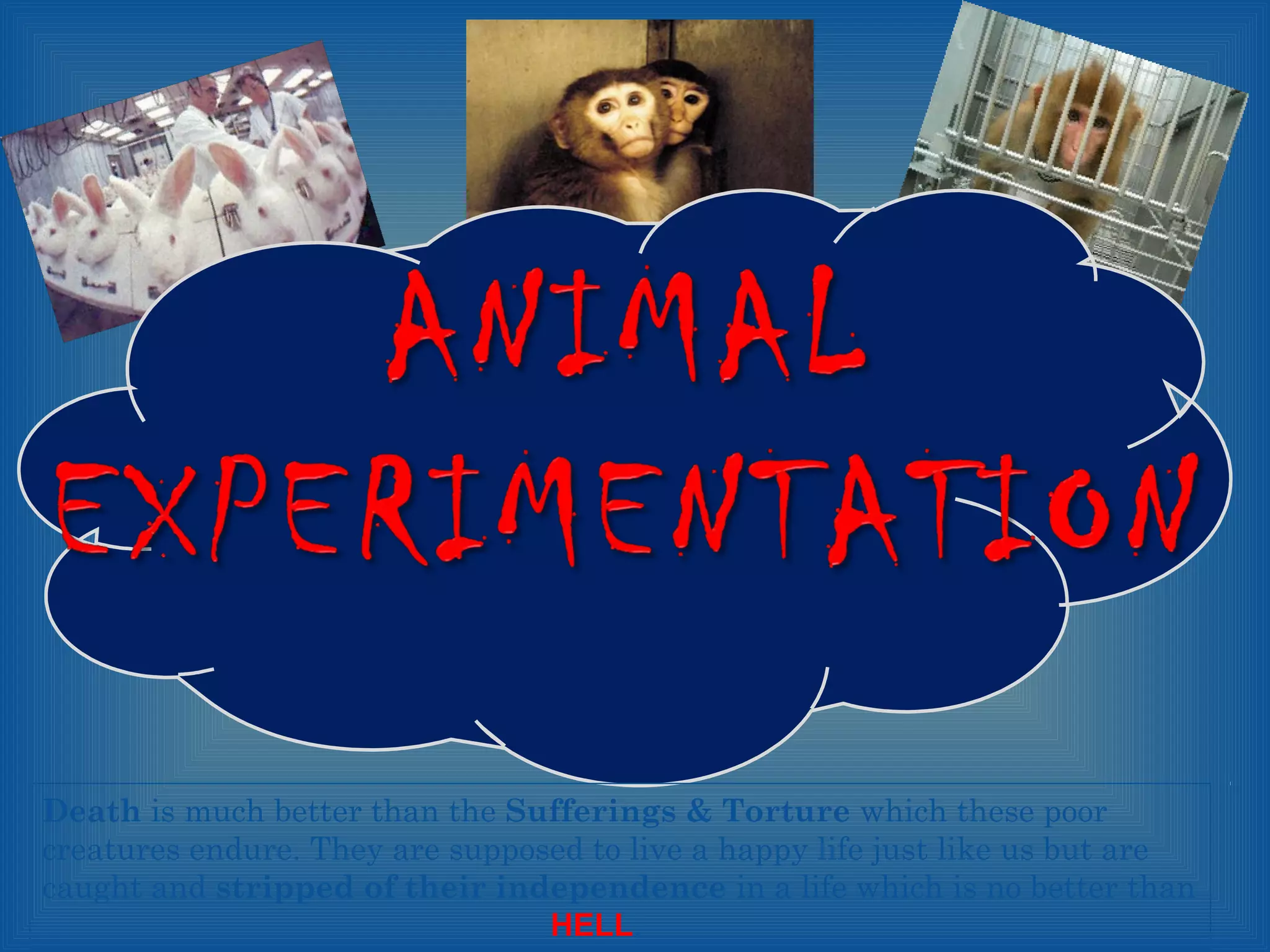
Death is much better than the Sufferings & Torture which these poor
creatures endure. They are supposed to live a happy life just like us but are
caught and stripped of their independence in a life which is no better than
HELL.
Many animals are used in
scientific and medical research.
They often undergo cruel
methods of testing and suffer
greatly as a result.
Animal experimentation
is both cruel and
unnecessary and humans
have no right to put
innocent animals through
such torture.
VIVISECTION
DRUG TESTING
DISEASE RESEARCH
TOXICOLOGY
SPACE RESEARCH
CLONING
Vivisection is the practice of experimenting on
live animals and it is a term to which many
scientists object.
In schools and colleges, frogs are the
most commonly dissected animals,
although other species, such as cats and
dogs, are also used.
Numerous drugs passed as safe on
animals caused side effects in humans
Skin Rashes
Nausea & Diarrhoea
Blindness
Birth Defects
Fatal Liver Failure
The advent of genetic technologies has made possible all
sorts of new and horrific acts of animal exploitation,
from cloning sheep to creating mutant and hybrid
creatures with no dignity or quality of life at all. We
should end animal experimentation before things get
even worse.
THIS WORLD IS NOT OURS.WE HAVE NO RIGHT TO
ALTER THE NATURAL ENVIRONMENT THROUGH
SUCH HORRIFIC DEEDS. Do You want
to be like
me???
IS This Our Future???!!!!
Two of the most common animal
safety tests are eye irritancy and
lethal dose tests.
In eye irritancy tests, chemicals
are dripped into the eyes of
albino rabbits. The animals are
usually immobilised in
stocks from which only their
heads protrude, and their
eyelids are held open with clips.
Often, they receive no
anaesthesia during the tests; some
rabbits break their backs as they
struggle to escape the pain.
After placing the chemicals in
the rabbits' eyes, laboratory
technicians record the
damage to the eye tissue,
which can include inflamed
irises, ulceration, bleeding,
massive deterioration and
blindness
In acute toxicity, or lethal dose, tests,
increasing amounts of detergent, eye shadow
and other products are force-fed to rats,
mice, rabbits, guinea pigs and other animals
until a certain percentage of them are
poisoned to death. The widely used lethal
dose 50 (LD50) test continues until at least
50 percent of the animals die, which usually
takes several weeks.
Experimenters observe the animals'
reactions to the chemicals-everything from
convulsions, laboured breathing,
diarrhoea, emaciation and skin
eruptions to bleeding from the eyes,
nose or mouth. Like eye irritancy tests,
lethal dose tests are unreliable at best.
In 1957,Laika became the first to be
launched into space, paving the way for
man.
Enos, the space chimp before insertion
into the Mercury-Atlas 5 capsule in
1961.
DISEASE RESEARCH
Vivisectors use animals in an attempt to find
cures for human disease
Mice are given cancers by being injected with
tumor cells
In arthritis research, chickens have chemicals
injected into their joints to induce pain and
inflammation
Heart attacks are triggered in dogs by tying off the
hearts main blood supply.
..
This is not how humansThis is not how humans
become sick nor dobecome sick nor do
artificially created diseasesartificially created diseases
progress in the same waysprogress in the same ways
as in humans.as in humans.
The FacT is ThaT all animals reacT
diFFerenTly To diFFerenT subsTances.
For example:-
- Lemon juice kills cats.
- Parsley kills parrots.
- Penicillin kills guinea-pigs.
- Strychnine is harmless to monkeys.
- Arsenic is harmless to sheep.
- Insulin causes malfunctions in chickens, rabbit
and mice.
- Aspirin causes birth defect in monkeys.
- Thalidomide is safe in guinea pigs.
- Opren kills humans but not monkeys.
Even CigarettesEven Cigarettes
!!!!!!
For decades, and up to this day, animal
experimenters have been testing cigarettes and their
components on animals. They have forced primates,
dogs, rabbits, and rats to breathe concentrated
cigarette smoke to determine what its effects are.
However, after all these decades of research, their
results continue to be "inconclusive" because
some species suffer negative effects while others do not
experience any health problems.
Animals used in the year 2001 in
the UK
ANIMALANIMAL NO. USEDNO. USED
MouseMouse 1,655,7661,655,766
RATRAT 489,613489,613
OTHER RODENTOTHER RODENT 60,52160,521
RABBITRABBIT 23,35623,356
CARNIVORECARNIVORE 8,2738,273
HOOFED MAMMALHOOFED MAMMAL 20,01320,013
PRIMATEPRIMATE 3,3423,342
OTHER MAMMALOTHER MAMMAL 776776
BIRDBIRD 125,605125,605
RAPTILERAPTILE 341341
AMPHIBIANAMPHIBIAN 9,6489,648
FISHFISH 170,459170,459
TOTALTOTAL 2,567,7132,567,713
Stats from Home Office,UK
An estimated 83% of substances are metabolized by rats in a
different way to humans.
Less than 2% of human illnesses (1.16%) are ever seen in
animals.
 95% of drugs passed by animal tests are immediately discarded
as useless or dangerous to humans.
According to the former scientific executive of Huntingdon
Life Sciences, animal tests and human results agree only '5%-
25% of the time'.
9% of anaesthetized animals, intended to recover, die.
Rats are only 37% effective in identifying what causes cancer
to humans. Flipping a coin would be more accurate.
We are told that they are less intelligent and important and so
hurting them is acceptable.
Isn't it wrong to cause deliberate suffering & death
Animals experience pain, fear & loneliness
Inside labs, animals have their hearts & other vital organs
deliberately damaged.
They are poisoned to death with toxic chemicals and subjected to
radiation burns.
Brain damaged monkeys are forced to perform repetitive tasks
in order to gain a reward of food and water.
Animals have been shot and exposed to nerve gases and given
addictive drugs.
Those who do not die during the experiment itself are invariably
killed so that their bodies can be examined.
Animal research has become a habit and an entire
industry has been built around it.
Scientists & Researchers who have built a career
promoting the value of animal studies, find it difficult
to reverse their positions.
Scientists who probably do not support animal
experimentation may be unwilling to speak out
publicly.
After all………………
Time, money, and resources devoted to these experiments could have
gone to human-based research.
 Clinical studies
Vitro research
Autopsies
Post-marketing drug
Micro dosing
Surveillance
Computer modeling
Epidemiology
Genetic research
pose no hazard to humans and provide accurate results.
Importantly, animal experiments have exhausted resources that could
have been dedicated to educating the public about health hazards and
health maintenance, therein diminishing the incidence of disease that
require treatment.
Animal Exploitation

Animal Exploitation

  • 2.
    Death is muchbetter than the Sufferings & Torture which these poor creatures endure. They are supposed to live a happy life just like us but are caught and stripped of their independence in a life which is no better than HELL.
  • 3.
    Many animals areused in scientific and medical research. They often undergo cruel methods of testing and suffer greatly as a result. Animal experimentation is both cruel and unnecessary and humans have no right to put innocent animals through such torture.
  • 4.
  • 5.
    Vivisection is thepractice of experimenting on live animals and it is a term to which many scientists object. In schools and colleges, frogs are the most commonly dissected animals, although other species, such as cats and dogs, are also used.
  • 6.
    Numerous drugs passedas safe on animals caused side effects in humans Skin Rashes Nausea & Diarrhoea Blindness Birth Defects Fatal Liver Failure
  • 8.
    The advent ofgenetic technologies has made possible all sorts of new and horrific acts of animal exploitation, from cloning sheep to creating mutant and hybrid creatures with no dignity or quality of life at all. We should end animal experimentation before things get even worse. THIS WORLD IS NOT OURS.WE HAVE NO RIGHT TO ALTER THE NATURAL ENVIRONMENT THROUGH SUCH HORRIFIC DEEDS. Do You want to be like me???
  • 9.
    IS This OurFuture???!!!!
  • 10.
    Two of themost common animal safety tests are eye irritancy and lethal dose tests. In eye irritancy tests, chemicals are dripped into the eyes of albino rabbits. The animals are usually immobilised in stocks from which only their heads protrude, and their eyelids are held open with clips. Often, they receive no anaesthesia during the tests; some rabbits break their backs as they struggle to escape the pain. After placing the chemicals in the rabbits' eyes, laboratory technicians record the damage to the eye tissue, which can include inflamed irises, ulceration, bleeding, massive deterioration and blindness
  • 11.
    In acute toxicity,or lethal dose, tests, increasing amounts of detergent, eye shadow and other products are force-fed to rats, mice, rabbits, guinea pigs and other animals until a certain percentage of them are poisoned to death. The widely used lethal dose 50 (LD50) test continues until at least 50 percent of the animals die, which usually takes several weeks. Experimenters observe the animals' reactions to the chemicals-everything from convulsions, laboured breathing, diarrhoea, emaciation and skin eruptions to bleeding from the eyes, nose or mouth. Like eye irritancy tests, lethal dose tests are unreliable at best.
  • 12.
    In 1957,Laika becamethe first to be launched into space, paving the way for man. Enos, the space chimp before insertion into the Mercury-Atlas 5 capsule in 1961.
  • 13.
    DISEASE RESEARCH Vivisectors useanimals in an attempt to find cures for human disease Mice are given cancers by being injected with tumor cells In arthritis research, chickens have chemicals injected into their joints to induce pain and inflammation Heart attacks are triggered in dogs by tying off the hearts main blood supply. ..
  • 14.
    This is nothow humansThis is not how humans become sick nor dobecome sick nor do artificially created diseasesartificially created diseases progress in the same waysprogress in the same ways as in humans.as in humans.
  • 15.
    The FacT isThaT all animals reacT diFFerenTly To diFFerenT subsTances. For example:- - Lemon juice kills cats. - Parsley kills parrots. - Penicillin kills guinea-pigs. - Strychnine is harmless to monkeys. - Arsenic is harmless to sheep. - Insulin causes malfunctions in chickens, rabbit and mice. - Aspirin causes birth defect in monkeys. - Thalidomide is safe in guinea pigs. - Opren kills humans but not monkeys.
  • 16.
    Even CigarettesEven Cigarettes !!!!!! Fordecades, and up to this day, animal experimenters have been testing cigarettes and their components on animals. They have forced primates, dogs, rabbits, and rats to breathe concentrated cigarette smoke to determine what its effects are. However, after all these decades of research, their results continue to be "inconclusive" because some species suffer negative effects while others do not experience any health problems.
  • 18.
    Animals used inthe year 2001 in the UK ANIMALANIMAL NO. USEDNO. USED MouseMouse 1,655,7661,655,766 RATRAT 489,613489,613 OTHER RODENTOTHER RODENT 60,52160,521 RABBITRABBIT 23,35623,356 CARNIVORECARNIVORE 8,2738,273 HOOFED MAMMALHOOFED MAMMAL 20,01320,013 PRIMATEPRIMATE 3,3423,342 OTHER MAMMALOTHER MAMMAL 776776 BIRDBIRD 125,605125,605 RAPTILERAPTILE 341341 AMPHIBIANAMPHIBIAN 9,6489,648 FISHFISH 170,459170,459 TOTALTOTAL 2,567,7132,567,713 Stats from Home Office,UK
  • 19.
    An estimated 83%of substances are metabolized by rats in a different way to humans. Less than 2% of human illnesses (1.16%) are ever seen in animals.  95% of drugs passed by animal tests are immediately discarded as useless or dangerous to humans. According to the former scientific executive of Huntingdon Life Sciences, animal tests and human results agree only '5%- 25% of the time'. 9% of anaesthetized animals, intended to recover, die. Rats are only 37% effective in identifying what causes cancer to humans. Flipping a coin would be more accurate.
  • 21.
    We are toldthat they are less intelligent and important and so hurting them is acceptable. Isn't it wrong to cause deliberate suffering & death Animals experience pain, fear & loneliness Inside labs, animals have their hearts & other vital organs deliberately damaged. They are poisoned to death with toxic chemicals and subjected to radiation burns. Brain damaged monkeys are forced to perform repetitive tasks in order to gain a reward of food and water. Animals have been shot and exposed to nerve gases and given addictive drugs. Those who do not die during the experiment itself are invariably killed so that their bodies can be examined.
  • 22.
    Animal research hasbecome a habit and an entire industry has been built around it. Scientists & Researchers who have built a career promoting the value of animal studies, find it difficult to reverse their positions. Scientists who probably do not support animal experimentation may be unwilling to speak out publicly.
  • 23.
    After all……………… Time, money,and resources devoted to these experiments could have gone to human-based research.  Clinical studies Vitro research Autopsies Post-marketing drug Micro dosing Surveillance Computer modeling Epidemiology Genetic research pose no hazard to humans and provide accurate results. Importantly, animal experiments have exhausted resources that could have been dedicated to educating the public about health hazards and health maintenance, therein diminishing the incidence of disease that require treatment.