





HR Strategy and Implementation
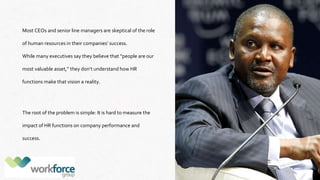
Most CEOs and senior line managers are skeptical of the role
of human resources in their companies’ success.
While many executives say they believe that “people are our
most valuable asset,” they don’t understand how HR
functions make that vision a reality.
The root of the problem is simple: It is hard to measure the
impact of HR functions on company performance and
success.
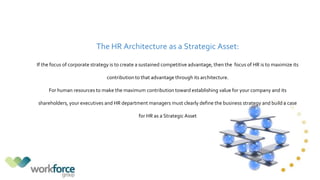
The HR Architecture as a Strategic Asset:
If the focus of corporate strategy is to create a sustained competitive advantage, then the focus of HR is to maximize its
contribution to that advantage through its architecture.
For human resources to make the maximum contribution toward establishing value for your company and its
shareholders, your executives and HR department managers must clearly define the business strategy and build a case
for HR as a Strategic Asset
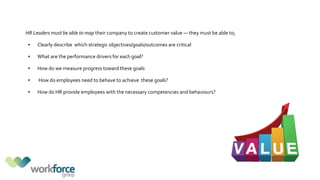
HR Leaders must be able to map their company to create customer value — they must be able to;
▪ Clearly describe which strategic objectives/goals/outcomes are critical
▪ What are the performance drivers for each goal?
▪ How do we measure progress toward these goals
▪ How do employees need to behave to achieve these goals?
▪ How do HR provide employees with the necessary competencies and behaviours?
The HR Strategy is a strategic management framework that will help you measure, manage and improve the strategic role of
your HR department in terms of delivering business imperatives
The HR Strategy requires a Measurement System called the HR Scorecard.
The Scorecard consists of measurements of:
1. HR deliverables.
2. HR policies, processes and practices.
3. HR system alignment.
4. HR efficiency.
The Core Competencies for being a HR Strategist
include:
1. Knowledge of the Business
2. Delivery of HR Practices.
3. Management of Change.
4. Management of Culture
5. Personal Credibility
Do you have any HR related question?
Are you an HR Expert?
Join the conversation at:
hrguru.workforcegroup.com
THANK YOU

Human Resource Strategy and Implementation

  • 1.
    HR Strategy andImplementation
  • 3.
    Most CEOs andsenior line managers are skeptical of the role of human resources in their companies’ success. While many executives say they believe that “people are our most valuable asset,” they don’t understand how HR functions make that vision a reality. The root of the problem is simple: It is hard to measure the impact of HR functions on company performance and success.
  • 4.
    The HR Architectureas a Strategic Asset: If the focus of corporate strategy is to create a sustained competitive advantage, then the focus of HR is to maximize its contribution to that advantage through its architecture. For human resources to make the maximum contribution toward establishing value for your company and its shareholders, your executives and HR department managers must clearly define the business strategy and build a case for HR as a Strategic Asset
  • 5.
    HR Leaders mustbe able to map their company to create customer value — they must be able to; ▪ Clearly describe which strategic objectives/goals/outcomes are critical ▪ What are the performance drivers for each goal? ▪ How do we measure progress toward these goals ▪ How do employees need to behave to achieve these goals? ▪ How do HR provide employees with the necessary competencies and behaviours?
  • 6.
    The HR Strategyis a strategic management framework that will help you measure, manage and improve the strategic role of your HR department in terms of delivering business imperatives The HR Strategy requires a Measurement System called the HR Scorecard. The Scorecard consists of measurements of: 1. HR deliverables. 2. HR policies, processes and practices. 3. HR system alignment. 4. HR efficiency.
  • 7.
    The Core Competenciesfor being a HR Strategist include: 1. Knowledge of the Business 2. Delivery of HR Practices. 3. Management of Change. 4. Management of Culture 5. Personal Credibility
  • 8.
    Do you haveany HR related question? Are you an HR Expert? Join the conversation at: hrguru.workforcegroup.com
  • 9.