Overview of Reproductive System
• Primary sex organs (gonads)
– Produce gametes (testes or ovaries) -
– Gametogenesis - spermatogenesis or oogenesis
• Secondary sex organs
– Male - ducts, glands, penis deliver sperm cells
– Female - uterine tubes, uterus and vagina receive sperm
and nourish developing fetus
• Secondary sex characteristics
– Develop at puberty to attract a mate
• pubic, axillary and facial hair, scent glands, body morphology
and low-pitched voice in males
Spermatogenesis
• Spermatogonia produce 2
kinds of daughter cells
– Type A remain outside blood-
testis barrier and produce more
daughter cells until death
– Type B differentiate into
primary spermatocytes
• Cells must pass through
BTB to move inward
toward lumen - new tight
junctions form behind
these cells
• meiosis I → 2 secondary
spermatocytes
• meiosis II → 4 spermatids
Brain-Testicular Axis
• Testicular regulation involves three sets of hormones:
– GnRH - gonadotropin-releasing hormone
• Secreted by hypothalamus
• Stimulates secretion of anterior pituitary secretion hormones
(FSH/LH)
– FSH and LH - Follicle stimulating hormone and leuteinizing hormone
• LH aka as Interstitial Cell Stimulating Hormone
• Secreted by anterior pituitary
• Directly stimulate the testes
– FSH - stimulates formation of ABP (androgen binding protein) by nurse
cells
– LH - stimulates interstitial cells to secrete testosterone
– Testosterone
• Secreted by cells of Leydig (Interstitial cells of seminiferous tubules)
• Exert negative feedback on hypothalamic and ant. pituitary hormones
• Stimulates spermatogenesis by binding to ABP and development of
secondary sex characteristics
Hormonal Regulation of
Testicular Function
• Feedback inhibition on
the hypothalamus and
pituitary results from:
– Rising levels of
testosterone
– Increased inhibin
Figure 27.10
Testosterone
• Most from interstitial cells of testes with small amounts from adrenal glands
and sustentacular cells
• Causes enlargement and differentiation of male genitals and reproductive duct
system
• Necessary for sperm cell formation
• Required for descent of testes
• Hair growth on certain parts of the body
• Skin is rougher and coarser
• Quantity of melanin increases
• Increases rate of secretion of sebaceous glands
• Hypertrophy of larynx
• Increases metabolic rate
• Increases red blood cell count
• Increases protein synthesis, rapid bone growth
• Causes closure of epiphyseal plates
Mechanism and Effects of
Testosterone Activity
• Testosterone is synthesized from cholesterol
• It must be transformed to exert its effects on some
target cells
– Prostate – it is converted into dihydrotestosterone
(DHT) before it can bind within the nucleus
• Requires the enzyme 5alpha-reductase
– Neurons – it is converted into estrogen to bring about
stimulatory effects
• Reqires the enzyme aromatase
• Testosterone targets all accessory organs and its
deficiency causes these organs to atrophy
Accessory Glands
• Seminal vesicles
– Empty into ejaculatory duct
– Produce about 60% of semen
– Secretion contains fibrinogen
– High pH
• Prostate gland
– Produces about 30% of semen
– Thin, milky secretion, high pH
– Contain clotting factors, and fibrinolysin
• Bulbourethral glands
– Contribute about 5% to semen
– Mucous secretion. Just before ejaculation
– Helps neutralize pH of female vagina
Semen or Seminal Fluid
• 2-5 mL of fluid expelled during orgasm
– 60% seminal vesicle fluid, 30% prostatic, 10% sperm
• normal sperm count 50-120 million/mL
• Other components of semen
– fructose - energy for sperm motility
– fibrinogen causes clotting
• enzymes convert fibrinogen to fibrin
– fibrinolysin liquefies semen within 30 minutes
– prostaglandins stimulate female peristaltic contractions
– spermine is a base stabilizing sperm pH at 7.2 to 7.6
Semen
• Secretions of all three accessory glands plus sperm
cells referred to as semen.
• Emission: discharge of semen into prostatic
urethra
• Ejaculation: forceful expulsion of semen from
urethra. Caused by peristalsis
• Temporary coagulation as fibrinogen becomes
fibrin then fibrinolysin breaks up the coagulation.
Sperm swim up vagina
Emission and Ejaculation
• Emission: accumulation of sperm cells and secretions of the
prostate gland and seminal vesicles in the urethra
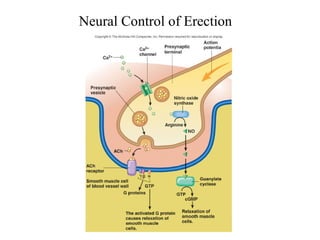
• Controlled by sympathetic centers in spinal cord
– Peristaltic contractions of reproductive ducts
– Seminal vesicles and prostate release secretions
• Accumulation in prostatic urethra sends sensory information
through pudendal nerve to spinal cord
• Sympathetic and somatic motor output
– Sympathetic: constriction of internal sphincter of urinary bladder so
semen and urine do not mix
– Somatic motor: to skeletal muscles, urogenital diaphragm and base of
penis causing rhythmic contractions that force semen out of urethra:
ejaculation
Neural Control of Erection
Female Reproductive Physiology
Establishing the Ovarian Cycle
• During childhood, ovaries grow and secrete
small amounts of estrogens that inhibit the
hypothalamic release of GnRH
• As puberty nears, GnRH is released; FSH
and LH are released by the pituitary, which
act on the ovaries
• These events continue until an adult cyclic
pattern is achieved and menarche occurs
Ovarian Cycle
• Monthly series of events associated with the
maturation of an egg
• Follicular phase – period of follicle growth
(days 1–14)
• Luteal phase – period of corpus luteum
activity (days 14–28)
• Ovulation occurs midcycle
Sexual Cycle
• Averages 28 days, ranges from 20 to 45
• Hormone cycle: hierarchy of control
– hypothalamus→ pituitary → ovaries → uterus
• Follicular phase (2 weeks)
– menstruation occurs during first 3 to 5 days of cycle
– uterus replaces lost endometrium and follicles grow
• Luteal phase (2 weeks)
– corpus luteum stimulates endometrial thickening
– endometrium lost without pregnancy
Hormonal Interactions During the
Ovarian Cycle
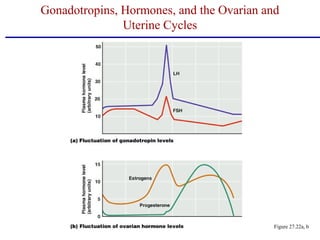
• Day 1 – GnRH stimulates the release of FSH and LH
• FSH and LH stimulate follicle growth and maturation,
and low-level estrogen release
• Rising estrogen levels:
– Inhibit the release of FSH and LH
– Prod the pituitary to synthesize and accumulate these
gonadotropins
• Estrogen levels increase and high estrogen levels have a
positive feedback effect on the pituitary, causing a
sudden surge of LH
Hormonal Interactions During
the Ovarian Cycle
• The LH spike stimulates the primary oocyte
to complete meiosis I, and the secondary
oocyte continues on to metaphase II
• Day 14 – LH triggers ovulation
• LH transforms the ruptured follicle into a
corpus luteum, which produces inhibin,
progesterone, and estrogen
Hormonal Interactions During
the Ovarian Cycle
• These hormones shut off FSH and LH
release and declining LH ends luteal
activity
• Days 26-28 – decline of the ovarian
hormones
– Ends the blockade of FSH and LH
– The cycle starts anew
Follicular Phase
• The primordial follicle, directed by the
oocyte, becomes a primary follicle
• Primary follicle becomes a secondary
follicle
– The theca folliculi and granulosa cells
cooperate to produce estrogens
– The zona pellucida forms around the oocyte
– The antrum is formed
Follicular Phase
• The secondary follicle becomes a vesicular
follicle
– The antrum expands and isolates the oocyte and
the corona radiata
– The full size follicle (vesicular follicle) bulges
from the external surface of the ovary
– The primary oocyte completes meiosis I, and
the stage is set for ovulation
Ovarian Cycle - Follicular Phase
• Menstruation (day 1) to ovulation(14) (variable)
• Difficult to predict date of ovulation
• Contains menstrual and preovulatory phases
Ovarian Cycle - Preantral Phase
• Discharge of menstrual fluid (days 1-5)
• Before follicle develops antrum
– primordial and primary follicles
Ovarian Cycle - Antral Phase
• Day 6 to 14, one dominant follicle advances to mature (graafian)
follicle; secretes estrogen
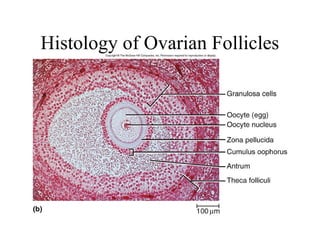
Histology of Ovarian Follicles
Ovulation
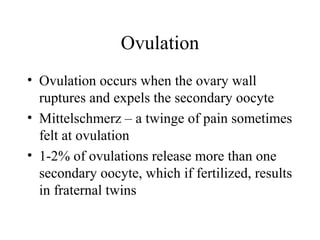
• Ovulation occurs when the ovary wall
ruptures and expels the secondary oocyte
• Mittelschmerz – a twinge of pain sometimes
felt at ovulation
• 1-2% of ovulations release more than one
secondary oocyte, which if fertilized, results
in fraternal twins
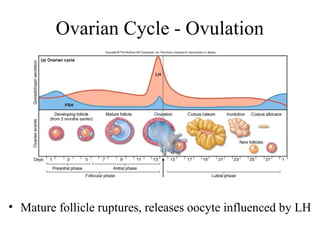
Ovarian Cycle - Ovulation
• Mature follicle ruptures, releases oocyte influenced by LH
Pituitary-Ovarian Axis
Luteal Phase
• After ovulation, the ruptured follicle collapses,
granulosa cells enlarge, and along with internal
thecal cells, form the corpus luteum
• The corpus luteum secretes progesterone and
estrogen
• If pregnancy does not occur, the corpus luteum
degenerates in 10 days, leaving a scar (corpus
albicans)
• If pregnancy does occur, the corpus luteum
produces hormones until the placenta takes over
that role (at about 3 months)
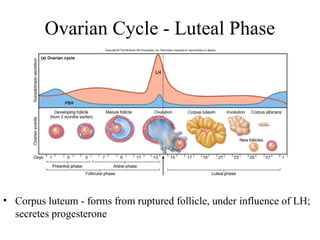
Ovarian Cycle - Luteal Phase
• Corpus luteum - forms from ruptured follicle, under influence of LH;
secretes progesterone
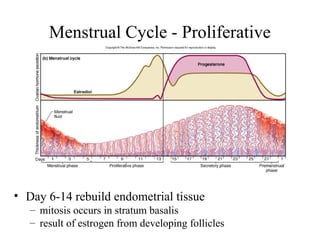
Menstrual Cycle - Proliferative
Phase
• Day 6-14 rebuild endometrial tissue
– mitosis occurs in stratum basalis
– result of estrogen from developing follicles
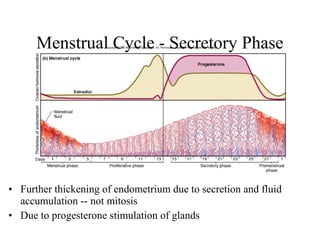
• Further thickening of endometrium due to secretion and fluid
accumulation -- not mitosis
• Due to progesterone stimulation of glands
Menstrual Cycle - Secretory Phase
Menstrual Cycle Premenstrual Phase
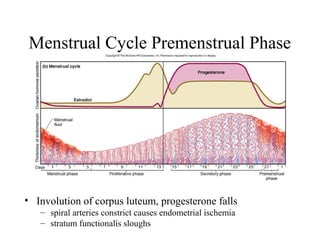
• Involution of corpus luteum, progesterone falls
– spiral arteries constrict causes endometrial ischemia
– stratum functionalis sloughs
Menstrual Cycle - Menstrual Phase
• Blood, serous fluid and endometrial tissue are discharged
Feedback Mechanisms in Ovarian Function
Figure 27.21
Uterine (Menstrual) Cycle
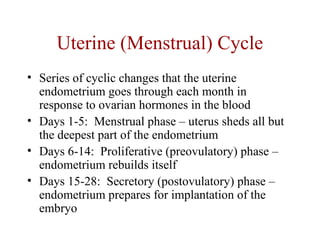
• Series of cyclic changes that the uterine
endometrium goes through each month in
response to ovarian hormones in the blood
• Days 1-5: Menstrual phase – uterus sheds all but
the deepest part of the endometrium
• Days 6-14: Proliferative (preovulatory) phase –
endometrium rebuilds itself
• Days 15-28: Secretory (postovulatory) phase –
endometrium prepares for implantation of the
embryo
Menses
• If fertilization does not occur, progesterone levels
fall, depriving the endometrium of hormonal
support
• Spiral arteries kink and go into spasms and
endometrial cells begin to die
• The functional layer begins to digest itself
• Spiral arteries constrict one final time then
suddenly relax and open wide
• The rush of blood fragments weakened capillary
beds and the functional layer sloughs
Figure 27.22a, b
Gonadotropins, Hormones, and the Ovarian and
Uterine Cycles
Figure 27.22c, d
Gonadotropins, Hormones, and the Ovarian and
Uterine Cycles
• Estrogen levels rise during puberty
• Promote oogenesis and follicle growth in the ovary
• Exert anabolic effects on the female reproductive tract
– Uterine tubes, uterus, and vagina grow larger and
become functional
– Uterine tubes and uterus exhibit enhanced motility
– Vaginal mucosa thickens and external genitalia mature
Extrauterine Effects of Estrogens
and Progesterone
• Growth of the breasts
• Increased deposition of subcutaneous fat,
especially in the hips and breasts
• Widening and lightening of the pelvis
• Growth of axillary and pubic hair
Estrogen-Induced Secondary Sex
Characteristics
From Egg to Embryo
• Pregnancy – events that occur from fertilization until the
infant is born
• Conceptus – the developing offspring
• Gestation period – from the last menstrual period until
birth
• Preembryo – conceptus from fertilization until it is two
weeks old
• Embryo – conceptus during the third through the eighth
week
• Fetus – conceptus from the ninth week through birth
Accomplishing Fertilization
• The oocyte is viable for 12 to 24 hours
• Sperm is viable 24 to 72 hours
• For fertilization to occur, coitus must occur
no more than:
– Three days before ovulation
– 24 hours after ovulation
• Fertilization – when a sperm fuses with an
egg to form a zygote
Sperm Transport and
Capacitation
• Fates of ejaculated sperm
– Leak out of the vagina immediately after deposition
– Destroyed by the acidic vaginal environment
– Fail to make it through the cervix
– Dispersed in the uterine cavity or destroyed by
phagocytic leukocytes
– Reach the uterine tubes
• Sperm must undergo capacitation before they can
penetrate the oocyte
Acrosomal Reaction and Sperm
Penetration
• An ovulated oocyte is encapsulated by:
– The corona radiata and zona pellucida
– Extracellular matrix
• Sperm binds to the zona pellucida and
undergoes the acrosomal reaction
– Enzymes are released near the oocyte
– Hundreds of acrosomes release their enzymes
to digest the zona pellucida
Acrosomal Reaction and Sperm
Penetration
• Once a sperm makes contact with the
oocyte’s membrane:
– Beta protein finds and binds to receptors on the
oocyte membrane
– Alpha protein causes it to insert into the
membrane
Acrosomal Reaction and Sperm
Penetration
Figure 28.2a
Blocks to Polyspermy
• Only one sperm is allowed to penetrate the oocyte
• Two mechanisms ensure monospermy
– Fast block to polyspermy – membrane depolarization
prevents sperm from fusing with the oocyte membrane
– Slow block to polyspermy – zonal inhibiting proteins
(ZIPs):
• Destroy sperm receptors
• Cause sperm already bound to receptors to detach
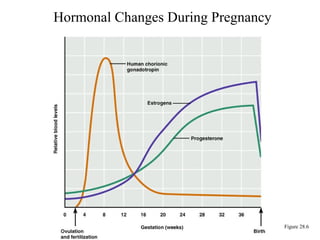
Implantation
• Viability of the corpus luteum is maintained by
human chorionic gonadotropin (hCG) secreted
by the trophoblasts
• hCG prompts the corpus luteum to continue to
secrete progesterone and estrogen
• Chorion – developed from trophoblasts after
implantation, continues this hormonal stimulus
• Between the second and third month, the
placenta:
– Assumes the role of progesterone and estrogen
production
– Is providing nutrients and removing wastes
Hormonal Changes During Pregnancy
Figure 28.6
Parturition: Initiation of Labor
Figure 28.16

Human reproduction-xii

  • 1.
    Overview of ReproductiveSystem • Primary sex organs (gonads) – Produce gametes (testes or ovaries) - – Gametogenesis - spermatogenesis or oogenesis • Secondary sex organs – Male - ducts, glands, penis deliver sperm cells – Female - uterine tubes, uterus and vagina receive sperm and nourish developing fetus • Secondary sex characteristics – Develop at puberty to attract a mate • pubic, axillary and facial hair, scent glands, body morphology and low-pitched voice in males
  • 2.
    Spermatogenesis • Spermatogonia produce2 kinds of daughter cells – Type A remain outside blood- testis barrier and produce more daughter cells until death – Type B differentiate into primary spermatocytes • Cells must pass through BTB to move inward toward lumen - new tight junctions form behind these cells • meiosis I → 2 secondary spermatocytes • meiosis II → 4 spermatids
  • 3.
    Brain-Testicular Axis • Testicularregulation involves three sets of hormones: – GnRH - gonadotropin-releasing hormone • Secreted by hypothalamus • Stimulates secretion of anterior pituitary secretion hormones (FSH/LH) – FSH and LH - Follicle stimulating hormone and leuteinizing hormone • LH aka as Interstitial Cell Stimulating Hormone • Secreted by anterior pituitary • Directly stimulate the testes – FSH - stimulates formation of ABP (androgen binding protein) by nurse cells – LH - stimulates interstitial cells to secrete testosterone – Testosterone • Secreted by cells of Leydig (Interstitial cells of seminiferous tubules) • Exert negative feedback on hypothalamic and ant. pituitary hormones • Stimulates spermatogenesis by binding to ABP and development of secondary sex characteristics
  • 4.
    Hormonal Regulation of TesticularFunction • Feedback inhibition on the hypothalamus and pituitary results from: – Rising levels of testosterone – Increased inhibin Figure 27.10
  • 5.
    Testosterone • Most frominterstitial cells of testes with small amounts from adrenal glands and sustentacular cells • Causes enlargement and differentiation of male genitals and reproductive duct system • Necessary for sperm cell formation • Required for descent of testes • Hair growth on certain parts of the body • Skin is rougher and coarser • Quantity of melanin increases • Increases rate of secretion of sebaceous glands • Hypertrophy of larynx • Increases metabolic rate • Increases red blood cell count • Increases protein synthesis, rapid bone growth • Causes closure of epiphyseal plates
  • 6.
    Mechanism and Effectsof Testosterone Activity • Testosterone is synthesized from cholesterol • It must be transformed to exert its effects on some target cells – Prostate – it is converted into dihydrotestosterone (DHT) before it can bind within the nucleus • Requires the enzyme 5alpha-reductase – Neurons – it is converted into estrogen to bring about stimulatory effects • Reqires the enzyme aromatase • Testosterone targets all accessory organs and its deficiency causes these organs to atrophy
  • 7.
    Accessory Glands • Seminalvesicles – Empty into ejaculatory duct – Produce about 60% of semen – Secretion contains fibrinogen – High pH • Prostate gland – Produces about 30% of semen – Thin, milky secretion, high pH – Contain clotting factors, and fibrinolysin • Bulbourethral glands – Contribute about 5% to semen – Mucous secretion. Just before ejaculation – Helps neutralize pH of female vagina
  • 8.
    Semen or SeminalFluid • 2-5 mL of fluid expelled during orgasm – 60% seminal vesicle fluid, 30% prostatic, 10% sperm • normal sperm count 50-120 million/mL • Other components of semen – fructose - energy for sperm motility – fibrinogen causes clotting • enzymes convert fibrinogen to fibrin – fibrinolysin liquefies semen within 30 minutes – prostaglandins stimulate female peristaltic contractions – spermine is a base stabilizing sperm pH at 7.2 to 7.6
  • 9.
    Semen • Secretions ofall three accessory glands plus sperm cells referred to as semen. • Emission: discharge of semen into prostatic urethra • Ejaculation: forceful expulsion of semen from urethra. Caused by peristalsis • Temporary coagulation as fibrinogen becomes fibrin then fibrinolysin breaks up the coagulation. Sperm swim up vagina
  • 10.
    Emission and Ejaculation •Emission: accumulation of sperm cells and secretions of the prostate gland and seminal vesicles in the urethra • Controlled by sympathetic centers in spinal cord – Peristaltic contractions of reproductive ducts – Seminal vesicles and prostate release secretions • Accumulation in prostatic urethra sends sensory information through pudendal nerve to spinal cord • Sympathetic and somatic motor output – Sympathetic: constriction of internal sphincter of urinary bladder so semen and urine do not mix – Somatic motor: to skeletal muscles, urogenital diaphragm and base of penis causing rhythmic contractions that force semen out of urethra: ejaculation
  • 11.
  • 12.
  • 13.
    Establishing the OvarianCycle • During childhood, ovaries grow and secrete small amounts of estrogens that inhibit the hypothalamic release of GnRH • As puberty nears, GnRH is released; FSH and LH are released by the pituitary, which act on the ovaries • These events continue until an adult cyclic pattern is achieved and menarche occurs
  • 14.
    Ovarian Cycle • Monthlyseries of events associated with the maturation of an egg • Follicular phase – period of follicle growth (days 1–14) • Luteal phase – period of corpus luteum activity (days 14–28) • Ovulation occurs midcycle
  • 15.
    Sexual Cycle • Averages28 days, ranges from 20 to 45 • Hormone cycle: hierarchy of control – hypothalamus→ pituitary → ovaries → uterus • Follicular phase (2 weeks) – menstruation occurs during first 3 to 5 days of cycle – uterus replaces lost endometrium and follicles grow • Luteal phase (2 weeks) – corpus luteum stimulates endometrial thickening – endometrium lost without pregnancy
  • 16.
    Hormonal Interactions Duringthe Ovarian Cycle • Day 1 – GnRH stimulates the release of FSH and LH • FSH and LH stimulate follicle growth and maturation, and low-level estrogen release • Rising estrogen levels: – Inhibit the release of FSH and LH – Prod the pituitary to synthesize and accumulate these gonadotropins • Estrogen levels increase and high estrogen levels have a positive feedback effect on the pituitary, causing a sudden surge of LH
  • 17.
    Hormonal Interactions During theOvarian Cycle • The LH spike stimulates the primary oocyte to complete meiosis I, and the secondary oocyte continues on to metaphase II • Day 14 – LH triggers ovulation • LH transforms the ruptured follicle into a corpus luteum, which produces inhibin, progesterone, and estrogen
  • 18.
    Hormonal Interactions During theOvarian Cycle • These hormones shut off FSH and LH release and declining LH ends luteal activity • Days 26-28 – decline of the ovarian hormones – Ends the blockade of FSH and LH – The cycle starts anew
  • 19.
    Follicular Phase • Theprimordial follicle, directed by the oocyte, becomes a primary follicle • Primary follicle becomes a secondary follicle – The theca folliculi and granulosa cells cooperate to produce estrogens – The zona pellucida forms around the oocyte – The antrum is formed
  • 20.
    Follicular Phase • Thesecondary follicle becomes a vesicular follicle – The antrum expands and isolates the oocyte and the corona radiata – The full size follicle (vesicular follicle) bulges from the external surface of the ovary – The primary oocyte completes meiosis I, and the stage is set for ovulation
  • 21.
    Ovarian Cycle -Follicular Phase • Menstruation (day 1) to ovulation(14) (variable) • Difficult to predict date of ovulation • Contains menstrual and preovulatory phases
  • 22.
    Ovarian Cycle -Preantral Phase • Discharge of menstrual fluid (days 1-5) • Before follicle develops antrum – primordial and primary follicles
  • 23.
    Ovarian Cycle -Antral Phase • Day 6 to 14, one dominant follicle advances to mature (graafian) follicle; secretes estrogen
  • 24.
  • 25.
    Ovulation • Ovulation occurswhen the ovary wall ruptures and expels the secondary oocyte • Mittelschmerz – a twinge of pain sometimes felt at ovulation • 1-2% of ovulations release more than one secondary oocyte, which if fertilized, results in fraternal twins
  • 26.
    Ovarian Cycle -Ovulation • Mature follicle ruptures, releases oocyte influenced by LH
  • 27.
  • 28.
    Luteal Phase • Afterovulation, the ruptured follicle collapses, granulosa cells enlarge, and along with internal thecal cells, form the corpus luteum • The corpus luteum secretes progesterone and estrogen • If pregnancy does not occur, the corpus luteum degenerates in 10 days, leaving a scar (corpus albicans) • If pregnancy does occur, the corpus luteum produces hormones until the placenta takes over that role (at about 3 months)
  • 29.
    Ovarian Cycle -Luteal Phase • Corpus luteum - forms from ruptured follicle, under influence of LH; secretes progesterone
  • 30.
    Menstrual Cycle -Proliferative Phase • Day 6-14 rebuild endometrial tissue – mitosis occurs in stratum basalis – result of estrogen from developing follicles
  • 31.
    • Further thickeningof endometrium due to secretion and fluid accumulation -- not mitosis • Due to progesterone stimulation of glands Menstrual Cycle - Secretory Phase
  • 32.
    Menstrual Cycle PremenstrualPhase • Involution of corpus luteum, progesterone falls – spiral arteries constrict causes endometrial ischemia – stratum functionalis sloughs
  • 33.
    Menstrual Cycle -Menstrual Phase • Blood, serous fluid and endometrial tissue are discharged
  • 34.
    Feedback Mechanisms inOvarian Function Figure 27.21
  • 35.
    Uterine (Menstrual) Cycle •Series of cyclic changes that the uterine endometrium goes through each month in response to ovarian hormones in the blood • Days 1-5: Menstrual phase – uterus sheds all but the deepest part of the endometrium • Days 6-14: Proliferative (preovulatory) phase – endometrium rebuilds itself • Days 15-28: Secretory (postovulatory) phase – endometrium prepares for implantation of the embryo
  • 36.
    Menses • If fertilizationdoes not occur, progesterone levels fall, depriving the endometrium of hormonal support • Spiral arteries kink and go into spasms and endometrial cells begin to die • The functional layer begins to digest itself • Spiral arteries constrict one final time then suddenly relax and open wide • The rush of blood fragments weakened capillary beds and the functional layer sloughs
  • 37.
    Figure 27.22a, b Gonadotropins,Hormones, and the Ovarian and Uterine Cycles
  • 38.
    Figure 27.22c, d Gonadotropins,Hormones, and the Ovarian and Uterine Cycles
  • 39.
    • Estrogen levelsrise during puberty • Promote oogenesis and follicle growth in the ovary • Exert anabolic effects on the female reproductive tract – Uterine tubes, uterus, and vagina grow larger and become functional – Uterine tubes and uterus exhibit enhanced motility – Vaginal mucosa thickens and external genitalia mature Extrauterine Effects of Estrogens and Progesterone
  • 40.
    • Growth ofthe breasts • Increased deposition of subcutaneous fat, especially in the hips and breasts • Widening and lightening of the pelvis • Growth of axillary and pubic hair Estrogen-Induced Secondary Sex Characteristics
  • 41.
    From Egg toEmbryo • Pregnancy – events that occur from fertilization until the infant is born • Conceptus – the developing offspring • Gestation period – from the last menstrual period until birth • Preembryo – conceptus from fertilization until it is two weeks old • Embryo – conceptus during the third through the eighth week • Fetus – conceptus from the ninth week through birth
  • 42.
    Accomplishing Fertilization • Theoocyte is viable for 12 to 24 hours • Sperm is viable 24 to 72 hours • For fertilization to occur, coitus must occur no more than: – Three days before ovulation – 24 hours after ovulation • Fertilization – when a sperm fuses with an egg to form a zygote
  • 43.
    Sperm Transport and Capacitation •Fates of ejaculated sperm – Leak out of the vagina immediately after deposition – Destroyed by the acidic vaginal environment – Fail to make it through the cervix – Dispersed in the uterine cavity or destroyed by phagocytic leukocytes – Reach the uterine tubes • Sperm must undergo capacitation before they can penetrate the oocyte
  • 44.
    Acrosomal Reaction andSperm Penetration • An ovulated oocyte is encapsulated by: – The corona radiata and zona pellucida – Extracellular matrix • Sperm binds to the zona pellucida and undergoes the acrosomal reaction – Enzymes are released near the oocyte – Hundreds of acrosomes release their enzymes to digest the zona pellucida
  • 45.
    Acrosomal Reaction andSperm Penetration • Once a sperm makes contact with the oocyte’s membrane: – Beta protein finds and binds to receptors on the oocyte membrane – Alpha protein causes it to insert into the membrane
  • 46.
    Acrosomal Reaction andSperm Penetration Figure 28.2a
  • 47.
    Blocks to Polyspermy •Only one sperm is allowed to penetrate the oocyte • Two mechanisms ensure monospermy – Fast block to polyspermy – membrane depolarization prevents sperm from fusing with the oocyte membrane – Slow block to polyspermy – zonal inhibiting proteins (ZIPs): • Destroy sperm receptors • Cause sperm already bound to receptors to detach
  • 48.
    Implantation • Viability ofthe corpus luteum is maintained by human chorionic gonadotropin (hCG) secreted by the trophoblasts • hCG prompts the corpus luteum to continue to secrete progesterone and estrogen • Chorion – developed from trophoblasts after implantation, continues this hormonal stimulus • Between the second and third month, the placenta: – Assumes the role of progesterone and estrogen production – Is providing nutrients and removing wastes
  • 49.
    Hormonal Changes DuringPregnancy Figure 28.6
  • 50.
    Parturition: Initiation ofLabor Figure 28.16