BBASIS OFASIS OF CCLASSIFICATIONLASSIFICATION
In spite of differences in structure and form ofIn spite of differences in structure and form of
different animals, there are fundamental featuresdifferent animals, there are fundamental features
common to various individuals in relation to thecommon to various individuals in relation to the
arrangement of cells, body symmetry, nature ofarrangement of cells, body symmetry, nature of
coelom, patterns of digestive, circulatory orcoelom, patterns of digestive, circulatory or
reproductive systems. These features are used asreproductive systems. These features are used as
the basis of animal classification.the basis of animal classification.
LLEVELS OFEVELS OF OORGANISATIONRGANISATION
 All members of Animalia are multicellular, all of them do not exhibit the sameAll members of Animalia are multicellular, all of them do not exhibit the same
pattern of organisation of cells. For examples, in sponges, the cells are arranged aspattern of organisation of cells. For examples, in sponges, the cells are arranged as
loose cell aggregates, i.e., they exhibitloose cell aggregates, i.e., they exhibit cellular levelcellular level of organisation.of organisation.
 In coelenterates, the arrangements of cells is more complex. Here the cellIn coelenterates, the arrangements of cells is more complex. Here the cell
performing the same function are arranged into tissues, hence is calledperforming the same function are arranged into tissues, hence is called tissue leveltissue level
of organisation.of organisation.
 A still higher level of organisation, i.e., organ level is exhibited by members ofA still higher level of organisation, i.e., organ level is exhibited by members of
Platyhelminthes and other higher phyla where tissues are grouped together to formPlatyhelminthes and other higher phyla where tissues are grouped together to form
organs, each specialised for a particular function.organs, each specialised for a particular function.
 In animals like Annelids, Arthropods , chordates, etc, organ have associated toIn animals like Annelids, Arthropods , chordates, etc, organ have associated to
form functional systems, each system concerned with a specific physiologicalform functional systems, each system concerned with a specific physiological
function. This pattern is called organ system level of organisation.function. This pattern is called organ system level of organisation.
 The circulatory system is of two types:The circulatory system is of two types:
a)a) Open typeOpen type in which the blood is pumped out of the heart and the cells and tissuesin which the blood is pumped out of the heart and the cells and tissues
are directly bathed in it andare directly bathed in it and
b)b) Closed typeClosed type in which the blood is circulated through a series of vessels of varyingin which the blood is circulated through a series of vessels of varying
diameters (arteries, veins and capillaries).diameters (arteries, veins and capillaries).
 The digestive system is of two types:The digestive system is of two types:
a)a) IncompleteIncomplete digestive system as only a single opening to the outside of the bodydigestive system as only a single opening to the outside of the body
that serves as both mouth and anus.that serves as both mouth and anus.
b)b) CompleteComplete digestive system has two openings, mouth and anusdigestive system has two openings, mouth and anus..
SSYMMETRYYMMETRY
 Animals can be categorised on the basis of theirAnimals can be categorised on the basis of their
symmetry.symmetry.
 Sponges are mostly asymmetrical, i.e., any planeSponges are mostly asymmetrical, i.e., any plane
that passes through the centre does not divide themthat passes through the centre does not divide them
into equal halves.into equal halves.
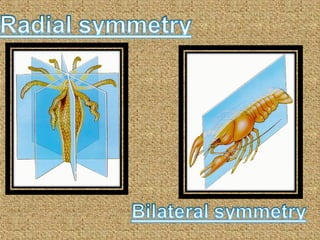
 When any plane passing through the central axis ofWhen any plane passing through the central axis of
the body divides the organisms into two identicalthe body divides the organisms into two identical
halves, it is called radial symmetry. Eg :-halves, it is called radial symmetry. Eg :-
coelenterates, ctenophores and echinoderms.coelenterates, ctenophores and echinoderms.
 Animals like annelids, arthropods, etc., where theAnimals like annelids, arthropods, etc., where the
body can be divided into identical left and rightbody can be divided into identical left and right
halves in only one plane, exhibit bilateral symmetryhalves in only one plane, exhibit bilateral symmetry..
DDiploblastic andiploblastic and TTriploblasticriploblastic
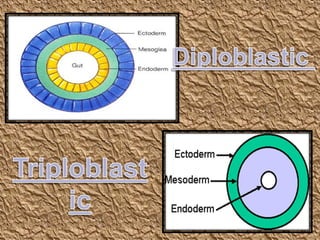
 Animals in which the cells are arranged in twoAnimals in which the cells are arranged in two
embryonic layers, an external ectoderm and anembryonic layers, an external ectoderm and an
internal endoderm, are called diploblastic animals,internal endoderm, are called diploblastic animals,
e.g., coelenterates.e.g., coelenterates.
 An undifferentiated layer, mesoglea, is present inAn undifferentiated layer, mesoglea, is present in
between the ectoderm and the endoderm. Thosebetween the ectoderm and the endoderm. Those
animals in which the developing embryo has theanimals in which the developing embryo has the
third germinal layer mesoderm, in between thethird germinal layer mesoderm, in between the
ectoderm and endoderm, are called triploblasticectoderm and endoderm, are called triploblastic
animals( platyhelminthes to chordatesanimals( platyhelminthes to chordates))
CCOELOMOELOM
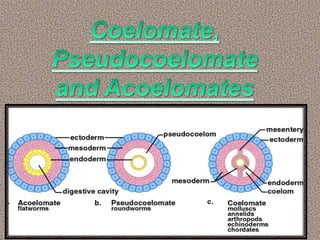
 Presence or absence of a cavity between the body wallPresence or absence of a cavity between the body wall
and the gut wall is very important in classification. Theand the gut wall is very important in classification. The
body, which is lined by mesoderm is calledbody, which is lined by mesoderm is called coelomcoelom..
Animals possessing coelom are calledAnimals possessing coelom are called coelomatescoelomates, e.g.,, e.g.,
annelids, molluscs, etc.annelids, molluscs, etc.
 In some animals, the body cavity iis not lined byIn some animals, the body cavity iis not lined by
mesoderm, instead, the mesoderm is present as scatteredmesoderm, instead, the mesoderm is present as scattered
pouches in between the ectoderm and endoderm. Such apouches in between the ectoderm and endoderm. Such a
body cavity is called pseudocoelom and the animalsbody cavity is called pseudocoelom and the animals
possessing them are calledpossessing them are called pseudocoelomatespseudocoelomates, e.g.,, e.g.,
aschelminthes.aschelminthes.
 The animals in which the body cavity is absent are calledThe animals in which the body cavity is absent are called
acoelomatesacoelomates, e.g., platyhelminthes., e.g., platyhelminthes.
SSEGMENTATIONEGMENTATION
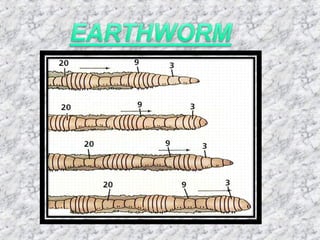
 In some animals, the body isIn some animals, the body is
externally and internally divided intoexternally and internally divided into
segments with serial repetition of atsegments with serial repetition of at
least some organs. For example, inleast some organs. For example, in
earthworm, the body shows thisearthworm, the body shows this
pattern called metamericpattern called metameric
segmentation and the phenomenon issegmentation and the phenomenon is
known as metamerismknown as metamerism..
NNOTOCHORDOTOCHORD
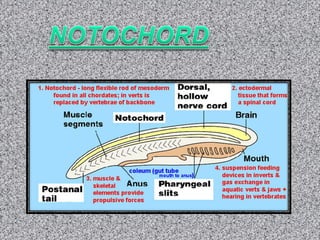
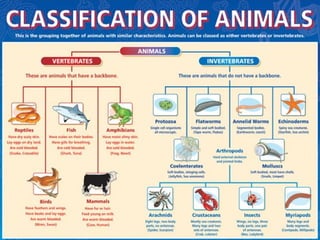
 Notochord is a mesodermally derived rod-Notochord is a mesodermally derived rod-
like structure formed on the dorsal sidelike structure formed on the dorsal side
during embryonic development in someduring embryonic development in some
animals. Animals with notochord are calledanimals. Animals with notochord are called
chordates and those animals which do notchordates and those animals which do not
form this structure are called non-form this structure are called non-
chordates, e.g., porifers to echinoderms.chordates, e.g., porifers to echinoderms.
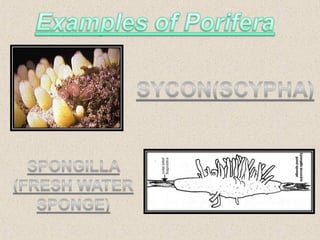
PPHYLUM -HYLUM - PPORIFERAORIFERA
 Marine and mostly asymmetrical animals.Marine and mostly asymmetrical animals.
 Primitive multicellular animals and have cellular level ofPrimitive multicellular animals and have cellular level of
organisation.organisation.
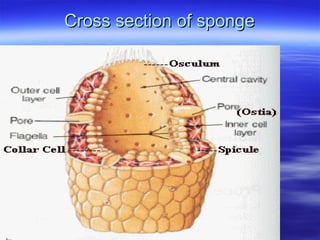
 Have a water transport or canal system. Water enters throughHave a water transport or canal system. Water enters through
minute pores in the body wall into a central cavity,minute pores in the body wall into a central cavity,
spongocoeol, from where it goes out through the osculum. It isspongocoeol, from where it goes out through the osculum. It is
help in food gathering, respiratory exchange and removal ofhelp in food gathering, respiratory exchange and removal of
waste.waste.
 The body is supported by a skeleton made up of spicules orThe body is supported by a skeleton made up of spicules or
spongin fibres.spongin fibres.
 Sexes are not separate(hermaphrodite),Sexes are not separate(hermaphrodite),
 Asexually by fragmentation and sexually by formation ofAsexually by fragmentation and sexually by formation of
gametes.gametes.
Cross section of spongeCross section of sponge
PHYLUM –PHYLUM –
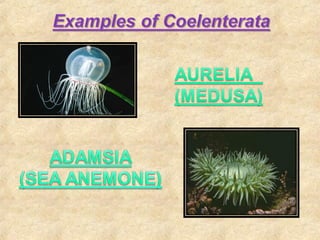
COELENTERATA(CNIDARIA)COELENTERATA(CNIDARIA)
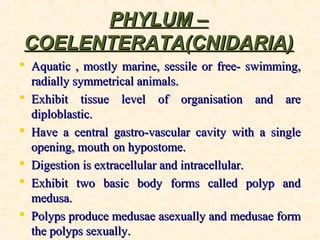
 Aquatic , mostly marine, sessile or free- swimming,Aquatic , mostly marine, sessile or free- swimming,
radially symmetrical animals.radially symmetrical animals.
 Exhibit tissue level of organisation and areExhibit tissue level of organisation and are
diploblastic.diploblastic.
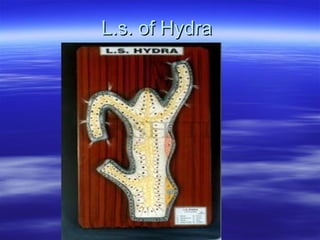
 Have a central gastro-vascular cavity with a singleHave a central gastro-vascular cavity with a single
opening, mouth on hypostome.opening, mouth on hypostome.
 Digestion is extracellular and intracellular.Digestion is extracellular and intracellular.
 Exhibit two basic body forms called polyp andExhibit two basic body forms called polyp and
medusa.medusa.
 Polyps produce medusae asexually and medusae formPolyps produce medusae asexually and medusae form
the polyps sexually.the polyps sexually.
L.s. of HydraL.s. of Hydra
PPHYLUM -HYLUM - CCTENOPHORATENOPHORA
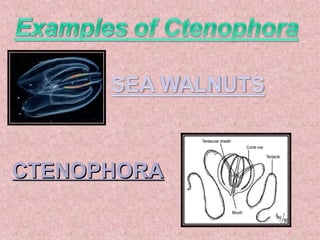
 Ctenophores, commonly known asCtenophores, commonly known as sea walnutssea walnuts oror
comb jelliescomb jellies are exclusively marine, radiallyare exclusively marine, radially
symmetrical, diploblastic organisms with tissue levelsymmetrical, diploblastic organisms with tissue level
of organization.of organization.
 The body bears eight external rows of ciliatedThe body bears eight external rows of ciliated combcomb
platesplates, which help in locomotion., which help in locomotion.
 Digestion is both extracellular and intracellular.Digestion is both extracellular and intracellular.
 BioluminescenceBioluminescence is well-marked in ctenophores.is well-marked in ctenophores.
 Sexes are not separate. Reproduction takes place onlySexes are not separate. Reproduction takes place only
by sexual means. Fertilisation is external with indirectby sexual means. Fertilisation is external with indirect
development.development.
CTENOPHORACTENOPHORA
PPHYLUM -HYLUM -
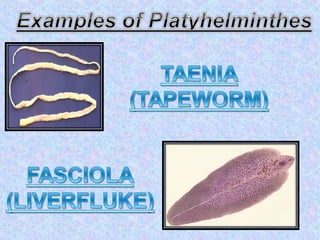
PPLATYHELMINTHESLATYHELMINTHES They have dorso – ventrally flattened body, hence are calledThey have dorso – ventrally flattened body, hence are called
flatwormsflatworms..
 These are mostly endoparasityes found in animals includingThese are mostly endoparasityes found in animals including
human beings.human beings.
 They are symmetrical, triploblastic and acoelamate animalsThey are symmetrical, triploblastic and acoelamate animals
with organ level of organisation.with organ level of organisation.
 Hooks and suckers are present in the parasitic forms. Some ofHooks and suckers are present in the parasitic forms. Some of
them absorb nutrients from the host directly through theirthem absorb nutrients from the host directly through their
body surface.body surface.
 Specialised cells called flame cells help in osmoregulation andSpecialised cells called flame cells help in osmoregulation and
excretion.excretion.
 Sexes are not separate. Fertilisation is internal andSexes are not separate. Fertilisation is internal and
development is through many larval stagesdevelopment is through many larval stages..
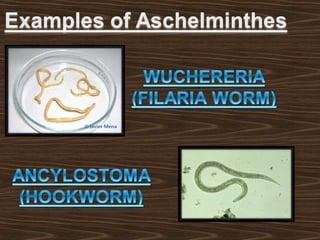
PHYLUM - ASCHELMINTHESPHYLUM - ASCHELMINTHES
 The body of the aschelminthes is circular in cross-section, hence theThe body of the aschelminthes is circular in cross-section, hence the
name roundworms.name roundworms.
 They are freeliving, aquatic and terrestrial or parasitic in plants andThey are freeliving, aquatic and terrestrial or parasitic in plants and
animals.animals.
 They have organ-system level of body organisation.They have organ-system level of body organisation.
 They are bilaterally symmetrical, triploblastic and pseudocoelomateThey are bilaterally symmetrical, triploblastic and pseudocoelomate
animals.animals.
 Alimentary canal is complete with a well developed muscular pharynx.Alimentary canal is complete with a well developed muscular pharynx.
 An excretory tube removes body wastes from the body cavity throughAn excretory tube removes body wastes from the body cavity through
the excretory pore.the excretory pore.
 Sexes are separate, i.e., males and females are distinct.Sexes are separate, i.e., males and females are distinct.
 Females are longer than males.Females are longer than males.
 Fertilisation is internal and development may be direct or indirect.Fertilisation is internal and development may be direct or indirect.
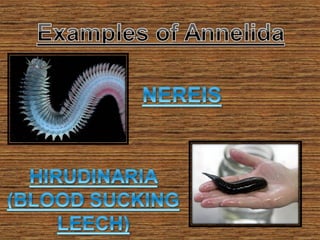
PPHYLUM -HYLUM - AANNELIDANNELIDA
 They may be aquatic or terestrial; free-living, and sometimesThey may be aquatic or terestrial; free-living, and sometimes
parasitic.parasitic.
 They exhibit organ-system level of body organisation andThey exhibit organ-system level of body organisation and
bilateral symmetry.bilateral symmetry.
 They are triploblastic, metamerically segmented and coelomateThey are triploblastic, metamerically segmented and coelomate
animals.animals.
 Their body surface is distinctly marked out intoTheir body surface is distinctly marked out into segmentssegments oror
metameresmetameres and , hence, the phylum name annelida.and , hence, the phylum name annelida.
 They possess longitudinal and circular muscles which help inThey possess longitudinal and circular muscles which help in
swimming.swimming.
 A closed circulatory system is present.A closed circulatory system is present.
 NephridiaNephridia help in osmoregulation and excretion.help in osmoregulation and excretion.
 Reproduction is sexual.Reproduction is sexual.
PPHYLUM -HYLUM - AARTHROPODARTHROPODA
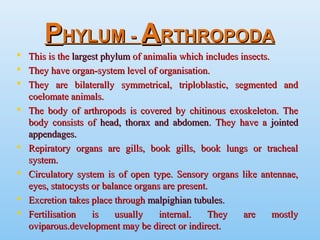
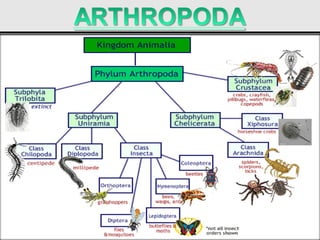
 This is theThis is the largest phylumlargest phylum of animalia which includes insects.of animalia which includes insects.
 They have organ-system level of organisation.They have organ-system level of organisation.
 They are bilaterally symmetrical, triploblastic, segmented andThey are bilaterally symmetrical, triploblastic, segmented and
coelomate animals.coelomate animals.
 The body of arthropods is covered by chitinous exoskeleton. TheThe body of arthropods is covered by chitinous exoskeleton. The
body consists ofbody consists of head, thorax and abdomenhead, thorax and abdomen. They have a. They have a jointedjointed
appendages.appendages.
 Repiratory organs are gills, book gills, book lungs or trachealRepiratory organs are gills, book gills, book lungs or tracheal
system.system.
 Circulatory system is of open type. Sensory organs like antennae,Circulatory system is of open type. Sensory organs like antennae,
eyes, statocysts or balance organs are present.eyes, statocysts or balance organs are present.
 Excretion takes place throughExcretion takes place through malpighian tubulesmalpighian tubules..
 Fertilisation is usually internal. They are mostlyFertilisation is usually internal. They are mostly
oviparous.development may be direct or indirect.oviparous.development may be direct or indirect.
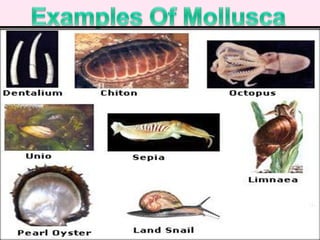
PPHYLUM -HYLUM - MMOLLUSCAOLLUSCA
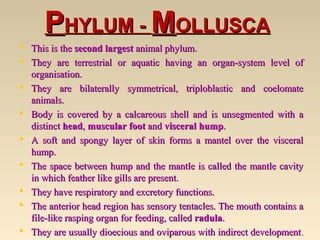
 This is theThis is the second largestsecond largest animal phylum.animal phylum.
 They are terrestrial or aquatic having an organ-system level ofThey are terrestrial or aquatic having an organ-system level of
organisation.organisation.
 They are bilaterally symmetrical, triploblastic and coelomateThey are bilaterally symmetrical, triploblastic and coelomate
animals.animals.
 Body is covered by a calcareous shell and is unsegmented with aBody is covered by a calcareous shell and is unsegmented with a
distinctdistinct headhead,, muscular footmuscular foot andand visceral humpvisceral hump..
 A soft and spongy layer of skin forms a mantel over the visceralA soft and spongy layer of skin forms a mantel over the visceral
hump.hump.
 The space between hump and the mantle is called the mantle cavityThe space between hump and the mantle is called the mantle cavity
in which feather like gills are present.in which feather like gills are present.
 They have respiratory and excretory functions.They have respiratory and excretory functions.
 The anterior head region has sensory tentacles. The mouth contains aThe anterior head region has sensory tentacles. The mouth contains a
file-like rasping organ for feeding, calledfile-like rasping organ for feeding, called radularadula..
 They are usually dioecious and oviparous with indirect developmentThey are usually dioecious and oviparous with indirect development..
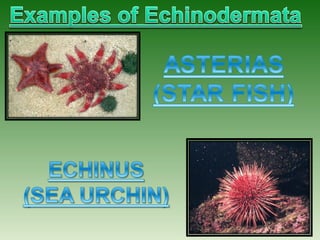
PHYLUM -ECHINODERMATAPHYLUM -ECHINODERMATA
 These animals have an endoskeleton of calcareous ossicles.These animals have an endoskeleton of calcareous ossicles.
 All the marine with organ-system level of organisation.All the marine with organ-system level of organisation.
 The adult echinoderms are radially symmetrical but larvae areThe adult echinoderms are radially symmetrical but larvae are
bilaterally symmetrical.bilaterally symmetrical.
 They are triploblastic and coelomate animals.They are triploblastic and coelomate animals.
 Digestive system is complete.Digestive system is complete.
 The most distinctive feature of echinoderms is the presence ofThe most distinctive feature of echinoderms is the presence of
water vascular systemwater vascular system which helps in locomotion, capturewhich helps in locomotion, capture
and transport of food and respiration.and transport of food and respiration.
 An excretory system is absent.An excretory system is absent.
 Sexes are separate.Sexes are separate.
 Fertilisation is usually external and development is indirectFertilisation is usually external and development is indirect
with free-swimming larva.with free-swimming larva.
PPHYLUM -HYLUM - HHEMICHORDATAEMICHORDATA
 This phylum consists of a small group ofThis phylum consists of a small group of worm-likeworm-like marinemarine
animals with organ-system level of organisation.animals with organ-system level of organisation.
 They are bilaterally symmetrical, triploblastic and coelomateThey are bilaterally symmetrical, triploblastic and coelomate
animals.animals.
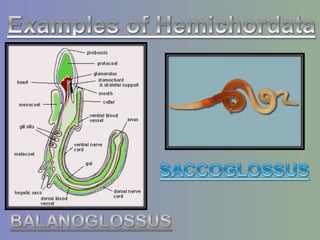
 The body is cylindrical and is composed of an anteriorThe body is cylindrical and is composed of an anterior
proboscisproboscis, a, a collarcollar and a longand a long trunktrunk..
 Circulatory system is of open type.Circulatory system is of open type.
 Respiration takes place through gills.Respiration takes place through gills.
 Excretory is proboscis gland.Excretory is proboscis gland.
 Sexes are separate.Sexes are separate.
 Fertilisation is external.Fertilisation is external.
 Development is indirect.Development is indirect.
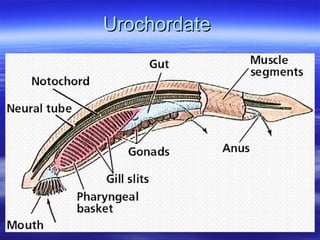
PPHYLUM -HYLUM - CCHORDATAHORDATA
 Animals are characterised by the presence of aAnimals are characterised by the presence of a
notochordnotochord, a, a dorsal hollow nerve corddorsal hollow nerve cord andand pairedpaired
pharyngeal gill slitspharyngeal gill slits..
 These are bilaterally symmetrical, triploblastic, coelomateThese are bilaterally symmetrical, triploblastic, coelomate
with organ-system level of organisation.with organ-system level of organisation.
 They possess a post anal tail and a closed circulatoryThey possess a post anal tail and a closed circulatory
system.system.
 Phylum chordata divided into three subphyla:Phylum chordata divided into three subphyla:
Urochordata, Cephalochordata and Vertebrata.Urochordata, Cephalochordata and Vertebrata.
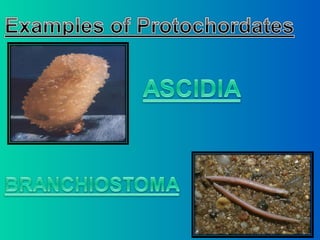
 Subphyla Urochordata and Cephalochordata are oftenSubphyla Urochordata and Cephalochordata are often
reffered to asreffered to as protochordatesprotochordates and are exclusively marine.and are exclusively marine.
 In Urochordata, notochord is present only in larval tail,In Urochordata, notochord is present only in larval tail,
while in Cephalochordata, it extends from head to tailwhile in Cephalochordata, it extends from head to tail
region and is persistent throughout their life.region and is persistent throughout their life.
UrochordateUrochordate
SSUBPHYLUMUBPHYLUM-V-VERTEBRATAERTEBRATA
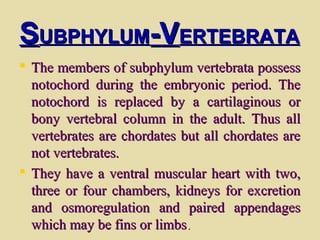
 The members of subphylum vertebrata possessThe members of subphylum vertebrata possess
notochord during the embryonic period. Thenotochord during the embryonic period. The
notochord is replaced by a cartilaginous ornotochord is replaced by a cartilaginous or
bony vertebral column in the adult. Thus allbony vertebral column in the adult. Thus all
vertebrates are chordates but all chordates arevertebrates are chordates but all chordates are
not vertebrates.not vertebrates.
 They have a ventral muscular heart with two,They have a ventral muscular heart with two,
three or four chambers, kidneys for excretionthree or four chambers, kidneys for excretion
and osmoregulation and paired appendagesand osmoregulation and paired appendages
which may be fins or limbswhich may be fins or limbs..
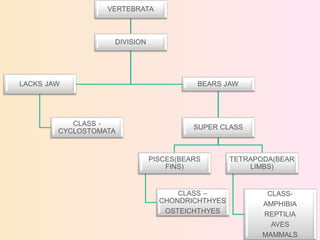
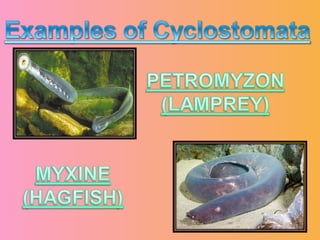
CCLASS -LASS - CCYCLOSTOMATAYCLOSTOMATA
 They are ectoparasites on some fishes.They are ectoparasites on some fishes.
 They have an elongated body bearing 6-15 pairs ofThey have an elongated body bearing 6-15 pairs of
gill slits for respiration.gill slits for respiration.
 They have a sucking and circular mouth withoutThey have a sucking and circular mouth without
jaws.jaws.
 The body is devoid of scales and paired fins.The body is devoid of scales and paired fins.
 Cranium and vertebral column are cartilaginous.Cranium and vertebral column are cartilaginous.
 Circulation is of closed type.Circulation is of closed type.
 They are marine but migrate for spawning to freshThey are marine but migrate for spawning to fresh
water. After spawning, within few days, they die.water. After spawning, within few days, they die.
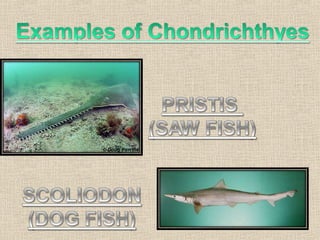
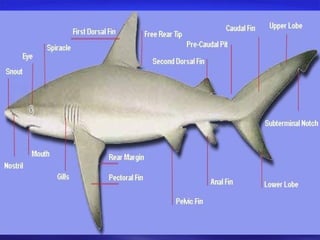
CLASS - CHONDRICHTHYESCLASS - CHONDRICHTHYES
 They are marine animals with streamlined body and haveThey are marine animals with streamlined body and have
cartilaginous endoskeletoncartilaginous endoskeleton..
 Mouth is located ventrally. Notochord is persistent throughoutMouth is located ventrally. Notochord is persistent throughout
life.life.
 Gill slits are separate andGill slits are separate and without operculumwithout operculum..
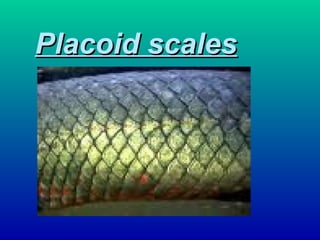
 The skin is tough, containing minute placoid scales. Teeth areThe skin is tough, containing minute placoid scales. Teeth are
modified placoid scales which backwardly directed. Thesemodified placoid scales which backwardly directed. These
animals are predaceous.animals are predaceous.
 Heart is two chambered. They lack the capacity to regulateHeart is two chambered. They lack the capacity to regulate
their body temperature.their body temperature.
 Sexes are separate. They have internal fertilisation and manySexes are separate. They have internal fertilisation and many
of them are viviparous.of them are viviparous.
Placoid scalesPlacoid scales
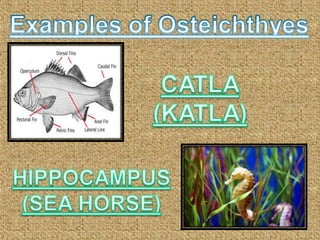
CCLASS -LASS - OOSTEICHTHYESSTEICHTHYES
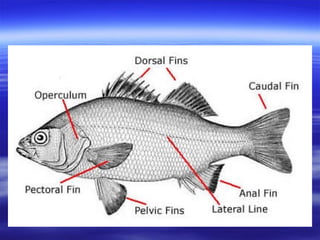
 It includes both marine and fresh water fishesIt includes both marine and fresh water fishes
with bony endoskeleton. Their body iswith bony endoskeleton. Their body is
streamlined. Mouth is terminal.streamlined. Mouth is terminal.
 They have four pairs of gills which covered by anThey have four pairs of gills which covered by an
operculum on each side. Skin is covered withoperculum on each side. Skin is covered with
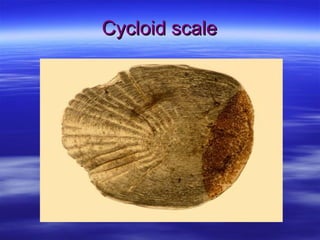
cycloid scaled.cycloid scaled.
 Air bladder is present which regulates buoyancy.Air bladder is present which regulates buoyancy.
 Heart is two chambered.Heart is two chambered.
 They are cold-blooded animals.They are cold-blooded animals.
 Sexes are separate. Fertilisation is external.Sexes are separate. Fertilisation is external.
 They mostly oviparous and development is directThey mostly oviparous and development is direct..
Cycloid scaleCycloid scale
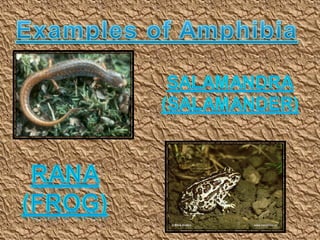
CCLASS -LASS - AAMPHIBIAMPHIBIA
 Amphibians can live in aquatic as well as terrestrial habitats.Amphibians can live in aquatic as well as terrestrial habitats.
 They have two pairs of limbs.They have two pairs of limbs.
 Body is divisible into head and trunk. Tail may be present in some.Body is divisible into head and trunk. Tail may be present in some.
 Their skin is moist. The eyes have eyelids.Their skin is moist. The eyes have eyelids.
 A tympanum represents the ear.A tympanum represents the ear.
 Alimentary canal, urinary and reproductive tracts open in to a commonAlimentary canal, urinary and reproductive tracts open in to a common
chamber called cloaca which opens to the exterior.chamber called cloaca which opens to the exterior.
 Respiration is by gills, lungs and through skin.Respiration is by gills, lungs and through skin.
 The heart is three- chambered. These are cold-blooded animals.The heart is three- chambered. These are cold-blooded animals.
 Sexes are separate.Sexes are separate.
 Fertilisation is external. They are oviparous and development is indirect.Fertilisation is external. They are oviparous and development is indirect.
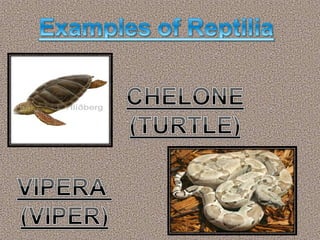
CLASS - REPTILIACLASS - REPTILIA
 They are mostly terrestrial animals and their body isThey are mostly terrestrial animals and their body is
covered by dry and cornified skin, epidermal scalescovered by dry and cornified skin, epidermal scales
or scutes.or scutes.
 They do not have external ear openings.They do not have external ear openings.
 Tympanum represents ear. Limbs, when present, areTympanum represents ear. Limbs, when present, are
two pairs.two pairs.
 heart is usually three – chambered, but four –heart is usually three – chambered, but four –
chambered in crocodiles.chambered in crocodiles.
 Reptiles are poikilotherms.Reptiles are poikilotherms.
 Sexes are separate. Fertilisation is internal.Sexes are separate. Fertilisation is internal.
 They are oviparous and development is direct.They are oviparous and development is direct.
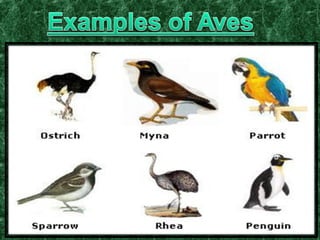
CCLASS -LASS - AAVESVES The characteristic features of aves are the presence of feathers and mostThe characteristic features of aves are the presence of feathers and most
of them can fly except flightless birds.of them can fly except flightless birds.
 They possess beak. The forelimb is modified into wings. The hindThey possess beak. The forelimb is modified into wings. The hind
limbs have scales and are modified for walking, swimming or claspinglimbs have scales and are modified for walking, swimming or clasping
the tree branches.the tree branches.
 Skin is dry without glands except the oil gland at the base of the tail.Skin is dry without glands except the oil gland at the base of the tail.
 Endoskeleton is fully ossified (bony) and the long bones are hollowEndoskeleton is fully ossified (bony) and the long bones are hollow
with air cavities.with air cavities.
 The digestive tract of birds has additional chambers, the crop andThe digestive tract of birds has additional chambers, the crop and
gizzard.gizzard.
 Heart is completely four chambered. They are warm-Heart is completely four chambered. They are warm-
blooded(homoiothermous) animals.blooded(homoiothermous) animals.
 Respiration is by lungs. Air sacs connected to lungs supplementRespiration is by lungs. Air sacs connected to lungs supplement
respiration.respiration.
 Sexes are separate. Fertilisation is internal. They are oviparous andSexes are separate. Fertilisation is internal. They are oviparous and
development is direct.development is direct.
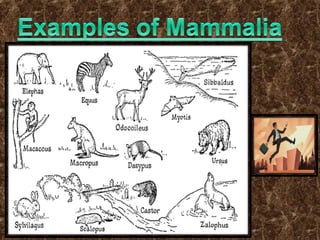
CCLASS -LASS - MMAMMALIAAMMALIA
 They are found in a variety of habitats – polar ice caps,They are found in a variety of habitats – polar ice caps,
deserts, mountains, forests, grasslands and dark caves.deserts, mountains, forests, grasslands and dark caves.
 Some f them fly or live in water.Some f them fly or live in water.
 The most unique mammalian characteristic is the presence ofThe most unique mammalian characteristic is the presence of
milk producing glands by which the young ones are nourished.milk producing glands by which the young ones are nourished.
 They have two pairs of limbs, adapted for working, running,They have two pairs of limbs, adapted for working, running,
climbing, burrowing, swimming or flying.climbing, burrowing, swimming or flying.
 The skin of possess hair. External ears or pinnae are present.The skin of possess hair. External ears or pinnae are present.
Different types of teeth are present in the jaw.Different types of teeth are present in the jaw.
 Heart is four chambered. They are homoiothermous.Heart is four chambered. They are homoiothermous.
 Respiration is by lungs.Respiration is by lungs.
 Sexes are separate and fertilisation is internal.Sexes are separate and fertilisation is internal.
 They are viviparous with exception and development is direct.They are viviparous with exception and development is direct.
Chap 4-animal-kingdom-vishnu1

Chap 4-animal-kingdom-vishnu1

  • 3.
    BBASIS OFASIS OFCCLASSIFICATIONLASSIFICATION In spite of differences in structure and form ofIn spite of differences in structure and form of different animals, there are fundamental featuresdifferent animals, there are fundamental features common to various individuals in relation to thecommon to various individuals in relation to the arrangement of cells, body symmetry, nature ofarrangement of cells, body symmetry, nature of coelom, patterns of digestive, circulatory orcoelom, patterns of digestive, circulatory or reproductive systems. These features are used asreproductive systems. These features are used as the basis of animal classification.the basis of animal classification.
  • 4.
    LLEVELS OFEVELS OFOORGANISATIONRGANISATION  All members of Animalia are multicellular, all of them do not exhibit the sameAll members of Animalia are multicellular, all of them do not exhibit the same pattern of organisation of cells. For examples, in sponges, the cells are arranged aspattern of organisation of cells. For examples, in sponges, the cells are arranged as loose cell aggregates, i.e., they exhibitloose cell aggregates, i.e., they exhibit cellular levelcellular level of organisation.of organisation.  In coelenterates, the arrangements of cells is more complex. Here the cellIn coelenterates, the arrangements of cells is more complex. Here the cell performing the same function are arranged into tissues, hence is calledperforming the same function are arranged into tissues, hence is called tissue leveltissue level of organisation.of organisation.  A still higher level of organisation, i.e., organ level is exhibited by members ofA still higher level of organisation, i.e., organ level is exhibited by members of Platyhelminthes and other higher phyla where tissues are grouped together to formPlatyhelminthes and other higher phyla where tissues are grouped together to form organs, each specialised for a particular function.organs, each specialised for a particular function.  In animals like Annelids, Arthropods , chordates, etc, organ have associated toIn animals like Annelids, Arthropods , chordates, etc, organ have associated to form functional systems, each system concerned with a specific physiologicalform functional systems, each system concerned with a specific physiological function. This pattern is called organ system level of organisation.function. This pattern is called organ system level of organisation.  The circulatory system is of two types:The circulatory system is of two types: a)a) Open typeOpen type in which the blood is pumped out of the heart and the cells and tissuesin which the blood is pumped out of the heart and the cells and tissues are directly bathed in it andare directly bathed in it and b)b) Closed typeClosed type in which the blood is circulated through a series of vessels of varyingin which the blood is circulated through a series of vessels of varying diameters (arteries, veins and capillaries).diameters (arteries, veins and capillaries).  The digestive system is of two types:The digestive system is of two types: a)a) IncompleteIncomplete digestive system as only a single opening to the outside of the bodydigestive system as only a single opening to the outside of the body that serves as both mouth and anus.that serves as both mouth and anus. b)b) CompleteComplete digestive system has two openings, mouth and anusdigestive system has two openings, mouth and anus..
  • 5.
    SSYMMETRYYMMETRY  Animals canbe categorised on the basis of theirAnimals can be categorised on the basis of their symmetry.symmetry.  Sponges are mostly asymmetrical, i.e., any planeSponges are mostly asymmetrical, i.e., any plane that passes through the centre does not divide themthat passes through the centre does not divide them into equal halves.into equal halves.  When any plane passing through the central axis ofWhen any plane passing through the central axis of the body divides the organisms into two identicalthe body divides the organisms into two identical halves, it is called radial symmetry. Eg :-halves, it is called radial symmetry. Eg :- coelenterates, ctenophores and echinoderms.coelenterates, ctenophores and echinoderms.  Animals like annelids, arthropods, etc., where theAnimals like annelids, arthropods, etc., where the body can be divided into identical left and rightbody can be divided into identical left and right halves in only one plane, exhibit bilateral symmetryhalves in only one plane, exhibit bilateral symmetry..
  • 7.
    DDiploblastic andiploblastic andTTriploblasticriploblastic  Animals in which the cells are arranged in twoAnimals in which the cells are arranged in two embryonic layers, an external ectoderm and anembryonic layers, an external ectoderm and an internal endoderm, are called diploblastic animals,internal endoderm, are called diploblastic animals, e.g., coelenterates.e.g., coelenterates.  An undifferentiated layer, mesoglea, is present inAn undifferentiated layer, mesoglea, is present in between the ectoderm and the endoderm. Thosebetween the ectoderm and the endoderm. Those animals in which the developing embryo has theanimals in which the developing embryo has the third germinal layer mesoderm, in between thethird germinal layer mesoderm, in between the ectoderm and endoderm, are called triploblasticectoderm and endoderm, are called triploblastic animals( platyhelminthes to chordatesanimals( platyhelminthes to chordates))
  • 9.
    CCOELOMOELOM  Presence orabsence of a cavity between the body wallPresence or absence of a cavity between the body wall and the gut wall is very important in classification. Theand the gut wall is very important in classification. The body, which is lined by mesoderm is calledbody, which is lined by mesoderm is called coelomcoelom.. Animals possessing coelom are calledAnimals possessing coelom are called coelomatescoelomates, e.g.,, e.g., annelids, molluscs, etc.annelids, molluscs, etc.  In some animals, the body cavity iis not lined byIn some animals, the body cavity iis not lined by mesoderm, instead, the mesoderm is present as scatteredmesoderm, instead, the mesoderm is present as scattered pouches in between the ectoderm and endoderm. Such apouches in between the ectoderm and endoderm. Such a body cavity is called pseudocoelom and the animalsbody cavity is called pseudocoelom and the animals possessing them are calledpossessing them are called pseudocoelomatespseudocoelomates, e.g.,, e.g., aschelminthes.aschelminthes.  The animals in which the body cavity is absent are calledThe animals in which the body cavity is absent are called acoelomatesacoelomates, e.g., platyhelminthes., e.g., platyhelminthes.
  • 11.
    SSEGMENTATIONEGMENTATION  In someanimals, the body isIn some animals, the body is externally and internally divided intoexternally and internally divided into segments with serial repetition of atsegments with serial repetition of at least some organs. For example, inleast some organs. For example, in earthworm, the body shows thisearthworm, the body shows this pattern called metamericpattern called metameric segmentation and the phenomenon issegmentation and the phenomenon is known as metamerismknown as metamerism..
  • 13.
    NNOTOCHORDOTOCHORD  Notochord isa mesodermally derived rod-Notochord is a mesodermally derived rod- like structure formed on the dorsal sidelike structure formed on the dorsal side during embryonic development in someduring embryonic development in some animals. Animals with notochord are calledanimals. Animals with notochord are called chordates and those animals which do notchordates and those animals which do not form this structure are called non-form this structure are called non- chordates, e.g., porifers to echinoderms.chordates, e.g., porifers to echinoderms.
  • 16.
    PPHYLUM -HYLUM -PPORIFERAORIFERA  Marine and mostly asymmetrical animals.Marine and mostly asymmetrical animals.  Primitive multicellular animals and have cellular level ofPrimitive multicellular animals and have cellular level of organisation.organisation.  Have a water transport or canal system. Water enters throughHave a water transport or canal system. Water enters through minute pores in the body wall into a central cavity,minute pores in the body wall into a central cavity, spongocoeol, from where it goes out through the osculum. It isspongocoeol, from where it goes out through the osculum. It is help in food gathering, respiratory exchange and removal ofhelp in food gathering, respiratory exchange and removal of waste.waste.  The body is supported by a skeleton made up of spicules orThe body is supported by a skeleton made up of spicules or spongin fibres.spongin fibres.  Sexes are not separate(hermaphrodite),Sexes are not separate(hermaphrodite),  Asexually by fragmentation and sexually by formation ofAsexually by fragmentation and sexually by formation of gametes.gametes.
  • 18.
    Cross section ofspongeCross section of sponge
  • 19.
    PHYLUM –PHYLUM – COELENTERATA(CNIDARIA)COELENTERATA(CNIDARIA) Aquatic , mostly marine, sessile or free- swimming,Aquatic , mostly marine, sessile or free- swimming, radially symmetrical animals.radially symmetrical animals.  Exhibit tissue level of organisation and areExhibit tissue level of organisation and are diploblastic.diploblastic.  Have a central gastro-vascular cavity with a singleHave a central gastro-vascular cavity with a single opening, mouth on hypostome.opening, mouth on hypostome.  Digestion is extracellular and intracellular.Digestion is extracellular and intracellular.  Exhibit two basic body forms called polyp andExhibit two basic body forms called polyp and medusa.medusa.  Polyps produce medusae asexually and medusae formPolyps produce medusae asexually and medusae form the polyps sexually.the polyps sexually.
  • 20.
  • 22.
    PPHYLUM -HYLUM -CCTENOPHORATENOPHORA  Ctenophores, commonly known asCtenophores, commonly known as sea walnutssea walnuts oror comb jelliescomb jellies are exclusively marine, radiallyare exclusively marine, radially symmetrical, diploblastic organisms with tissue levelsymmetrical, diploblastic organisms with tissue level of organization.of organization.  The body bears eight external rows of ciliatedThe body bears eight external rows of ciliated combcomb platesplates, which help in locomotion., which help in locomotion.  Digestion is both extracellular and intracellular.Digestion is both extracellular and intracellular.  BioluminescenceBioluminescence is well-marked in ctenophores.is well-marked in ctenophores.  Sexes are not separate. Reproduction takes place onlySexes are not separate. Reproduction takes place only by sexual means. Fertilisation is external with indirectby sexual means. Fertilisation is external with indirect development.development.
  • 23.
  • 24.
    PPHYLUM -HYLUM - PPLATYHELMINTHESLATYHELMINTHESThey have dorso – ventrally flattened body, hence are calledThey have dorso – ventrally flattened body, hence are called flatwormsflatworms..  These are mostly endoparasityes found in animals includingThese are mostly endoparasityes found in animals including human beings.human beings.  They are symmetrical, triploblastic and acoelamate animalsThey are symmetrical, triploblastic and acoelamate animals with organ level of organisation.with organ level of organisation.  Hooks and suckers are present in the parasitic forms. Some ofHooks and suckers are present in the parasitic forms. Some of them absorb nutrients from the host directly through theirthem absorb nutrients from the host directly through their body surface.body surface.  Specialised cells called flame cells help in osmoregulation andSpecialised cells called flame cells help in osmoregulation and excretion.excretion.  Sexes are not separate. Fertilisation is internal andSexes are not separate. Fertilisation is internal and development is through many larval stagesdevelopment is through many larval stages..
  • 26.
    PHYLUM - ASCHELMINTHESPHYLUM- ASCHELMINTHES  The body of the aschelminthes is circular in cross-section, hence theThe body of the aschelminthes is circular in cross-section, hence the name roundworms.name roundworms.  They are freeliving, aquatic and terrestrial or parasitic in plants andThey are freeliving, aquatic and terrestrial or parasitic in plants and animals.animals.  They have organ-system level of body organisation.They have organ-system level of body organisation.  They are bilaterally symmetrical, triploblastic and pseudocoelomateThey are bilaterally symmetrical, triploblastic and pseudocoelomate animals.animals.  Alimentary canal is complete with a well developed muscular pharynx.Alimentary canal is complete with a well developed muscular pharynx.  An excretory tube removes body wastes from the body cavity throughAn excretory tube removes body wastes from the body cavity through the excretory pore.the excretory pore.  Sexes are separate, i.e., males and females are distinct.Sexes are separate, i.e., males and females are distinct.  Females are longer than males.Females are longer than males.  Fertilisation is internal and development may be direct or indirect.Fertilisation is internal and development may be direct or indirect.
  • 28.
    PPHYLUM -HYLUM -AANNELIDANNELIDA  They may be aquatic or terestrial; free-living, and sometimesThey may be aquatic or terestrial; free-living, and sometimes parasitic.parasitic.  They exhibit organ-system level of body organisation andThey exhibit organ-system level of body organisation and bilateral symmetry.bilateral symmetry.  They are triploblastic, metamerically segmented and coelomateThey are triploblastic, metamerically segmented and coelomate animals.animals.  Their body surface is distinctly marked out intoTheir body surface is distinctly marked out into segmentssegments oror metameresmetameres and , hence, the phylum name annelida.and , hence, the phylum name annelida.  They possess longitudinal and circular muscles which help inThey possess longitudinal and circular muscles which help in swimming.swimming.  A closed circulatory system is present.A closed circulatory system is present.  NephridiaNephridia help in osmoregulation and excretion.help in osmoregulation and excretion.  Reproduction is sexual.Reproduction is sexual.
  • 30.
    PPHYLUM -HYLUM -AARTHROPODARTHROPODA  This is theThis is the largest phylumlargest phylum of animalia which includes insects.of animalia which includes insects.  They have organ-system level of organisation.They have organ-system level of organisation.  They are bilaterally symmetrical, triploblastic, segmented andThey are bilaterally symmetrical, triploblastic, segmented and coelomate animals.coelomate animals.  The body of arthropods is covered by chitinous exoskeleton. TheThe body of arthropods is covered by chitinous exoskeleton. The body consists ofbody consists of head, thorax and abdomenhead, thorax and abdomen. They have a. They have a jointedjointed appendages.appendages.  Repiratory organs are gills, book gills, book lungs or trachealRepiratory organs are gills, book gills, book lungs or tracheal system.system.  Circulatory system is of open type. Sensory organs like antennae,Circulatory system is of open type. Sensory organs like antennae, eyes, statocysts or balance organs are present.eyes, statocysts or balance organs are present.  Excretion takes place throughExcretion takes place through malpighian tubulesmalpighian tubules..  Fertilisation is usually internal. They are mostlyFertilisation is usually internal. They are mostly oviparous.development may be direct or indirect.oviparous.development may be direct or indirect.
  • 32.
    PPHYLUM -HYLUM -MMOLLUSCAOLLUSCA  This is theThis is the second largestsecond largest animal phylum.animal phylum.  They are terrestrial or aquatic having an organ-system level ofThey are terrestrial or aquatic having an organ-system level of organisation.organisation.  They are bilaterally symmetrical, triploblastic and coelomateThey are bilaterally symmetrical, triploblastic and coelomate animals.animals.  Body is covered by a calcareous shell and is unsegmented with aBody is covered by a calcareous shell and is unsegmented with a distinctdistinct headhead,, muscular footmuscular foot andand visceral humpvisceral hump..  A soft and spongy layer of skin forms a mantel over the visceralA soft and spongy layer of skin forms a mantel over the visceral hump.hump.  The space between hump and the mantle is called the mantle cavityThe space between hump and the mantle is called the mantle cavity in which feather like gills are present.in which feather like gills are present.  They have respiratory and excretory functions.They have respiratory and excretory functions.  The anterior head region has sensory tentacles. The mouth contains aThe anterior head region has sensory tentacles. The mouth contains a file-like rasping organ for feeding, calledfile-like rasping organ for feeding, called radularadula..  They are usually dioecious and oviparous with indirect developmentThey are usually dioecious and oviparous with indirect development..
  • 34.
    PHYLUM -ECHINODERMATAPHYLUM -ECHINODERMATA These animals have an endoskeleton of calcareous ossicles.These animals have an endoskeleton of calcareous ossicles.  All the marine with organ-system level of organisation.All the marine with organ-system level of organisation.  The adult echinoderms are radially symmetrical but larvae areThe adult echinoderms are radially symmetrical but larvae are bilaterally symmetrical.bilaterally symmetrical.  They are triploblastic and coelomate animals.They are triploblastic and coelomate animals.  Digestive system is complete.Digestive system is complete.  The most distinctive feature of echinoderms is the presence ofThe most distinctive feature of echinoderms is the presence of water vascular systemwater vascular system which helps in locomotion, capturewhich helps in locomotion, capture and transport of food and respiration.and transport of food and respiration.  An excretory system is absent.An excretory system is absent.  Sexes are separate.Sexes are separate.  Fertilisation is usually external and development is indirectFertilisation is usually external and development is indirect with free-swimming larva.with free-swimming larva.
  • 36.
    PPHYLUM -HYLUM -HHEMICHORDATAEMICHORDATA  This phylum consists of a small group ofThis phylum consists of a small group of worm-likeworm-like marinemarine animals with organ-system level of organisation.animals with organ-system level of organisation.  They are bilaterally symmetrical, triploblastic and coelomateThey are bilaterally symmetrical, triploblastic and coelomate animals.animals.  The body is cylindrical and is composed of an anteriorThe body is cylindrical and is composed of an anterior proboscisproboscis, a, a collarcollar and a longand a long trunktrunk..  Circulatory system is of open type.Circulatory system is of open type.  Respiration takes place through gills.Respiration takes place through gills.  Excretory is proboscis gland.Excretory is proboscis gland.  Sexes are separate.Sexes are separate.  Fertilisation is external.Fertilisation is external.  Development is indirect.Development is indirect.
  • 38.
    PPHYLUM -HYLUM -CCHORDATAHORDATA  Animals are characterised by the presence of aAnimals are characterised by the presence of a notochordnotochord, a, a dorsal hollow nerve corddorsal hollow nerve cord andand pairedpaired pharyngeal gill slitspharyngeal gill slits..  These are bilaterally symmetrical, triploblastic, coelomateThese are bilaterally symmetrical, triploblastic, coelomate with organ-system level of organisation.with organ-system level of organisation.  They possess a post anal tail and a closed circulatoryThey possess a post anal tail and a closed circulatory system.system.  Phylum chordata divided into three subphyla:Phylum chordata divided into three subphyla: Urochordata, Cephalochordata and Vertebrata.Urochordata, Cephalochordata and Vertebrata.  Subphyla Urochordata and Cephalochordata are oftenSubphyla Urochordata and Cephalochordata are often reffered to asreffered to as protochordatesprotochordates and are exclusively marine.and are exclusively marine.  In Urochordata, notochord is present only in larval tail,In Urochordata, notochord is present only in larval tail, while in Cephalochordata, it extends from head to tailwhile in Cephalochordata, it extends from head to tail region and is persistent throughout their life.region and is persistent throughout their life.
  • 39.
  • 41.
    SSUBPHYLUMUBPHYLUM-V-VERTEBRATAERTEBRATA  The membersof subphylum vertebrata possessThe members of subphylum vertebrata possess notochord during the embryonic period. Thenotochord during the embryonic period. The notochord is replaced by a cartilaginous ornotochord is replaced by a cartilaginous or bony vertebral column in the adult. Thus allbony vertebral column in the adult. Thus all vertebrates are chordates but all chordates arevertebrates are chordates but all chordates are not vertebrates.not vertebrates.  They have a ventral muscular heart with two,They have a ventral muscular heart with two, three or four chambers, kidneys for excretionthree or four chambers, kidneys for excretion and osmoregulation and paired appendagesand osmoregulation and paired appendages which may be fins or limbswhich may be fins or limbs..
  • 43.
    CCLASS -LASS -CCYCLOSTOMATAYCLOSTOMATA  They are ectoparasites on some fishes.They are ectoparasites on some fishes.  They have an elongated body bearing 6-15 pairs ofThey have an elongated body bearing 6-15 pairs of gill slits for respiration.gill slits for respiration.  They have a sucking and circular mouth withoutThey have a sucking and circular mouth without jaws.jaws.  The body is devoid of scales and paired fins.The body is devoid of scales and paired fins.  Cranium and vertebral column are cartilaginous.Cranium and vertebral column are cartilaginous.  Circulation is of closed type.Circulation is of closed type.  They are marine but migrate for spawning to freshThey are marine but migrate for spawning to fresh water. After spawning, within few days, they die.water. After spawning, within few days, they die.
  • 45.
    CLASS - CHONDRICHTHYESCLASS- CHONDRICHTHYES  They are marine animals with streamlined body and haveThey are marine animals with streamlined body and have cartilaginous endoskeletoncartilaginous endoskeleton..  Mouth is located ventrally. Notochord is persistent throughoutMouth is located ventrally. Notochord is persistent throughout life.life.  Gill slits are separate andGill slits are separate and without operculumwithout operculum..  The skin is tough, containing minute placoid scales. Teeth areThe skin is tough, containing minute placoid scales. Teeth are modified placoid scales which backwardly directed. Thesemodified placoid scales which backwardly directed. These animals are predaceous.animals are predaceous.  Heart is two chambered. They lack the capacity to regulateHeart is two chambered. They lack the capacity to regulate their body temperature.their body temperature.  Sexes are separate. They have internal fertilisation and manySexes are separate. They have internal fertilisation and many of them are viviparous.of them are viviparous.
  • 46.
  • 49.
    CCLASS -LASS -OOSTEICHTHYESSTEICHTHYES  It includes both marine and fresh water fishesIt includes both marine and fresh water fishes with bony endoskeleton. Their body iswith bony endoskeleton. Their body is streamlined. Mouth is terminal.streamlined. Mouth is terminal.  They have four pairs of gills which covered by anThey have four pairs of gills which covered by an operculum on each side. Skin is covered withoperculum on each side. Skin is covered with cycloid scaled.cycloid scaled.  Air bladder is present which regulates buoyancy.Air bladder is present which regulates buoyancy.  Heart is two chambered.Heart is two chambered.  They are cold-blooded animals.They are cold-blooded animals.  Sexes are separate. Fertilisation is external.Sexes are separate. Fertilisation is external.  They mostly oviparous and development is directThey mostly oviparous and development is direct..
  • 51.
  • 53.
    CCLASS -LASS -AAMPHIBIAMPHIBIA  Amphibians can live in aquatic as well as terrestrial habitats.Amphibians can live in aquatic as well as terrestrial habitats.  They have two pairs of limbs.They have two pairs of limbs.  Body is divisible into head and trunk. Tail may be present in some.Body is divisible into head and trunk. Tail may be present in some.  Their skin is moist. The eyes have eyelids.Their skin is moist. The eyes have eyelids.  A tympanum represents the ear.A tympanum represents the ear.  Alimentary canal, urinary and reproductive tracts open in to a commonAlimentary canal, urinary and reproductive tracts open in to a common chamber called cloaca which opens to the exterior.chamber called cloaca which opens to the exterior.  Respiration is by gills, lungs and through skin.Respiration is by gills, lungs and through skin.  The heart is three- chambered. These are cold-blooded animals.The heart is three- chambered. These are cold-blooded animals.  Sexes are separate.Sexes are separate.  Fertilisation is external. They are oviparous and development is indirect.Fertilisation is external. They are oviparous and development is indirect.
  • 55.
    CLASS - REPTILIACLASS- REPTILIA  They are mostly terrestrial animals and their body isThey are mostly terrestrial animals and their body is covered by dry and cornified skin, epidermal scalescovered by dry and cornified skin, epidermal scales or scutes.or scutes.  They do not have external ear openings.They do not have external ear openings.  Tympanum represents ear. Limbs, when present, areTympanum represents ear. Limbs, when present, are two pairs.two pairs.  heart is usually three – chambered, but four –heart is usually three – chambered, but four – chambered in crocodiles.chambered in crocodiles.  Reptiles are poikilotherms.Reptiles are poikilotherms.  Sexes are separate. Fertilisation is internal.Sexes are separate. Fertilisation is internal.  They are oviparous and development is direct.They are oviparous and development is direct.
  • 57.
    CCLASS -LASS -AAVESVES The characteristic features of aves are the presence of feathers and mostThe characteristic features of aves are the presence of feathers and most of them can fly except flightless birds.of them can fly except flightless birds.  They possess beak. The forelimb is modified into wings. The hindThey possess beak. The forelimb is modified into wings. The hind limbs have scales and are modified for walking, swimming or claspinglimbs have scales and are modified for walking, swimming or clasping the tree branches.the tree branches.  Skin is dry without glands except the oil gland at the base of the tail.Skin is dry without glands except the oil gland at the base of the tail.  Endoskeleton is fully ossified (bony) and the long bones are hollowEndoskeleton is fully ossified (bony) and the long bones are hollow with air cavities.with air cavities.  The digestive tract of birds has additional chambers, the crop andThe digestive tract of birds has additional chambers, the crop and gizzard.gizzard.  Heart is completely four chambered. They are warm-Heart is completely four chambered. They are warm- blooded(homoiothermous) animals.blooded(homoiothermous) animals.  Respiration is by lungs. Air sacs connected to lungs supplementRespiration is by lungs. Air sacs connected to lungs supplement respiration.respiration.  Sexes are separate. Fertilisation is internal. They are oviparous andSexes are separate. Fertilisation is internal. They are oviparous and development is direct.development is direct.
  • 59.
    CCLASS -LASS -MMAMMALIAAMMALIA  They are found in a variety of habitats – polar ice caps,They are found in a variety of habitats – polar ice caps, deserts, mountains, forests, grasslands and dark caves.deserts, mountains, forests, grasslands and dark caves.  Some f them fly or live in water.Some f them fly or live in water.  The most unique mammalian characteristic is the presence ofThe most unique mammalian characteristic is the presence of milk producing glands by which the young ones are nourished.milk producing glands by which the young ones are nourished.  They have two pairs of limbs, adapted for working, running,They have two pairs of limbs, adapted for working, running, climbing, burrowing, swimming or flying.climbing, burrowing, swimming or flying.  The skin of possess hair. External ears or pinnae are present.The skin of possess hair. External ears or pinnae are present. Different types of teeth are present in the jaw.Different types of teeth are present in the jaw.  Heart is four chambered. They are homoiothermous.Heart is four chambered. They are homoiothermous.  Respiration is by lungs.Respiration is by lungs.  Sexes are separate and fertilisation is internal.Sexes are separate and fertilisation is internal.  They are viviparous with exception and development is direct.They are viviparous with exception and development is direct.