REPRODUCTION
Reproduction is the process of producing offsprings that are
biologically or genetically similar to the parent organism, it is
important as it helps in the perpetuation or continuation of
species.
•There are two types of reproduction, sexual and asexual
reproduction.
•Asexual reproduction is a type of reproduction in which only
one parent is involved to reproduce offspring.
•Sexual reproduction is the production of new organisms by
the combination of genetic information of two individuals of
different sex.
2/22/2023 1
Footer Text
The Female Reproductive System
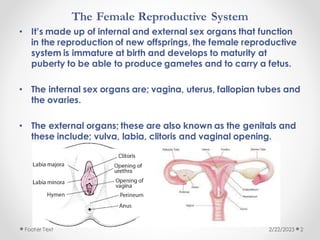
• It’s made up of internal and external sex organs that function
in the reproduction of new offsprings, the female reproductive
system is immature at birth and develops to maturity at
puberty to be able to produce gametes and to carry a fetus.
• The internal sex organs are; vagina, uterus, fallopian tubes and
the ovaries.
• The external organs; these are also known as the genitals and
these include; vulva, labia, clitoris and vaginal opening.
2/22/2023
Footer Text 2
FUNCTIONS OF THE PARTS
2/22/2023
Footer Text 3
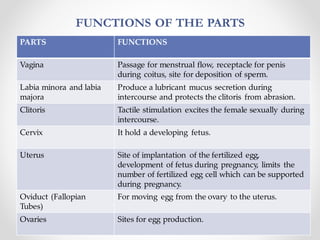
PARTS FUNCTIONS
Vagina Passage for menstrual flow, receptacle for penis
during coitus, site for deposition of sperm.
Labia minora and labia
majora
Produce a lubricant mucus secretion during
intercourse and protects the clitoris from abrasion.
Clitoris Tactile stimulation excites the female sexually during
intercourse.
Cervix It hold a developing fetus.
Uterus Site of implantation of the fertilized egg,
development of fetus during pregnancy, limits the
number of fertilized egg cell which can be supported
during pregnancy.
Oviduct (Fallopian
Tubes)
For moving egg from the ovary to the uterus.
Ovaries Sites for egg production.
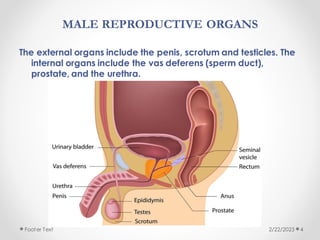
MALE REPRODUCTIVE ORGANS
The external organs include the penis, scrotum and testicles. The
internal organs include the vas deferens (sperm duct),
prostate, and the urethra.
2/22/2023
Footer Text 4
FUNCTIONS OF THE PARTS
2/22/2023
Footer Text 5
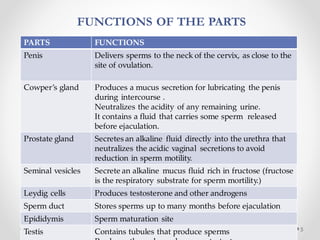
PARTS FUNCTIONS
Penis Delivers sperms to the neck of the cervix, as close to the
site of ovulation.
Cowper’s gland Produces a mucus secretion for lubricating the penis
during intercourse .
Neutralizes the acidity of any remaining urine.
It contains a fluid that carries some sperm released
before ejaculation.
Prostate gland Secretes an alkaline fluid directly into the urethra that
neutralizes the acidic vaginal secretions to avoid
reduction in sperm motility.
Seminal vesicles Secrete an alkaline mucus fluid rich in fructose (fructose
is the respiratory substrate for sperm mortility.)
Leydig cells Produces testosterone and other androgens
Sperm duct Stores sperms up to many months before ejaculation
Epididymis Sperm maturation site
Testis Contains tubules that produce sperms
Gametogenesis
Gametogenesis is the production of gametes from haploid
precursor cells. In animals and higher plants, two
morphologically distinct types of gametes are produced
(male and female) via distinct differentiation programs.
Animals produce a tissue that is dedicated to forming
gametes, called the germ line.
What is the process of gametogenesis?
During the process of gametogenesis, a germ cell undergoes
meiosis to produces haploid cells that directly develop into
gametes. Hence, in animals, the meiosis is an integral part of
gametogenesis. In plants, some fungi, and some algae,
meiosis is temporally separated from gametogenesis.
2/22/2023
Footer Text 6
What are the 4 stages of gametogensis?
Gametogenesis is divided into four phases:
▪ Extra-gonadal origin of primordial germ cells.
▪ Proliferation of germ cells by mitosis.
▪ Meiosis
▪ Structural and functional maturation of the ova and
spermatozoa.
What are the two types of gametogenesis?
Spermatogenesis and oogenesis are both forms of
gametogenesis, in which a diploid gamete cell produces
haploid sperm and egg cells, respectively.
2/22/2023
Footer Text 7
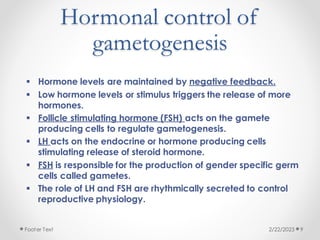
What hormones are involved in gametogenesis?
Gametogenesis in both females and males are regulated by
specific hormones called follicle- stimulating hormone (FSH) and
LH (Leydig hormone). Both LH and FSH work together in order to
stimulate the cells present in Leydig of the testes in males and
help in generation of male gamete.
Is meiosis haploid or diploid?
Meiosis is the production of four genetically diverse haploid
daughter calls from one diploid parent cell. Meiosis can only
occur in eukaryotic organisms.
2/22/2023
Footer Text 8
Hormonal control of
gametogenesis
▪ Hormone levels are maintained by negative feedback.
▪ Low hormone levels or stimulus triggers the release of more
hormones.
▪ Follicle stimulating hormone (FSH) acts on the gamete
producing cells to regulate gametogenesis.
▪ LH acts on the endocrine or hormone producing cells
stimulating release of steroid hormone.
▪ FSH is responsible for the production of gender specific germ
cells called gametes.
▪ The role of LH and FSH are rhythmically secreted to control
reproductive physiology.
2/22/2023
Footer Text 9
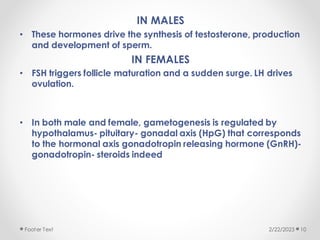
IN MALES
• These hormones drive the synthesis of testosterone, production
and development of sperm.
IN FEMALES
• FSH triggers follicle maturation and a sudden surge. LH drives
ovulation.
• In both male and female, gametogenesis is regulated by
hypothalamus- pituitary- gonadal axis (HpG) that corresponds
to the hormonal axis gonadotropin releasing hormone (GnRH)-
gonadotropin- steroids indeed
2/22/2023
Footer Text 10
How do hormones control gametogenesis in males
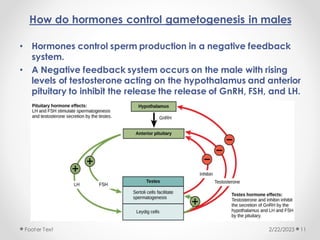
• Hormones control sperm production in a negative feedback
system.
• A Negative feedback system occurs on the male with rising
levels of testosterone acting on the hypothalamus and anterior
pituitary to inhibit the release the release of GnRH, FSH, and LH.
2/22/2023
Footer Text 11
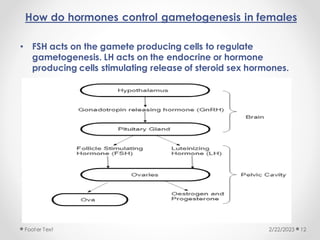
How do hormones control gametogenesis in females
• FSH acts on the gamete producing cells to regulate
gametogenesis. LH acts on the endocrine or hormone
producing cells stimulating release of steroid sex hormones.
2/22/2023
Footer Text 12
MENSRUATION
• Menstruation, or period is the regular discharge of blood and
mucosal tissue from the inner lining of the uterus through the
vagina. Every month , females body prepares for pregnancy. If no
pregnancy occurs, the uterus , or womb, sheds it’s lining.
Menstruation is triggered by falling progesterone levels and is a
sign that pregnancy has not occurred.
MENSTRUAL CYCLE
• The menstrual cycle is the time from the first day of women’s
period to the day before her next period.
• The length of the menstrual cycle varies from woman to woman
, but the average is to have periods every 28 days.
• Girls can start their periods anywhere from the age of 8
upwards, and the average age for the menopause is 51.
• Menopause is the time that marks the end of female’s menstrual
cycle.
2/22/2023
Footer Text 13
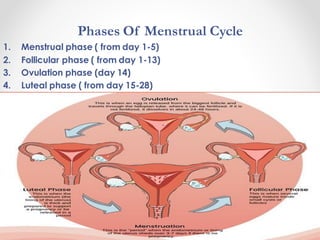
Phases Of Menstrual Cycle
1. Menstrual phase ( from day 1-5)
2. Follicular phase ( from day 1-13)
3. Ovulation phase (day 14)
4. Luteal phase ( from day 15-28)
2/22/2023
Footer Text 14
1 Menstrual phase
Menstrual phase begins on the first day of menstruation
and lasts till the 5th day of the menstrual cycle. The
following events occur during this phase:
• The uterus sheds its inner lining of soft tissue and blood
vessels which exist the body from the vagina in the form of
menstrual fluid.
• Blood loss of 10 ml to 80 ml is considered normal.
• You may experience abdominal cramps . These cramps
are caused by the contraction of uterine and the
abdominal muscles to expel the menstrual fluid .
2/22/2023
Footer Text 15
2 Follicular phase
This phase also begins on the first day of menstruation,
but it lasts till the 13th day of the menstrual cycle . The
following events occur during this phase:
• the pituitary secretes a hormone that stimulates the egg
cells in the ovaries to grow.
• One of these egg cells begins to mature in a sac-like-
structure called follicle. It takes 13 days for the egg cell to
reach maturity.
• While the egg cell matures, its follicle secretes a hormone
that stimulates the uterus to develop a lining of blood
vessels and soft tissue called endometrium .
2/22/2023
Footer Text 16
3 Ovulation phase
On the 14th day of the cycle , the pituitary glad
secretes a hormone that causes the ovary to release the
matured egg cell. The released egg cell is swept into the
fallopian tube by the cilia of the fimbriae . Fimbriae are
finger like projections located at the end of the fallopian
tube close to the ovaries and cilia are slender hair like
projections on each fimbria.
4 Luteal phase
This phase begins on the 15th day and lasts till the end of
the cycle. The following events occur during this phase:
• The egg cell released during the ovulation phase stays in
the fallopian tube for 24 hours.
• If a sperm cell doesn’t impregnate the egg cell within that
time, the egg cell disintegrates.
2/22/2023
Footer Text 17
• The hormone that causes the uterus to retain its
endometrium gets used up by the end of the menstrual
cycle. This causes the menstrual phase of the next cycle
to begin.
Hormonal Control Of Menstruation
Cycle
The menstrual cycle is governed by interaction between
the reproductive hormones LH , FSH , oestradiol ,
progestrone that result in growth of follicle, ovulation ,
formation of the corpus luteum.
If no pregnancy occurs the fall of progestrone leads to
the shading of womb lining and recommencing the cycle.
2/22/2023
Footer Text 18
The hormones governing the menstrual cycle changes
the following,
1. A small rise in FSH occurs at the beginning of the cycle.
2. As the follicles grow, they produce Oesrtradial and Inhibin B. Inhabin
B and low level of oestradiol exert negative feed back on the
hypothalamic-pituitary-gonadal axis to reduce FSH levels. This
reduction aids selection of the dominant follicle.
3. As the dominant follicle continues to grow it continues to produce
oesrtadial.
4. The mid cycle rise in LH that last for 36-48 hours , leads to ovulation
and remnant of the follicle forms corpus luteum.
5. The progestrone prepares the endometrium for implantation in case
an egg is fertilized to form embryo .
6. If an embryo forms it secretes the human choriomic gonadotrophin
(hCG) which can activate the LH recepters to mentain the function of
the corpus luteam. Such that it can continue to produce progestrone
and maintain the pregnancy
2/22/2023
Footer Text 19
7. If no embryo forms and implants the corpus luteam no
longer survive and this leads to a fall in progestrone.
8. The fall in progestrone leads to shedding of the
endometrial lining. Then menstrual bleeding and the
cycle recommences.
FERTILISATION
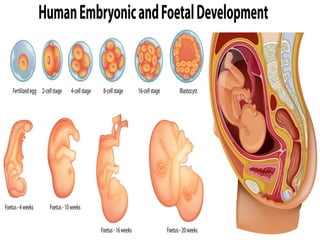
Fertilization is a complex multi step process that is
complete in 24 hours . The sperm from male meets am
ovum from female and form a zygote.
2/22/2023
Footer Text 20
2/22/2023
Footer Text 21
• There are three main stages in fertilization and those are
1. Sperm capacitation and acrosome reaction
• sperm capacitation is the set of natural physical changes that a spermatozoon
undergoes in order to be able to fertilize the ovum.
• Acrosomal reaction is the reaction during which the sperm reaches the egg
and allows the sperm to break the surroundin jelly coat.
2. Sperm – egg binding and fusion
• In order for fertilization to occur sperm must bind to the zona prllucide, undergo
acrosome reaction , penetrate the zona pellucide and then bind to and fuse
with egg plazma membrain.
3. Cortical reaction and oocyte activation
• cortical reaction is a reaction during which a hardening of the jelly coat
post fertilization to prevent potential polyspermy.
• Oocyte activation is the process by which oocytes arrested in metaphase ll
of meiosis are stimulated to resume meiosis.
2/22/2023
Footer Text 22
Infertility Causes (Male and Female) and
Treatment
• Infertility refers to the inability to concieve in
females and failure to produce mature and healthy
sperms in males.
MALES
• Abnormal production of sperms
• Genetic conditions
• Hormonal or sexual disorders such as gonorrhea,
mumps, chlamydia.
• Hormone imbalance – dismpting ovulation
2/22/2023
Footer Text 23
WOMEN
• Ovulation disorders
• Endometriosis
• Damage of the fallopian tubes
• Uterus Abnormalities
• Age
• Fibroids
• Family Planning
2/22/2023
Footer Text 24
Signs and Symptoms of Infertility in Males
• Problem obtaining and maintaining erection.
• Problem with ejaculation or reduced volume of semen.
• Loss of sexual desires.
• Growth of breast tissues in males.
• Pain or discomfort in the testicles or on the area surrounding
the testicles.
Signs of Infertility of Females
• Abnormal periods, bleeding is heavier or lighter than usual .
• Irregular periods, the number of days in between each
period varies each month.
• No periods, you have never had periods or they suddenly
stopped
2/22/2023
Footer Text 25
Treatment (fertility)
• Hormone treatments
• Fertility drugs
• Surgery incase of fibroids to restore fertility
• Intrauterine insermination
2/22/2023
Footer Text 26
GROUP 6 MEMBERS (Reproduction)
▪ Haliimo Mohamed tahliil
▪ Nakimbugwe Sandrah
▪ Bidal Alias Noah Loro
▪ Naod Atobrhan Ghebregziabiher
▪ Selam Yemane Eyasu
▪ Zekarias Yonas Russom
▪ Zufan kahsay Mezgebo
2/22/2023
Footer Text 27

Reproduction Presentation.pdf

  • 1.
    REPRODUCTION Reproduction is theprocess of producing offsprings that are biologically or genetically similar to the parent organism, it is important as it helps in the perpetuation or continuation of species. •There are two types of reproduction, sexual and asexual reproduction. •Asexual reproduction is a type of reproduction in which only one parent is involved to reproduce offspring. •Sexual reproduction is the production of new organisms by the combination of genetic information of two individuals of different sex. 2/22/2023 1 Footer Text
  • 2.
    The Female ReproductiveSystem • It’s made up of internal and external sex organs that function in the reproduction of new offsprings, the female reproductive system is immature at birth and develops to maturity at puberty to be able to produce gametes and to carry a fetus. • The internal sex organs are; vagina, uterus, fallopian tubes and the ovaries. • The external organs; these are also known as the genitals and these include; vulva, labia, clitoris and vaginal opening. 2/22/2023 Footer Text 2
  • 3.
    FUNCTIONS OF THEPARTS 2/22/2023 Footer Text 3 PARTS FUNCTIONS Vagina Passage for menstrual flow, receptacle for penis during coitus, site for deposition of sperm. Labia minora and labia majora Produce a lubricant mucus secretion during intercourse and protects the clitoris from abrasion. Clitoris Tactile stimulation excites the female sexually during intercourse. Cervix It hold a developing fetus. Uterus Site of implantation of the fertilized egg, development of fetus during pregnancy, limits the number of fertilized egg cell which can be supported during pregnancy. Oviduct (Fallopian Tubes) For moving egg from the ovary to the uterus. Ovaries Sites for egg production.
  • 4.
    MALE REPRODUCTIVE ORGANS Theexternal organs include the penis, scrotum and testicles. The internal organs include the vas deferens (sperm duct), prostate, and the urethra. 2/22/2023 Footer Text 4
  • 5.
    FUNCTIONS OF THEPARTS 2/22/2023 Footer Text 5 PARTS FUNCTIONS Penis Delivers sperms to the neck of the cervix, as close to the site of ovulation. Cowper’s gland Produces a mucus secretion for lubricating the penis during intercourse . Neutralizes the acidity of any remaining urine. It contains a fluid that carries some sperm released before ejaculation. Prostate gland Secretes an alkaline fluid directly into the urethra that neutralizes the acidic vaginal secretions to avoid reduction in sperm motility. Seminal vesicles Secrete an alkaline mucus fluid rich in fructose (fructose is the respiratory substrate for sperm mortility.) Leydig cells Produces testosterone and other androgens Sperm duct Stores sperms up to many months before ejaculation Epididymis Sperm maturation site Testis Contains tubules that produce sperms
  • 6.
    Gametogenesis Gametogenesis is theproduction of gametes from haploid precursor cells. In animals and higher plants, two morphologically distinct types of gametes are produced (male and female) via distinct differentiation programs. Animals produce a tissue that is dedicated to forming gametes, called the germ line. What is the process of gametogenesis? During the process of gametogenesis, a germ cell undergoes meiosis to produces haploid cells that directly develop into gametes. Hence, in animals, the meiosis is an integral part of gametogenesis. In plants, some fungi, and some algae, meiosis is temporally separated from gametogenesis. 2/22/2023 Footer Text 6
  • 7.
    What are the4 stages of gametogensis? Gametogenesis is divided into four phases: ▪ Extra-gonadal origin of primordial germ cells. ▪ Proliferation of germ cells by mitosis. ▪ Meiosis ▪ Structural and functional maturation of the ova and spermatozoa. What are the two types of gametogenesis? Spermatogenesis and oogenesis are both forms of gametogenesis, in which a diploid gamete cell produces haploid sperm and egg cells, respectively. 2/22/2023 Footer Text 7
  • 8.
    What hormones areinvolved in gametogenesis? Gametogenesis in both females and males are regulated by specific hormones called follicle- stimulating hormone (FSH) and LH (Leydig hormone). Both LH and FSH work together in order to stimulate the cells present in Leydig of the testes in males and help in generation of male gamete. Is meiosis haploid or diploid? Meiosis is the production of four genetically diverse haploid daughter calls from one diploid parent cell. Meiosis can only occur in eukaryotic organisms. 2/22/2023 Footer Text 8
  • 9.
    Hormonal control of gametogenesis ▪Hormone levels are maintained by negative feedback. ▪ Low hormone levels or stimulus triggers the release of more hormones. ▪ Follicle stimulating hormone (FSH) acts on the gamete producing cells to regulate gametogenesis. ▪ LH acts on the endocrine or hormone producing cells stimulating release of steroid hormone. ▪ FSH is responsible for the production of gender specific germ cells called gametes. ▪ The role of LH and FSH are rhythmically secreted to control reproductive physiology. 2/22/2023 Footer Text 9
  • 10.
    IN MALES • Thesehormones drive the synthesis of testosterone, production and development of sperm. IN FEMALES • FSH triggers follicle maturation and a sudden surge. LH drives ovulation. • In both male and female, gametogenesis is regulated by hypothalamus- pituitary- gonadal axis (HpG) that corresponds to the hormonal axis gonadotropin releasing hormone (GnRH)- gonadotropin- steroids indeed 2/22/2023 Footer Text 10
  • 11.
    How do hormonescontrol gametogenesis in males • Hormones control sperm production in a negative feedback system. • A Negative feedback system occurs on the male with rising levels of testosterone acting on the hypothalamus and anterior pituitary to inhibit the release the release of GnRH, FSH, and LH. 2/22/2023 Footer Text 11
  • 12.
    How do hormonescontrol gametogenesis in females • FSH acts on the gamete producing cells to regulate gametogenesis. LH acts on the endocrine or hormone producing cells stimulating release of steroid sex hormones. 2/22/2023 Footer Text 12
  • 13.
    MENSRUATION • Menstruation, orperiod is the regular discharge of blood and mucosal tissue from the inner lining of the uterus through the vagina. Every month , females body prepares for pregnancy. If no pregnancy occurs, the uterus , or womb, sheds it’s lining. Menstruation is triggered by falling progesterone levels and is a sign that pregnancy has not occurred. MENSTRUAL CYCLE • The menstrual cycle is the time from the first day of women’s period to the day before her next period. • The length of the menstrual cycle varies from woman to woman , but the average is to have periods every 28 days. • Girls can start their periods anywhere from the age of 8 upwards, and the average age for the menopause is 51. • Menopause is the time that marks the end of female’s menstrual cycle. 2/22/2023 Footer Text 13
  • 14.
    Phases Of MenstrualCycle 1. Menstrual phase ( from day 1-5) 2. Follicular phase ( from day 1-13) 3. Ovulation phase (day 14) 4. Luteal phase ( from day 15-28) 2/22/2023 Footer Text 14
  • 15.
    1 Menstrual phase Menstrualphase begins on the first day of menstruation and lasts till the 5th day of the menstrual cycle. The following events occur during this phase: • The uterus sheds its inner lining of soft tissue and blood vessels which exist the body from the vagina in the form of menstrual fluid. • Blood loss of 10 ml to 80 ml is considered normal. • You may experience abdominal cramps . These cramps are caused by the contraction of uterine and the abdominal muscles to expel the menstrual fluid . 2/22/2023 Footer Text 15
  • 16.
    2 Follicular phase Thisphase also begins on the first day of menstruation, but it lasts till the 13th day of the menstrual cycle . The following events occur during this phase: • the pituitary secretes a hormone that stimulates the egg cells in the ovaries to grow. • One of these egg cells begins to mature in a sac-like- structure called follicle. It takes 13 days for the egg cell to reach maturity. • While the egg cell matures, its follicle secretes a hormone that stimulates the uterus to develop a lining of blood vessels and soft tissue called endometrium . 2/22/2023 Footer Text 16
  • 17.
    3 Ovulation phase Onthe 14th day of the cycle , the pituitary glad secretes a hormone that causes the ovary to release the matured egg cell. The released egg cell is swept into the fallopian tube by the cilia of the fimbriae . Fimbriae are finger like projections located at the end of the fallopian tube close to the ovaries and cilia are slender hair like projections on each fimbria. 4 Luteal phase This phase begins on the 15th day and lasts till the end of the cycle. The following events occur during this phase: • The egg cell released during the ovulation phase stays in the fallopian tube for 24 hours. • If a sperm cell doesn’t impregnate the egg cell within that time, the egg cell disintegrates. 2/22/2023 Footer Text 17
  • 18.
    • The hormonethat causes the uterus to retain its endometrium gets used up by the end of the menstrual cycle. This causes the menstrual phase of the next cycle to begin. Hormonal Control Of Menstruation Cycle The menstrual cycle is governed by interaction between the reproductive hormones LH , FSH , oestradiol , progestrone that result in growth of follicle, ovulation , formation of the corpus luteum. If no pregnancy occurs the fall of progestrone leads to the shading of womb lining and recommencing the cycle. 2/22/2023 Footer Text 18
  • 19.
    The hormones governingthe menstrual cycle changes the following, 1. A small rise in FSH occurs at the beginning of the cycle. 2. As the follicles grow, they produce Oesrtradial and Inhibin B. Inhabin B and low level of oestradiol exert negative feed back on the hypothalamic-pituitary-gonadal axis to reduce FSH levels. This reduction aids selection of the dominant follicle. 3. As the dominant follicle continues to grow it continues to produce oesrtadial. 4. The mid cycle rise in LH that last for 36-48 hours , leads to ovulation and remnant of the follicle forms corpus luteum. 5. The progestrone prepares the endometrium for implantation in case an egg is fertilized to form embryo . 6. If an embryo forms it secretes the human choriomic gonadotrophin (hCG) which can activate the LH recepters to mentain the function of the corpus luteam. Such that it can continue to produce progestrone and maintain the pregnancy 2/22/2023 Footer Text 19
  • 20.
    7. If noembryo forms and implants the corpus luteam no longer survive and this leads to a fall in progestrone. 8. The fall in progestrone leads to shedding of the endometrial lining. Then menstrual bleeding and the cycle recommences. FERTILISATION Fertilization is a complex multi step process that is complete in 24 hours . The sperm from male meets am ovum from female and form a zygote. 2/22/2023 Footer Text 20
  • 21.
  • 22.
    • There arethree main stages in fertilization and those are 1. Sperm capacitation and acrosome reaction • sperm capacitation is the set of natural physical changes that a spermatozoon undergoes in order to be able to fertilize the ovum. • Acrosomal reaction is the reaction during which the sperm reaches the egg and allows the sperm to break the surroundin jelly coat. 2. Sperm – egg binding and fusion • In order for fertilization to occur sperm must bind to the zona prllucide, undergo acrosome reaction , penetrate the zona pellucide and then bind to and fuse with egg plazma membrain. 3. Cortical reaction and oocyte activation • cortical reaction is a reaction during which a hardening of the jelly coat post fertilization to prevent potential polyspermy. • Oocyte activation is the process by which oocytes arrested in metaphase ll of meiosis are stimulated to resume meiosis. 2/22/2023 Footer Text 22
  • 23.
    Infertility Causes (Maleand Female) and Treatment • Infertility refers to the inability to concieve in females and failure to produce mature and healthy sperms in males. MALES • Abnormal production of sperms • Genetic conditions • Hormonal or sexual disorders such as gonorrhea, mumps, chlamydia. • Hormone imbalance – dismpting ovulation 2/22/2023 Footer Text 23
  • 24.
    WOMEN • Ovulation disorders •Endometriosis • Damage of the fallopian tubes • Uterus Abnormalities • Age • Fibroids • Family Planning 2/22/2023 Footer Text 24
  • 25.
    Signs and Symptomsof Infertility in Males • Problem obtaining and maintaining erection. • Problem with ejaculation or reduced volume of semen. • Loss of sexual desires. • Growth of breast tissues in males. • Pain or discomfort in the testicles or on the area surrounding the testicles. Signs of Infertility of Females • Abnormal periods, bleeding is heavier or lighter than usual . • Irregular periods, the number of days in between each period varies each month. • No periods, you have never had periods or they suddenly stopped 2/22/2023 Footer Text 25
  • 26.
    Treatment (fertility) • Hormonetreatments • Fertility drugs • Surgery incase of fibroids to restore fertility • Intrauterine insermination 2/22/2023 Footer Text 26
  • 27.
    GROUP 6 MEMBERS(Reproduction) ▪ Haliimo Mohamed tahliil ▪ Nakimbugwe Sandrah ▪ Bidal Alias Noah Loro ▪ Naod Atobrhan Ghebregziabiher ▪ Selam Yemane Eyasu ▪ Zekarias Yonas Russom ▪ Zufan kahsay Mezgebo 2/22/2023 Footer Text 27