Human genome project Achievement and future direction
1.
z
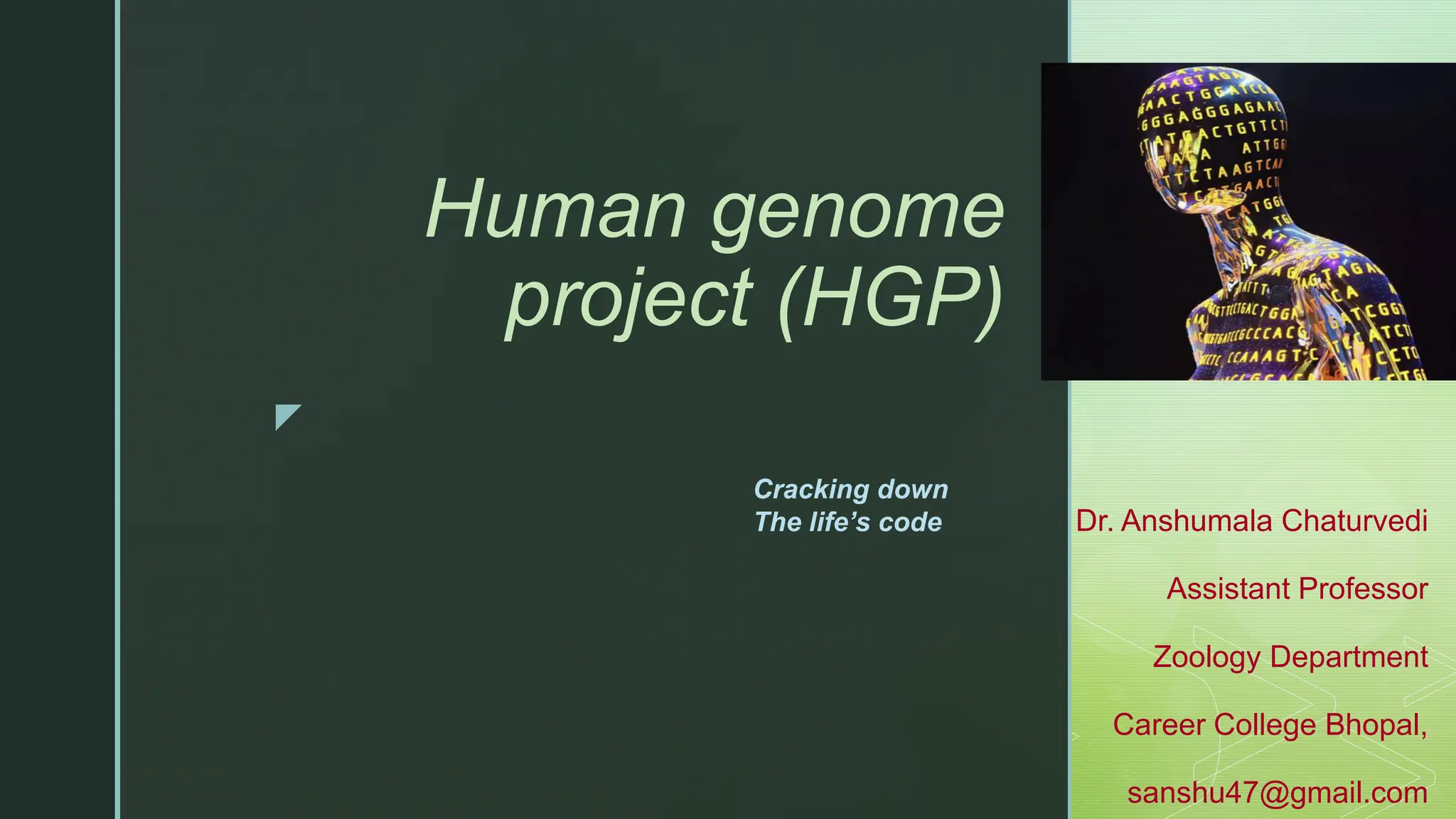
Human genome
project (HGP)
Dr.Anshumala Chaturvedi
Assistant Professor
Zoology Department
Career College Bhopal,
sanshu47@gmail.com
Cracking down
The life’s code
2.
z
Content
Introduction ofHGP
Goals of HGP
Estimate and reality of HGP
Methodology
Sequencing
Maps created
Application
3.
z
Introduction of HGP
Genome – A total number of genes present on a haploid set of
chromosome.
The human genome project was an international scientific
research project that aimed to determine the complete sequence of
nucleotide base pairs that make up human DNA and all the genes it
contains.
It remains the world’s largest collaborative biological project.
The idea was picked up by the US government in 1984 when the
planning started, the project was formally launched in 1990 and
was declared complete in 2003.
4.
z
The genomeof any given individual is unique; mapping the
human genome involved sequencing the genomes of a small
number of individuals and then assembling these together to get
a complete sequence of each chromosome.
The finished human genome is thus a mosaic, not representing
anyone individual.
5.
z
In 1997United States established the National human genome
research Institute (NHGRI)
The HGP was an international research groups from six
countries - USA ,UK, France, Germany, Japan and China and
several laboratories and a large number of scientist and
technicians from various disciplines.
HGP provide a new area for research work And develop a new
branch called Bioinformatics where statistics and data were
maintained.
6.
z
Goals of HGP
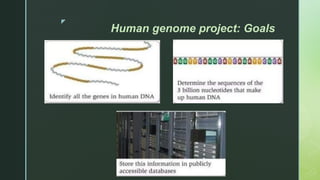
To identify and map all the gene in the human DNA from a
physical and functional stand point.
To determine the sequence of the three billion chemical base
pairs that make up the human DNA.
To store these informations in databases.
Also to sequence the genomes of other organisms that are
important in medical research such as mouse, drosophila etc,.
z
Estimate ofHGP
1. It was 15 years plan.
2. They assume that human genome contain 80,000 to 1,00,000
gene .
3. Approximately 3 billion Nucleotides Were present.
Reality of HGP
1. human genome contain 20,000 to 25,000 gene
2. project was completed before time (2003).
10.
z
Methodology
Two major approach:
1. identify all genes that are expressed as RNA - That means all
the mRNA work as a functional gene and expressed gene is
known as EST (Expressed sequence tag’s)
2. Blind approach – That means simply sequencing the whole set
of genome. It is a time taking process because sequence
annotation is must here
11.
z
How todo sequence annotations?
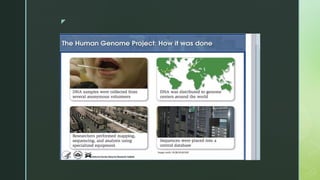
Take a Long strand of DNA break them into small fragments then clone
them in a suitable vector (bacterial artificial chromosome and yeast
artificial chromosome) the introduce the vector inside the host (bacteria
and yeast) and create a multiple copies.
12.
z
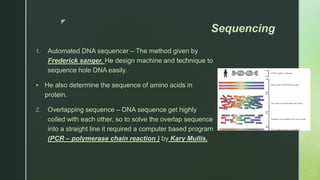
Sequencing
1. Automated DNAsequencer – The method given by
Frederick sanger. He design machine and technique to
sequence hole DNA easily.
He also determine the sequence of amino acids in
protein.
2. Overlapping sequence – DNA sequence get highly
coiled with each other, so to solve the overlap sequence
into a straight line it required a computer based program
(PCR – polymerase chain reaction ) by Kary Mullis.
13.
z
Sequence ofchromosome no.1 was completed in may 2006. Its
sequence will complete lastly .
Sequencing of 22 autosomes, X+Y – chromosome will be
completed in 2003, only chromosome no.1 took longer time to
complete.
Last chromosome sequence is Y – chromosome.
14.
z
Maps created
Anotherchallenge was assigning the genetic and physical maps on
the genomes. This was generated using information on
polymorphism of restriction endonuclease recognition sites, and
some repetitive DNA sequences known as microsatellites (1-
6repeats).
The average gene we get is minimum 3000bases.
Largest human gene is called Dystrophin and it is around 2.4
million bases.
99.9% of nucleotides sequence of every human being is same only
0.1% difference will be seen .
15.
z
50% genesfunctions are undiscovered till now.
Less than 2%of gene were coded for protein.
Chromosome no.1 carry maximum no. Of gene and that is 2,968
Chromosome - Y carry least no. Of gene that is 231 only.
There are 1.4 million locations in the genome were only single
base pair differes (SNP’s) single nucleotide polymorphism.
16.
z
1. Genetic linkagemap
Arrangement or distance between the Gene and the marker (a fix
point)
2. Physical linkage map
It detect the actual location of the gene with no function .
17.
z
Scientists sequencedifferent kind of organisms :
1. Arabidopsis thaliana – plant
2. Saccharomyces cerevisiae – yeast
3. Caenor habditis elegans – worm
4. Mus musculus – mouse
5. Mycobacterium genitalium (having smallest genome) - 569 kilo base pair genome
6. Hemophilus influnzae – 1830 kbp genome
7. Methanococcus janaschii – 1660 kbp genome
Yeast having 16 chromosome and having 12500 kbp genome.
18.
z
Application
The sequencingof the human genome holds benefits for many
fields from molecular medicine to human evolution
Help in identifying disease causing genes.
Identification of mutations linked to different form of cancer.
The sequence of DNA age store In data base available to anyone
on the internet
Benefited the advancement of forensic science
Will allow for advance in agriculture through genetic modification to
yield healthier and more disease resistance crops.




![Getting Started with Apache Spark: Big Data Made Simple [Free Meetup]](https://cdn.slidesharecdn.com/ss_thumbnails/apachesparkgettingstarted-260203175547-8361bcc3-thumbnail.jpg?width=640&height=640&fit=bounds)


