DestructionDestruction
aNDaND
DesecrationDesecration
Traditional indigenous beliefs and
practice become a target of destruction in an
active, behavioral and confrontative second
level of colonization.
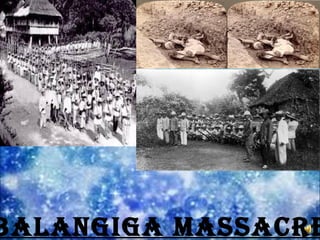
The infamous Balangica Massacre
in Samar, Philippines is an example of
destruction and desecration.
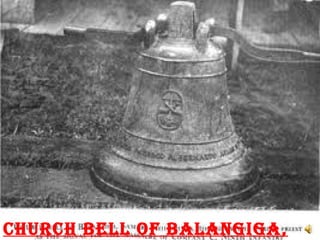
The bell from the Balangica church
was stolen and kept to a fort in the USA.
Balangiga Massacre
church Bell of Balangiga,
American History books do not
include a discussion of the Philippine-
American war. It does not really help that
much if the event is called America’s “My
first Lai.”
Filipinos are invisible in American
and World history books used in the USA
and this stepsided knowledge is considered
adequate.
A people without a memory of
theirpast is also deprived of theirfuture.
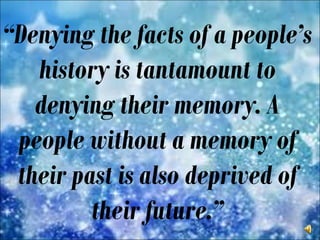
“Denying the facts of a people’s
history is tantamount to
denying their memory. A
people without a memory of
their past is also deprived of
their future.”
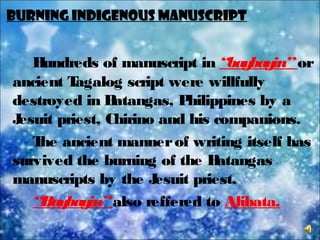
BURNING INDIGENOUS MANUSCRIPT
Hundreds of manuscript in “baybayin”or
ancient Tagalog script were willfully
destroyed in Batangas, Philippines by a
Jesuit priest, Chirino and his companions.
The ancient mannerof writing itself has
survived the burning of the Batangas
manuscripts by the Jesuit priest.
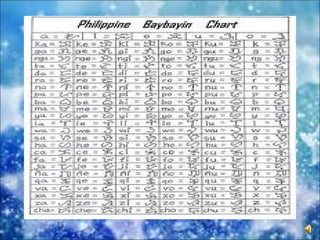
“Baybayin”also reffered to Alibata.
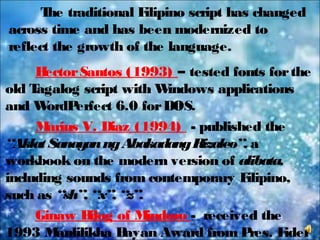
The traditional Filipino script has changed
across time and has been modernized to
reflect the growth of the language.
HectorSantos (1993) – tested fonts forthe
old Tagalog script with Windows applications
and WordPerfect 6.0 forDOS.
Marius V. Diaz (1994) - published the
“AklatSanayanngAbakadangRizaleo”, a
workbook on the modern version of alibata,
including sounds from contemporary Filipino,
such as “sh”, “x”, “z”.
Ginaw Bilog of Mindoro - received the
1993 Manlilikha Bayan Award from Pres. Fidel
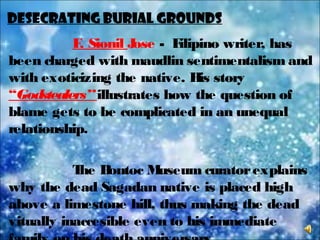
Desecrating Burial Grounds
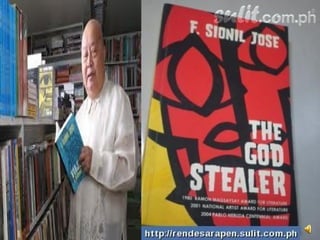
F. Sionil Jose - Filipino writer, has
been charged with maudlin sentimentalism and
with exoticizing the native. His story
“Godstealers”illustrates how the question of
blame gets to be complicated in an unequal
relationship.
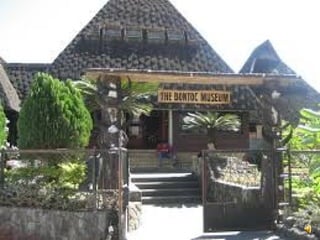
The Bontoc Museum curatorexplains
why the dead Sagadan native is placed high
above a limestone hill, thus making the dead
vitually inaccesible even to his immediate
“Every Filipino schoolchild has to
be told about the Egyptian
Mummies. Meanwhile, either he is
left ignorant of the Kabayan
mummies or told that there is a
“bit of Egypt” in the Philippines”
Sinha (1986) cited Macaulay, a
Western social scientist, who concluded
publication of Oriental books was a waste
of public money.
Clearly, as the dominant culture
attempts to destroy elements of the
supposedly inferiorculture, it tries to
institutionalize and strengthen its own.
Submitted to:
Prof. Agnes Montalbo
Rizal Technological University

Destruction and Desecration

  • 1.
  • 2.
    Traditional indigenous beliefsand practice become a target of destruction in an active, behavioral and confrontative second level of colonization. The infamous Balangica Massacre in Samar, Philippines is an example of destruction and desecration. The bell from the Balangica church was stolen and kept to a fort in the USA.
  • 3.
  • 4.
    church Bell ofBalangiga,
  • 5.
    American History booksdo not include a discussion of the Philippine- American war. It does not really help that much if the event is called America’s “My first Lai.” Filipinos are invisible in American and World history books used in the USA and this stepsided knowledge is considered adequate. A people without a memory of theirpast is also deprived of theirfuture.
  • 6.
    “Denying the factsof a people’s history is tantamount to denying their memory. A people without a memory of their past is also deprived of their future.”
  • 7.
    BURNING INDIGENOUS MANUSCRIPT Hundredsof manuscript in “baybayin”or ancient Tagalog script were willfully destroyed in Batangas, Philippines by a Jesuit priest, Chirino and his companions. The ancient mannerof writing itself has survived the burning of the Batangas manuscripts by the Jesuit priest. “Baybayin”also reffered to Alibata.
  • 9.
    The traditional Filipinoscript has changed across time and has been modernized to reflect the growth of the language. HectorSantos (1993) – tested fonts forthe old Tagalog script with Windows applications and WordPerfect 6.0 forDOS. Marius V. Diaz (1994) - published the “AklatSanayanngAbakadangRizaleo”, a workbook on the modern version of alibata, including sounds from contemporary Filipino, such as “sh”, “x”, “z”. Ginaw Bilog of Mindoro - received the 1993 Manlilikha Bayan Award from Pres. Fidel
  • 10.
    Desecrating Burial Grounds F.Sionil Jose - Filipino writer, has been charged with maudlin sentimentalism and with exoticizing the native. His story “Godstealers”illustrates how the question of blame gets to be complicated in an unequal relationship. The Bontoc Museum curatorexplains why the dead Sagadan native is placed high above a limestone hill, thus making the dead vitually inaccesible even to his immediate
  • 13.
    “Every Filipino schoolchildhas to be told about the Egyptian Mummies. Meanwhile, either he is left ignorant of the Kabayan mummies or told that there is a “bit of Egypt” in the Philippines”
  • 14.
    Sinha (1986) citedMacaulay, a Western social scientist, who concluded publication of Oriental books was a waste of public money. Clearly, as the dominant culture attempts to destroy elements of the supposedly inferiorculture, it tries to institutionalize and strengthen its own.
  • 15.
    Submitted to: Prof. AgnesMontalbo Rizal Technological University