HUMAN
DEVELOPMENT:
MEANING, CONCEPTS
AND APPROACHES
-is the pattern of movement or
change that begins at conception
and continues through life span.
-Development includes growth
and decline.
Human Development
MAJOR PRINCIPLES
OF HUMAN
DEVELOPMENT
Kenn
Naschielle
Proximodistal Pattern
Naschielle and Kenn will
learn to sit, crawl then walk
before they can run. The
muscular control of the trunk
Development is relatively orderly
Cephalo-caudal Pattern
During infancy, the greatest
growth always occurs at the
top-the head-with physical
and the arms comes earlier
as compared to the hands
and fingers.
growth in size, weight and
future differentiation
gradually working its way
down from top to bottom (for
example, neck, shoulders,
middle trunk and so on.)
While the pattern of development is
likely to be similar, the outcomes of
developmental processes and the
rate of development are likely to
vary among individuals.
Meaning if they come
from a good home with
loving and caring parents
they may develop into warm
and responsible children,
adolescents and adults.
If they come from a
deprived environment, they
may develop into carefree
and irresponsible adolescents
and adults.
While some changes occur in a
flash of insight, more often it
takes weeks, months, or years
for a person to undergo changes
that result in the display of
developmental characteristics.
Development takes place gradually
Biological processes involve
changes in the individual’s
physical nature.
Development as a process is complex
because it is the product of biological,
cognitive and socioemotional
processes
They will experience hormonal
changes as they approach late
adulthood.
Cognitive processes involve
changes in the individual’s
thought, intelligence, and
language.
Socioemotional processes
include changes in the
individual’s relationships with
other people, changes in
emotions, and changes in
personality.
TWO APPROACHES TO
HUMAN DEVELOPMENT
If you believe that Nikki and Kenn will
show extensive change from birth to
adolescence, little or no change in
adulthood and decline in late old age,
your approach to development is
traditional. In contrast, if you believe that
even in adulthood developmental change
takes place as it does during childhood,
your approach is termed life-span
approach.
It emphasizes extensive
change from birth to
adolescence, little or no
change in adulthood, and
decline in late old age.
Traditional Approach
Life Span Approach
It emphasizes
developmental change
during adulthood as well
as childhood.
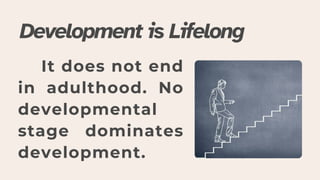
Development is Lifelong
It does not end
in adulthood. No
developmental
stage dominates
development.
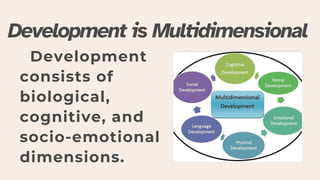
Development
consists of
biological,
cognitive, and
socio-emotional
dimensions.
Development is Multidimensional
Development is Plastic
Development
is possible
throughout
the life-span.
Individuals are
changing beings
in a changing
world.
Development is Contextual
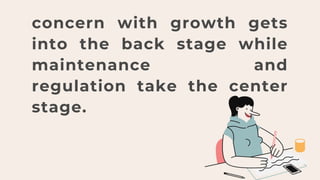
Development involves growth, maintenance
and regulation.
Growth, maintenance and
regulation are 3 goals of human
development. The goals of
individuals vary among
developmental stages. For instance,
as individuals reach middle and late
adulthood,
concern with growth gets
into the back stage while
maintenance and
regulation take the center
stage.
PRINCIPLES OF CHILD
DEVELOPMENT AND
LEARNING THAT
INFORM PRACTICE
1. All the domains of
development and learning
physical, social and emotional
and cognitive are important
and they are closely
interrelated.
2. Many aspects of children
learning and development
follow well documented
sequence.
3. Development and learning
proceed at varying rates
from child to child as well
as at uneven rates across
different areas of child
individual functioning
4. Development and learning
result from a dynamic and
continuous interaction of
biological maturation and
experience.
5. Early experience have
profound effects, both
cumulative and delayed on a
child development and learning
and optimal periods exist for
certain types of development
and learning to occur.
6.Development proceed
towards greater complenity self-
regulation and symbolic on
representational capacities.
7.Children develop best when
they have secure consistent
relationship with responsive
adults and opportunities for
positive relationship with
peers.
8. Development and learning
occur in and are influence by
multiple social and cultural
context.
9. Always mentally active in
seeking to understand the
world around them.
10. Play is an important vehicle
for self and regulation as well
as for promoting language.
11. Development and learning
advance when children are
challenge to achieve at a
level just beyond their
current masterity.
12. Children experience
shape their motivation and
approaches to learning.

Chapter1ProfEdpresentationsfordemo hehehehehehehehe

  • 1.
  • 2.
    -is the patternof movement or change that begins at conception and continues through life span. -Development includes growth and decline. Human Development
  • 3.
  • 4.
  • 5.
    Proximodistal Pattern Naschielle andKenn will learn to sit, crawl then walk before they can run. The muscular control of the trunk Development is relatively orderly
  • 6.
    Cephalo-caudal Pattern During infancy,the greatest growth always occurs at the top-the head-with physical and the arms comes earlier as compared to the hands and fingers.
  • 7.
    growth in size,weight and future differentiation gradually working its way down from top to bottom (for example, neck, shoulders, middle trunk and so on.)
  • 8.
    While the patternof development is likely to be similar, the outcomes of developmental processes and the rate of development are likely to vary among individuals.
  • 9.
    Meaning if theycome from a good home with loving and caring parents they may develop into warm and responsible children, adolescents and adults.
  • 10.
    If they comefrom a deprived environment, they may develop into carefree and irresponsible adolescents and adults.
  • 11.
    While some changesoccur in a flash of insight, more often it takes weeks, months, or years for a person to undergo changes that result in the display of developmental characteristics. Development takes place gradually
  • 12.
    Biological processes involve changesin the individual’s physical nature. Development as a process is complex because it is the product of biological, cognitive and socioemotional processes
  • 13.
    They will experiencehormonal changes as they approach late adulthood. Cognitive processes involve changes in the individual’s thought, intelligence, and language.
  • 14.
    Socioemotional processes include changesin the individual’s relationships with other people, changes in emotions, and changes in personality.
  • 15.
  • 16.
    If you believethat Nikki and Kenn will show extensive change from birth to adolescence, little or no change in adulthood and decline in late old age, your approach to development is traditional. In contrast, if you believe that even in adulthood developmental change takes place as it does during childhood, your approach is termed life-span approach.
  • 17.
    It emphasizes extensive changefrom birth to adolescence, little or no change in adulthood, and decline in late old age. Traditional Approach
  • 18.
    Life Span Approach Itemphasizes developmental change during adulthood as well as childhood.
  • 19.
    Development is Lifelong Itdoes not end in adulthood. No developmental stage dominates development.
  • 20.
  • 21.
    Development is Plastic Development ispossible throughout the life-span.
  • 22.
    Individuals are changing beings ina changing world. Development is Contextual
  • 23.
    Development involves growth,maintenance and regulation. Growth, maintenance and regulation are 3 goals of human development. The goals of individuals vary among developmental stages. For instance, as individuals reach middle and late adulthood,
  • 24.
    concern with growthgets into the back stage while maintenance and regulation take the center stage.
  • 25.
    PRINCIPLES OF CHILD DEVELOPMENTAND LEARNING THAT INFORM PRACTICE
  • 26.
    1. All thedomains of development and learning physical, social and emotional and cognitive are important and they are closely interrelated.
  • 27.
    2. Many aspectsof children learning and development follow well documented sequence. 3. Development and learning proceed at varying rates
  • 28.
    from child tochild as well as at uneven rates across different areas of child individual functioning
  • 29.
    4. Development andlearning result from a dynamic and continuous interaction of biological maturation and experience.
  • 30.
    5. Early experiencehave profound effects, both cumulative and delayed on a child development and learning and optimal periods exist for certain types of development and learning to occur.
  • 31.
    6.Development proceed towards greatercomplenity self- regulation and symbolic on representational capacities. 7.Children develop best when they have secure consistent
  • 32.
    relationship with responsive adultsand opportunities for positive relationship with peers. 8. Development and learning occur in and are influence by
  • 33.
    multiple social andcultural context. 9. Always mentally active in seeking to understand the world around them.
  • 34.
    10. Play isan important vehicle for self and regulation as well as for promoting language. 11. Development and learning advance when children are challenge to achieve at a
  • 35.
    level just beyondtheir current masterity. 12. Children experience shape their motivation and approaches to learning.