Module 1
Human Development
Human Development
• Development is a continuous process in human beings. According
to developmental psychology, Development starts with conception and ends
with death.
• Human development refers to the physical, cognitive, and psychosocial
development of humans throughout the lifespan.
• Physical development involves growth and changes in the body and
brain, the senses, motor skills, and health and wellness. Cognitive
development involves learning, attention, memory, language, thinking,
reasoning, and creativity. Psychosocial development involves emotions,
personality, and social relationships.
• Many academic disciplines contribute to the study of development and
this type of course is offered in some schools as psychology (particularly
as developmental psychology); in other schools, it is taught under
sociology, human development, or family studies.
Domains of Human Development
1. Physical Domain
• Many of us are familiar with the height and weight charts that
pediatricians consult to estimate if babies, children, and teens
are growing within normative ranges of physical development.
• We may also be aware of changes in children’s fine and gross
motor skills, as well as their increasing coordination,
particularly in terms of playing sports.
• But we may not realize that physical development also
involves brain development, which not only enables childhood
motor coordination but also greater coordination between
emotions and planning in adulthood, as our brains are not
done developing in infancy or childhood.
2. Cognitive Domain
• When we watch and listen to infants and toddlers, we can’t help but
wonder how they learn so much so fast, particularly when it comes to
language development.
• Then as we compare young children to those in middle childhood,
there appear to be huge differences in their ability to think logically
about the concrete world around them.
• Cognitive development includes mental processes, thinking, learning,
and understanding, and it doesn’t stop in childhood. Adolescents
develop the ability to think logically about the abstract world (and may
like to debate matters with adults as they exercise their new cognitive
skills!).
• Moral reasoning develops further, as does practical intelligence—
wisdom may develop with experience over time. Memory abilities and
different forms of intelligence tend to change with age.
3. Psychosocial Domain
• Development in this domain involves what’s going on both psychologically
and socially. Early on, the focus is on infants and caregivers, as
temperament and attachment are significant.
• As the social world expands and the child grows psychologically, different
types of play and interactions with other children and teachers become
important. Psychosocial development involves emotions, personality, self-
esteem, and relationships.
• Peers also become more important for adolescents, who are exploring new
roles and forming their own identities. Cohabitation, marriage, having
children, and finding work or a career are all parts of the transition into
adulthood.
• Psychosocial development continues across adulthood with similar (and
some different) developmental issues of family, friends, parenting, romance,
divorce, remarriage, blended families, caregiving for elders, becoming
grandparents and great grandparents, retirement, new careers, coping with
losses, and death and dying.
Key Issues in Human Development
There are many different theoretical approaches regarding human
develop and along with it comes few questions like:-
• Is the change smooth or uneven (continuous versus discontinuous)?
• Is this pattern of change the same for everyone, or are there different
patterns of change (one course of development versus many courses)?
• How do genetics and environment interact to influence development
(nature versus nurture)?
Is Development Continuous or
Discontinuous?
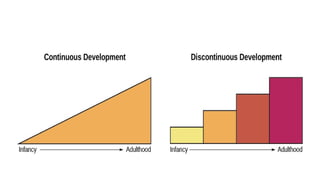
• Continuous development views development as a
cumulative process, gradually improving on existing skills .
With this type of development, there is gradual change.
• Consider, for example, a child’s physical growth: adding
inches to her height year by year. In contrast, theorists who
view development as discontinuous believe that
development takes place in unique stages: It occurs at
specific times or ages. With this type of development, the
change is more sudden, such as an infant’s ability to
conceive object permanence
Important questions Developmental psychologists
researching upon:-
• Is development essentially the same, or universal, for all
children (i.e., there is one course of development) or does
development follow a different course for each child,
depending on the child’s specific genetics and environment
(i.e., there are many courses of development)?
• Do people across the world share more similarities or more
differences in their development?
• How much do culture and genetics influence a child’s
behavior?
• Childcare practices vary by culture, and different practices have been
found to accelerate or inhibit achievement of developmental milestones
such as sitting, crawling, and walking (Karasik, Adolph, Tamis-LeMonda, &
Bornstein, 2010).
• A study reported about the Aché society in Paraguay. They spend a
significant amount of time foraging in forests. While foraging, Aché
mothers carry their young children, rarely putting them down in order to
protect them from getting hurt in the forest. Consequently, their children
walk much later: They walk around 23–25 months old, in comparison to
infants in Western cultures who begin to walk around 12 months old.
However, as Aché children become older, they are allowed more freedom
to move about, and by about age 9, their motor skills surpass those of
U.S. children of the same age: Aché children are able to climb trees up to
25 feet tall and use machetes to chop their way through the forest
(Kaplan & Dove, 1987). As you can see, our development is influenced by
multiple contexts, so the timing of basic motor functions may vary across
cultures.
Principles of Development
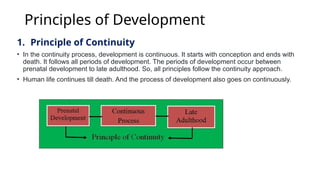
1. Principle of Continuity
• In the continuity process, development is continuous. It starts with conception and ends with
death. It follows all periods of development. The periods of development occur between
prenatal development to late adulthood. So, all principles follow the continuity approach.
• Human life continues till death. And the process of development also goes on continuously.
2. Principles of development direction
• According to prenatal development, the direction of the
development is head to tail and near to far. This development
head to tail is called cephalocaudal trend and near to far is
called the proximodistal trend.
• The development follows a specific and sequential process.
This principle plays an important role in the principles of child
development. And development has its own specific direction.
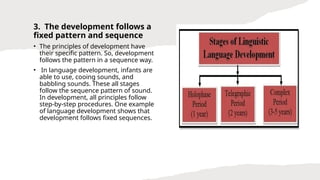
3. The development follows a
fixed pattern and sequence
• The principles of development have
their specific pattern. So, development
follows the pattern in a sequence way.
• In language development, infants are
able to use, cooing sounds, and
babbling sounds. These all stages
follow the sequence pattern of sound.
In development, all principles follow
step-by-step procedures. One example
of language development shows that
development follows fixed sequences.
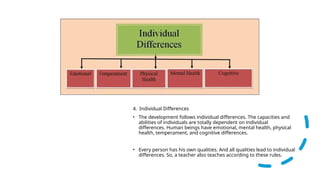
4. Individual Differences
• The development follows individual differences. The capacities and
abilities of individuals are totally dependent on individual
differences. Human beings have emotional, mental health, physical
health, temperament, and cognitive differences.
• Every person has his own qualities. And all qualities lead to individual
differences. So, a teacher also teaches according to these rules.
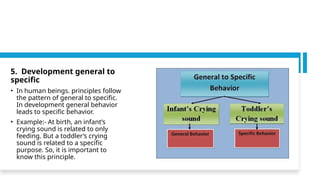
5. Development general to
specific
• In human beings. principles follow
the pattern of general to specific.
In development general behavior
leads to specific behavior.
• Example:- At birth, an infant’s
crying sound is related to only
feeding. But a toddler’s crying
sound is related to a specific
purpose. So, it is important to
know this principle.
6. Development is predictable
• According to developmental psychologists, the prediction of
development is possible. And developmental psychologists can apply
many psychological tests and methods to children and predict the
children’s future behavior.
• The main goal of all principles is to predict behavior for the future.
Psychologists explained the development with examples.
• Example 1:- Jean Piaget’s cognitive development theory, conducted
many experiments on children and explained that cognitive
development occurs according to four stages. So, prediction of the
development is possible.
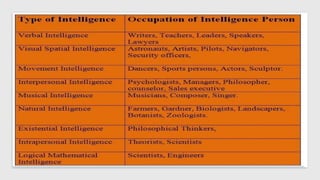
• Example 2:- Gardner’s theory of multi-dimensional intelligence
showed that prediction of the behavior is possible. Psychologists
identified the individual’s occupation for the future with the help of
multi-dimensional intelligence theory.
7. Development is a gradual process
• Development is not always the same process.
• Erik Erikson’s psychosocial development theory explained that
development is divided into eight stages. process.
8. Interaction heredity and environment
• The development of children is not possible without heredity
and environmental factors.
• Because of these two, the complete development of the
children is possible.
9. Principle of Integration
• Children integrate knowledge.
• Piaget did experiments for children’s integrated knowledge.
They integrate on the basis of previous knowledge.
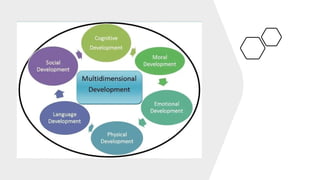
10. Development is Multidimensional
• Development is presented with the help of multi-
dimensional.
• Multidimensional includes cognitive, social, emotional,
physical, language, and moral development.
Human Development and its stages psychology

Human Development and its stages psychology

  • 1.
  • 2.
    Human Development • Developmentis a continuous process in human beings. According to developmental psychology, Development starts with conception and ends with death. • Human development refers to the physical, cognitive, and psychosocial development of humans throughout the lifespan. • Physical development involves growth and changes in the body and brain, the senses, motor skills, and health and wellness. Cognitive development involves learning, attention, memory, language, thinking, reasoning, and creativity. Psychosocial development involves emotions, personality, and social relationships. • Many academic disciplines contribute to the study of development and this type of course is offered in some schools as psychology (particularly as developmental psychology); in other schools, it is taught under sociology, human development, or family studies.
  • 3.
    Domains of HumanDevelopment 1. Physical Domain • Many of us are familiar with the height and weight charts that pediatricians consult to estimate if babies, children, and teens are growing within normative ranges of physical development. • We may also be aware of changes in children’s fine and gross motor skills, as well as their increasing coordination, particularly in terms of playing sports. • But we may not realize that physical development also involves brain development, which not only enables childhood motor coordination but also greater coordination between emotions and planning in adulthood, as our brains are not done developing in infancy or childhood.
  • 4.
    2. Cognitive Domain •When we watch and listen to infants and toddlers, we can’t help but wonder how they learn so much so fast, particularly when it comes to language development. • Then as we compare young children to those in middle childhood, there appear to be huge differences in their ability to think logically about the concrete world around them. • Cognitive development includes mental processes, thinking, learning, and understanding, and it doesn’t stop in childhood. Adolescents develop the ability to think logically about the abstract world (and may like to debate matters with adults as they exercise their new cognitive skills!). • Moral reasoning develops further, as does practical intelligence— wisdom may develop with experience over time. Memory abilities and different forms of intelligence tend to change with age.
  • 5.
    3. Psychosocial Domain •Development in this domain involves what’s going on both psychologically and socially. Early on, the focus is on infants and caregivers, as temperament and attachment are significant. • As the social world expands and the child grows psychologically, different types of play and interactions with other children and teachers become important. Psychosocial development involves emotions, personality, self- esteem, and relationships. • Peers also become more important for adolescents, who are exploring new roles and forming their own identities. Cohabitation, marriage, having children, and finding work or a career are all parts of the transition into adulthood. • Psychosocial development continues across adulthood with similar (and some different) developmental issues of family, friends, parenting, romance, divorce, remarriage, blended families, caregiving for elders, becoming grandparents and great grandparents, retirement, new careers, coping with losses, and death and dying.
  • 6.
    Key Issues inHuman Development There are many different theoretical approaches regarding human develop and along with it comes few questions like:- • Is the change smooth or uneven (continuous versus discontinuous)? • Is this pattern of change the same for everyone, or are there different patterns of change (one course of development versus many courses)? • How do genetics and environment interact to influence development (nature versus nurture)?
  • 7.
    Is Development Continuousor Discontinuous? • Continuous development views development as a cumulative process, gradually improving on existing skills . With this type of development, there is gradual change. • Consider, for example, a child’s physical growth: adding inches to her height year by year. In contrast, theorists who view development as discontinuous believe that development takes place in unique stages: It occurs at specific times or ages. With this type of development, the change is more sudden, such as an infant’s ability to conceive object permanence
  • 9.
    Important questions Developmentalpsychologists researching upon:- • Is development essentially the same, or universal, for all children (i.e., there is one course of development) or does development follow a different course for each child, depending on the child’s specific genetics and environment (i.e., there are many courses of development)? • Do people across the world share more similarities or more differences in their development? • How much do culture and genetics influence a child’s behavior?
  • 10.
    • Childcare practicesvary by culture, and different practices have been found to accelerate or inhibit achievement of developmental milestones such as sitting, crawling, and walking (Karasik, Adolph, Tamis-LeMonda, & Bornstein, 2010). • A study reported about the Aché society in Paraguay. They spend a significant amount of time foraging in forests. While foraging, Aché mothers carry their young children, rarely putting them down in order to protect them from getting hurt in the forest. Consequently, their children walk much later: They walk around 23–25 months old, in comparison to infants in Western cultures who begin to walk around 12 months old. However, as Aché children become older, they are allowed more freedom to move about, and by about age 9, their motor skills surpass those of U.S. children of the same age: Aché children are able to climb trees up to 25 feet tall and use machetes to chop their way through the forest (Kaplan & Dove, 1987). As you can see, our development is influenced by multiple contexts, so the timing of basic motor functions may vary across cultures.
  • 11.
    Principles of Development 1.Principle of Continuity • In the continuity process, development is continuous. It starts with conception and ends with death. It follows all periods of development. The periods of development occur between prenatal development to late adulthood. So, all principles follow the continuity approach. • Human life continues till death. And the process of development also goes on continuously.
  • 12.
    2. Principles ofdevelopment direction • According to prenatal development, the direction of the development is head to tail and near to far. This development head to tail is called cephalocaudal trend and near to far is called the proximodistal trend. • The development follows a specific and sequential process. This principle plays an important role in the principles of child development. And development has its own specific direction.
  • 13.
    3. The developmentfollows a fixed pattern and sequence • The principles of development have their specific pattern. So, development follows the pattern in a sequence way. • In language development, infants are able to use, cooing sounds, and babbling sounds. These all stages follow the sequence pattern of sound. In development, all principles follow step-by-step procedures. One example of language development shows that development follows fixed sequences.
  • 14.
    4. Individual Differences •The development follows individual differences. The capacities and abilities of individuals are totally dependent on individual differences. Human beings have emotional, mental health, physical health, temperament, and cognitive differences. • Every person has his own qualities. And all qualities lead to individual differences. So, a teacher also teaches according to these rules.
  • 15.
    5. Development generalto specific • In human beings. principles follow the pattern of general to specific. In development general behavior leads to specific behavior. • Example:- At birth, an infant’s crying sound is related to only feeding. But a toddler’s crying sound is related to a specific purpose. So, it is important to know this principle.
  • 16.
    6. Development ispredictable • According to developmental psychologists, the prediction of development is possible. And developmental psychologists can apply many psychological tests and methods to children and predict the children’s future behavior. • The main goal of all principles is to predict behavior for the future. Psychologists explained the development with examples. • Example 1:- Jean Piaget’s cognitive development theory, conducted many experiments on children and explained that cognitive development occurs according to four stages. So, prediction of the development is possible. • Example 2:- Gardner’s theory of multi-dimensional intelligence showed that prediction of the behavior is possible. Psychologists identified the individual’s occupation for the future with the help of multi-dimensional intelligence theory.
  • 18.
    7. Development isa gradual process • Development is not always the same process. • Erik Erikson’s psychosocial development theory explained that development is divided into eight stages. process. 8. Interaction heredity and environment • The development of children is not possible without heredity and environmental factors. • Because of these two, the complete development of the children is possible.
  • 19.
    9. Principle ofIntegration • Children integrate knowledge. • Piaget did experiments for children’s integrated knowledge. They integrate on the basis of previous knowledge. 10. Development is Multidimensional • Development is presented with the help of multi- dimensional. • Multidimensional includes cognitive, social, emotional, physical, language, and moral development.