CLASS DISCUSSION RULES
1. Raise your hand if you want to answer.
2. Zip mouth when someone is talking.
3. Cellphones must be in silent mode.
4. Interactive learning is hereby
encourage.
5. Recitation points are accumulated,
participate.
ACTIVITY
ANALYSIS
1. What have you observe
about the bingo game?
2. Describe a human being.
3. Is development an innate
process? Why or Why not?
HUMAN
DEVELOPMENT
MEANING, CONCEPTS AND APPROACHES
• Development refers to changes over time in a
person’s body, thought, and behavior due to
biological and environmental influences.
• Developmental psychologists focus on common
features of human development.
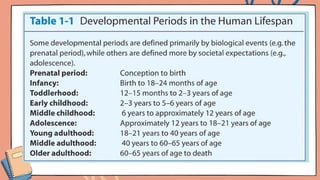
• They usually divide the lifespan into
developmental periods or stages that most
people share
Learning Outcomes
At the end of the lesson, students are able to:
1. Define the concept of human development as a
process.
2. Identify the different principles of human
development and its implication to education.
3. Understand the two patterns of human
development.
4. Analyze the different issues relating to the study of
human growth and development.
de
DEFINING
HUMAN
DEVELOPMENT
• Human development is the pattern of movement or
change that begins at conception and continues through the
life span.
• Human development refers to the physical, cognitive, and
psychosocial development of humans throughout the
lifespan.
• Physical development involves growth and changes in
the body and brain, the senses, motor skills, and health and
wellness.
• Cognitive development involves learning, attention,
memory, language, thinking, reasoning, and creativity.
• Psychosocial development involves emotions,
personality, and social relationships.
de
Why Do We Study
Human Growth and
Development?
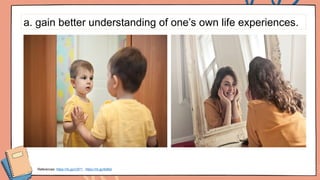
a. gain better understanding of one’s own life experiences.
References: https://rb.gy/c3t71 , https://rb.gy/6d8st
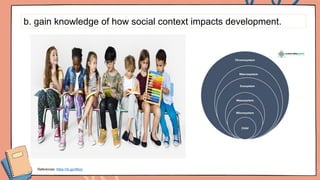
b. gain knowledge of how social context impacts development.
References: https://rb.gy/r6bzy
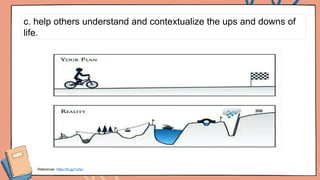
c. help others understand and contextualize the ups and downs of
life.
References: https://rb.gy/1cdyc
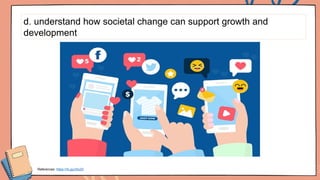
d. understand how societal change can support growth and
development
References: https://rb.gy/z5u03
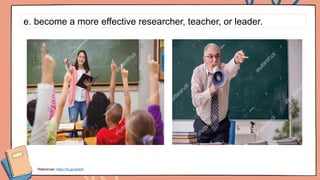
e. become a more effective researcher, teacher, or leader.
References: https://rb.gy/ybdzh ,
f. Support the physical and mental health of individuals.
References: https://rb.gy/ybdzh ,
PRINCIPLE
OF HUMAN
DEVELOPMENT
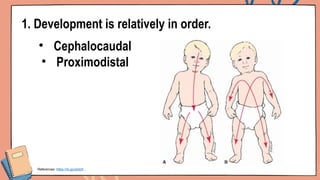
1. Development is relatively in order.
• Cephalocaudal
• Proximodistal
References: https://rb.gy/ybdzh ,
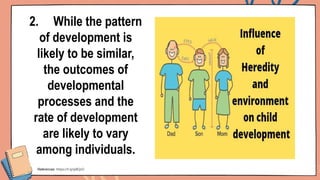
2. While the pattern
of development is
likely to be similar,
the outcomes of
developmental
processes and the
rate of development
are likely to vary
among individuals.
References: https://t.ly/p8QzO
3. Development takes place
gradually.
4. Development as a process is
complex because it is the
product of biological, cognitive
and socio-emotional processes.
TWO APPROACHES
IN HUMAN
DEVELOPMENT
 TRADITIONAL
 LIFE SPAN
GROWTH
VS.
DEVELOPMENT
GROWTH
VS.
DEVELOPMENT
CHILDHOOD
ADOLESCENCE
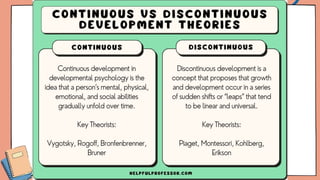
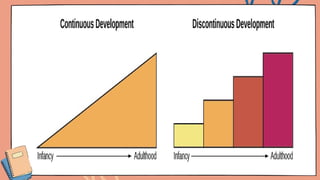
CONTINUOUS
OD
DISCONTINUOS
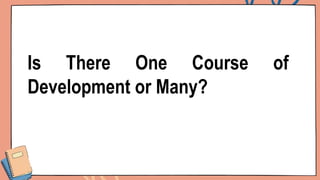
QUESTION
Is There One Course of
Development or Many?
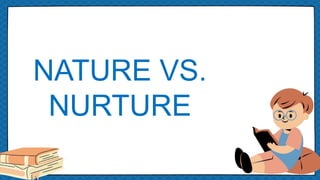
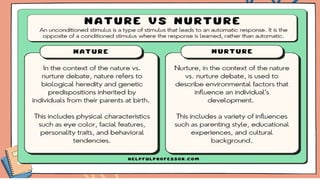
NATURE VS.
NURTURE
• “Are we who we are because
of nature (biology and genetics),
or are we who we are because of
nurture (our environment and
culture)?”
12 RIGHTS OF
FILIPINO CHILDREN
QUESTIONS?
EVERY INDIVIDUAL IS
UNIQUE
GOODBYE

MODULE-1-HUMAN-BEHAVIOR-CONCEPT-AND-THEORIES-Copy (1).pptx

  • 3.
    CLASS DISCUSSION RULES 1.Raise your hand if you want to answer. 2. Zip mouth when someone is talking. 3. Cellphones must be in silent mode. 4. Interactive learning is hereby encourage. 5. Recitation points are accumulated, participate.
  • 4.
  • 5.
    ANALYSIS 1. What haveyou observe about the bingo game? 2. Describe a human being. 3. Is development an innate process? Why or Why not?
  • 6.
  • 7.
    • Development refersto changes over time in a person’s body, thought, and behavior due to biological and environmental influences. • Developmental psychologists focus on common features of human development. • They usually divide the lifespan into developmental periods or stages that most people share
  • 8.
    Learning Outcomes At theend of the lesson, students are able to: 1. Define the concept of human development as a process. 2. Identify the different principles of human development and its implication to education. 3. Understand the two patterns of human development. 4. Analyze the different issues relating to the study of human growth and development.
  • 9.
  • 10.
    • Human developmentis the pattern of movement or change that begins at conception and continues through the life span. • Human development refers to the physical, cognitive, and psychosocial development of humans throughout the lifespan. • Physical development involves growth and changes in the body and brain, the senses, motor skills, and health and wellness. • Cognitive development involves learning, attention, memory, language, thinking, reasoning, and creativity. • Psychosocial development involves emotions, personality, and social relationships.
  • 12.
    de Why Do WeStudy Human Growth and Development?
  • 13.
    a. gain betterunderstanding of one’s own life experiences. References: https://rb.gy/c3t71 , https://rb.gy/6d8st
  • 14.
    b. gain knowledgeof how social context impacts development. References: https://rb.gy/r6bzy
  • 15.
    c. help othersunderstand and contextualize the ups and downs of life. References: https://rb.gy/1cdyc
  • 16.
    d. understand howsocietal change can support growth and development References: https://rb.gy/z5u03
  • 17.
    e. become amore effective researcher, teacher, or leader. References: https://rb.gy/ybdzh ,
  • 18.
    f. Support thephysical and mental health of individuals. References: https://rb.gy/ybdzh ,
  • 19.
  • 20.
    1. Development isrelatively in order. • Cephalocaudal • Proximodistal References: https://rb.gy/ybdzh ,
  • 21.
    2. While thepattern of development is likely to be similar, the outcomes of developmental processes and the rate of development are likely to vary among individuals. References: https://t.ly/p8QzO
  • 22.
    3. Development takesplace gradually. 4. Development as a process is complex because it is the product of biological, cognitive and socio-emotional processes.
  • 23.
    TWO APPROACHES IN HUMAN DEVELOPMENT TRADITIONAL  LIFE SPAN
  • 24.
  • 26.
  • 27.
  • 29.
  • 31.
  • 34.
  • 35.
    Is There OneCourse of Development or Many?
  • 36.
  • 38.
    • “Are wewho we are because of nature (biology and genetics), or are we who we are because of nurture (our environment and culture)?”
  • 39.
  • 41.
  • 42.
  • 43.

Editor's Notes

  • #10 Development includes growth and decline. This means that development can be positive or negative. (Santrock, 2002).
  • #11 Development includes growth and decline. This means that development can be positive or negative. (Santrock, 2002).
  • #13 Development includes growth and decline. This means that development can be positive or negative. (Santrock, 2002).
  • #14 Development includes growth and decline. This means that development can be positive or negative. (Santrock, 2002).
  • #15 Development includes growth and decline. This means that development can be positive or negative. (Santrock, 2002).
  • #16 Development includes growth and decline. This means that development can be positive or negative. (Santrock, 2002).
  • #17 Development includes growth and decline. This means that development can be positive or negative. (Santrock, 2002).
  • #18 Development includes growth and decline. This means that development can be positive or negative. (Santrock, 2002).
  • #20 The largeness of an infant's head is one of the best examples of the cephalocaudal development. In cephalocaudal development, growth starts at the head and moves down. As the infant grows, the rest of its body catches up with the larger head, which grew first. Proximodistal development is the progression of motor development radiating from the center of an organism to the periphery. The classic example is a child learning to move her shoulders before learning to control fine finger movement.
  • #21 Heredity, experiences, culture and environment differs among people and this makes individuals differ from one another. As a result, individual differences in developmental characteristics and experiences vary uniquely from one person to the other. Example: A child who was raised from a loving and supportive home may develop into warm and responsible adult. A child who was exposed to a deprived and unhealthy environment may develop into carefree and irresponsible adult.
  • #22 Changing this model of the world takes time, especially when it comes to something new and unknown. It is like trying to get to grips with an iPhone after using an Android phone for years. At certain moments in the adjustment period you will use Android gestures that do not work on an iPhone. But gradually you start to forget the Android gestures and you have no problem with using the iPhone, instead you start to have trouble remembering the obscure Android gestures you used infrequently. A person grows and matures over a long period of time. There is no exact or definite period where people manifests developmental characteristics. Development comes naturally and gradually.
  • #23 Development is lifelong. It does not end in adulthood. No developmental stage dominates development. Development is multidimensional. It consists of biological, cognitive and socio-emotional dimensions. Development is plastic. Development is possible throughout the lifespan. Development is contextual. Individuals are changing beings in a changing world. Development involves growth, maintenance and regulation. Growth, maintenance and regulation are three goals of human development. The goals of individuals vary among developmental stages. For instance, as individuals reach middle and late adulthood, concern with growth gets into the back stage while maintenance and regulation take the center stage.
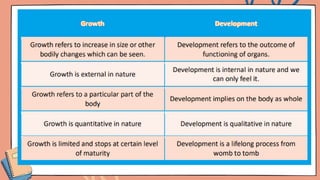
  • #24 Human development is a lifelong process of physical, behavioral, cognitive, and emotional growth and change. In the early stages of life—from babyhood to childhood, childhood to adolescence, and adolescence to adulthood—enormous changes take place. Throughout the process, each person develops attitudes and values that guide choices, relationships, and understanding. Growth refers to physical and biological changes. Development refers to function and behavioral changes
  • #26 Human development is a lifelong process of physical, behavioral, cognitive, and emotional growth and change. In the early stages of life—from babyhood to childhood, childhood to adolescence, and adolescence to adulthood—enormous changes take place. Throughout the process, each person develops attitudes and values that guide choices, relationships, and understanding. Growth refers to physical and biological changes. Development refers to function and behavioral changes
  • #27 Human development is a lifelong process of physical, behavioral, cognitive, and emotional growth and change. In the early stages of life—from babyhood to childhood, childhood to adolescence, and adolescence to adulthood—enormous changes take place. Throughout the process, each person develops attitudes and values that guide choices, relationships, and understanding. Growth refers to physical and biological changes. Development refers to function and behavioral changes
  • #28 Childhood is the period between the end of infancy (about 2 years of age) and the onset of puberty, marking the beginning of adolescence (10–12 years of age). In considering characteristics of children, it should be recognized that every child is unique and special in its own way. There are, however, some common characteristics of the period of childhood, which should guide caregivers in the way they look at and work with children. Three of the most important are: dependency, vulnerability, and resilience. Dependency: having a need for the support of something or someone in order to continue existing or to thrive. Vulnerability: being more easily physically, emotionally, or mentally hurt, influenced, or attacked. Resilience: the process of adapting well in the face of adversity, trauma, tragedy, threats or significant sources of stress. It is important to recognize that these three characteristics are influenced by both external and internal factors. Children do not just acquire competencies and skills according to pre-determined biological or psychological forces. Of equal significance are environmental factors and the ability of children to make an active contribution to their social environments.
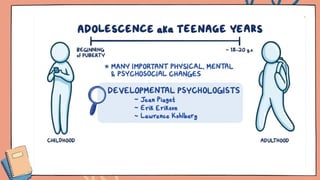
  • #29 Adolescence, on the other hand, is a transitional stage of physical and psychological development that generally occurs during the period from puberty to legal adulthood. Adolescence is usually associated with the teenage years, but its physical, psychological or cultural expressions may begin earlier and end later.
  • #30 Physical Changes For both boys and girls, these changes include a growth spurt in height, growth of pubic and underarm hair, and skin changes (e.g., pimples). Boys also experience growth in facial hair and a deepening of their voice. Girls experience breast development and begin menstruating.
  • #31 Adolescence, on the other hand, is a transitional stage of physical and psychological development that generally occurs during the period from puberty to legal adulthood. Adolescence is usually associated with the teenage years, but its physical, psychological or cultural expressions may begin earlier and end later.
  • #32 Continuous development views development as a cumulative process, gradually improving on existing skills (Figure 1). With this type of development, there is a gradual change. Consider, for example, a child’s physical growth: adding inches to their height year by year. In contrast, theorists who view development as discontinuous believe that development takes place in unique stages and that it occurs at specific times or ages.
  • #33 Physical Changes For both boys and girls, these changes include a growth spurt in height, growth of pubic and underarm hair, and skin changes (e.g., pimples). Boys also experience growth in facial hair and a deepening of their voice. Girls experience breast development and begin menstruating.
  • #34 Adolescence, on the other hand, is a transitional stage of physical and psychological development that generally occurs during the period from puberty to legal adulthood. Adolescence is usually associated with the teenage years, but its physical, psychological or cultural expressions may begin earlier and end later.
  • #35 Is development essentially the same, or universal, for all children (i.e., there is one course of development) or does development follow a different course for each child, depending on the child’s specific genetics and environment (i.e., there are many courses of development)? Do people across the world share more similarities or more differences in their development? How much do culture and genetics influence a child’s behavior? Stage theories hold that the sequence of development is universal. For example, in cross-cultural studies of language development, children from around the world reach language milestones in a similar sequence (Gleitman & Newport, 1995). Infants in all cultures coo before they babble. They begin babbling at about the same age and utter their first word around 12 months old. Yet people live in diverse contexts that have a unique effect on each of us. For example, researchers once believed that motor development followed one course for all children regardless of culture. However, childcare practices vary by culture, and different practices have been found to accelerate or inhibit the achievement of developmental milestones such as sitting, crawling, and walking (Karasik, 2010).
  • #36 Adolescence, on the other hand, is a transitional stage of physical and psychological development that generally occurs during the period from puberty to legal adulthood. Adolescence is usually associated with the teenage years, but its physical, psychological or cultural expressions may begin earlier and end later.
  • #38 This longstanding question is known in psychology as the nature versus nurture debate. It seeks to understand how our personalities and traits are the product of our genetic makeup and biological factors, and how they are shaped by our environment, including our parents, peers, and culture. For instance, why do biological children sometimes act like their parents—is it because of genetics or because of early childhood environment and what the child has learned from their parents? What about children who are adopted—are they more like their biological families or more like their adoptive families? And how can siblings from the same family be so different?

  • #40 1. Every child has the right to be born well. It is the responsibility of the parents to make sure they can provide a safe environment for their unborn child. This includes proper medical attention and care from conception, birth, and throughout childhood years in a newborn services unit or pediatric center. 2. Every child has the right to a wholesome family life. The child’s first learning environment and teachers are their home and family. They are entitled to be a part of a loving family that will instill ethical values and morals in them. 3. Every child has the right to be raised well and become contributing members of society. By raising them in a safe and loving environment, parents and guardians can shape the personalities of their young to be useful and contributing members of their respective communities when they grow older. 4. Every child has the right to basic needs. The four basic needs of people outlined in the law are as follows: a balanced diet, adequate clothing, sufficient shelter, and proper healthcare. This also includes any other requirements to lead a healthy and active life. 5. Every child has the right to access what they need to have a good life. This right goes beyond the basic needs and focuses more on the atmosphere of the place they will be raised in. A child’s needs must always be attended to so they feel the support of people around them, which in turn will build and strengthen their character in adulthood. 6. Every child has the right to education. In an ideal world, every child should have the means to go to a classroom and have access to books and learning materials that can enrich their intelligence and skills. 7. Every child has the right to play and enjoy their youth. Children have the right to engage in wholesome recreational activities whenever they wish and not be exploited for events that are deemed only for adults to do, i.e., intensive manual labor. 8. Every child has the right to be protected from danger. This includes all hazards that could affect their physical, mental, and emotional states, such as removing them from dangerous living situations, preventing them from getting into accidents, or protecting them from the abuse of adults, to name a few. 9. Every child has the right to live in a productive environment. Children should be surrounded by safe communities that inspire them to give back when they are older. This means staying away from bad influences and situations that can cause harm to their health. 10. Every child has the right to be cared for in the absence of their parent or guardian. If the parent or guardian fails to fulfill their role, the State shall assume custody and care for the child, providing them with their fundamental needs for growth and development. 11. Every child has the right to good governance. Children also have a right to be born under the presence of good governance that can inspire them to become a helpful and active citizen. This doesn’t necessarily mean they have to get involved with politics but rather have an interest in being involved in political discussions for the betterment of their country. 12. Every child has the right to freedom and peace. Last but not the least, every child is entitled to do whatever they want in their lives, so long as it contributes to the peace and betterment of the communities they are a part of.