EDUC 1
MWF 7:30-8:30
HUMAN DEVELOPMENT
Meaning, Concepts and Approaches
• Human Development
 the pattern of movement or change that begins at conception and continues
through the life span (pre-natal- “before birth” and post natal-”after
birth”)
 includes growth and decline
the scientific of the quantitative and qualitative ways by which people change
over time.
Definition of terms
• Growth - change in size, quantitative change
• Development - change in capacity, qualitative change series of changes
affected by maturation
• Learning - change for the better; aspect of development that connotes
modification of behavior which results from practice and experience
Major Principles of Human Development:
1. Development is relatively orderly
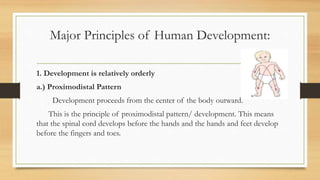
a.) Proximodistal Pattern
Development proceeds from the center of the body outward.
This is the principle of proximodistal pattern/ development. This means
that the spinal cord develops before the hands and the hands and feet develop
before the fingers and toes.
Major Principles of Human Development:
b.) Cephalocaudal Pattern
Development proceeds from the head downward. This is called cephalo-
caudal principle/ pattern. The child gains control of the head first, then the
arm, then the legs. Infants develop control of the head and face movements
within the first 2 months after birth
Major Principles of Human Development:
2. While the pattern of development is likely to be similar, the outcomes of
developmental processes and rate of development are likely to vary among
individuals.
3. Development takes place gradually.
4. Development as a process is complex because it is the product of biological,
cognitive and socio- emotional processes.
PRINCIPLES OF DEVELOPMENT
• 1. Early foundations are critical.
• 2. Maturation and learning play important roles in development
• 3. Development follows a definite and predictable
pattern(cephalocaudal & proximo distal)
• 4. All individuals are different
• 5. Each phase of development has its hazard.
PRINCIPLES OF DEVELOPMENT
• 6. Development is aided by stimulation
• 7. Development is affected by cultural changes
• 8. There are social expectations for every stage of development
• 9. Each phase of development has characteristic patterns of
behavior
Meaning, Concepts and Approaches
Quantitative change – are changes in the number or
amount of something, such as height, or weight, or size of
vocabulary
Qualitative change – refers to the increase in skills and
complexity of function resulting in increased specialization.
Aspects of Human Development
• Human Development is very complex because growth and change occur in
different aspects of the self. These different aspects of life are intertwined.
• 1.) Physical Development
 Changes in the body, brain, sensory, capacities, and motor skills.
 Exert major influence on both intellect and personality.
Aspects of Human Development
• 2.) Intellectual Development
Changes in a wide variety of mental abilities such as learning,
memory, reasoning, thinking and facility with language; related to
both motor and the emotional aspect of development
Aspects of Human Development
• 3.) Personality and Social Development
 Personality is the unique way in which each person deals with the world,
expresses emotions and gets along with other individuals.
 Social development is that which affects birth the physical and cognitive
aspects of functioning.
Aspects of Human Development
4.) Moral Development
 Aware of what is right or what is wrong; to unfold standards or habits that
have to do with right or wrong conduct.
5.) Spiritual Development
 An evolved refinement of though and feeling of the spirit or soul as
distinguished from the body or material matters.
A consciousness; of religion or the church.
Two Approaches to Human Development
If you believe that 2 people will show extensive change from
birth to adolescence, little or no change in adulthood and decline in
late old age, your approach to development is TRADITIONAL. In
contrast, if you believe that even in adulthood development change
takes place as it does during childhood, your approach is
TERMED LIFE-SPAN APPROACH.
Two Approaches to Human Development
Characteristics of life-span perspective by Paul Baltes
 Development is lifelong. It does not end in adulthood. No developmental stage
dominates development.
 Development is multidimensional. Development consist of biological, cognitive,
and socio-emotional dimensions
 Development is plastic. Development is possible throughout the life span.
 Development is contextual. Individuals are changing beings in a changing world.
Thank you!

EDUC 1- Week 1 session.pptx

  • 1.
  • 2.
    HUMAN DEVELOPMENT Meaning, Conceptsand Approaches • Human Development  the pattern of movement or change that begins at conception and continues through the life span (pre-natal- “before birth” and post natal-”after birth”)  includes growth and decline the scientific of the quantitative and qualitative ways by which people change over time.
  • 3.
    Definition of terms •Growth - change in size, quantitative change • Development - change in capacity, qualitative change series of changes affected by maturation • Learning - change for the better; aspect of development that connotes modification of behavior which results from practice and experience
  • 4.
    Major Principles ofHuman Development: 1. Development is relatively orderly a.) Proximodistal Pattern Development proceeds from the center of the body outward. This is the principle of proximodistal pattern/ development. This means that the spinal cord develops before the hands and the hands and feet develop before the fingers and toes.
  • 5.
    Major Principles ofHuman Development: b.) Cephalocaudal Pattern Development proceeds from the head downward. This is called cephalo- caudal principle/ pattern. The child gains control of the head first, then the arm, then the legs. Infants develop control of the head and face movements within the first 2 months after birth
  • 6.
    Major Principles ofHuman Development: 2. While the pattern of development is likely to be similar, the outcomes of developmental processes and rate of development are likely to vary among individuals. 3. Development takes place gradually. 4. Development as a process is complex because it is the product of biological, cognitive and socio- emotional processes.
  • 7.
    PRINCIPLES OF DEVELOPMENT •1. Early foundations are critical. • 2. Maturation and learning play important roles in development • 3. Development follows a definite and predictable pattern(cephalocaudal & proximo distal) • 4. All individuals are different • 5. Each phase of development has its hazard.
  • 8.
    PRINCIPLES OF DEVELOPMENT •6. Development is aided by stimulation • 7. Development is affected by cultural changes • 8. There are social expectations for every stage of development • 9. Each phase of development has characteristic patterns of behavior
  • 9.
    Meaning, Concepts andApproaches Quantitative change – are changes in the number or amount of something, such as height, or weight, or size of vocabulary Qualitative change – refers to the increase in skills and complexity of function resulting in increased specialization.
  • 10.
    Aspects of HumanDevelopment • Human Development is very complex because growth and change occur in different aspects of the self. These different aspects of life are intertwined. • 1.) Physical Development  Changes in the body, brain, sensory, capacities, and motor skills.  Exert major influence on both intellect and personality.
  • 11.
    Aspects of HumanDevelopment • 2.) Intellectual Development Changes in a wide variety of mental abilities such as learning, memory, reasoning, thinking and facility with language; related to both motor and the emotional aspect of development
  • 12.
    Aspects of HumanDevelopment • 3.) Personality and Social Development  Personality is the unique way in which each person deals with the world, expresses emotions and gets along with other individuals.  Social development is that which affects birth the physical and cognitive aspects of functioning.
  • 13.
    Aspects of HumanDevelopment 4.) Moral Development  Aware of what is right or what is wrong; to unfold standards or habits that have to do with right or wrong conduct. 5.) Spiritual Development  An evolved refinement of though and feeling of the spirit or soul as distinguished from the body or material matters. A consciousness; of religion or the church.
  • 14.
    Two Approaches toHuman Development If you believe that 2 people will show extensive change from birth to adolescence, little or no change in adulthood and decline in late old age, your approach to development is TRADITIONAL. In contrast, if you believe that even in adulthood development change takes place as it does during childhood, your approach is TERMED LIFE-SPAN APPROACH.
  • 15.
    Two Approaches toHuman Development Characteristics of life-span perspective by Paul Baltes  Development is lifelong. It does not end in adulthood. No developmental stage dominates development.  Development is multidimensional. Development consist of biological, cognitive, and socio-emotional dimensions  Development is plastic. Development is possible throughout the life span.  Development is contextual. Individuals are changing beings in a changing world.
  • 16.