HUMAN
CIRCULATORY
SYSTEM
www.yogalife.co.in
THE CIRCULATORY
SYSTEM
• Humans have a closed circulatory system, typical of
all vertebrates, in which blood is confined to vessels and is
distinct from the interstitial fluid.
• The heart pumps blood into large vessels
that branch into smaller ones leading into the organs, thus
also known as Cardio Vascular System.
• Materials are exchanged by diffusion between the blood
and the interstitial fluid bathing the cells.
www.yogalife.co.in
THE CARDIOVASCULAR
SYSTEM
3 Major Elements –
Heart
Blood Vessels
Blood
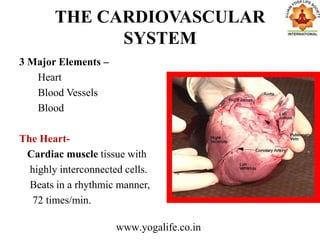
The Heart-
Cardiac muscle tissue with
highly interconnected cells.
Beats in a rhythmic manner,
72 times/min.
www.yogalife.co.in
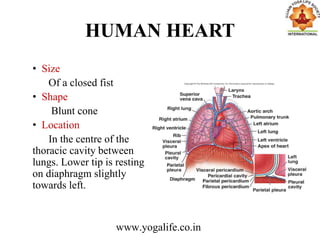
HUMAN HEART
• Size
Of a closed fist
• Shape
Blunt cone
• Location
In the centre of the
thoracic cavity between
lungs. Lower tip is resting
on diaphragm slightly
towards left.
www.yogalife.co.in
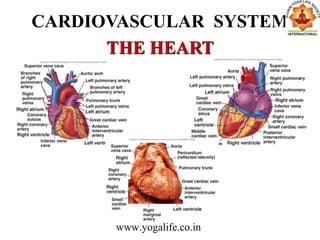
CARDIOVASCULAR SYSTEM
THE HEART
www.yogalife.co.in
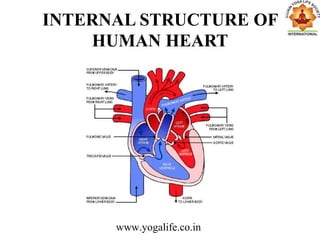
INTERNAL STRUCTURE OF
HUMAN HEART
www.yogalife.co.in
FUNCTIONS OF THE HEART
• Generating blood pressure
• Routing blood
– Heart separates pulmonary and systemic
circulations
• Ensuring one-way blood flow
– Heart valves ensure one-way flow
• Regulating blood supply
– Changes in contraction rate and force match blood
delivery to changing metabolic needs
www.yogalife.co.in
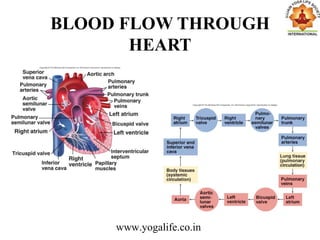
BLOOD FLOW THROUGH
HEART
www.yogalife.co.in
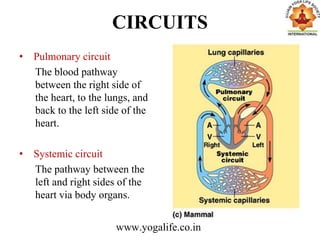
CIRCUITS
• Pulmonary circuit
The blood pathway
between the right side of
the heart, to the lungs, and
back to the left side of the
heart.
• Systemic circuit
The pathway between the
left and right sides of the
heart via body organs.
www.yogalife.co.in
CARDIAC CYCLE
• Right and left halves of the Heart represent two pumps that
work together.
• Repetitive contraction (systole) and relaxation (diastole) of
heart chambers, one after the other.
• Blood moves through circulatory system from areas of
higher to lower pressure.
www.yogalife.co.in
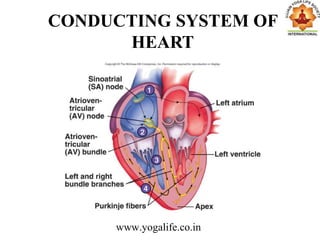
CONDUCTING SYSTEM OF
HEART
www.yogalife.co.in
HEART SOUNDS
• First heart sound or “lubb”
– Atrioventricular valves and surrounding fluid vibrations
as valves close at beginning of ventricular systole
• Second heart sound or “dupp”
– Results from closure of aortic and pulmonary semilunar
valves at beginning of ventricular diastole, lasts longer
www.yogalife.co.in
BLOOD VESSELS
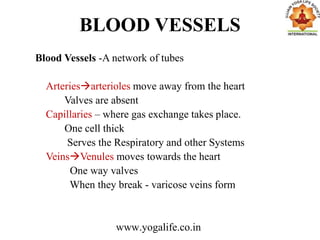
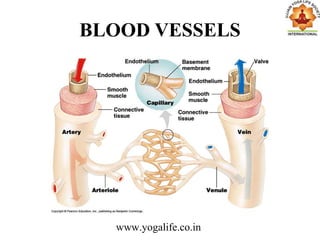
Blood Vessels -A network of tubes
Arteriesarterioles move away from the heart
Valves are absent
Capillaries – where gas exchange takes place.
One cell thick
Serves the Respiratory and other Systems
VeinsVenules moves towards the heart
One way valves
When they break - varicose veins form
www.yogalife.co.in
BLOOD VESSELS
www.yogalife.co.in
BLOOD VESSELS
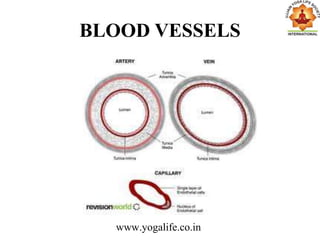
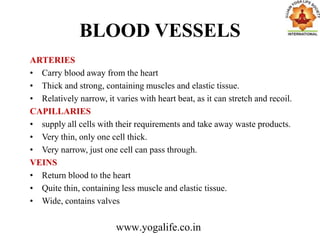
ARTERIES
• Carry blood away from the heart
• Thick and strong, containing muscles and elastic tissue.
• Relatively narrow, it varies with heart beat, as it can stretch and recoil.
CAPILLARIES
• supply all cells with their requirements and take away waste products.
• Very thin, only one cell thick.
• Very narrow, just one cell can pass through.
VEINS
• Return blood to the heart
• Quite thin, containing less muscle and elastic tissue.
• Wide, contains valves
www.yogalife.co.in
BLOOD VESSELS
www.yogalife.co.in
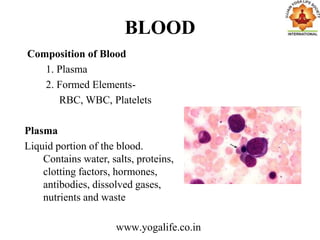
BLOOD
Composition of Blood
1. Plasma
2. Formed Elements-
RBC, WBC, Platelets
Plasma
Liquid portion of the blood.
Contains water, salts, proteins,
clotting factors, hormones,
antibodies, dissolved gases,
nutrients and waste
www.yogalife.co.in
BLOOD
Formed Elements
A. Erythrocytes – RBC
(Red Blood Corpuscles)
Contain 12-16 gms of
hemoglobin to carry
oxygen.
Do not have a nucleus and
live only about 120 days.
5-5.5 million/cubic mm
www.yogalife.co.in
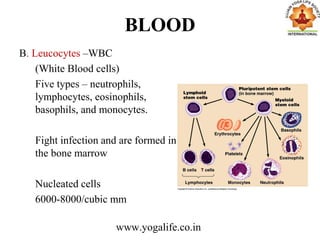
BLOOD
B. Leucocytes –WBC
(White Blood cells)
Five types – neutrophils,
lymphocytes, eosinophils,
basophils, and monocytes.
Fight infection and are formed in
the bone marrow
Nucleated cells
6000-8000/cubic mm
www.yogalife.co.in
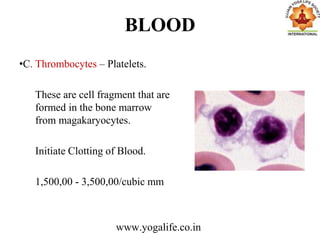
BLOOD
•C. Thrombocytes – Platelets.
These are cell fragment that are
formed in the bone marrow
from magakaryocytes.
Initiate Clotting of Blood.
1,500,00 - 3,500,00/cubic mm
www.yogalife.co.in
FUNCTIONS OF BLOOD
• Transport food and waste
• Transport oxygen and carbon di oxide
• Transport hormones
• Storehouse of salts, nutrients, calcium etc.
• Maintain a constant body temperature
• Provide resistance against infections
www.yogalife.co.in
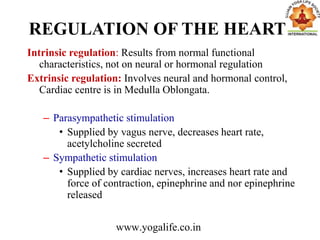
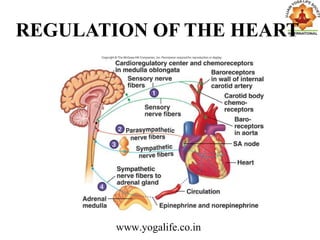
REGULATION OF THE HEART
Intrinsic regulation: Results from normal functional
characteristics, not on neural or hormonal regulation
Extrinsic regulation: Involves neural and hormonal control,
Cardiac centre is in Medulla Oblongata.
– Parasympathetic stimulation
• Supplied by vagus nerve, decreases heart rate,
acetylcholine secreted
– Sympathetic stimulation
• Supplied by cardiac nerves, increases heart rate and
force of contraction, epinephrine and nor epinephrine
released
www.yogalife.co.in
REGULATION OF THE HEART
www.yogalife.co.in
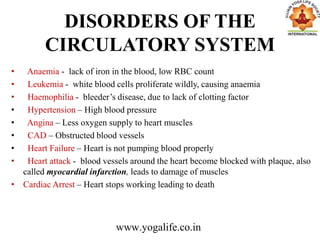
DISORDERS OF THE
CIRCULATORY SYSTEM
• Anaemia - lack of iron in the blood, low RBC count
• Leukemia - white blood cells proliferate wildly, causing anaemia
• Haemophilia - bleeder’s disease, due to lack of clotting factor
• Hypertension – High blood pressure
• Angina – Less oxygen supply to heart muscles
• CAD – Obstructed blood vessels
• Heart Failure – Heart is not pumping blood properly
• Heart attack - blood vessels around the heart become blocked with plaque, also
called myocardial infarction, leads to damage of muscles
• Cardiac Arrest – Heart stops working leading to death
www.yogalife.co.in
THANK YOU
www.yogalife.co.in

Human circulatory system

  • 1.
  • 2.
    THE CIRCULATORY SYSTEM • Humanshave a closed circulatory system, typical of all vertebrates, in which blood is confined to vessels and is distinct from the interstitial fluid. • The heart pumps blood into large vessels that branch into smaller ones leading into the organs, thus also known as Cardio Vascular System. • Materials are exchanged by diffusion between the blood and the interstitial fluid bathing the cells. www.yogalife.co.in
  • 3.
    THE CARDIOVASCULAR SYSTEM 3 MajorElements – Heart Blood Vessels Blood The Heart- Cardiac muscle tissue with highly interconnected cells. Beats in a rhythmic manner, 72 times/min. www.yogalife.co.in
  • 4.
    HUMAN HEART • Size Ofa closed fist • Shape Blunt cone • Location In the centre of the thoracic cavity between lungs. Lower tip is resting on diaphragm slightly towards left. www.yogalife.co.in
  • 5.
  • 6.
    INTERNAL STRUCTURE OF HUMANHEART www.yogalife.co.in
  • 7.
    FUNCTIONS OF THEHEART • Generating blood pressure • Routing blood – Heart separates pulmonary and systemic circulations • Ensuring one-way blood flow – Heart valves ensure one-way flow • Regulating blood supply – Changes in contraction rate and force match blood delivery to changing metabolic needs www.yogalife.co.in
  • 8.
  • 9.
    CIRCUITS • Pulmonary circuit Theblood pathway between the right side of the heart, to the lungs, and back to the left side of the heart. • Systemic circuit The pathway between the left and right sides of the heart via body organs. www.yogalife.co.in
  • 10.
    CARDIAC CYCLE • Rightand left halves of the Heart represent two pumps that work together. • Repetitive contraction (systole) and relaxation (diastole) of heart chambers, one after the other. • Blood moves through circulatory system from areas of higher to lower pressure. www.yogalife.co.in
  • 11.
  • 12.
    HEART SOUNDS • Firstheart sound or “lubb” – Atrioventricular valves and surrounding fluid vibrations as valves close at beginning of ventricular systole • Second heart sound or “dupp” – Results from closure of aortic and pulmonary semilunar valves at beginning of ventricular diastole, lasts longer www.yogalife.co.in
  • 13.
    BLOOD VESSELS Blood Vessels-A network of tubes Arteriesarterioles move away from the heart Valves are absent Capillaries – where gas exchange takes place. One cell thick Serves the Respiratory and other Systems VeinsVenules moves towards the heart One way valves When they break - varicose veins form www.yogalife.co.in
  • 14.
  • 15.
    BLOOD VESSELS ARTERIES • Carryblood away from the heart • Thick and strong, containing muscles and elastic tissue. • Relatively narrow, it varies with heart beat, as it can stretch and recoil. CAPILLARIES • supply all cells with their requirements and take away waste products. • Very thin, only one cell thick. • Very narrow, just one cell can pass through. VEINS • Return blood to the heart • Quite thin, containing less muscle and elastic tissue. • Wide, contains valves www.yogalife.co.in
  • 16.
  • 17.
    BLOOD Composition of Blood 1.Plasma 2. Formed Elements- RBC, WBC, Platelets Plasma Liquid portion of the blood. Contains water, salts, proteins, clotting factors, hormones, antibodies, dissolved gases, nutrients and waste www.yogalife.co.in
  • 18.
    BLOOD Formed Elements A. Erythrocytes– RBC (Red Blood Corpuscles) Contain 12-16 gms of hemoglobin to carry oxygen. Do not have a nucleus and live only about 120 days. 5-5.5 million/cubic mm www.yogalife.co.in
  • 19.
    BLOOD B. Leucocytes –WBC (WhiteBlood cells) Five types – neutrophils, lymphocytes, eosinophils, basophils, and monocytes. Fight infection and are formed in the bone marrow Nucleated cells 6000-8000/cubic mm www.yogalife.co.in
  • 20.
    BLOOD •C. Thrombocytes –Platelets. These are cell fragment that are formed in the bone marrow from magakaryocytes. Initiate Clotting of Blood. 1,500,00 - 3,500,00/cubic mm www.yogalife.co.in
  • 21.
    FUNCTIONS OF BLOOD •Transport food and waste • Transport oxygen and carbon di oxide • Transport hormones • Storehouse of salts, nutrients, calcium etc. • Maintain a constant body temperature • Provide resistance against infections www.yogalife.co.in
  • 22.
    REGULATION OF THEHEART Intrinsic regulation: Results from normal functional characteristics, not on neural or hormonal regulation Extrinsic regulation: Involves neural and hormonal control, Cardiac centre is in Medulla Oblongata. – Parasympathetic stimulation • Supplied by vagus nerve, decreases heart rate, acetylcholine secreted – Sympathetic stimulation • Supplied by cardiac nerves, increases heart rate and force of contraction, epinephrine and nor epinephrine released www.yogalife.co.in
  • 23.
    REGULATION OF THEHEART www.yogalife.co.in
  • 24.
    DISORDERS OF THE CIRCULATORYSYSTEM • Anaemia - lack of iron in the blood, low RBC count • Leukemia - white blood cells proliferate wildly, causing anaemia • Haemophilia - bleeder’s disease, due to lack of clotting factor • Hypertension – High blood pressure • Angina – Less oxygen supply to heart muscles • CAD – Obstructed blood vessels • Heart Failure – Heart is not pumping blood properly • Heart attack - blood vessels around the heart become blocked with plaque, also called myocardial infarction, leads to damage of muscles • Cardiac Arrest – Heart stops working leading to death www.yogalife.co.in
  • 25.