Agricultural innovation
Marc Schut
(marc.schut@wur.nl)
Wageningen University, the Netherlands
Humidtropics capacity development workshop,
Nairobi, 29 April – 2 May 2014
http://humidtropics.cgiar.org/
Objectives of the session
• Participants:
– Are triggered to think about different
characteristics of complex agricultural problems
– Are triggered to think about different agricultural
innovation strategies to address such problems
– Are familiarised with tools that can support the:
• Structural analysis of complex agricultural
problems
• Development of coherent innovation strategies
to address complex agricultural problems
Complex agricultural problems
4 Key characteristics of complex agricultural
problems:
• Different problem dimensions
• Interactions across different levels
• Involvement of multiple stakeholders and the
organisations they represent
• How problems develop and what will be the impact of
solutions is uncertain and unpredictable
Complex agricultural problems
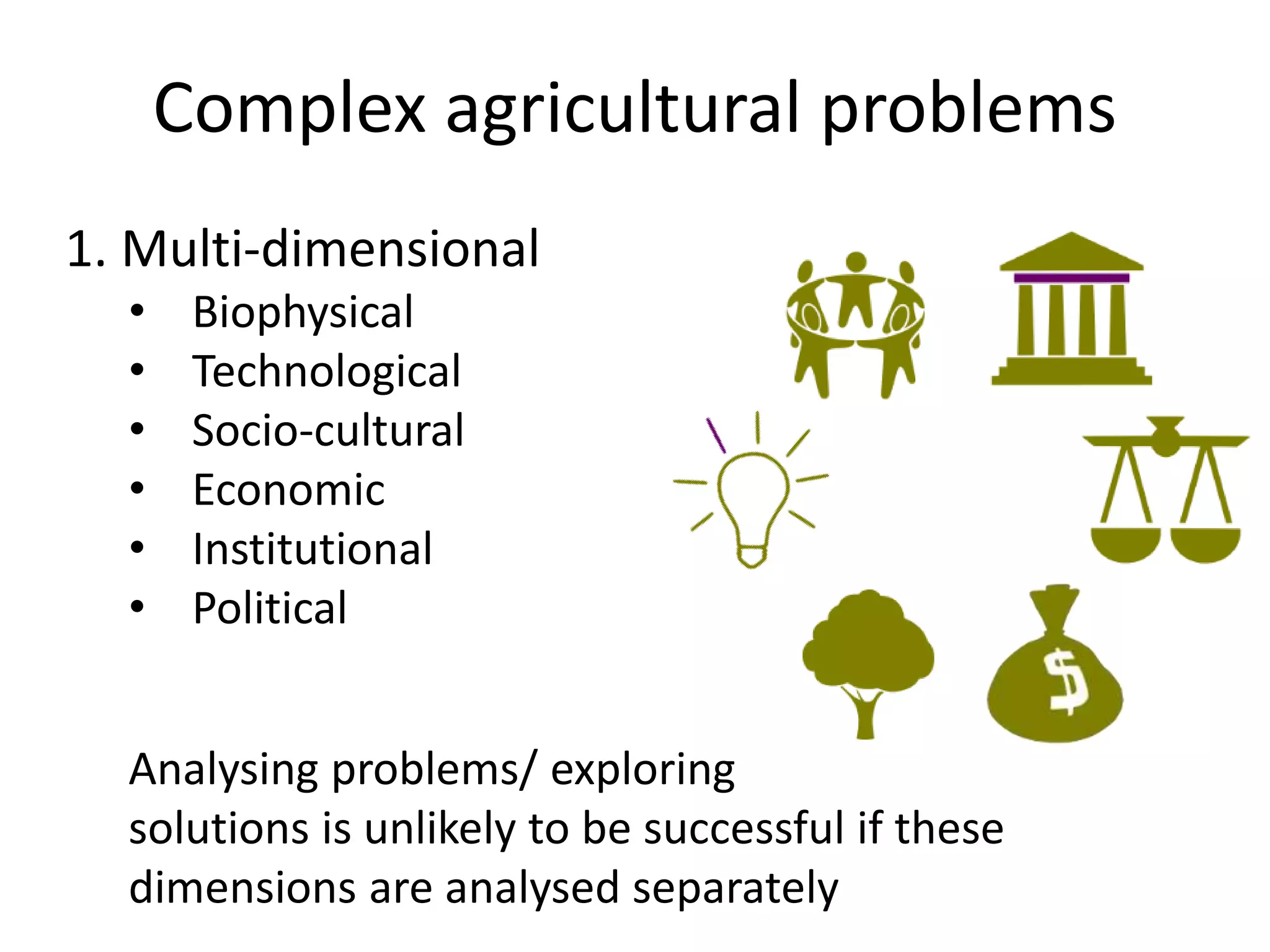
1. Multi-dimensional
• Biophysical
• Technological
• Socio-cultural
• Economic
• Institutional
• Political
Analysing problems/ exploring
solutions is unlikely to be successful if these
dimensions are analysed separately
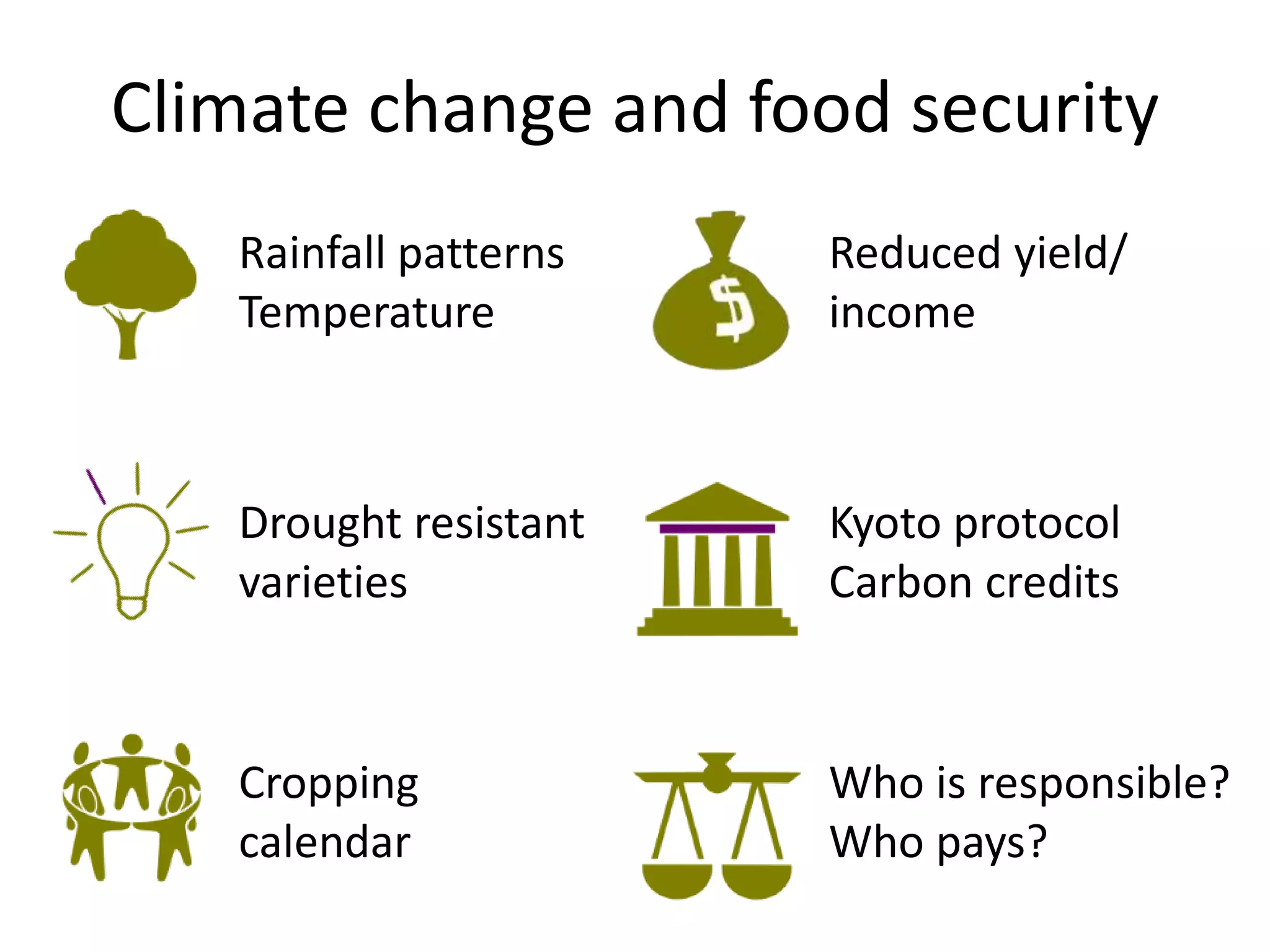
Climate change and food security
Rainfall patterns
Temperature
Drought resistant
varieties
Reduced yield/
income
Kyoto protocol
Carbon credits
Who is responsible?
Who pays?
Cropping
calendar
Complex agricultural problems
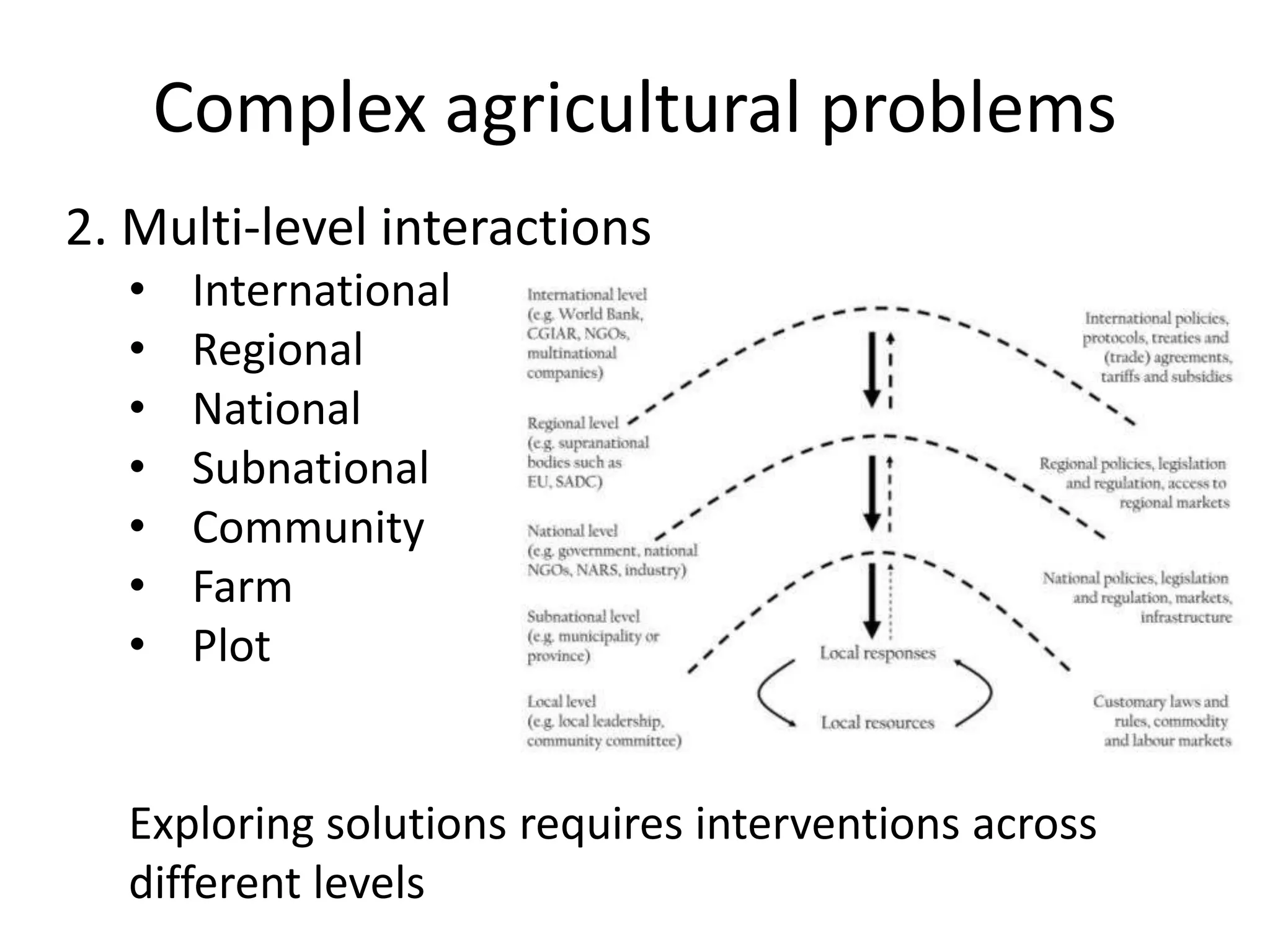
2. Multi-level interactions
• International
• Regional
• National
• Subnational
• Community
• Farm
• Plot
Exploring solutions requires interventions across
different levels
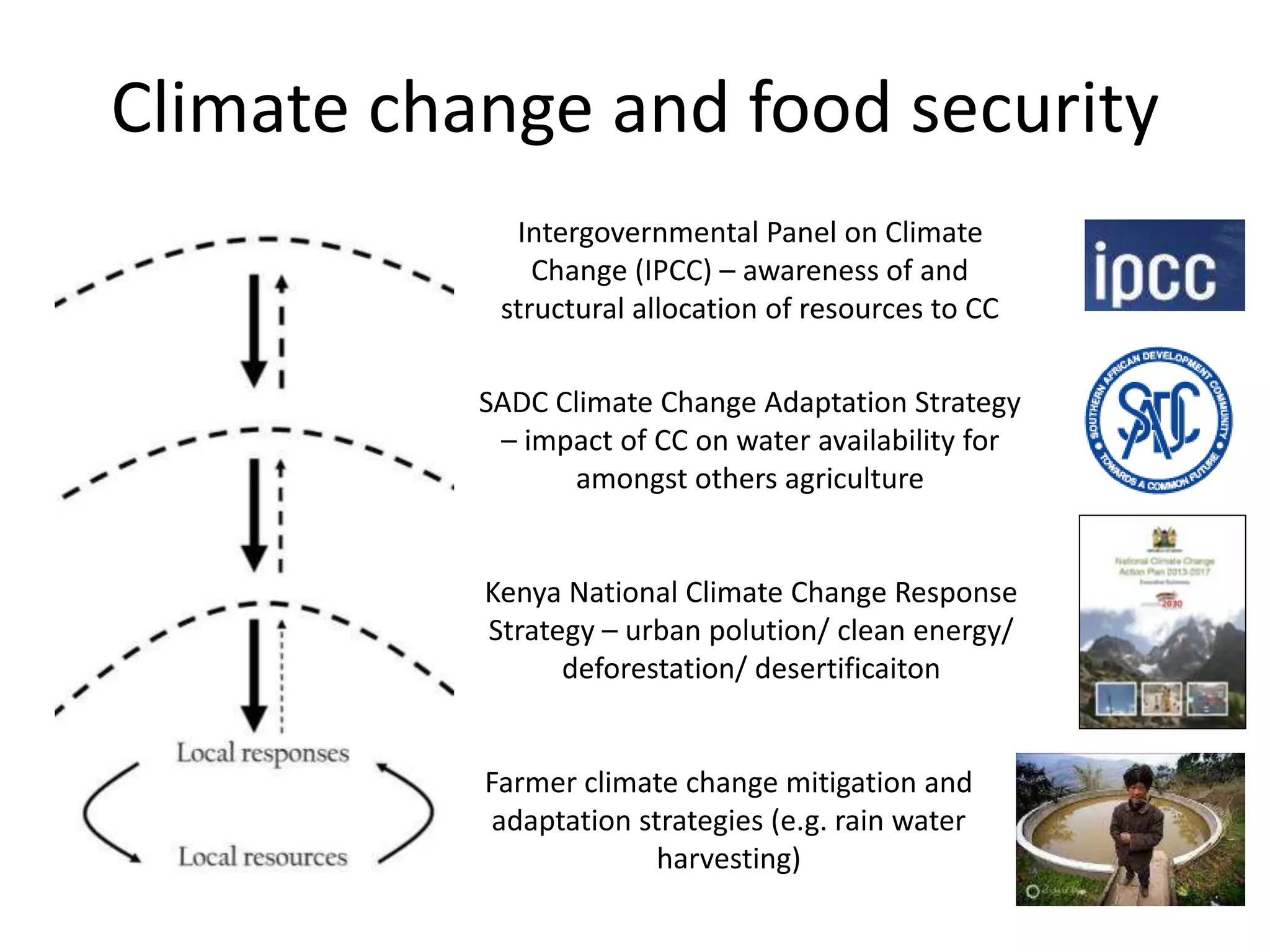
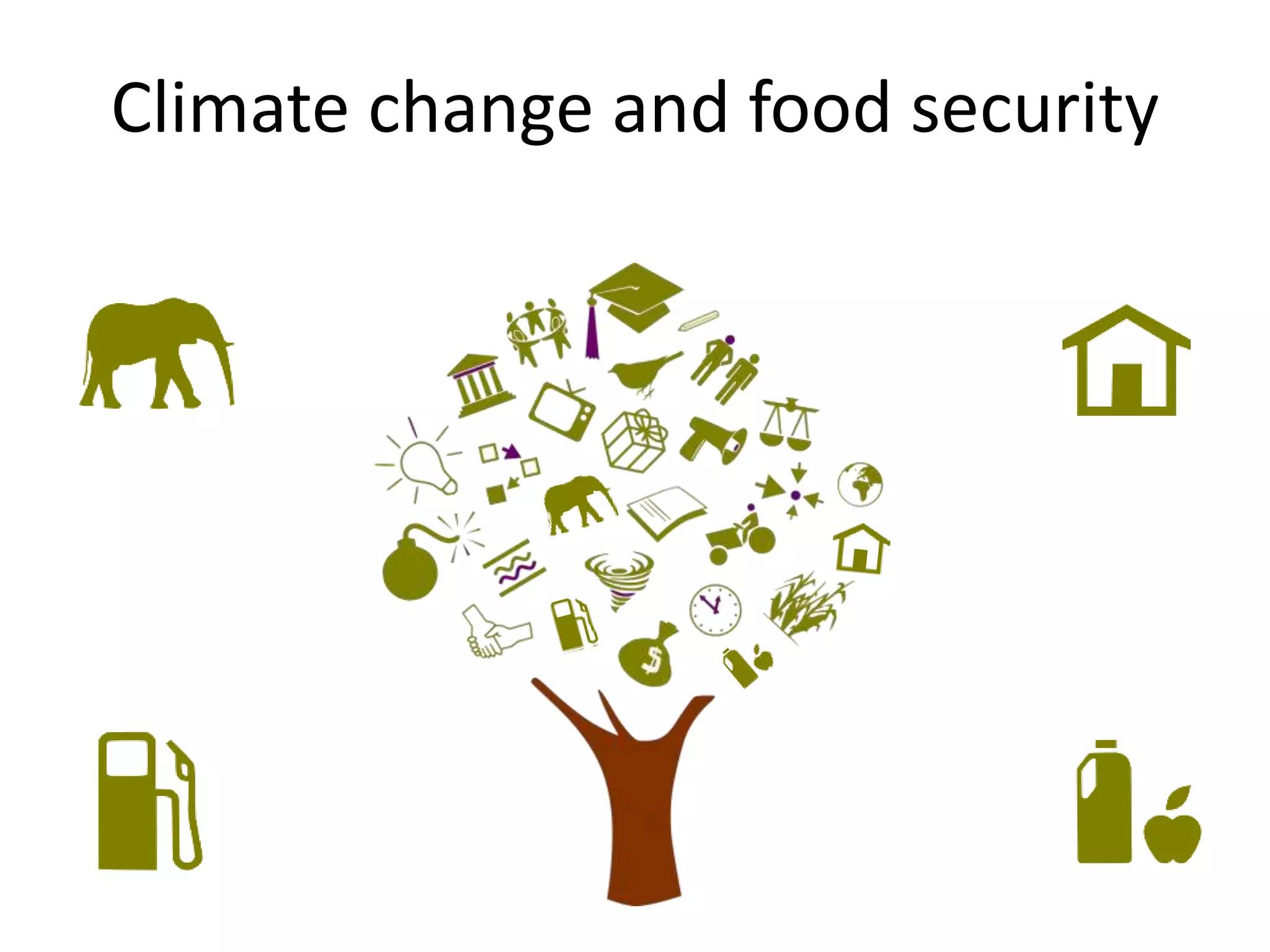
Climate change and food security
Intergovernmental Panel on Climate
Change (IPCC) – awareness of and
structural allocation of resources to CC
SADC Climate Change Adaptation Strategy
– impact of CC on water availability for
amongst others agriculture
Kenya National Climate Change Response
Strategy – urban polution/ clean energy/
deforestation/ desertificaiton
Farmer climate change mitigation and
adaptation strategies (e.g. rain water
harvesting)
Complex agricultural problems
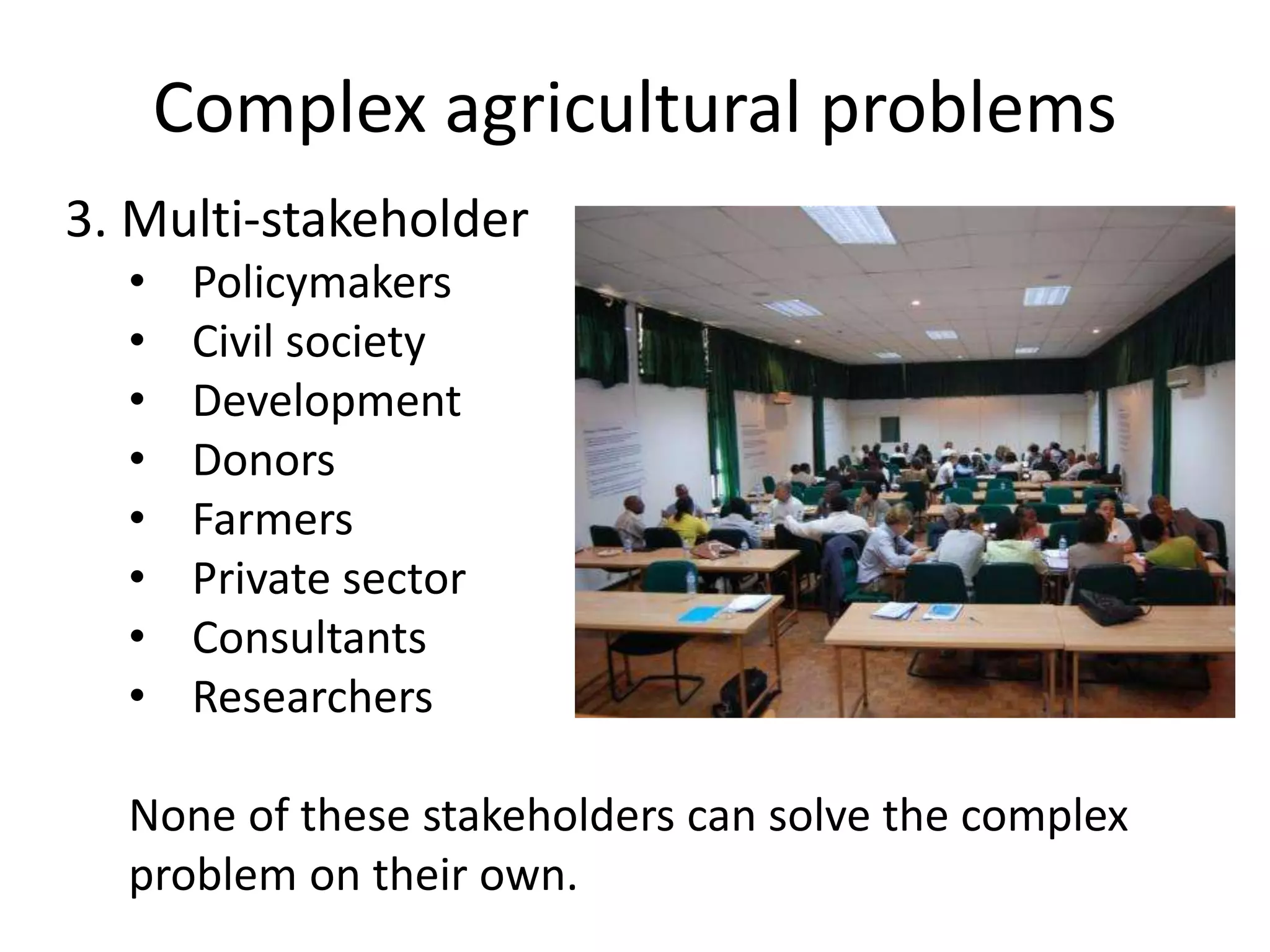
3. Multi-stakeholder
• Policymakers
• Civil society
• Development
• Donors
• Farmers
• Private sector
• Consultants
• Researchers
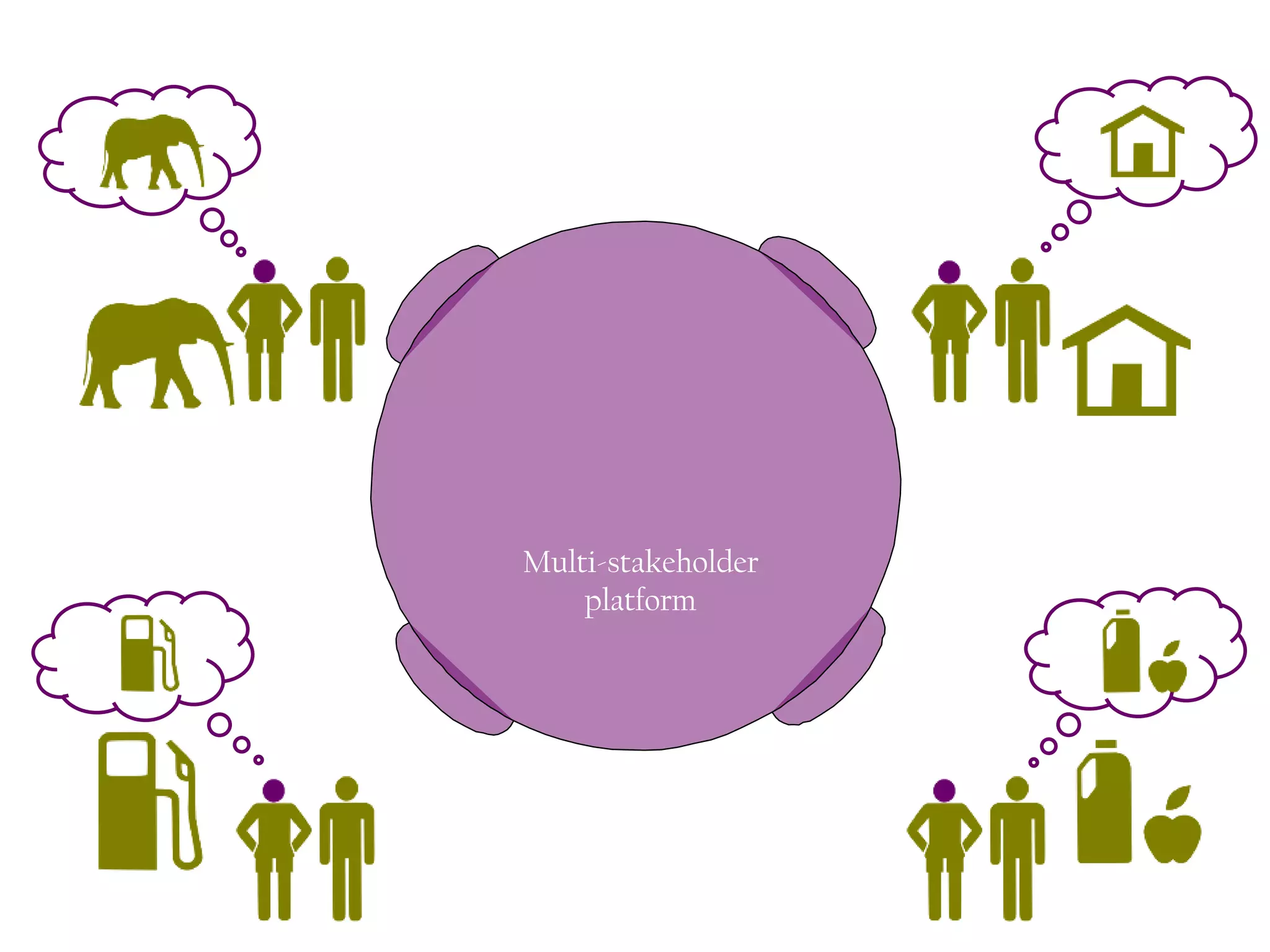
None of these stakeholders can solve the complex
problem on their own.
Climate change and food security
Multi-stakeholder
platform
Multi-stakeholder
platform
Complex agricultural problems
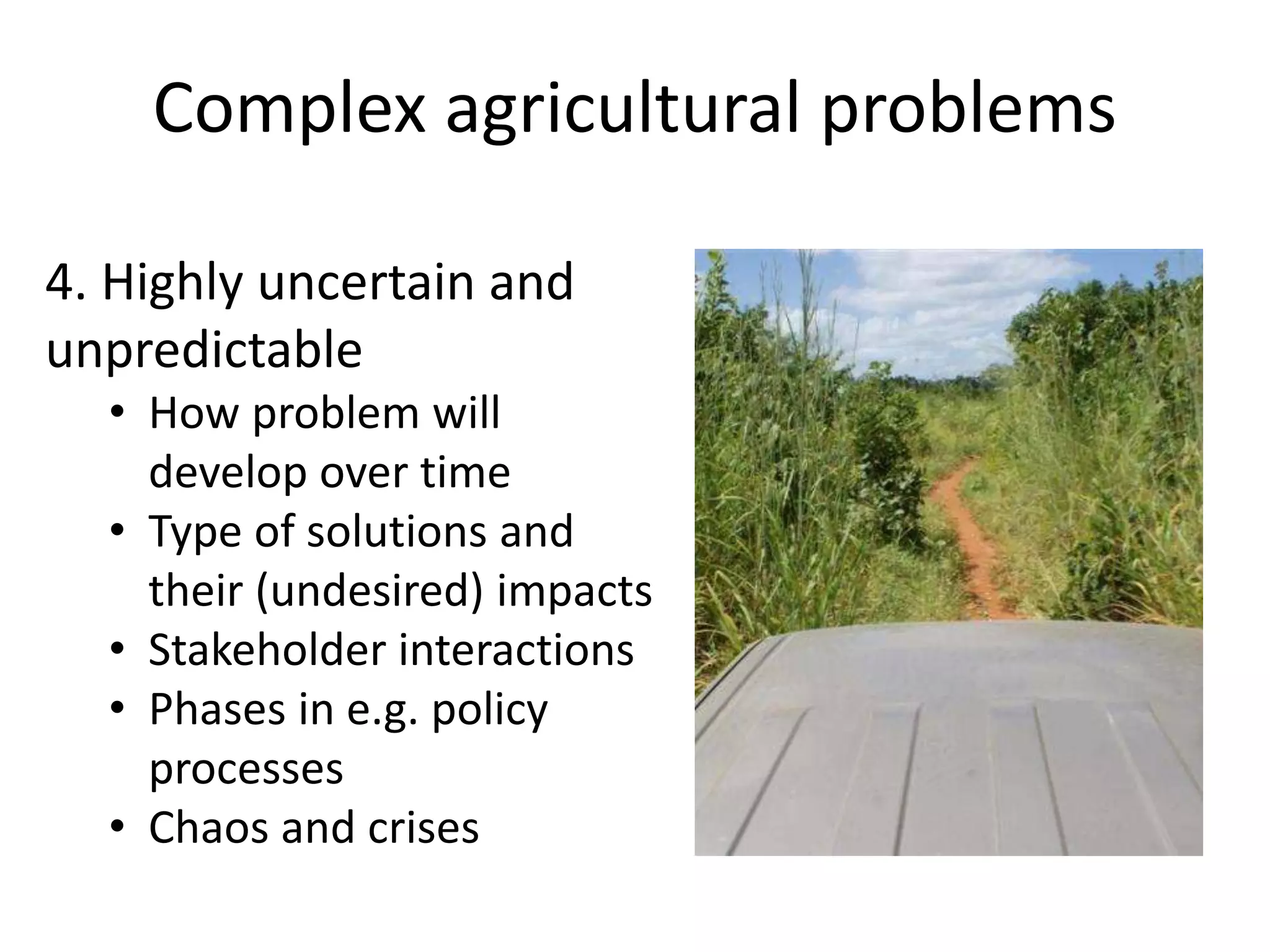
4. Highly uncertain and
unpredictable
• How problem will
develop over time
• Type of solutions and
their (undesired) impacts
• Stakeholder interactions
• Phases in e.g. policy
processes
• Chaos and crises
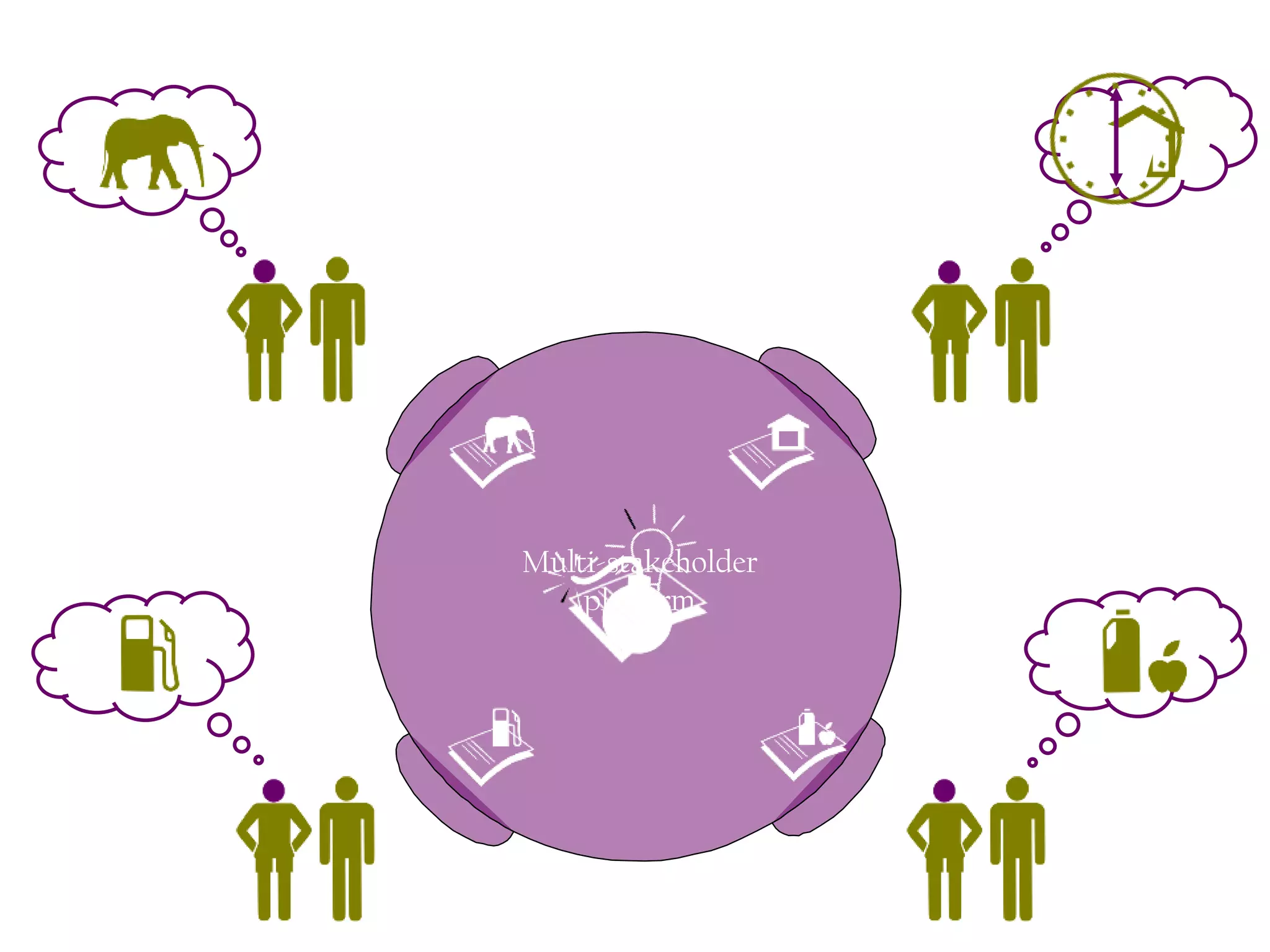
Climate change and food security
• How will climate change
develop over time?
• What type of climate change
adaptation and mitigation
strategies will be effective?
• Will different types of
stakeholder continue to work
together?
Need for agricultural innovations
Solution strategies with attention for:
• Integrated analysis of problem dimensions,
design integrated solutions
• Interactions between multiple levels
• Needs and interest of different stakeholder
groups (including gender, age, ethnic groups)
• Flexibility and adaptive capacity to respond to
uncertain and unpredictable context
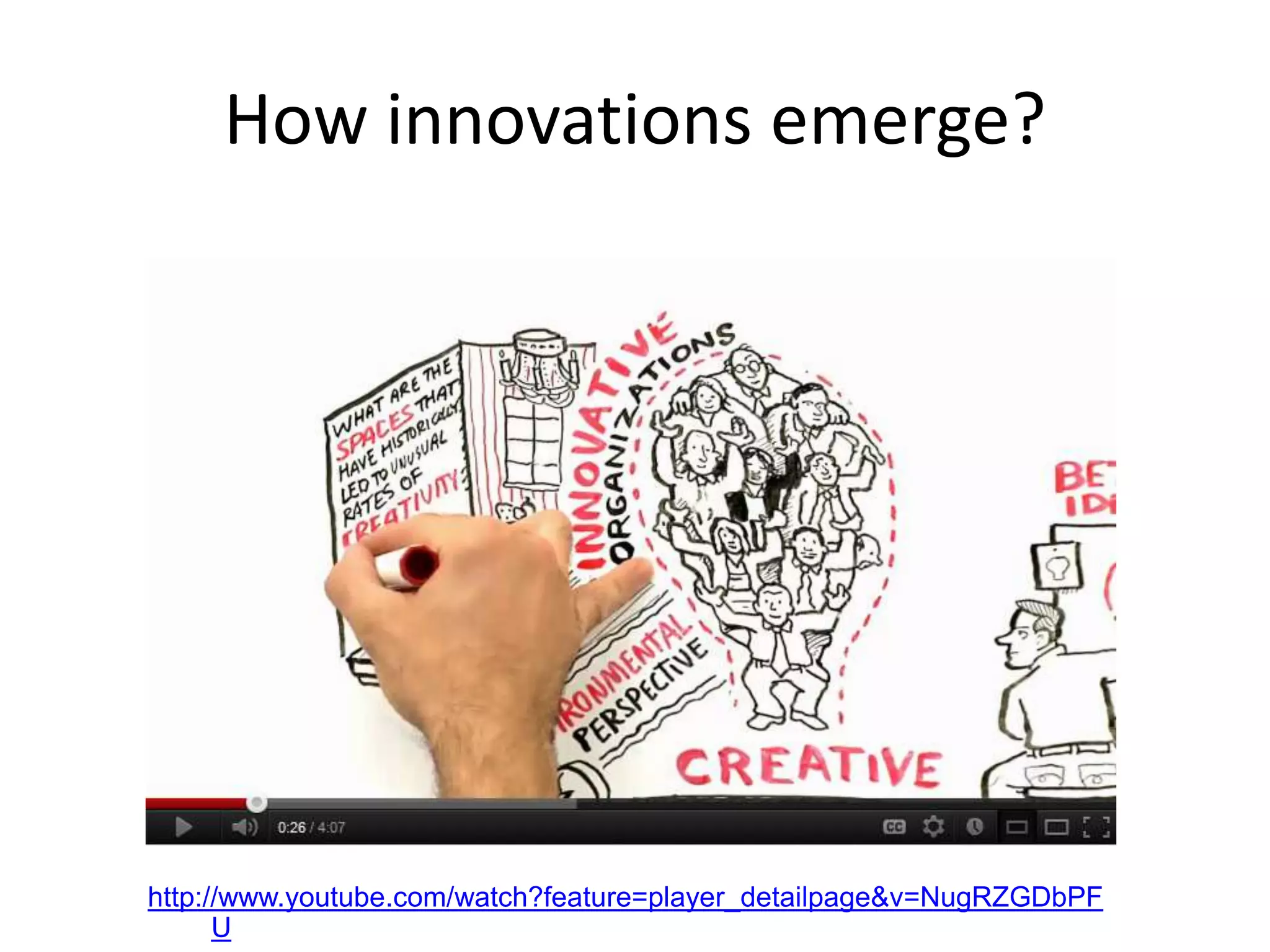
How innovations emerge?
http://www.youtube.com/watch?feature=player_detailpage&v=NugRZGDbPF
U
How innovations emerge?
• Spaces for creativity
• Where ideas of different people can mingle
• Connectivity, borrow from each other, combine
perspectives
• Finding the missing piece
• Such processes take time
• “The whole is bigger than the sum of its parts”
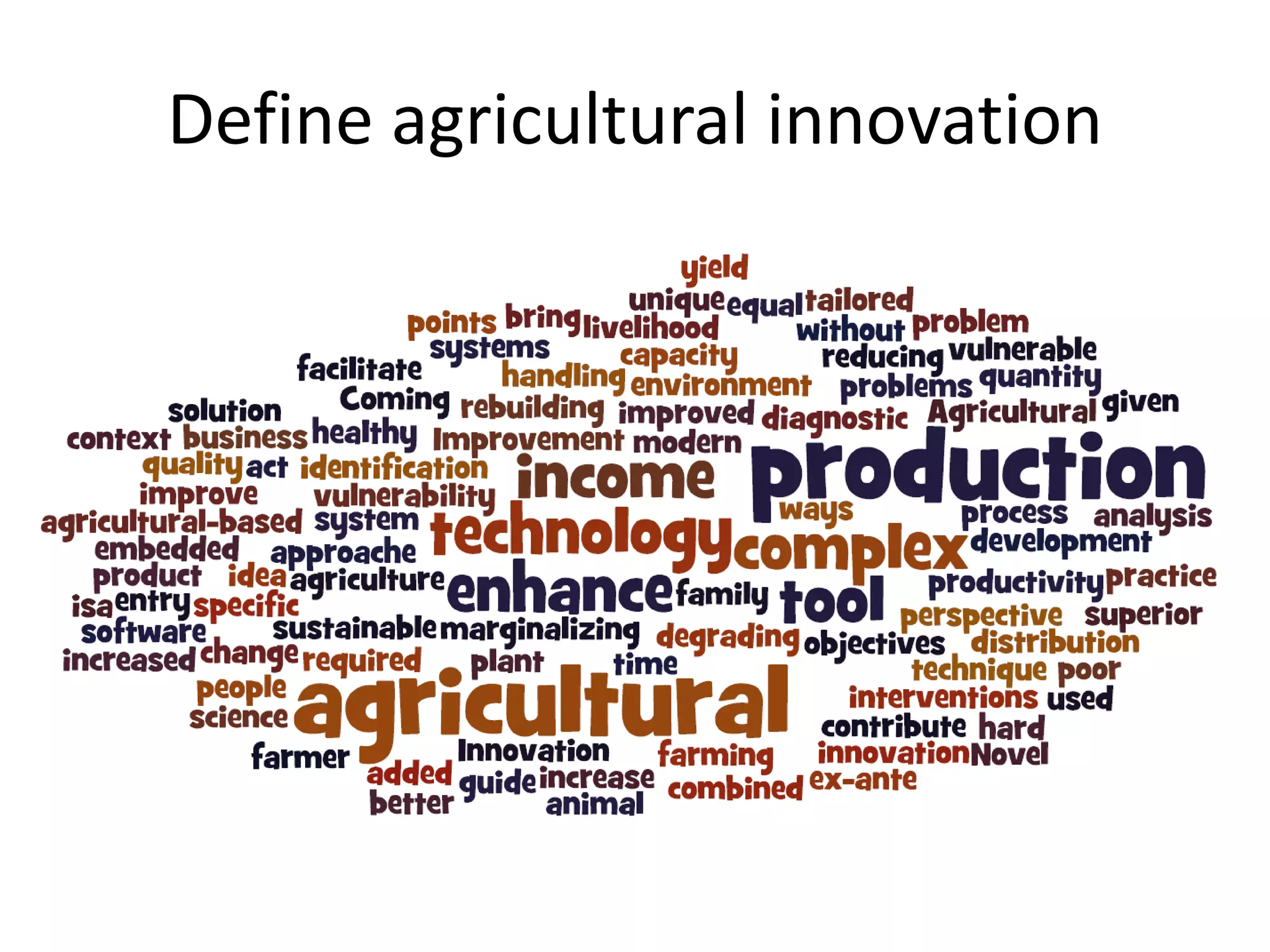
Define agricultural innovation
Define agricultural innovation (1)
• Technology, practice or product handling that
will bring increased yield and income to the
farmer
• Modern/ improved or superior production
technique used to improve production or
quality and quantity required at a given time.
• Novel idea, process, tool, or solution to
facilitate healthy and sustainable agriculture
that is tailored to a specific context.
Define agricultural innovation (2)
• Combined hardware (technologies – e.g. seeds)
and software (social-organisational – e.g. seed
systems) to enhance development and business
objectives, change for the better
• Tool that can guide analysis of complex
agricultural problems, and the identification of
entry points that enhance the innovation
capacity of the agricultural system in which the
complex agricultural problem is embedded.
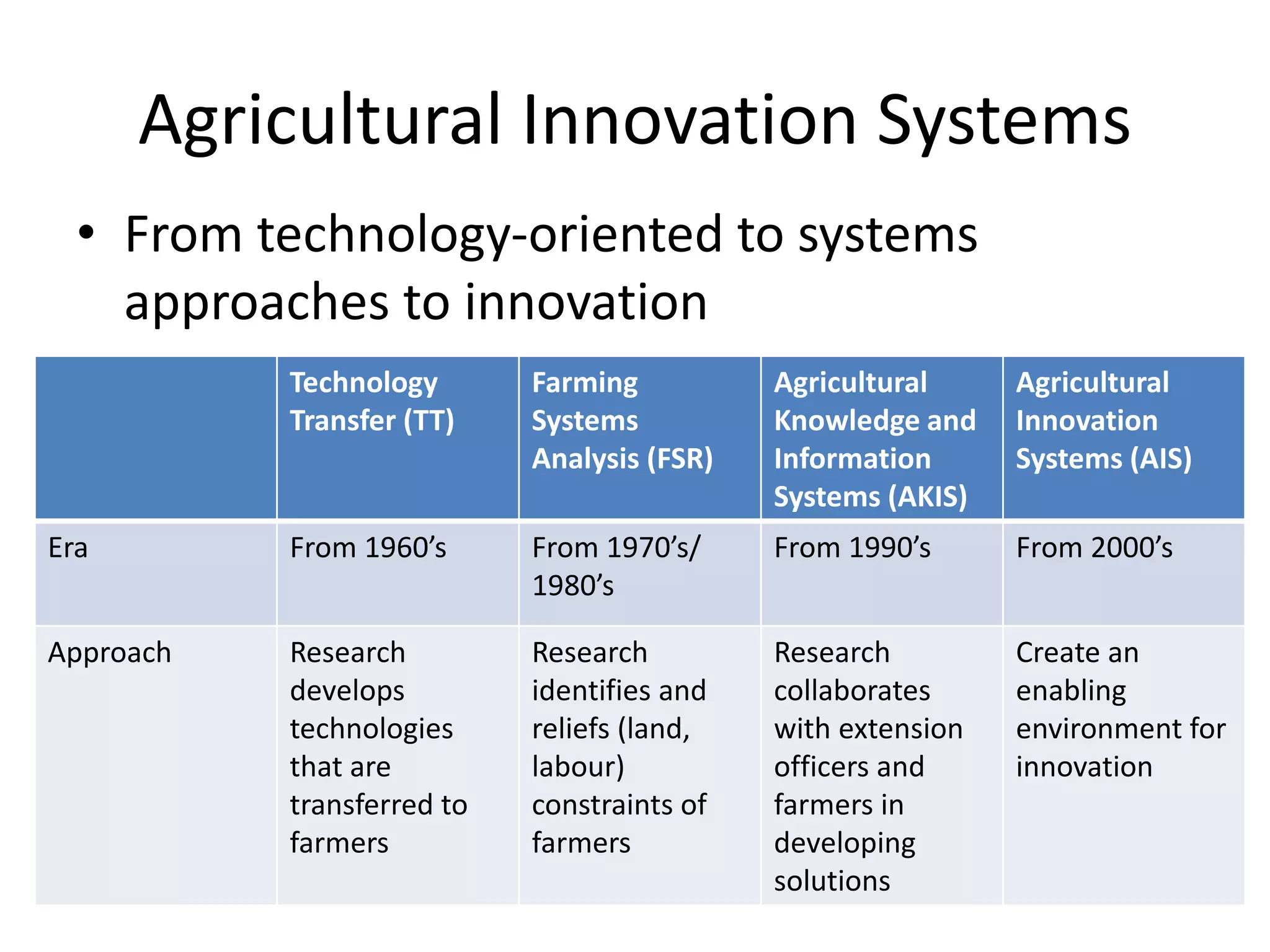
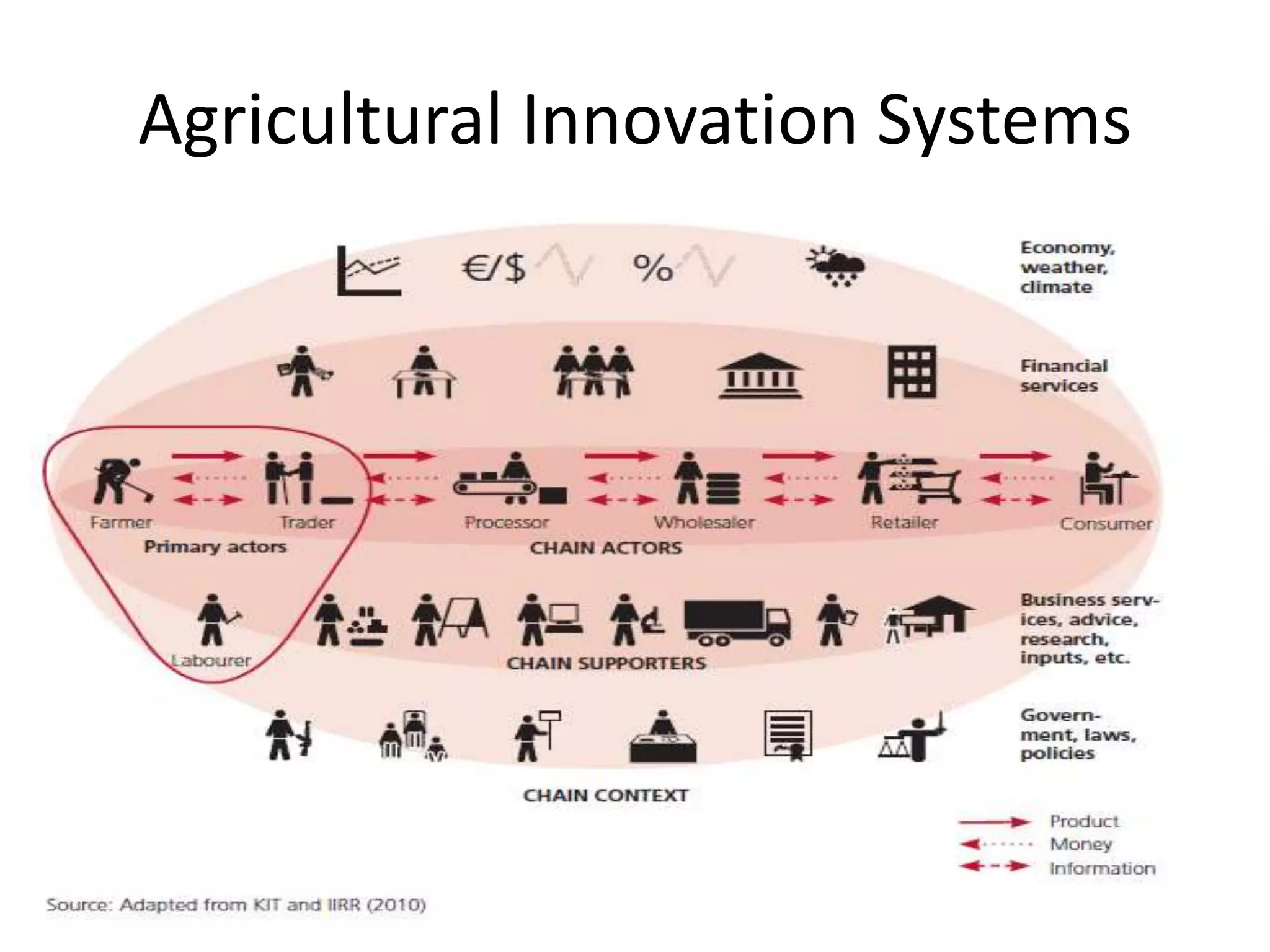
Agricultural Innovation Systems
• From technology-oriented to systems
approaches to innovation
Technology
Transfer (TT)
Farming
Systems
Analysis (FSR)
Agricultural
Knowledge and
Information
Systems (AKIS)
Agricultural
Innovation
Systems (AIS)
Era From 1960’s From 1970’s/
1980’s
From 1990’s From 2000’s
Approach Research
develops
technologies
that are
transferred to
farmers
Research
identifies and
reliefs (land,
labour)
constraints of
farmers
Research
collaborates
with extension
officers and
farmers in
developing
solutions
Create an
enabling
environment for
innovation
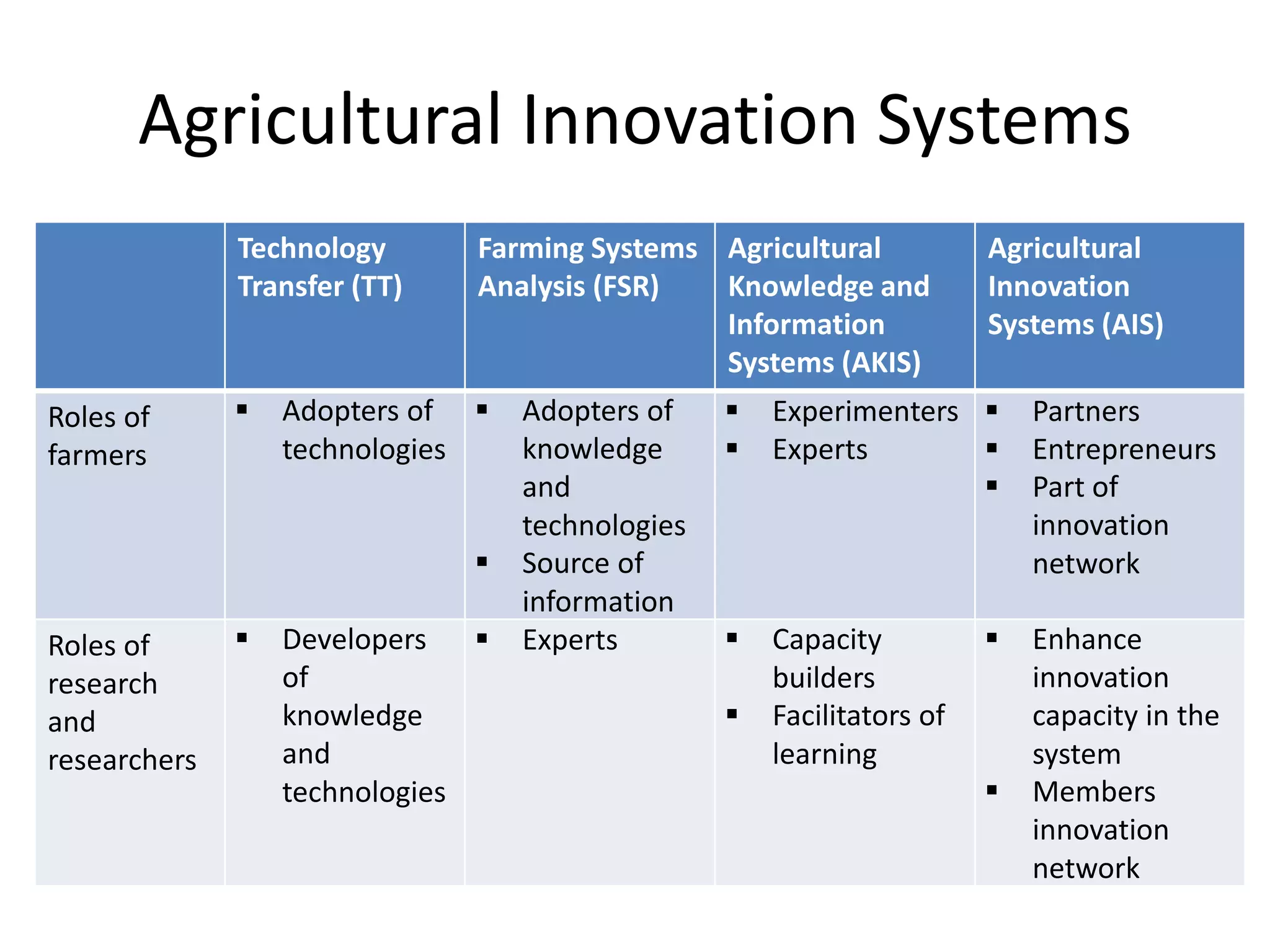
Agricultural Innovation Systems
Technology
Transfer (TT)
Farming Systems
Analysis (FSR)
Agricultural
Knowledge and
Information
Systems (AKIS)
Agricultural
Innovation
Systems (AIS)
Roles of
farmers
 Adopters of
technologies
 Adopters of
knowledge
and
technologies
 Source of
information
 Experimenters
 Experts
 Partners
 Entrepreneurs
 Part of
innovation
network
Roles of
research
and
researchers
 Developers
of
knowledge
and
technologies
 Experts  Capacity
builders
 Facilitators of
learning
 Enhance
innovation
capacity in the
system
 Members
innovation
network
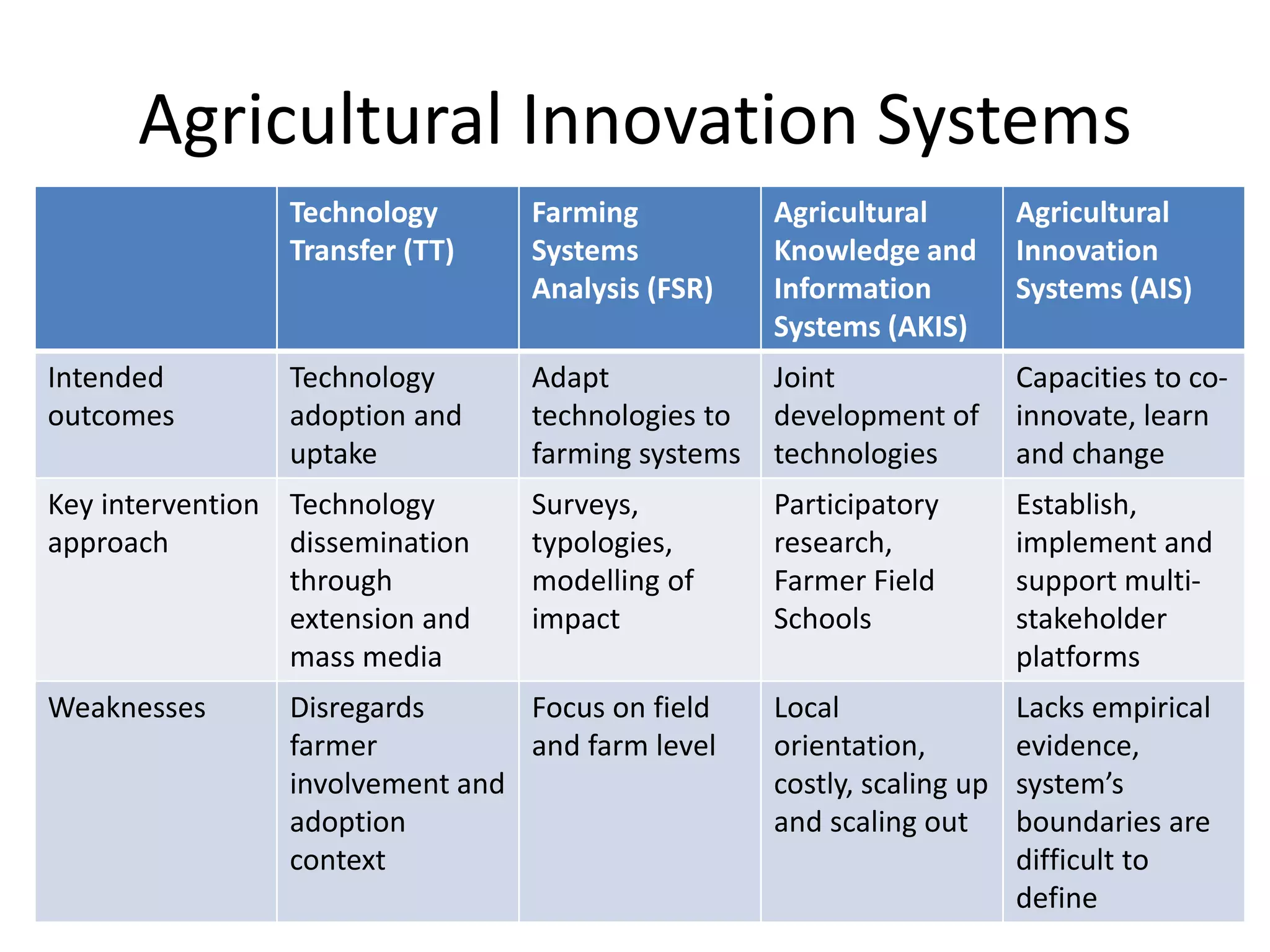
Agricultural Innovation Systems
Technology
Transfer (TT)
Farming
Systems
Analysis (FSR)
Agricultural
Knowledge and
Information
Systems (AKIS)
Agricultural
Innovation
Systems (AIS)
Intended
outcomes
Technology
adoption and
uptake
Adapt
technologies to
farming systems
Joint
development of
technologies
Capacities to co-
innovate, learn
and change
Key intervention
approach
Technology
dissemination
through
extension and
mass media
Surveys,
typologies,
modelling of
impact
Participatory
research,
Farmer Field
Schools
Establish,
implement and
support multi-
stakeholder
platforms
Weaknesses Disregards
farmer
involvement and
adoption
context
Focus on field
and farm level
Local
orientation,
costly, scaling up
and scaling out
Lacks empirical
evidence,
system’s
boundaries are
difficult to
define
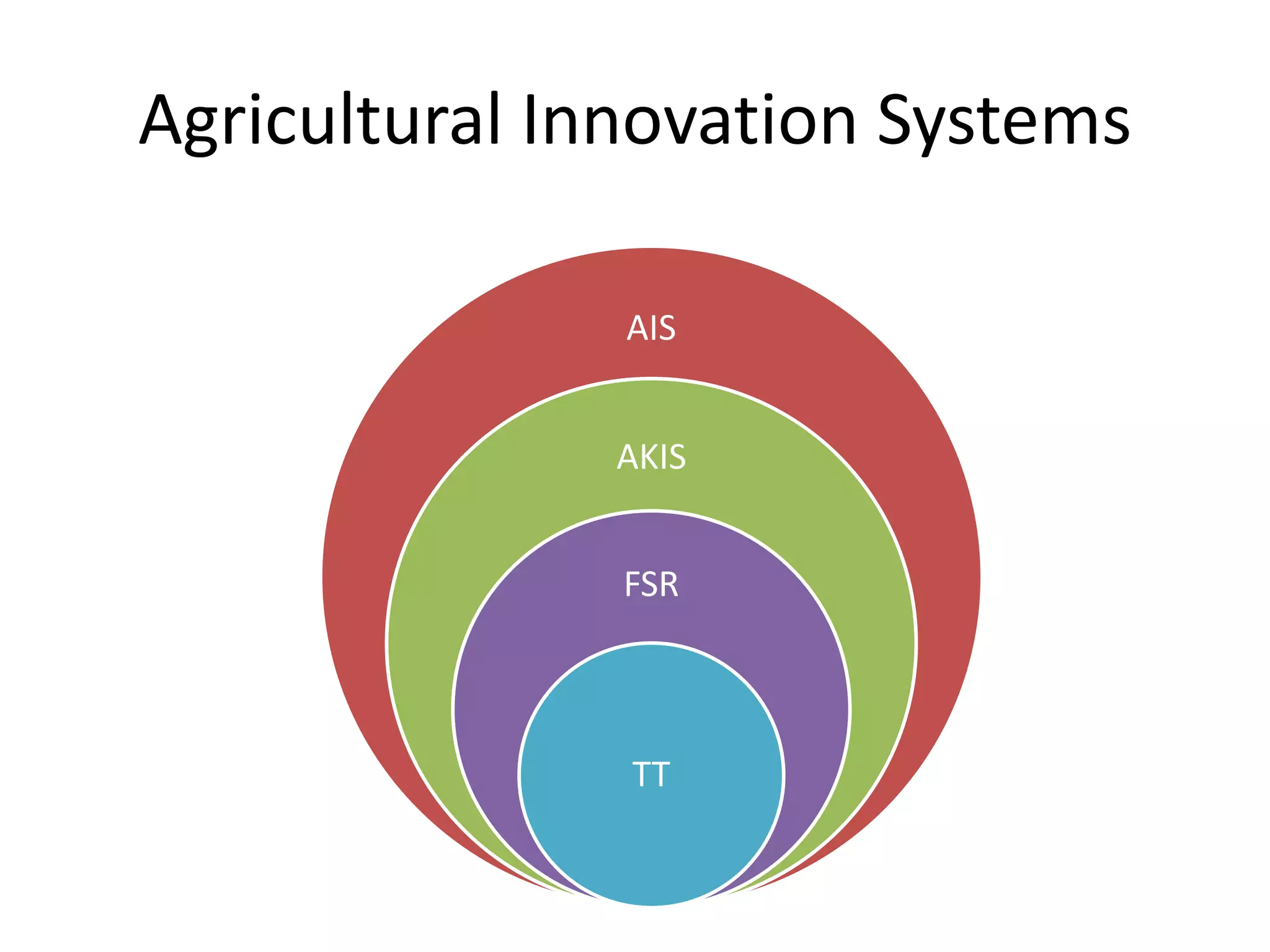
Agricultural Innovation Systems
AIS
AKIS
FSR
TT
Agricultural Innovation Systems
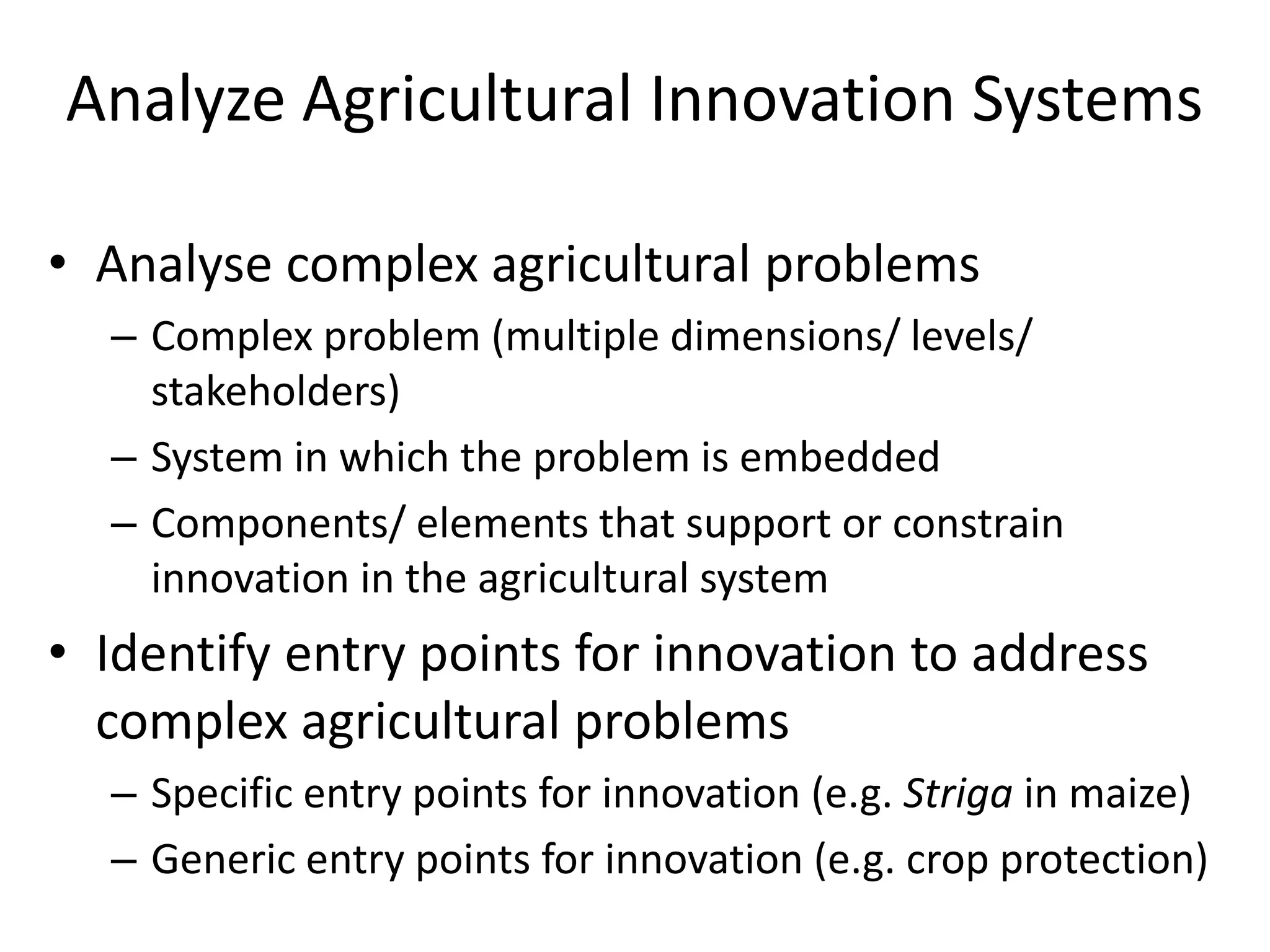
Analyze Agricultural Innovation Systems
• Analyse complex agricultural problems
– Complex problem (multiple dimensions/ levels/
stakeholders)
– System in which the problem is embedded
– Components/ elements that support or constrain
innovation in the agricultural system
• Identify entry points for innovation to address
complex agricultural problems
– Specific entry points for innovation (e.g. Striga in maize)
– Generic entry points for innovation (e.g. crop protection)
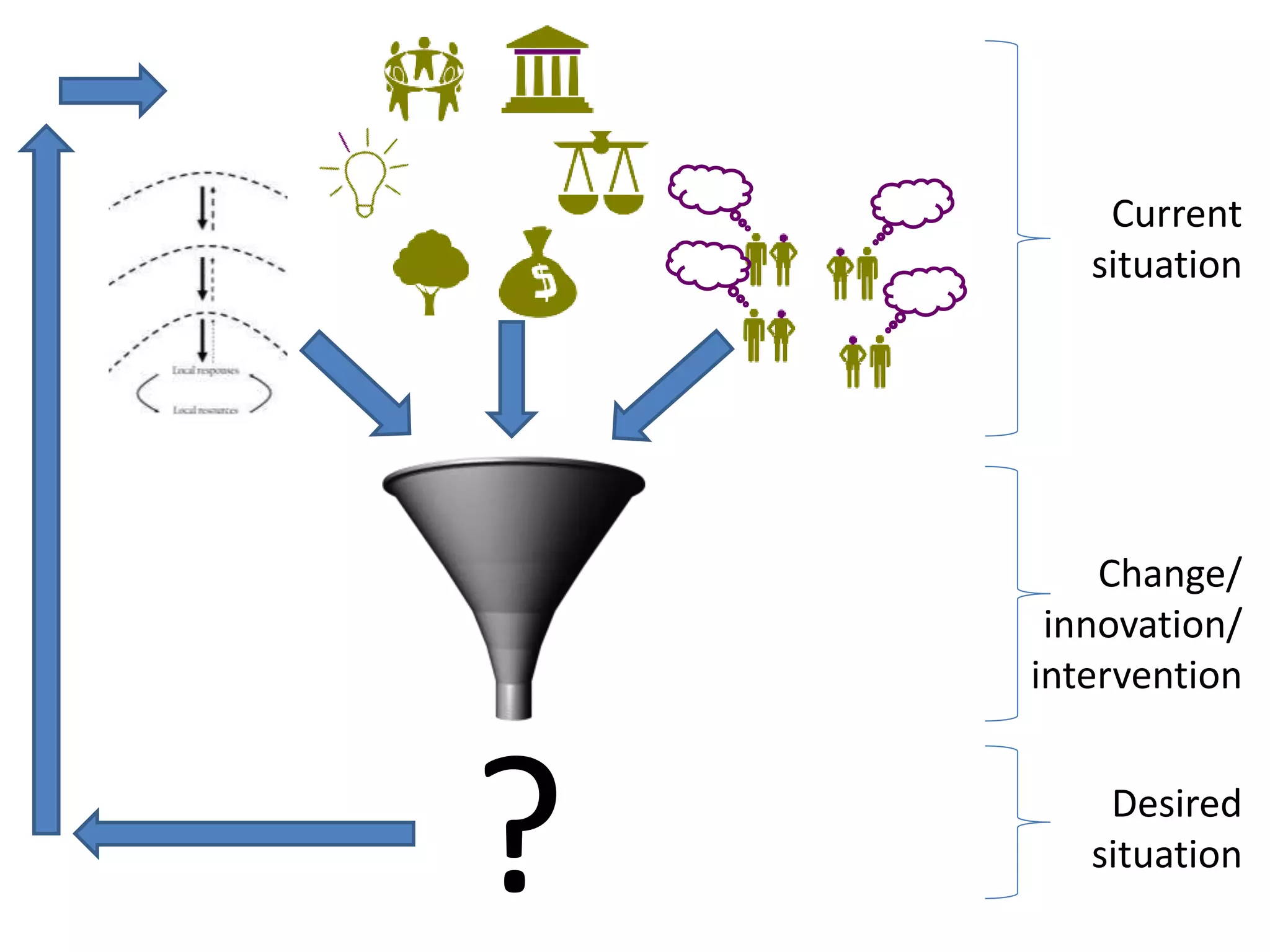
?
Current
situation
Desired
situation
Change/
innovation/
intervention
Break
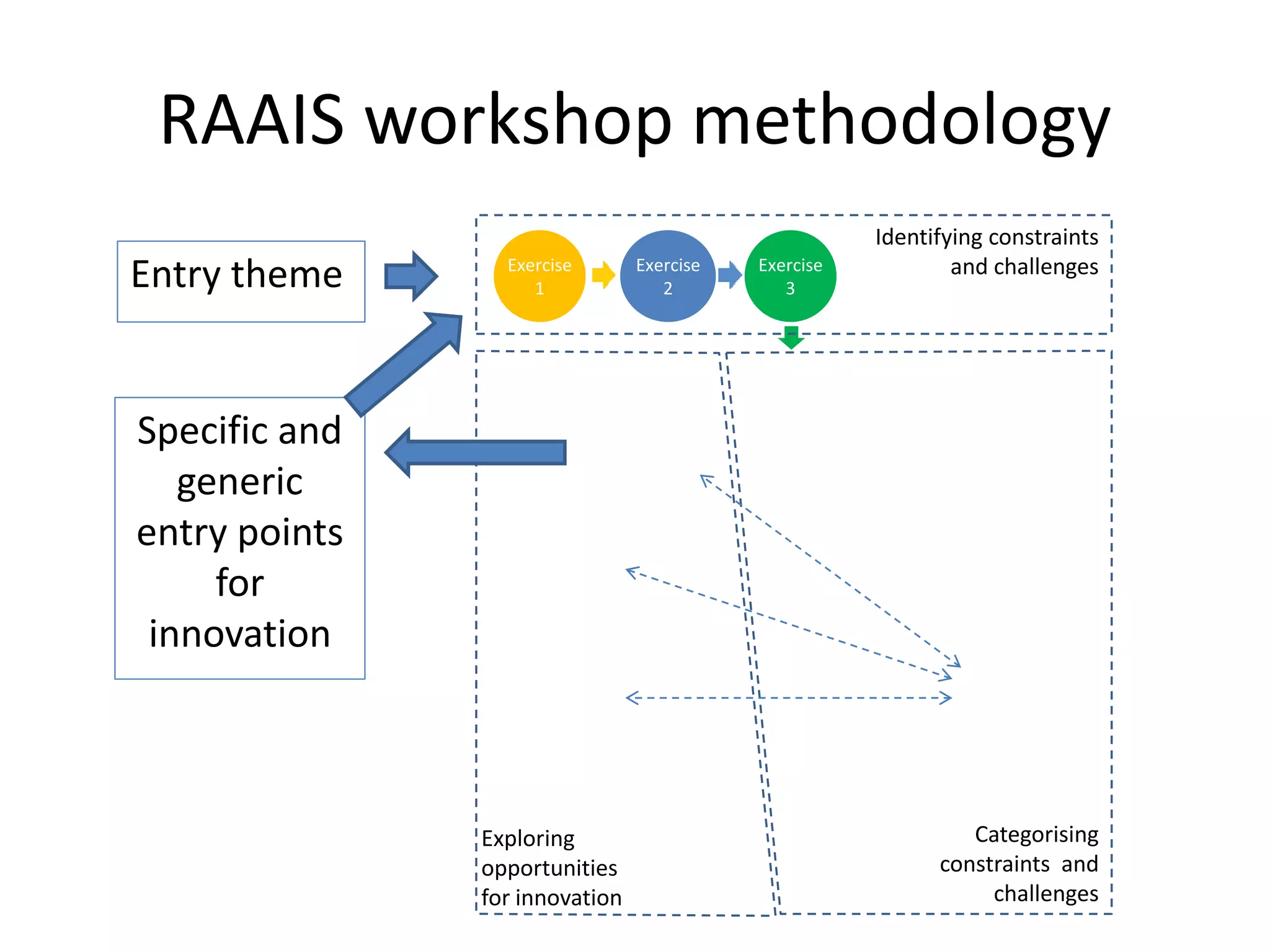
What is RAAIS?
• ‘An easy way to make people do a difficult job’
• Rapid Appraisal of Agricultural Innovation
Systems is a tool to:
– Analyse characteristics of complex problems
– Identify challenges and constraints for innovation
in the agricultural system
– Identify opportunities for innovation in systems
• Use different types of data/ methods
– Workshops, questionnaires, interviews, existing
statistics
RAAIS workshop methodology
Exercise
2
Exercise
3
Exercise
1
Categorising
constraints and
challenges
Exploring
opportunities
for innovation
Identifying constraints
and challenges
Entry theme
Specific and
generic
entry points
for
innovation
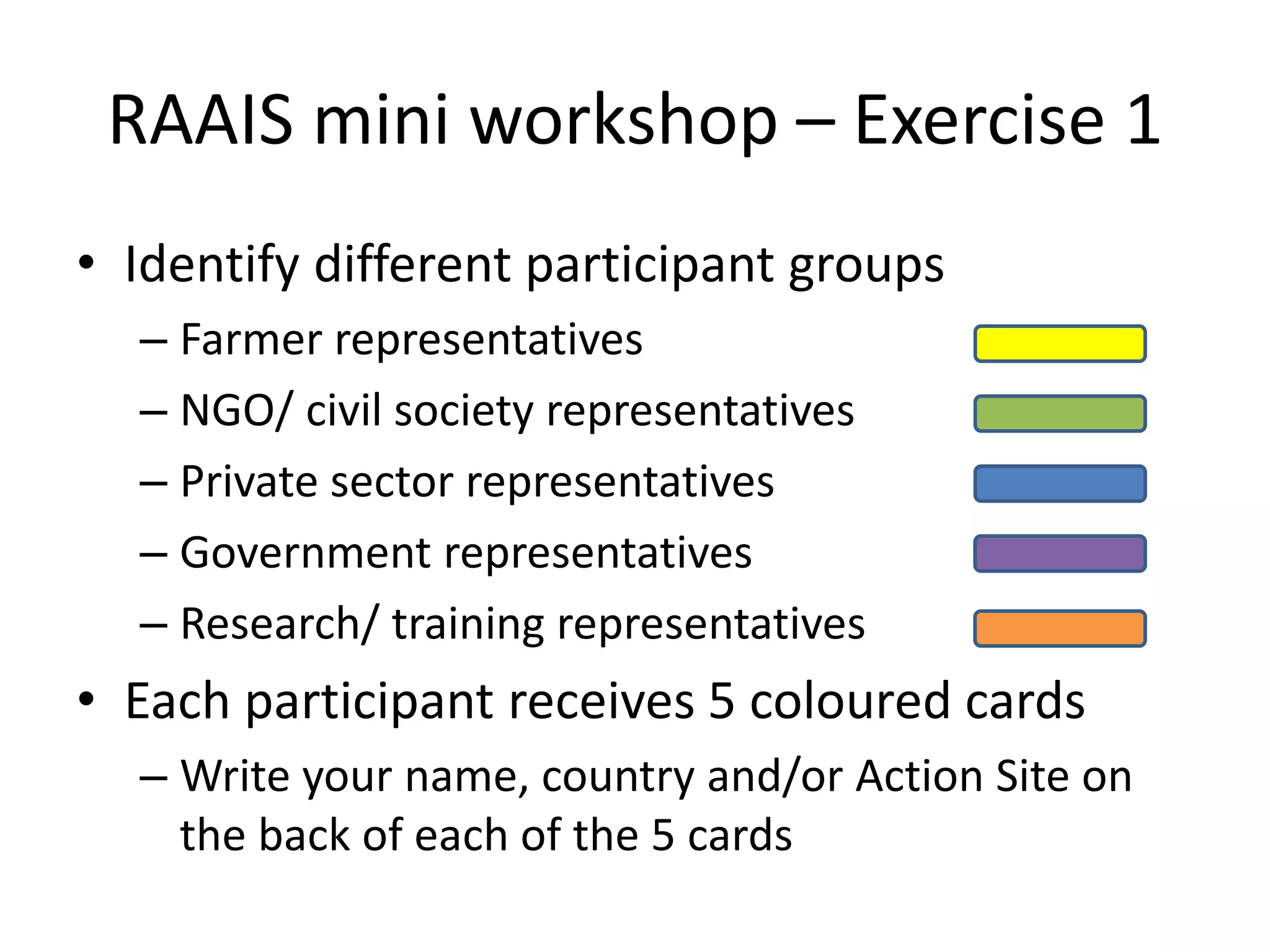
RAAIS mini workshop – Exercise 1
• Identify different participant groups
– Farmer representatives
– NGO/ civil society representatives
– Private sector representatives
– Government representatives
– Research/ training representatives
• Each participant receives 5 coloured cards
– Write your name, country and/or Action Site on
the back of each of the 5 cards
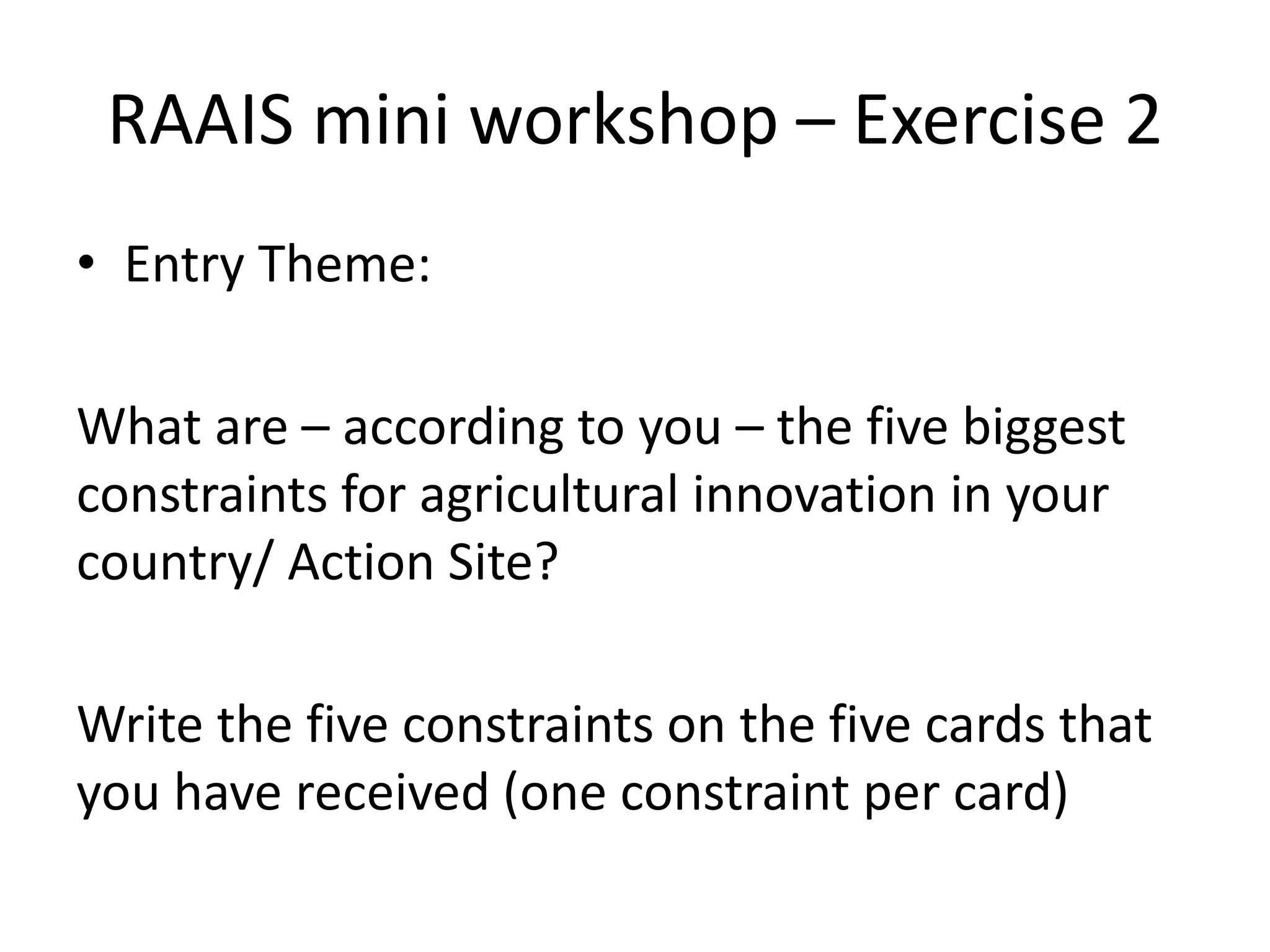
RAAIS mini workshop – Exercise 2
• Entry Theme:
What are – according to you – the five biggest
constraints for agricultural innovation in your
country/ Action Site?
Write the five constraints on the five cards that
you have received (one constraint per card)
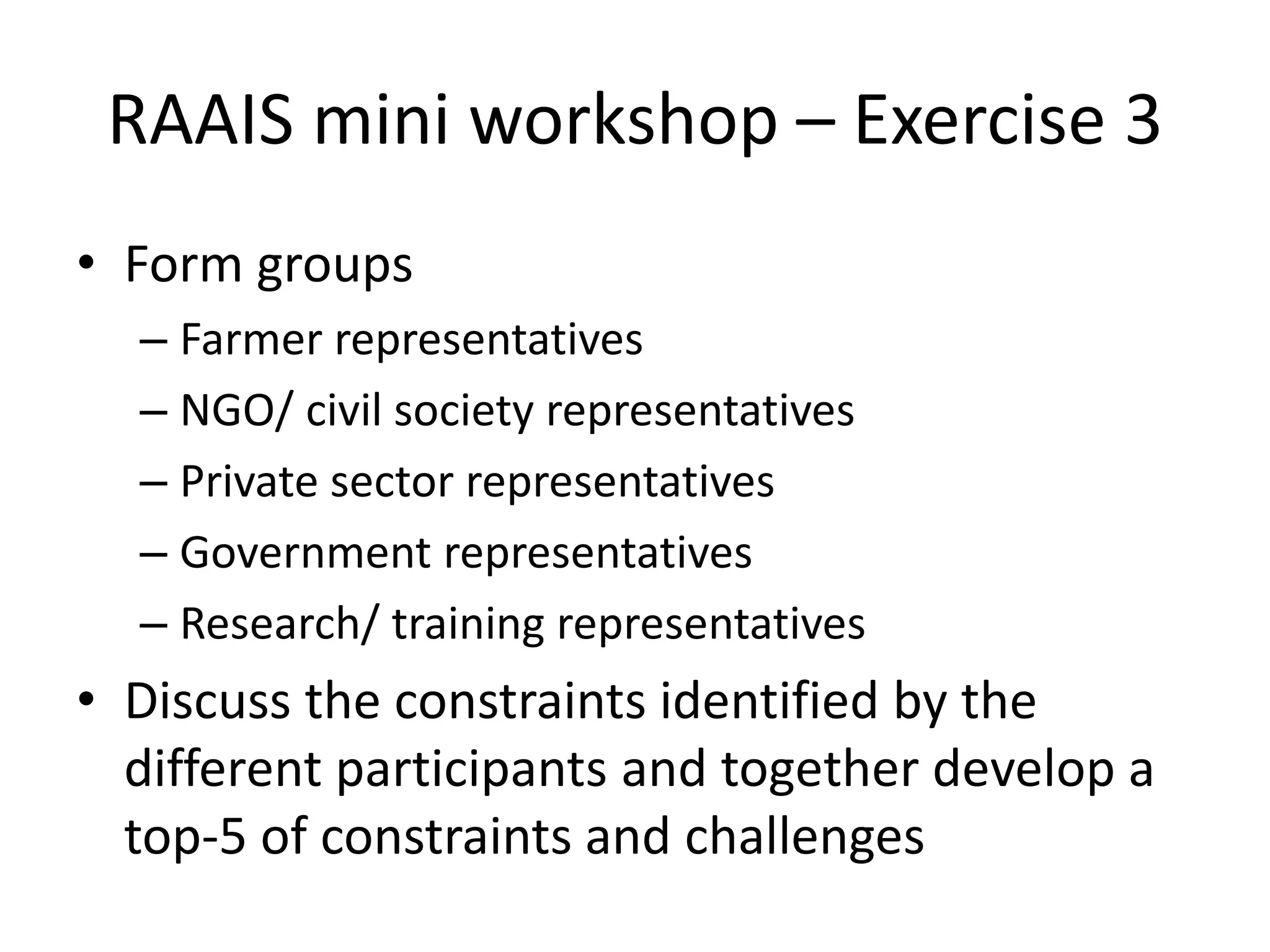
RAAIS mini workshop – Exercise 3
• Form groups
– Farmer representatives
– NGO/ civil society representatives
– Private sector representatives
– Government representatives
– Research/ training representatives
• Discuss the constraints identified by the
different participants and together develop a
top-5 of constraints and challenges
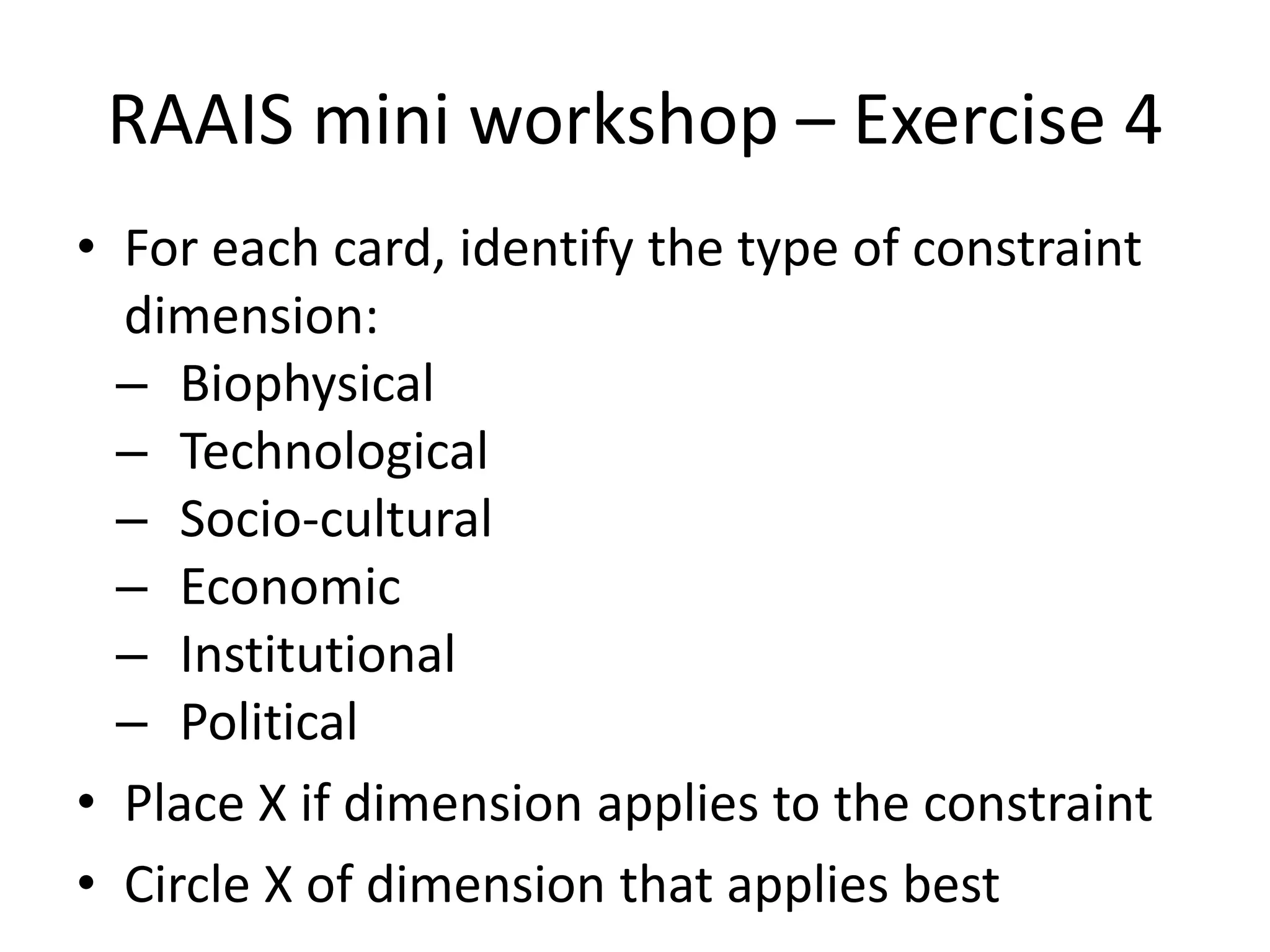
RAAIS mini workshop – Exercise 4
• For each card, identify the type of constraint
dimension:
– Biophysical
– Technological
– Socio-cultural
– Economic
– Institutional
– Political
• Place X if dimension applies to the constraint
• Circle X of dimension that applies best
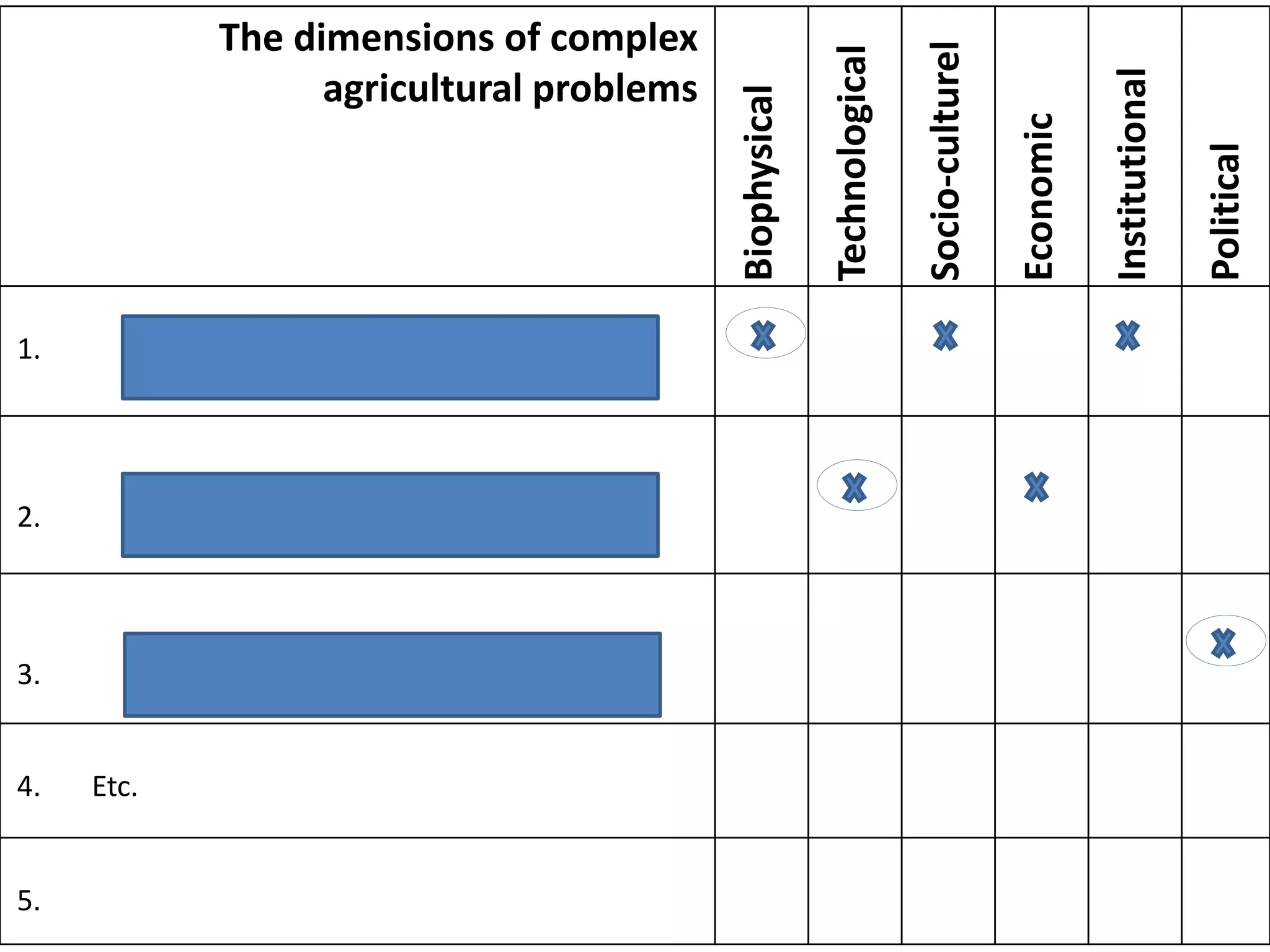
The dimensions of complex
agricultural problems
Biophysical
Technological
Socio-culturel
Economic
Institutional
Political
1.
2.
3.
4. Etc.
5.
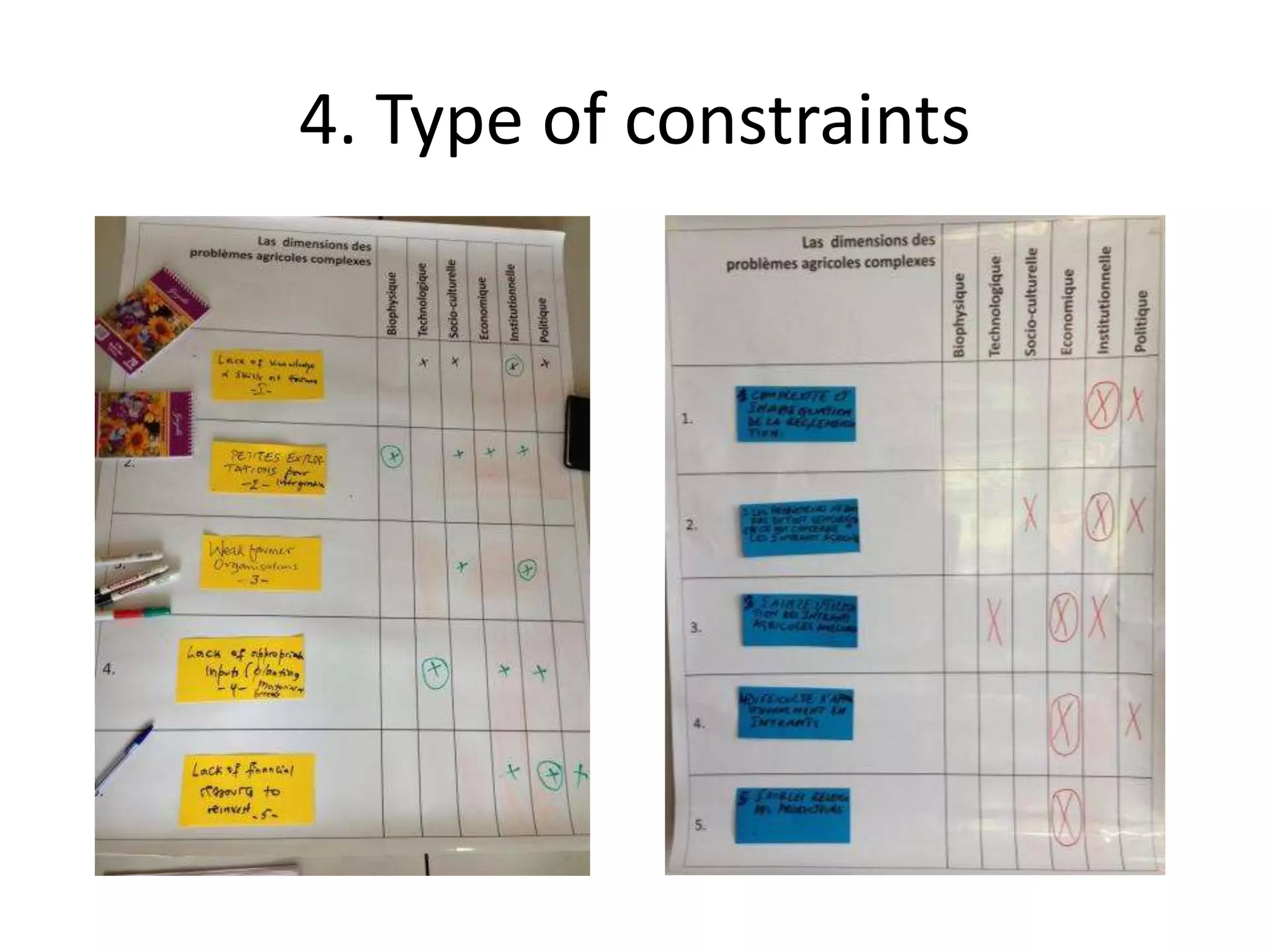
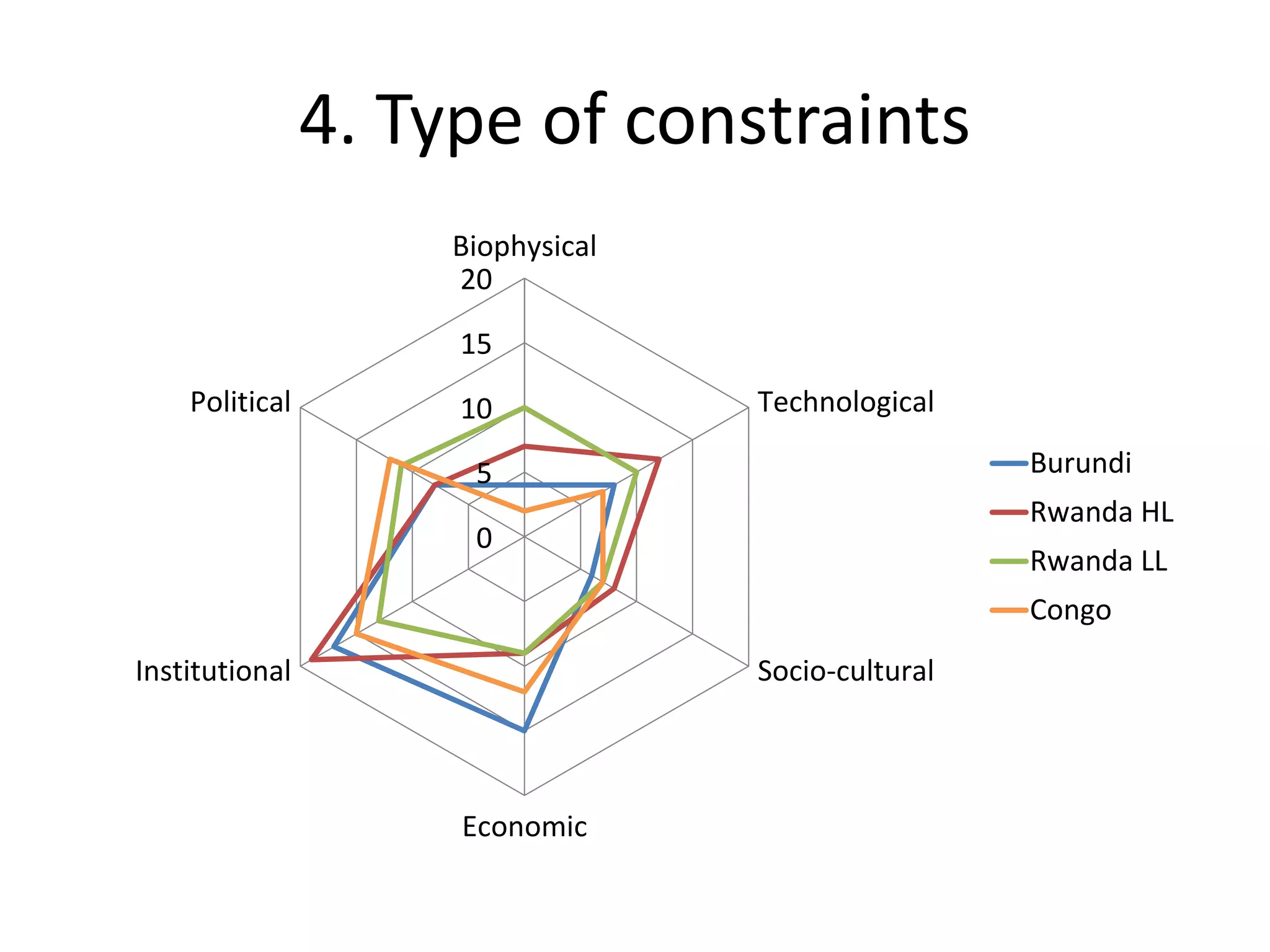
4. Type of constraints
0
5
10
15
20
Biophysical
Technological
Socio-cultural
Economic
Institutional
Political
Burundi
Rwanda HL
Rwanda LL
Congo
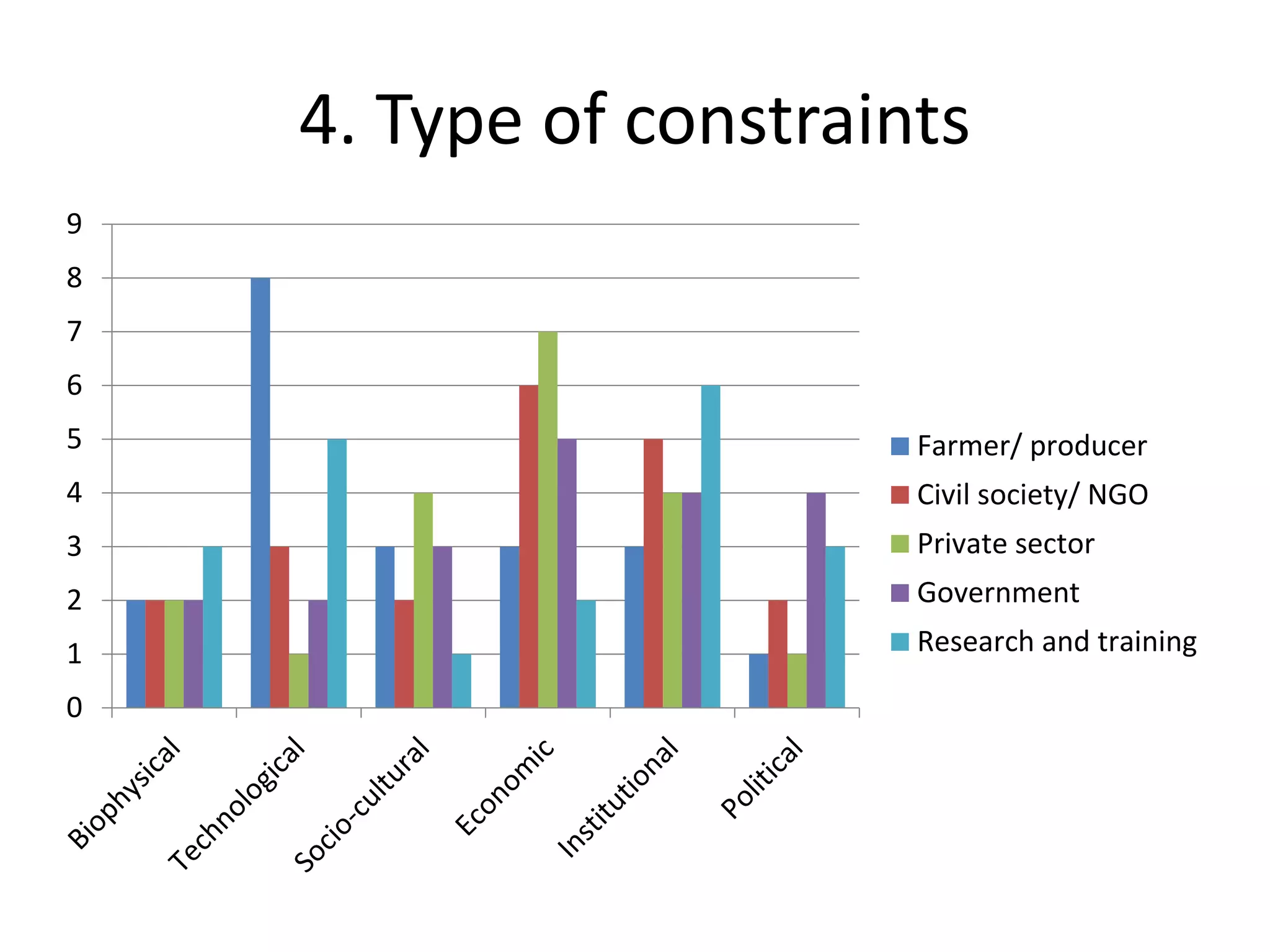
4. Type of constraints
0
1
2
3
4
5
6
7
8
9
Farmer/ producer
Civil society/ NGO
Private sector
Government
Research and training
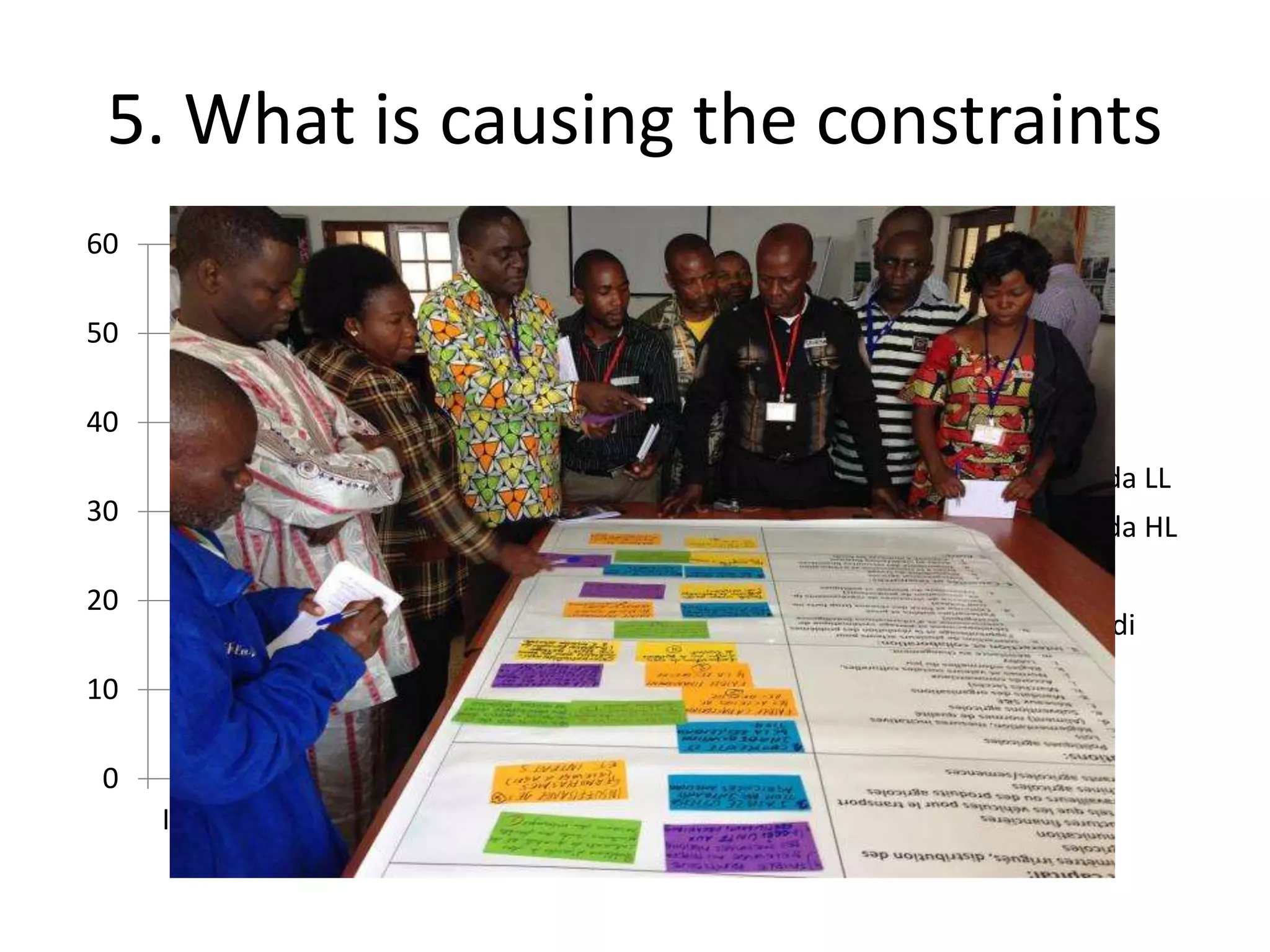
5. What is causing the constraints
0
10
20
30
40
50
60
Infrastructure
and assets
Institutions Interaction and
collaboration
Capactities and
resources
Rwanda LL
Rwanda HL
Congo
Burundi
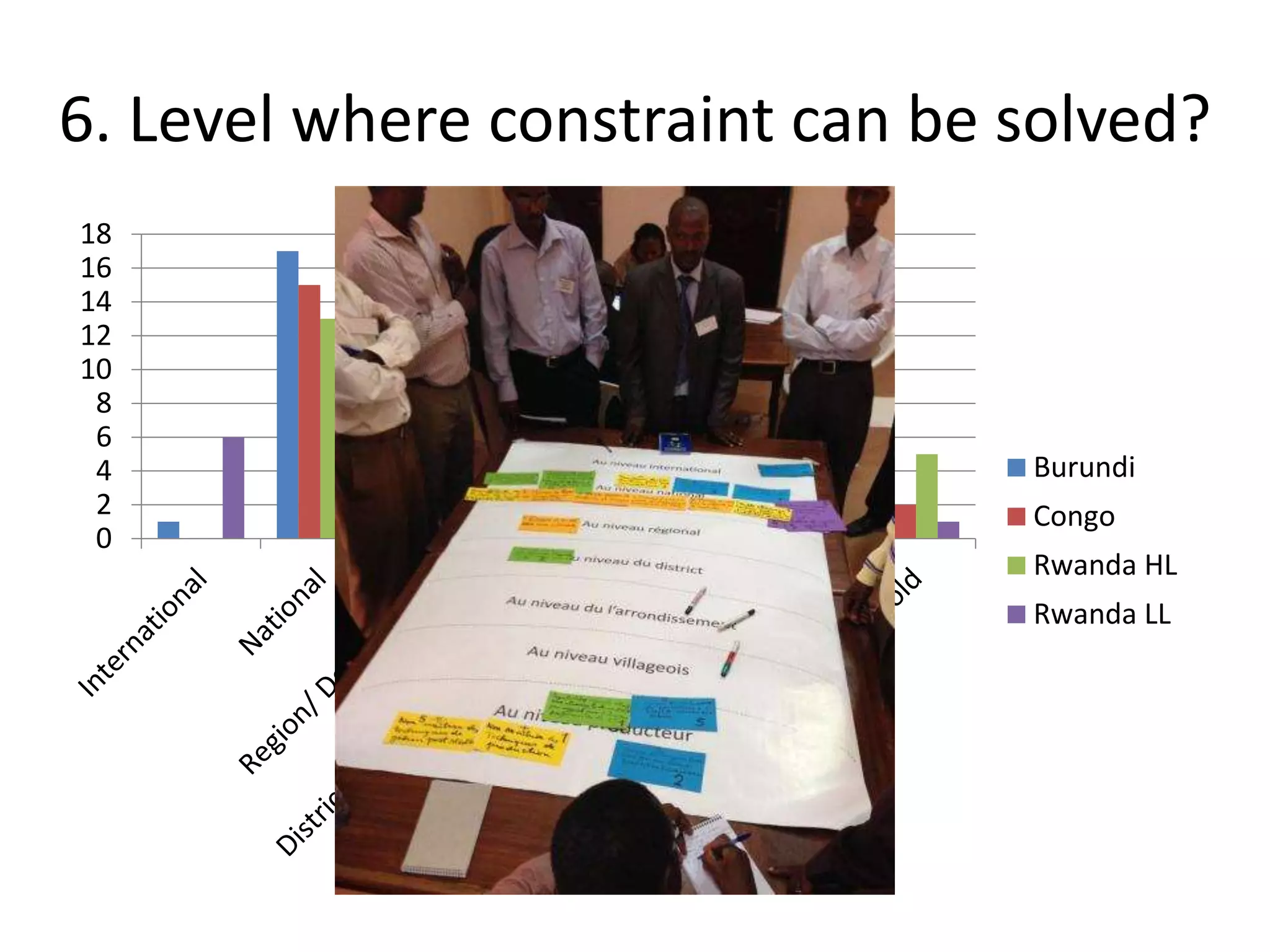
6. Level where constraint can be solved?
0
2
4
6
8
10
12
14
16
18
Burundi
Congo
Rwanda HL
Rwanda LL
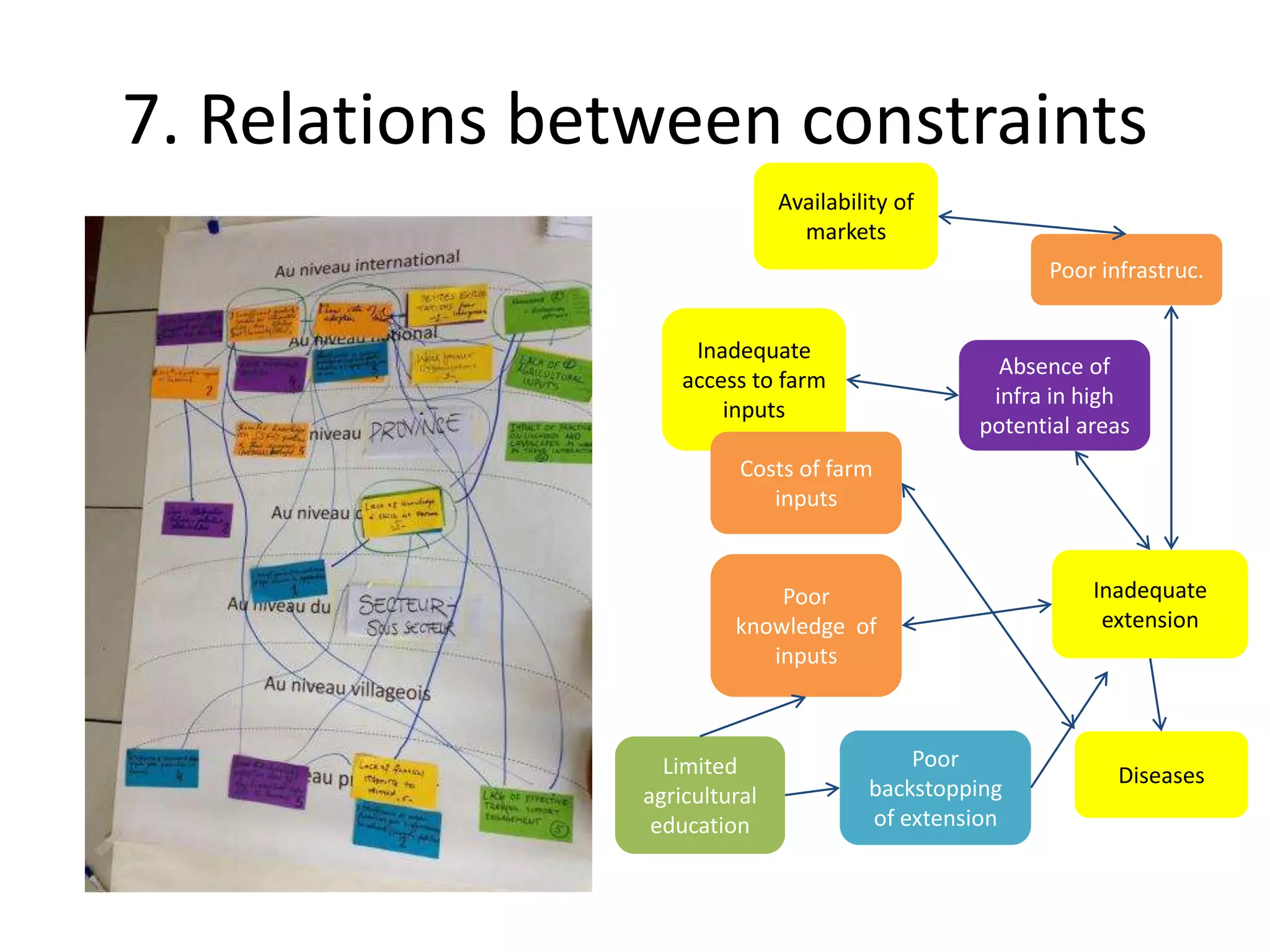
7. Relations between constraints
Diseases
Inadequate
extension
Absence of
infra in high
potential areas
Poor infrastruc.
Inadequate
access to farm
inputs
Costs of farm
inputs
Availability of
markets
Poor
backstopping
of extension
Poor
knowledge of
inputs
Limited
agricultural
education
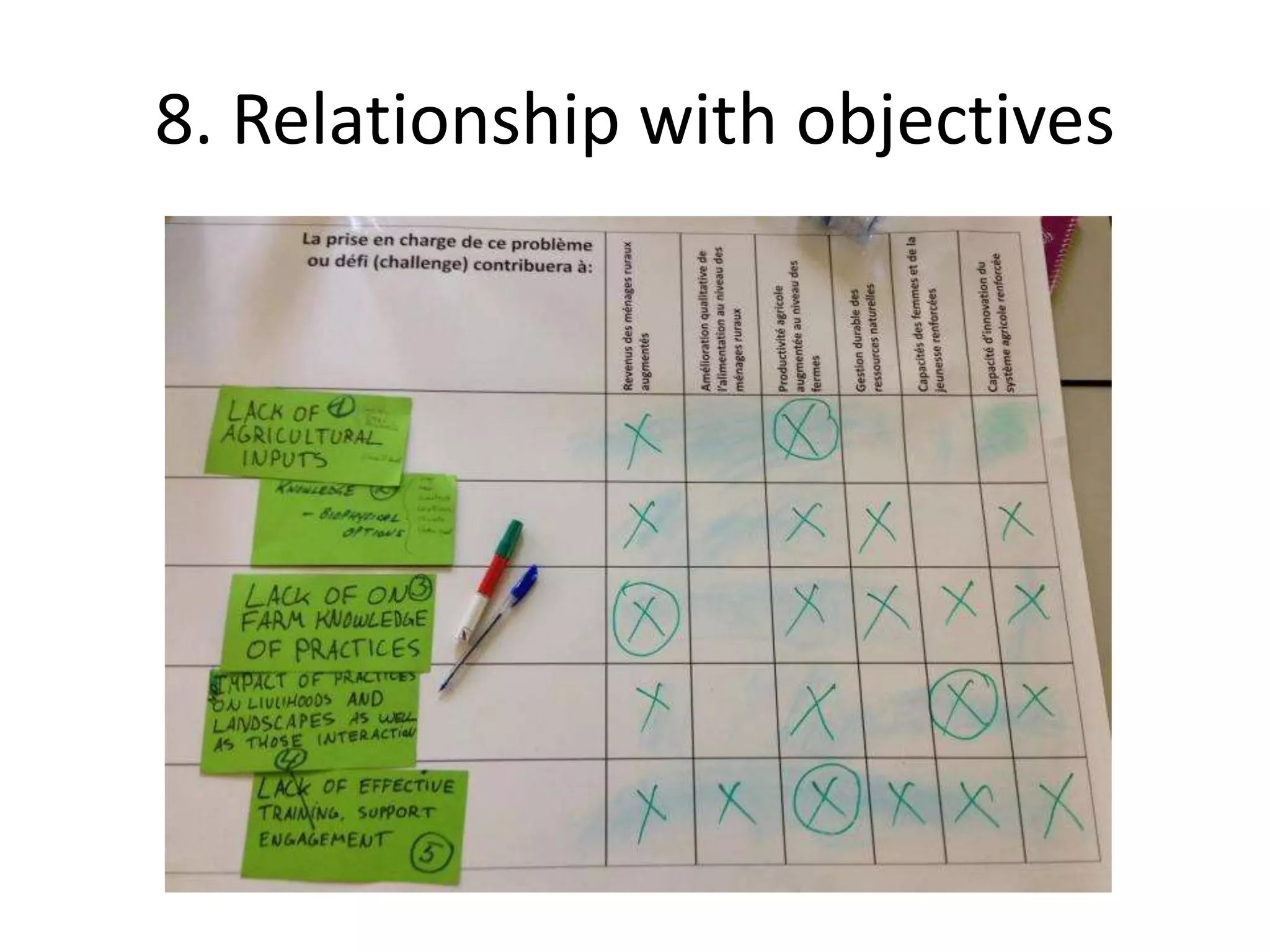
8. Relationship with objectives
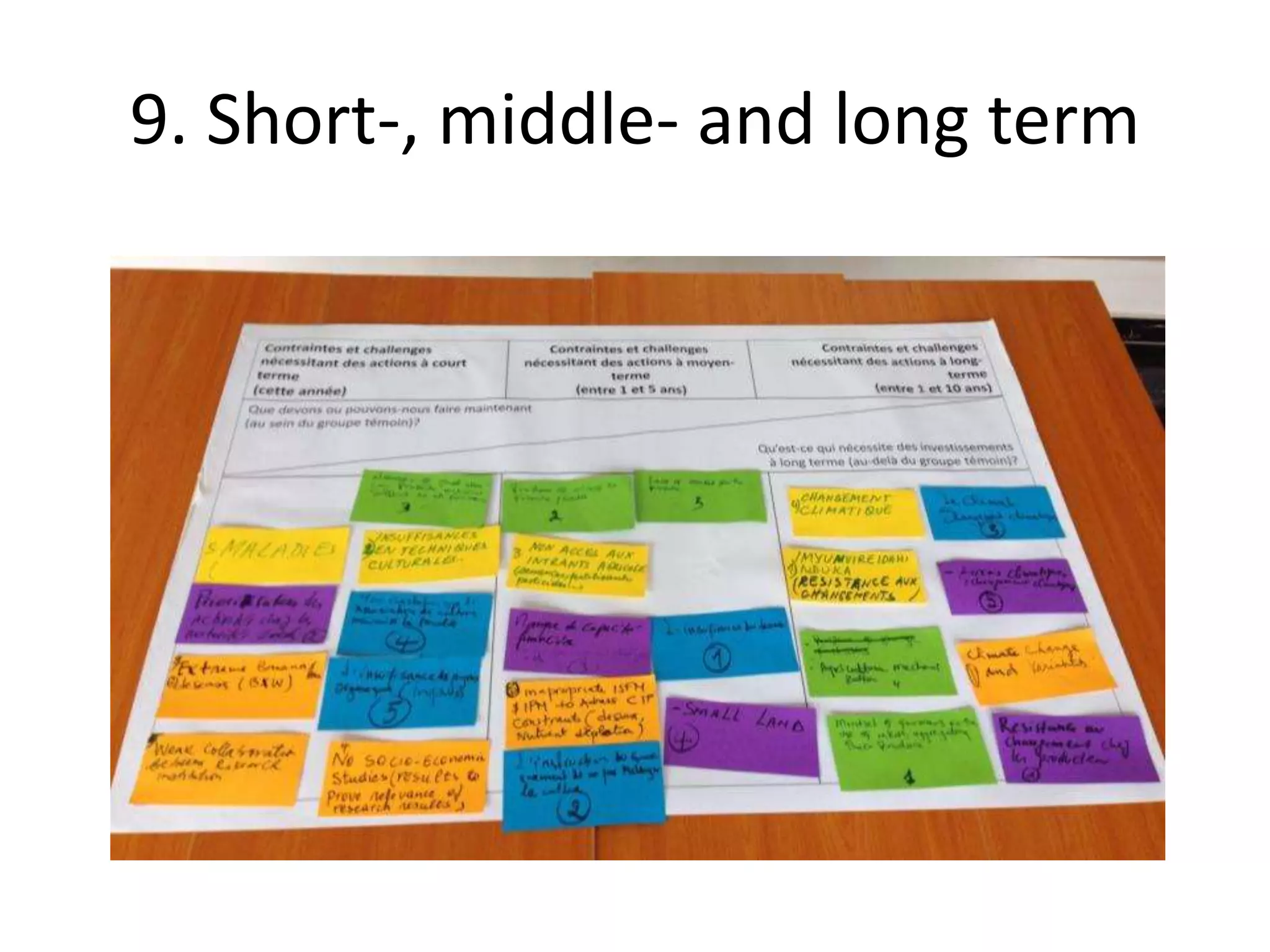
9. Short-, middle- and long term
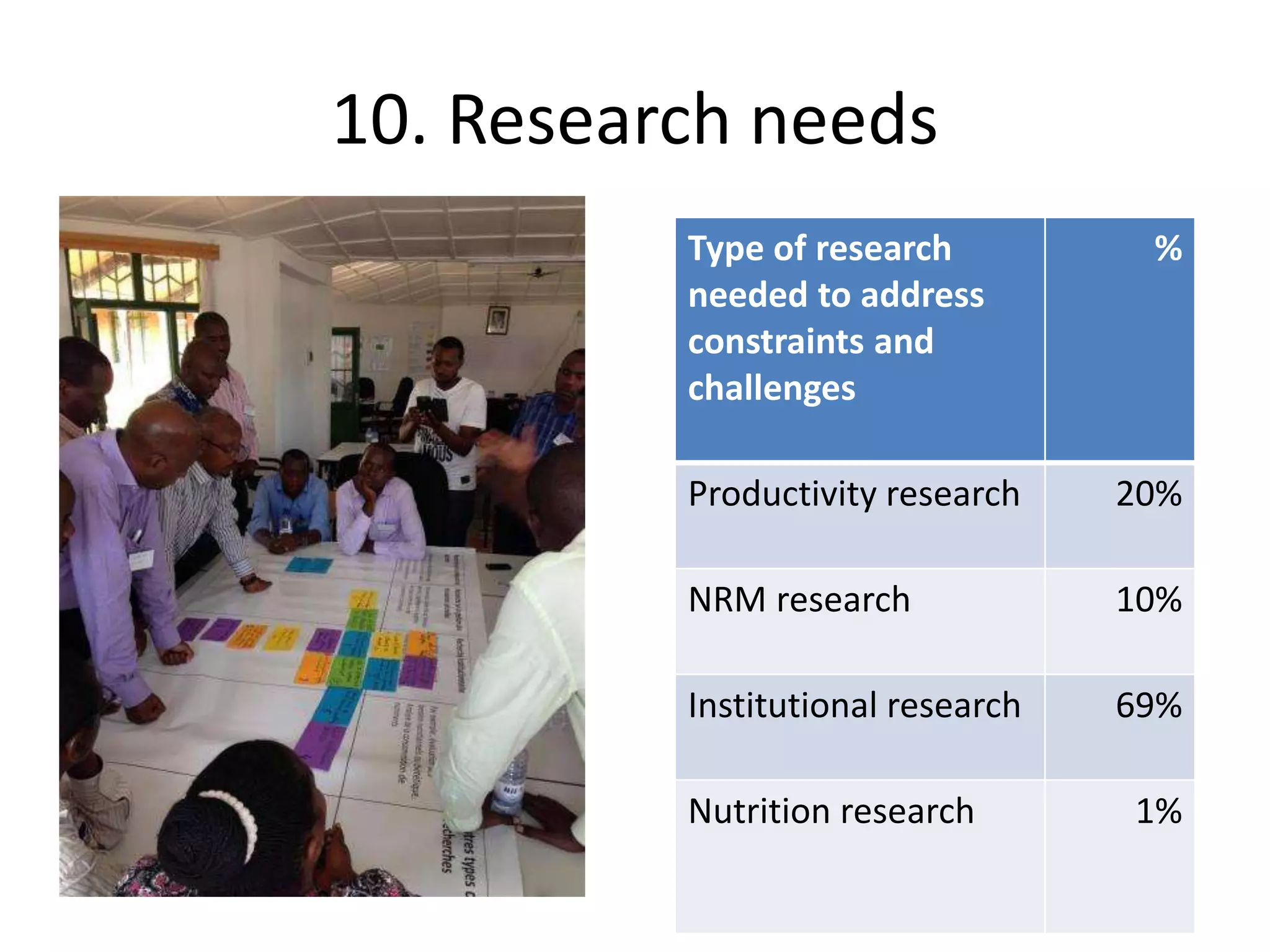
10. Research needs
Type of research
needed to address
constraints and
challenges
%
Productivity research 20%
NRM research 10%
Institutional research 69%
Nutrition research 1%
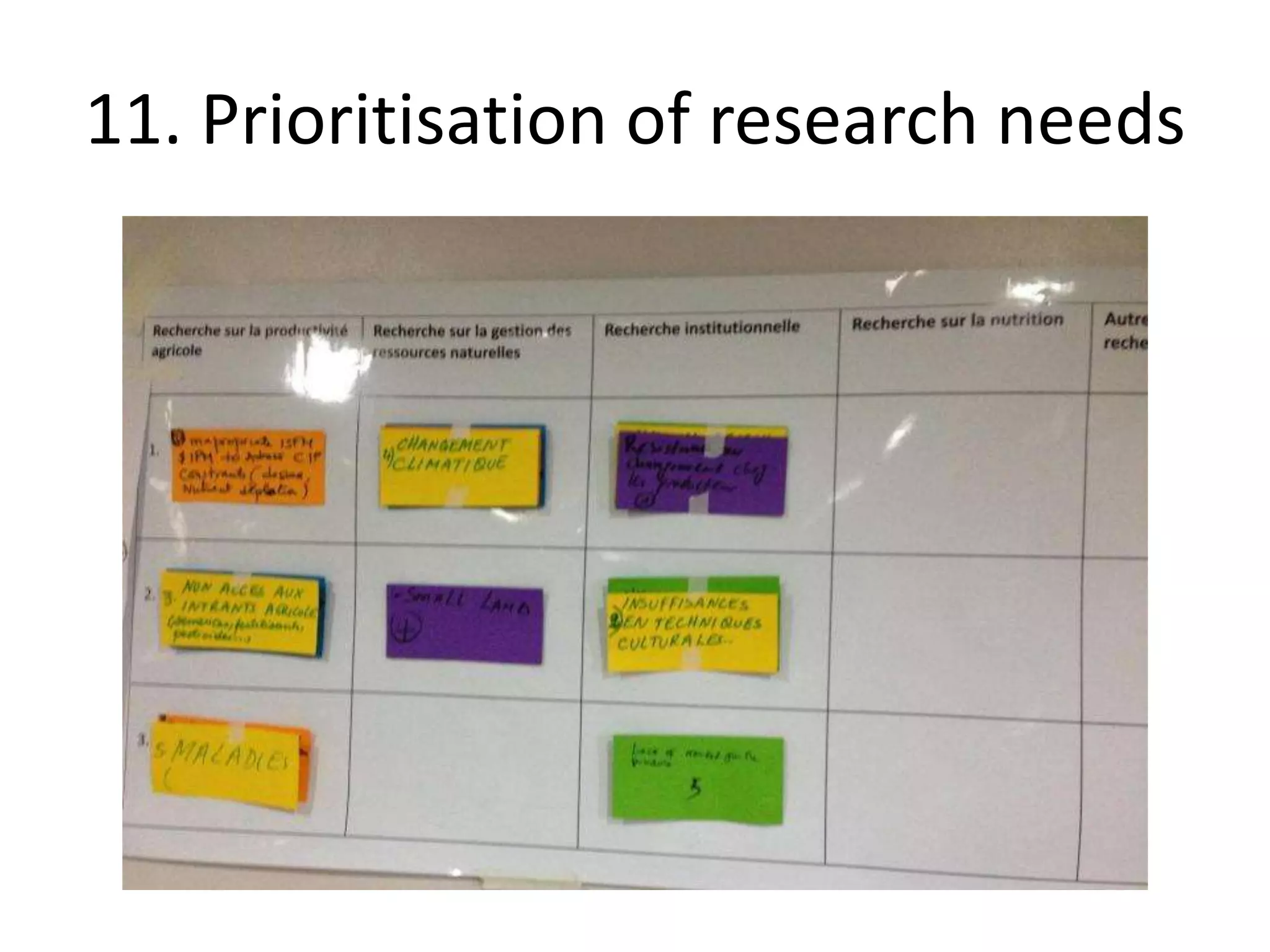
11. Prioritisation of research needs
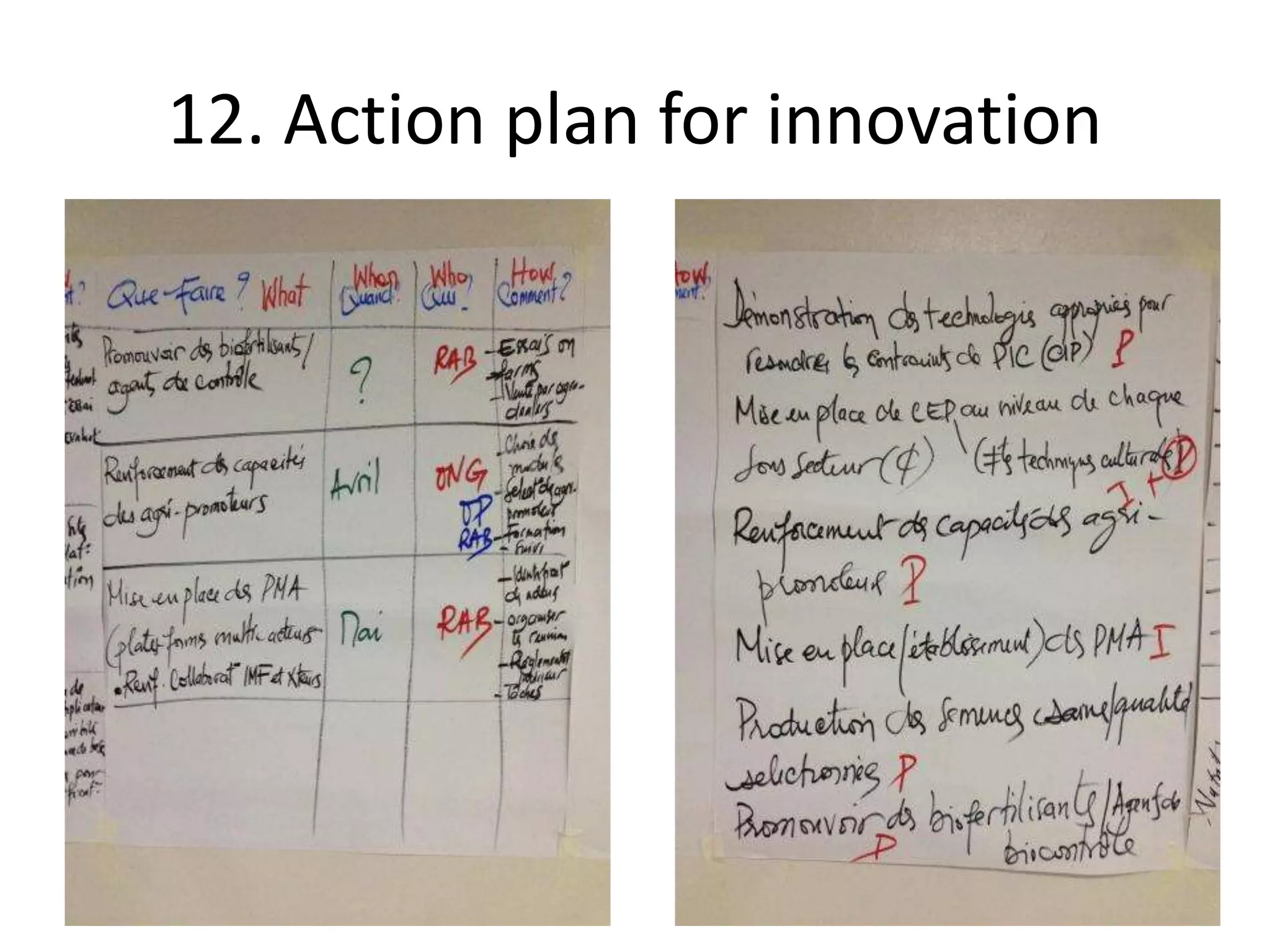
12. Action plan for innovation
Validation
• Combine multiple methods?
–E.g. workshops, in-depth interviews,
surveys, secondary data analyses
–Validate and triangulate data
–What insights do multi-stakeholder
workshop not provide?
• Towards implementation and action
Reflection and closure
• Participants:
– Are triggered to think about different
characteristics of complex agricultural problems
– Are triggered to think about different agricultural
innovation strategies to address such problems
– Are familiarised with tools that can support the:
• Structural analysis of complex agricultural
problems
• Development of coherent innovation strategies
to address complex agricultural problems
Thank you so much!
Marc Schut
(marc.schut@wur.nl)
Wageningen University, the Netherlands
Capacity Development Workshop
29 April – 2 May 2014, Nairobi, Kenya

Agricultural innovation

  • 1.
    Agricultural innovation Marc Schut (marc.schut@wur.nl) WageningenUniversity, the Netherlands Humidtropics capacity development workshop, Nairobi, 29 April – 2 May 2014 http://humidtropics.cgiar.org/
  • 2.
    Objectives of thesession • Participants: – Are triggered to think about different characteristics of complex agricultural problems – Are triggered to think about different agricultural innovation strategies to address such problems – Are familiarised with tools that can support the: • Structural analysis of complex agricultural problems • Development of coherent innovation strategies to address complex agricultural problems
  • 3.
    Complex agricultural problems 4Key characteristics of complex agricultural problems: • Different problem dimensions • Interactions across different levels • Involvement of multiple stakeholders and the organisations they represent • How problems develop and what will be the impact of solutions is uncertain and unpredictable
  • 4.
    Complex agricultural problems 1.Multi-dimensional • Biophysical • Technological • Socio-cultural • Economic • Institutional • Political Analysing problems/ exploring solutions is unlikely to be successful if these dimensions are analysed separately
  • 5.
    Climate change andfood security Rainfall patterns Temperature Drought resistant varieties Reduced yield/ income Kyoto protocol Carbon credits Who is responsible? Who pays? Cropping calendar
  • 6.
    Complex agricultural problems 2.Multi-level interactions • International • Regional • National • Subnational • Community • Farm • Plot Exploring solutions requires interventions across different levels
  • 7.
    Climate change andfood security Intergovernmental Panel on Climate Change (IPCC) – awareness of and structural allocation of resources to CC SADC Climate Change Adaptation Strategy – impact of CC on water availability for amongst others agriculture Kenya National Climate Change Response Strategy – urban polution/ clean energy/ deforestation/ desertificaiton Farmer climate change mitigation and adaptation strategies (e.g. rain water harvesting)
  • 8.
    Complex agricultural problems 3.Multi-stakeholder • Policymakers • Civil society • Development • Donors • Farmers • Private sector • Consultants • Researchers None of these stakeholders can solve the complex problem on their own.
  • 9.
    Climate change andfood security
  • 10.
    Climate change andfood security
  • 11.
  • 12.
  • 13.
    Complex agricultural problems 4.Highly uncertain and unpredictable • How problem will develop over time • Type of solutions and their (undesired) impacts • Stakeholder interactions • Phases in e.g. policy processes • Chaos and crises
  • 14.
    Climate change andfood security • How will climate change develop over time? • What type of climate change adaptation and mitigation strategies will be effective? • Will different types of stakeholder continue to work together?
  • 15.
    Need for agriculturalinnovations Solution strategies with attention for: • Integrated analysis of problem dimensions, design integrated solutions • Interactions between multiple levels • Needs and interest of different stakeholder groups (including gender, age, ethnic groups) • Flexibility and adaptive capacity to respond to uncertain and unpredictable context
  • 16.
  • 17.
    How innovations emerge? •Spaces for creativity • Where ideas of different people can mingle • Connectivity, borrow from each other, combine perspectives • Finding the missing piece • Such processes take time • “The whole is bigger than the sum of its parts”
  • 18.
  • 19.
    Define agricultural innovation(1) • Technology, practice or product handling that will bring increased yield and income to the farmer • Modern/ improved or superior production technique used to improve production or quality and quantity required at a given time. • Novel idea, process, tool, or solution to facilitate healthy and sustainable agriculture that is tailored to a specific context.
  • 20.
    Define agricultural innovation(2) • Combined hardware (technologies – e.g. seeds) and software (social-organisational – e.g. seed systems) to enhance development and business objectives, change for the better • Tool that can guide analysis of complex agricultural problems, and the identification of entry points that enhance the innovation capacity of the agricultural system in which the complex agricultural problem is embedded.
  • 21.
    Agricultural Innovation Systems •From technology-oriented to systems approaches to innovation Technology Transfer (TT) Farming Systems Analysis (FSR) Agricultural Knowledge and Information Systems (AKIS) Agricultural Innovation Systems (AIS) Era From 1960’s From 1970’s/ 1980’s From 1990’s From 2000’s Approach Research develops technologies that are transferred to farmers Research identifies and reliefs (land, labour) constraints of farmers Research collaborates with extension officers and farmers in developing solutions Create an enabling environment for innovation
  • 22.
    Agricultural Innovation Systems Technology Transfer(TT) Farming Systems Analysis (FSR) Agricultural Knowledge and Information Systems (AKIS) Agricultural Innovation Systems (AIS) Roles of farmers  Adopters of technologies  Adopters of knowledge and technologies  Source of information  Experimenters  Experts  Partners  Entrepreneurs  Part of innovation network Roles of research and researchers  Developers of knowledge and technologies  Experts  Capacity builders  Facilitators of learning  Enhance innovation capacity in the system  Members innovation network
  • 23.
    Agricultural Innovation Systems Technology Transfer(TT) Farming Systems Analysis (FSR) Agricultural Knowledge and Information Systems (AKIS) Agricultural Innovation Systems (AIS) Intended outcomes Technology adoption and uptake Adapt technologies to farming systems Joint development of technologies Capacities to co- innovate, learn and change Key intervention approach Technology dissemination through extension and mass media Surveys, typologies, modelling of impact Participatory research, Farmer Field Schools Establish, implement and support multi- stakeholder platforms Weaknesses Disregards farmer involvement and adoption context Focus on field and farm level Local orientation, costly, scaling up and scaling out Lacks empirical evidence, system’s boundaries are difficult to define
  • 24.
  • 25.
  • 26.
    Analyze Agricultural InnovationSystems • Analyse complex agricultural problems – Complex problem (multiple dimensions/ levels/ stakeholders) – System in which the problem is embedded – Components/ elements that support or constrain innovation in the agricultural system • Identify entry points for innovation to address complex agricultural problems – Specific entry points for innovation (e.g. Striga in maize) – Generic entry points for innovation (e.g. crop protection)
  • 27.
  • 28.
  • 29.
    What is RAAIS? •‘An easy way to make people do a difficult job’ • Rapid Appraisal of Agricultural Innovation Systems is a tool to: – Analyse characteristics of complex problems – Identify challenges and constraints for innovation in the agricultural system – Identify opportunities for innovation in systems • Use different types of data/ methods – Workshops, questionnaires, interviews, existing statistics
  • 30.
    RAAIS workshop methodology Exercise 2 Exercise 3 Exercise 1 Categorising constraintsand challenges Exploring opportunities for innovation Identifying constraints and challenges Entry theme Specific and generic entry points for innovation
  • 31.
    RAAIS mini workshop– Exercise 1 • Identify different participant groups – Farmer representatives – NGO/ civil society representatives – Private sector representatives – Government representatives – Research/ training representatives • Each participant receives 5 coloured cards – Write your name, country and/or Action Site on the back of each of the 5 cards
  • 32.
    RAAIS mini workshop– Exercise 2 • Entry Theme: What are – according to you – the five biggest constraints for agricultural innovation in your country/ Action Site? Write the five constraints on the five cards that you have received (one constraint per card)
  • 33.
    RAAIS mini workshop– Exercise 3 • Form groups – Farmer representatives – NGO/ civil society representatives – Private sector representatives – Government representatives – Research/ training representatives • Discuss the constraints identified by the different participants and together develop a top-5 of constraints and challenges
  • 34.
    RAAIS mini workshop– Exercise 4 • For each card, identify the type of constraint dimension: – Biophysical – Technological – Socio-cultural – Economic – Institutional – Political • Place X if dimension applies to the constraint • Circle X of dimension that applies best
  • 35.
    The dimensions ofcomplex agricultural problems Biophysical Technological Socio-culturel Economic Institutional Political 1. 2. 3. 4. Etc. 5.
  • 36.
    4. Type ofconstraints
  • 37.
    4. Type ofconstraints 0 5 10 15 20 Biophysical Technological Socio-cultural Economic Institutional Political Burundi Rwanda HL Rwanda LL Congo
  • 38.
    4. Type ofconstraints 0 1 2 3 4 5 6 7 8 9 Farmer/ producer Civil society/ NGO Private sector Government Research and training
  • 39.
    5. What iscausing the constraints 0 10 20 30 40 50 60 Infrastructure and assets Institutions Interaction and collaboration Capactities and resources Rwanda LL Rwanda HL Congo Burundi
  • 40.
    6. Level whereconstraint can be solved? 0 2 4 6 8 10 12 14 16 18 Burundi Congo Rwanda HL Rwanda LL
  • 41.
    7. Relations betweenconstraints Diseases Inadequate extension Absence of infra in high potential areas Poor infrastruc. Inadequate access to farm inputs Costs of farm inputs Availability of markets Poor backstopping of extension Poor knowledge of inputs Limited agricultural education
  • 42.
  • 43.
    9. Short-, middle-and long term
  • 44.
    10. Research needs Typeof research needed to address constraints and challenges % Productivity research 20% NRM research 10% Institutional research 69% Nutrition research 1%
  • 45.
    11. Prioritisation ofresearch needs
  • 46.
    12. Action planfor innovation
  • 47.
    Validation • Combine multiplemethods? –E.g. workshops, in-depth interviews, surveys, secondary data analyses –Validate and triangulate data –What insights do multi-stakeholder workshop not provide? • Towards implementation and action
  • 48.
    Reflection and closure •Participants: – Are triggered to think about different characteristics of complex agricultural problems – Are triggered to think about different agricultural innovation strategies to address such problems – Are familiarised with tools that can support the: • Structural analysis of complex agricultural problems • Development of coherent innovation strategies to address complex agricultural problems
  • 49.
    Thank you somuch! Marc Schut (marc.schut@wur.nl) Wageningen University, the Netherlands Capacity Development Workshop 29 April – 2 May 2014, Nairobi, Kenya